
Psalms 26:5

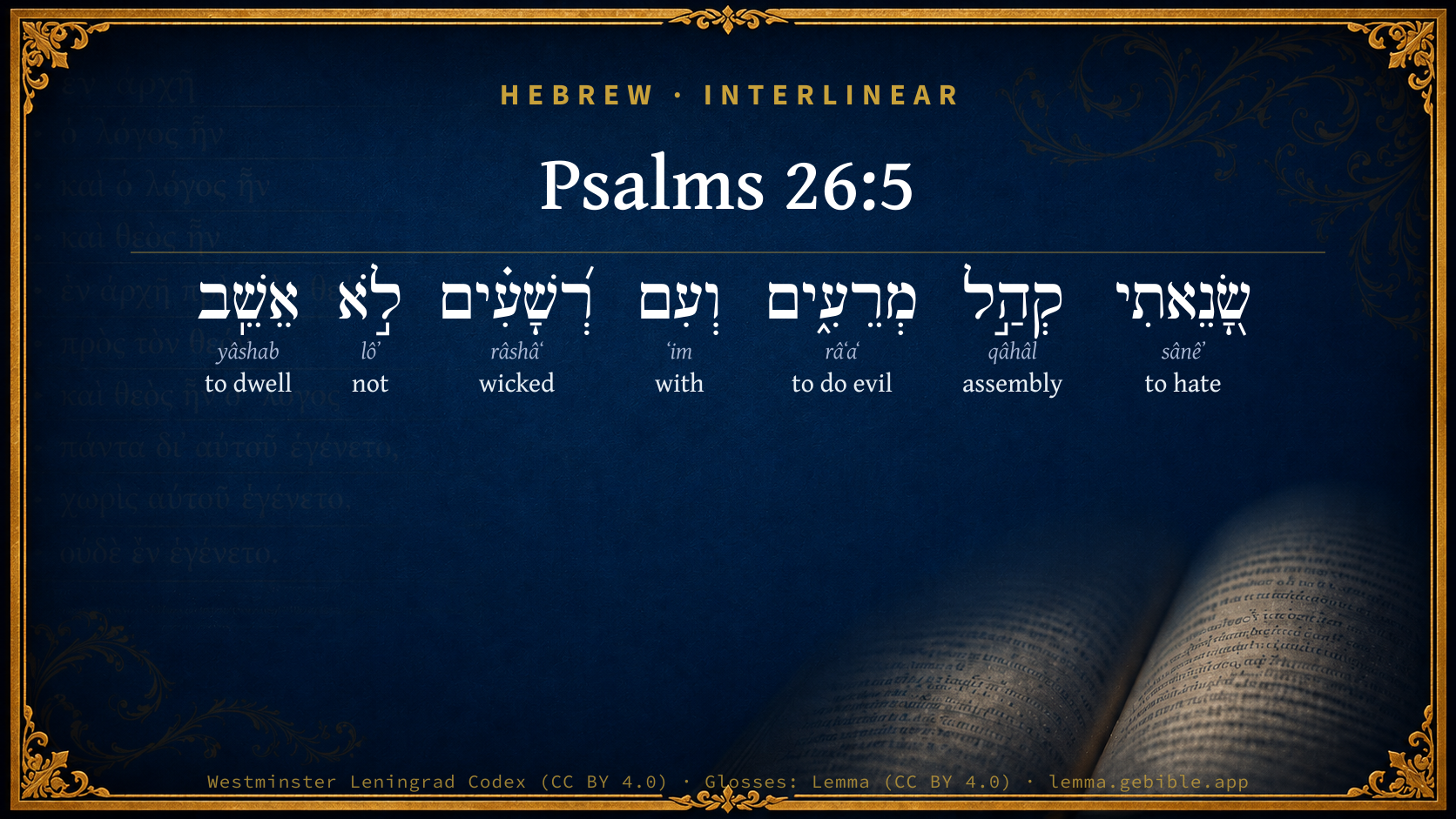
Hebrew (Westminster Leningrad Codex) Psalms 26:5 appears in the Hebrew Old Testament. The text above is from the Westminster Leningrad Codex. Each word links to its Strong’s number, a concise gloss, and parsing drawn from the Open Scriptures Hebrew Bible morphology. Click any word for its full Brown-Driver-Briggs (BDB) entry.
Download image
Cite this verse

Psalms 26:5 (World English Bible). Public Domain. Lemma interlinear Bible study tool, https://lemma.gebible.app/v/psalms/26/5.

Show BibTeX & RIS
BibTeX
RIS
English Translation
I hate the assembly of evil-doers, And will not sit with the wicked.
World English Bible · Public Domain
Download a study sheet

One document with this verse’s original text, its word-by-word gloss line, the meaning frame, cross-references with their text, attributed commentary, and full source and license credits — printable, and it pastes into notes with its structure intact.

This verse Autodidact and up

Study sheet (.html) Plain text (.txt)

A passage Seminary Student

Up to 50 verses in one chapter. A passage sheet keeps up to 6 commentary sources and 12 cross-references per verse, in the order this page ranks them, and says so on the sheet whenever that leaves anything out. Ask for a single verse and you get the Autodidact verse sheet above.

Everything on this page stays free to read, with no account — the sheet is a download of what is already on screen, not access to it.

Want to remove ads? Support Godless Engineer
Compare translations 3

The same verse in 3 English versions, stacked beneath the original-language interlinear above. Click any original word for its lexicon entry.

Each is an independent rendering of the whole verse — the interlinear is not word-aligned to these translations.

Highlighted words mark where these versions differ — a whole-verse word diff, not a word-by-word alignment.

  • World English Bible Public Domain
    I hate the assembly of evil-doers, And will not sit with the wicked.
  • King James Version Public Domain
    I have hated the congregation of evil doers; and will not sit with the wicked.
  • unfoldingWord Literal Text CC BY-SA 4.0
    I hate the assembly of the ones doing evil, and I will not sit with the wicked.

unfoldingWord Literal Text — © unfoldingWord, licensed CC BY-SA 4.0. Word-aligned USFM3 via Door43 (git.door43.org/unfoldingWord/en_ult).

Versions to compare (up to 4)

3 of 4 selected

Show all 18 translations

Every available English version of this verse, each an independent rendering of the whole verse.

  • World English Bible Public Domain
    I hate the assembly of evil-doers, And will not sit with the wicked.
  • Berean Standard Bible Public Domain
    I hate the mob of evildoers, and refuse to sit with the wicked.
  • Majority Standard Bible Public Domain
    I hate the mob of evildoers, and refuse to sit with the wicked.
  • King James Version Public Domain
    I have hated the congregation of evil doers; and will not sit with the wicked.
  • American Standard Version (1901) Public Domain
    I hate the assembly of evil-doers, And will not sit with the wicked.
  • Revised Version (1885) Public Domain
    I hate the congregation of evil-doers, and will not sit with the wicked.
  • Geneva Bible (1599) Public Domain
    I haue hated the assemblie of the euill, and haue not companied with the wicked.
  • Douay-Rheims (1899) Public Domain
    I have hated the assembly of the malignant; and with the wicked I will not sit.
  • Young's Literal Translation Public Domain
    I have hated the assembly of evil doers, And with the wicked I sit not.
  • Literal Standard Version CC BY-SA 4.0
    I have hated the assembly of evildoers, || And I do not sit with the wicked.
  • Unlocked Literal Bible CC BY-SA 4.0
    I hate the assembly of evildoers, and I do not live with the wicked.
  • unfoldingWord Literal Text CC BY-SA 4.0
    I hate the assembly of the ones doing evil, and I will not sit with the wicked.
  • Darby Bible Public Domain
    I have hated the congregation of evil-doers, and I have not sat with the wicked.
  • World Messianic Bible Public Domain
    I hate the assembly of evildoers, and will not sit with the wicked.
  • Webster's Bible Public Domain
    I have hated the congregation of evil doers; and will not sit with the wicked.
  • Free Bible Version CC BY-SA 4.0
    I refuse to get together with those who do evil, and I won't involve myself with the wicked.
  • Bible in Basic English Public Domain
    I have been a hater of the band of wrongdoers, and I will not be seated among sinners.
  • JPS Tanakh (1917) Public Domain
    I hate the gathering of evil doers, and will not sit with the wicked.

Literal Standard Version (2020), Covenant Press — licensed CC BY-SA 4.0. Text via the HelloAO Bible API (eBible.org). Unlocked Literal Bible (unfoldingWord) — licensed CC BY-SA 4.0. Text via the HelloAO Bible API (eBible.org). unfoldingWord Literal Text — © unfoldingWord, licensed CC BY-SA 4.0. Word-aligned USFM3 via Door43 (git.door43.org/unfoldingWord/en_ult). Free Bible Version, Dr. Jonathan Gallagher — licensed CC BY-SA 4.0. Text via the HelloAO Bible API (eBible.org).

Word by word

More ways to search: Search by grammar → Find every occurrence → Compare this word →

Practice this passage: Drill this verse → Learn its vocabulary →

מְרֵעִ֑ים
râʻaʻ
H7489
“doing evil”
Verb, Hiphil, Participle Active, Masculine, Plural, Absolute
Part of Speech
Verb
Stem
Hiphil
Form
Participle Active
Gender
Masculine
Number
Plural
State
Absolute
Full BDB Definition

Origin: a primitive root

TWOT: 2191 , 2192

to be bad, be evil - (Qal) - to be displeasing - to be sad - to be injurious, be evil - to be wicked, be evil (ethically) - (Hiphil) - to do an injury or hurt - to do evil or wickedly - mischief (participle) - to break, shatter - (Qal) - to break - broken (participle) - to be broken - (Hithpolel) to be broken, be broken in pieces, be broken asunder
  1. שָׂ֭נֵאתִי sânêʼ H8130 “to hate” Verb, Qal, Perfect, 1st Person, Common, Singular
  2. קְהַ֣ל qâhâl H6951 “assembly of” Noun, Common, Masculine, Singular, Construct
  3. וְעִם ʻim H5973 “and · with” Conjunction + Preposition
  4. רְ֝שָׁעִ֗ים râshâʻ H7563 “wicked” Adjective, Adjective, Masculine, Plural, Absolute
  5. לֹ֣א lôʼ H3808 “not” Particle, Negative
  6. אֵשֵֽׁב yâshab H3427 “to dwell” Verb, Qal, Imperfect, 1st Person, Common, Singular

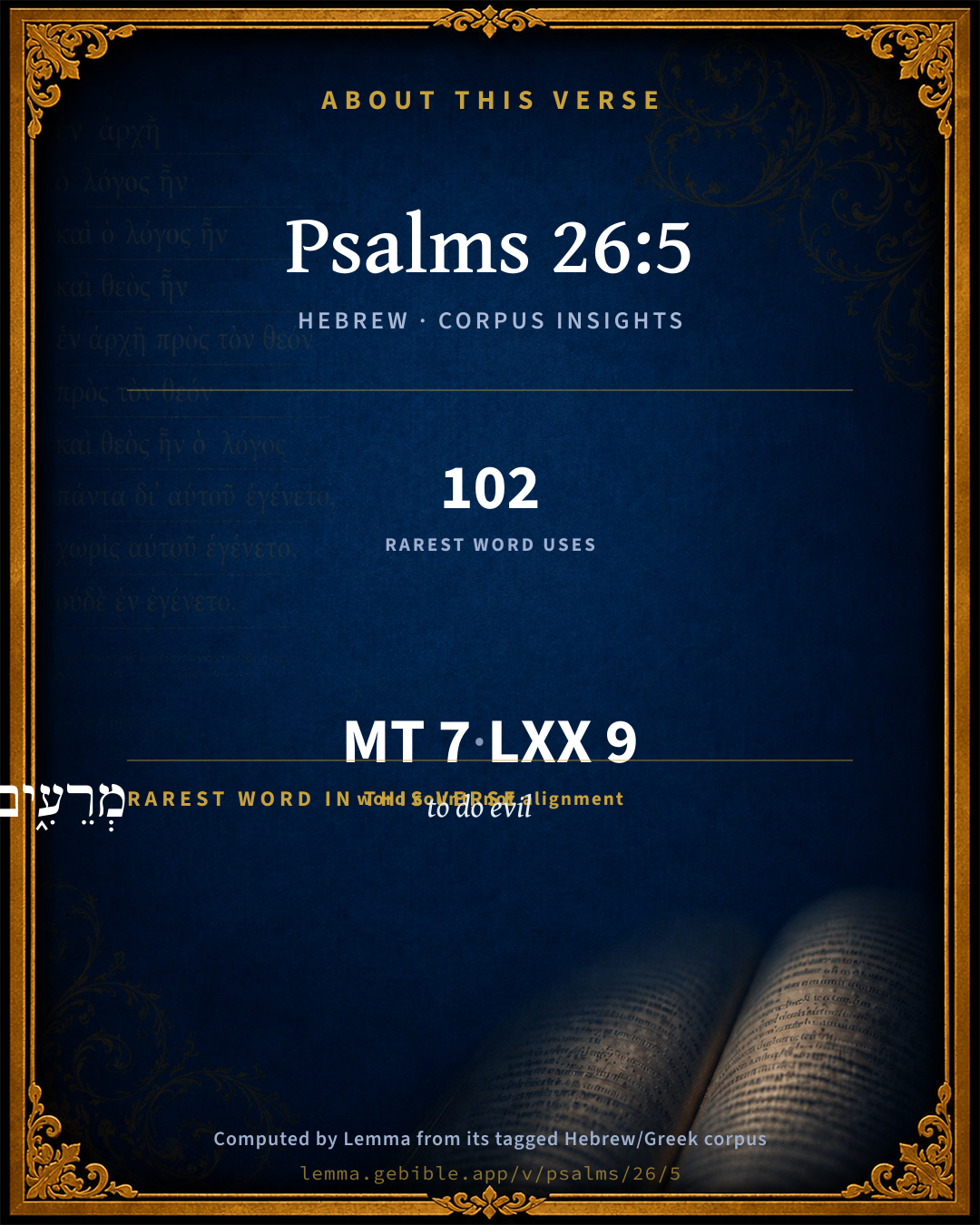
About this verse

These counts appear in no published source. They are computed here, from the morphology-tagged text and Lemma’s own curated glosses. What Lemma adds →

7
words
7
distinct lemmas
Wisdom
section

Grammatical profile

  • 3 verbs
  • 1 noun
  • 1 adjective
  • 1 preposition
  • 1 particle

Verb forms

  • שָׂ֭נֵאתִי Qal · Perfect
  • מְרֵעִ֑ים Hiphil · Participle Active
  • אֵשֵֽׁב Qal · Imperfect

Hebrew & Septuagint length

In English translation the verse runs 13 words from the Hebrew and 15 from the Septuagint (LXX English) — closely comparable.

A rough comparison of the two English renderings, which tokenize alike — not a word-level alignment.

Word counts can differ between the Hebrew and the Greek without any difference in meaning — e.g. the Hebrew direct-object marker אֵת has no separate Greek word, and Greek often adds the article ὁ.

In the original languages it is 7 Hebrew tokens and 9 Greek tokens — but the two are counted differently (Hebrew bundles its prefixes and suffixes into one token; the Greek is in lemma form), so that isn’t a like-for-like length.

Cross-references

5

Topical passages linked to Psalms 26:5 in the Treasury of Scripture Knowledge — connected by theme and wording, ordered by reader-vote popularity; previews shown in the World English Bible.

  • Psalms 31:6 I hate those who regard lying vanities, But I trust in Yahweh.
  • Psalms 101:3–8 I will set no vile thing before my eyes. I hate the deeds of faithless men. They will not cling to me.
  • Psalms 139:21–22 Yahweh, don't I hate those who hate you? Am I not grieved with those who rise up against you?
  • Psalms 1:1 Blessed is the man who doesn't walk in the counsel of the wicked, Nor stand in the way of sinners, Nor sit in the seat of scoffers;
  • 1 Corinthians 5:9–11 I wrote to you in my letter to have no company with sexual sinners;

Cross-references courtesy of OpenBible.info (CC BY 4.0).

Hebrew and Greek witnesses Masoretic Hebrew ↔ Greek Septuagint

The same verse in the two great witnesses to the Old Testament, shown verse-for-verse.

You’re reading Greek Psalm 25 (Hebrew Psalm 26). The Septuagint counts the superscription, so verse numbers can differ from the Hebrew — chapter-level alignment, not verse-by-verse. Numbering follows Rahlfs.

These are two independent witnesses, not word-aligned to each other, and the Septuagint is shown in lemma (dictionary) form.

Hebrew Psalms 26:5 Masoretic · Westminster Leningrad Codex

שָׂ֭נֵאתִי קְהַ֣ל מְרֵעִ֑ים וְעִם רְ֝שָׁעִ֗ים לֹ֣א אֵשֵֽׁב

I hate the assembly of evil-doers, And will not sit with the wicked.

World English Bible · Public Domain

Greek LXX Greek Psalm 25:5 Septuagint · lemma form

μισέω ἐκκλησία πονηρεύομαι καί μετά ἀσεβής οὐ μή καταἵζω

I have hated the assembly of wicked doers; and will not sit with ungodly men.

LXX2012 (modern English Septuagint) · Public Domain

Hebrew: Westminster Leningrad Codex (CC BY 4.0). Greek: Septuagint (public domain); English from LXX2012 (modern English Septuagint) (Public Domain). How the Septuagint differs from the Hebrew →

Commentary

Notes on Psalms 26:5 from classic Christian and Jewish commentators (each source and its license shown beneath its notes). The classic Christian expositions comment on the surrounding passage and are grouped to its opening verse, so a note may address several verses; the Jewish commentaries on the Tanakh (Rashi and others) are per-verse, so they appear only where the commentator wrote on this verse.

Lemma curates 59 commentaries, every one of them public domain or Creative Commons licensed, each selected and text-cleaned for this edition rather than reprinted as found. About our sources →

Trapp's Complete Commentary

John Trapp

Psa 26:5 I have hated the congregation of evil doers; and will not sit with the wicked.

Ver. 5. I have hated the congregation of evildoers] The Church malignant, whose lives are a mystery of iniquity, as Josephus saith of Antipater; qui omnia turbant et miscent, tantum ut ipsi crescere possint, as Aristophanes saith of Cleon; care not whom they ruin, so they may raise themselves, nor what mischief they work to others, so they may drive on their own sinful designs. Luther said of the monks in Germany, that they were so bad, tam desperatae malitiae, ut nihil cogitent quod non idem patrare ausint, that they would stick at no villany whatsoever. David held it a hell to be in company with such incarnate devils. It was once the prayer of a good gentlewoman when she was to die, being in much trouble of conscience, O Lord, let me not go to hell where the wicked are, for, Lord, thou knowest I never loved their company here.

And will not sit with the wicked] But hate the very garment spotted by the flesh, Jdg 1:2-3; that is, avoid evil company, saith Mr Perkins, as Lev 15:4; so Deu 22:12. It is not safe coming near stinking carrion, except one have the wind of it. Sin is as catching as the plague.

John Trapp, A Commentary or Exposition upon All the Books of the Old and New Testament (1647–1656) — public domain. Text from a community e-Sword module.

J. A. Alexander on Psalms

Joseph Addison Alexander

5. (Psa 26:5) I hate the assembly of evil-doers, And will not sit with the wicked. Commentary on this verse is not included by Alexander. This is reminiscent of Psa 1:1-2. He does not walk (participate) in the counsel of the wicked. Neither does he stand in (or follow) the way (pathway) of sinners (the worldly). And he does not sit in the seat of the scoffers (those who ridicule the things of God)...Isn't this the attitude that Christians should have today?

Joseph Addison Alexander, The Psalms Translated and Explained (1850) — public domain. Text from a community e-Sword module.

Adam Clarke's Commentary

Verse 5. I have hated the congregation of evil doers] I have never made one in the crowds of discontented persons; persons who, under pretense of rectifying what was wrong in the state, strove to subvert it, to breed general confusion, to overturn the laws, seize on private property, and enrich themselves by the spoils of the country.

Adam Clarke's Commentary on the Bible (1810–1826) — public domain. Text from a community e-Sword/MySword module.

John Calvin's Commentaries

5. I hate the assembly. The Psalmist protests again how greatly he abhorred the ungodly. Formerly he denied that he had any fellowship with them; now he still more explicitly declares that he fled from their company with loathing, for that is the meaning of the phrase, I hate. It is indeed true, that the wicked are everywhere hated; but how few withdraw themselves from them, that they may not imitate their vices! David asserts both; he tells us that he hated their society, and that he had no communion with them, from which it appears that he warred not so much with their persons as with their evil doings. He mentions also as another qualification, that he shunned the wicked in such a manner as not on that account to forsake the congregation of God, or withdraw himself from the company of those with whom he was commanded by divine appointment to associate. Many err in this way grievously; imagining when they see the evil mingled with the good, that they will be infected with pollution, unless they immediately withdraw themselves from the whole congregation. This preciseness drove the Donatists of old, and prior to them the Cathari and the Novatians, into mischievous schisms. In our own times, too, the Anabaptists, from a similar conceit, have separated themselves from the sacred assemblies, because they reckoned them not so free from all defilement as could have been wished. Moreover, the Donatists made themselves a laughing-stock in a certain process, by tenaciously clinging to mere words. When an assembly was held to settle dissensions, and they were invited by the president of the meeting, with a view to do honor to them, to take a seat, they replied, they would stand, because it was not lawful to “sit with the wicked.” Why then, wittily replied Augustine, did your conscience permit you to come in amongst us? for the one is written as well as the other, I will not go in to the wicked, neither will I sit with the ungodly. David, therefore, prudently moderates his zeal, and while separating himself from the ungodly, ceases not to frequent the temple, as the divine commandment and the order prescribed in the law required. When he denominates them the assembly of the ungodly, we may unquestionably conclude, that their number was not few; nay, it is probable that they flaunted about at that time, as if they alone were exalted above the people of God, and were lords over them: yet this did not prevent David from coming as usual to the sacrifices. Public care, indeed, is to be used that the Church be not defiled by such wickedness, and every man ought privately to endeavor, in his own place, that his remissness and forbearance do not cherish the disorders which these vices occasion. Although, however, this strictness should not be exercised with that care which is necessary, there is nothing in this to hinder any of the faithful from piously and holily remaining in the fellowship of the Church. It is to be observed, in the meantime, that what retained David, was his communion with God and with sacred things.

John Calvin's Commentaries (1540-1563) — public domain. Text from the Calvin Translation Society English edition (1840s-50s) via the Christian Classics Ethereal Library (ccel.org). Calvin's coverage is partial (roughly two-thirds of the Bible); uncommented books and verses are honest gaps, never fabricated. The 19th-century editor's footnotes and remarks are omitted so the notes are faithfully Calvin's own voice.

Ellicott's Commentary for English Readers

(5) Evil doers.—With idea of violence; from a root meaning to break in pieces.

A Bible Commentary for English Readers, edited by Charles John Ellicott (1878–1897) — public domain. Text from a community e-Sword module.

The Cambridge Bible for Schools and Colleges

gen. ed. J. J. S. Perowne

5. I have hated] R.V., I hate.

the congregation of evil doers] Cp. Psa_22:16. Is there not a tacit contrast between the congregation which meets for its own evil purposes, and that which assembles for the worship of Jehovah (Psa_26:12)?

The Cambridge Bible for Schools and Colleges (gen. ed. J. J. S. Perowne; Cambridge University Press, 1878–1918) — public domain. Text from a community e-Sword module.

John Gill's Exposition

I have hated the congregation of evildoers,.... That do harm to the persons, characters, or properties of men; and who meet together in bodies, to consult and form schemes to do mischief, and have their assemblies to encourage each other in it; these, their works and actions, the psalmist hated, though not their persons; and showed his displicency at them, and dislike and disapprobation of them, by absenting from them; see Jer 15:17;

and will not sit with the wicked; ungodly and unrighteous men, sons of Belial; for with such what fellowship and concord can there be? Co2 6:14; the word (x) signifies restless and uneasy persons, who cannot rest unless they do mischief; are like the troubled sea, continually casting up mire and dirt, Isa 57:20; now, by all this the psalmist means not that good men should have no manner of conversation with the men of the world: for then, as the apostle says, we must needs go out of the world, Co1 5:9. Conversation in civil things, in matters of trade and business, is lawful; though all unnecessary conversation in things of civil life is to be shunned; no more should be had than what natural relation and the business of life require; but all conversation in things criminal is to be avoided; company is not to be kept with them, so as to join them in anything sinful; this is to harden them in their evil ways, and it brings into danger and into disgrace: a man is known and is judged of by the company that he keeps; and evil communications corrupt good manners.

(x) "significat inquietum esse, ceu patet ex", Isa. xlviii. 22. Gejerus.

John Gill's Exposition of the Whole Bible (1746–1763) — public domain (CC PDM 1.0). Text via the HelloAO Bible API.

Albert Barnes' Notes on the Bible

I have hated - We have here the same evidence of his piety repeated in another and a stronger form. In the previous verse he had merely stated that he had not been found among that class of persons, or that he had not made them his companions. He here says positively that he disapproved of their principles; that he hated the purpose for which they gathered themselves together; that he had no sympathy whatever with them.

The congregation of evil-doers - All such assemblages as were gathered together for wicked purposes, for sin and revelry; to plot wickedness; to injure men; to oppose God.

And will not sit with the wicked - That is, I will not be associated with them. This was the fixed purpose of his soul; and this was then, as it is now, an evidence of true piety. This, moreover, is an “indispensable” evidence of piety. He who does thus sit with the wicked; who makes them his companions and friends; who unites with them in their plans and purposes; who partakes with them in their special amusements and pursuits, cannot possibly be a pious man. If he mingles with such people at all, it must be only as demanded by the necessities of social or civil life; or in the transactions of business; or for the purpose of doing them good. If it is for other purposes, if he makes them his chosen companions and friends, he gives the clearest evidence that his heart is with them, and that it is not with God.

Albert Barnes' Notes on the Bible (1834–1885) — public domain. Text from a community e-Sword/MySword module.

Matthew Poole's English Annotations

The congregation of evil-doers; either,

1. Their whole rank or society. I have an antipathy against all such persons, without any exception. Or,

2. To meet and join with them in their assemblies and consultations, or sit with them, as it follows.

Matthew Poole's English Annotations on the Holy Bible (1683–1685) — public domain. Text from a community e-Sword/MySword module.

The Treasury of David

Charles H. Spurgeon

Ver. 5. I have hated the congregation of evil doers. A severe sentence, but not too severe. A man who does not hate evil terribly, does not love good heartily. Men, as men, we must always love, for they are our neighbours, and therefore to be loved as ourselves; but evil doers, as such, are traitors to the Great King, and no loyal subject can love traitors. What God hates we must hate. The congregation or assembly of evil doers, signifies violent men in alliance and conclave for the overthrow of the innocent; such synagogues of Satan are to be held in abhorrence. What a sad reflection it is that there should be a congregation of evil doers as well as a congregation of the upright, a church of Satan as well as a church of God; a seed of the serpent as well as a seed of the woman; an old Babylon as well as a new Jerusalem: a great whore sitting upon many waters, to be judged in wrath, as well as a chaste bride of the Lamb to be crowned at his coming. And will not sit with the wicked. Saints have a seat at another table, and will never leave the King's dainties for the husks of the swine trough. Better to sit with the blind, and the halt, and the lame, at the table of mercy, than with the wicked in their feasts of ungodliness, yea, better to sit on Job's dunghill than on Pharaoh's throne. Let each reader see well to his company, for such as we keep in this world, we are likely to keep in the next.

Ver. 5. I have hated the congregation of evil doers, etc. The hatred of God's enemies, qua his enemies"yea, I hate them right sore" so entirely opposed to the indifferentism of the present day, has always been one distinguishing mark of his ancient servants. Witness Phinehas Ps 106:41; "And that was counted unto him for righteousness unto all generations for evermore; " Samuel with Agag; Elias with the priests of Baal. And notice the commendation of the angel of Ephesus, "Thou canst not bear them that are evil." Re 2:2. J. M. Neale.

Ver. 5. I have hated the congregation of evil doers. We consider them as God's enemies, so we hate them; not their persons, but their vices; for that, as Augustine defines it, is odium perfectum, a perfect hatred. And indeed it is the hatred that God beareth to his enemies; for "the wrath of God is revealed from heaven against all ungodliness and unrighteousness of men" Ro 1:18; not against their personsthey are his workmanship, and carry his image in some sort, though much disfigured; but against the unrighteousness and ungodliness of men, by which their persons do stand obnoxious to his displeasure. And thus I find the saints of God have triumphed over the wicked, as Israel over Pharaoh, and the Gileadites over the children of Ammon; not rejoicing in the destruction of God's creatures, but of God's enemies; and wishing with Deborah and Barak, "So let all thine enemies perish, O Lord." This is no more but an applauding of the judgment of God, and a celebration of his justice. Edward Marbury.

Ver. 5. I have hated, etc. Consider that there can be no true friendship betwixt a godly and a wicked person; therefore it concerneth thee to be the more wary in thy choice. He that in factions hath an eye to power, in friendship will have an eye to virtue. Friendship, according to the philosopher, is one soul in two bodies. But how can they ever be of one soul that are as different as air and earth, and as contrary as fire and water? All true love is, motus animi ad fruendum Deo propter ipsum; se et proximo propter Deum a motion of the soul towards the enjoyment of God for himself, and his neighbours for God's sake; so that he can never truly love man who doth not love his Maker. God is the only foundation upon which we can build friendship; therefore such as live without him, cannot love us in him. That building which is loose, without this foundation can never stand long. A wicked man may call that profession he maketh to his brother by the name of love, but heathens can tell us that virtue alone is the hand which can twist the cords of love; that other combinations are but a confederacy, and all other but conjunctions in hypocrisy. George Swinnock.

Ver. 5. Wheresoever we perceive any people to worship God truly after his word, there we may be certain the church of Christ to be, unto the which we ought to associate ourselves, and to desire, with the prophet David, to praise God in the midst of this church. But if we behold, through the iniquity of time, congregations to be made with counterfeit religion, otherwise than the word of God doth teach, we ought then, if we be required to be companions thereof, to say again with David, "I have hated the synagogue of the malignant, and will not sit with the wicked." In the Apocalypse, the church of Ephesus is highly commended, because she tried such as said they were apostles and were not in deed, and therefore would not abide the company of them. Further, God commanded his people that they should not seek Bethel, neither enter into Galgala, where idolatry was used, by the mouth of his prophet Amos. John Philpot (Martyr). Burnt at Smithfield, 1555.

Ver. 5. How few consider how they harden wicked men by an intimacy with them, whereas withdrawal from them might be a means to make them ashamed! Whilst we are merry and jovial with them, we make them believe their condition is not deplorable, their danger is not great; whereas if we shunned them, as we would a bowed wall, whilst they remain enemies to the Lord, this might do them good, for the startling of them, and rousing of them out of their unhappy security and strong delusions wherein they are held. Lewis Stuckley.

Ver. 5. Bad company. Cases of its evil results, excuses for it answered, warnings given, motives urged for relinquishing.

Psalms 26:6*

Charles H. Spurgeon's The Treasury of David (1869–1885) — public domain. Psalms only. Text from a community e-Sword/MySword module.

The Pulpit Commentary

I have hated the congregation of evil-doers. Fifthly, he has hated, and hates, with a holy and strong abhorrence, (comp. Psa_139:22) the congregation of evil-doers the gatherings and assemblies of those who meet only for wicked purposes to sin themselves, and to draw others into like evil courses. This is a positive trait of a very marked character, and goes far beyond the explanation which has been given of it: "I take no part in assemblies for the ruin of others" (Hengstenberg). Sixthly and lastly, he will not sit with the wicked. This only goes beyond the declarations in ver. 4 by extending to all wicked persons of every kind the avoidance there limited to "vain persons," and "dissemblers." The spirit is that indicated by Jacob in Gen_49:6; by St. Paul, in 1Co_5:9-11 and Eph_5:7, Eph_5:11; and by St. John, on the celebrated occasion when he avoided contact with Cerinthus (Iren., 3:3,

The Pulpit Commentary (1880–1919), ed. H.D.M. Spence-Jones & Joseph S. Exell — public domain. Text from a community e-Sword module.

Lesson kit

Teaching starters — assembled from the data on this page, not authored interpretation. Every prompt links to the verse data it draws on. Edit before teaching.

Psalms, in the Wisdom, opens this verse with 7 words (7 distinct Hebrew lemmas). Its most distinctive word is râʻaʻ (“to do evil”). A historical commentator’s framing appears above. Read the whole chapter for the surrounding context.

Discussion questions

  1. How does “to do evil” (râʻaʻ) shape what this verse is saying?
  2. How does Psalms 31:6, which shares this passage’s theme, read alongside this verse?
  3. These translations render this verse differently. What is at stake in choosing one wording over another?
  4. «שָׂ֭נֵאתִי» is a Qal Perfect verb. How does that grammatical form shape the action described?
  5. Compare how Trapp's Complete Commentary and J. A. Alexander on Psalms read this verse. Where do they agree or differ?

Things to notice

Reading settings

Reading text

Shown beneath each verse's original-language words.

Old Testament
Old Testament edition

Read the OT as the Masoretic Hebrew (MT) or the Greek Septuagint (LXX).

English shown for the Greek Septuagint (in the Hebrew ↔ Greek comparison).

Comparing translations? Open the Compare panel on any verse page to stack up to four side by side.