
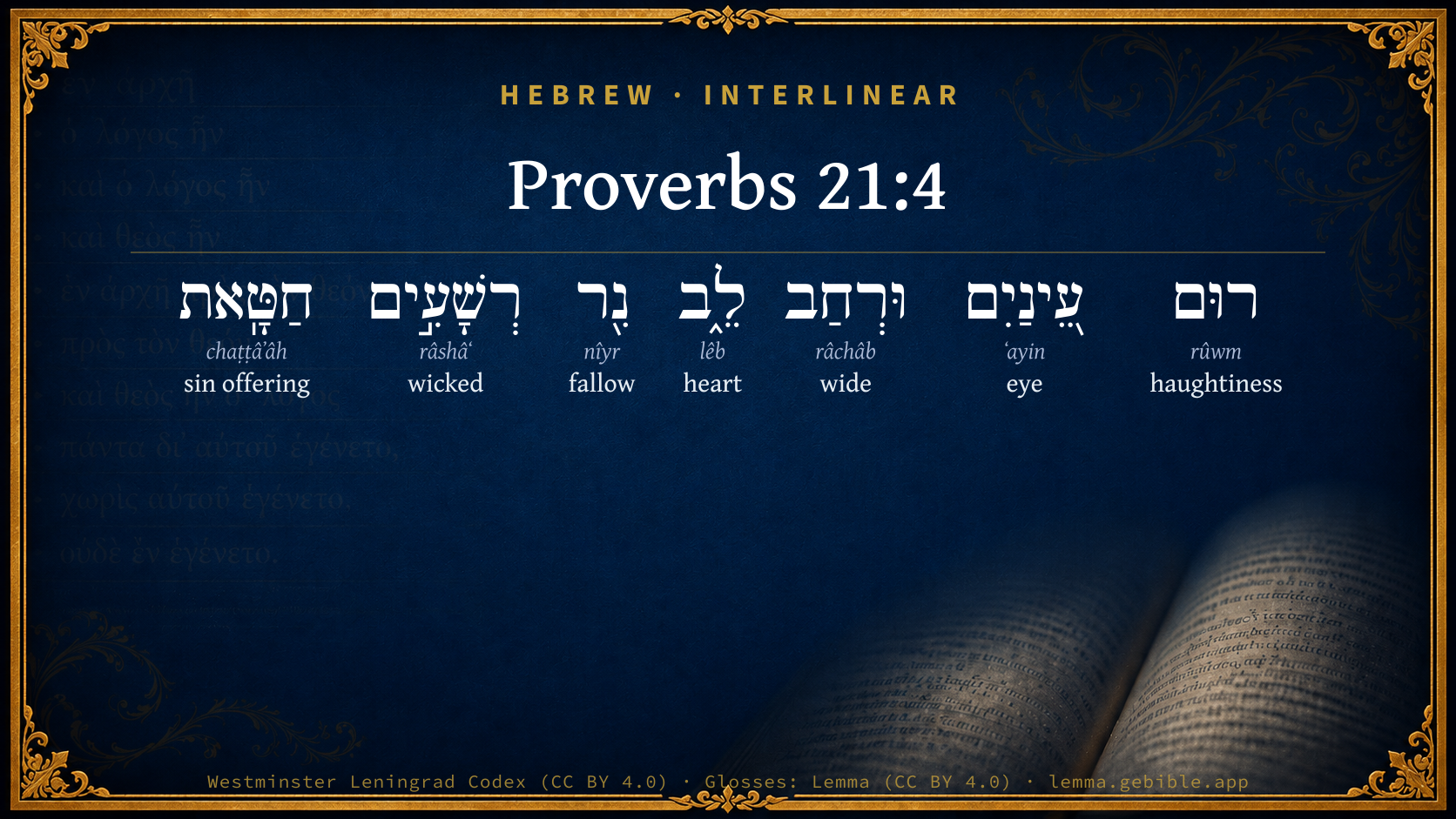
Proverbs 21:4

Hebrew (Westminster Leningrad Codex) Proverbs 21:4 appears in the Hebrew Old Testament. The text above is from the Westminster Leningrad Codex. Each word links to its Strong’s number, a concise gloss, and parsing drawn from the Open Scriptures Hebrew Bible morphology. Click any word for its full Brown-Driver-Briggs (BDB) entry.
Download image
Cite this verse

Proverbs 21:4 (World English Bible). Public Domain. Lemma interlinear Bible study tool, https://lemma.gebible.app/v/proverbs/21/4.

Show BibTeX & RIS
BibTeX
RIS
English Translation
A high look, and a proud heart, The lamp of the wicked, is sin.
World English Bible · Public Domain
Highlights
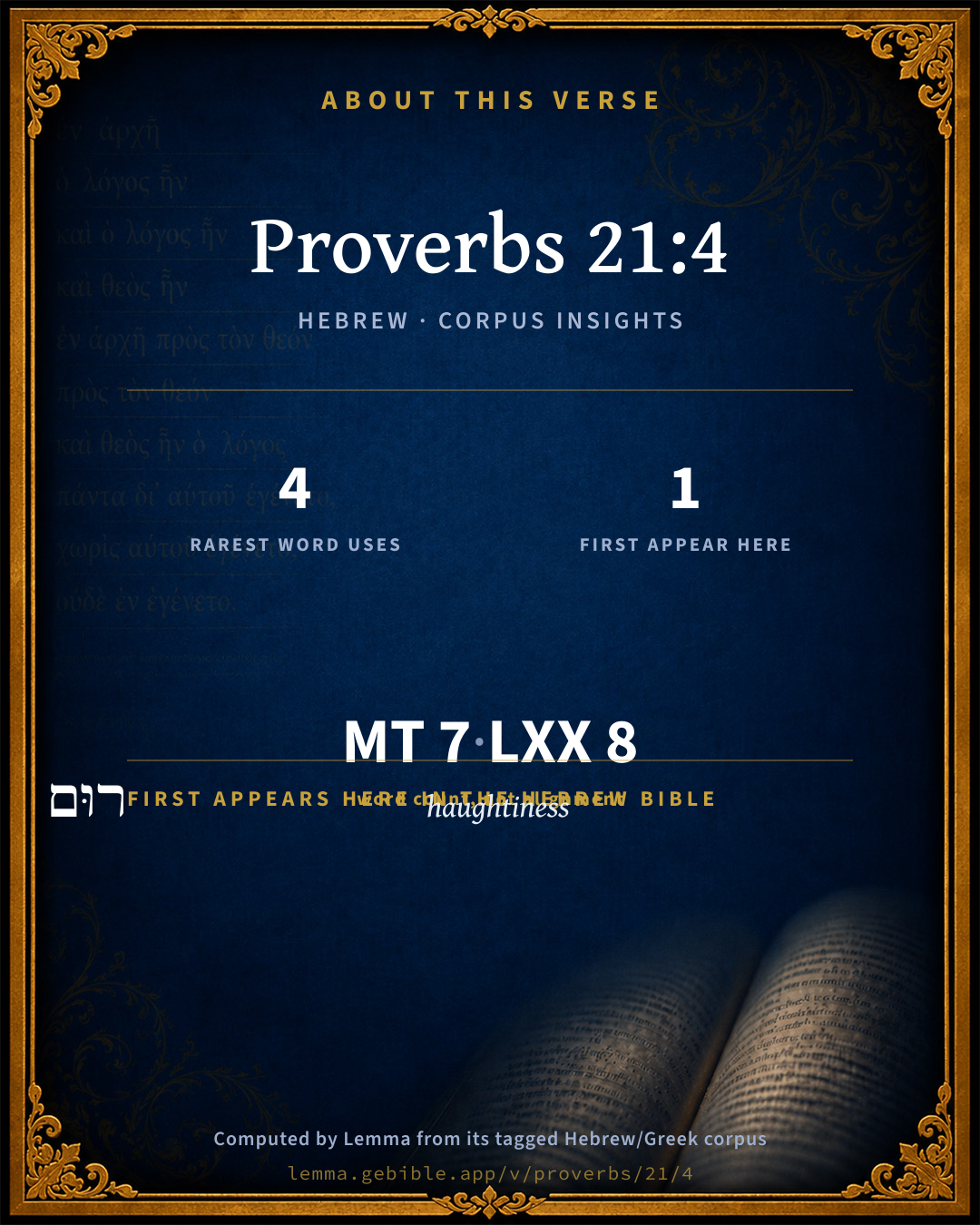
  • 1 first appearance in the Hebrew Bible
Full analysis ↓
Download a study sheet

One document with this verse’s original text, its word-by-word gloss line, the meaning frame, cross-references with their text, attributed commentary, and full source and license credits — printable, and it pastes into notes with its structure intact.

This verse Autodidact and up

Study sheet (.html) Plain text (.txt)

A passage Seminary Student

Up to 50 verses in one chapter. A passage sheet keeps up to 6 commentary sources and 12 cross-references per verse, in the order this page ranks them, and says so on the sheet whenever that leaves anything out. Ask for a single verse and you get the Autodidact verse sheet above.

Everything on this page stays free to read, with no account — the sheet is a download of what is already on screen, not access to it.

Want to remove ads? Support Godless Engineer
Compare translations 3

The same verse in 3 English versions, stacked beneath the original-language interlinear above. Click any original word for its lexicon entry.

Each is an independent rendering of the whole verse — the interlinear is not word-aligned to these translations.

Highlighted words mark where these versions differ — a whole-verse word diff, not a word-by-word alignment.

  • World English Bible Public Domain
    A high look, and a proud heart, The lamp of the wicked, is sin.
  • King James Version Public Domain
    An high look, and a proud heart, and the plowing of the wicked, is sin.
  • unfoldingWord Literal Text CC BY-SA 4.0
    Height of eyes and broadness of heart, the lamp of wicked ones, sin.

unfoldingWord Literal Text — © unfoldingWord, licensed CC BY-SA 4.0. Word-aligned USFM3 via Door43 (git.door43.org/unfoldingWord/en_ult).

Versions to compare (up to 4)

3 of 4 selected

Show all 18 translations

Every available English version of this verse, each an independent rendering of the whole verse.

  • World English Bible Public Domain
    A high look, and a proud heart, The lamp of the wicked, is sin.
  • Berean Standard Bible Public Domain
    Haughty eyes and a proud heart—the guides of the wicked—are sin.
  • Majority Standard Bible Public Domain
    Haughty eyes and a proud heart—the guides of the wicked—are sin.
  • King James Version Public Domain
    An high look, and a proud heart, and the plowing of the wicked, is sin.
  • American Standard Version (1901) Public Domain
    A high look, and a proud heart, `Even' the lamp of the wicked, is sin.
  • Revised Version (1885) Public Domain
    An high look, and a proud heart, even the lamp of the wicked, is sin.
  • Geneva Bible (1599) Public Domain
    A hautie looke, and a proude heart, which is the light of the wicked, is sinne.
  • Douay-Rheims (1899) Public Domain
    Haughtiness of the eyes is the enlarging of the heart: the lamp of the wicked is sin.
  • Young's Literal Translation Public Domain
    Loftiness of eyes, and breadth of heart, Tillage of the wicked `is' sin.
  • Literal Standard Version CC BY-SA 4.0
    Loftiness of eyes, and breadth of heart, || Tillage of the wicked [is] sin.
  • Unlocked Literal Bible CC BY-SA 4.0
    Haughty eyes and a proud heart— the lamp of the wicked—are sin.
  • unfoldingWord Literal Text CC BY-SA 4.0
    Height of eyes and broadness of heart, the lamp of wicked ones, sin.
  • Darby Bible Public Domain
    Lofty eyes, and a proud heart, the lamp of the wicked, is sin.
  • World Messianic Bible Public Domain
    A high look and a proud heart, the lamp of the wicked, is sin.
  • Webster's Bible Public Domain
    A high look, and a proud heart, and the plowing of the wicked, is sin.
  • Free Bible Version CC BY-SA 4.0
    Pride and arrogance are the sins the wicked live by.
  • Bible in Basic English Public Domain
    A high look and a heart of pride, *** of the evil-doer is sin.
  • JPS Tanakh (1917) Public Domain
    A haughty look, and a proud heart — the tillage of the wicked is sin.

Literal Standard Version (2020), Covenant Press — licensed CC BY-SA 4.0. Text via the HelloAO Bible API (eBible.org). Unlocked Literal Bible (unfoldingWord) — licensed CC BY-SA 4.0. Text via the HelloAO Bible API (eBible.org). unfoldingWord Literal Text — © unfoldingWord, licensed CC BY-SA 4.0. Word-aligned USFM3 via Door43 (git.door43.org/unfoldingWord/en_ult). Free Bible Version, Dr. Jonathan Gallagher — licensed CC BY-SA 4.0. Text via the HelloAO Bible API (eBible.org).

Word by word

More ways to search: Search by grammar → Find every occurrence → Compare this word →

Practice this passage: Drill this verse → Learn its vocabulary →

About this verse

These counts appear in no published source. They are computed here, from the morphology-tagged text and Lemma’s own curated glosses. What Lemma adds →

7
words
7
distinct lemmas
Wisdom
section

Notable vocabulary

The rarest word here is נִ֖ר fallow H5215 — appearing just 4 times in the whole Hebrew Bible.

First appearance in Scripture

This word makes its first canonical appearance in the Hebrew Bible here:

  • רוּם haughtiness H7312

Shared distinctive vocabulary

נִ֖ר fallow H5215 occurs in 4 verses of the Hebrew Bible. Also found in:

Grammatical profile

  • 5 nouns
  • 2 adjectives

Hebrew & Septuagint length

In English translation the verse runs 14 words from the Hebrew and 16 from the Septuagint (LXX English) — closely comparable.

A rough comparison of the two English renderings, which tokenize alike — not a word-level alignment.

Word counts can differ between the Hebrew and the Greek without any difference in meaning — e.g. the Hebrew direct-object marker אֵת has no separate Greek word, and Greek often adds the article ὁ.

In the original languages it is 7 Hebrew tokens and 8 Greek tokens — but the two are counted differently (Hebrew bundles its prefixes and suffixes into one token; the Greek is in lemma form), so that isn’t a like-for-like length.

Cross-references

12

Topical passages linked to Proverbs 21:4 in the Treasury of Scripture Knowledge — connected by theme and wording, ordered by reader-vote popularity; previews shown in the World English Bible.

  • Proverbs 6:17 Haughty eyes, a lying tongue, Hands that shed innocent blood;
  • 1 Peter 5:5 Likewise, you younger ones, be subject to the elder. Yes, all of you gird yourselves with humility, to subject yourselves to one another; for "God resists the proud, but gives grace to the humble."
  • Proverbs 8:13 The fear of Yahweh is to hate evil. I hate pride, arrogance, the evil way, and the perverse mouth.
  • Isaiah 2:17 The loftiness of man shall be bowed down, And the haughtiness of men shall be brought low; And Yahweh alone shall be exalted in that day.
  • Luke 18:14 I tell you, this man went down to his house justified rather than the other; for everyone who exalts himself will be humbled, but he who humbles himself will be exalted."
  • Proverbs 15:8 The sacrifice made by the wicked is an abomination to Yahweh, But the prayer of the upright is his delight.
  • Proverbs 21:27 The sacrifice of the wicked is an abomination: How much more, when he brings it with a wicked mind!
  • Psalms 10:4 The wicked, in the pride of his face, Has no room in his thoughts for God.
  • Isaiah 3:16 Moreover Yahweh said, "Because the daughters of Zion are haughty, And walk with outstretched necks and flirting eyes, Walking to trip as they go, Jingling ornaments on their feet;
  • Romans 14:23 But he who doubts is condemned if he eats, because it isn't of faith; and whatever is not of faith is sin. (14:24) Now to him who is able to establish you according to my Gospel and the preaching of Jesus Christ, according to the revelation of the mystery which has been kept secret through long ages, (14:25) but now is revealed, and by the Scriptures of the prophets, according to the commandment of the eternal God, is made known for obedience of faith to all the nations; (14:26) to the only wise God, through Jesus Christ, to whom be the glory forever! Amen.
  • Proverbs 30:13 There is a generation, oh how lofty are their eyes! Their eyelids are lifted up.
  • Isaiah 2:11 The lofty looks of man will be brought low, The haughtiness of men will be bowed down, And Yahweh alone will be exalted in that day.

Cross-references courtesy of OpenBible.info (CC BY 4.0).

Hebrew and Greek witnesses Masoretic Hebrew ↔ Greek Septuagint

The same verse in the two great witnesses to the Old Testament, shown verse-for-verse.

These are two independent witnesses, not word-aligned to each other, and the Septuagint is shown in lemma (dictionary) form.

Hebrew Proverbs 21:4 Masoretic · Westminster Leningrad Codex

רוּם עֵ֭ינַיִם וּרְחַב לֵ֑ב נִ֖ר רְשָׁעִ֣ים חַטָּֽאת

A high look, and a proud heart, The lamp of the wicked, is sin.

World English Bible · Public Domain

Greek LXX Proverbs 21:4 Septuagint · lemma form

μεγαλόφρων ἐπί ὕβρις θρασυκάρδιος λαμπτήρ δέ ἀσεβής ἁμαρτία

A high-minded man is stout-hearted in his pride; and the lamp of the wicked is sin.

LXX2012 (modern English Septuagint) · Public Domain

On this verse, The Preacher's Complete Homiletical Commentary discusses the Septuagint’s reading. Read the note in Commentary ↓

Hebrew: Westminster Leningrad Codex (CC BY 4.0). Greek: Septuagint (public domain); English from LXX2012 (modern English Septuagint) (Public Domain). How the Septuagint differs from the Hebrew →

Commentary

Notes on Proverbs 21:4 from classic Christian and Jewish commentators (each source and its license shown beneath its notes). The classic Christian expositions comment on the surrounding passage and are grouped to its opening verse, so a note may address several verses; the Jewish commentaries on the Tanakh (Rashi and others) are per-verse, so they appear only where the commentator wrote on this verse.

Lemma curates 59 commentaries, every one of them public domain or Creative Commons licensed, each selected and text-cleaned for this edition rather than reprinted as found. About our sources →

Trapp's Complete Commentary

John Trapp

Pro 21:4 An high look, and a proud heart, [and] the plowing of the wicked, [is] sin.

Ver. 4. An high look and proud heart.] {See Trapp on "Pro 6:17"}

And the ploughing of the wicked is sin.] As they plot and plough mischief - being the devil’s hinds and drudges - so all their actions, natural, moral, spiritual, are turned into sin; whether they plough, or play, or pray, or eat, or sleep, "to the impure and unbelieving, all things are impure." {Tit 1:15} Their proud or big swollen heart is full of filthy corrupt matter, that oozeth out still and offendeth the eyes of God’s glory. Everything they do is as an evil vapour reeking from that loathsome dunghill, worse than those that came up from the five cities of the plain. Pride is like copperas, which will turn wine or milk into ink; - or leaven, which turns a very passover into pollution; - or as the sanies pus of a plague sore, which will render the richest robe infectious.

John Trapp, A Commentary or Exposition upon All the Books of the Old and New Testament (1647–1656) — public domain. Text from a community e-Sword module.

Joseph Benson's Commentary

Pro 21:4. A high look — One sign of pride put for all the rest; and a proud heart — Pride lurking and reigning in the heart, though it do not discover itself to men by outward actions, but be disguised with a show of humility, as it frequently is; and the ploughing of the wicked — Even their civil or natural actions, which in themselves are lawful and good, are made sinful, as they are managed by ungodly men, without any regard to the glory of God, which ought to be the end of all our actions; is sin — Is by them turned into sin, and made the occasion of much wickedness.

Joseph Benson's Commentary on the Old and New Testaments (1811–1818) — public domain. Text from a community e-Sword module.

The Preacher's Complete Homiletical Commentary

Joseph S. Exell (gen. ed.)

CRITICAL NOTES.—

Pro_21:4. The ploughing. This word is by most modern commentators translated, as in the marginal references, light. It is likewise so rendered in the Septuagint, the Vulgate, and in Luther’s version. Ewald, Elster, Wordsworth, and others, translate as in the English version. The Hebrew words are very similar. Those who adopt the former rendering understand the word to stand in apposition to the high look and the proud heart of the first clause (literally “To be lofty of eyes, and to be swollen of heart”), and regard it as a figurative representation of the spirit of the wicked man. Ewald and others refer the ploughing of the wicked to the “very first-fruits of a man’s activity.”

MAIN HOMILETICS OF Pro_21:4

THE PLOUGHING OF THE WICKED

I. The high look and the proud heart indicate a man wrong at the foundation of his character. They show that he has not yet learned the alphabet of true godliness—that he has not yet begun to know his guilt and his weakness. He is ignorant of the depravity of his moral nature—of the capabilities of wrong that lie hidden within him, undeveloped now, it may be, but ready to assert their presence when the temptation presents itself. The man who has been born blind is entirely ignorant of the outline even of his own features, but he does not form a conception which is farther removed from the reality than a spiritually unenlightened man does of the real features of his moral character. The proud man by his pride proclaims his moral blindness—his high look is a sure indication that the light within him is darkness—that he has never seen himself as he really is. Hence it follows that he is wrong at the very core and centre of his moral being; where pride holds her throne there is no room for God, there is no confession of sin, and no yielding to Divine guidance.

II. While the heart is wrong the whole life will be wrong. This truth is expressed in the proverb, however we translate the verb in the second clause (See Critical Notes). Things that are not wrong in themselves become wrong if done from a sinful motive. A man may plough a field, and in itself the action may be neither good nor bad, but if he plough in order to sow a crop of thistles the action is a criminal one. A man may be diligent and painstaking in his business, and his diligence may in itself seem commendable, but if he exercises it only to gain money for sinful ends his very buying and selling becomes sin. And if we translate the word “light,” and understand it to signify prosperity, the truth taught is very much the same. While a man’s pride keeps him at a moral distance from God, no matter how successful he may be, the taint and curse of unpardoned guilt is upon all his gains and possessions.

OUTLINES AND SUGGESTIVE COMMENTS

Holy intention is to the actions of a man that which the soul is to the body, or form to its matter, or the root to the tree, or the sun to the world, or the fountain to the river, or the base to a pillar. Without these the body is a dead trunk, the matter is sluggish, the tree is a block, the world is darkness, the river is quickly dry, the pillar rushes into flatness and ruin, and the action is sinful, or unprofitable and vain.—Jeremy Taylor.

The evil spirit called sin may be trained up to politeness, and made to be genteel sin; it may be elegant, cultivated sin; it may be very exclusive and fashionable sin; it may be industrious, thrifty sin; it may be a great political manager, a great commercial operator, a great inventor; it may be learned, scientific, eloquent, highly-poetic sin! Still it is sin, and, being that, has in fact the same radical and fundamental quality that, in its ranker and less restrained conditions, produces all the most hideous and revolting crimes of the world.—Bushnell.

All thine actions while unregenerate—whether inward or outward, whether worldly or religious—are all sinful and cursed. Like the leper under the law, thou taintest whatever thou touchest, and makest it unclean.… Thy calling is not without its corruption.… nay, thy very religious exercises are sinful.… Thine incense stinks of the hand that offered it.… The vessel of thy heart is not clean, and God will not taste of the liquor which cometh out of it. Because thy person is not accepted, thy performances are all rejected. “Thou art in the flesh, and therefore canst not please God” (Rom_8:8).—Swinnock.

The Preacher's Complete Homiletical Commentary (gen. ed. Joseph S. Exell; Funk & Wagnalls, c. 1892) — public domain (pre-1929). A full-Bible homiletical/sermon-outline anthology covering 65 of 66 books (2 John is absent from the source module). Text from a community e-Sword module.

Tyndale Open Study Notes

Tyndale Open Resources

21:4 Demeanor (eyes), character (heart), and actions are all significant. God hates pride (see 6:17-18; 11:2; 13:10; 15:33; 16:18; 18:12).

Tyndale Open Study Notes — © Tyndale Open Resources, licensed CC BY-SA 4.0. Text via the HelloAO Bible API.

Geneva Bible (1599)

Geneva Bible translators

Or, plowing.

That is, the thing whereby he is guided or which he bringeth forth as the fruit of his work.

Geneva Bible (1599) marginal notes — public domain. Text via Bolls.life.

Matthew Henry's Commentary

This may be taken as showing us, 1. The marks of a wicked man. He that has a high look and a proud heart, that carries himself insolently and scornfully towards both God and man, and that is always ploughing and plotting, designing and devising some mischief or other, is indeed a wicked man. The light of the wicked is sin. Sin is the pride, the ambition, the glory and joy, and the business of wicked men. 2. The miseries of wicked man. His raised expectations, his high designs, and most elaborate contrivances and projects, are sin to him; he contracts guilt in them and so prepares trouble for himself. The very business of all wicked men, as well as their pleasure, is nothing but sin; so Bishop Patrick. They do all to serve their lusts, and have no regard to the glory of God in it, and therefore their ploughing is sin, and no marvel when their sacrificing is so, Pro 15:8.

Matthew Henry's Commentary on the Whole Bible (1708–1710) — public domain (CC PDM 1.0). Text via the HelloAO Bible API.

Jamieson, Fausset & Brown

Robert Jamieson, A. R. Fausset & David Brown

high look--(Compare Margin; Psa 131:1).

proud heart--or, "heart of breadth," one that is swollen (compare Psa 101:5).

ploughing--better "lamp," a frequent figure for prosperity (Pro 20:20); hence joy or delight.

Jamieson, Fausset & Brown — Commentary Critical and Explanatory on the Whole Bible (1871) — public domain (CC PDM 1.0). Text via the HelloAO Bible API.

Adam Clarke's Commentary

Verse 4. A high look] The evidence of pride, self-conceit, and vanity. A proud heart, from which the high look, c., come.

And the ploughing] נר ner, lucerna, the lamp, the prosperity and posterity of the wicked is sin - it is evil in the seed, and evil in the root, evil in the branch, and evil in the fruit. They are full of sin themselves, and what they do is sinful.

Adam Clarke's Commentary on the Bible (1810–1826) — public domain. Text from a community e-Sword/MySword module.

Ellicott's Commentary for English Readers

(4) The plowing of the wicked.—i.e., their work, all they do; for it is not done to please God but themselves; nor carried on in His strength, but in reliance upon their own, and therefore it is “sin,” not pleasing to Him. For the word here translated “plowing,” see above on Pro_13:23, where it is rendered “tillage.” It may also signify “lamp” (see above on 13:9).

A Bible Commentary for English Readers, edited by Charles John Ellicott (1878–1897) — public domain. Text from a community e-Sword module.

The Cambridge Bible for Schools and Colleges

gen. ed. J. J. S. Perowne

4. the plowing] This, which is an admissible rendering, is virtually retained (the tillage) in R.V. marg. The haughty bearing, the proud look, the prosperous labours of the wicked are alike condemned as “sin.” But it is better to render lamp, instead of plowing or tillage, even the lamp of the wicked is sin. λαμπτήρ, LXX.; lucerna, Vulg.

The lamp burning brightly and steadily in the tent or house is the symbol of the prosperity of an individual (Pro_13:9; Job_18:6; and of a dynasty, 1Ki_11:36; 1Ki_15:4). But in the case of “the wicked,” instead of being accepted with humble thankfulness as lighted by Jehovah (Psa_18:28), it finds expression in “an high look and a proud heart,” and therefore “is sin.”

The Cambridge Bible for Schools and Colleges (gen. ed. J. J. S. Perowne; Cambridge University Press, 1878–1918) — public domain. Text from a community e-Sword module.

John Gill's Exposition

An high look, and a proud heart,.... The former is a sign of the latter, and commonly go together, and are both abominable to the Lord; see Psa 101:5. A man that looks above others, and with disdain upon them, shows that pride reigns in him, and swells his mind with a vain opinion of himself; this may be observed in every self-righteous man; the parable of the Pharisee and publican is a comment upon it; sometimes there may be a proud heart under a disguise of humility; but the pride of the heart is often discovered by the look of the eyes. It may be rendered, "the elevation of the eyes, and the enlargement of the heart" (p); but not to be understood in a good sense, of the lifting up of the eyes in prayer to God, with faith and fear; nor of the enlargement of the heart with solid knowledge and wisdom, such as Solomon had; but in a bad sense, of the lofty looks and haughtiness of man towards his fellow creatures, and of his unbounded desires after filthy lucre or sinful lusts: the Targum renders it,

"the swelling of the heart,''

with pride and vanity;

and the ploughing of the wicked is sin; taken literally; not that it is so in itself; for it is a most useful invention, and exceeding beneficial to mankind, and is to be ascribed to God himself; and of this the Heathens are so sensible, that they have a deity to whom they attribute it, and whom they call Ceres (q), from to plough; it only denotes that all the civil actions of a wicked man, one being put for all, are attended with sin; he sins in all he does. Or, metaphorically, for his schemes, contrivances, and projects, which are the ploughing of his mind; these are all sinful, or tend to that which is so. Some understand this particularly of his high look and proud heart, which are his ploughing and his sin; Ben Melech; and others of his ploughing, or persecuting and oppressing, the poor. The word is sometimes used for a lamp or light, and is so rendered here by some, "the light of the wicked is sin" (r); their outward happiness and prosperity leads them into sin, involves them in guilt, and so brings them to ruin and destruction: and this way go the Targum: Septuagint, Vulgate Latin, Syriac, and Arabic versions.

(p) "elatio oculorum et latitudo cordis", Piscator, Michaelis, Cocceius, Schultens. (q) "Prima Ceres ferro mortales vertere terram instituit", Virgil. Georgic. l. 1. (r) "Incerna impiorum", V. L. Mercerus, Gejerus, Cocceius, Michaelis, Schultens.

John Gill's Exposition of the Whole Bible (1746–1763) — public domain (CC PDM 1.0). Text via the HelloAO Bible API.

Albert Barnes' Notes on the Bible

The plowing - The Hebrew word, with a change in its vowel points, may signify either:

(1) the “fallow field,” the “tillage” of Pro 13:23, or

(2) the lamp.

According to: (1) the verse would mean, “The outward signs of pride, the proud heart, the broad lands of the wicked, all are evil.” (2) however, belongs, as it were, to the language of the time and of the book Pro 13:9; Pro 24:20. The “lamp of the wicked” is their outwardly bright prosperity.

Albert Barnes' Notes on the Bible (1834–1885) — public domain. Text from a community e-Sword/MySword module.

Haydock's Catholic Bible Commentary

Heart. Or when it is proud, it causes the eyes to appear so too. (Calmet) --- Lamp. Protestants, "ploughing of the wicked is sin." When it is done with a bad motive, out of pride. Hebrew, "the haughtiness of the eyes, and the enlarging of the heart, are the labour ("tillage," Montanus; "thought," Pagnin) of the wicked; yea, sin." (Haydock) --- Those things are their employment, and their sin. (Calmet) --- Septuagint and Vulgate may also mean, "sin is the lamp and exultation of the wicked." (Haydock)

George Leo Haydock (1774–1849), Haydock's Catholic Family Bible and Commentary, 1859 edition — public domain. Excludes Psalms (Douay-Rheims chapter numbering differs from Protestant) and Deuterocanonical books (Catholic canon only).

Matthew Poole's English Annotations

An high look; one gesture or sign of pride put for all the rest, Pro 6:17.

A proud heart; pride lurking and reigning in the heart, though it do not discover itself to men by outward actions, but be disguised with a show of humility, it is frequently.

The ploughing; either,

1. Strictly and properly so called: even their civil or natural actions, which in themselves are lawful and good, are made sinful, as they are managed by ungodly men, without any regard to the service and glory of God, which ought to be the great end of all our actions, 1Co 10:31, and with a design of serving their own wicked lusts by it. Or,

2. Metaphorically, their designs and endeavours, which are said to be sin, because they are wholly and fully set upon sin, and they make sin their trade or business, which is called ploughing wickedness, Job 4:8. But all the ancient interpreters, and divers others, render the word the lamp or light, as this Hebrew word, even thus pointed, is rendered, 1Ki 11:36; 15:4; 2Ki 8:19; 2Ch 21:7; and the lamp of the wicked is a phrase used in this book, Pro 13:9; 24:20, as also Job 21:17; whereas the ploughing of the wicked is a phrase not elsewhere used. And this seems best to agree with the context, for by their lamp he seems to understand all their pomp and glory, that worldly greatness and prosperity, which is the fuel of their pride, and therefore is most fitly joined with it. Is sin; it is by them turned into sin, and made the occasion of much wickedness. The whole verse may be thus rendered, An high look and a proud heart, which is the light or glory of the wicked, (i.e. wherein they glory, esteeming it magnanimity or gallantry of spirit,) is sin, i.e. is a great and grievous sin. And in this manner the learned Mercer renders the verse, save only that he translates the Hebrew word nir, the ploughing.

Matthew Poole's English Annotations on the Holy Bible (1683–1685) — public domain. Text from a community e-Sword/MySword module.

Whedon's Commentary on the Bible

Daniel D. Whedon

4. Ploughing of the wicked — The versions and critics differ on the word rendered “ploughing.” The balance is in favour of rendering נר, (nir,) a lamp or light, the emblem of prosperity, joy, splendour, etc. Stuart renders thus: “Softness of look and pride of heart, the light of the wicked, is sin.” So, substantially, Conant. The Speaker’s Commentary prefers the old reading. Miller, “Elation of eyes and dilation of heart, the very light of the wicked, is the sin offering.” On the whole, the reading of the Authorized Version may be permitted to stand. Comp. Pro_6:17. The Septuagint, Vulgate, etc., read lamp instead of ploughing. “A hautie loke, and a proude hart, which is the light of the wicked, is sinne.” — Geneva Bible.

Daniel D. Whedon (gen. ed.), Commentary on the Old and New Testaments (1874–1909) — public domain. Text from a community e-Sword module.

The Pulpit Commentary

A high look and a proud heart; Vulgate, exaltatio oculorum est dilatatio cordis, "The lifting up of the eyes is a swelling of the heart." But it is best to make the whole verse one idea, as in the Authorized Version. The lifting of the eyes is a term implying pride, as shown in supercilious looks, as if other people were of inferior clay and not worthy of notice. So we have "haughty eyes" in Pro_6:17 (where see note); and in Pro_30:13 we read, "There is a generation, oh how lofty are their eyes! and their eyelids are lifted up." "The enlargement of the heart" is the cause of the proud look, for it signifies the evil affections and concupiscence of the will, wholly filled up with self, and controlling the actions and expression of the body. Septuagint, "A high-minded man (kehalofrwn ) is stout-hearted in his pride." And the ploughing of the wicked is sin. The Authorized Version takes the reading rni (nir), which means "tillage", (Pro_13:23) or, as Delitzsch supposes, "land ploughed for the first time" (novale). The proverb, taken thus, will mean, "high look, proud heart, even all the field which the godless cultivate, all that they do, is sin." "Pride," says the Talmud, "is worse than sin." But another pointing gives a different and very appropriate (comp. Pro_13:9 Pro_24:20) meaning rne (ner) signifies "a lamp." Thus the Vulgate, Lucerna impiorum peccatum, "The lamp of the wicked is sin;" and the Septuagint, Lampth asebwn amartia "Lamp" is, as often, a metaphor for prosperity and happiness; (comp. 2Sa_22:29 1Ki_11:36) and it is here said that the sinner"s outward prosperity and joyousness, springing from no good source, being founded in self, and not resting on virtue and godliness, are in themselves sinful and displeasing to God.

Vers. 4-9. A family of vices.

There is a kinship between all vices as between all virtues. All sins spring from a disturbance of our true relations to God, as all virtues rest upon the deep consciousness of that relation.

I THE SIN OF PRIDE. (Ver. 4) Its aspect the lofty eyes, the haughty glance and its principle in the heart are struck by the Divine rebuke. The meaning of the second clause is not quite clear; probably it is, "The light of the wicked is only sin," i.e. his haughty and overweening temper is compared to a flaming or a lurid light, contrasted with the mild serene ray that seems to stream from a good man"s life.

II THE VICE OF COVETOUSNESS. (Ver. 5) Shown by an eager and selfish haste to obtain the wealth which Providence has apportioned only as the reward of painstaking toil. Religion teaches us moderation, measure in all things. "Unhasting, unresting," expresses the measure of diligence in all our life business.

III THE USE OF DISHONEST MEATS. (Ver. 6) This can never lead to aught but a seeming success (see the exegesis of this passage). "Man is a shadow"s dream," said Pindar. "What shadows we are! and what shadows we pursue!" said a great Englishman. But of none is the word more true than of him who seeks gain at the expense of inner truth, profit by the loss of the soul!

IV VIOLENT DEEDS. (Ver. 7) All violence recoils upon the perpetrator. The desolation which godless men bring upon others finally carries away themselves. No one who persistently sets himself against right can stand, can abide, for right is the very foundation and constitution of things in the order of God. And so of criminality or impurity in general (ver. 8). It is a crooked way, a twisted web. Perplexities, miserable intricacies of doubt, are generally to be traced to the fault of the will; and the straightforward man is he who walks by the light of a pure heart.

V THE CONTENTIOUS TEMPER. (Ver. 9) It unfits for society. It makes the home intolerable. The vexing, captious, irritable temper makes a solitude around it, and calls it peace. The very idea of the Christian household is peace. Wherever struggle may be necessary, it is certainly out of place there. Let us seek the "things that make for peace these first and foremost. Every wife, mother, daughter, should be in reality, if not in name, a "Salome!" ("a peaceful one"). J.

The Pulpit Commentary (1880–1919), ed. H.D.M. Spence-Jones & Joseph S. Exell — public domain. Text from a community e-Sword module.

John Wesley's Explanatory Notes

The plowing - Even their civil or natural actions, which in themselves are lawful, are made sinful as they are managed by ungodly men, without any regard to the glory of God, which ought to be the end of all our actions.

John Wesley, Explanatory Notes Upon the Whole Bible (1754–1765) — public domain. Text via the GEBible commentary corpus.

Keil & Delitzsch

C. F. Keil & F. Delitzsch

4 Loftiness of eyes and swelling of heart -

The husbandry of the godless is sin.

If נר, in the sense of light, gives a satisfactory meaning, then one might appeal to Kg1 11:36 (cf. Sa2 21:17), where ניר appears to signify lamp, in which meaning it is once (Sa2 22:29) written ניר (like חיק); or since ניר = נר (ground-form, nawir, lightening) is as yet certainly established neither in the Heb. nor Syr., one might punctuate נר instead of נר, according to which the Greeks, Aram., and Luther, with Jerome, translate. But of the lamp of the godless we read at Pro 13:9 and elsewhere, that it goeth out. We must here understand by נר the brilliant prosperity (Bertheau and others) of the wicked, or their "proud spirit flaming and flaring like a bright light" (Zckler), which is contrary to the use of the metaphor as found elsewhere, which does not extend to a prosperous condition. We must then try another meaning for נר; but not that of yoke, for this is not Heb., but Aram.-Arab., and the interpretation thence derived by Lagarde: "Haughtiness and pride; but the godless for all that bear their yoke, viz., sin," seeks in vain to hide behind the "for all that" the breaking asunder of the two lines of the verse. In Heb. נר means that which lightens (burning) = lamp, נוּר, the shining (that which burns) = fire, and ניר, Pro 13:23, from ניר, to plough up (Targ. Sa1 8:12, למנר = לחרשׁ) the fresh land, i.e., the breaking up of the fallow land; according to which the Venet. as Kimchi: νέωμα ἀσεβῶν ἁμαρτία, which as Ewald and Elster explain: "where a disposition of wicked haughtiness, of unbridled pride, prevails, there will also sin be the first-fruit on the field of action; נר, novale, the field turned up for the first time, denotes here the first-fruits of sin." But why just the first-fruits, and not the fruit in general? We are better to abide by the field itself, which is here styled נר, not שׂדה (or as once in Jer 39:10, יגב); because with this word, more even than with שׂדה, is connected the idea of agricultural work, of arable land gained by the digging up or the breaking up of one or more years' fallow ground (cf. Pea ii. 1, ניר, Arab. siḳâḳ, opp. בור, Arab. bûr, Menachoth 85a, שׂדות מניּרות, a fresh broken-up field, Erachin 29b, נר ,, opp. הביר, to let lie fallow), so that נר רשׁעים may mean the cultivation of the fields, and generally the husbandry, i.e., the whole conduct and life of the godless. נר is here ethically metaph., but not like Hos 10:12; Jer 4:3, where it means a new moral commencement of life; but like חרשׁ, arare, Job 4:8; Hos 10:13; cf. Pro 3:29. רחב is not adj. like Pro 28:25, Psa 101:5, but infin. like חסר, Pro 10:21; and accordingly also רוּם is not adj. like חוּם, or past like סוּג, but infin. like Isa 10:12. And חטּאת is the pred. of the complex subject, which consists of רוּם עינים, a haughty looking down with the eyes, רחב־לב, breadth of heart, i.e., excess of self-consciousness, and נר רשׁעים taken as an asyndeton summativum: pride of look, and making oneself large of heart, in short, the whole husbandry of the godless, or the whole of the field cultivated by them, with all that grows thereon, is sin.

Keil & Delitzsch — Biblical Commentary on the Old Testament (1861–1891) — public domain (CC PDM 1.0). Text via the HelloAO Bible API. (Old Testament only.)

Bridges on Proverbs

Charles Bridges

Another stamp of abomination upon pride!†1 We cannot mistake the mind of God so continually declared. Yet so many shapes does this sin assume, that, until the Spirit of God shews a man to himself, he rejects the idea of any concern in it. Nay, he will be proud of his very pride, proud of a high spirit; counting a Christian mean and cowardly, who in the true spirit of the Gospel, yields up his right to a stronger hand.†2

But not only the haughtiness, but even the natural actions — the plowing of the wicked — is sin. "This is an hard saying; who can hear it?" (Joh 6:60 .) How can the plowing of the soil, in itself a duty (Gen 3:19 ), become a sin? The motive determines the act. The most natural actions are inculcated for Christian ends.†3 They become therefore moral actions, good or bad according to their own motives. The man, who plows the soil, acknowledging God in his work, and seeking his strength and blessing — "does it acceptably to the glory of God." It is essentially a religious action. But the wicked, who does the same work without any regard to God — for want of a godly end, his plowing is sin.†4 His idleness is sin against a plain command. (2Th 3:10 .) His industry is the sin of ungodliness, putting God out of his own world. The substance of his act is good. But the corrupt principle defiles the very best actions. (Tit 1:15 .) "Every thought, every imagination, of the" natural "heart," is unmixed "evil." (Gen 6:5 .) If the fountain-head be bitter, how can the waters be pure? Sin indeed defiles every motive in the Christian’s heart. But here it is the substance of sin. In the one case it is infirmity of walk in the straight path. In the other, it is an habitual walk in a crooked path. With the wicked — ’his eating as well as his gluttony; his drinking as well as his drunkenness; his commerce, negotiation, and trafficking, as well as his covetousness, and inordinate love of the world, are all set down and reckoned by God for sins, and such sins as he must reckon for with God.’†5 Fearful indeed is his condition. Would that he could see it! Whether he prays,†6 or neglects to pray,†7 it is abomination. He cannot but sin; and yet he is fully accountable for his sin. To die, is to plunge into ruin.†8 To live in unregeneracy is even worse; it is daily "heaping up wrath against the day of wrath." (Rom 2:5 .) Ought he then to leave his duties undone? ’The impotency of man must not prejudice God’s authority, nor diminish his duty.’†9 What then ought he to do? Let him learn the absolute necessity of the vital change — "Ye must be born again." (Joh 3:7 .) The leper taints everything that he touches. But let him seek to the Great Physician, whose word is sovereign healing (Mat 8:3 ), whose Divine blood cleanses from every spot. (1Jn 1:7 .) His nature once cleansed, his works will be clean. His thoughts and principles, all will be for the glory of God; all acceptable to God.†10

Footnotes:

†1 Pro 3:34; Pro 8:13 ; Pro 16:5 .

†2 Mat 5:39-41. 1Co 6:7 .

†3 1Co 10:31 . Col 3:17 .

†4 ’Holy intention is to the actions of a man that, which the soul is to the body, or form to its matter, or the root to the tree, or the sun to the world, or the fountain to the river, or the base to a pillar. Without these, the body is a dead trunk, the matter is sluggish, the tree is a block, the world is darkness, the river is quickly dry, the pillar rushes into flatness and ruin, and the action is sinful, or unprofitable and vain.’ — Bp. Taylor’s Holy Living, Chap. i. Sec. iii.

†5 Bp. Hopkins’ Works, ii. 481.

†6 Pro 21:27. Pro 15:8 . Isa 1:13 .

†7 Psa 10:4.

†8 Psa 9:17. Mat 25:41-46 .

†9 Bp. Reynolds’ Works, p. 94.

†10 Tit 1:15, first clause. Many good commentators, following the old versions, adopt the marginal reading. (Pro 13:9 ; Pro 24:20 . Job 21:17 .) But as the word is used in a similar sense, Pro 13:23, and as our version is well supported, and gives a most important meaning, we have been content to adhere to it. Bishop Patrick explains the ploughing in the figurative sense of dressing. But as the two first illustrations in the verse are literal, it seems more consonant to unity to take the third on the same ground — ’What can they (the wicked) think, say, or do; even when they eat, play, fast, or pray, they are always under the guilt of sin, because all flows from an impure heart, and the bad tree cannot bring forth good fruit?’ Mat 7:18 . Cartwright in loco. ’Whatsoever they devise, or whatsoever they do, inside and outside, the cloth and linings of their garments are all sin.’ Caryl on Job 4:8 . ’The wicked man hath a haughty look and a proud heart. Neither are his misdispositions only sinful. But those his very actions and endeavors, which in another man would be harmless, are in him no other than sin.’ — Bp. Hall. See also Scott in loco.

Charles Bridges, An Exposition of the Book of Proverbs (1846) — public domain. Text from a community e-Sword module.

Kretzmann's Popular Commentary

Paul E. Kretzmann

v. 4. An high look and a proud heart, literally, "haughtiness of eyes and pompousness of heart," and the plowing of the wicked, either the light, the prosperity, or the whole business, all that the ungodly do, is sin, and therefore makes them guilty in the eyes of the Lord.

Paul E. Kretzmann, Popular Commentary of the Bible (1921–1924) — public domain. Text from a community e-Sword module.

Rashi

Rabbi Shlomo Yitzchaki (Rashi)

Haughty eyes A haughty spirit.

and unlimited lust The desire to satisfy the lusts of his heart; that is the tillage of the wicked. Their “plowing” and their thoughts is their sin.

Rashi on the Tanakh — English translations: “The Judaica Press complete Tanach with Rashi, translated by A. J. Rosenberg” (CC BY 4.0); “Pentateuch with Rashi's commentary by M. Rosenbaum and A.M. Silbermann, 1929-1934” (public domain); “The Metsudah Tanach series, Lakewood, N.J” (CC BY 4.0); and “The Book of Joshua, Metsudah Publications, 1997” (CC BY 4.0). Text via Sefaria.

Lesson kit

Teaching starters — assembled from the data on this page, not authored interpretation. Every prompt links to the verse data it draws on. Edit before teaching.

Proverbs, in the Wisdom, opens this verse with 7 words (7 distinct Hebrew lemmas). Its most distinctive word is nîyr (“fallow”). A historical commentator’s framing appears above. Read the whole chapter for the surrounding context.

Discussion questions

  1. What does “fallow” (nîyr) contribute to the verse as a whole?
  2. The word “haughtiness” first appears here in Scripture. What is being introduced at this debut?
  3. Proverbs 13:23 shares the word «fallow» with this verse. How do the two illuminate each other?
  4. These translations render this verse differently. What is at stake in choosing one wording over another?
  5. Reading how Trapp's Complete Commentary and Joseph Benson's Commentary read this verse, where do the two commentators agree and where do they part?

Things to notice

Reading settings

Reading text

Shown beneath each verse's original-language words.

Old Testament
Old Testament edition

Read the OT as the Masoretic Hebrew (MT) or the Greek Septuagint (LXX).

English shown for the Greek Septuagint (in the Hebrew ↔ Greek comparison).

Comparing translations? Open the Compare panel on any verse page to stack up to four side by side.