
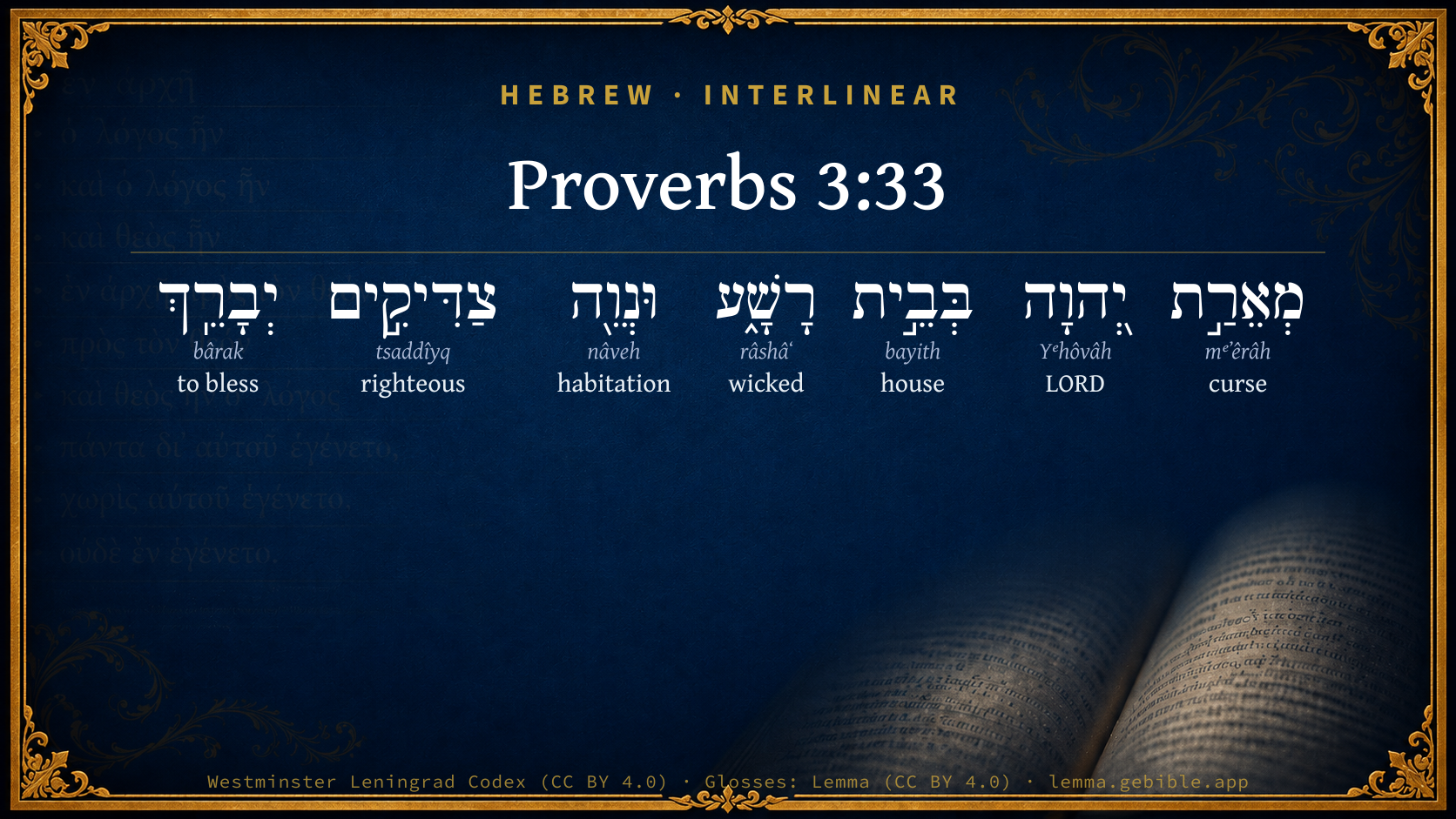
Proverbs 3:33

Hebrew (Westminster Leningrad Codex) Proverbs 3:33 appears in the Hebrew Old Testament. The text above is from the Westminster Leningrad Codex. Each word links to its Strong’s number, a concise gloss, and parsing drawn from the Open Scriptures Hebrew Bible morphology. Click any word for its full Brown-Driver-Briggs (BDB) entry.
Download image
Cite this verse

Proverbs 3:33 (World English Bible). Public Domain. Lemma interlinear Bible study tool, https://lemma.gebible.app/v/proverbs/3/33.

Show BibTeX & RIS
BibTeX
RIS
English Translation
Yahweh's curse is in the house of the wicked, But he blesses the habitation of the righteous.
World English Bible · Public Domain
Download a study sheet

One document with this verse’s original text, its word-by-word gloss line, the meaning frame, cross-references with their text, attributed commentary, and full source and license credits — printable, and it pastes into notes with its structure intact.

This verse Autodidact and up

Study sheet (.html) Plain text (.txt)

A passage Seminary Student

Up to 50 verses in one chapter. A passage sheet keeps up to 6 commentary sources and 12 cross-references per verse, in the order this page ranks them, and says so on the sheet whenever that leaves anything out. Ask for a single verse and you get the Autodidact verse sheet above.

Everything on this page stays free to read, with no account — the sheet is a download of what is already on screen, not access to it.

Want to remove ads? Support Godless Engineer
Compare translations 3

The same verse in 3 English versions, stacked beneath the original-language interlinear above. Click any original word for its lexicon entry.

Each is an independent rendering of the whole verse — the interlinear is not word-aligned to these translations.

Highlighted words mark where these versions differ — a whole-verse word diff, not a word-by-word alignment.

  • World English Bible Public Domain
    Yahweh's curse is in the house of the wicked, But he blesses the habitation of the righteous.
  • King James Version Public Domain
    The curse of the LORD is in the house of the wicked: but he blesseth the habitation of the just.
  • unfoldingWord Literal Text CC BY-SA 4.0
    The curse of Yahweh on the house of a wicked, but he blesses the abode of the righteous.

unfoldingWord Literal Text — © unfoldingWord, licensed CC BY-SA 4.0. Word-aligned USFM3 via Door43 (git.door43.org/unfoldingWord/en_ult).

Versions to compare (up to 4)

3 of 4 selected

Show all 18 translations

Every available English version of this verse, each an independent rendering of the whole verse.

  • World English Bible Public Domain
    Yahweh's curse is in the house of the wicked, But he blesses the habitation of the righteous.
  • Berean Standard Bible Public Domain
    The curse of the LORD is on the house of the wicked, but He blesses the home of the righteous.
  • Majority Standard Bible Public Domain
    The curse of the LORD is on the house of the wicked, but He blesses the home of the righteous.
  • King James Version Public Domain
    The curse of the LORD is in the house of the wicked: but he blesseth the habitation of the just.
  • American Standard Version (1901) Public Domain
    The curse of Jehovah is in the house of the wicked; But he blesseth the habitation of the righteous.
  • Revised Version (1885) Public Domain
    The curse of the LORD is in the house of the wicked; but he blesseth the habitation of the righteous.
  • Geneva Bible (1599) Public Domain
    The curse of the Lord is in the house of the wicked: but he blesseth the habitation of the righteous.
  • Douay-Rheims (1899) Public Domain
    Want is from the Lord in the house of the wicked: but the habitations of the just shall be blessed.
  • Young's Literal Translation Public Domain
    The curse of Jehovah `is' in the house of the wicked. And the habitation of the righteous He blesseth.
  • Literal Standard Version CC BY-SA 4.0
    The curse of YHWH [is] in the house of the wicked. And He blesses the habitation of the righteous.
  • Unlocked Literal Bible CC BY-SA 4.0
    The curse of Yahweh is on the house of the wicked person, but he blesses the home of righteous people.
  • unfoldingWord Literal Text CC BY-SA 4.0
    The curse of Yahweh on the house of a wicked, but he blesses the abode of the righteous.
  • Darby Bible Public Domain
    The curse of Jehovah is in the house of the wicked; but he blesseth the habitation of the righteous.
  • World Messianic Bible Public Domain
    The LORD’s curse is in the house of the wicked, but he blesses the habitation of the righteous.
  • Webster's Bible Public Domain
    The curse of the LORD is in the house of the wicked: but he blesseth the habitation of the just.
  • Free Bible Version CC BY-SA 4.0
    The houses of the wicked are cursed by the Lord, but he blesses the homes of those who live right.
  • Bible in Basic English Public Domain
    The curse of the Lord is on the house of the evil-doer, but his blessing is on the tent of the upright.
  • JPS Tanakh (1917) Public Domain
    The curse of the LORD is in the house of the wicked; but He blesseth the habitation of the righteous.

Literal Standard Version (2020), Covenant Press — licensed CC BY-SA 4.0. Text via the HelloAO Bible API (eBible.org). Unlocked Literal Bible (unfoldingWord) — licensed CC BY-SA 4.0. Text via the HelloAO Bible API (eBible.org). unfoldingWord Literal Text — © unfoldingWord, licensed CC BY-SA 4.0. Word-aligned USFM3 via Door43 (git.door43.org/unfoldingWord/en_ult). Free Bible Version, Dr. Jonathan Gallagher — licensed CC BY-SA 4.0. Text via the HelloAO Bible API (eBible.org).

Word by word

More ways to search: Search by grammar → Find every occurrence → Compare this word →

Practice this passage: Drill this verse → Learn its vocabulary →

About this verse

These counts appear in no published source. They are computed here, from the morphology-tagged text and Lemma’s own curated glosses. What Lemma adds →

7
words
7
distinct lemmas
Wisdom
section

Notable vocabulary

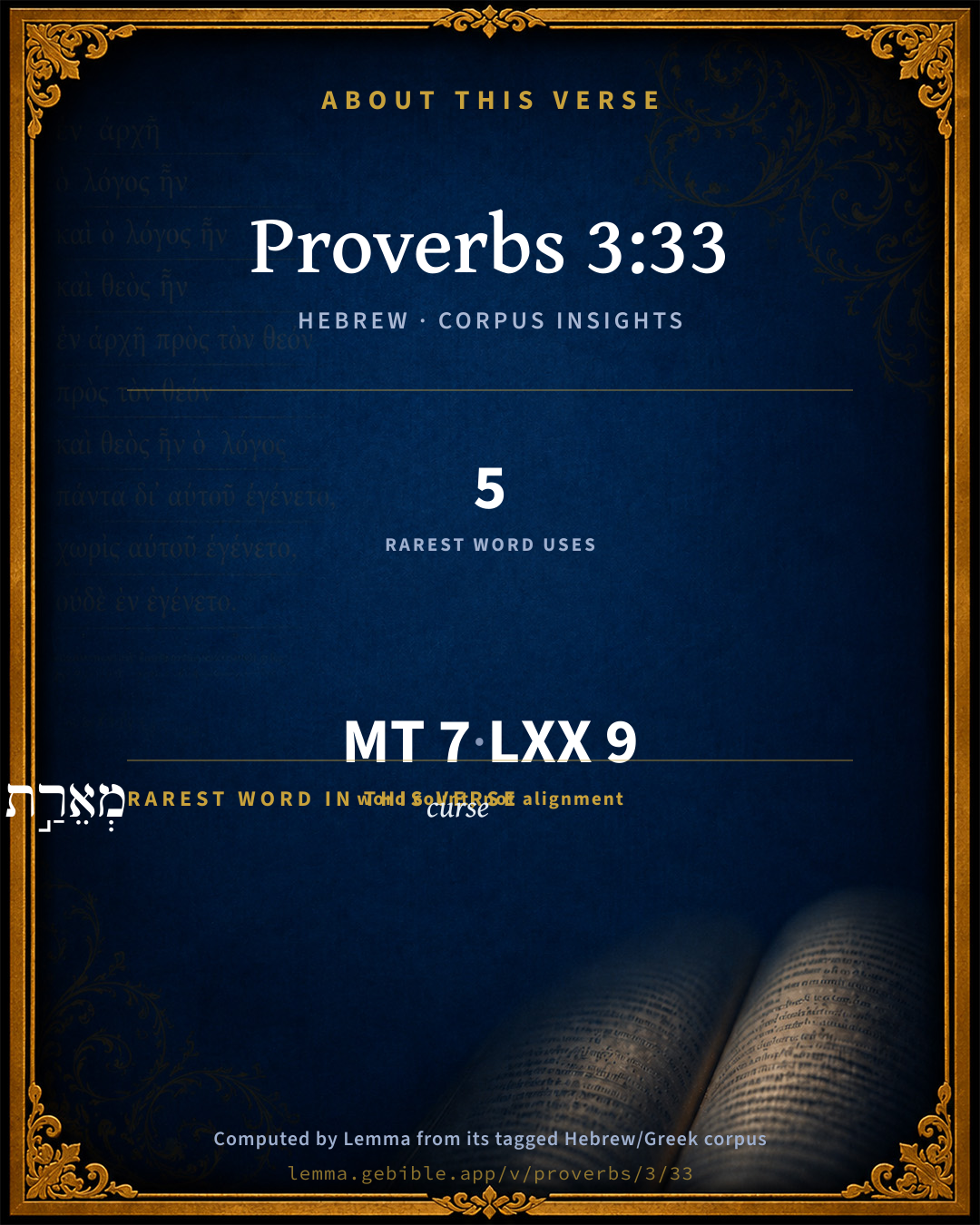
The rarest word here is מְאֵרַ֣ת curse H3994 — appearing just 5 times in the whole Hebrew Bible.

Shared distinctive vocabulary

מְאֵרַ֣ת curse H3994 occurs in 5 verses of the Hebrew Bible. Also found in:

Grammatical profile

  • 1 verb
  • 4 nouns
  • 2 adjectives

Verb forms

  • יְבָרֵֽךְ Piel · Imperfect

Hebrew & Septuagint length

In English translation the verse runs 17 words from the Hebrew and 19 from the Septuagint (LXX English) — closely comparable.

A rough comparison of the two English renderings, which tokenize alike — not a word-level alignment.

Word counts can differ between the Hebrew and the Greek without any difference in meaning — e.g. the Hebrew direct-object marker אֵת has no separate Greek word, and Greek often adds the article ὁ.

In the original languages it is 7 Hebrew tokens and 9 Greek tokens — but the two are counted differently (Hebrew bundles its prefixes and suffixes into one token; the Greek is in lemma form), so that isn’t a like-for-like length.

Cross-references

15

Topical passages linked to Proverbs 3:33 in the Treasury of Scripture Knowledge — connected by theme and wording, ordered by reader-vote popularity; previews shown in the World English Bible.

  • Psalms 37:22 For such as are blessed by him shall inherit the land. Those who are cursed by him shall be cut off.
  • Leviticus 26:14–46 "'But if you will not listen to me, and will not do all these commandments;
  • Job 8:6–7 If you were pure and upright, Surely now he would awaken for you, And make the habitation of your righteousness prosperous.
  • Psalms 91:10 No evil shall happen to you, Neither shall any plague come near your dwelling.
  • Malachi 2:2 If you will not listen, and if you will not lay it to heart, to give glory to my name," says Yahweh of Hosts, "then will I send the curse on you, and I will curse your blessings. Indeed, I have cursed them already, because you do not lay it to heart.
  • Deuteronomy 7:26 You shall not bring an abomination into your house, and become a devoted thing like it: you shall utterly detest it, and you shall utterly abhor it; for it is a devoted thing.
  • Proverbs 21:12 The Righteous One considers the house of the wicked, And brings the wicked to ruin.
  • Deuteronomy 28:2–68 and all these blessings shall come on you, and overtake you, if you shall listen to the voice of Yahweh your God.
  • Deuteronomy 29:19–29 and it happen, when he hears the words of this curse, that he bless himself in his heart, saying, I shall have peace, though I walk in the stubbornness of my heart, to destroy the moist with the dry.
  • 2 Samuel 6:11 The ark of Yahweh remained in the house of Obed-edom the Gittite three months: and Yahweh blessed Obed-edom, and all his house.
  • Psalms 1:3 He will be like a tree planted by the streams of water, That brings forth its fruit in its season, Whose leaf also does not wither. Whatever he does shall prosper.
  • Zechariah 5:3–4 Then he said to me, "This is the curse that goes out over the surface of the whole land; for everyone who steals shall be cut off according to it on the one side; and everyone who swears falsely shall be cut off according to it on the other side.
  • Deuteronomy 11:28 and the curse, if you shall not listen to the commandments of Yahweh your God, but turn aside out of the way which I command you this day, to go after other gods, which you have not known.
  • Joshua 7:13 Up, sanctify the people, and say, Sanctify yourselves against tomorrow: for thus says Yahweh, the God of Israel, There is a devoted thing in the midst of you, Israel; you can not stand before your enemies, until you take away the devoted thing from among you.
  • Joshua 6:18 But as for you, only keep yourselves from the devoted thing, lest when you have devoted it, you take of the devoted thing; so would you make the camp of Israel accursed, and trouble it.

Cross-references courtesy of OpenBible.info (CC BY 4.0).

Hebrew and Greek witnesses Masoretic Hebrew ↔ Greek Septuagint

The same verse in the two great witnesses to the Old Testament, shown verse-for-verse.

These are two independent witnesses, not word-aligned to each other, and the Septuagint is shown in lemma (dictionary) form.

Hebrew Proverbs 3:33 Masoretic · Westminster Leningrad Codex

מְאֵרַ֣ת יְ֭הוָה בְּבֵ֣ית רָשָׁ֑ע וּנְוֵ֖ה צַדִּיקִ֣ים יְבָרֵֽךְ

Yahweh's curse is in the house of the wicked, But he blesses the habitation of the righteous.

World English Bible · Public Domain

Greek LXX Proverbs 3:33 Septuagint · lemma form

κατάρα θεός ἐν οἶκος ἀσεβής ἔπαυλις δέ δίκαιος εὐλογέω

The curse of God is in the houses of the ungodly; but the habitations of the just are blessed.

LXX2012 (modern English Septuagint) · Public Domain

On this verse, Joseph Benson's Commentary discusses the Septuagint’s reading. Read the note in Commentary ↓

Hebrew: Westminster Leningrad Codex (CC BY 4.0). Greek: Septuagint (public domain); English from LXX2012 (modern English Septuagint) (Public Domain). How the Septuagint differs from the Hebrew →

Commentary

Notes on Proverbs 3:33 from classic Christian and Jewish commentators (each source and its license shown beneath its notes). The classic Christian expositions comment on the surrounding passage and are grouped to its opening verse, so a note may address several verses; the Jewish commentaries on the Tanakh (Rashi and others) are per-verse, so they appear only where the commentator wrote on this verse.

Lemma curates 59 commentaries, every one of them public domain or Creative Commons licensed, each selected and text-cleaned for this edition rather than reprinted as found. About our sources →

Trapp's Complete Commentary

John Trapp

Pro 3:33 The curse of the LORD [is] in the house of the wicked: but he blesseth the habitation of the just.

Ver. 33. In the house of the wicked.] His wife, children, family, possessions, all are accursed; his fine clothes have the plague in them: or his house, which is his castle, the flying roll of curses - that is, ten yards long and five yards broad - shall remain in the midst of it, and consume it. {Zec 5:4}

But he blesseth the habitation of the just.] "Kabvenaki," casam exponit et tuguriolum egregio sensu, saith Mercer. The poor little cottage or tenement of the righteous, there is a blessing in it, there is contented godliness, which is greatest gain; the blessing of God which maketh rich. Eνθα και οι θεοι, Here are the gods - could the philosopher say of his poor habitation, meaning his heathenish household gods - whatever else is wanting to me. How much more may a saint say so of his God, who will "awake for him, and make the habitation of his righteousness prosperous!" {Job 8:6}

John Trapp, A Commentary or Exposition upon All the Books of the Old and New Testament (1647–1656) — public domain. Text from a community e-Sword module.

The Biblical Illustrator

Joseph S. Exell

Pro_3:33

The curse of the Lord is in the house of the wicked.

In what sense, and in what cases, a curse may still extend to Christians

I. Christians are most certainly exposed to the Divine curse, if guilty of the sins to which it appertains. There is no curse remaining for the believing and the penitent. But still there is a curse retained on record, and it must be as surely kept for some beneath the gospel as it ever was aforetime. There are some who are cold and selfish, who have no root of Christian tenderness, nor any spirit of believing love; who take no pity on the poor, the stranger, or the naked. If neglect brings curse, how much more must positive wrong. Our Saviour speaks of the condemned in general terms as the workers of iniquity. There is, then, a possibility of curse yet remaining beneath the covenant of grace.

II. Make detailed examination of one or two of the more secret of the sins that too many Christians are guilty of.

1. Cursed is he that removeth his neighbours landmark. The Christian translation of this is, Let no man go beyond and defraud his brother in any matter.

2. Cursed is he that maketh the blind to go out of his way. In a moral and spiritual sense this reads, Cursed is he who imposeth upon the simple, the credulous, the unwary, the ignorant, or the helpless, and either wilfully deceives, misleads, corrupts, or plunders any of these, for selfish or unworthy purpose of his own. (John Miller, M.A.)

The curse and the blessing

I. The different characters here mentioned. All men are sinful, but all men are not wicked, in the sense of being immoral. The just are the sincere and renewed of mankind.

II. The different portion assigned to each. On the house of the wicked a curse, on the habitation of the just a blessing. The curse of the law, of a troubled conscience, of a neglected gospel, of a judgment to come. The blessing comes by God making all things work together for good. The blessing of God is upon the table of the just, upon their sorrows, upon their toils, upon their families--in a word, upon their souls. They are blessed with peace and light and liberty--with all spiritual blessings in Christ Jesus. (American National Preacher.)

Different characters and destinies

I. The difference of character. The doctrine of the corruption of human nature should always be viewed in connection with the redemption of the world by the sacrifice of the death of Christ. As this redemption extends to all mankind, all are consequently placed in a state of trial. And this leads to the difference of character mentioned in the text. Some receive and improve the grace that is offered to them; others refuse and oppose it. Hence all the inhabitants of the world are divided into two distinct classes of character. By the wicked we are to understand all that vast multitude who take this world for their portion. The house of the wicked means every family where the love and fear of God are not the ruling principles. The just means one who accepts and improves the grace offered him in the gospel; whose religion is seated in the heart and is displayed in the life. A just person is governed by a principle of love to God and of love to man. The habitation of the just means a family where religion is the principal thing. The members of such a family act uprightly, according to their different stations.

II. The different states of those to whom these characters severally belong.

1. The curse of the wicked. They are not, however, always in an afflicted state. The expression means that, whatever their outward circumstances, God does not look favourably upon them. When Gods blessing is withdrawn nothing but curse remains.

2. The blessing of the just. It lies in the continual favour, protection, and presence of God. Not necessarily in outward circumstances. All things work together for their good.

Observe--

1. That the characters and states of mankind have been always the same in every age of the world, and they will continue to be so till time shall cease.

2. That the difference of character necessarily leads to a difference of state. (J. S. Pratt, B. C. L.)

Gods curse and blessing

1. Gods curse is on wicked men in all their ways. Their poverty, losses, and crosses are not properly trials, but beginnings of sorrows.

2. Gods blessing is on godly men in all their doings. If they have but little, they have content with it. God will turn poverty into plenty if He sees it best so to do. (Francis Taylor, B.D.)

Moral contrasts in character and destiny

There are in human life great contrasts of character, and these are accompanied by corresponding contrasts in the lot and destiny of men. Three examples in Pro_3:33-35. All three, however, resolve themselves into the general distinction and opposition between right and wrong which run through the whole of life.

I. Let us seek to bring that radical contrast before our minds in a general view. What is right? What is wrong?

1. The words themselves give us some hint of what we mean and what we feel, for right is the same as direct, straight, and wrong is the same as wrung, twisted, turned, perverted from that which is straight and direct. There are actions and habits of mind which we feel to be in some sense straight, direct, right; others which we feel to be wrong--that is, which deviate from that which is straight. There are other words, referring to moral distinctions, which contain the same idea. A good man is constantly spoken of in the Scriptures as an upright man--a man upright in heart. A bad man is often spoken of as a perverse, a froward man; he is one who turns aside from the right way; his ways are crooked; and so on. But, so far, we have nothing more than an analogy before our minds. The word informs us that we have gathered our notion of something belonging to the mind and feelings from something that has been seen by the bodily senses in the world outside us; that is all. It tells us that our ideas of right and wrong resemble our ideas of a straight or a curved line. But we want to know not merely what right and wrong resemble, but, if possible, what they are in themselves.

2. Do you mean that what you call a right action is a useful action, and what you call a wrong action is a hurtful action? The opinion before us is, that the experience of mankind, gradually forming and accumulating through the ages of the past, has ascertained certain things to be helpful, and certain other things to be injurious, to its welfare, and that we have learned to name the one class of things right, and the other wrong.

(1) If this theory, which identifies the right with the socially useful, and the wrong with the socially injurious, be true, why should we need two sets of words to express the same idea? When a man has done a generous action, or spoken the truth in the face of a strong temptation to speak falsehood, why should we not say he has acted usefully, instead of saying he has acted rightly?

(2) Again, refer this question to your own feelings. When these words--useful, right--are pronounced in your hearing, and you take in their respective meanings, do they not awaken two entirely different feelings in your mind? You may, indeed, feel about a particular act that it is both right and useful at the same time; still, that is not one, but two feelings in regard to the action, which happen for the moment to meet and be blended in your mind. On the other hand, there are many actions in regard to which you have one of these feelings and not the other present to your mind. You say, It was a useful deed, it was very convenient; but it was not right after all. You have a sense of utility which is gratified by what has been done; you have another and a higher feeling about right and wrong, which is dissatisfied and displeased by what has been done.

(3) Again, if you take a general survey of mens actions, you will be led to the same conclusion. What do you say of the act in which one man rushes forward in a moment of sudden opportunity and takes the life of his fellow-man? What do you say of assassination, of murder? Is it right--can anything in the world ever make such an act other than wrong? Yet such an act has often turned out in the highest degree useful to society.

3. Is our feeling about right and wrong the same essentially as our feeling about beauty and ugliness? All that is right is beautiful; but there is much that is beautiful that is not right.

4. I take my stand, then--fearless of contradiction from any really awakened conscience--upon this position: your feeling for right is superior to every other single feeling of your nature. It is the noblest part of your feeling for God, and every other feeling--that for use and that for beauty, that for self and that for society--stands in a lower and subordinate relation to it: like servants in the presence of their master. Your conscience is your master, and woe to you if you seek to put any other passion into the lordly seat which conscience holds--if you would make that part of your nature the slave which something within you says you were Divinely made to obey.

II. Application of these principles to the text.

1. The wicked is spoken of, and the just is spoken of. These names, these characters, can never be interchanged. Who is the wicked man? He is one who is the slave of his lower feelings--his appetites, his passions, his lusts, his comforts and conveniences, and who is the constant rebel to the law of right, to God within his soul. Who is the just man? He is the man who obeys and follows, because he reveres the right, the God revealed in the soul; and who makes every other part and passion, every comfort and convenience, give way to and follow in the wake of the highest. The curse of the Lord is in the house of the former, and cannot but rest thereon, and there must remain until the falsehood of his heart and life be removed. The blessing of the Lord is on the habitation of the later--is necessarily there, as God is true and faithful in His ways. As the blade of grass catches on its summit the pearly globe of heavens dew, so the blessing of the Most High is caught by every upward-looking, obedient, praying heart.

2. Again, there is the scorner, and there is the lowly man. These names, these characters, cannot be confounded with one another. Who is the scorner? The man who has lifted his pride and egotism into the seat where conscience ought to be; who obeys that dark and irrational passion; who is swollen with self-idolatry instead of bending in the sense of his littleness before the God who made him. And the lowly--who is he? The man who feels and owns himself to be low and God to be high; himself to be little and God to be great; himself to be sinful and seamed with faults, and God to be the Holy Father of his spirit. The former is and will be an object of Heavens scorn; for who is so worthy of the deepest contempt as a human creature the slave of pride? and a scorned object he must remain until his proud heart be broken. But to the lowly grace, or favour, is given; for God is faithful, and grants to men their true needs. Heaven stoops to those who know that they cannot of themselves rise to heaven.

3. There is the wise man and there is the fool; and these names and characters can never really be confused. For who is the wise man? He who lives, and ever seeks to live, according to the best light given to him; who reveres the nature God has bestowed upon him; who prayerfully and humbly endeavours to be true to it. And who is the fool? Just the opposite of this. One who plays the fool with the glorious nature God has given; breaks down its holy landmarks by letting loose the swine and tigers of his evil passions into it; defiles the temple of his body by vice; does his best to put out the eyes of his conscience, and fling the dethroned ruler of his nature into prison and darkness. Glory, eternal glory and life, shall be the portion of the former; but shame the promotion (or exaltation) of the latter! What terrible irony, what scathing satire, in that word! Exalted to shame! Promoted to disgrace! Advanced in the ranks of ignominy and dishonour! (E. Johnson, M. A.)

The Biblical Illustrator, edited by Joseph S. Exell (c. 1880s–1900s) — public domain. Text from a community e-Sword module.

Joseph Benson's Commentary

Pro 3:33-35. The curse of the Lord is in the house, &c. — Not only upon his own person, but upon his posterity, and upon all his domestic concerns. But he blesseth the habitation — Hebrew, נוה, the cottage, or sheepcot, that is, the dwelling, however mean; of the just — The blessing of God is upon him, his house and family, and all his concerns. Surely he scorneth the scorners — He will expose to scorn and contempt all proud and insolent sinners, who make a mock at sin, (Pro 14:9,) and at God and religion, and who despise all counsels and means of amendment: for those that exalt themselves shall certainly be abased. But he giveth grace unto the lowly — Namely, favour, both with himself and with men, as this phrase is often used. The LXX. render this verse, The Lord resisteth the proud, but giveth grace to the lowly; and St. Peter and St. James have quoted it according to them, 1Pe 5:5; Jas 4:6. The wise shall inherit glory — Shall enjoy it, not only for a season, as wicked men often do, but as an inheritance, constantly and for ever; but shame shall be the promotion of fools — Instead of that glory which they greedily seek, they shall meet with nothing but ignominy. The reading in the margin, Shame exalteth the fools, or, as some render the clause, The elevation of fools shall turn to their confusion, seems more agreeable to the Hebrew: that is, the more they have been elevated, “the more their folly shall be known, and their fall become more fatal.”

Joseph Benson's Commentary on the Old and New Testaments (1811–1818) — public domain. Text from a community e-Sword module.

Whedon's Commentary on the Bible

Daniel D. Whedon

DECISIONS OF GOD, Pro_3:33-35.

33. Curse of… Lord, etc. — A continuation of the preceding thought, though couched in stronger terms, and carrying it out to its consequences. As Jehovah abominates the unjust, so will his “curse” rest on the wicked and his house; as he loves the righteous with the love of an intimate friend, he will bless him and his habitation, though it be but an humble resting place, as the word may imply. Zec_5:3-4.

Daniel D. Whedon (gen. ed.), Commentary on the Old and New Testaments (1874–1909) — public domain. Text from a community e-Sword module.

Jamieson, Fausset & Brown

Robert Jamieson, A. R. Fausset & David Brown

curse . . . wicked--It abides with them, and will be manifested.

Jamieson, Fausset & Brown — Commentary Critical and Explanatory on the Whole Bible (1871) — public domain (CC PDM 1.0). Text via the HelloAO Bible API.

Adam Clarke's Commentary

Verse 33. The curse of the Lord] No godly people meet in such a house; nor is God ever an inmate there.

But he blesseth the habitation of the just.] He considers it as his own temple. There he is worshipped in spirit and in truth; and hence God makes it his dwelling-place.

Adam Clarke's Commentary on the Bible (1810–1826) — public domain. Text from a community e-Sword/MySword module.

Ellicott's Commentary for English Readers

(33) He blesseth the habitation of the just.—The word rendered “habitation” often signifies “pasture,” “sheepfold,” and this is a relic of the time when the Israelites led a nomad life and had no fixed habitations; so the cry, “To your tents, O Israel!” (1Ki_12:16) was still in use long after the settlement in Canaan. By some there is thought to be a distinction intended between the well-built “house” of the wicked and the slightly constructed cottage of the humble just man, no better than a shepherd’s hut.

A Bible Commentary for English Readers, edited by Charles John Ellicott (1878–1897) — public domain. Text from a community e-Sword module.

John Gill's Exposition

The curse of the Lord is in the house of the wicked,.... The wicked man, being a transgressor of the law, is under the curse of it; and all that he has, his house, his substance, his very blessings are curses; see Mal 2:2; he is accursed amidst his greatest affluence, and sometimes from a plentiful estate is reduced to penury and want: and Aben Ezra interprets it, "the curse of want"; and the Vulgate Latin version is, "want from the Lord is", &c.

but he blesseth the habitation of the just; the righteous man, as before described; he is blessed himself, having the righteousness of Christ imputed to him, and his sins forgiven him for his sake; and what he has of worldly substance, though it be ever so little, he has it with a blessing; and therefore it is better than the riches of many wicked men; his house, though it is but a courage, as the word (k) here signifies, is blessed with the presence of God in it; his family, his children, and servants, are blessed, having his instructions and example, and especially when made effectual by the grace of God; as the house of Obededom was blessed for the sake of the ark, so is a just man's house, being a "bethel", an house of God, blessed on account of his worship in it; see Sa2 6:11.

(k) "tugurio", Montanus; "tugurium, vel casam pastoritiam", Gejerus.

John Gill's Exposition of the Whole Bible (1746–1763) — public domain (CC PDM 1.0). Text via the HelloAO Bible API.

Haydock's Catholic Bible Commentary

Want. Hebrew, "a curse." --- Shall be. Hebrew, "he blesseth." (Haydock)

George Leo Haydock (1774–1849), Haydock's Catholic Family Bible and Commentary, 1859 edition — public domain. Excludes Psalms (Douay-Rheims chapter numbering differs from Protestant) and Deuterocanonical books (Catholic canon only).

Matthew Poole's English Annotations

In the house of the wicked; not only upon his own person, but also upon his posterity, and upon all his domestical concerns.

Matthew Poole's English Annotations on the Holy Bible (1683–1685) — public domain. Text from a community e-Sword/MySword module.

The Pulpit Commentary

The curse of the Lord is in the house of the wicked. From ver. 33 to the end of the discourse the contrast is continued between the condition of the wicked and the just, the scornful and the lowly, the wise and the fools. In the verse before us a further reason is given why the prosperity of the wicked is not enviable. The curse of Jehovah dwells in and rests upon his house. The curse; m"erah, from arav, "to curse." This word only occurs five times in the Old Testament once in Deuteronomy, twice in Proverbs, (here and in Pro_28:27) and twice in Malachi. The nature of the curse may be learned from Deu_28:20, where it is the infliction of temporal misfortunes ending with the "cutting off" of the wicked. (see Psa_37:22) It is a hovering evil, the source of constant misfortune. LXX, katara . Cf. "the cursing" (alah) against thieves and swearers in Zec_5:4. But he blesseth the habitation the just. The contrast to the former, as in Deu_28:2-6. He blesseth; i.e. both temporarily and spiritually. Blessing does not exclude affliction, but "trials" are not "curses" (Wardlaw). Both the LXX and the Vulgate render, "But the habitations of the just shall be blessed," the LXX having read the pual future (y"vorak), "they shall be blessed," for the piel future (y"varik), "he shall bless," of the text. The habitation ; naveh, from navah, "to sit down," "to dwell." A poetic and nomad (Fleischer) word usually understood of a small dwelling is tugurium, the shepherd"s hut or cottage, "the sheepcote" of 2Sa_7:8. The LXX epauliv , and tho Vulgate hubitaculam, favour the suggestion of Gejerus, that a contrast is here made between the large house or palace (bayith) of the wicked and the small dwelling of the just. In Pro_21:20 and Pro_24:15 the word is rendered "dwelling.

Vers. 33-35. The height of well-being and the depth of ill-being.

The issues of righteousness and unrighteousness are here very broadly stated. These verses indicate to us the long and large results of wisdom on the one hand and of folly on the other.

I THOSE WHOM GOD FAVOURS AND THAT WHICH HE APPORTIONS THEM. There are three epithets by which they are here characterized; they are called "the just," "the lowly," and "the wise." In those whom God loves and means to bless there are found

(1) the spirit of humility, they are conscious of their own demerit and unworthiness;

(2) the spirit of wisdom, they are in the attitude of inquiry towards God, desirous of knowing his truth and doing his will; and

(3) the spirit of conscientiousness, they are the "just," wishful to do that which is right toward their fellows, to act honestly, fairly, considerately, in the various relations they sustain. These God loves, and on them he will bestow his Divine benediction.

1. He will give them "grace his own royal favour and that which draws down upon them the genial and gracious regard of men.

2. He will bless them in their home life. He "blesseth the habitation of the just." He will give them purity, love, honour, affection, peace, joy in their most intimate relations; so that their homes shall be blessed. He will be known as the "God of the families of Israel.

3. And He will give them exaltation in the end. "The wise shall inherit glory." "Unto the upright there will arise light in the darkness." Present gloom shall give place to glory, either now on this side the grave, or hereafter in "that world of light.

II THOSE WITH WHOM GOD IS DISPLEASED AND HIS AWFUL MALEDICTIONS ON THEM. These are also thrice characterized here; they are "the wicked," "the scorners," "fools." These are they who

(1) in their folly reject the counsel of God; who

(2) in their guilt yield themselves up to sin in its various forms; who

(3) in their arrogance scoff at all sacred things the "scorners;" this is the last and worst development of sin, the treatment of things holy and Divine with flippant irreverence. These God regards with Divine disapproval; them he strongly condemns and visits with fearful penalty.

1. His wrath is on themselves. He "scorneth the scorners." "He that sitteth in the heavens laughs" at them, he "has them in derision". (Psa_2:4) His feeling toward them and his power over them are such that they have reason to apprehend overthrow and ruin at any hour. (see Psa_73:19, Psa_73:20)

2. His curse is on their house (ver. 33). They may expect that in their domestic relations they will have, as in fact they do have, saddest occasions of sorrow and remorse.

3. His hand is against their hope. They may be anticipating great things for themselves in the future, their castles are high and strong in the air, their hope is great; but "lo! sudden destruction," the wind of heaven blows, and all is brought into desolation. God touches their fine structure with his finger, and it is in ruins. "Shame is the promotion of fouls. C.

The Pulpit Commentary (1880–1919), ed. H.D.M. Spence-Jones & Joseph S. Exell — public domain. Text from a community e-Sword module.

John Wesley's Explanatory Notes

The house - Not only upon his own person, but also upon his posterity.

John Wesley, Explanatory Notes Upon the Whole Bible (1754–1765) — public domain. Text via the GEBible commentary corpus.

Keil & Delitzsch

C. F. Keil & F. Delitzsch

The prosperity of the godless, far from being worthy of envy, has as its reverse side the curse:

The curse of Jahve is in the house of the godless,

And the dwelling of the just He blesseth.

מארה (a curse), like מסלּה (a highway, from סלל), is formed from ארר (cf. Arab. harr, detestari, abhorrere, a word-imitation of an interjection used in disagreeable experiences). The curse is not merely a deprivation of external goods which render life happy, and the blessing is not merely the fulness of external possessions; the central-point of the curse lies in continuous disquiet of conscience, and that of the blessing in the happy consciousness that God is with us, in soul-rest and peace which is certain of the grace and goodness of God. The poetic נוה (from נוה = Arab. nwy, tetendit aliquo) signifies the place of settlement, and may be a word borrowed from a nomad life, since it denotes specially the pasture-ground; cf. Pro 24:15 (Fleischer). While the curse of God rests in the house of the wicked (vid., Khler on Zac 5:4), He blesses, on the contrary, the dwelling-place of the righteous. The lxx and Jerome read יברך, but יברך is more agreeable, since God continues to be the subject.

Keil & Delitzsch — Biblical Commentary on the Old Testament (1861–1891) — public domain (CC PDM 1.0). Text via the HelloAO Bible API. (Old Testament only.)

Bridges on Proverbs

Charles Bridges

The contrast between the sinner and the saint, affects us not only personally, but relatively. The curse or blessing of the LORD follows us to our homes. Shall we then envy the wicked, with his cup of earthly joy filled to the brim? The curse of the LORD is in his house (Mal 2:2 ) — a "curse that never cometh causeless." (Pro 26:2 ) Let him think — ’It is my Maker’s curse — how awful, that my being and my curse should come from the same sacred source!’ It is not the impotent wishing of ill. Could we trace its deadly work, we should see the man wasting, withering, consuming under it. Observe "the roll in the house of the thief, and of the swearer — twenty cubits long" — a long catalogue of woes; "flying" — to mark its swiftness; "remaining in the midst of the house; consuming it even with the timbers and stones thereof." (Zec 5:1-4 .) Is this an idle dream? Surely — but for the blindness of the heart, the wicked would see the naked sword hanging by a hair over his head, or the awful "hand-writing upon the wall," solemnly proclaiming — "There is no peace — saith my God — unto the wicked." (Dan 5:5-6 . Isa 57:21 .) Vainly will the proud worm resist. Ahab multiplied his house beyond all human average, as if to set at defiance the curse pronounced against it. Yet at one stroke all were swept away. (1Ki 21:20-22 . 2Ki 10:1-11 .) Similar instances†1 abundantly prove whose words shall stand — man’s or God’s. (Jer 44:28 .) "Who hath hardened himself against him, and prospered? Who hath resisted his will?" (Job 9:4 . Rom 9:19 .)

But bright is the sunshine of the just. Not only is the secret of the LORD with their souls, but his blessing on their habitation. And when he blesseth, who can reverse it? (Num 23:20 . Job 34:29 .) Many a homely cottage, tenanted by a child of Abraham, shines more splendidly than the princely palace of the ungodly.†2 An heir of glory dwells here. A family altar of prayer and praise consecrates it as the temple of Jehovah. (Gen 12:8 .) Promises, like clouds of blessings, rest over it. God has been honoured, and God will honour. (2Sa 6:11 . Jer 35:18-19 . 2Ti 1:18 .) "They that dwell under his shadow shall return." (Hos 14:7 .) Is then my house under the curse or blessing of the LORD? Let my God be honoured in his own gifts: that I and mine may be manifestly sealed with the full tokens of his love.

Footnotes

†1 Jeroboam: 1Ki 14:9-11 ; Amo 7:9 . Baasha: 1Ki 16:1-4, 1Ki 16:12-13 . Jehu: 2Ki 15:8-12 . Hos 1:4 . Hazael: Amo 1:4 . Jehoiakim: Jer 22:13-19 . Coniah: Jeremiah 24-30. Esau: Oba 1:18 . Compare Pro 14:11 ; Pro 15:25 .

†2 Job 29:4. Isa 4:5 . EnJa kai oi Qeoi. (). ’The God’s are within’ — said the Heathen philosopher of his poor cottage. F. Taylor in loco.

Charles Bridges, An Exposition of the Book of Proverbs (1846) — public domain. Text from a community e-Sword module.

unfoldingWord translationNotes

Door43 World Missions Community

The curse of Yahweh is on the house of the wicked person

The writer speaks of Yahweh's curse as if it were an object that he placed on top of the wicked person's house. The word "house" is a metonym for family. AT: "Yahweh has cursed the family of the wicked person" (See: Metaphor and Metonymy)

he blesses the home of righteous people

The word "home" represents the family. AT: "he blesses the families of righteous people" (See: Metonymy)

he gives his favor to humble people

The writer speaks of Yahweh's favor as if it were an object that he gives to people. AT: "he shows his favor to humble people" or "he is gracious to humble people" (See: Metaphor)

translationWords

curse

Yahweh

house

evil

bless

righteous

mock

favor

humble

unfoldingWord translationNotes — © Distant Shores Media and the Door43 World Missions Community, licensed CC BY-SA 4.0. Source: git.door43.org/Door43/en_tn.

Lesson kit

Teaching starters — assembled from the data on this page, not authored interpretation. Every prompt links to the verse data it draws on. Edit before teaching.

Proverbs, in the Wisdom, opens this verse with 7 words (7 distinct Hebrew lemmas). Its most distinctive word is mᵉʼêrâh (“curse”). A historical commentator’s framing appears above. Read the whole chapter for the surrounding context.

Discussion questions

  1. The word mᵉʼêrâh carries the sense “curse.” How does it shape the verse?
  2. Deuteronomy 28:20 shares the word «curse» with this verse. How do the two illuminate each other?
  3. The translations on this page render this verse differently — a whole-verse word diff, not a word-by-word alignment. What might account for the different wordings?
  4. The verb «יְבָרֵֽךְ» is Piel Imperfect. How does its form color the action?
  5. Reading how Trapp's Complete Commentary and The Biblical Illustrator read this verse, where do the two commentators agree and where do they part?

Things to notice

Reading settings

Reading text

Shown beneath each verse's original-language words.

Old Testament
Old Testament edition

Read the OT as the Masoretic Hebrew (MT) or the Greek Septuagint (LXX).

English shown for the Greek Septuagint (in the Hebrew ↔ Greek comparison).

Comparing translations? Open the Compare panel on any verse page to stack up to four side by side.