Psalms 140:4

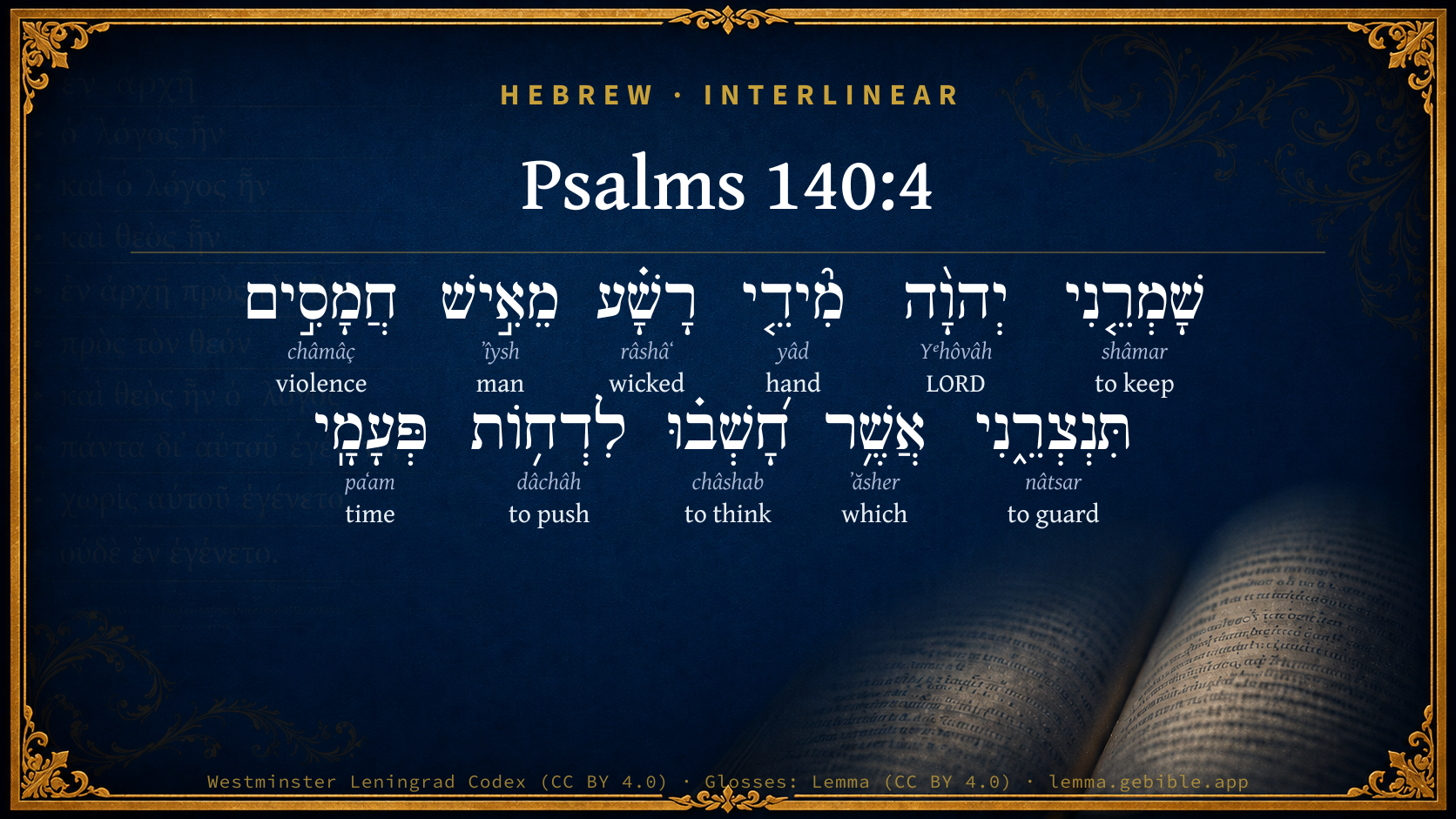
Hebrew (Westminster Leningrad Codex) Psalms 140:4 appears in the Hebrew Old Testament. The text above is from the Westminster Leningrad Codex. Each word links to its Strong’s number, a concise gloss, and parsing drawn from the Open Scriptures Hebrew Bible morphology. Click any word for its full Brown-Driver-Briggs (BDB) entry.
Download image
Cite this verse

Psalms 140:4 (World English Bible). Public Domain. Lemma interlinear Bible study tool, https://lemma.gebible.app/v/psalms/140/4.

Show BibTeX & RIS
BibTeX
RIS
English Translation
Yahweh, keep me from the hands of the wicked. Preserve me from the violent men who have determined to trip my feet.
World English Bible · Public Domain
Download a study sheet

One document with this verse’s original text, its word-by-word gloss line, the meaning frame, cross-references with their text, attributed commentary, and full source and license credits — printable, and it pastes into notes with its structure intact.

This verse Autodidact and up

Study sheet (.html) Plain text (.txt)

A passage Seminary Student

Up to 50 verses in one chapter. A passage sheet keeps up to 6 commentary sources and 12 cross-references per verse, in the order this page ranks them, and says so on the sheet whenever that leaves anything out. Ask for a single verse and you get the Autodidact verse sheet above.

Everything on this page stays free to read, with no account — the sheet is a download of what is already on screen, not access to it.

Want to remove ads? Support Godless Engineer
Compare translations 3

The same verse in 3 English versions, stacked beneath the original-language interlinear above. Click any original word for its lexicon entry.

Each is an independent rendering of the whole verse — the interlinear is not word-aligned to these translations.

Highlighted words mark where these versions differ — a whole-verse word diff, not a word-by-word alignment.

  • World English Bible Public Domain
    Yahweh, keep me from the hands of the wicked. Preserve me from the violent men who have determined to trip my feet.
  • King James Version Public Domain
    Keep me, O LORD, from the hands of the wicked; preserve me from the violent man; who have purposed to overthrow my goings.
  • unfoldingWord Literal Text CC BY-SA 4.0
    Guard me, Yahweh, from the hands of the wicked; from the man of violence preserve me, who have planned to push down my steps.

unfoldingWord Literal Text — © unfoldingWord, licensed CC BY-SA 4.0. Word-aligned USFM3 via Door43 (git.door43.org/unfoldingWord/en_ult).

Versions to compare (up to 4)

3 of 4 selected

Show all 18 translations

Every available English version of this verse, each an independent rendering of the whole verse.

  • World English Bible Public Domain
    Yahweh, keep me from the hands of the wicked. Preserve me from the violent men who have determined to trip my feet.
  • Berean Standard Bible Public Domain
    Guard me, O LORD, from the hands of the wicked. Keep me safe from men of violence who scheme to make me stumble.
  • Majority Standard Bible Public Domain
    Guard me, O LORD, from the hands of the wicked. Keep me safe from men of violence who scheme to make me stumble.
  • King James Version Public Domain
    Keep me, O LORD, from the hands of the wicked; preserve me from the violent man; who have purposed to overthrow my goings.
  • American Standard Version (1901) Public Domain
    Keep me, O Jehovah, from the hands of the wicked; Preserve me from the violent man: Who have purposed to thrust aside my steps.
  • Revised Version (1885) Public Domain
    Keep me, O LORD, from the hands of the wicked; preserve me from the violent man: Who have purposed to thrust aside my steps.
  • Geneva Bible (1599) Public Domain
    Keepe mee, O Lord, from the handes of the wicked: preserue mee from the cruell man, which purposeth to cause my steppes to slide.
  • Douay-Rheims (1899) Public Domain
    And thou hast foreseen all my ways: for there is no speech in my tongue.
  • Young's Literal Translation Public Domain
    Preserve me, Jehovah, from the hands of the wicked, From one of violence Thou keepest me, Who have devised to overthrow my steps.
  • Literal Standard Version CC BY-SA 4.0
    Preserve me, YHWH, from the hands of the wicked, || Keep me from one of violence, || Who have devised to overthrow my steps.
  • Unlocked Literal Bible CC BY-SA 4.0
    Keep me from the hands of the wicked, Yahweh; preserve me from violent men who plan to knock me over.
  • unfoldingWord Literal Text CC BY-SA 4.0
    Guard me, Yahweh, from the hands of the wicked; from the man of violence preserve me, who have planned to push down my steps.
  • Darby Bible Public Domain
    Keep me, O Jehovah, from the hands of the wicked [man], preserve me from the violent man, who devise to overthrow my steps.
  • World Messianic Bible Public Domain
    LORD, keep me from the hands of the wicked. Preserve me from the violent men who have determined to trip my feet.
  • Webster's Bible Public Domain
    \\140:3\\They have sharpened their tongues like a serpent; adder's poison is under their lips. Selah.
  • Free Bible Version CC BY-SA 4.0
    Lord, please keep me from falling into the hands of the wicked; protect me especially from those who are violent, who are plotting my downfall.
  • Bible in Basic English Public Domain
    O Lord, take me out of the hands of sinners; keep me safe from the violent man: for they are designing my downfall.
  • JPS Tanakh (1917) Public Domain
    (140-5) Keep me, O LORD, from the hands of the wicked; preserve me from the violent man; who have purposed to make my steps slip.

Literal Standard Version (2020), Covenant Press — licensed CC BY-SA 4.0. Text via the HelloAO Bible API (eBible.org). Unlocked Literal Bible (unfoldingWord) — licensed CC BY-SA 4.0. Text via the HelloAO Bible API (eBible.org). unfoldingWord Literal Text — © unfoldingWord, licensed CC BY-SA 4.0. Word-aligned USFM3 via Door43 (git.door43.org/unfoldingWord/en_ult). Free Bible Version, Dr. Jonathan Gallagher — licensed CC BY-SA 4.0. Text via the HelloAO Bible API (eBible.org).

Word by word

More ways to search: Search by grammar → Find every occurrence → Compare this word →

Practice this passage: Drill this verse → Learn its vocabulary →

לִדְח֥וֹת
dâchâh
H1760
“to push”
Preposition + Verb, Qal, Infinitive Construct
Part of Speech
Preposition + Verb
Stem
Qal
Form
Infinitive Construct
Full BDB Definition

Origin: a primitive root

TWOT: 420

to push, thrust, chase, overflow, totter, sore, drive away or out, be outcast, be cast down - (Qal) to push, push violently - (Niphal) to be thrust down, be cast down - (Pual) to be thrust down
  1. שָׁמְרֵ֤נִי shâmar H8104 “keep · me” Verb, Qal, Imperative, 2nd Person, Masculine, Singular + Suffix, Personal, 1st Person, Common, Singular
  2. יְהוָ֨ה Yᵉhôvâh H3068 “LORD” Noun, Proper
  3. מִ֘ידֵ֤י yâd H3027 “from · hands of” Preposition + Noun, Common, Both, Dual, Construct
  4. רָשָׁ֗ע râshâʻ H7563 “wicked” Adjective, Adjective, Masculine, Singular, Absolute
  5. מֵאִ֣ישׁ ʼîysh H376 “from · man of” Preposition + Noun, Common, Masculine, Singular, Construct
  6. חֲמָסִ֣ים châmâç H2555 “violence” Noun, Common, Masculine, Plural, Absolute
  7. תִּנְצְרֵ֑נִי nâtsar H5341 “to guard · me” Verb, Qal, Imperfect, 2nd Person, Masculine, Singular + Suffix, Personal, 1st Person, Common, Singular
  8. אֲשֶׁ֥ר ʼăsher H834 “which” Particle, Relative
  9. חָ֝שְׁב֗וּ châshab H2803 “to think” Verb, Qal, Perfect, 3rd Person, Common, Plural
  10. פְּעָמָֽי paʻam H6471 “times · my” Noun, Common, Feminine, Plural, Construct + Suffix, Personal, 1st Person, Common, Singular

About this verse

These counts appear in no published source. They are computed here, from the morphology-tagged text and Lemma’s own curated glosses. What Lemma adds →

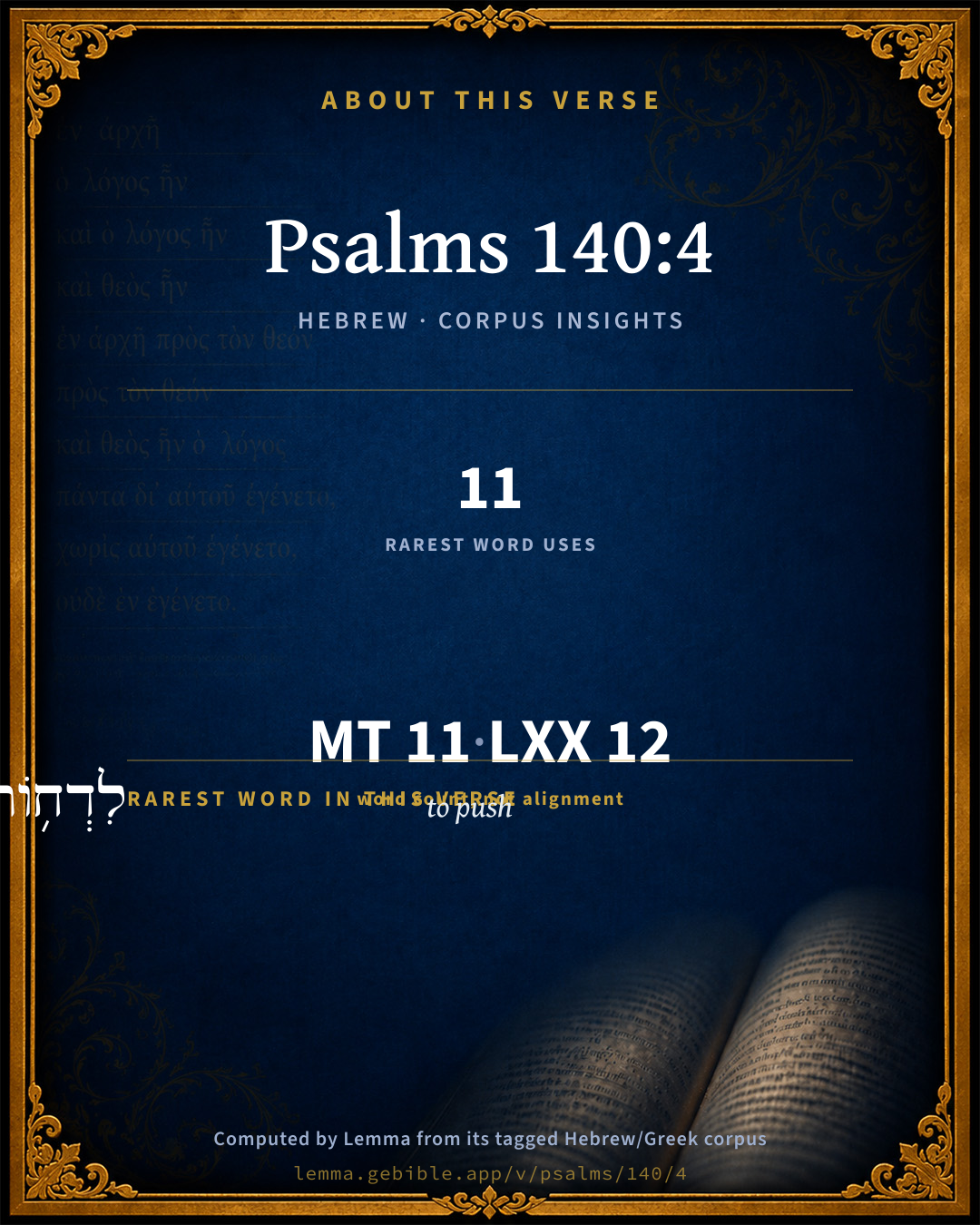
11
words
11
distinct lemmas
Wisdom
section

Notable vocabulary

The rarest word here is לִדְח֥וֹת to push H1760 — appearing just 11 times in the whole Hebrew Bible.

Shared distinctive vocabulary

לִדְח֥וֹת to push H1760 occurs in 10 verses of the Hebrew Bible. Also found in:

Grammatical profile

  • 4 verbs
  • 5 nouns
  • 1 adjective
  • 1 particle

Verb forms

  • שָׁמְרֵ֤נִי Qal · Imperative
  • תִּנְצְרֵ֑נִי Qal · Imperfect
  • חָ֝שְׁב֗וּ Qal · Perfect
  • לִדְח֥וֹת Qal · Infinitive Construct

Hebrew & Septuagint length

In English translation the verse runs 22 words from the Hebrew and 22 from the Septuagint (LXX English) — the same length.

A rough comparison of the two English renderings, which tokenize alike — not a word-level alignment.

Word counts can differ between the Hebrew and the Greek without any difference in meaning — e.g. the Hebrew direct-object marker אֵת has no separate Greek word, and Greek often adds the article ὁ.

In the original languages it is 11 Hebrew tokens and 12 Greek tokens — but the two are counted differently (Hebrew bundles its prefixes and suffixes into one token; the Greek is in lemma form), so that isn’t a like-for-like length.

Cross-references

7

Topical passages linked to Psalms 140:4 in the Treasury of Scripture Knowledge — connected by theme and wording, ordered by reader-vote popularity; previews shown in the World English Bible.

  • Psalms 36:11 Don't let the foot of pride come against me. Don't let the hand of the wicked drive me away.
  • Psalms 17:5 My steps have held fast to your paths, My feet have not slipped.
  • Psalms 71:4 Rescue me, my God, from the hand of the wicked, From the hand of the unrighteous and cruel man.
  • Psalms 17:8–9 Keep me as the apple of your eye; Hide me under the shadow of your wings,
  • Psalms 37:32–40 The wicked watches the righteous, And seeks to kill him.
  • Psalms 55:1–3 Listen to my prayer, God. Don't hide yourself from my supplication.
  • Proverbs 18:5 To be partial to the faces of the wicked is not good, Nor to deprive the innocent of justice.

Cross-references courtesy of OpenBible.info (CC BY 4.0).

Hebrew and Greek witnesses Masoretic Hebrew ↔ Greek Septuagint

The same verse in the two great witnesses to the Old Testament, shown verse-for-verse.

You’re reading Greek Psalm 139 (Hebrew Psalm 140). The Septuagint counts the superscription, so verse numbers can differ from the Hebrew — chapter-level alignment, not verse-by-verse. Numbering follows Rahlfs.

These are two independent witnesses, not word-aligned to each other, and the Septuagint is shown in lemma (dictionary) form.

Hebrew Psalms 140:4 Masoretic · Westminster Leningrad Codex

שָׁמְרֵ֤נִי יְהוָ֨ה מִ֘ידֵ֤י רָשָׁ֗ע מֵאִ֣ישׁ חֲמָסִ֣ים תִּנְצְרֵ֑נִי אֲשֶׁ֥ר חָ֝שְׁב֗וּ לִדְח֥וֹת פְּעָמָֽי

Yahweh, keep me from the hands of the wicked. Preserve me from the violent men who have determined to trip my feet.

World English Bible · Public Domain

Greek LXX Greek Psalm 139:4 Septuagint · lemma form

ἀκονάω γλῶσσα αὐτός ὡσεὶ ὄφις ἰός ἀσπίς ὑπό ὁ χεῖλος αὐτός διάψαλμα

Keep me, O Lord, from the hand of the sinner; rescue me from unjust men; who have purposed to overthrow my goings.

LXX2012 (modern English Septuagint) · Public Domain

Hebrew: Westminster Leningrad Codex (CC BY 4.0). Greek: Septuagint (public domain); English from LXX2012 (modern English Septuagint) (Public Domain). How the Septuagint differs from the Hebrew →

Commentary

Notes on Psalms 140:4 from classic Christian and Jewish commentators (each source and its license shown beneath its notes). The classic Christian expositions comment on the surrounding passage and are grouped to its opening verse, so a note may address several verses; the Jewish commentaries on the Tanakh (Rashi and others) are per-verse, so they appear only where the commentator wrote on this verse.

Lemma curates 59 commentaries, every one of them public domain or Creative Commons licensed, each selected and text-cleaned for this edition rather than reprinted as found. About our sources →

Trapp's Complete Commentary

John Trapp

Psa 140:4 Keep me, O LORD, from the hands of the wicked; preserve me from the violent man; who have purposed to overthrow my goings.

Ver. 4. Keep me] Who am thus sought and set for; but thou canst rescue me.

To overthrow my goings] Praecipitare, to hurl me down headlong.

John Trapp, A Commentary or Exposition upon All the Books of the Old and New Testament (1647–1656) — public domain. Text from a community e-Sword module.

Joseph Benson's Commentary

Psa 140:4-5. Keep me from the hands of the wicked — Hebrew, רשׁע, the wicked man. Let him not prevail to take away my life, my reputation, my interest, or my comfort, or to prevent my coming to the throne. Preserve me from the violent man — Hebrew, מאישׁ חמסים, (as also in Psa 140:1,) from the man of violences, injuries, or rapines; who hath purposed — Whose design and full resolution it is, if thou do not prevent it; to overthrow my goings — My feet, or footsteps; that is, to throw me down to the ground, to defeat all my hopes and counsels, and bring me to ruin. The proud — My insolent enemies, who despise me for my meanness, and exalt themselves against thee; have hid — Have secretly laid; a snare for me — That their designs, being undiscovered, might be the more likely to take effect, and I might fall into their hands ere I was aware. They have spread a net by the way — In which I used to walk. No hunter or fowler can be more industrious and cunning in spreading nets, or setting gins and traps for the beasts or birds which he wishes to insnare and catch, than they are to trace me in all my motions, (1Sa 23:23,) and to invent all manner of wiles and subtle arts to surprise me.

Joseph Benson's Commentary on the Old and New Testaments (1811–1818) — public domain. Text from a community e-Sword module.

J. A. Alexander on Psalms

Joseph Addison Alexander

5. (Psa 140:4) Keep me, Jehovah, from the hands of the wicked (man); from the man of violences thou wilt preserve me, who have thought to subvert my steps. A varied repetition of the prayer in ver. 1. With the last clause compare Psa 35:5; Psa 36:12; Psa 56:13; Psa 118:13.

Joseph Addison Alexander, The Psalms Translated and Explained (1850) — public domain. Text from a community e-Sword module.

Tyndale Open Study Notes

Tyndale Open Resources

140:4-5 The psalmist asks for divine protection (see Ps 121), praying that the Lord will keep him safe from the many schemes of the wicked.

Tyndale Open Study Notes — © Tyndale Open Resources, licensed CC BY-SA 4.0. Text via the HelloAO Bible API.

Geneva Bible (1599)

Geneva Bible translators

He declareth what is the remedy of the godly, when they are oppressed by the worldlings.

Geneva Bible (1599) marginal notes — public domain. Text via Bolls.life.

Adam Clarke's Commentary

Verse 4. Preserve me from the violent man] Saul again; who was as headstrong and violent in all his measures, as he was cruel, and inflexibly bent on the destruction of David.

Adam Clarke's Commentary on the Bible (1810–1826) — public domain. Text from a community e-Sword/MySword module.

John Calvin's Commentaries

4. Keep me, O Jehovah! To complaints and accusations he now again adds prayer, from which it appears more clearly, as I observed already, that it is God whom he seeks to be his avenger. It is the same sentiment repeated, with one or two words changed; for he had said deliver me, now he says keep me, and for the wicked man he substitutes the hand of the wicked. He had spoken of their conceiving mischief’s, now of their plotting how they might ruin a poor unsuspecting individual. What he had said of their fraud and deceit he repeats in figurative language, which does not want emphasis. He speaks of nets spread out on every side to circumvent him, unless God interposed for his help. Though at first sight the metaphors may seem more obscure than the prayer was in its simple unfigurative expression, they are far from darkening the previous declarations, and they add much to the strength of them. From the word גאים, geim, which signifies proud or lofty in the Hebrew, we learn that he does not speak of common men, but of men in power, who considered that they would have no difficulty in crushing an insignificant individual. When our enemies attack us in the insolence of pride, let us learn to resort to God, who can repel the rage of the wicked. Nor does he mean to say that they attacked him merely by bold and violent measures, for he complains of their spreading gins and snares; both methods are spoken of, namely, that while they were confident of the power which they possessed, they devised stratagems for his destruction.

John Calvin's Commentaries (1540-1563) — public domain. Text from the Calvin Translation Society English edition (1840s-50s) via the Christian Classics Ethereal Library (ccel.org). Calvin's coverage is partial (roughly two-thirds of the Bible); uncommented books and verses are honest gaps, never fabricated. The 19th-century editor's footnotes and remarks are omitted so the notes are faithfully Calvin's own voice.

Ellicott's Commentary for English Readers

(4) Overthrow my goings.—Literally, thrust aside my steps. The verse is a repetition, with variation, of Psa_140:1.

A Bible Commentary for English Readers, edited by Charles John Ellicott (1878–1897) — public domain. Text from a community e-Sword module.

The Cambridge Bible for Schools and Colleges

gen. ed. J. J. S. Perowne

4. to overthrow my goings] To trip me up and overthrow me. Cp. Psa_118:13. R.V. to thrust aside my steps.

4, 5. Repeated prayer for deliverance from their plots.

The Cambridge Bible for Schools and Colleges (gen. ed. J. J. S. Perowne; Cambridge University Press, 1878–1918) — public domain. Text from a community e-Sword module.

John Gill's Exposition

Keep me, O Lord, from the hands of the wicked,.... From falling into their hands, and the weight of them); and from their laying hands on him, being men of power and authority;

preserve me from the violent man: or men, everyone of them; See Gill on Psa 140:1;

who have purposed to overthrow my goings: to supplant him; to cause him to stumble and fall, to his disgrace and reproach; and that they might take an advantage of him, and an occasion against him. Arama interprets it, to drive me out of the land of Israel; see Sa1 26:1. So Christ's enemies thought to have supplanted him, and have found something against him, to accuse him of to Caesar, Mat 22:15.

John Gill's Exposition of the Whole Bible (1746–1763) — public domain (CC PDM 1.0). Text via the HelloAO Bible API.

Albert Barnes' Notes on the Bible

Keep me, O Lord, from the hands of the wicked ... - See the notes at Psa 71:4. This is a repetition of the prayer in Psa 140:1.

Who have purposed to overthrow my goings - To thrust me down as I go; to defeat my plans; to destroy me. They endeavor to prevent my accomplishing what I had designed to do.

Albert Barnes' Notes on the Bible (1834–1885) — public domain. Text from a community e-Sword/MySword module.

Matthew Poole's English Annotations

Whose design and full resolution it is, if thou dost not prevent it, to overthrow my goings, or my feet or footsteps, i.e. to throw me down to the ground, to defeat all my hopes and counsels, and bring me to ruin.

Matthew Poole's English Annotations on the Holy Bible (1683–1685) — public domain. Text from a community e-Sword/MySword module.

The Treasury of David

Charles H. Spurgeon

Ver. 4. Keep me, O LORD, from the hands of the wicked. To fall into their hands would be a calamity indeed. David in his most pitiable plight chose to fall into the hand of a chastising God rather than to be left in the power of men. No creature among the wild beasts of the wood is so terrible an enemy to man as man himself when guided by evil, and impelled by violence. The Lord by providence and grace can keep us out of the power of the wicked. He alone can do this, for neither our own watchfulness nor the faithfulness of friends can secure us against the serpentine assaults of the foe. We have need to be preserved from the smooth as well as the rough hands of the ungodly, for their flatteries may harm us as much as their calumnies. The hands of their example may pollute us, and so do us more harm than the hands of their oppression. Jehovah must be our keeper, or evil hands will do what evil hearts have imagined and evil lips have threatened. Preserve me from the violent man. His intense passion makes him terribly dangerous. He will strike anyhow, use any weapon, smite from any quarter: he is so furious that he is reckless of his own life if he may accomplish his detestable design. Lord, preserve us by thine omnipotence when men attack us with their violence. This prayer is a wise and suitable one. Who have purposed to overthrow my goings. They resolve to turn the good man from his resolve, they would defeat his designs, injure his integrity, and blast his character. Their own goings are wicked, and therefore they hate those of the righteous, seeing they are a standing rebuke to them. This is a forcible argument to use in prayer with God: he is the patron of holiness, and when the pure lives of his people are in danger of overthrow, he may be expected to interpose. Never let the pious forget to pray, for this is a weapon against which the most determined enemy cannot stand.

Ver. 4. Keep me, etc. From doing as they do, or as they would have me do, or as they promise themselves I will do. Matthew Henry.

Ver. 4. Preserve me from the violent man. The second clause of the first versicle of this verse is the same as the second versicle of Ps 140:1, which seems the burden of the song. "Speaker's Commentary."

Ver. 4. To overthrow my goings. To take my feet from under me, to destroy the basis of belief, the power of advance in good works, that we may turn back from the way of salvation, or fall upon it, or, at any rate, may go very slowly along it. Neale and Littledale.

Ver. 4. (first clause). A wise prayer. The wicked will slander, and oppress, or mislead, flatter and defile. No one can keep us but the Lord.

Psalms 140:5*

Charles H. Spurgeon's The Treasury of David (1869–1885) — public domain. Psalms only. Text from a community e-Sword/MySword module.

Whedon's Commentary on the Bible

Daniel D. Whedon

4. Keep me—A repetition of the prayer of Psa_140:1.

Goings—The word may mean either feet, or the steps of his feet.

Daniel D. Whedon (gen. ed.), Commentary on the Old and New Testaments (1874–1909) — public domain. Text from a community e-Sword module.

The Pulpit Commentary

Keep me, O Lord, from the hands of the wicked; preserve me from the violent man. A repetition of ver. 1 in a modified form. The fact of iteration indicates the extremity of the psalmist"s need. Who have purposed to overthrow my goings; i.e. to bring me to destruction. (comp. Psa_17:5)

The Pulpit Commentary (1880–1919), ed. H.D.M. Spence-Jones & Joseph S. Exell — public domain. Text from a community e-Sword module.

Keil & Delitzsch

C. F. Keil & F. Delitzsch

The course of this second strophe is exactly parallel with the first. The perfects describe their conduct hitherto, as a comparison of Psa 140:3 with Psa 140:3 shows. פּעמים is poetically equivalent to רגלים, and signifies both the foot that steps (Psa 57:5; Psa 58:11) and the step that is made by the foot (Ps 85:14; Psa 119:133), and here the two senses are undistinguishable. They are called גּאים on account of the inordinate ambition that infatuates them. The metaphors taken from the life of the hunter (Psa 141:9; Psa 142:4) are here brought together as it were into a body of synonyms. The meaning of ליד־מעגּל becomes explicable from Psa 142:4; ליד, at hand, is equivalent to "immediately beside" (Ch1 18:17; Neh 11:24). Close by the path along which he has to pass, lie gins ready to spring together and ensnare him when he appears.

Keil & Delitzsch — Biblical Commentary on the Old Testament (1861–1891) — public domain (CC PDM 1.0). Text via the HelloAO Bible API. (Old Testament only.)

unfoldingWord translationNotes

Door43 World Missions Community

the hands of the wicked

That is, the power of the wicked (See: Metaphor)

have set a trap ... have spread a net ... have set a snare

The exact kinds of traps are less important than the idea that wicked and proud people are planning to make trouble for the psalmist. If your readers do not know much about different ways of trapping, you may need to reduce this to one line. AT: "have set a trap to catch me" (See: Metaphor and Doublet)

translationWords

hand

evil

proud

selah

unfoldingWord translationNotes — © Distant Shores Media and the Door43 World Missions Community, licensed CC BY-SA 4.0. Source: git.door43.org/Door43/en_tn.

Rashi

Rabbi Shlomo Yitzchaki (Rashi)

the venom of a spider Heb. חמתעכשוב. חמת is an expression of venom, as (Deut. 32:33): “the venom of (חמת) dragons is their wine,” for if you interpret it as an expression of wrath, does an expression of wrath fit with wine? Rather, it is an expression of venom, venimos in Old French. Similarly, here the term venom relates to “under the lips.”

a spider Heb. עכשוב, a spider, araignee in French.

Rashi on the Tanakh — English translations: “The Judaica Press complete Tanach with Rashi, translated by A. J. Rosenberg” (CC BY 4.0); “Pentateuch with Rashi's commentary by M. Rosenbaum and A.M. Silbermann, 1929-1934” (public domain); “The Metsudah Tanach series, Lakewood, N.J” (CC BY 4.0); and “The Book of Joshua, Metsudah Publications, 1997” (CC BY 4.0). Text via Sefaria.

Lesson kit

Teaching starters — assembled from the data on this page, not authored interpretation. Every prompt links to the verse data it draws on. Edit before teaching.

Psalms, in the Wisdom, opens this verse with 11 words (11 distinct Hebrew lemmas). Its most distinctive word is dâchâh (“to push”). A historical commentator’s framing appears above. Read the whole chapter for the surrounding context.

Discussion questions

  1. What does “to push” (dâchâh) contribute to the verse as a whole?
  2. How does Psalms 35:5, which shares the word «to push», read alongside this verse?
  3. These translations render this verse differently; the difference is in the English rendering, not the original. What questions does that raise?
  4. «שָׁמְרֵ֤נִי» is a Qal Imperative verb. How does that grammatical form shape the action described?
  5. Compare how Trapp's Complete Commentary and Joseph Benson's Commentary read this verse. Where do they agree or differ?

Things to notice

Reading settings

Reading text

Shown beneath each verse's original-language words.

Old Testament
Old Testament edition

Read the OT as the Masoretic Hebrew (MT) or the Greek Septuagint (LXX).

English shown for the Greek Septuagint (in the Hebrew ↔ Greek comparison).

Comparing translations? Open the Compare panel on any verse page to stack up to four side by side.