
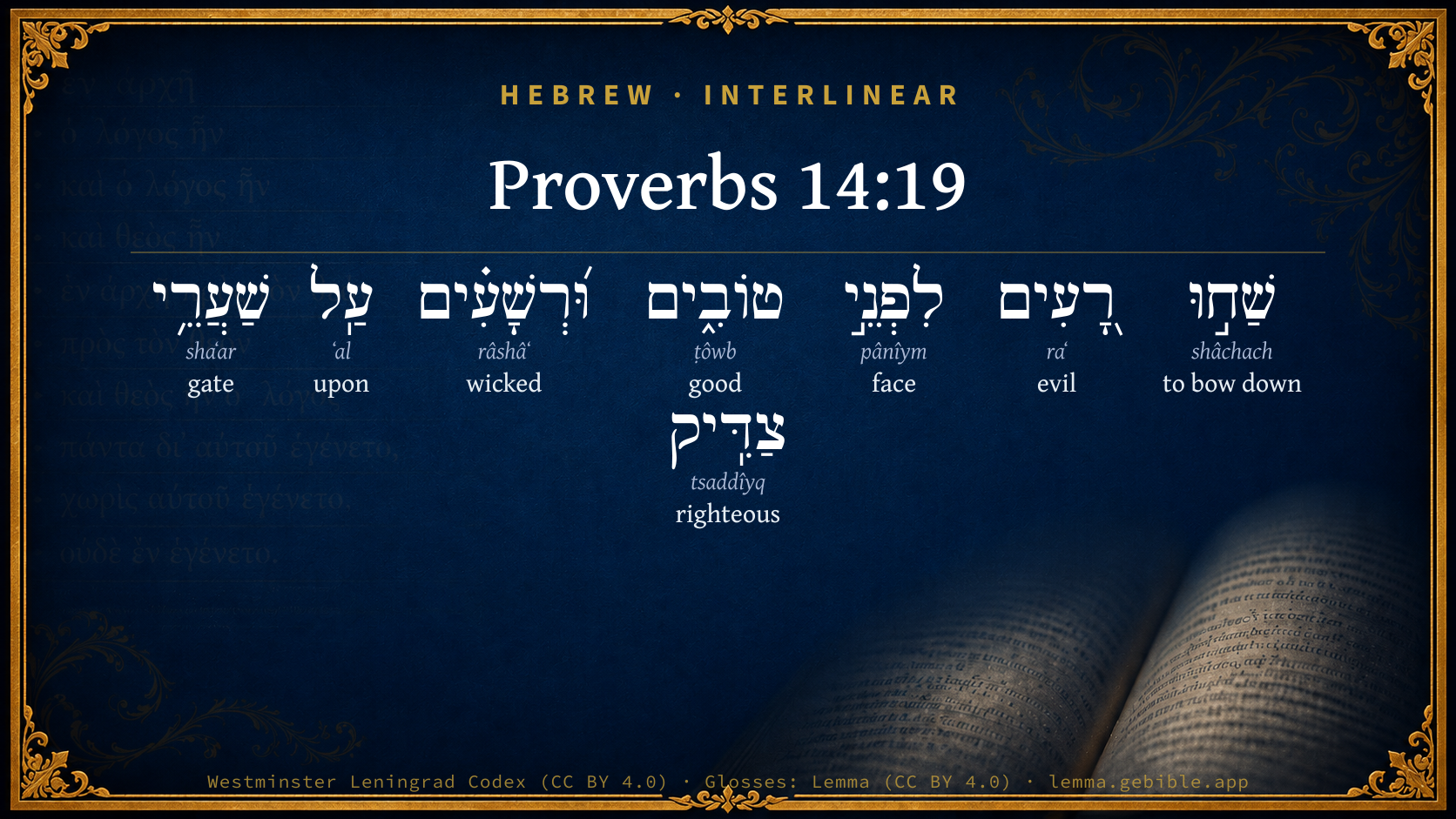
Proverbs 14:19

Hebrew (Westminster Leningrad Codex) Proverbs 14:19 appears in the Hebrew Old Testament. The text above is from the Westminster Leningrad Codex. Each word links to its Strong’s number, a concise gloss, and parsing drawn from the Open Scriptures Hebrew Bible morphology. Click any word for its full Brown-Driver-Briggs (BDB) entry.
Download image
Cite this verse

Proverbs 14:19 (World English Bible). Public Domain. Lemma interlinear Bible study tool, https://lemma.gebible.app/v/proverbs/14/19.

Show BibTeX & RIS
BibTeX
RIS
English Translation
The evil bow down before the good, And the wicked at the gates of the righteous.
World English Bible · Public Domain
Download a study sheet

One document with this verse’s original text, its word-by-word gloss line, the meaning frame, cross-references with their text, attributed commentary, and full source and license credits — printable, and it pastes into notes with its structure intact.

This verse Autodidact and up

Study sheet (.html) Plain text (.txt)

A passage Seminary Student

Up to 50 verses in one chapter. A passage sheet keeps up to 6 commentary sources and 12 cross-references per verse, in the order this page ranks them, and says so on the sheet whenever that leaves anything out. Ask for a single verse and you get the Autodidact verse sheet above.

Everything on this page stays free to read, with no account — the sheet is a download of what is already on screen, not access to it.

Want to remove ads? Support Godless Engineer
Compare translations 3

The same verse in 3 English versions, stacked beneath the original-language interlinear above. Click any original word for its lexicon entry.

Each is an independent rendering of the whole verse — the interlinear is not word-aligned to these translations.

Highlighted words mark where these versions differ — a whole-verse word diff, not a word-by-word alignment.

  • World English Bible Public Domain
    The evil bow down before the good, And the wicked at the gates of the righteous.
  • King James Version Public Domain
    The evil bow before the good; and the wicked at the gates of the righteous.
  • unfoldingWord Literal Text CC BY-SA 4.0
    The evil will bow down to the face of the good, and the wicked at the gates of the righteous one.

unfoldingWord Literal Text — © unfoldingWord, licensed CC BY-SA 4.0. Word-aligned USFM3 via Door43 (git.door43.org/unfoldingWord/en_ult).

Versions to compare (up to 4)

3 of 4 selected

Show all 18 translations

Every available English version of this verse, each an independent rendering of the whole verse.

  • World English Bible Public Domain
    The evil bow down before the good, And the wicked at the gates of the righteous.
  • Berean Standard Bible Public Domain
    The evil bow before the good, and the wicked at the gates of the righteous.
  • Majority Standard Bible Public Domain
    The evil bow before the good, and the wicked at the gates of the righteous.
  • King James Version Public Domain
    The evil bow before the good; and the wicked at the gates of the righteous.
  • American Standard Version (1901) Public Domain
    The evil bow down before the good; And the wicked, at the gates of the righteous.
  • Revised Version (1885) Public Domain
    The evil bow before the good; and the wicked at the gates of the righteous.
  • Geneva Bible (1599) Public Domain
    The euill shall bowe before the good, and the wicked at the gates of the righteous.
  • Douay-Rheims (1899) Public Domain
    The evil shall fall down before the good: and the wicked before the gates of the just.
  • Young's Literal Translation Public Domain
    The evil have bowed down before the good, And the wicked at the gates of the righteous.
  • Literal Standard Version CC BY-SA 4.0
    The evil have bowed down before the good, || And the wicked at the gates of the righteous.
  • Unlocked Literal Bible CC BY-SA 4.0
    Evil people will bow down before those who are good and those who are wicked will bow down at the gates of the righteous person.
  • unfoldingWord Literal Text CC BY-SA 4.0
    The evil will bow down to the face of the good, and the wicked at the gates of the righteous one.
  • Darby Bible Public Domain
    The evil bow before the good, and the wicked at the gates of the righteous [man].
  • World Messianic Bible Public Domain
    The evil bow down before the good, and the wicked at the gates of the righteous.
  • Webster's Bible Public Domain
    The evil bow before the good; and the wicked at the gates of the righteous.
  • Free Bible Version CC BY-SA 4.0
    Evil people bow down before good people, and the wicked bow down at the doors of those who do right.
  • Bible in Basic English Public Domain
    The knees of the evil are bent before the good; and sinners go down in the dust at the doors of the upright.
  • JPS Tanakh (1917) Public Domain
    The evil bow before the good, and the wicked at the gates of the righteous.

Literal Standard Version (2020), Covenant Press — licensed CC BY-SA 4.0. Text via the HelloAO Bible API (eBible.org). Unlocked Literal Bible (unfoldingWord) — licensed CC BY-SA 4.0. Text via the HelloAO Bible API (eBible.org). unfoldingWord Literal Text — © unfoldingWord, licensed CC BY-SA 4.0. Word-aligned USFM3 via Door43 (git.door43.org/unfoldingWord/en_ult). Free Bible Version, Dr. Jonathan Gallagher — licensed CC BY-SA 4.0. Text via the HelloAO Bible API (eBible.org).

Word by word

More ways to search: Search by grammar → Find every occurrence → Compare this word →

Practice this passage: Drill this verse → Learn its vocabulary →

שַׁח֣וּ
shâchach
H7817
“to bow down”
Verb, Qal, Perfect, 3rd Person, Common, Plural
Part of Speech
Verb
Stem
Qal
Form
Perfect
Person
3rd Person
Gender
Common
Number
Plural
Full BDB Definition

Origin: a primitive root

TWOT: 2361

to bow, crouch, bow down, be bowed down - (Qal) - to be bowed down, be prostrated, be humbled - to bow (in homage) - to bow (of mourner) - to crouch (of wild beast in lair) - (Niphal) to be prostrated, be humbled, be reduced, be weakened, proceed humbly, be bowed down - (Hiphil) to prostrate, lay low, bow down - (Hithpolel) to be cast down, be despairing
  1. רָ֭עִים raʻ H7451 “evil” Adjective, Adjective, Masculine, Plural, Absolute
  2. לִפְנֵ֣י pânîym H6440 “to/for · face(s) of” Preposition + Noun, Common, Both, Plural, Construct
  3. טוֹבִ֑ים ṭôwb H2896 “good” Adjective, Adjective, Masculine, Plural, Absolute
  4. וּ֝רְשָׁעִ֗ים râshâʻ H7563 “and · wicked” Conjunction + Adjective, Adjective, Masculine, Plural, Absolute
  5. עַֽל ʻal H5921 “upon” Preposition
  6. שַׁעֲרֵ֥י shaʻar H8179 “gates of” Noun, Common, Masculine, Plural, Construct
  7. צַדִּֽיק tsaddîyq H6662 “righteous” Adjective, Adjective, Masculine, Singular, Absolute

About this verse

These counts appear in no published source. They are computed here, from the morphology-tagged text and Lemma’s own curated glosses. What Lemma adds →

8
words
8
distinct lemmas
Wisdom
section

Notable vocabulary

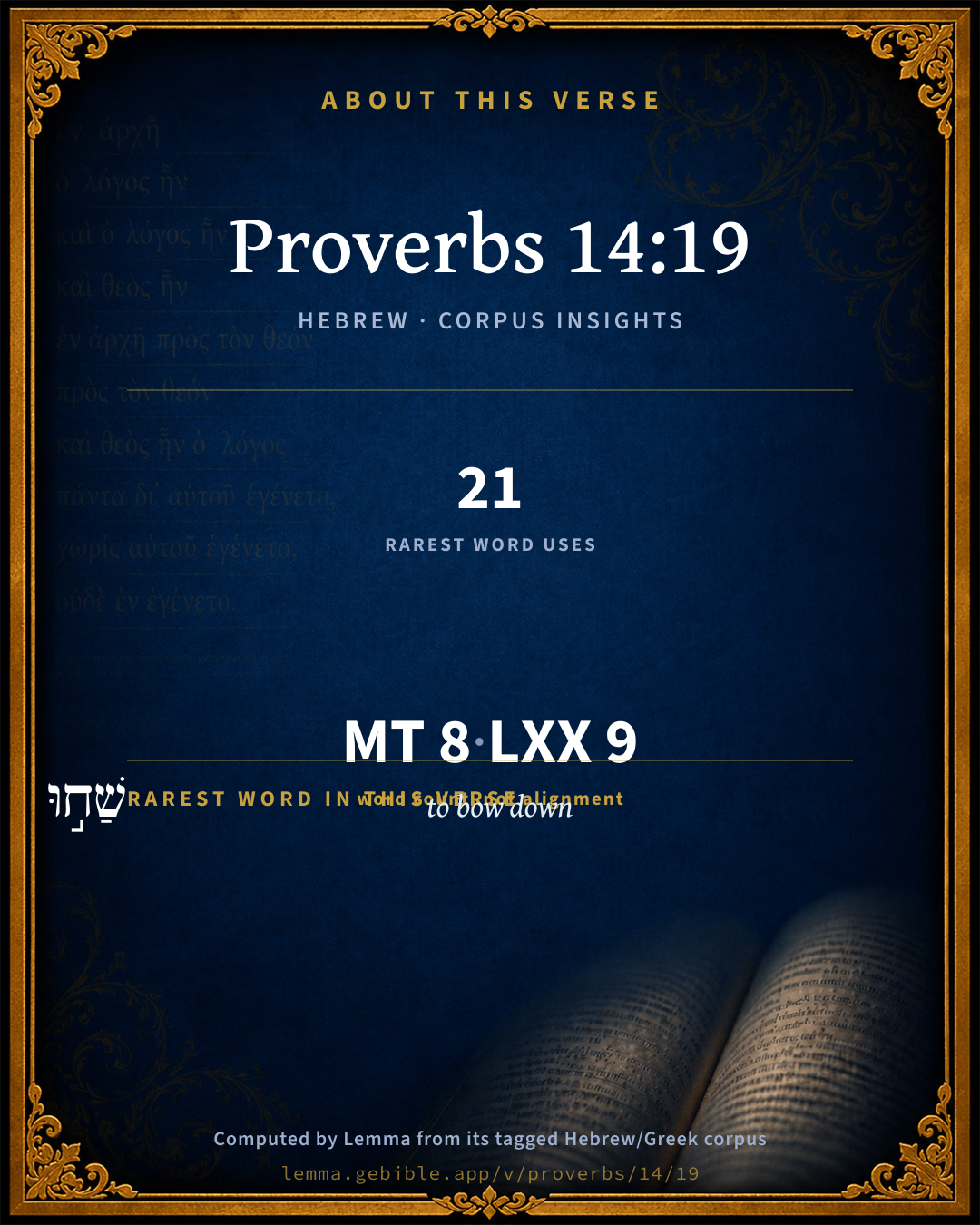
The rarest word here is שַׁח֣וּ to bow down H7817 — appearing just 21 times in the whole Hebrew Bible.

Shared distinctive vocabulary

שַׁח֣וּ to bow down H7817 occurs in 21 verses of the Hebrew Bible. Also found in:

Grammatical profile

  • 1 verb
  • 2 nouns
  • 4 adjectives
  • 1 preposition

Verb forms

  • שַׁח֣וּ Qal · Perfect

Hebrew & Septuagint length

In English translation the verse runs 16 words from the Hebrew and 18 from the Septuagint (LXX English) — closely comparable.

A rough comparison of the two English renderings, which tokenize alike — not a word-level alignment.

Word counts can differ between the Hebrew and the Greek without any difference in meaning — e.g. the Hebrew direct-object marker אֵת has no separate Greek word, and Greek often adds the article ὁ.

In the original languages it is 8 Hebrew tokens and 9 Greek tokens — but the two are counted differently (Hebrew bundles its prefixes and suffixes into one token; the Greek is in lemma form), so that isn’t a like-for-like length.

Cross-references

16

Topical passages linked to Proverbs 14:19 in the Treasury of Scripture Knowledge — connected by theme and wording, ordered by reader-vote popularity; previews shown in the World English Bible.

  • Genesis 42:6 Joseph was the governor over the land. It was he who sold to all the people of the land. Joseph's brothers came, and bowed themselves down to him with their faces to the earth.
  • Malachi 4:3 You shall tread down the wicked; for they will be ashes under the soles of your feet in the day that I make," says Yahweh of Hosts.
  • Exodus 8:8 Then Pharaoh called for Moses and Aaron, and said, "Entreat Yahweh, that he take away the frogs from me, and from my people; and I will let the people go, that they may sacrifice to Yahweh."
  • Genesis 43:28 They said, "Your servant, our father, is well. He is still alive." They bowed the head, and did homage.
  • Exodus 9:27–28 Pharaoh sent, and called for Moses and Aaron, and said to them, "I have sinned this time. Yahweh is righteous, and I and my people are wicked.
  • Exodus 11:8 All these your servants shall come down to me, and bow down themselves to me, saying, 'Get out, and all the people who follow you; and after that I will go out.'" He went out from Pharaoh in hot anger.
  • 1 Samuel 2:36 It shall happen, that everyone who is left in your house shall come and bow down to him for a piece of silver and a loaf of bread, and shall say, Please put me into one of the priests' offices, that I may eat a morsel of bread.
  • 2 Kings 3:12 Jehoshaphat said, The word of Yahweh is with him. So the king of Israel and Jehoshaphat and the king of Edom went down to him.
  • Isaiah 60:14 The sons of those who afflicted you shall come bending to you; and all those who despised you shall bow themselves down at the soles of your feet; and they shall call you The city of Yahweh, The Zion of the Holy One of Israel.
  • Micah 7:16–17 The nations will see and be ashamed of all their might. They will lay their hand on their mouth. Their ears will be deaf.
  • Psalms 49:14 They are appointed as a flock for Sheol. Death shall be their shepherd. The upright shall have dominion over them in the morning. Their beauty shall decay in Sheol, Far from their mansion.
  • Proverbs 11:29 He who troubles his own house shall inherit the wind. The foolish shall be servant to the wise of heart.
  • Micah 7:9–10 I will bear the indignation of Yahweh, Because I have sinned against him, Until he pleads my case, and executes judgment for me. He will bring me forth to the light. I will see his righteousness.
  • Revelation 3:9 Behold, I give of the synagogue of Satan, of those who say they are Jews, and they are not, but lie. Behold, I will make them to come and worship before your feet, and to know that I have loved you.
  • Esther 7:7–8 The king arose in his wrath from the banquet of wine [and went] into the palace garden: and Haman stood up to make request for his life to Esther the queen; for he saw that there was evil determined against him by the king.
  • Acts 16:39 and they came and begged them. When they had brought them out, they asked them to depart from the city.

Cross-references courtesy of OpenBible.info (CC BY 4.0).

Hebrew and Greek witnesses Masoretic Hebrew ↔ Greek Septuagint

The same verse in the two great witnesses to the Old Testament, shown verse-for-verse.

These are two independent witnesses, not word-aligned to each other, and the Septuagint is shown in lemma (dictionary) form.

Hebrew Proverbs 14:19 Masoretic · Westminster Leningrad Codex

שַׁח֣וּ רָ֭עִים לִפְנֵ֣י טוֹבִ֑ים וּ֝רְשָׁעִ֗ים עַֽל שַׁעֲרֵ֥י צַדִּֽיק

The evil bow down before the good, And the wicked at the gates of the righteous.

World English Bible · Public Domain

Greek LXX Proverbs 14:19 Septuagint · lemma form

ὀλισθαίνω κακός ἔναντι ἀγαθός καί ἀσεβής θεραπεύω θύρα δίκαιος

Evil men shall fall before the good; and the ungodly shall attend at the gates of the righteous.

LXX2012 (modern English Septuagint) · Public Domain

On this verse, John Gill's Exposition discusses the Septuagint’s reading. Read the note in Commentary ↓

Hebrew: Westminster Leningrad Codex (CC BY 4.0). Greek: Septuagint (public domain); English from LXX2012 (modern English Septuagint) (Public Domain). How the Septuagint differs from the Hebrew →

Commentary

Notes on Proverbs 14:19 from classic Christian and Jewish commentators (each source and its license shown beneath its notes). The classic Christian expositions comment on the surrounding passage and are grouped to its opening verse, so a note may address several verses; the Jewish commentaries on the Tanakh (Rashi and others) are per-verse, so they appear only where the commentator wrote on this verse.

Lemma curates 59 commentaries, every one of them public domain or Creative Commons licensed, each selected and text-cleaned for this edition rather than reprinted as found. About our sources →

Trapp's Complete Commentary

John Trapp

Pro 14:19 The evil bow before the good; and the wicked at the gates of the righteous.

Ver. 19. The evil bow before the good.] Here they do so many times, as Joseph’s brethren before him in his greatness, as Saul before Samuel, Belshazzar before Daniel, the persecuting tyrants before Constantine the Great; {a} yea, one of them, viz., Maximinus Galerius, being visited with grievous sickness, not only proclaimed liberty to the poor persecuted Christians, but also commanded their churches to be re-edified, and public prayers to be made for his recovery {b} So Ezr 6:10, "Pray for the king’s life, and for his sons’," some of which had died in their minority; for the rest, therefore, prayer must be made by the Church. That place is well known, {Isa 49:23} "Kings shall be thy nursing fathers, and their queens thy nursing mothers: they shall bow down to thee with their faces toward the earth, and lick up the dust of thy feet." The prophet seems to allude to the manner of the Persians, who, when they were to speak to their king, did first kiss the pavement whereon he trod. {c} Howsoever, natural consciences cannot but do homage to the image of God, stamped upon the natures and practices of the righteous, as is aforenoted; and the worst cannot but think well of such, and honour them in their hearts. In the life to come these things shall have their full accomplishment; and at the last day, when the saints shall judge the world, and Christ shall have put all things under his feet, so that they shall have "power over the nations." {Rev 2:26}

{a} Euseb.

{b} Ctesius.

{c} Pictorum solea basiare regum. - Martial.

John Trapp, A Commentary or Exposition upon All the Books of the Old and New Testament (1647–1656) — public domain. Text from a community e-Sword module.

Joseph Benson's Commentary

Pro 14:19. The evil bow before the good — Giving honour to them, and supplicating their favour and help; and the wicked at the gates of the righteous — As clients and petitioners are wont to wait at the houses of the great and powerful, or beggars at the doors of such as they expect will relieve their wants. The sense is, good men will have the pre-eminence over the wicked often in this life, when God sees it expedient, but assuredly in the life to come.

Joseph Benson's Commentary on the Old and New Testaments (1811–1818) — public domain. Text from a community e-Sword module.

The Preacher's Complete Homiletical Commentary

Joseph S. Exell (gen. ed.)

MAIN HOMILETICS OF Pro_14:19

A LEVELLING LAW

I. This law is now manifest to the inner life of the wicked. If a wicked man has any sense of right and wrong, he is conscious of the superiority of the good man. There is an inward bowing down of the evil to the good which is as real, although invisible, as any outward bending of the person of one man before another. Indeed it is far more real than much outward homage. There are many outward and visible bendings and bowings which are mere matters of form, which are only made to keep up appearances. But the involuntary bowing of the evil man’s soul in the presence of the good man is a real act of homage, although there is in it an element of unwillingness. There is a compulsory consent, so to speak, of the man himself against himself. But this genuflexion of soul is no mere pretence.

II. The good man is also conscious of it. He knows that it is so because in the constitution of the universe good is made to rule evil, because the head of the one kingdom—the kingdom of evil—is compelled to acknowledge the authority of the head of the kingdom of good. His own moral consciousness tells him that it must be so, and he has the declaration of God to confirm it. “No weapon that is formed against thee shall prosper, and every tongue that shall rise against thee in judgment thou shalt condemn. This is the heritage of the servants of the Lord, and their righteousness is of Me, saith the Lord” (Isa_54:17).

III. What has been occasionally manifested in the outward life, and what is always the inner experience, will one day be universally visible to all the universe. The revelation of God tells us that there will be a universally visible manifestation of the submission of the evil to the good. And our sense of justice demands that it should be so. A day will come when, at the name of Incarnate Goodness, “every knee shall bow” (Php_2:10), and the servants will have a portion of like reverence. “The sons also of them that afflicted Thee shall come bending unto Thee; and all they that despised Thee shall bow themselves down at the soles of Thy feet” (Isa_60:14).—See also Rev_20:4. It is also revealed to us when this visible manifestation shall take place. “In the end of this world,” at the close of the present dispensation, “the Son of Man shall send forth His angels, and they shall gather out of His kingdom all things that offend, and them which do iniquity … then shall the righteous shine forth as the sun in the kingdom of their Father (Mat_13:40-43). “For this manifestation of the sons of God” they wait with “earnest expectation;” “creation groans” for it; Christ Himself awaits it at “the right hand of God” (Heb_10:12-13; Rom_8:19-22).

OUTLINES AND SUGGESTIVE COMMENTS

At one time or other, in one respect or other, the ungodly serve and crouch to the godly. Sometimes they that fear the Lord are lifted up to honour, and then the evil men bow themselves before them. Sometimes, again, the righteous wax rich through God’s blessing on their labours, and then come the wicked to their gates for alms and relief. Not only the poor ones, but the great ones, who yet are wicked ones, seek and sue now and then with all submission to the godly for their counsel and help. And I cannot tell how, but such a majesty there is in the godly oftentimes, that most desperately wicked men reverence their faces, and are silent or courteous in their presence.—Muffet.

This is not the general rule in the present dispensation. Righteous Lazarus bowed at the rich man’s gate (Luk_16:20).… But “the upright shall have dominion over the wicked in the morning” (Psa_49:14; Mal_4:1-3). “The saints shall judge the world” (1Co_6:2).—Bridges.

There have been instances in which this proverb was verified in a very remarkable manner. The Egyptians bowed down before Joseph, and Moses, and the Israelites. The proud king of Babylon almost worshipped the captive Daniel, and Elisha’s favour was solicited by three kings, one or two of whom were bad men.—Lawson.

The wicked serve the righteous; and whether they do it knowingly, they do it wholly, and through eternal ages.—Miller.

In times of worldly prosperity, and while the wicked flourish, there is none more lifted up in pride and bravery of outward shows than they are; there is none, then, less esteemed, and more despised, than the good and righteous are. They shall give long attendance before the gates give way to them, and when they are entered a proud eye shall mightily overlook them, a scornful language shall throw them down at their feet. Wherefore Augustine calleth riches wings, by which men in pride fly not only above others, but themselves also. But if the time alter, and either some storm of common calamity beat upon them, or else the hand of God privately seize on them, then none are more dejected than the wicked, none then more esteemed than the righteous are by them. Then their ways are to the gates of the righteous, and much bowing there is to entreat their prayers unto God, and to obtain help and comfort from them. Then Dives, but fearing hell only, already sees Lazarus in heaven, and fain would come unto him.—Jermin.

The Preacher's Complete Homiletical Commentary (gen. ed. Joseph S. Exell; Funk & Wagnalls, c. 1892) — public domain (pre-1929). A full-Bible homiletical/sermon-outline anthology covering 65 of 66 books (2 John is absent from the source module). Text from a community e-Sword module.

Geneva Bible (1599)

Geneva Bible translators

If this come not daily to pass, we must consider that it is because of our sins, which let God’s working.

Geneva Bible (1599) marginal notes — public domain. Text via Bolls.life.

Matthew Henry's Commentary

That is, 1. The wicked are oftentimes impoverished and brought low, so that they are forced to beg, their wickedness having reduced them to straits; while good men, by the blessing of God, are enriched, and enabled to give, and do give, even to the evil; for where God grants life we must not deny a livelihood. 2. Sometimes God extorts, even from bad men, an acknowledgement of the excellency of God's people. The evil ought always to bow before the good, and sometimes they are made to do it and to know that God has loved them, Rev 3:9. They desire their favour (Est 7:7), their prayers, Kg2 3:12. 3. There is a day coming when the upright shall have the dominion (Psa 49:14), when the foolish virgins shall come begging to the wise for oil, and shall knock in vain at that gate of the Lord at which the righteous entered.

Matthew Henry's Commentary on the Whole Bible (1708–1710) — public domain (CC PDM 1.0). Text via the HelloAO Bible API.

Jamieson, Fausset & Brown

Robert Jamieson, A. R. Fausset & David Brown

Describes the humbling of the wicked by the punishment their sins incur.

Jamieson, Fausset & Brown — Commentary Critical and Explanatory on the Whole Bible (1871) — public domain (CC PDM 1.0). Text via the HelloAO Bible API.

Adam Clarke's Commentary

Verse 19. The evil bow before the good] They are almost constrained to show them respect; and the wicked, who have wasted their substance with riotous living, bow before the gates of the righteous-of benevolent men-begging a morsel of bread.

Adam Clarke's Commentary on the Bible (1810–1826) — public domain. Text from a community e-Sword/MySword module.

Ellicott's Commentary for English Readers

(19) The evil bow before the good.—(Comp. 1Sa_2:36.) That this final retribution is certain is implied by the tense employed, though it may be long delayed till the “awakening” (Psa_73:20) of God and man to judgment. (Comp. Wis_5:1, sqq.)

A Bible Commentary for English Readers, edited by Charles John Ellicott (1878–1897) — public domain. Text from a community e-Sword module.

John Gill's Exposition

The evil bow before the good,.... Wicked men before good men. This, as Jarchi observes, respects future time; even the latter day glory, or the spiritual times of the Messiah, when the kingdom under the whole heaven shall be given to the saints of the most High: for though there may have been some few instances of this kind, as Haman bowing before Mordecai, and the Heathen emperors before Constantine; and there may be some now, in some cases where obligation requires; yet this is far from being general, as it will be in the spiritual reign of Christ; when the sons of those that afflicted the church will come bending to her, and they that have despised her shall bow themselves down at the soles of her feet; and even great personages too shall bow down and lick the dust of her feet; the kings of the earth, who before have been in confederacy with antichrist, and have persecuted the saints, now shall hate the whore, and honour the true church of Christ: this will be in the Philadelphian state, which is the same with the spiritual reign of Christ; such who called themselves Jews, and are not, shall come and worship before the feet of the church, and own that she and her members are the favourites of heaven, Dan 7:27, Isa 49:23;

and the wicked at the gates of the righteous; or, "come to the gates of the righteous", as the Syriac version supplies it; they come and knock there, stand and wait, or lay themselves down; become prostrate and humble supplicants for relief and protection, as beggars do. This may also respect their attendance at Wisdom's gates, at the gates of Zion, on public ordinances, for counsel and instruction, which before they despised, Pro 8:34. The Septuagint version is, "shall serve thy gates"; that is, at them; see Isa 60:11.

John Gill's Exposition of the Whole Bible (1746–1763) — public domain (CC PDM 1.0). Text via the HelloAO Bible API.

Matthew Poole's English Annotations

Bow before the good; giving honour to them, and supplicating their favour and help, either for supply of their wants, as being brought low for their sins, or for counsel or comfort, or for their prayers to God for them.

At the gates; as clients, and petitioners, and beggars use to wait at the doors and houses of great and potent men. The sense is, Good men shall have the pre-eminency over the wicked, ofttimes in this life, when God sees it expedient, but assuredly in the next life.

Matthew Poole's English Annotations on the Holy Bible (1683–1685) — public domain. Text from a community e-Sword/MySword module.

Whedon's Commentary on the Bible

Daniel D. Whedon

19. At the gates — That is, bow at “the gates” as beggars, supplicating favour and relief. Evil and wicked are only different words descriptive of the same class of persons. The proverb does not imply that this is always the case in this world, but that often, in the retributions of Providence, the wicked who oppressed and persecuted the righteous are made to humble themselves before them, and even to beg their bread from them. Compare Pro_13:9; Pro_13:22; Psa_37:25, seq.; Gen_43:26; Gen_50:18; Est_3:2; Est_6:11; Rev_3:9; Luk_16:24.

Daniel D. Whedon (gen. ed.), Commentary on the Old and New Testaments (1874–1909) — public domain. Text from a community e-Sword module.

The Pulpit Commentary

The evil bow before the good; and the wicked stand at the gates of the righteous. (Pro_8:34) The final victory of good over evil is here set forth. However triumphant for a time and apparently prosperous the wicked may be, their success is not lasting; they shall in the end succumb to the righteous, even as the Canaanite kings crouched before Joshua"s captains, (Jos_10:24) and, hurled from their high estate, they shall stand humbly at the good man"s door, begging for bread to support their life. (1Sa_2:36) The contrast here indicated is seen in our Lord"s parable of Dives and Lazarus, when the beggar is comforted and the rich man is tormented, and when the latter urgently sues for the help of the once despised outcast to mitigate the agony which he is suffering. (comp. RAPC Wis 5)

The Pulpit Commentary (1880–1919), ed. H.D.M. Spence-Jones & Joseph S. Exell — public domain. Text from a community e-Sword module.

John Wesley's Explanatory Notes

The evil - Good men shall have the pre-eminency over the wicked.

John Wesley, Explanatory Notes Upon the Whole Bible (1754–1765) — public domain. Text via the GEBible commentary corpus.

Keil & Delitzsch

C. F. Keil & F. Delitzsch

19 The wicked must bow before the good,

And the godless stand at the doors of the righteous.

The good, viz., that which is truly good, which has love as its principle, always at last holds the supremacy. The good men who manifest love to men which flows from love to God, come finally forward, so that the wicked, who for a long time played the part of lords, bow themselves willingly or unwillingly before them, and often enough it comes about that godless men fall down from their prosperity and their places of honour so low, that they post themselves at the entrance of the stately dwelling of the righteous (Pro 13:22), waiting for his going out and in, or seeking an occasion of presenting to him a supplication, or also as expecting gifts to be bestowed (Psa 37:25). The poor man Lazarus πρὸς τὸν πυλῶνα of the rich man, Luk 16:20, shows, indeed, that this is not always the case on this side of the grave. שׁחוּ has, according to the Masora (cf. Kimchi's Wrterbuch under שׁחח), the ultima accented; the accentuation of the form סכּוּ wavers between the ult. and penult. Olsh. p. 482f., cf. Gesen. 68, Anm. 10. The substantival clause 19b is easily changed into a verbal clause: they come (Syr.), appear, stand (incorrectly the Targ.: they are judged in the gates of the righteous).

Keil & Delitzsch — Biblical Commentary on the Old Testament (1861–1891) — public domain (CC PDM 1.0). Text via the HelloAO Bible API. (Old Testament only.)

Bridges on Proverbs

Charles Bridges

This is not the general rule of the present dispensation. Righteous Lazarus bowed at the wicked man’s gate. (Luk 16:20 .) Thus faith is tried (Psa 73:12 ), and the foundations of our heavenly hopes more deeply grounded. (2Co 4:17-18 .) And yet often has the very letter of the proverb been verified. The Egyptians and Joseph’s brethren bowed before Joseph;†1 the proud Pharaoh and his people before Moses;†2 Saul to David;†3 Jehoram and Naaman before Elisha;†4 Haman before Esther;†5 the magistrates before the apostles.†6 More often still is the spirit of this proverb illustrated in the constrained testimony of the wicked to the pre-eminence of the righteous. (Rev 3:9 .) The millennial era will exhibit a more glorious fulfillment. (Isa 49:23 ; Isa 60:14 . Rev 20:4 .) The grand consummation will set all things right, and shed a Divine splendour over this profound aphorism. "The upright shall have dominion over the wicked in the morning." (Psa 49:14 . Mal 4:1-3 .) "The saints shall judge the world." (1Co 6:2 .) They shall there appear in their suitable rank, exalted with their glorious Head over the whole creation. (Rev 2:26 .) Oh! let the sunshine of this glory irradiate every clouded morn. If this be not enough to counter-balance the scorn of the ungodly, where is our faith? Had we a clear apprehension of this glory, should we have an eye for anything else? Would not all besides, except as it had a reference to this day, be an utter impertinence?

Footnotes:

†1 Gen 41:43; Gen 42:6 .

†2 Exo 8:8; Exo 9:27-28 ; Exo 11:8 .

†3 1Sa 24:16-21 ; 1Sa 26:21 .

†4 2Ki 3:12 ; 2Ki 5:9 .

†5 Est 7:7.

†6 Act 16:39.

Charles Bridges, An Exposition of the Book of Proverbs (1846) — public domain. Text from a community e-Sword module.

Kretzmann's Popular Commentary

Paul E. Kretzmann

v. 19. The evil bow before the good, humbling themselves as a result of the punishment which they incurred for their sins, and the wicked at the gates of the righteous, like beggars humbly praying for some gift of charity.

Paul E. Kretzmann, Popular Commentary of the Bible (1921–1924) — public domain. Text from a community e-Sword module.

unfoldingWord translationNotes

Door43 World Missions Community

bow down

This means to bend over to humbly express respect and submission toward someone. (See: Symbolic Action)

at the gates of the righteous

The word "gates" represents an entrance to meet with another. This means the wicked will have to wait for the righteous person and beg to enter his presence. AT: "to meet with the righteous person" (See: Metonymy)

The poor person is hated even by his own companions

This can be stated in active form. AT: "Everyone hates the poor person even his own neighbors" (See: Active or Passive)

translationWords

evil

bow

gate

companion

unfoldingWord translationNotes — © Distant Shores Media and the Door43 World Missions Community, licensed CC BY-SA 4.0. Source: git.door43.org/Door43/en_tn.

Rashi

Rabbi Shlomo Yitzchaki (Rashi)

The evil bend down before the good in the future.

Rashi on the Tanakh — English translations: “The Judaica Press complete Tanach with Rashi, translated by A. J. Rosenberg” (CC BY 4.0); “Pentateuch with Rashi's commentary by M. Rosenbaum and A.M. Silbermann, 1929-1934” (public domain); “The Metsudah Tanach series, Lakewood, N.J” (CC BY 4.0); and “The Book of Joshua, Metsudah Publications, 1997” (CC BY 4.0). Text via Sefaria.

Lesson kit

Teaching starters — assembled from the data on this page, not authored interpretation. Every prompt links to the verse data it draws on. Edit before teaching.

Proverbs, in the Wisdom, opens this verse with 8 words (8 distinct Hebrew lemmas). Its most distinctive word is shâchach (“to bow down”). A historical commentator’s framing appears above. Read the whole chapter for the surrounding context.

Discussion questions

  1. What does “to bow down” (shâchach) contribute to the verse as a whole?
  2. Job 9:13 shares the word «to bow down» with this verse. How do the two illuminate each other?
  3. The translations on this page render this verse differently — a whole-verse word diff, not a word-by-word alignment. What might account for the different wordings?
  4. The verb «שַׁח֣וּ» is Qal Perfect. How does its form color the action?
  5. Reading how Trapp's Complete Commentary and Joseph Benson's Commentary read this verse, where do the two commentators agree and where do they part?

Things to notice

Reading settings

Reading text

Shown beneath each verse's original-language words.

Old Testament
Old Testament edition

Read the OT as the Masoretic Hebrew (MT) or the Greek Septuagint (LXX).

English shown for the Greek Septuagint (in the Hebrew ↔ Greek comparison).

Comparing translations? Open the Compare panel on any verse page to stack up to four side by side.