
Proverbs 13:9

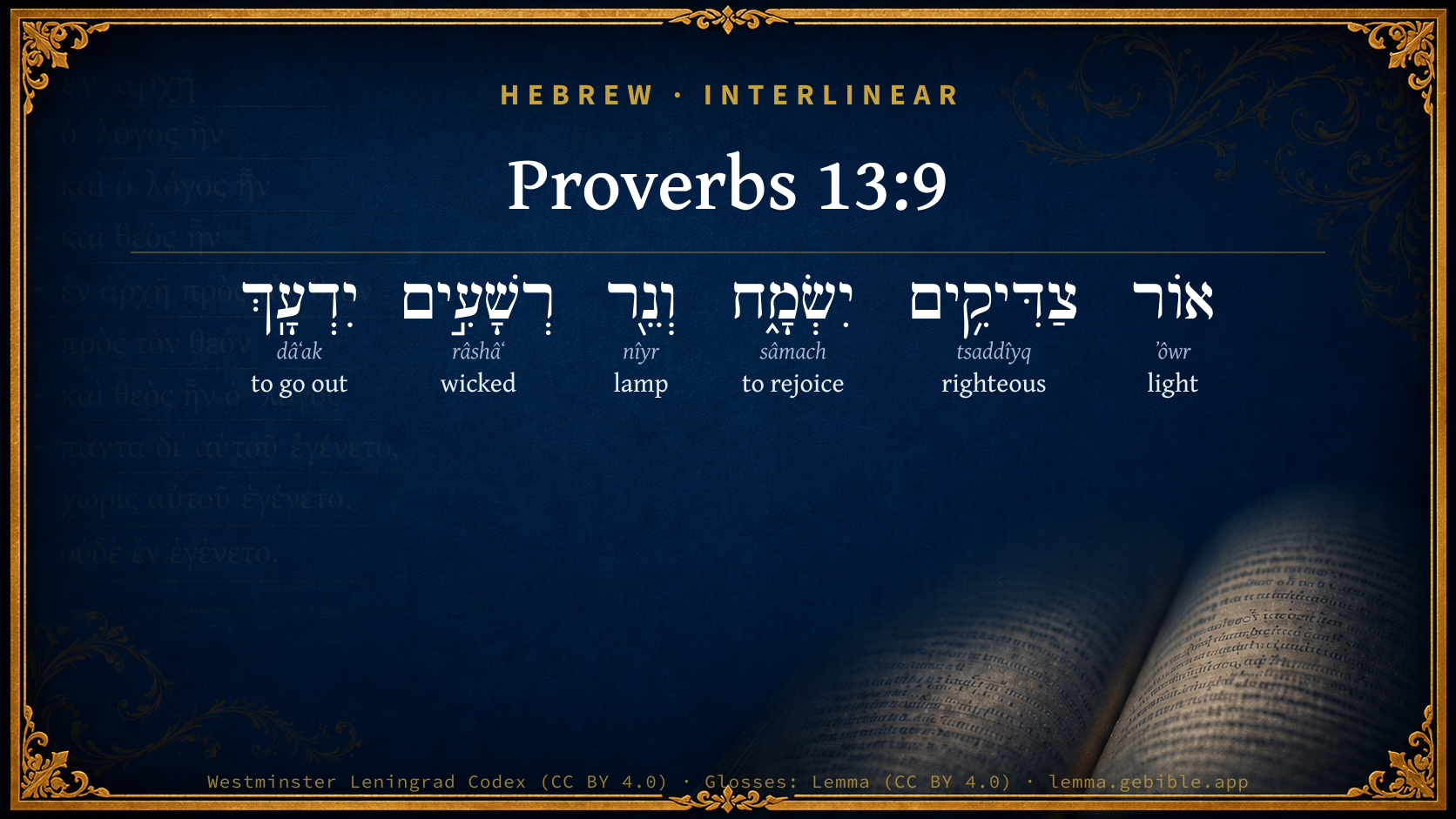
Hebrew (Westminster Leningrad Codex) Proverbs 13:9 appears in the Hebrew Old Testament. The text above is from the Westminster Leningrad Codex. Each word links to its Strong’s number, a concise gloss, and parsing drawn from the Open Scriptures Hebrew Bible morphology. Click any word for its full Brown-Driver-Briggs (BDB) entry.
Download image
Cite this verse

Proverbs 13:9 (World English Bible). Public Domain. Lemma interlinear Bible study tool, https://lemma.gebible.app/v/proverbs/13/9.

Show BibTeX & RIS
BibTeX
RIS
English Translation
The light of the righteous shines brightly, But the lamp of the wicked is snuffed out.
World English Bible · Public Domain
Download a study sheet

One document with this verse’s original text, its word-by-word gloss line, the meaning frame, cross-references with their text, attributed commentary, and full source and license credits — printable, and it pastes into notes with its structure intact.

This verse Autodidact and up

Study sheet (.html) Plain text (.txt)

A passage Seminary Student

Up to 50 verses in one chapter. A passage sheet keeps up to 6 commentary sources and 12 cross-references per verse, in the order this page ranks them, and says so on the sheet whenever that leaves anything out. Ask for a single verse and you get the Autodidact verse sheet above.

Everything on this page stays free to read, with no account — the sheet is a download of what is already on screen, not access to it.

Want to remove ads? Support Godless Engineer
Compare translations 3

The same verse in 3 English versions, stacked beneath the original-language interlinear above. Click any original word for its lexicon entry.

Each is an independent rendering of the whole verse — the interlinear is not word-aligned to these translations.

Highlighted words mark where these versions differ — a whole-verse word diff, not a word-by-word alignment.

  • World English Bible Public Domain
    The light of the righteous shines brightly, But the lamp of the wicked is snuffed out.
  • King James Version Public Domain
    The light of the righteous rejoiceth: but the lamp of the wicked shall be put out.
  • unfoldingWord Literal Text CC BY-SA 4.0
    The light of the righteous will be glad, but the lamp of the wicked goes out.

unfoldingWord Literal Text — © unfoldingWord, licensed CC BY-SA 4.0. Word-aligned USFM3 via Door43 (git.door43.org/unfoldingWord/en_ult).

Versions to compare (up to 4)

3 of 4 selected

Show all 18 translations

Every available English version of this verse, each an independent rendering of the whole verse.

  • World English Bible Public Domain
    The light of the righteous shines brightly, But the lamp of the wicked is snuffed out.
  • Berean Standard Bible Public Domain
    The light of the righteous shines brightly, but the lamp of the wicked is extinguished.
  • Majority Standard Bible Public Domain
    The light of the righteous shines brightly, but the lamp of the wicked is extinguished.
  • King James Version Public Domain
    The light of the righteous rejoiceth: but the lamp of the wicked shall be put out.
  • American Standard Version (1901) Public Domain
    The light of the righteous rejoiceth; But the lamp of the wicked shall be put out.
  • Revised Version (1885) Public Domain
    The light of the righteous rejoiceth: but the lamp of the wicked shall be put out.
  • Geneva Bible (1599) Public Domain
    The light of the righteous reioyceth: but the candle of the wicked shall be put out.
  • Douay-Rheims (1899) Public Domain
    The light of the just giveth joy: but the lamp of the wicked shall be put out.
  • Young's Literal Translation Public Domain
    The light of the righteous rejoiceth, And the lamp of the wicked is extinguished.
  • Literal Standard Version CC BY-SA 4.0
    The light of the righteous rejoices, || And the lamp of the wicked is extinguished.
  • Unlocked Literal Bible CC BY-SA 4.0
    The light of righteous people rejoices, but the lamp of wicked people will be put out.
  • unfoldingWord Literal Text CC BY-SA 4.0
    The light of the righteous will be glad, but the lamp of the wicked goes out.
  • Darby Bible Public Domain
    The light of the righteous rejoiceth; but the lamp of the wicked shall be put out.
  • World Messianic Bible Public Domain
    The light of the righteous shines brightly, but the lamp of the wicked is snuffed out.
  • Webster's Bible Public Domain
    The light of the righteous rejoiceth: but the lamp of the wicked shall be extinguished.
  • Free Bible Version CC BY-SA 4.0
    The life of good people shines brightly, but the lamp of the wicked will be snuffed out.
  • Bible in Basic English Public Domain
    There is a glad dawn for the upright man, but the light of the sinner will be put out.
  • JPS Tanakh (1917) Public Domain
    The light of the righteous rejoiceth; but the lamp of the wicked shall be put out.

Literal Standard Version (2020), Covenant Press — licensed CC BY-SA 4.0. Text via the HelloAO Bible API (eBible.org). Unlocked Literal Bible (unfoldingWord) — licensed CC BY-SA 4.0. Text via the HelloAO Bible API (eBible.org). unfoldingWord Literal Text — © unfoldingWord, licensed CC BY-SA 4.0. Word-aligned USFM3 via Door43 (git.door43.org/unfoldingWord/en_ult). Free Bible Version, Dr. Jonathan Gallagher — licensed CC BY-SA 4.0. Text via the HelloAO Bible API (eBible.org).

Word by word

More ways to search: Search by grammar → Find every occurrence → Compare this word →

Practice this passage: Drill this verse → Learn its vocabulary →

About this verse

These counts appear in no published source. They are computed here, from the morphology-tagged text and Lemma’s own curated glosses. What Lemma adds →

6
words
6
distinct lemmas
Wisdom
section

Notable vocabulary

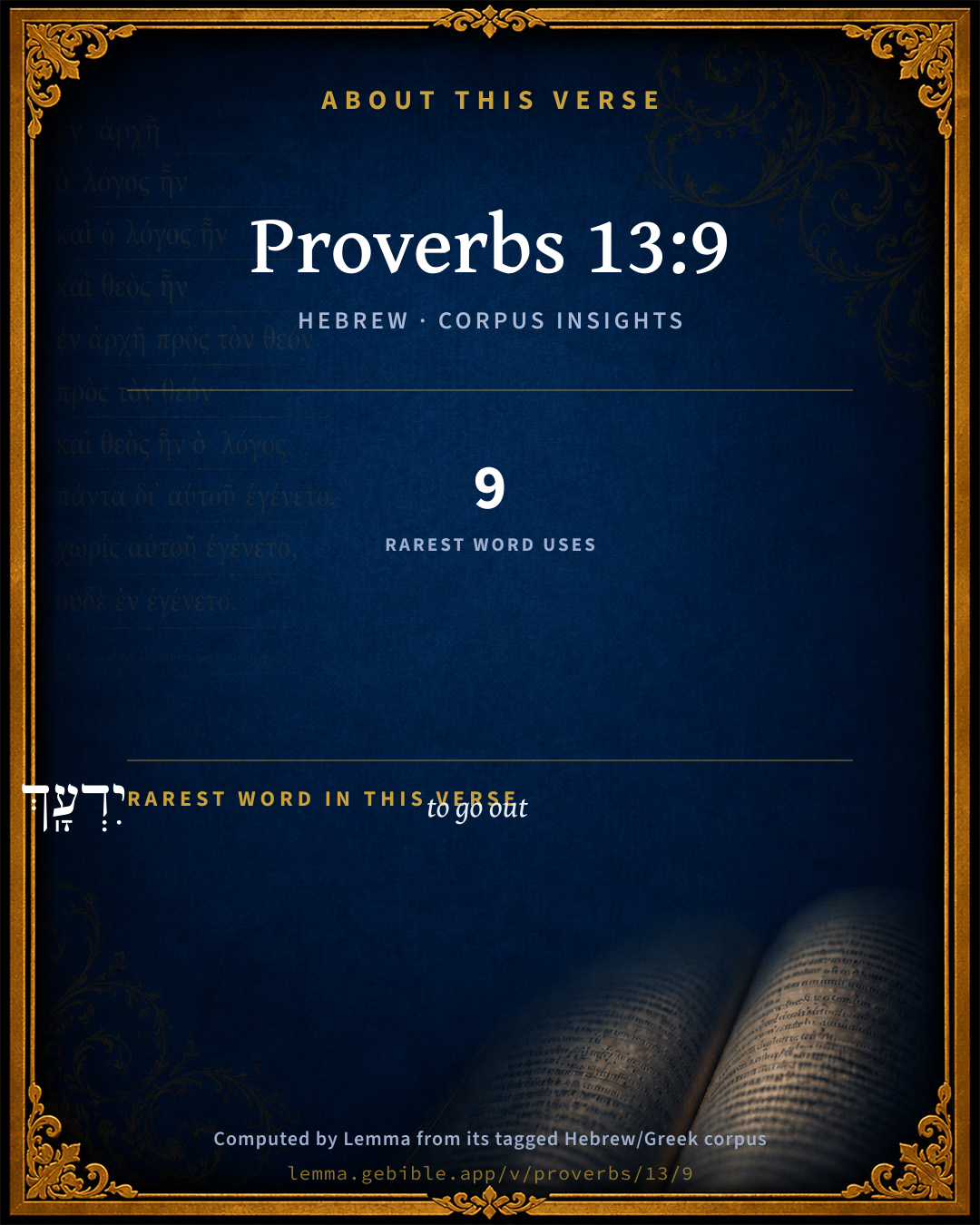
The rarest word here is יִדְעָֽךְ to go out H1846 — appearing just 9 times in the whole Hebrew Bible.

Shared distinctive vocabulary

יִדְעָֽךְ to go out H1846 occurs in 9 verses of the Hebrew Bible. Also found in:

Grammatical profile

  • 2 verbs
  • 2 nouns
  • 2 adjectives

Verb forms

  • יִשְׂמָ֑ח Qal · Imperfect
  • יִדְעָֽךְ Qal · Imperfect

Hebrew & Septuagint length

In English translation the verse runs 16 words from the Hebrew and 26 from the Septuagint (LXX English) — the Septuagint runs noticeably longer here. See the side-by-side →

A rough comparison of the two English renderings, which tokenize alike — not a word-level alignment.

Word counts can differ between the Hebrew and the Greek without any difference in meaning — e.g. the Hebrew direct-object marker אֵת has no separate Greek word, and Greek often adds the article ὁ.

Cross-references

11

Topical passages linked to Proverbs 13:9 in the Treasury of Scripture Knowledge — connected by theme and wording, ordered by reader-vote popularity; previews shown in the World English Bible.

  • Proverbs 24:20 For there will be no reward to the evil man; And the lamp of the wicked shall be snuffed out.
  • Proverbs 4:18 But the path of the righteous is like the dawning light, That shines more and more until the perfect day.
  • Proverbs 20:20 Whoever curses his father or his mother, His lamp shall be put out in blackness of darkness.
  • Psalms 97:11 Light is sown for the righteous, And gladness for the upright in heart.
  • Psalms 112:4 Light dawns in the darkness for the upright, Gracious, merciful, and righteous.
  • Job 18:5–6 "Yes, the light of the wicked shall be put out, The spark of his fire shall not shine.
  • Matthew 25:8 The foolish said to the wise, 'Give us some of your oil, for our lamps are going out.'
  • 1 Kings 11:36 To his son will I give one tribe, that David my servant may have a lamp always before me in Jerusalem, the city which I have chosen me to put my name there.
  • Job 21:17 "How often is it that the lamp of the wicked is put out? That their calamity comes on them? That God distributes sorrows in his anger?
  • Isaiah 50:10–11 Who is among you who fears Yahweh, who obeys the voice of his servant? He who walks in darkness, and has no light, let him trust in the name of Yahweh, and rely on his God.
  • Job 29:3 When his lamp shone on my head, And by his light I walked through darkness;

Cross-references courtesy of OpenBible.info (CC BY 4.0).

Hebrew and Greek witnesses Masoretic Hebrew ↔ Greek Septuagint

The same verse in the two great witnesses to the Old Testament, shown verse-for-verse.

Here the Septuagint runs noticeably longer than the Hebrew — LXX2012 (modern English Septuagint) 26 words vs World English Bible 16. A rough length comparison of the two English translations, not a word-level alignment — read both below.

These are two independent witnesses, not word-aligned to each other, and the Septuagint is shown in lemma (dictionary) form.

Hebrew Proverbs 13:9 Masoretic · Westminster Leningrad Codex

אוֹר צַדִּיקִ֥ים יִשְׂמָ֑ח וְנֵ֖ר רְשָׁעִ֣ים יִדְעָֽךְ

The light of the righteous shines brightly, But the lamp of the wicked is snuffed out.

World English Bible · Public Domain

Greek LXX Proverbs 13:9 Septuagint · lemma form

φῶς δίκαιος διά πᾶς φῶς δέ ἀσεβής σβέννυμι ψυχή δόλιος πλανάω ἐν ἁμαρτία δίκαιος δέ οἰκτείρω καί ἐλεάω

The righteous always have light: but the light of the ungodly is quenched. Crafty souls go astray in sins: but just men pity, and are merciful.

LXX2012 (modern English Septuagint) · Public Domain

On this verse, Keil & Delitzsch discusses the Septuagint’s reading. Read the note in Commentary ↓

Hebrew: Westminster Leningrad Codex (CC BY 4.0). Greek: Septuagint (public domain); English from LXX2012 (modern English Septuagint) (Public Domain). How the Septuagint differs from the Hebrew →

Commentary

Notes on Proverbs 13:9 from classic Christian and Jewish commentators (each source and its license shown beneath its notes). The classic Christian expositions comment on the surrounding passage and are grouped to its opening verse, so a note may address several verses; the Jewish commentaries on the Tanakh (Rashi and others) are per-verse, so they appear only where the commentator wrote on this verse.

Lemma curates 59 commentaries, every one of them public domain or Creative Commons licensed, each selected and text-cleaned for this edition rather than reprinted as found. About our sources →

Trapp's Complete Commentary

John Trapp

Pro 13:9 The light of the righteous rejoiceth: but the lamp of the wicked shall be put out.

Ver. 9. The light of the righteous rejoiceth.] As the sun rejoiceth to run his race, and seemeth sometimes to suffer eclipse, but doth not. {a} A saint’s joy is as the light of the sun, fed by heavenly influence, and never extinct, but diffused through all parts of the world.

But the lamp of the wicked shall be put out.] Their joy is but as the light of a candle, - fed by base and stinking matter, soon wasting and ending in an offensive snuff. "The light of the wicked shall be put out, and the spark of his fire shall not shine. The light shall be dark in his tabernacle; and his candle shall be put out with him." {Job 18:5-6} Ecquandone vidisti flammom stipula exortam claro strepitu, largo fulgore, cito incremento, sed enim materalevi, caduco incendio, nullis requiis? {b} Solomon compares it fitly to a handful of brushwood or sear thorn under the pot. {Ecc 7:6}

{a} Sol non patitur eclipsin, sed videtur tantum pati.

{b} Apuleius in Apolog.

John Trapp, A Commentary or Exposition upon All the Books of the Old and New Testament (1647–1656) — public domain. Text from a community e-Sword module.

The Biblical Illustrator

Joseph S. Exell

Pro_13:9

The light of the righteous rejoiceth: but the lamp of the wicked shall be put out.

The light of the righteous and the lamp of the wicked

By this we are to understand that the light of the righteous burns joyously, is a very image of gladness and rapture: the sun rejoiceth as a giant to run his course; he is, so to say, conscious of his power and of his speed; travelling does not weary him; shining does not exhaust him: at the end he is as mighty as at the beginning. It will be observed that in the one case the word is light as applied to the righteous, and in the other the word is lamp as applied to the wicked. The path of the just is as a shining light, shining more and more unto the perfect day; the light of the righteous man is above, it is not of his own making, it never can be exhausted: the light in which the wicked man walks is a lamp of his own creation, he made it, he lighted it, he is above and greater than that light, and at any moment it may be extinguished; he walks in the fire and in the sparks which he himself has kindled; he is full of brilliant fancies, flashing and glaring eccentricities; he rejoices transiently in the rockets which he throws up into the air, but as they expire and fall back in dead ashes at his feet he sees how poor have been his resources, and how mean is the issue of a cleverness that is without moral basis and moral inspiration. Gods blessing is always attached to the true light. God himself is Light. Jesus Christ was the Light of the world, and Christians are to be lights of their day and generation, reflecting the glory of their Master. The wicked indeed have a kind of light; that should always be amply acknowledged: but it is a light of their own creation, and a light that is doomed to extinction--it shall be put out; a drop of rain shall fall upon it, and the little flicker shall expire, never to be rekindled. (J. Parker, D.D.)

The lights of souls

I. The joyous light of soul. The light of the righteous rejoiceth. In what does the light of the soul consist? There are at least three elements--faith, hope, love. The first fills the soul with the light of ideas; the second, with the light of a bright future; the third, with the light of happy affections. Extinguish these in any soul, and there is the blackness of darkness for ever. The righteous have these as Divine impartations, as beams from the Father of lights, and in their radiance they live, walk, and rejoice. They rejoice in their faith. Their faith connects them with the Everlasting Sun. They rejoice in their hope. Their hope bears them into the regions of the blest. They rejoice in their love. Their love fixes their enrapturing gaze on Him in whose presence there is fulness of joy.

II. The transient light of soul. The lamp of the wicked shall be put out. It is implied that the light of the righteous is permanent. It is inextinguishable. Not so the light of the wicked. Their light, too, is in their faith, their hope, their love. But their faith is in the false, and it must give way. The temple of their hope is built on sand, and the storm of destiny will destroy it. Their love is on corrupt things, and all that is corrupt must be burnt by the all-consuming fire of eternal justice. Thus the lamp of the wicked must be put out. (Homilist.)

The Biblical Illustrator, edited by Joseph S. Exell (c. 1880s–1900s) — public domain. Text from a community e-Sword module.

Joseph Benson's Commentary

Pro 13:9. The light of the righteous rejoiceth, &c. — Or, as Schultens renders it, The light of the righteous shall shine forth joyfully; but the darkening lamp of the wicked shall be put out — See note on Pro 4:18-19. The meaning seems to be, 1st, The comfort of good men is flourishing and lasting; their prosperity increases and makes them glad. 2d, The comfort of bad men is withering and dying; their lamp burns dim and faint; it looks melancholy, like a taper in an urn; and it will shortly be put out in litter darkness, Isa 50:11.

Joseph Benson's Commentary on the Old and New Testaments (1811–1818) — public domain. Text from a community e-Sword module.

The Preacher's Complete Homiletical Commentary

Joseph S. Exell (gen. ed.)

CRITICAL NOTES.—

Pro_13:9. Rejoiceth, “burns brightly.” The words light and lamp are regarded by most modern commentators as synonymous.

MAIN HOMILETICS OF Pro_13:9

THE ABIDING LIGHT

I. The analogy between the righteous and the wicked. Both have a light or lamp. The words here translated lamp and light are elsewhere used interchangeably, and are often used to signify prosperity (1Ki_15:4; 2Ki_8:19) of any and every kind. Prosperity resembles a lamp in that it is an attractive force. A benighted traveller in the darkness is drawn towards a light wherever he sees it, although he does not know whether it is the light of a thief or of an honest man. Tempest-tossed mariners look anxiously for a light in their extremity, and hope for help from it whether it swings from the masthead of a pirate or from a vessel which carries the police of the seas. So prosperity in any man is an attractive force. A prosperous wicked man attracts to himself the needy and unfortunate. The unprincipled gather round him, hoping to share in some degree in the light and heat of his worldly success, and the good man who is poor is often compelled by need to do the same. The lamp of prosperity, like the net of the kingdom, “gathers of every kind” (Mat_13:47), not because of what the prosperous man is, but because of what he has. Many saints are dependent on sinners for their daily bread. Lazarus lay at the rich man’s gate hoping to be fed with the crumbs which fell from his table. The prosperity of the righteous is equally attractive both to good men and bad for the same reason. The great mass of men in the world are toiling upon the sea of life for daily bread like tempest-tossed mariners, and wherever they see the light of prosperity they make for it, hoping for help in their need. And prosperity in the general acceptance of the word is as often given to the good as to the bad—to the wicked as to the righteous. Some commentators regard the light or the lamp as emblematic also of posterity. The words in 2Ki_8:19 may be translated “to give him always a light in his children” (see Lange on 2Ch_21:7), and in this sense also the analogy holds good, seeing that both good and bad men become the heads of households, and have joy and honour in their children.

II. The contrast between the righteous and the wicked.

1. The righteous man will grow more and more prosperous. Present and material prosperity is but an earnest and a shadow of that higher light which shall “rejoice” throughout eternity. For the contrast implies that his light shall not “be put out.” And this continuance has its root in his character. Although in this world character does not govern circumstances, there is a world in which it does. And, after all, a good man’s light—or occasion of satisfaction—consists more in what he is than in what he has, and this shines “more and more unto the perfect day” (chap. Pro_4:18)—See Homiletics, page 58.

2. The wicked man’s prosperity will come to an end. His candle will be put out by the hand of death. It may burn well for a time and he may rejoice in its light, but even if it continue to shed its rays around him till the last hour of earthly life, death will put it out. All that has made him a prosperous man has belonged to the earth, and this can shed no light beyond the grave. It may be put out by the hand of retribution before death. Lamps kindled by unjust means may burn well for a time, and human retribution may never put out their light, because men may not know how they were lighted; but God’s providence may put them out. (On this subject see next verse.) Or if Divine retribution reserves its extinguisher for another world, another avenger may “put out” the light. Conscience may assert its right, and without actually taking from a man that in which he has promised himself satisfaction, may take the satisfaction from it, and thus as surely “put out” his “lamp.”

OUTLINES AND SUGGESTIVE COMMENTS

How glowing, then, is the light of the Church in the combined shining of all her members! Many of them have no remarkable individual splendour; yet, like the lesser stars forming the Milky Way, they present a bright path of holiness in the spiritual firmament.… But it is the light of the righteous that rejoiceth. Sin, therefore, will bring the cloud. Do we hope to shine in the heavenly firmament? Then we must shine with present glory in the firmament of the Church. So delicate is the Divine principle, that every breath of this world dims its lustre.—Bridges.

The comfort of the righteous is a heavenly light, whose shining is rejoicing, and which even in this life maketh the darkness of Egypt to be light in Goshen, maketh the night of troubles to be day; but at length it shall be such a sunshine of glory, as that it dazzleth the human understanding to conceive it now. On the other side, the best comfort which the wicked have is but a lamp or a candle which shineth in the night; for as the light of a candle is shut up within a narrow circle of space, so their comfort is shut up within a narrow compass of time, until at length the candle be put out, never again to be lighted. But what say I at length, when Job saith the candle of the wicked is often put out. Upon which words St. Gregory saith, “Ofttimes the wicked thinks his child to be his candle, but when his child, too much beloved, is taken away, “his candle is put out” and so with present honour or wealth. He, therefore, that desireth not to rejoice in eternal things, cannot here always rejoice where he would be eternal.—Jermin.

They may not always rejoice, but their light will. “The lamp of the wicked” shines upon their own transitoriness. They never say that it will last. They know “that it shall he put out.” This is rather a dismal provision for being very cheerful. But “the light of the righteous,” however much they look at it, “rejoices.” The more they try it, the more it burns. It does not shine upon its own lack of oil. And, though they are not self-luminous, yet their “light” is, for it is the light of the Spirit, and it shines more and more through eternal ages.—Miller.

The Preacher's Complete Homiletical Commentary (gen. ed. Joseph S. Exell; Funk & Wagnalls, c. 1892) — public domain (pre-1929). A full-Bible homiletical/sermon-outline anthology covering 65 of 66 books (2 John is absent from the source module). Text from a community e-Sword module.

Keil & Delitzsch

C. F. Keil & F. Delitzsch

The three following proverbs in Pro 13:9-11 have at least this in common, that the two concluding words of each correspond with one another almost rhythmically.

9 The light of the righteous burneth joyously,

And the lamp of the godless goeth out.

The second line = Pro 24:20, cf. Pro 20:20. In the Book of Job 18:5., אור רשׁעים ידעך and נרו עליו ידעך (cf. Pro 21:17) stand together, and there is spoken of (Pro 29:3) a divine נר as well as a divine אור which enlightens the righteous; however, one must say that the poet, as he, Pro 6:3, deliberately calls the Tor אור, and the commandment, as derived from it and separated, נר, so also here designedly calls the righteous אור, viz., אור היום (Pro 4:18, cf. Pe2 1:19), and the godless נר, viz., נר דלוק - the former imparts the sunny daylight, the latter the light of tapers set in darkness. The authentic punctuation is אור־צדיקים, Ben-Naphtali's is 'אור צ' si s'i without Makkeph. To ישׂמח Hitzig compares the "laughing tongue of the taper" of Meidni, iii. 475; Kimchi also the "laughing, i.e., amply measured span, טפח שׂוהק," of the Talmud; for the light laughs when it brightly shines, and increases rather than decreases; in Arab. samuḥa has in it the idea of joy directly related to that of liberality. The lxx translates ישׂמח incorrectly by διαπαντός, and has a distich following Pro 13:9, the first line of which is ψυχαὶ δόλιαι (נפשׁ רמיּה?) πλανῶνται ἐν ἁμαρτίαις, and the second line is from Psa 37:21.

Keil & Delitzsch — Biblical Commentary on the Old Testament (1861–1891) — public domain (CC PDM 1.0). Text via the HelloAO Bible API. (Old Testament only.)

Tyndale Open Study Notes

Tyndale Open Resources

13:9 snuffed out: Cp. 20:20; 24:20.

Tyndale Open Study Notes — © Tyndale Open Resources, licensed CC BY-SA 4.0. Text via the HelloAO Bible API.

Matthew Henry's Commentary

Here is, 1. The comfort of good men flourishing and lasting: The light of the righteous rejoices, that is, it increases, and makes them glad. Even their outward prosperity is their joy, and much more those gifts, graces, and comforts, with which their souls are illuminated; these shine more and more, Pro 4:18. The Spirit is their light, and he gives them a fulness of joy, and rejoices to do them good. 2. The comfort of bad men withering and dying: The lamp of the wicked burns dimly and faint; it looks melancholy, like a taper in an urn, and it will shortly be put out in utter darkness, Isa 50:11. The light of the righteous is as that of the sun, which may be eclipsed and clouded, but will continue; that of the wicked is as a lamp of their own kindling, which will presently go out and is easily put out.

Matthew Henry's Commentary on the Whole Bible (1708–1710) — public domain (CC PDM 1.0). Text via the HelloAO Bible API.

Jamieson, Fausset & Brown

Robert Jamieson, A. R. Fausset & David Brown

light . . . lamp--prosperity; the first, the greater, and it

rejoiceth--burns brightly, or continues, while the other, at best small, soon fails.

Jamieson, Fausset & Brown — Commentary Critical and Explanatory on the Whole Bible (1871) — public domain (CC PDM 1.0). Text via the HelloAO Bible API.

Adam Clarke's Commentary

Verse 9. The light of the righteous rejoiceth] They shall have that measure of prosperity which shall be best for them; but the wicked, howsoever prosperous for a time, shall be brought into desolation. Light and lamp in both cases may signify posterity. The righteous shall have a joyous posterity; but that of the wicked shall be cut off. So 1Kg 11:36: "And unto his son will I give one tribe, that David my servant may have a light ( ner, a lamp) always before me." 1Kg 15:4: "Nevertheless for David's sake did the Lord give them a lamp, to set up his son after him." See also Ps 132:17, and several other places.

Adam Clarke's Commentary on the Bible (1810–1826) — public domain. Text from a community e-Sword/MySword module.

Ellicott's Commentary for English Readers

(9) The light of the righteous rejoiceth—i.e., burns joyously, as the sun “rejoiceth as a giant to run his course” (Psa_19:5). A distinction may be drawn between the “light” of the righteous and “lamp” of the wicked. The one walks in the “light” of God’s truth, and so his path becomes continually more plain (see above on Pro_6:23); the other walks by the glimmer of his own “lamp,” the “fire” and “sparks” of his own kindling (Isa_50:11), the fancies of his own devising, and so his end is darkness. But this distinction is not always observed (comp. Job_18:5-6, where “light” and “lamp” are both applied to the wicked.)

A Bible Commentary for English Readers, edited by Charles John Ellicott (1878–1897) — public domain. Text from a community e-Sword module.

The Cambridge Bible for Schools and Colleges

gen. ed. J. J. S. Perowne

9. light … lamp] The change of word is doubtless designed. So our Lord is φῶς, and John Baptist λύχνος (Joh_8:12; Joh_5:35).

shall be put out] Comp. Pro_20:20, Pro_24:20.

The LXX. add to this verse:

“Deceitful souls go astray in sins;

But the righteous are pitiful and merciful.”

The Cambridge Bible for Schools and Colleges (gen. ed. J. J. S. Perowne; Cambridge University Press, 1878–1918) — public domain. Text from a community e-Sword module.

John Gill's Exposition

The light of the righteous rejoiceth,.... The light of joy and gladness, which is sown for them, and arises to them; the light of spiritual knowledge and experience they have; the light of sound doctrine; the light of good works, and a Gospel conversation; all this, as it is delightful to themselves and others, so it is increasing more and more to the perfect day, and it continues: so the Septuagint and Arabic versions, "light is always for the righteous"; especially it will be in the latter day, and particularly in the New Jerusalem state, when there will be no night, Rev 21:23;

but the lamp of the wicked shall be put out; the light of the righteous is like that of the sun, bright and pleasant; but the light of the wicked is like that of a lamp, lesser and not so agreeable, nor will it last; their prosperity is short lived, their joy is but for a moment; the pleasures of sin are but for a season; their candle soon goes out; it is put out in obscure darkness, and they themselves are reserved to blackness of darkness, Job 18:5; as prosperous and flourishing as the kingdom of antichrist has been or is, it will be full of darkness, Rev 16:12.

John Gill's Exposition of the Whole Bible (1746–1763) — public domain (CC PDM 1.0). Text via the HelloAO Bible API.

Albert Barnes' Notes on the Bible

Very beautiful in its poetry is the idea of the light “rejoicing” in its brightness (compare Psa 19:5; Job 38:7). Note also the distinction between the “light” and the “lamp.” The righteous ones have the true light in them. That which belongs to the wicked is only derived and temporary, and even that shall be extinguished before long. Compare a like distinction in Joh 1:8; Joh 5:35.

Albert Barnes' Notes on the Bible (1834–1885) — public domain. Text from a community e-Sword/MySword module.

Haydock's Catholic Bible Commentary

Out. They are hated as well as their offspring. (Calmet)

George Leo Haydock (1774–1849), Haydock's Catholic Family Bible and Commentary, 1859 edition — public domain. Excludes Psalms (Douay-Rheims chapter numbering differs from Protestant) and Deuterocanonical books (Catholic canon only).

Matthew Poole's English Annotations

The light; the prosperity or happiness, which is oft called a light or lamp in Scripture, and other authors.

Rejoiceth; shineth with a pleasant and constant brightness and glory; for this is opposed to the putting out in the next clause. Rejoicing is here ascribed to the light, as it is to the sun, Psa 19:5, both metaphorically, because they would rejoice in it if they were capable of any such passions; and metonymically, because they refresh and cheer men’s spirits. So mountains and trees are said to rejoice, Psa 65:12; 96:12.

The lamp of the wicked shall be put out; their felicity shall have a sudden and a dismal end.

Matthew Poole's English Annotations on the Holy Bible (1683–1685) — public domain. Text from a community e-Sword/MySword module.

Whedon's Commentary on the Bible

Daniel D. Whedon

9. The light of the righteous rejoiceth — Burns brightly, cheerfully, as if rejoicing; equal to, they shall have prosperity, or a happy posterity.

The lamp of the wicked… put out — An Arabic proverbial saying is: “Ill fortune has put out my lamp;” that is, good fortune has failed me. Comp. Job_18:5-6; Job_21:17; Job_22:28; Job_29:3; Job_38:7; Psa_19:5; Psa_97:11; Psa_112:4; Pro_4:18; Mat_5:16.

Daniel D. Whedon (gen. ed.), Commentary on the Old and New Testaments (1874–1909) — public domain. Text from a community e-Sword module.

The Pulpit Commentary

The light of the righteous rejoiceth; laetificat, Vulgate. But the verb is intransitive, and means "burn joyfully," bright and clear, as the sun rejoices as a strong man to run a race. (Psa_19:5) This light (or) is the grace and virtue which adorn the good man"s life, and which beam through all his actions with a cheerful, kindly radiance. (comp. Pro_4:18, Pro_4:19) This is a true light, kindled in his heart by God, different from the lamp (ner) of the wicked, which is devised and lighted by themselves, and has no element of permanence, but soon shall be put out. (Pro_24:20; comp. Pro_20:20 Job_18:5 Joh_1:8 Joh_5:35, where the distinction between "light" and "lamp" is maintained) The lamp of the wicked is the false show of wisdom or piety, which may glimmer and deceive for a time, but is ere long detected and brought to naught. There may be here an allusion to a common custom in the East. "No house, however poor," says Dr. Geikie ("Holy Land," 1:117), "is left without a light burning in it all night; the housewife rising betimes to secure its continuance by replenishing the lamp with oil. If a lamp goes out, it is a fatal omen". (comp. 1Ki_15:4 Jer_25:10 Rev_18:23) Septuagint, "The light of the righteous is everlasting; but the light of sinners is quenched." Then is introduced a couplet not found in the Hebrew, of which the latter part is borrowed from Psa_37:21 or Psa_112:5, "Crafty souls go astray in sins; righteous men show mercy and pity." The Vulgate inserts this paragraph after ver. 13.

Joy and gloom.

I LIGHT IS THE SYMBOL OF JOY.

II HENCE THE CHEERFUL BURNING OF A LIGHT IS THE SYMBOL OF THE GOOD MAN"S HEART. He sits in the centre and enjoys clear day.

III GLOOM IS THE NATURAL EMBLEM OF SORROW.

IV THE PUTTING OUT OF A LAMP IN DARKNESS IS THE EMBLEM OF THE EXTINCTION OF JOY, OF HOPE Of all that makes life worth having, and of life itself. J.

The Pulpit Commentary (1880–1919), ed. H.D.M. Spence-Jones & Joseph S. Exell — public domain. Text from a community e-Sword module.

John Wesley's Explanatory Notes

The light - The prosperity. Rejoiceth - Shines with a pleasant and constant brightness. Rejoicing is here ascribed to the light, as it is to the sun, Psalm xix, 5, metaphorically. Put out - Their felicity shall have a hidden end.

John Wesley, Explanatory Notes Upon the Whole Bible (1754–1765) — public domain. Text via the GEBible commentary corpus.

Bridges on Proverbs

Charles Bridges

Who can estimate the worth of a Christian’s bright shining light? (Mat 5:14-16 . Php 2:15 . Pro 4:18 .) Happy in his own soul, like his counterpart in the heavens, he sheds a joyous light around him. But how glowing, then, is the light of the Church in the combined shining of all her members! Many of them have no remarkable individual splendour; yet, like the lesser stars forming the milky way, they present a bright path of holiness in the spiritual firmament. This happy heavenly light "shineth into perfect day," and that day will never set. (Isa 60:19-20 .) Sometimes it may be obscured, but only that it may break out more gloriously (Mic 7:8 ); and soon will it be a day without a cloud. (Rev 21:23-24 .)

But it is the light of the righteous that rejoiceth. Sin therefore will bring the cloud. Do we hope to shine in the heavenly firmament? Then must we shine with present glory in the firmament of the Church. So delicate is the Divine principle, that every breath of this world dims its lustre.

The wicked have their lamp, a cold profession of the name of religion. But being without oil, it will soon be put out (Job 18:5-6 . Mat 25:8 .) Even while it lasts, it rejoiceth not. It sheds no light upon the soul. It guides no fellow-pilgrim with its light. Fearful will be the end. He takes his leave of the light of this world, only to enter into eternal darkness, without even a flickering ray to cheer "the blackness of darkness for ever." (Psa 49:19 . Mat 22:13 .)

Charles Bridges, An Exposition of the Book of Proverbs (1846) — public domain. Text from a community e-Sword module.

Kretzmann's Popular Commentary

Paul E. Kretzmann

v. 9. The light of the righteous rejoiceth, burning brightly and cheerfully; he enjoys true happiness no matter what befalls him; but the lamp of the wicked shall be put out, they shall not enjoy true prosperity.

Paul E. Kretzmann, Popular Commentary of the Bible (1921–1924) — public domain. Text from a community e-Sword module.

unfoldingWord translationNotes

Door43 World Missions Community

The light of righteous people rejoices

Here the light represents the righteous person's life or good behavior, and rejoicing represents causing people to rejoice. AT: "The life of a righteous person is like a light that causes people to rejoice" (See: Metaphor and Metonymy)

the lamp of wicked people will be put out

Here the lamp represents the life or behavior of wicked people, and "be put out" is an idiom that means that a fire is stopped. The lamp being put out represents either the person dying or the person's life not giving any joy. AT: "the lives of wicked people are like a lamp whose fire will be stopped" (See: Metaphor and Idiom)

Pride only breeds conflict

"Pride always causes conflict"

listen to

"heed" or "follow"

good advice

suggestions that are helpful and profitable

translationWords

light

joy

lamp

evil

proud

wise

unfoldingWord translationNotes — © Distant Shores Media and the Door43 World Missions Community, licensed CC BY-SA 4.0. Source: git.door43.org/Door43/en_tn.

Rashi

Rabbi Shlomo Yitzchaki (Rashi)

will ebb away Heb. ידעך, an expression of springing, for the flame springs and is cut off.

Rashi on the Tanakh — English translations: “The Judaica Press complete Tanach with Rashi, translated by A. J. Rosenberg” (CC BY 4.0); “Pentateuch with Rashi's commentary by M. Rosenbaum and A.M. Silbermann, 1929-1934” (public domain); “The Metsudah Tanach series, Lakewood, N.J” (CC BY 4.0); and “The Book of Joshua, Metsudah Publications, 1997” (CC BY 4.0). Text via Sefaria.

Lesson kit

Teaching starters — assembled from the data on this page, not authored interpretation. Every prompt links to the verse data it draws on. Edit before teaching.

Proverbs, in the Wisdom, opens this verse with 6 words (6 distinct Hebrew lemmas). Its most distinctive word is dâʻak (“to go out”). The Greek Septuagint runs longer here. A historical commentator’s framing appears above. Read the whole chapter for the surrounding context.

Discussion questions

  1. The word dâʻak carries the sense “to go out.” How does it shape the verse?
  2. Job 6:17 shares the word «to go out» with this verse. How do the two illuminate each other?
  3. Compared with the Hebrew, the Septuagint runs longer here. What questions does that raise?
  4. These translations render this verse differently. What is at stake in choosing one wording over another?
  5. The verb «יִשְׂמָ֑ח» is Qal Imperfect. How does its form color the action?
  6. Reading how Trapp's Complete Commentary and The Biblical Illustrator read this verse, where do the two commentators agree and where do they part?

Things to notice

Reading settings

Reading text

Shown beneath each verse's original-language words.

Old Testament
Old Testament edition

Read the OT as the Masoretic Hebrew (MT) or the Greek Septuagint (LXX).

English shown for the Greek Septuagint (in the Hebrew ↔ Greek comparison).

Comparing translations? Open the Compare panel on any verse page to stack up to four side by side.