

Job 21:16

Hebrew (Westminster Leningrad Codex) Job 21:16 appears in the Hebrew Old Testament. The text above is from the Westminster Leningrad Codex. Each word links to its Strong’s number, a concise gloss, and parsing drawn from the Open Scriptures Hebrew Bible morphology. Click any word for its full Brown-Driver-Briggs (BDB) entry.
Download image
Cite this verse

Job 21:16 (World English Bible). Public Domain. Lemma interlinear Bible study tool, https://lemma.gebible.app/v/job/21/16.

Show BibTeX & RIS
BibTeX
RIS
English Translation
Behold, their prosperity is not in their hand: The counsel of the wicked is far from me.
World English Bible · Public Domain
Download a study sheet

One document with this verse’s original text, its word-by-word gloss line, the meaning frame, cross-references with their text, attributed commentary, and full source and license credits — printable, and it pastes into notes with its structure intact.

This verse Autodidact and up

Study sheet (.html) Plain text (.txt)

A passage Seminary Student

Up to 50 verses in one chapter. A passage sheet keeps up to 6 commentary sources and 12 cross-references per verse, in the order this page ranks them, and says so on the sheet whenever that leaves anything out. Ask for a single verse and you get the Autodidact verse sheet above.

Everything on this page stays free to read, with no account — the sheet is a download of what is already on screen, not access to it.

Want to remove ads? Support Godless Engineer
Compare translations 3

The same verse in 3 English versions, stacked beneath the original-language interlinear above. Click any original word for its lexicon entry.

Each is an independent rendering of the whole verse — the interlinear is not word-aligned to these translations.

Highlighted words mark where these versions differ — a whole-verse word diff, not a word-by-word alignment.

  • World English Bible Public Domain
    Behold, their prosperity is not in their hand: The counsel of the wicked is far from me.
  • King James Version Public Domain
    Lo, their good is not in their hand: the counsel of the wicked is far from me.
  • unfoldingWord Literal Text CC BY-SA 4.0
    Behold, their prosperity not in their hand! the counsel of the wicked far from me!

unfoldingWord Literal Text — © unfoldingWord, licensed CC BY-SA 4.0. Word-aligned USFM3 via Door43 (git.door43.org/unfoldingWord/en_ult).

Versions to compare (up to 4)

3 of 4 selected

Show all 18 translations

Every available English version of this verse, each an independent rendering of the whole verse.

  • World English Bible Public Domain
    Behold, their prosperity is not in their hand: The counsel of the wicked is far from me.
  • Berean Standard Bible Public Domain
    Still, their prosperity is not in their own hands, so I stay far from the counsel of the wicked.
  • Majority Standard Bible Public Domain
    Still, their prosperity is not in their own hands, so I stay far from the counsel of the wicked.
  • King James Version Public Domain
    Lo, their good is not in their hand: the counsel of the wicked is far from me.
  • American Standard Version (1901) Public Domain
    Lo, their prosperity is not in their hand: The counsel of the wicked is far from me.
  • Revised Version (1885) Public Domain
    Lo, their prosperity is not in their hand: the counsel of the wicked is far from me.
  • Geneva Bible (1599) Public Domain
    Lo, their wealth is not in their hand: therfore let the counsell of the wicked bee farre from me.
  • Douay-Rheims (1899) Public Domain
    Yet because their good things are not in their hand, may the counsel of the wicked be far from me.
  • Young's Literal Translation Public Domain
    Lo, not in their hand `is' their good, (The counsel of the wicked Hath been far from me.)
  • Literal Standard Version CC BY-SA 4.0
    Behold, their good [is] not in their hand || (The counsel of the wicked || Has been far from me).
  • Unlocked Literal Bible CC BY-SA 4.0
    See, is not their prosperity in their own hands? I have nothing to do with the advice of wicked people.
  • unfoldingWord Literal Text CC BY-SA 4.0
    Behold, their prosperity not in their hand! the counsel of the wicked far from me!
  • Darby Bible Public Domain
    Behold, their prosperity is not in their hand. The counsel of the wicked be far from me!
  • World Messianic Bible Public Domain
    Behold, their prosperity is not in their hand. The counsel of the wicked is far from me.
  • Webster's Bible Public Domain
    Lo, their good is not in their hand: the counsel of the wicked is far from me.
  • Free Bible Version CC BY-SA 4.0
    Such people believe they make their own fortune, but I don't accept their way of thinking.
  • Bible in Basic English Public Domain
    Truly, is not their well-being in their power? (The purpose of the evil-doers is far from me.)
  • JPS Tanakh (1917) Public Domain
    Lo, their prosperity is not in their hand; the counsel of the wicked is far from me.

Literal Standard Version (2020), Covenant Press — licensed CC BY-SA 4.0. Text via the HelloAO Bible API (eBible.org). Unlocked Literal Bible (unfoldingWord) — licensed CC BY-SA 4.0. Text via the HelloAO Bible API (eBible.org). unfoldingWord Literal Text — © unfoldingWord, licensed CC BY-SA 4.0. Word-aligned USFM3 via Door43 (git.door43.org/unfoldingWord/en_ult). Free Bible Version, Dr. Jonathan Gallagher — licensed CC BY-SA 4.0. Text via the HelloAO Bible API (eBible.org).

Word by word

More ways to search: Search by grammar → Find every occurrence → Compare this word →

Practice this passage: Drill this verse → Learn its vocabulary →

About this verse

These counts appear in no published source. They are computed here, from the morphology-tagged text and Lemma’s own curated glosses. What Lemma adds →

8
words
8
distinct lemmas
Wisdom
section

Shared distinctive vocabulary

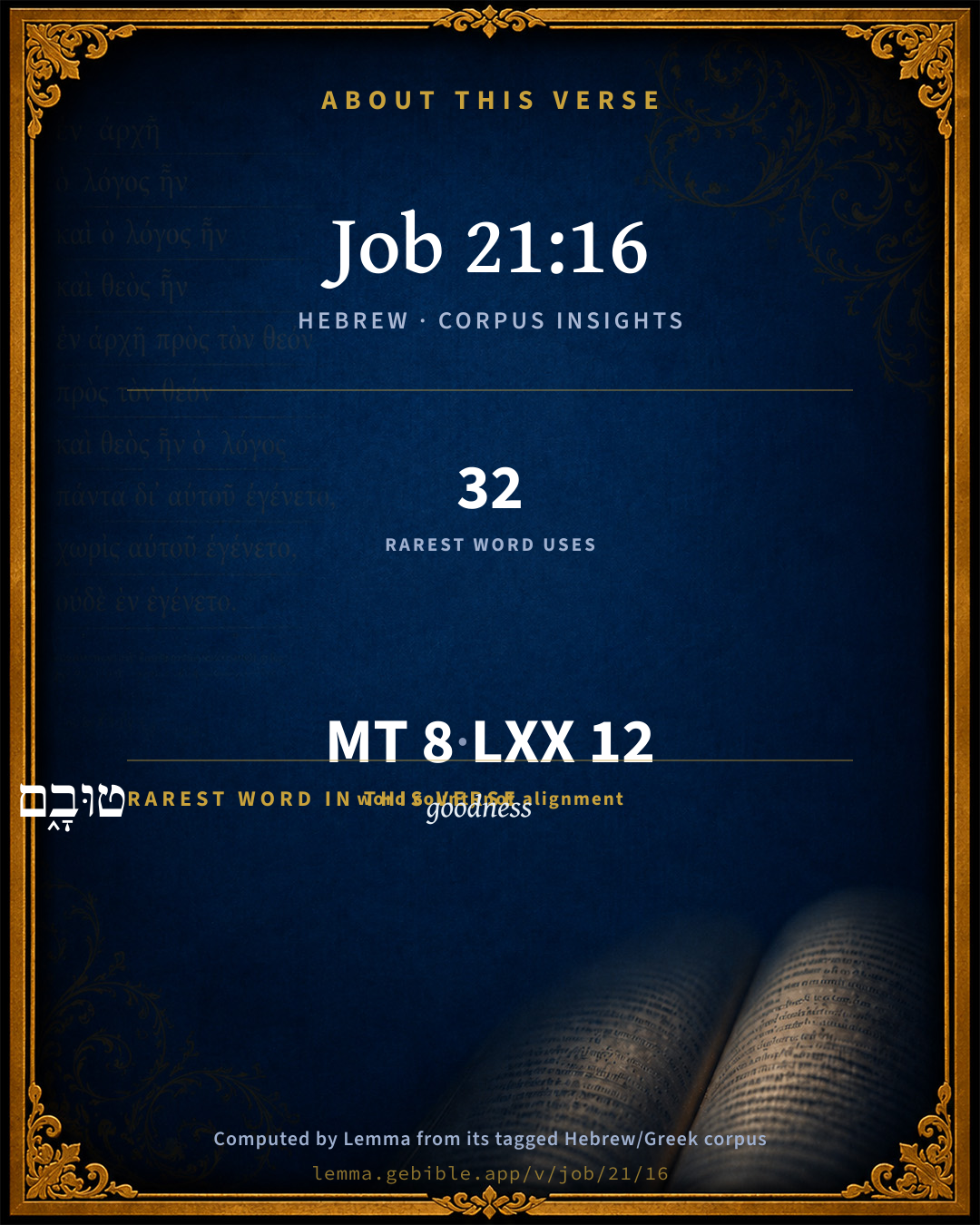
טוּבָ֑ם goodness H2898 occurs in 31 verses of the Hebrew Bible. Also found in:

Grammatical profile

  • 1 verb
  • 3 nouns
  • 1 adjective
  • 1 preposition
  • 2 particles

Verb forms

  • רָ֣חֲקָה Qal · Perfect

Hebrew & Septuagint length

In English translation the verse runs 17 words from the Hebrew and 17 from the Septuagint (LXX English) — the same length.

A rough comparison of the two English renderings, which tokenize alike — not a word-level alignment.

Word counts can differ between the Hebrew and the Greek without any difference in meaning — e.g. the Hebrew direct-object marker אֵת has no separate Greek word, and Greek often adds the article ὁ.

In the original languages it is 8 Hebrew tokens and 12 Greek tokens — but the two are counted differently (Hebrew bundles its prefixes and suffixes into one token; the Greek is in lemma form), so that isn’t a like-for-like length.

Cross-references

12

Topical passages linked to Job 21:16 in the Treasury of Scripture Knowledge — connected by theme and wording, ordered by reader-vote popularity; previews shown in the World English Bible.

  • Job 22:18 Yet he filled their houses with good things, But the counsel of the wicked is far from me.
  • Psalms 1:1 Blessed is the man who doesn't walk in the counsel of the wicked, Nor stand in the way of sinners, Nor sit in the seat of scoffers;
  • Genesis 49:6 My soul, don't come into their council; My glory, don't be united to their assembly; For in their anger they killed a man, In their self-will they hamstrung an ox.
  • Psalms 49:6–7 Those who trust in their wealth, And boast in the multitude of their riches--
  • Psalms 52:5–7 God will likewise destroy you forever. He will take you up, and pluck you out of your tent, And root you out of the land of the living. Selah.
  • Proverbs 1:10 My son, if sinners entice you, don't consent.
  • Job 1:21 He said, "Naked I came out of my mother's womb, and naked shall I return there. Yahweh gave, and Yahweh has taken away. Blessed be the name of Yahweh."
  • Job 12:9–10 Who doesn't know that in all these, The hand of Yahweh has done this,
  • Proverbs 5:8 Remove your way far from her. Don't come near the door of her house,
  • Ecclesiastes 8:8 There is no man who has power over the spirit to contain the spirit; neither does he have power over the day of death. There is no discharge in war; neither shall wickedness deliver those who practice it.
  • Luke 16:2 He called him, and said to him, 'What is this that I hear about you? Give an accounting of your management, for you can no longer be manager.'
  • Luke 16:25 "But Abraham said, 'Son, remember that you, in your lifetime, received your good things, and Lazarus, in like manner, bad things. But now here he is comforted and you are in anguish.

Cross-references courtesy of OpenBible.info (CC BY 4.0).

Hebrew and Greek witnesses Masoretic Hebrew ↔ Greek Septuagint

The same verse in the two great witnesses to the Old Testament, shown verse-for-verse.

These are two independent witnesses, not word-aligned to each other, and the Septuagint is shown in lemma (dictionary) form.

Hebrew Job 21:16 Masoretic · Westminster Leningrad Codex

הֵ֤ן לֹ֣א בְיָדָ֣ם טוּבָ֑ם עֲצַ֥ת רְ֝שָׁעִ֗ים רָ֣חֲקָה מֶֽנִּי

Behold, their prosperity is not in their hand: The counsel of the wicked is far from me.

World English Bible · Public Domain

Greek LXX Job 21:16 Septuagint · lemma form

ἐν χείρ γάρ εἰμί αὐτός ὁ ἀγαθός ἔργον δέ ἀσεβής οὐ ἐπιὁράω

For their good things were in their hands, but he regards not the works of the ungodly.

LXX2012 (modern English Septuagint) · Public Domain

On this verse, Haydock's Catholic Bible Commentary discusses the Septuagint’s reading. Read the note in Commentary ↓

Hebrew: Westminster Leningrad Codex (CC BY 4.0). Greek: Septuagint (public domain); English from LXX2012 (modern English Septuagint) (Public Domain). How the Septuagint differs from the Hebrew →

Commentary

Notes on Job 21:16 from classic Christian and Jewish commentators (each source and its license shown beneath its notes). The classic Christian expositions comment on the surrounding passage and are grouped to its opening verse, so a note may address several verses; the Jewish commentaries on the Tanakh (Rashi and others) are per-verse, so they appear only where the commentator wrote on this verse.

Lemma curates 59 commentaries, every one of them public domain or Creative Commons licensed, each selected and text-cleaned for this edition rather than reprinted as found. About our sources →

Trapp's Complete Commentary

John Trapp

Job 21:16 Lo, their good [is] not in their hand: the counsel of the wicked is far from me.

Ver. 16. Lo, their good is not in their hand] That is, they are not enriched by their own industry, prudence, piety, &c., but God hath exalted them thus, that he may bring them down again with the greater poise; so some sense the text. Others thus, Their good is not in their hand; that is, they are no masters of them, but are mastered by them; they are servants to their wealth, as the Persian kings were to their wives or concubines, Captivarum suarum captivi (Plut.). And as those stall fed beasts in the Gospel, the recusant guests, I mean, that had bought farms, oxen, &c., or rather were bought of them. - Difficile est opibus non tradere mores. Others make this the sense, and I concur with them, These wicked rich men, buried in a bog of security, condemn God, as if they had their happiness in their own hands, and were petty gods within themselves. But they are deceived. All is in God’s hand, who can take away their wealth when he pleaseth. These men may fall sooner than they rose, since they subsist merely by God’s manutension, and he may do with his own as he wishes.

The counsel of the wicked is far from me] I am so far from envying their prosperity, that I cannot approve of their course of life, for all their wealth. I am not of their judgment, I like not of their way. O my soul, come not thou into their secret. Let their money perish with them (said that noble Italian convert, Caracciolus, to a Jesuit who tempted him with a great sum), who esteem all the gold in the world worth one day’s society with Jesus Christ and his Holy Spirit; and cursed be that religion for ever and ever.

John Trapp, A Commentary or Exposition upon All the Books of the Old and New Testament (1647–1656) — public domain. Text from a community e-Sword module.

Joseph Benson's Commentary

Job 21:16. Lo, their good is not in their hand — These words, says Chappelow, will be more consistent with what goes before, if read with an interrogation; namely, Lo, is not their good in their hand? that is, Is not every thing in their power? Do they not enjoy whatever they desire? To this purpose, he observes, is Sol. Jarchi’s comment. Most commentators, however, read the words without an interrogation, which is certainly more agreeable to the Hebrew text. And Poole, with Henry and several others, consider them as containing an answer to the foregoing questions, and a confutation of the ungodly opinion and practice mentioned Job 21:14-15, as if he had said, Wicked men have no reason to reject God, because of their prosperity, for their wealth is not in their hand; neither obtained nor kept by their own might, but only by God’s power and favour. Therefore I am far from approving their opinion, or following their course. “After the foregoing elegant description of the prosperity of some wicked men,” says Dr. Dodd, “Job proceeds, on the other hand, to confess what was likewise apparent in the ways of Providence, that some of them were as remarkably distinguished by their wretchedness, being exposed to the most dreadful evils and calamities. He knew that while he had been recounting the prosperity of the wicked, he had touched upon a tender point, to which his adversaries would be apt to give a wrong turn, as if he had been pleading the cause of iniquity. He therefore guards against their entertaining any idea of that kind, in this verse, in which he speaks to this purpose: ‘Do not imagine that because I say the wicked sometimes prosper, therefore, I believe their prosperity to be owing to themselves, or in their own hand or power. God forbid that I should give such a countenance to impiety! No; though they may thus presumptuously imagine with themselves, I am not of their opinion, nor yet of their society; the counsel of the wicked is far from me — I know that all the happiness that they can boast is merely by the will and sufferance of Almighty God, and that sometimes he is pleased to make them terrible examples of his justice.’” Of which he speaks in the following verses to Job 21:21.

Joseph Benson's Commentary on the Old and New Testaments (1811–1818) — public domain. Text from a community e-Sword module.

Geneva Bible (1599)

Geneva Bible translators

It is not their own, but God only lendeth it unto them.

God keep me from their prosperity.

Geneva Bible (1599) marginal notes — public domain. Text via Bolls.life.

Jamieson, Fausset & Brown

Robert Jamieson, A. R. Fausset & David Brown

not in their hand--but in the hand of God. This is Job's difficulty, that God who has sinners prosperity (good) in His hand should allow them to have it.

is--rather, "may the counsel of the wicked be far from me!" [UMBREIT]. This naturally follows the sentiment of the first clause: Let me not hereby be thought to regard with aught but horror the ways of the wicked, however prosperous.

Jamieson, Fausset & Brown — Commentary Critical and Explanatory on the Whole Bible (1871) — public domain (CC PDM 1.0). Text via the HelloAO Bible API.

Adam Clarke's Commentary

Verse 16. Their good is not in their hand] With all their boasting and self-dependence, God only lends them his bounty; and though it appears to be their own, yet it is at his disposal. Some of the wicked he permits to live and die in affluence, provided it be acquired in the ordinary way of his providence, by trade, commerce, &c. Others he permits to possess it for a while only, and then strips them of their illegally procured property.

The counsel of the wicked is far from me.] Some understand the words thus: "Far be it from me to advocate the cause of the wicked." I have nothing in common with them, and am not their apologist. I state a fact: they are often found in continual prosperity. I state another fact: they are often found in wretchedness and misery.

Adam Clarke's Commentary on the Bible (1810–1826) — public domain. Text from a community e-Sword/MySword module.

Ellicott's Commentary for English Readers

(16) Lo, their good (i.e., their prosperity) is not in their own hand.—And that constitutes the mystery of it, for it is God who gives it to them; or the words may be a hypothetical answer to his statement, thus, “Lo, thou repliest, their prosperity is not,” &c.; and then the words, “the counsel of the wicked is far from me,” are Job’s indignant repudiation of all knowledge of their reasoning.

A Bible Commentary for English Readers, edited by Charles John Ellicott (1878–1897) — public domain. Text from a community e-Sword module.

The Cambridge Bible for Schools and Colleges

gen. ed. J. J. S. Perowne

16. Finally Job adverts to the mystery: this prosperity of theirs does not depend upon themselves, it is not of their own making; it comes from another, from God. God prospers the wicked, and Job had elsewhere said that He mocked at the despair of the innocent, Job_9:23.

the counsel of the wicked is far] Or, perhaps, the counsel of the wicked be far from me! Having drawn in such attractive colours the prosperity of the wicked, a prosperity given from the hand of God, Job, even in the midst of his own misery, which is also from God, cannot refrain from repudiating their principles—far be from me the counsel (see ch. Job_10:3, Job_18:7) of the wicked, cf. ch. Job_22:18. The above seems the most simple and effective way of understanding this verse. Others take it as an objection of the three friends, which Job anticipates and answers; Lo! say ye, their good is not in their own hand; the meaning being that they cannot retain it, they have no certainty of tenure of it, it will speedily desert them (Hitzig). To this Job is then supposed to reply in the following verses: How often, then, is it seen to desert them? This gives a very good sense.

The Cambridge Bible for Schools and Colleges (gen. ed. J. J. S. Perowne; Cambridge University Press, 1878–1918) — public domain. Text from a community e-Sword module.

John Gill's Exposition

How oft is the candle of the wicked put out?.... Job here returns, as Jarchi observes, to his former account of the constant and continued prosperity of wicked men; and puts questions tending to prove the same. Bildad had said, that the light and candle of the wicked would be put out, Job 18:5. Job, referring to this, asks how often this is the case; meaning, by the candle of the wicked, not his soul or spirit, which cannot be put out, or become extinct, as to be no more; nor the light of nature in his soul, though that may be put out in a great measure, and he be given up to judicial blindness and hardness of heart; but either his natural life, which, like a candle, burns for a while, and then becomes extinct, or rather his outward prosperity and happiness: if the question relates to the former, to the natural life of wicked men, it is not whether they die, that is no question; all die, good and bad; but whether they die in common sooner than others, or whether the instances of the brevity of the life of wicked men were frequent, or but seldom; or, is this always the case? it is not, it is rare, and not common; they live as long as other men, and oftentimes longer; they live and become old, as Job before observes; they prolong their days in their wickedness; or, if this refers to the latter, the prosperity of the wicked, the question is, is that for the most part a short lived prosperity? it is not, it is but rarely so; wicked men generally spend all their days in wealth, as before observed; so Ramban interprets "how oft", that is, how seldom; and to the same sense Mr. Broughton,

"not so often is the candle of the wicked put out;''

and how oft cometh their destruction upon them? not eternal, but temporal destruction, calamities and distresses; these are threatened them, but they are not executed on them immediately; and therefore their hearts are set in them to do evil: generally speaking, they have their good things here; they are filled with hidden treasure, which they enjoy while they live, and leave the rest of their substance to their babes; they are not destroyed on every side, as Job was; their substance, their cattle, their servants, their children, and their own health. Job asks how often this is their case, as had been his; and his sense is, and what experience testifies, it is but rarely the, case of wicked men; he seems to refer to what is said, Job 18:12.

God distributeth sorrows in his anger; or rather, "how oft doth he distribute sorrows in his anger?" but seldom; he is angry with the wicked every day, and reserves wrath for them, and many sorrows shall be to them, but not for the present; those are future, and even such as of a woman in travail, as the word used signifies, and which shall come upon them suddenly and certainly, and there will be no avoiding them; see Psa 32:10; but does God frequently distribute or portion out sorrows to them now? he does not; they have their portion of good things in this life; does he usually give them sorrow of heart, his curse unto them? he does not; it is very seldom he does; they are not in trouble, nor plagued as other men; they are not men of sorrows and acquainted with griefs; they are generally strangers to them, and live merrily all their days, Job 21:12; respect seems to be had to the conclusion of Zophar's speech, Job 20:29.

John Gill's Exposition of the Whole Bible (1746–1763) — public domain (CC PDM 1.0). Text via the HelloAO Bible API.

Albert Barnes' Notes on the Bible

Lo, their good is not in their hand - Schultens, Rosenmuller, and Noyes, suppose, I think, correctly, that this is to be understood ironically, or as referring to what “they” had maintained. “Lo! you say, that their good is not in their hand! They do not enjoy prosperity, do they? They are soon overwhelmed with calamity, are they? How often have I seen it otherwise! How often is it a fact that they continue to enjoy prosperity, and live and die in peace!” The common interpretation, which Prof. Lee has adopted, seems to me to be much less probable. According to that it means that “their prosperity was not brought about or preserved by their own power. It was by the power of God, and was under his control. An inscrutable Providence governs all things.” But the true sense is, that Job is replying to the arguments which they had advanced, and one of those was, that whatever prosperity they had was not at all secure, but that in a moment it might be, and often was, wrested from them. Job maintains the contrary, and affirms that it was a somewhat unusual occurrence Job 21:17, that the wicked were plunged into sudden calamity. The phrase “in their hand” means “in their power,” or under their control, and at their disposal.

The counsel of the wicked is far from me - Or, rather, “far be it from me!” Perhaps the meaning is this, “Do not misunderstand me. I maintain that the wicked are often prospered, and that God does not in this life deal with them according to their deserts. They have life, and health, and property. But do not suppose that I am their advocate. Far be it from me to defend them. Far from me be their counsels and their plans. I have no sympathy with them. But I maintain merely that your position is not correct that they are always subjected to calamity, and that the character of people can always be known by the dealings of Providence toward them.” Or, it may mean, that he was not disposed to be united with them. They were, in fact, prospered; but though they were prospered, he wished to have no part in their plans and counsels. He would prefer a holy life with all the ills that might attend it.

Albert Barnes' Notes on the Bible (1834–1885) — public domain. Text from a community e-Sword/MySword module.

Haydock's Catholic Bible Commentary

Because, is not in Hebrew. "Lo, their good is not." They are not possessed of true riches, or of good sense. Alexandrian Septuagint, "For good things were in their hands: but the works of the impious are not pure." No: the more they possess, the greater is their perversity. Grabe substitutes Greek: oukathora, for Greek: kathara; God "does not behold" the works, &c., which is more conformable to the other editions; and thus the blasphemies of the impious are continued. (Haydock) --- When we are not sensible of our wants and dependance, we think less on God. (Calmet) --- Hand, or power, they are only the gifts of God; far be then such sentiments from me. (Calmet)

George Leo Haydock (1774–1849), Haydock's Catholic Family Bible and Commentary, 1859 edition — public domain. Excludes Psalms (Douay-Rheims chapter numbering differs from Protestant) and Deuterocanonical books (Catholic canon only).

Matthew Poole's English Annotations

Their good is not in their hand: this seems to be an answer to the foregoing question, and a confutation of that ungodly opinion and practice, Job 21:14,15. Wicked men (saith he) have no reason to neglect and reject God because of their prosperity, for their good, i.e. all their wealth and felicity, is not

in their hand, i.e. it neither was obtained nor can be kept by their own might, but only by God’s power and favour, upon whom they wholly depend for it. Or the sense is, Though they have riches, and power, and glory in their hands, yet their true and proper good is not in their hand, i.e. they are destitute of that in which their true happiness lies, to wit, in God’s love and favour; and all the comforts which they enjoy are attended with God’s wrath and curse, and therefore not to be envied by any man in his wits. They say to God, Depart from us, when indeed their true and only felicity consists in the enjoyment of him: compare Psa 4:6,7.

The counsel of the wicked is far from me; therefore I am far from approving their opinion, or following their course, or enjoying their prosperity, or desiring to partake of their delicates upon such terms.

Matthew Poole's English Annotations on the Holy Bible (1683–1685) — public domain. Text from a community e-Sword/MySword module.

Whedon's Commentary on the Bible

Daniel D. Whedon

16. Their good — This verse is parenthetical. Notwithstanding their godlessness, God gives them good. (The same word as wealth in Job_21:13.) He, not they, is the author of their happiness, which to Job is an astounding feature of moral government. Astounded at himself, he adds, The counsel of the wicked, far be it from me! (Job_22:18.) Job’s exclamation is of great moment in its bearing upon the problem of the book. (Job_1:11; Job_2:5.) Instead of repudiating God, he repudiates the entire counsel and views (עצה) of the wicked. Right in the midst of the whirlpool we still see the brow of the rock, and feel it is immovable.

Daniel D. Whedon (gen. ed.), Commentary on the Old and New Testaments (1874–1909) — public domain. Text from a community e-Sword module.

The Pulpit Commentary

Lo, their good is not in their hand; i.e. their prosperity is not in their own power, not the result of their own efforts. God"s providence is, at least, one element in it, since he exalts men and abases them, he casteth down and lifteth up. Hence it would seem to follow that they are his favourites. Shall Job therefore cast in his lot with them? No, he says, a thousand times, No! The counsel of the wicked is far from me; or better, be the counsel of the wicked far from me! I will have nothing to do with it. I will cling to God. I will maintain my integrity. Satan had charged Job with serving God for the sake of temporal reward. Job had disproved the charge by still clinging to God, notwithstanding all his afflictions. Now he goes further, and declines to throw in his lot with the wicked, even although it should appear that the balance of prosperity is with them.

The Pulpit Commentary (1880–1919), ed. H.D.M. Spence-Jones & Joseph S. Exell — public domain. Text from a community e-Sword module.

John Wesley's Explanatory Notes

Lo - But wicked men have no reason to reject God, because of their prosperity, for their wealth, is not in their hand; neither obtained, nor kept by their own might, but only by God's power and favour. Therefore I am far from approving their opinion, or following their course.

John Wesley, Explanatory Notes Upon the Whole Bible (1754–1765) — public domain. Text via the GEBible commentary corpus.

unfoldingWord translationNotes

Door43 World Missions Community

Connecting Statement:

Job continues speaking to his friends.

See, is not their prosperity in their own hands?

Here "hands" refers to their power or control. Job uses this question to challenge his friends. AT: "Look, these wicked people claim that they make themselves prosper!" (See: Metonymy and Rhetorical Question)

How often is it ... their calamity comes upon them?

Job uses this question to emphasize that it seems to him that God does not punish the wicked very often. AT: "It is not often ... their calamity comes upon them." (See: Rhetorical Question)

the lamp of wicked people is put out

Job compares extinguishing the lamp to a person dying. This can be stated in active form. AT: "that God causes them to die suddenly" (See: Metaphor and Active or Passive)

the lamp of wicked people

Job compares the life of the wicked to a lamp that is burning. (See: Metaphor)

How often does it happen ... in his anger?

Job uses this second question to emphasize that it seems to him that God does not punish the wicked very often. AT: "It is not often ... in his anger." (See: Rhetorical Question)

How often is it ... the storm carries away?

Job uses this third question to emphasize that it seems to him that God does not punish the wicked very often. AT: "It is not often ... the storm carries away." (See: Rhetorical Question)

they become like stubble before the wind or like chaff that the storm carries away

The death of the wicked is spoken of as if they were worthless less chaff and stubble that blows away. This can be stated in active form. AT: "God takes them away like the wind blows away the chaff" (See: Simile and Active or Passive)

translationWords

prosper

hand

advice

evil

lamp

anger

chaff

unfoldingWord translationNotes — © Distant Shores Media and the Door43 World Missions Community, licensed CC BY-SA 4.0. Source: git.door43.org/Door43/en_tn.

Rashi

Rabbi Shlomo Yitzchaki (Rashi)

Behold, is not their prosperity in their hand This is a question: Is not all their prosperity in their hand?

The counsel of the wicked has distanced itself from me Job was boasting that he saw them [the wicked] and was not counted among them.

Rashi on the Tanakh — English translations: “The Judaica Press complete Tanach with Rashi, translated by A. J. Rosenberg” (CC BY 4.0); “Pentateuch with Rashi's commentary by M. Rosenbaum and A.M. Silbermann, 1929-1934” (public domain); “The Metsudah Tanach series, Lakewood, N.J” (CC BY 4.0); and “The Book of Joshua, Metsudah Publications, 1997” (CC BY 4.0). Text via Sefaria.

Lesson kit

Teaching starters — assembled from the data on this page, not authored interpretation. Every prompt links to the verse data it draws on. Edit before teaching.

Job, in the Wisdom, opens this verse with 8 words (8 distinct Hebrew lemmas). Its most distinctive word is ṭûwb (“goodness”). A historical commentator’s framing appears above. Read the whole chapter for the surrounding context.

Discussion questions

  1. How does “goodness” (ṭûwb) shape what this verse is saying?
  2. How does Genesis 24:10, which shares the word «goodness», read alongside this verse?
  3. These translations render this verse differently; the difference is in the English rendering, not the original. What questions does that raise?
  4. «רָ֣חֲקָה» is a Qal Perfect verb. How does that grammatical form shape the action described?
  5. Compare how Trapp's Complete Commentary and Joseph Benson's Commentary read this verse. Where do they agree or differ?

Things to notice

Reading settings

Reading text

Shown beneath each verse's original-language words.

Old Testament
Old Testament edition

Read the OT as the Masoretic Hebrew (MT) or the Greek Septuagint (LXX).

English shown for the Greek Septuagint (in the Hebrew ↔ Greek comparison).

Comparing translations? Open the Compare panel on any verse page to stack up to four side by side.