
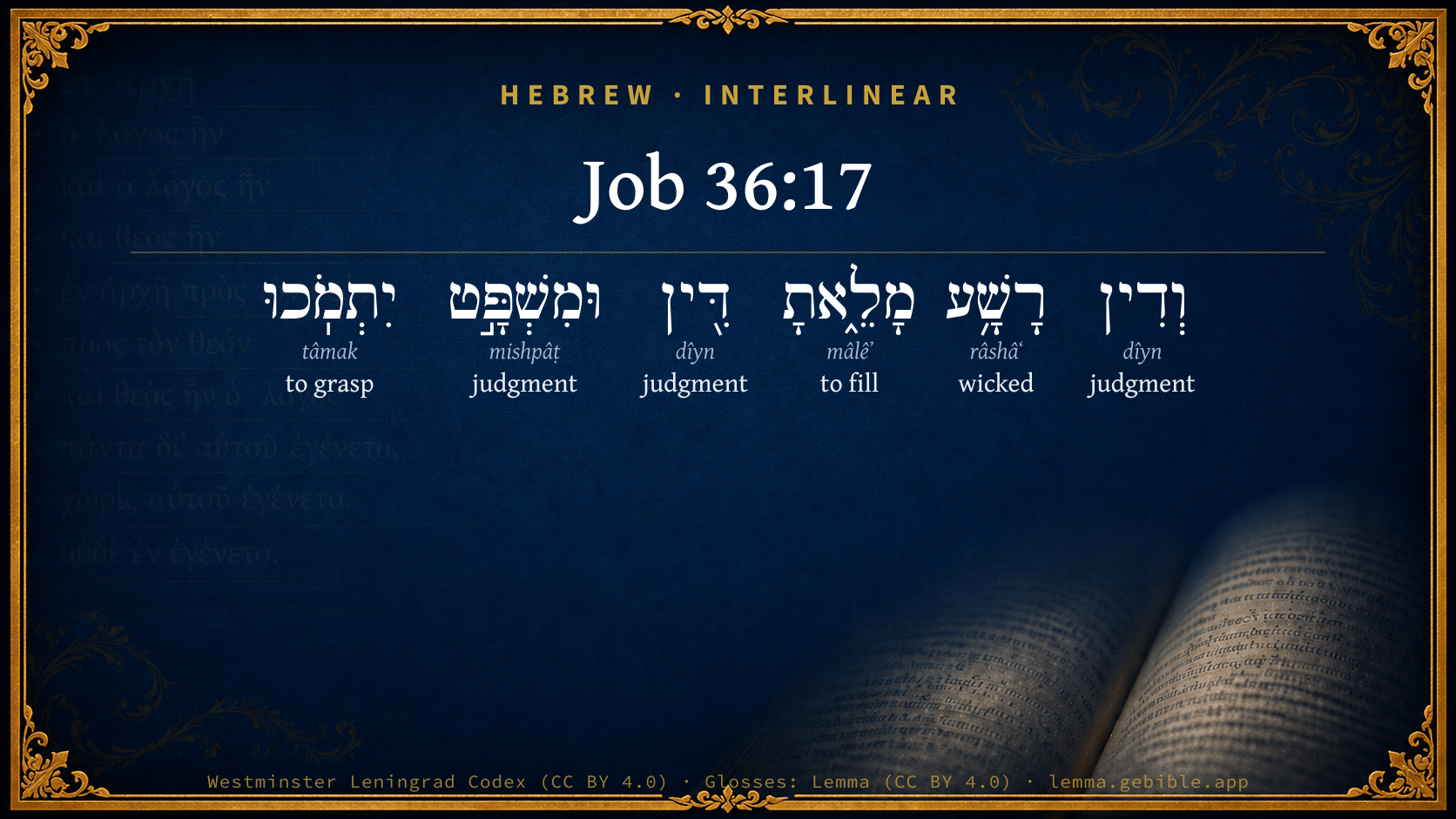
Job 36:17

Hebrew (Westminster Leningrad Codex) Job 36:17 appears in the Hebrew Old Testament. The text above is from the Westminster Leningrad Codex. Each word links to its Strong’s number, a concise gloss, and parsing drawn from the Open Scriptures Hebrew Bible morphology. Click any word for its full Brown-Driver-Briggs (BDB) entry.
Download image
Cite this verse

Job 36:17 (World English Bible). Public Domain. Lemma interlinear Bible study tool, https://lemma.gebible.app/v/job/36/17.

Show BibTeX & RIS
BibTeX
RIS
English Translation
"But you are full of the judgment of the wicked. Judgment and justice take hold of you.
World English Bible · Public Domain
Download a study sheet

One document with this verse’s original text, its word-by-word gloss line, the meaning frame, cross-references with their text, attributed commentary, and full source and license credits — printable, and it pastes into notes with its structure intact.

This verse Autodidact and up

Study sheet (.html) Plain text (.txt)

A passage Seminary Student

Up to 50 verses in one chapter. A passage sheet keeps up to 6 commentary sources and 12 cross-references per verse, in the order this page ranks them, and says so on the sheet whenever that leaves anything out. Ask for a single verse and you get the Autodidact verse sheet above.

Everything on this page stays free to read, with no account — the sheet is a download of what is already on screen, not access to it.

Want to remove ads? Support Godless Engineer
Compare translations 3

The same verse in 3 English versions, stacked beneath the original-language interlinear above. Click any original word for its lexicon entry.

Each is an independent rendering of the whole verse — the interlinear is not word-aligned to these translations.

Highlighted words mark where these versions differ — a whole-verse word diff, not a word-by-word alignment.

  • World English Bible Public Domain
    "But you are full of the judgment of the wicked. Judgment and justice take hold of you.
  • King James Version Public Domain
    But thou hast fulfilled the judgment of the wicked: judgment and justice take hold on thee.
  • unfoldingWord Literal Text CC BY-SA 4.0
    But you are full of the judgment of the wicked; judgment and justice take hold.

unfoldingWord Literal Text — © unfoldingWord, licensed CC BY-SA 4.0. Word-aligned USFM3 via Door43 (git.door43.org/unfoldingWord/en_ult).

Versions to compare (up to 4)

3 of 4 selected

Show all 18 translations

Every available English version of this verse, each an independent rendering of the whole verse.

  • World English Bible Public Domain
    "But you are full of the judgment of the wicked. Judgment and justice take hold of you.
  • Berean Standard Bible Public Domain
    But now you are laden with the judgment due the wicked; judgment and justice have seized you.
  • Majority Standard Bible Public Domain
    But now you are laden with the judgment due the wicked; judgment and justice have seized you.
  • King James Version Public Domain
    But thou hast fulfilled the judgment of the wicked: judgment and justice take hold on thee.
  • American Standard Version (1901) Public Domain
    But thou art full of the judgment of the wicked: Judgment and justice take hold `on thee'.
  • Revised Version (1885) Public Domain
    But thou art full of the judgment of the wicked: judgment and justice take hold on thee.
  • Geneva Bible (1599) Public Domain
    But thou art ful of the iudgement of the wicked, though iudgement and equitie maintaine all things.
  • Douay-Rheims (1899) Public Domain
    Thy cause hath been judged as that of the wicked, cause and judgment thou shalt recover.
  • Young's Literal Translation Public Domain
    And the judgment of the wicked thou hast fulfilled, Judgment and justice are upheld -- because of fury,
  • Literal Standard Version CC BY-SA 4.0
    And you have fulfilled the judgment of the wicked, || Judgment and justice are upheld because of fury,
  • Unlocked Literal Bible CC BY-SA 4.0
    But you are full of judgment on wicked people; judgment and justice have laid hold of you.
  • unfoldingWord Literal Text CC BY-SA 4.0
    But you are full of the judgment of the wicked; judgment and justice take hold.
  • Darby Bible Public Domain
    But thou art full of the judgments of the wicked: judgment and justice take hold [on thee].
  • World Messianic Bible Public Domain
    “But you are full of the judgment of the wicked. Judgment and justice take hold of you.
  • Webster's Bible Public Domain
    But thou hast fulfilled the judgment of the wicked: judgment and justice take hold on thee.
  • Free Bible Version CC BY-SA 4.0
    But you are preoccupied with the fate of the wicked; judgment and justice fill your mind.
  • Bible in Basic English Public Domain
    ...
  • JPS Tanakh (1917) Public Domain
    And thou art full of the judgment of the wicked; judgment and justice take hold on them.

Literal Standard Version (2020), Covenant Press — licensed CC BY-SA 4.0. Text via the HelloAO Bible API (eBible.org). Unlocked Literal Bible (unfoldingWord) — licensed CC BY-SA 4.0. Text via the HelloAO Bible API (eBible.org). unfoldingWord Literal Text — © unfoldingWord, licensed CC BY-SA 4.0. Word-aligned USFM3 via Door43 (git.door43.org/unfoldingWord/en_ult). Free Bible Version, Dr. Jonathan Gallagher — licensed CC BY-SA 4.0. Text via the HelloAO Bible API (eBible.org).

Word by word

More ways to search: Search by grammar → Find every occurrence → Compare this word →

Practice this passage: Drill this verse → Learn its vocabulary →

About this verse

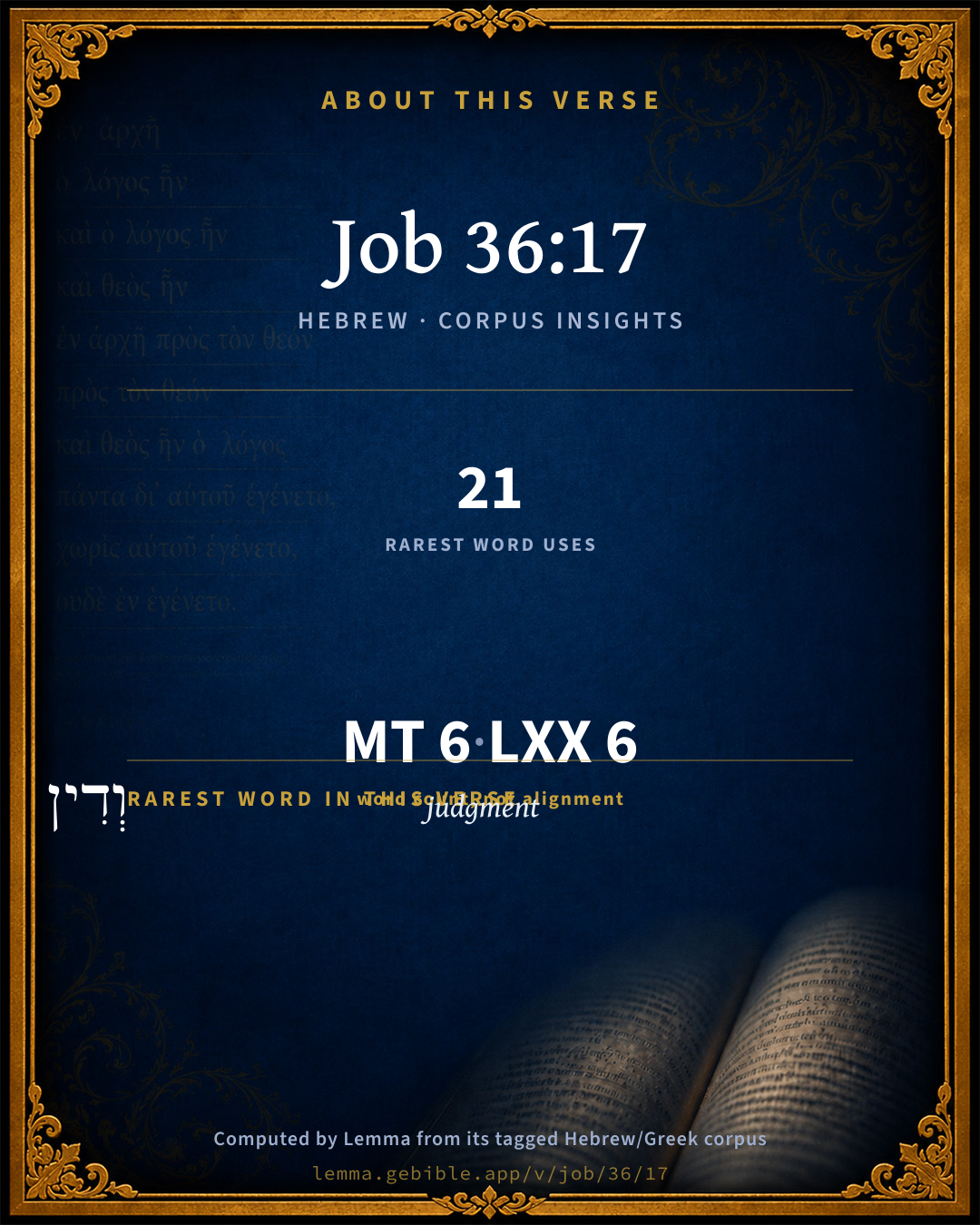
These counts appear in no published source. They are computed here, from the morphology-tagged text and Lemma’s own curated glosses. What Lemma adds →

6
words
5
distinct lemmas
Wisdom
section

Notable vocabulary

The rarest word here is וְדִין judgment H1779 — appearing just 21 times in the whole Hebrew Bible.

Shared distinctive vocabulary

וְדִין judgment H1779 occurs in 17 verses of the Hebrew Bible. Also found in:

Grammatical profile

  • 2 verbs
  • 3 nouns
  • 1 adjective

Verb forms

  • מָלֵ֑אתָ Qal · Perfect
  • יִתְמֹֽכוּ Qal · Imperfect

Repetition

A word recurs within this verse — often emphatic in Hebrew:

  • וְדִין judgment H1779 ×2

Hebrew & Septuagint length

In English translation the verse runs 17 words from the Hebrew and 26 from the Septuagint (LXX English) — the Septuagint runs noticeably longer here. See the side-by-side →

A rough comparison of the two English renderings, which tokenize alike — not a word-level alignment.

Word counts can differ between the Hebrew and the Greek without any difference in meaning — e.g. the Hebrew direct-object marker אֵת has no separate Greek word, and Greek often adds the article ὁ.

In the original languages it is 6 Hebrew tokens and 6 Greek tokens — but the two are counted differently (Hebrew bundles its prefixes and suffixes into one token; the Greek is in lemma form), so that isn’t a like-for-like length.

Cross-references

6

Topical passages linked to Job 36:17 in the Treasury of Scripture Knowledge — connected by theme and wording, ordered by reader-vote popularity; previews shown in the World English Bible.

  • Romans 1:32 who, knowing the ordinance of God, that those who practice such things are worthy of death, not only do the same, but also approve of those who practice them.
  • Revelation 18:4 I heard another voice from heaven, saying, "Come out of her, my people, that you have no participation in her sins, and that you don't receive of her plagues,
  • Job 16:5 But I would strengthen you with my mouth. The solace of my lips would relieve you.
  • Job 22:11 Or darkness, so that you can not see, And floods of waters cover you.
  • Job 34:8 Who goes in company with the workers of iniquity, And walks with wicked men?
  • Job 34:36 I wish that Job were tried to the end, Because of his answering like wicked men.

Cross-references courtesy of OpenBible.info (CC BY 4.0).

Hebrew and Greek witnesses Masoretic Hebrew ↔ Greek Septuagint

The same verse in the two great witnesses to the Old Testament, shown verse-for-verse.

Here the Septuagint runs noticeably longer than the Hebrew — LXX2012 (modern English Septuagint) 26 words vs World English Bible 17. A rough length comparison of the two English translations, not a word-level alignment — read both below.

These are two independent witnesses, not word-aligned to each other, and the Septuagint is shown in lemma (dictionary) form.

Hebrew Job 36:17 Masoretic · Westminster Leningrad Codex

וְדִין רָשָׁ֥ע מָלֵ֑אתָ דִּ֖ין וּמִשְׁפָּ֣ט יִתְמֹֽכוּ

"But you are full of the judgment of the wicked. Judgment and justice take hold of you.

World English Bible · Public Domain

Greek LXX Job 36:17 Septuagint · lemma form

οὐ ὑστερέω δέ ἀπό δίκαιος κρίμα

there is a deep gulf and a rushing stream beneath it, and your table came down full of fatness. Judgment shall not fail from the righteous;

LXX2012 (modern English Septuagint) · Public Domain

Hebrew: Westminster Leningrad Codex (CC BY 4.0). Greek: Septuagint (public domain); English from LXX2012 (modern English Septuagint) (Public Domain). How the Septuagint differs from the Hebrew →

Commentary

Notes on Job 36:17 from classic Christian and Jewish commentators (each source and its license shown beneath its notes). The classic Christian expositions comment on the surrounding passage and are grouped to its opening verse, so a note may address several verses; the Jewish commentaries on the Tanakh (Rashi and others) are per-verse, so they appear only where the commentator wrote on this verse.

Lemma curates 59 commentaries, every one of them public domain or Creative Commons licensed, each selected and text-cleaned for this edition rather than reprinted as found. About our sources →

Trapp's Complete Commentary

John Trapp

Job 36:17 But thou hast fulfilled the judgment of the wicked: judgment and justice take hold [on thee].

Ver. 17. But thou hast fulfilled the judgment of the wicked] But thou contrariwise blusterest against God, and blurtest out such words, that thou seemest to be as bad as the worst, and to have little or no goodness in thee. See Job 34:8. It is a shame to God’s holy people to symbolize with the wicked, to be carnal in their speeches or carriages, and to walk as men, 2Co 3:3. They should so speak and so do as those that shall be judged by the law of liberty, Jas 2:12.

Judgment and justice take hold of thee] Thou art worthily attached by the Divine justice, which thou hast quarrelled.

John Trapp, A Commentary or Exposition upon All the Books of the Old and New Testament (1647–1656) — public domain. Text from a community e-Sword module.

Joseph Benson's Commentary

Job 36:17. But thou hast fulfilled the judgment of the wicked — Or, the cause, or sentence, as the word דיןdin, most properly signifies. Thou hast fully pleaded their cause, and justified the hard speeches which wicked men utter against God. Therefore the just judgment of God takes hold on thee. Thou hast maintained their cause against God, and God passes against thee the sentence of condemnation due to wicked men.

Joseph Benson's Commentary on the Old and New Testaments (1811–1818) — public domain. Text from a community e-Sword module.

Geneva Bible (1599)

Geneva Bible translators

Thou art altogether after the manner of the wicked: for thou dost murmur against the justice of God.

Geneva Bible (1599) marginal notes — public domain. Text via Bolls.life.

Jamieson, Fausset & Brown

Robert Jamieson, A. R. Fausset & David Brown

Rather, "But if thou art fulfilled (that is, entirely filled) with the judgment of the wicked (that is, the guilt incurring judgment" [MAURER]; or rather, as UMBREIT, referring to Job 34:5-7, Job 34:36, the judgment pronounced on God by the guilty in misfortunes), judgment (God's judgment on the wicked, Jer 51:9, playing on the double meaning of "judgment") and justice shall closely follow each other [UMBREIT].

Jamieson, Fausset & Brown — Commentary Critical and Explanatory on the Whole Bible (1871) — public domain (CC PDM 1.0). Text via the HelloAO Bible API.

Adam Clarke's Commentary

Verse 17. But thou hast fulfilled the judgment of the wicked] As thou art acting like the wicked, so God deals with thee as he deals with them.

Elihu is not a whit behind Job's other friends. None of them seems to have known any thing of the permission given by God to Satan to afflict and torment an innocent man.

Adam Clarke's Commentary on the Bible (1810–1826) — public domain. Text from a community e-Sword/MySword module.

The Cambridge Bible for Schools and Colleges

gen. ed. J. J. S. Perowne

17. The A. V. takes this verse positively; it is more suitable to the connexion and purpose of the speaker to understand it conditionally—if thou art filled with, or as A. V. fulfillest. To be full of, or to fulfil, the judgment of the wicked, is to join the wicked in their judgment of God when He afflicts, to lay up wrath against God (Job_36:13), an idea immediately taken up in Job_36:18. If Job acts in this way, as he is too much inclined (Job_36:21), then judgment and justice shall keep hold on him. God’s condemnation of him will reveal itself in the continuance and increase of his chastisement (cf. Job_36:13-14, ch. Job_5:1 seq.). The word “judgment” is used in the one clause of man’s, and in the other of God’s judgment, making a forcible antithesis.

The Cambridge Bible for Schools and Colleges (gen. ed. J. J. S. Perowne; Cambridge University Press, 1878–1918) — public domain. Text from a community e-Sword module.

John Gill's Exposition

But thou hast fulfilled the judgment of the wicked,.... Some (w) take this to be a continuation of the happiness Job would have enjoyed, had he behaved in his affliction as he ought to have done; then he would have been filled to satisfaction, by seeing the judgments of God exercised on wicked men, as on the Chaldeans and Sabeans, who had injured him: "and judgment and justice would have upheld thee"; when they should be cast down. But these words rather seem to be expressive of his present state, and the reason of it, he not being sufficiently humbled: and the sense is, not that he had lived a vicious course of life, as the wicked do, and filled up the measure of his wickedness as they; and so deserved to be filled with the like judgments as inflicted on them. Mr. Broughton reads the words,

"as thou hast fulfilled the sentence of the wicked, sentence and judgment have laid hold:''

but rather the meaning is, that he had "fulfilled the contention of the wicked" (x); pleaded as they did, argued with God after their manner: and therefore is said to go in company and walk with them, and make answers for them, Job 34:8. Wherefore

justice and judgment take hold on thee; afflictions in righteousness, or the chastening hand of God, in righteous judgment, had taken hold upon him, and would hold him until he was sufficiently humbled under them.

(w) Schmidt, Michaelis. (x) "et litem improbi implevisti", Schultens.

John Gill's Exposition of the Whole Bible (1746–1763) — public domain (CC PDM 1.0). Text via the HelloAO Bible API.

Albert Barnes' Notes on the Bible

But thou hast fulfilled the judgment of the wicked - Rosenmuller explains this as meaning, “If under divine inflictions and chastisements you wish to imitate the obduracy of the wicked, then the cause and the punishment will mutually sustain them selves; that is, the one will be commensurate with the other.” But it is not necessary to regard this as a “supposition.” It has rather the aspect of; an affirmation, meaning to express the fact that Job “had,” as Elihu feared, envinced the same spirit in his trials which the wicked do. He had not seen in him evidence of penitence and of a desire to return to God, but had heard complaints and murmurings, such as the wicked indulge in. He had “filled up,” or “fulfilled,” the judgment of the wicked; that is, he had in no way come short of the opinion which “they” expressed of the divine dealings. Still it is possible that the word “if” may be here understood, and that Elihu means merely to state that if Job should manifest the same spirit with the wicked, instead of a spirit of penitence, he would have reason to apprehend the same doom which they experience.

Judgment and justice take hold on thee - Margin, “or, should uphold thee.” The Hebrew word here rendered “take” - יתמכוּ yitmokû, is from תמך tâmak - “to take hold of, to obtain, to hold fast, to support.” Rosenmuller and Gesenius suppose that the word here has a “reciprocal” sense, and means they take hold of each other, or sustain each other. Prof. Lee renders it, “Both judgment and justice will uphold this;” that is, the sentiment which he had just advanced, that Job had filled up the judgment of the wicked. Urnbrett renders it, “If thou art full of the opinion of the wicked, then the opinion and justice will rapidly follow each other.”

Doch worm du yell bist yon des Frevlers Urtheil,

So werden Urthoil und Gericht schnell auf einander folgen.

According to this the meaning is, that if Job held the opinions of wicked people, he must expect that these opinions would be rapidly followed by judgment, or that they would go together, and support each other. This seems to me to be in accordance with the connection, and to express the thought which Elihu meant to convey. It is a sentiment which is undoubtedly true - that if a man holds the sentiments, and manifests the spirit of the wicked, he must expect to be treated as they are.

Albert Barnes' Notes on the Bible (1834–1885) — public domain. Text from a community e-Sword/MySword module.

Haydock's Catholic Bible Commentary

Recover. Thou shalt be treated as thou hast treated others. Hebrew is not well understood. It may be, "Thou hast spoken like the impious; but judgment and justice rule. (18) Beware lest wrath overtake thee, so that thy prayers may not avert it. (19) Will He regard thy cries, thy riches, gold or strength?" (Calmet)

George Leo Haydock (1774–1849), Haydock's Catholic Family Bible and Commentary, 1859 edition — public domain. Excludes Psalms (Douay-Rheims chapter numbering differs from Protestant) and Deuterocanonical books (Catholic canon only).

Matthew Poole's English Annotations

The judgment; or, the cause, or sentence, as the word most properly signifieth. Thou hast fully pleaded their cause, and justified the hard and reproachful speeches which wicked men in their rage utter against God, condemning God and justifying themselves.

Judgment and justice take hold on thee; or, therefore (which is oft understood) the sentence and judgment (or, the judicial sentence, to wit, of the wicked now mentioned) shall take hold on thee. Thou hast maintained their cause against God, and God shall pass against thee their sentence, or the sentence of condemnation due to such wicked men.

Matthew Poole's English Annotations on the Holy Bible (1683–1685) — public domain. Text from a community e-Sword/MySword module.

Whedon's Commentary on the Bible

Daniel D. Whedon

17. But thou hast fulfilled — But if thou art filled with the judgment of the wicked, then will judgment and justice take hold, (on thee,) or, as others read, “hold fast together,” that is, being closely joined, they will prove inseparable. For him whose mind is filled with the judgment, דין, of the wicked, who makes “answers for wicked men,” (Job_34:36,) judgment, דין, and justice wait; an element of retributive justice, like for like. “He whom thou presumest to judge with words will judge thee indeed.” — Schlottmann.

Daniel D. Whedon (gen. ed.), Commentary on the Old and New Testaments (1874–1909) — public domain. Text from a community e-Sword module.

The Pulpit Commentary

But thou hast fulfilled the judgment of the wicked; i.e. but, as thou hast not so acted, the result has been different. Thy hardness and impenitence have brought upon thee the judgments reserved by God for the wicked judgment and justice take hold on thee thou art suffering the just penalty of thy obstinacy.

The Pulpit Commentary (1880–1919), ed. H.D.M. Spence-Jones & Joseph S. Exell — public domain. Text from a community e-Sword module.

John Wesley's Explanatory Notes

The judgment - Or, the sentence, thou hast justified the hard speeches which wicked men utter against God. Therefore - Therefore the just judgment of God takes hold on thee. Thou hast maintained their cause against God, and God passes against thee the sentence of condemnation due to wicked men.

John Wesley, Explanatory Notes Upon the Whole Bible (1754–1765) — public domain. Text via the GEBible commentary corpus.

unfoldingWord translationNotes

Door43 World Missions Community

you are full of judgment on wicked people

Possible meanings are 1) "God is punishing you as he would punish the wicked" or 2) "you are obsessed with the judgment that the wicked deserve."

judgment and justice have laid hold of you

Elihu speaks of God judging Job and giving him justice as if judgment and justice were people that have laid hold of Job. AT: "God has brought you to judgment and given you justice" (See: Personification)

Do not let your anger entice you to mockery

Some versions of the Bible translate this as "Beware that you are not enticed by wealth."

translationWords

judge

evil

just

bribe

unfoldingWord translationNotes — © Distant Shores Media and the Door43 World Missions Community, licensed CC BY-SA 4.0. Source: git.door43.org/Door43/en_tn.

Rashi

Rabbi Shlomo Yitzchaki (Rashi)

And if you have had your fill of the sentence of the wicked And if you have had your fill of the sufferings of the wicked, the judgment and the sentence—which are [represented by] the sufferings—will support you in the future from Gehinnom, and you must accept them lovingly.

Rashi on the Tanakh — English translations: “The Judaica Press complete Tanach with Rashi, translated by A. J. Rosenberg” (CC BY 4.0); “Pentateuch with Rashi's commentary by M. Rosenbaum and A.M. Silbermann, 1929-1934” (public domain); “The Metsudah Tanach series, Lakewood, N.J” (CC BY 4.0); and “The Book of Joshua, Metsudah Publications, 1997” (CC BY 4.0). Text via Sefaria.

Lesson kit

Teaching starters — assembled from the data on this page, not authored interpretation. Every prompt links to the verse data it draws on. Edit before teaching.

Job, in the Wisdom, opens this verse with 6 words (5 distinct Hebrew lemmas). Its most distinctive word is dîyn (“judgment”). The Greek Septuagint runs longer here. A historical commentator’s framing appears above. Read the whole chapter for the surrounding context.

Discussion questions

  1. What does “judgment” (dîyn) contribute to the verse as a whole?
  2. Deuteronomy 17:8 shares the word «judgment» with this verse. How do the two illuminate each other?
  3. “judgment” occurs 2× in this one verse. What is the effect of the repetition?
  4. Compared with the Hebrew, the Septuagint runs longer here. What questions does that raise?
  5. These translations render this verse differently. What is at stake in choosing one wording over another?
  6. The verb «מָלֵ֑אתָ» is Qal Perfect. How does its form color the action?
  7. Reading how Trapp's Complete Commentary and Joseph Benson's Commentary read this verse, where do the two commentators agree and where do they part?

Things to notice

Reading settings

Reading text

Shown beneath each verse's original-language words.

Old Testament
Old Testament edition

Read the OT as the Masoretic Hebrew (MT) or the Greek Septuagint (LXX).

English shown for the Greek Septuagint (in the Hebrew ↔ Greek comparison).

Comparing translations? Open the Compare panel on any verse page to stack up to four side by side.