

Proverbs 10:28

Hebrew (Westminster Leningrad Codex) Proverbs 10:28 appears in the Hebrew Old Testament. The text above is from the Westminster Leningrad Codex. Each word links to its Strong’s number, a concise gloss, and parsing drawn from the Open Scriptures Hebrew Bible morphology. Click any word for its full Brown-Driver-Briggs (BDB) entry.
Download image
Cite this verse

Proverbs 10:28 (World English Bible). Public Domain. Lemma interlinear Bible study tool, https://lemma.gebible.app/v/proverbs/10/28.

Show BibTeX & RIS
BibTeX
RIS
English Translation
The prospect of the righteous is joy, But the hope of the wicked will perish.
World English Bible · Public Domain
Download a study sheet

One document with this verse’s original text, its word-by-word gloss line, the meaning frame, cross-references with their text, attributed commentary, and full source and license credits — printable, and it pastes into notes with its structure intact.

This verse Autodidact and up

Study sheet (.html) Plain text (.txt)

A passage Seminary Student

Up to 50 verses in one chapter. A passage sheet keeps up to 6 commentary sources and 12 cross-references per verse, in the order this page ranks them, and says so on the sheet whenever that leaves anything out. Ask for a single verse and you get the Autodidact verse sheet above.

Everything on this page stays free to read, with no account — the sheet is a download of what is already on screen, not access to it.

Want to remove ads? Support Godless Engineer
Compare translations 3

The same verse in 3 English versions, stacked beneath the original-language interlinear above. Click any original word for its lexicon entry.

Each is an independent rendering of the whole verse — the interlinear is not word-aligned to these translations.

Highlighted words mark where these versions differ — a whole-verse word diff, not a word-by-word alignment.

  • World English Bible Public Domain
    The prospect of the righteous is joy, But the hope of the wicked will perish.
  • King James Version Public Domain
    The hope of the righteous shall be gladness: but the expectation of the wicked shall perish.
  • unfoldingWord Literal Text CC BY-SA 4.0
    The hope of the righteous ones joy, but the expectation of the wicked ones will perish.

unfoldingWord Literal Text — © unfoldingWord, licensed CC BY-SA 4.0. Word-aligned USFM3 via Door43 (git.door43.org/unfoldingWord/en_ult).

Versions to compare (up to 4)

3 of 4 selected

Show all 18 translations

Every available English version of this verse, each an independent rendering of the whole verse.

  • World English Bible Public Domain
    The prospect of the righteous is joy, But the hope of the wicked will perish.
  • Berean Standard Bible Public Domain
    The hope of the righteous is joy, but the expectations of the wicked will perish.
  • Majority Standard Bible Public Domain
    The hope of the righteous is joy, but the expectations of the wicked will perish.
  • King James Version Public Domain
    The hope of the righteous shall be gladness: but the expectation of the wicked shall perish.
  • American Standard Version (1901) Public Domain
    The hope of the righteous `shall be' gladness; But the expectation of the wicked shall perish.
  • Revised Version (1885) Public Domain
    The hope of the righteous shall be gladness: but the expectation of the wicked shall perish.
  • Geneva Bible (1599) Public Domain
    The patient abiding of the righteous shall be gladnesse: but the hope of the wicked shall perish.
  • Douay-Rheims (1899) Public Domain
    The expectation of the just is joy; but the hope of the wicked shall perish.
  • Young's Literal Translation Public Domain
    The hope of the righteous `is' joyful, And the expectation of the wicked perisheth.
  • Literal Standard Version CC BY-SA 4.0
    The hope of the righteous [is] joyful, || And the expectation of the wicked perishes.
  • Unlocked Literal Bible CC BY-SA 4.0
    The hope of righteous people is their joy, but the years of wicked people will be short.
  • unfoldingWord Literal Text CC BY-SA 4.0
    The hope of the righteous ones joy, but the expectation of the wicked ones will perish.
  • Darby Bible Public Domain
    The hope of the righteous is joy; but the expectation of the wicked shall perish.
  • World Messianic Bible Public Domain
    The prospect of the righteous is joy, but the hope of the wicked will perish.
  • Webster's Bible Public Domain
    The hope of the righteous shall be gladness: but the expectation of the wicked shall perish.
  • Free Bible Version CC BY-SA 4.0
    Good people look forward to happiness, but the hopes of the wicked come to nothing.
  • Bible in Basic English Public Domain
    The hope of the upright man will give joy, but the waiting of the evil-doer will have its end in sorrow.
  • JPS Tanakh (1917) Public Domain
    The hope of the righteous is gladness; but the expectation of the wicked shall perish.

Literal Standard Version (2020), Covenant Press — licensed CC BY-SA 4.0. Text via the HelloAO Bible API (eBible.org). Unlocked Literal Bible (unfoldingWord) — licensed CC BY-SA 4.0. Text via the HelloAO Bible API (eBible.org). unfoldingWord Literal Text — © unfoldingWord, licensed CC BY-SA 4.0. Word-aligned USFM3 via Door43 (git.door43.org/unfoldingWord/en_ult). Free Bible Version, Dr. Jonathan Gallagher — licensed CC BY-SA 4.0. Text via the HelloAO Bible API (eBible.org).

Word by word

More ways to search: Search by grammar → Find every occurrence → Compare this word →

Practice this passage: Drill this verse → Learn its vocabulary →

About this verse

These counts appear in no published source. They are computed here, from the morphology-tagged text and Lemma’s own curated glosses. What Lemma adds →

6
words
6
distinct lemmas
Wisdom
section

Notable vocabulary

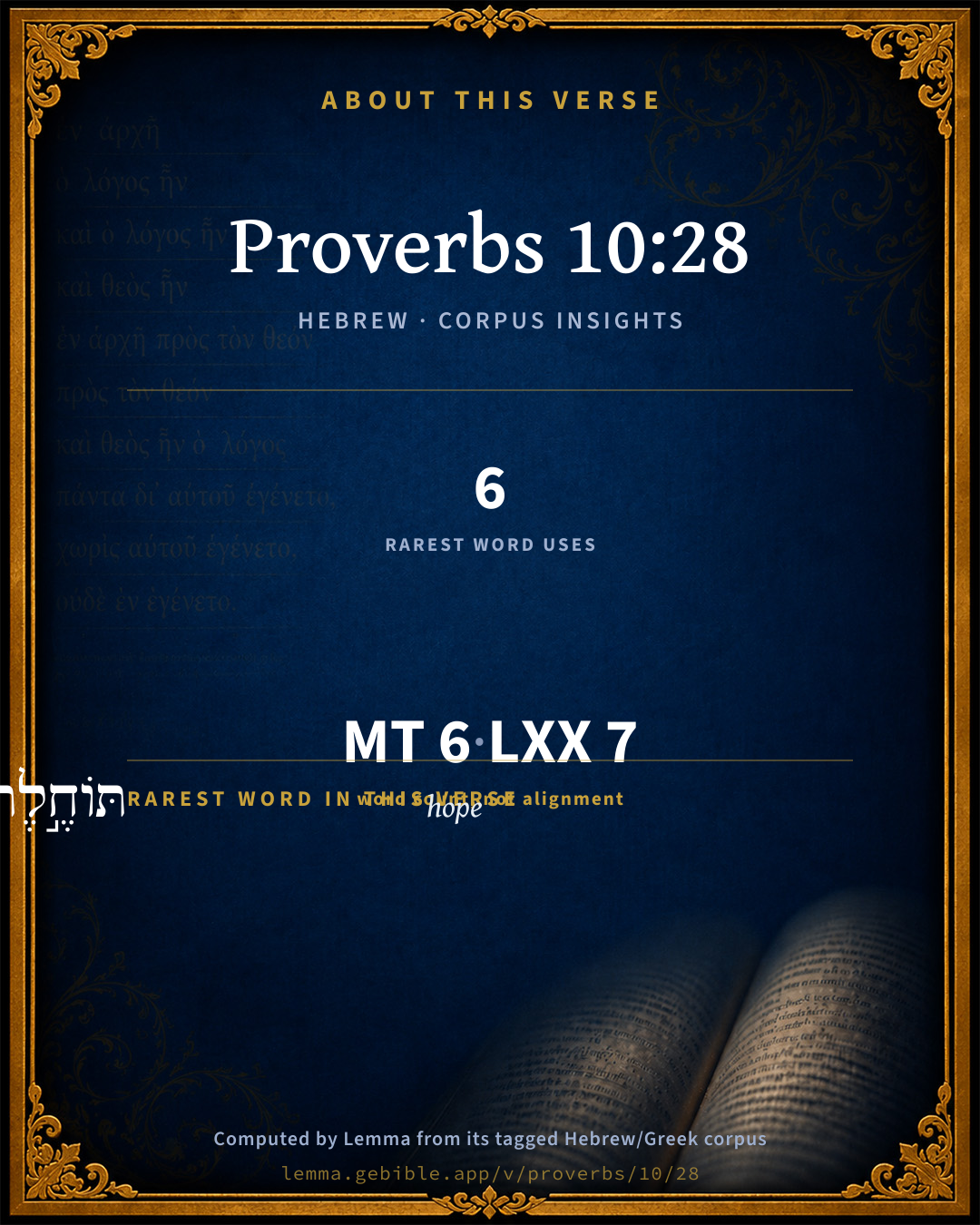
The rarest word here is תּוֹחֶ֣לֶת hope H8431 — appearing just 6 times in the whole Hebrew Bible.

Shared distinctive vocabulary

תּוֹחֶ֣לֶת hope H8431 occurs in 6 verses of the Hebrew Bible. Also found in:

Grammatical profile

  • 1 verb
  • 3 nouns
  • 2 adjectives

Verb forms

  • תֹּאבֵֽד Qal · Imperfect

Hebrew & Septuagint length

In English translation the verse runs 15 words from the Hebrew and 14 from the Septuagint (LXX English) — closely comparable.

A rough comparison of the two English renderings, which tokenize alike — not a word-level alignment.

Word counts can differ between the Hebrew and the Greek without any difference in meaning — e.g. the Hebrew direct-object marker אֵת has no separate Greek word, and Greek often adds the article ὁ.

In the original languages it is 6 Hebrew tokens and 7 Greek tokens — but the two are counted differently (Hebrew bundles its prefixes and suffixes into one token; the Greek is in lemma form), so that isn’t a like-for-like length.

Cross-references

12

Topical passages linked to Proverbs 10:28 in the Treasury of Scripture Knowledge — connected by theme and wording, ordered by reader-vote popularity; previews shown in the World English Bible.

  • Job 8:13 So are the paths of all who forget God. The hope of the godless man shall perish,
  • Psalms 73:24–26 You will guide me with your counsel, And afterward receive me to glory.
  • Romans 15:13 Now may the God of hope fill you with all joy and peace in believing, that you may abound in hope, in the power of the Holy Spirit.
  • Proverbs 11:7 When a wicked man dies, hope perishes, And expectation of power comes to nothing.
  • Job 11:20 But the eyes of the wicked shall fail, They shall have no way to flee; Their hope shall be the giving up of the spirit."
  • Psalms 112:10 The wicked will see it, and be grieved. He shall gnash with his teeth, and melt away. The desire of the wicked will perish.
  • Proverbs 14:32 The wicked is brought down in his calamity, But in death, the righteous has a refuge.
  • Romans 5:2 through whom we also have our access by faith into this grace in which we stand. We rejoice in hope of the glory of God.
  • Romans 12:12 rejoicing in hope; enduring in troubles; continuing steadfastly in prayer;
  • 2 Thessalonians 2:16 Now our Lord Jesus Christ himself, and God our Father, who loved us and gave us eternal comfort and good hope through grace,
  • Psalms 16:9 Therefore my heart is glad, and my tongue rejoices. My body shall also dwell in safety.
  • Luke 16:23–26 In Hades, he lifted up his eyes, being in torment, and saw Abraham far off, and Lazarus at his bosom.

Cross-references courtesy of OpenBible.info (CC BY 4.0).

Hebrew and Greek witnesses Masoretic Hebrew ↔ Greek Septuagint

The same verse in the two great witnesses to the Old Testament, shown verse-for-verse.

These are two independent witnesses, not word-aligned to each other, and the Septuagint is shown in lemma (dictionary) form.

Hebrew Proverbs 10:28 Masoretic · Westminster Leningrad Codex

תּוֹחֶ֣לֶת צַדִּיקִ֣ים שִׂמְחָ֑ה וְתִקְוַ֖ת רְשָׁעִ֣ים תֹּאבֵֽד

The prospect of the righteous is joy, But the hope of the wicked will perish.

World English Bible · Public Domain

Greek LXX Proverbs 10:28 Septuagint · lemma form

ἐνχρονίζω δίκαιος εὐφροσύνη ἐλπίς δέ ἀσεβής ὄλλυμι

Joy rests long with the righteous: but the hope of the ungodly shall perish.

LXX2012 (modern English Septuagint) · Public Domain

On this verse, The Pulpit Commentary discusses the Septuagint’s reading. Read the note in Commentary ↓

Hebrew: Westminster Leningrad Codex (CC BY 4.0). Greek: Septuagint (public domain); English from LXX2012 (modern English Septuagint) (Public Domain). How the Septuagint differs from the Hebrew →

Commentary

Notes on Proverbs 10:28 from classic Christian and Jewish commentators (each source and its license shown beneath its notes). The classic Christian expositions comment on the surrounding passage and are grouped to its opening verse, so a note may address several verses; the Jewish commentaries on the Tanakh (Rashi and others) are per-verse, so they appear only where the commentator wrote on this verse.

Lemma curates 59 commentaries, every one of them public domain or Creative Commons licensed, each selected and text-cleaned for this edition rather than reprinted as found. About our sources →

Trapp's Complete Commentary

John Trapp

Pro 10:28 The hope of the righteous [shall be] gladness: but the expectation of the wicked shall perish.

Ver. 28. The hope of the righteous shall be gladness.] The righteous doth not so fear God, {Pro 10:2; Pro 10:7} but that he hopes in him also; - see Psa 130:4-5 : - and that with such a hope as "maketh not ashamed." Deo confisi nunquam confusi: "The righteous hath hope in his death"; {Pro 14:32} his motto is, Cum expiro, spero; - My hope lasts beyond life.

But the expectations of the wicked.] As Esau came from hunting, with his head full of hopes, but went away with his heart full of blanks, and his face full of blushing.

John Trapp, A Commentary or Exposition upon All the Books of the Old and New Testament (1647–1656) — public domain. Text from a community e-Sword module.

The Biblical Illustrator

Joseph S. Exell

Pro_10:28

The hope of the righteous shall be gladness.

On hopes and disappointments

I. We are not to expect permanence in our acquisitions. On the lot of some men Providence is pleased to bestow a longer continuance of prosperity than on that of others. But as the term of that continuance is hidden from us, all flattering and confident expectations are without foundation. Human life never stands still for any long time. It is by no means a fixed and steady object, like a mountain or rock. Nor is it a still, smooth stream with the same constant tenor. Amid such vicissitudes of time and life, who has any title to reckon upon the future? To faults all are subject, to troubles all are exposed. To look for entire exemption from faults or troubles is to court disappointment. We must not, however, sadden the present hour by dwelling on the thoughts of future disappointment. What is given us, let us cheerfully enjoy, and render thanks to Him who bestows it. Virtue, conjoined with prudence, may reasonably afford the prospect of good days to come.

II. We are not to expect, from our intercourse with others, all that satisfaction which we fondly wish. What the individual either enjoys or suffers by himself, exhibits only an imperfect view of his condition. In the present state of human affairs we are closely interwoven with one another. These associations open a field within which our wishes and expectations find an ample range. Among persons of all characters and descriptions many an expectation must perish, and many a disappointment be endured. All are jealous of the high pretensions of others. Hence the endless mortifications which the vain and self-conceited suffer. Hence the spleen and resentment which is so often breaking forth, disturbing the peace of society and involving it in crimes and miseries. Were expectations more moderate they would be more favourably received. Did we more rarely attempt to push ourselves into notice the world would more readily allow us, nay, sometimes assist us to come forward, in the closer connections which men form of intimate friendship and domestic life there is still more reason for due moderation in our expectations and hopes. For the nearer that men approach to each other, the more numerous the points of contact are in which they touch, the greater indeed will be the pleasure of perfect symphony and agreements of feelings; but, at the same time, if any harsh and repulsive sensations take place, the more grating and pungent will be the pain. From trifling misunderstandings, arising from the most frivolous causes, spring much of the misery of social and domestic life.

III. We are not to expect constant gratitude from those whom we have most obliged and served. Grateful sensations for favours received are very generally felt. When no strong passions counteract these sensations, grateful returns are generally intended, and often are actually made. But then our expectations of proper returns must be kept within moderate bounds. Many circumstances, it is to be remembered, tend to cool the grateful emotion. Time always deadens the memory of benefits. As benefits conferred are sometimes underrated by those who receive them, they are sometimes overvalued by those who confer them. On persons of light and careless minds no moral sentiment makes any deep impression. With the proud spirit, which claims everything as its due, gratitude is in a great measure incompatible. On the other hand--

IV. Whatever course the affairs of the world take, the good man may justly hope to enjoy peace of mind. To the sceptic and the profligate this will be held as a very inconsiderable object of expectation and hope. But surely the peace of an approving conscience is one of the chief ingredients of human happiness, if it be tempered with true humility, and regulated by Christian faith! He, whose study it is to preserve a conscience void of offence towards God and man, will have, in every state of fortune, a ground of hope which may justly be denominated gladness. He has always somewhat to rest upon for comfort.

V. A good man has ground to expect that any external condition into which, in the course of human affairs, he may pass, shall, by means of virtue and wisdom, be rendered, if not perfectly agreeable, yet tolerably easy to him. The inequality of real happiness is not to be measured by the inequality of outward estate. The wise and good man hopes to find, or make, his state tolerable to himself. In some corner of our lot there are always comforts that may be found. And the spirit of man will long sustain his infirmities.

VI. we have ground to expect, from the ordinary course of human affairs, that if we persevere in studying to do our duty towards God and man, we shall meet with the esteem, the love, and confidence of those who are around us. In regard to moral qualifications the world is ready to do justice to character. No man is hurt by hearing his neighbour esteemed a worthy and honourable man. The basis of all lasting reputation is laid in moral worth. Great parts and endowments may sparkle for a while in the public eye. Candour and fairness never fail to attract esteem and trust. The world commonly judges soundly in the end. The good man is likely to possess many friends and well-wishers, and to have few enemies. This subject, in its treatment, has been limited to what the righteous man has to hope for in the ordinary course of the world. But it has to be added that there is a hope laid up for him in heaven. He knows that in due season he shall reap if he faint not. For here, or yonder, his hope is perpetual gladness. (Hugh Blair,D.D.)

The hope of the righteous

The righteous here meant are those right with God.

I. Its foundation is good: The righteous is an everlasting foundation (Pro_10:25), therefore not swept away, as too often the hopes of the wicked.

II. the righteous shall never be moved (Pro_10:30). Confidence in this brings gladness to the Christians heart.

III. No removal by death from God. The character they bear is a security against death. Righteousness delivereth from death (Pro_10:2).

IV. The fact that the righteous have an almighty keeper and provider makes their hope one of gladness.The Lord will not suffer the soul of the righteous to famish (Pro_10:3).

V. Thus we see the labour of the righteous tendeth to life (Pro_10:16). Careful, thoughtful, systematic in whatever employment he chooses, he so works that the labour itself promotes life.

VI. Thus another reason why the hope of the righteous is gladness is the assurance: the desire of the righteous shall be granted.

VII. Thus another reason for his gladness: the lips of the righteous feed many (Pro_10:21). The righteous man, being a student of the Word of God, and treasuring His precepts in the heart, is able to employ his lips in feeding many.

VIII. In the use of his lips to bless others another reason is found for his gladness: The lips of the righteous know what is acceptable (Pro_10:32) The right words are spoken to the helpfulness of others and to the glory of God.

IX. A final reason for the hope of the righteous bringing gladness is found in that his resources are unfailing: The mouth of the righteous man is a well of life (Pro_10:11). He has in himself a living well, and a well as drawn from is life-giving. Such is the assurance of the Master: The words that I speak unto you, they are spirit, and they are life (Joh_6:63). (G. H. Morss.)

The hope of the righteous best

The expectation of the man who has his portion in this life is continually deteriorating; for every hour brings him nearer to the loss of all his treasures. But the good hope through grace is always approaching its realities, and therefore grows with the lapse of time more valuable and more lively. As it is spiritual in its quality, and heavenly in its object, it does not depend on outward things, and is not affected with the decays of nature. Like the Glastonbury thorn, it blossoms in the depth of winter. The hope of the one is a treasure out at interest which is continually augmenting; that of the other resembles stock, the capital of which has been continually invaded, until the last pound is ready to be consumed. (H. G. Salter.)

The hopes of the righteous, and of the wicked

No subject is of so much importance to man as religion. On no subject is it so desirable that right views should be possessed. Yet in religion to what extremes of formalism and folly, absurdity and asceticism, men proceed. Multitudes identify religion with a tiresome routine of forms and ceremonies. And many build their hopes of heaven on the groundwork of austerities. In one direction we see men placing religion in little more than a name, regardless of all the duties and dispositions and devotions of which it consists. In another direction our attention is arrested by people who are so ascetic as to think it sinful to smile. The text contains a powerful corrective of all those false impressions of religion which moody and soured examples of it may have produced.

I. The character depicted. The righteous. Not one who fulfils every requirement of Gods law; nor one strictly honest in dealing with his fellow-men. If sinful man is to be righteous before his Maker, he must be so--

1. By Divine imputation.

2. By spiritual renovation.

3. By habitual practice. We demand a lustrous manifestation of probity as well as piety. Good works are as essential to salvation as a sound creed and a changed heart.

II. The Divine possession of this character. We are justified in describing this hope as Divine, because--

1. It has a Divine Author.

2. A Divine foundation.

3. A Divine tendency.

III. The blessed fruit of this Divine possession. Gladness.

IV. The awful contrast which the text presents. A contrast in character, and in destiny. (E. Dewhirst.)

The Biblical Illustrator, edited by Joseph S. Exell (c. 1880s–1900s) — public domain. Text from a community e-Sword module.

The Preacher's Complete Homiletical Commentary

Joseph S. Exell (gen. ed.)

MAIN HOMILETICS OF Pro_10:28

HOPES REALISED AND DISAPPOINTED

I. The righteous man’s present possession—“Hope.” We saw in treating Pro_10:24 that the righteous man possesses God-begotten desires, and that he has good ground for believing that these desires will be granted, therefore he expects their fulfilment, and desire and expectation constitute his hope. Hope is a fortune in itself. It gives a present gladness, and therefore a present power. It is in itself a tower of strength. Nothing upholds us so surely in present difficulties as the hope of a brighter future. If in the hour of darkness a man can say to his soul, “Why art thou cast down, and why art thou disquieted within me? hope thou in God” (Psa_42:5), he holds in possession a sheet-anchor which will prevent him from making shipwreck upon the rocks of despair and infidelity. The hope of the righteous is a present salvation. “We are saved by hope” (Rom_8:24). It is “an anchor of the soul” (Heb_6:19).

II. The righteous man’s future inheritance—gladness. If the hope of an expected good gives gladness, how much more its realisation! A man is glad when the title deeds of an estate are handed over to him even if he cannot at once enter upon its possession, how much more glad is he when he enters into the full enjoyment of his inheritance. The righteous man’s hope is a more certain guarantee of his future inheritance of gladness than the most indisputable deed ever written upon parchment. It is as we saw before (see on Pro_10:24) an earnest of its own fulfilment. The hope begotten in the heart of a child, by the inspiration of his father’s character and genius, that he may one day be like his parent, is a hope that the father himself will not disappoint. Love for his child and a regard for his own honour will impel him to do all that lies within his reach to satisfy the desire—to fulfil the expectation—of his child. If, in addition, he was able to promise the child that his hope should be realised, nothing could acquit him of his obligation to perform his promise except inability. The Eternal Father has by His spirit and by His promise begotten such a hope within His children and “begotten them” unto the hope (1Pe_1:3). This is “the hope” of the righteous, and the character and the omnipotence of Him who gave it birth is a sure pledge that it shall be “gladness.” Closely connected with it are the hopes of the coming of God’s kingdom, and of the “adoption of the body” (Rom_8:23), noticed in considering “the desire of the righteous.”

III. The doom of the expectation of the ungodly man. If the wicked man has fears concerning the future (see on Pro_10:24), he has also vague hopes concerning it, although his desires and expectations are chiefly in relation to the present world. As to his desires of a state of happiness after death, they are not strong enough to lead him to comply with the conditions of entering upon it. Any expectation of this nature can be based upon nothing outside himself, and it must therefore perish. His expectation of the results of his own earthborn and devilish schemes will also perish. He may apparently bring them to a successful issue, but the end will show that it is not so. If he succeeds in gaining wealth or power, he will not get what he expected out of them. Any expectation which he forms as to the overthrow of the good will meet with the same doom. Pharaoh expected to be able to retain the Hebrews in bondage, but his expectation was broken to shivers upon the shield of Eternal Omnipotence. The chief priests and scribes expected to stamp out the name and the influence of the Nazarene by crucifying Him, but the result contradicted their expectations. In these instances may be seen a reflection of the doom of every expectation which is out of harmony with righteousness.

OUTLINES AND SUGGESTIVE COMMENTS

Christian! make sure the ground of your hope (2Pe_1:10). Then set out its gladness as becomes an heir of glory. Let not a drooping spirit tell the world the scantiness of your hope. But show that you can live upon its gladness until you enter into its perfect and everlasting fruition. Doubtfulness leaves believers and infidels nearly upon the same level.—Bridges.

The proverb means literally—“The hope of the righteous (itself) turns to joy.” Faith is the begining of felicity.… The expectation or “assurance” of the impenitent man, even if he finds it well placed, “perishes” as of its very nature. “The world passes away and the desire thereof.” The lost may have had all he wished, but his very wishes perish at the last day (1Jn_2:17).—Miller.

All the hopes of the wicked shall not bring him to heaven; all the fears of the righteous shall not bring him to hell.—Bunyan.

It would be better for “hope” and “expectation” to change places. Even the expectant waiting of the righteous is joyful at the time, and ends in joy; the eager hope of the wicked comes to nought (comp. Job_8:13).—Plumptre.

The wicked cannot choose but fear, and, therefore, Eliphaz says of a wicked man, the sound of fear is in his ears (Job_15:21). And in Isaiah (Pro_20:17) they are compared to the troubled sea, which cannot rest. And because where fear is, it is some ease to think, if not to hope, that the evil feared may not fall upon them; this ease is taken away, for the fear shall come. Come it shall, as it were of itself without sending for, because it is most due unto them. An instance of this is given in those who lived at the time of the building of the Tower of Babel, and who saying “Let us build it lest we be scattered abroad upon the face of the whole earth,” it followeth soon after, “and the Lord scattered them upon the face of all the earth.” On the other side, the righteous having tasted of goodness cannot choose but desire it; and because where desire is, it is some trouble to think, if not to doubt, that the good desired may not be accomplished, this trouble is taken away, for He shall give who can give whatsoever Himself will, whatsoever they can desire.—Jermin.

Attachment to futurity has a remarkable influence on the operation of the human mind. The present, whatever it be, seldom engages our attention so much as what is to come. The present is apt to be considered an evanescent scene, just about to pass away; and in the midst of wishes and desires, of hopes and fears, which all respect futurity, we may be said to dwell. As on these the life of man is so much suspended, it becomes a material part of wisdom and duty to attend to any regulations by which they may be properly conducted. The anticipations of the righteous, conducted by prudence, and regulated by piety, mislead him not from his duty, and afford him satisfaction in the end. While the expectation of the wicked, arising from fantastic imaginary prospects, delude him for a while and terminate in misery. Let us consider, what we may, and what we may not, reasonably expect from the world.

I. We must not expect the uninterrupted continuance of any measure of health, prosperity, or comfort, which we now enjoy.

II. We are not to expect, from our intercourse with others, all that satisfaction which we fondly wish.… Such is the power which the sophistry of self-love exercises over us, that almost everyone may be assured that he measures himself by a deceitful scale; that he places the point of his own merit at a higher degree than others will admit that it reaches.… Were expectations more moderate, they would be more favourably received. If you look for a friend in whose temper there is not to be found the least inequality, who upon no occasion is to be hurt or offended by any frailties you discover, whose feelings are to harmonise in every trifle with yours, whose countenance is always to reflect the image of your own, you look for a pleasing phantom, which is never, or at most, very rarely, to be found; and if disappointment sour your mind, you have your own folly to blame. You ought to have considered that you live in a region of human infirmity, where everyone has imperfections and failings.

III. We are not to expect constant gratitude from those whom we have obliged and served. I am far from saying that gratitude is a rare virtue, but our expectations of proper returns must be kept within moderate bounds. We must not imagine that gratitude is to produce unlimited compliance with every desire we indulge, or that those whom we have obliged will altogether desert their own interest for the sake of their benefactors. I shall next show what a good man may reasonably expect from human life. I. Whatever course the affairs of the world may take, he may justly hope to enjoy peace of mind. This to the sceptic and the profligate will be held as a very inconsiderable object of hope. But, assuredly, the peace of an approving conscience is one of the chief ingredients of human happiness; provided always that this self-approbation be tempered with due humility and regulated by Christian faith. II. He has ground to expect that any external condition into which he may pass shall, by means of virtue and wisdom, be rendered if not perfectly agreeable, yet tolerably easy to him. The inequality of real happiness is not to be measured by the inequality of outward estate. A wise and good man is never left without resources by which to make his state tolerable. Seldom or never do all good things forsake a man at once. What is very severe of any kind, seldom lasts long. Time and continuance reconcile us to many things that were at first insuportable. III. We have ground to expect that, if we persevere in studying to do our duty towards God and man, we shall meet with the esteem and love of those around us. The world, as I have before observed, is seldom disposed to give a favourable reception to claims based on superior talents and merits. But, with respect to moral qualifications, the world is more ready to do justice to character. Unaffected piety commands respect. Candour never fails to attract esteem and trust. Kindness conciliates love and creates warm friendships. I have considered only what the righteous man has to hope for in the ordinary course of the world. But—IV. He has before him a much higher object of hope, even the hope which is laid up for him in heaven; the assured expectation of a better life in a higher and better world Put the case of a servant of God being overwhelmed with all the disappointments which the world can bring upon him, here is an expectation which will always be gladness.—Blair.

The Preacher's Complete Homiletical Commentary (gen. ed. Joseph S. Exell; Funk & Wagnalls, c. 1892) — public domain (pre-1929). A full-Bible homiletical/sermon-outline anthology covering 65 of 66 books (2 John is absent from the source module). Text from a community e-Sword module.

Jamieson, Fausset & Brown

Robert Jamieson, A. R. Fausset & David Brown

gladness--in confidence of realizing it.

expectation . . . perish--in disappointment.

Jamieson, Fausset & Brown — Commentary Critical and Explanatory on the Whole Bible (1871) — public domain (CC PDM 1.0). Text via the HelloAO Bible API.

Adam Clarke's Commentary

Verse 28. The expectation of the wicked shall perish.] A wicked man is always imposing on himself by the hope of God's mercy and final happiness; and he continues hoping, till he dies without receiving that mercy which alone would entitle him to that glory.

Adam Clarke's Commentary on the Bible (1810–1826) — public domain. Text from a community e-Sword/MySword module.

John Gill's Exposition

The hope of the righteous shall be gladness,.... Or, "is gladness" (w); it is now attended with joy; he has a pleasure in the exercise of the grace of hope as to future things; he rejoices in hope of the glory of God, and is enabled to hold fast the rejoicing of his hope firm unto the end, Rom 5:2; and the issue of his hope will be an abundant entrance into the joy of his Lord; a being brought into his presence, in which is fulness of joy; he is not ashamed of his hope now, and he will not be disappointed hereafter;

but the expectation of the wicked shall perish; his hope and expectation, either of riches, and honour, and pleasure in this world, or of a long life in it; or of happiness in the other, and of escaping the wrath of God, and the vengeance of eternal fire; all which, being grounded on a wrong bottom, shall be frustrated; see Job 8:13.

(w) "Est", Pagninus, Junius & Tremellius, Piscator, Michaelis.

John Gill's Exposition of the Whole Bible (1746–1763) — public domain (CC PDM 1.0). Text via the HelloAO Bible API.

Albert Barnes' Notes on the Bible

Transpose “hope” and “expectation.” The expectant waiting of the righteous is joyful at the time, and ends in joy: the eager hope of the wicked comes to nought.

Albert Barnes' Notes on the Bible (1834–1885) — public domain. Text from a community e-Sword/MySword module.

Matthew Poole's English Annotations

Shall be gladness; though at present it be mixed with doubts, and fears, and disappointments, yet at last it shall be accomplished, and turned into enjoyment.

Shall perish; shall be utterly frustrated, and so end in sorrow.

Matthew Poole's English Annotations on the Holy Bible (1683–1685) — public domain. Text from a community e-Sword/MySword module.

Whedon's Commentary on the Bible

Daniel D. Whedon

28. Shall be gladness — Shall be fulfilled, and so produce gladness. Compare Pro_11:7; Job_8:13; Job_11:20; Psa_112:10; Psalms 119; Rom_8:24; Rom_5:2; Rom_12:12; Rom_15:13; 2Th_2:16; 1Jn_3:2-3.

Daniel D. Whedon (gen. ed.), Commentary on the Old and New Testaments (1874–1909) — public domain. Text from a community e-Sword module.

The Pulpit Commentary

The hope of the righteous shall be gladness. The patient expectation of the righteous is joyful, because it has good hope of being, and is, fulfilled. So the apostle (Rom_12:12) speaks, "Rejoicing in hope, patient in tribulation." Septuagint, "Gladness delayeth for the just." The expectation of the wicked; that which the wicked eagerly hope for shall come to naught. (Pro_11:7 Job_8:13 Psa_112:10)

The hope of the righteous.

I WE ALL LIVE BY HOPE. The righteous has his "hope," the wicked his "expectation;" both live in the future. The present takes its colours chiefly from our anticipations of the future. It is dark or bright according as shadows or light fall on it from that visionary world. The man who has no hope here or hereafter is practically dead. Despair is suicide. Hence the importance of seeing to our hopes. If they are ill-grounded, all life is a mistake.

II THE LOTS OF THE RIGHTEOUS AND THE WICKED DIFFER LESS IN THEIR PRESENT CONDITION THAN IN THE FUTURE OF THEIR HOPES. Old Testament saints were often distressed at the sufferings of the good and, the prosperity of the bad. It is when we see "their end" that we discover the just allotment. The house on the sand stands as fairly as the house on the rock till the storm comes. "When the whirlwind passeth, the wicked is no more; but the righteous is an everlasting portion" (ver. 25). Men of very different deserts may have equally bright hopes; for hope is not founded on the verdict of justice, but on a man"s own ideas, or even his idle fancies. The vigour of the hope is no guarantee of the certainty of its fulfilment.

III THE PROVIDENTIAL JUSTICE OF GOD WILL OVERRULE THE ISSUE OF ALL HOPES. Our views of the future can only be safely depended on when they are determined by what we know of God. The future is in his hands. So, of course, is the present. But it is only in the course of a long time that the modifying influence of temporary accidents is removed and great general laws exert their full force. What will then happen we cannot tell by only investigating present phenomena, because of the confusion of transient influences. We must study the character of God. Then we shall be constrained to exclaim, "Shall not the Judge of all the earth do right?" Because God is just, justice must be the ultimate outcome of all things. Through all time God is surely working on to this end. We are deceived by the tardiness of the process, yet this very tardiness is effecting the more complete final result. "The mills of God grind slowly, But they grind exceeding small.

IV THE DIFFERENT NATURE OF THE HOPES OF MEN OF DIFFERENT CHARACTER LARGELY DETERMINES THE QUESTION OF THEIR FUTURE FULFILMENT. God works through means and laws. Some hopes are naturally doomed to failure, others contain seeds of immortal fruition. Now, the nature of our hopes is dependent on our character. Better than professions, words, or even deeds, as a test of character, are a man"s hopes. Tell us what he hopes, and we can say what he is. The hope is an emanation of the very essence of the soul. Therefore bad men have bad hopes, and good men good hopes. If both seem to hope for the same thing, the hopes are still wide apart as the poles; for the same thing objectively is quite different to us according to the thoughts with which we view it. The heaven for which a wicked man hopes is very unlike the Christian"s heaven. Good men hope for what is good; i.e. for what agrees with God"s will. Thus their hope will not be disappointed. Christians have faith in "Christ in us the Hope of glory." Such an expectation presages its own satisfaction.

The Pulpit Commentary (1880–1919), ed. H.D.M. Spence-Jones & Joseph S. Exell — public domain. Text from a community e-Sword module.

John Wesley's Explanatory Notes

Gladness - Shall be accomplished, and turned into enjoyment.

John Wesley, Explanatory Notes Upon the Whole Bible (1754–1765) — public domain. Text via the GEBible commentary corpus.

Keil & Delitzsch

C. F. Keil & F. Delitzsch

21 The lips of the righteous edify many;

But fools die through want of understanding.

Keil & Delitzsch — Biblical Commentary on the Old Testament (1861–1891) — public domain (CC PDM 1.0). Text via the HelloAO Bible API. (Old Testament only.)

Bridges on Proverbs

Charles Bridges

The fear of the LORD, so far from being opposed to, is often connected with, the hope of the righteous. (Psa 33:18 ; Psa 147:11 .) And well may this hope be gladness; for it is ’accompanied with sweet patience, joyful hope, and crowned with a happy issue.’†1 It has its origin in eternity. (Tit 1:2 .) Its substance is Christ and heaven. (Rom 5:2 . 1Pe 1:3-4 . Col 1:27 .) The foundation is the work of Christ. (1Pe 1:3, 1Pe 1:21 .) The security, the unchangeable engagements of God. (Heb 6:17-18 .) Who then but must see it to be "a hope that maketh not ashamed; sure and steadfast"? (Rom 5:5 . Heb 6:19 . 2Th 2:16 .) Instead of, as is commonly supposed, bidding farewell to gladness, it brings the only sunshine of the soul. Beaming from the precious cross, how does it dry up the penitent’s tears. (Isa 12:2 .) Or, if the gladness be withheld for a time, yet it is sown; and the "sheaves of joy shall doubtless" follow the "weeping." (Psa 97:11 ; Psa 126:6 . Isa 35:10 .) And then — carrying as it were heaven in and about us (Heb 10:34 ) — how refreshing is this hope in its clear insight into eternity! as Bunyan describes, in one of his beautiful touches, his feelings on witnessing Christian and Hopeful’s welcome into the heavenly city — ’which when I had seen, I wished myself among them.’ Oh! there must be a reality in that hope, which bears us away from earth, and makes its meanest heir richer and happier, than if he were the sole possessor of this world’s glory. Let me hasten towards it, longing, yet not impatient. For how can I but desire to change my traveller’s lot for my home; my toil for rest; my sorrow for joy; my body of sin for the likeness to my Lord; "the tents of Kedar" for "the innumerable company of angels, and the church of the first-born"? (Psa 120:5, with Heb 12:22-23 .) Do I grasp this hope? Then — as a godly man exclaimed — ’Let who will be miserable; I will not — I cannot!’

But the wicked —they too have their expectation. For none have a stronger hope than those, who have no ground for hope. (Deu 29:19 .) And this dilusion often reaches to the moment of eternity (Mat 25:10 ) — nay, even to the "day" of the Lord (Mat 7:22-23 ); expecting the door to be "opened to them," after it has been "shut" for ever (Mat 25:11 ); dreaming of heaven, and waking in hell! The expectation of the wicked shall perish.†2

Christian! make sure the ground of your hope. (2Pe 1:10 .) Then set out its gladness, as becomes an heir of glory. Let not a drooping spirit tell the world the scantiness of your hope. But show that you can live upon its gladness, until you enter into its perfect and everlasting fruition. (Psa 16:11 .) Doubtfulness leaves believers and infidels nearly on the same level. A clear apprehension of its infinite joy stimulates our "diligence to make our calling and election sure."

Footnotes:

†1 Diodati.

†2 See the hope of the worlding, Psa 49:6-14 . Luk 12:19-20 . Of the wicked, Job 11:20 ; Job 18:14 . Of the hypocrite, Job 8:13-14 ; Job 27:8 .

Charles Bridges, An Exposition of the Book of Proverbs (1846) — public domain. Text from a community e-Sword module.

Kretzmann's Popular Commentary

Paul E. Kretzmann

v. 28. The hope of the righteous shall be gladness, their expectation is fulfilled, bringing them true happiness; but the expectation of the wicked shall perish, they will be disappointed in their hopes of lasting fortune.

Paul E. Kretzmann, Popular Commentary of the Bible (1921–1924) — public domain. Text from a community e-Sword module.

unfoldingWord translationNotes

Door43 World Missions Community

the years of wicked people

Here "years" represent the time a person lives. AT: "the lifetime of the evil person" (See: Metaphor)

will never be overthrown

This can be stated as active and positive: AT: "will be secure" (See: Litotes and Active or Passive)

translationWords

hope

joy

evil

Yahweh

integrity

unfoldingWord translationNotes — © Distant Shores Media and the Door43 World Missions Community, licensed CC BY-SA 4.0. Source: git.door43.org/Door43/en_tn.

Rashi

Rabbi Shlomo Yitzchaki (Rashi)

The expectation of the righteous [will result in] joy Eventually, it will be realized, and they will rejoice.

but the hope of the wicked shall be lost for it will not come.

Rashi on the Tanakh — English translations: “The Judaica Press complete Tanach with Rashi, translated by A. J. Rosenberg” (CC BY 4.0); “Pentateuch with Rashi's commentary by M. Rosenbaum and A.M. Silbermann, 1929-1934” (public domain); “The Metsudah Tanach series, Lakewood, N.J” (CC BY 4.0); and “The Book of Joshua, Metsudah Publications, 1997” (CC BY 4.0). Text via Sefaria.

Lesson kit

Teaching starters — assembled from the data on this page, not authored interpretation. Every prompt links to the verse data it draws on. Edit before teaching.

Proverbs, in the Wisdom, opens this verse with 6 words (6 distinct Hebrew lemmas). Its most distinctive word is tôwcheleth (“hope”). A historical commentator’s framing appears above. Read the whole chapter for the surrounding context.

Discussion questions

  1. How does “hope” (tôwcheleth) shape what this verse is saying?
  2. Job 41:9 shares the word «hope» with this verse. How do the two illuminate each other?
  3. These translations render this verse differently. What is at stake in choosing one wording over another?
  4. The verb «תֹּאבֵֽד» is Qal Imperfect. How does its form color the action?
  5. Reading how Trapp's Complete Commentary and The Biblical Illustrator read this verse, where do the two commentators agree and where do they part?

Things to notice

Reading settings

Reading text

Shown beneath each verse's original-language words.

Old Testament
Old Testament edition

Read the OT as the Masoretic Hebrew (MT) or the Greek Septuagint (LXX).

English shown for the Greek Septuagint (in the Hebrew ↔ Greek comparison).

Comparing translations? Open the Compare panel on any verse page to stack up to four side by side.