
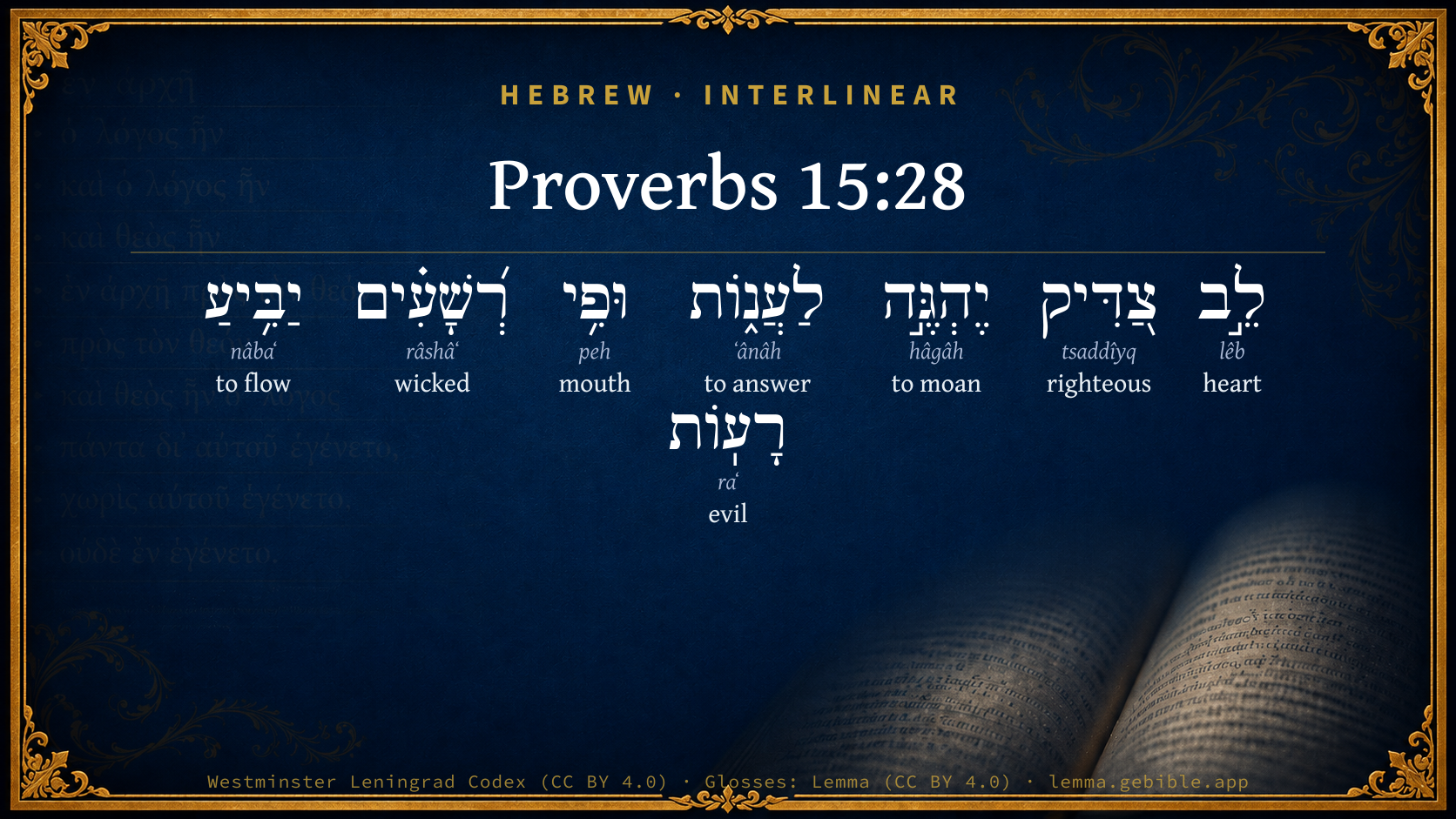
Proverbs 15:28

Hebrew (Westminster Leningrad Codex) Proverbs 15:28 appears in the Hebrew Old Testament. The text above is from the Westminster Leningrad Codex. Each word links to its Strong’s number, a concise gloss, and parsing drawn from the Open Scriptures Hebrew Bible morphology. Click any word for its full Brown-Driver-Briggs (BDB) entry.
Download image
Cite this verse

Proverbs 15:28 (World English Bible). Public Domain. Lemma interlinear Bible study tool, https://lemma.gebible.app/v/proverbs/15/28.

Show BibTeX & RIS
BibTeX
RIS
English Translation
The heart of the righteous weighs answers, But the mouth of the wicked gushes out evil.
World English Bible · Public Domain
Download a study sheet

One document with this verse’s original text, its word-by-word gloss line, the meaning frame, cross-references with their text, attributed commentary, and full source and license credits — printable, and it pastes into notes with its structure intact.

This verse Autodidact and up

Study sheet (.html) Plain text (.txt)

A passage Seminary Student

Up to 50 verses in one chapter. A passage sheet keeps up to 6 commentary sources and 12 cross-references per verse, in the order this page ranks them, and says so on the sheet whenever that leaves anything out. Ask for a single verse and you get the Autodidact verse sheet above.

Everything on this page stays free to read, with no account — the sheet is a download of what is already on screen, not access to it.

Want to remove ads? Support Godless Engineer
Compare translations 3

The same verse in 3 English versions, stacked beneath the original-language interlinear above. Click any original word for its lexicon entry.

Each is an independent rendering of the whole verse — the interlinear is not word-aligned to these translations.

Highlighted words mark where these versions differ — a whole-verse word diff, not a word-by-word alignment.

  • World English Bible Public Domain
    The heart of the righteous weighs answers, But the mouth of the wicked gushes out evil.
  • King James Version Public Domain
    The heart of the righteous studieth to answer: but the mouth of the wicked poureth out evil things.
  • unfoldingWord Literal Text CC BY-SA 4.0
    The heart of the righteous considers to answer, but the mouth of the wicked gushes forth evils.

unfoldingWord Literal Text — © unfoldingWord, licensed CC BY-SA 4.0. Word-aligned USFM3 via Door43 (git.door43.org/unfoldingWord/en_ult).

Versions to compare (up to 4)

3 of 4 selected

Show all 18 translations

Every available English version of this verse, each an independent rendering of the whole verse.

  • World English Bible Public Domain
    The heart of the righteous weighs answers, But the mouth of the wicked gushes out evil.
  • Berean Standard Bible Public Domain
    The heart of the righteous ponders how to answer, but the mouth of the wicked blurts out evil.
  • Majority Standard Bible Public Domain
    The heart of the righteous ponders how to answer, but the mouth of the wicked blurts out evil.
  • King James Version Public Domain
    The heart of the righteous studieth to answer: but the mouth of the wicked poureth out evil things.
  • American Standard Version (1901) Public Domain
    The heart of the righteous studieth to answer; But the mouth of the wicked poureth out evil things.
  • Revised Version (1885) Public Domain
    The heart of the righteous studieth to answer: but the mouth of the wicked poureth out evil things.
  • Geneva Bible (1599) Public Domain
    The heart of the righteous studieth to answere: but the wicked mans mouth babbleth euil thinges.
  • Douay-Rheims (1899) Public Domain
    The mind of the just studieth obedience: the mouth of the wicked over floweth with evils.
  • Young's Literal Translation Public Domain
    The heart of the righteous meditateth to answer, And the mouth of the wicked uttereth evil things.
  • Literal Standard Version CC BY-SA 4.0
    The heart of the righteous meditates to answer, || And the mouth of the wicked utters evil things.
  • Unlocked Literal Bible CC BY-SA 4.0
    The heart of the righteous person ponders before it answers, but the mouth of wicked people pours out all its evil.
  • unfoldingWord Literal Text CC BY-SA 4.0
    The heart of the righteous considers to answer, but the mouth of the wicked gushes forth evils.
  • Darby Bible Public Domain
    The heart of a righteous [man] studieth to answer; but the mouth of the wicked poureth out evil things.
  • World Messianic Bible Public Domain
    The heart of the righteous weighs answers, but the mouth of the wicked gushes out evil.
  • Webster's Bible Public Domain
    The heart of the righteous studieth to answer: but the mouth of the wicked poureth out evil things.
  • Free Bible Version CC BY-SA 4.0
    Good people think how best to answer questions, but stupid people say all kinds of evil things.
  • Bible in Basic English Public Domain
    The heart of the upright gives thought to his answer; but from the mouth of the evil-doer comes a stream of evil things.
  • JPS Tanakh (1917) Public Domain
    The heart of the righteous studieth to answer; but the mouth of the wicked poureth out evil things.

Literal Standard Version (2020), Covenant Press — licensed CC BY-SA 4.0. Text via the HelloAO Bible API (eBible.org). Unlocked Literal Bible (unfoldingWord) — licensed CC BY-SA 4.0. Text via the HelloAO Bible API (eBible.org). unfoldingWord Literal Text — © unfoldingWord, licensed CC BY-SA 4.0. Word-aligned USFM3 via Door43 (git.door43.org/unfoldingWord/en_ult). Free Bible Version, Dr. Jonathan Gallagher — licensed CC BY-SA 4.0. Text via the HelloAO Bible API (eBible.org).

Word by word

More ways to search: Search by grammar → Find every occurrence → Compare this word →

Practice this passage: Drill this verse → Learn its vocabulary →

About this verse

These counts appear in no published source. They are computed here, from the morphology-tagged text and Lemma’s own curated glosses. What Lemma adds →

8
words
8
distinct lemmas
Wisdom
section

Notable vocabulary

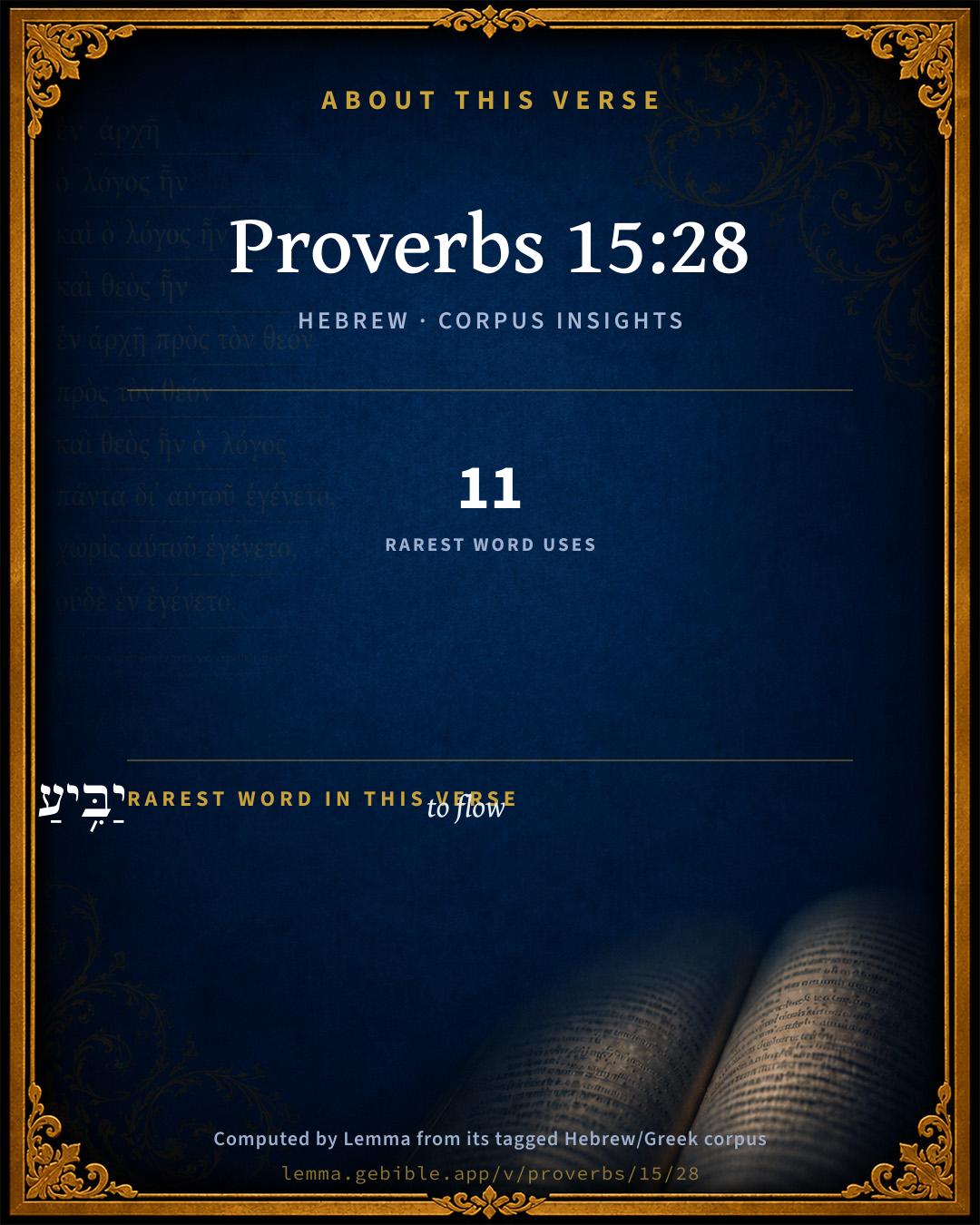
The rarest word here is יַבִּ֥יעַ to flow H5042 — appearing just 11 times in the whole Hebrew Bible.

Shared distinctive vocabulary

יַבִּ֥יעַ to flow H5042 occurs in 11 verses of the Hebrew Bible. Also found in:

Grammatical profile

  • 3 verbs
  • 3 nouns
  • 2 adjectives

Verb forms

  • יֶהְגֶּ֣ה Qal · Imperfect
  • לַעֲנ֑וֹת Qal · Infinitive Construct
  • יַבִּ֥יעַ Hiphil · Imperfect

Hebrew & Septuagint length

In English translation the verse runs 16 words from the Hebrew and 33 from the Septuagint (LXX English) — the Septuagint runs noticeably longer here. See the side-by-side →

A rough comparison of the two English renderings, which tokenize alike — not a word-level alignment.

Word counts can differ between the Hebrew and the Greek without any difference in meaning — e.g. the Hebrew direct-object marker אֵת has no separate Greek word, and Greek often adds the article ὁ.

Cross-references

15

Topical passages linked to Proverbs 15:28 in the Treasury of Scripture Knowledge — connected by theme and wording, ordered by reader-vote popularity; previews shown in the World English Bible.

  • 1 Peter 3:15 But sanctify the Lord God in your hearts; and always be ready to give an answer to everyone who asks you a reason concerning the hope that is in you, with humility and fear:
  • Proverbs 29:11 A fool vents all of his anger, But a wise man brings himself under control.
  • Ecclesiastes 5:2 Don't be rash with your mouth, and don't let your heart be hasty to utter anything before God; for God is in heaven, and you on earth. Therefore let your words be few.
  • James 3:6–8 And the tongue is a fire. The world of iniquity among our members is the tongue, which defiles the whole body, and sets on fire the course of nature, and is set on fire by Gehenna.
  • Proverbs 15:2 The tongue of the wise commends knowledge, But the mouth of fools gush out folly.
  • Proverbs 16:23 The heart of the wise instructs his mouth, And adds learning to his lips.
  • Matthew 12:34 You offspring of vipers, how can you, being evil, speak good things? For out of the abundance of the heart, the mouth speaks.
  • Proverbs 10:19 In the multitude of words there is no lack of disobedience, But he who restrains his lips does wisely.
  • Proverbs 13:16 Every prudent man acts from knowledge, But a fool exposes folly.
  • Proverbs 29:20 Do you see a man who is hasty in his words? There is more hope for a fool than for him.
  • Ecclesiastes 5:6 Don't allow your mouth to lead you into sin. Don't protest before the messenger that this was a mistake. Why should God be angry at your voice, and destroy the work of your hands?
  • Ecclesiastes 10:12–14 The words of a wise man's mouth are gracious; but a fool is swallowed by his own lips.
  • 1 Kings 3:23–28 Then said the king, The one says, This is my son who lives, and your son is the dead: and the other says, No; but your son is the dead, and my son is the living.
  • Titus 1:10–11 For there are also many unruly men, vain talkers and deceivers, especially those of the circumcision,
  • 2 Peter 2:18 For, uttering great swelling words of emptiness, they entice in the lusts of the flesh, by licentiousness, those who are indeed escaping from those who live in error;

Cross-references courtesy of OpenBible.info (CC BY 4.0).

Hebrew and Greek witnesses Masoretic Hebrew ↔ Greek Septuagint

The same verse in the two great witnesses to the Old Testament, shown verse-for-verse.

Here the Septuagint runs noticeably longer than the Hebrew — LXX2012 (modern English Septuagint) 33 words vs World English Bible 16. A rough length comparison of the two English translations, not a word-level alignment — read both below.

These are two independent witnesses, not word-aligned to each other, and the Septuagint is shown in lemma (dictionary) form.

Hebrew Proverbs 15:28 Masoretic · Westminster Leningrad Codex

לֵ֣ב צַ֭דִּיק יֶהְגֶּ֣ה לַעֲנ֑וֹת וּפִ֥י רְ֝שָׁעִ֗ים יַבִּ֥יעַ רָעֽוֹת

The heart of the righteous weighs answers, But the mouth of the wicked gushes out evil.

World English Bible · Public Domain

Greek LXX Proverbs 15:28 Septuagint · lemma form

καρδία δίκαιος μελετάω πίστις στόμα δέ ἀσεβής ἀποκρίνω κακός δεκτός παρά κύριος ὁδός ἄνθρωπος δίκαιος διά δέ αὐτός καί ὁ ἐχθρός φίλος γίγνομαι

The hearts of the righteous meditate faithfulness; but the mouth of the ungodly answers evil things. The ways of righteous men are acceptable with the Lord; and through them even enemies become friends.

LXX2012 (modern English Septuagint) · Public Domain

On this verse, Haydock's Catholic Bible Commentary discusses the Septuagint’s reading. Read the note in Commentary ↓

Hebrew: Westminster Leningrad Codex (CC BY 4.0). Greek: Septuagint (public domain); English from LXX2012 (modern English Septuagint) (Public Domain). How the Septuagint differs from the Hebrew →

Commentary

Notes on Proverbs 15:28 from classic Christian and Jewish commentators (each source and its license shown beneath its notes). The classic Christian expositions comment on the surrounding passage and are grouped to its opening verse, so a note may address several verses; the Jewish commentaries on the Tanakh (Rashi and others) are per-verse, so they appear only where the commentator wrote on this verse.

Lemma curates 59 commentaries, every one of them public domain or Creative Commons licensed, each selected and text-cleaned for this edition rather than reprinted as found. About our sources →

Trapp's Complete Commentary

John Trapp

Pro 15:28 The heart of the righteous studieth to answer: but the mouth of the wicked poureth out evil things.

Ver. 28. The heart of the righteous studieth to answer.] His tongue runs not before his wit, but he weighs his words before he utters them (as carrying a pair of balance between his lips), and dips his words in his mind ere men see what colour they are of, as Plutarch saith Phocion did. {a} He hath his heart, not at his mouth, but at his right hand, saith Solomon, to make use of when he sees his time. Melanchthon, when some hard question was proposed to him, would take three days’ deliberation to answer it. And, in his answer to Staphylus, he ingenuously confesseth, or rather complaineth, Quos fugiamus habemus, quos sequamur nondum intelligimus; We know whom we are to flee from (meaning the Papists), but whom to follow we as yet know not. Such divisions there were amongst themselves, and such lack of light at the beginning of the Reformation, that it was an ingenuous thing to be a right reformed catholic. A young man, one Vincentius Victor, as Chemnitius relates it, when learned Augustine demurred, and would not determine the point concerning the original of a rational soul, censured boldly the father’s unresolvedness, and vaunted that he would undertake to prove by demonstration that souls are created de novo by God; for which peremptory rashness the father returned the young man a sober reprehension, a mild answer, as the Hebrew word {b} here used imports. Not so sharp as that of Basil to the emperor’s cook, who yet well enough deserved it; for when the fellow would needs be pouring forth what he thought of such and such deep points of divinity which he understood not, Basil rounded him up with, Sον εστι της των ζωμων καρυκειας φροντιζειν: - It is for thee, man, to look well to thy porridge pot, and not to meddle with these disputes.

{a} προφερομενον τον λεξιν εις νουν αποβαπρειν.

{b} ענה, significat respondere, humiliare, negotiari.

John Trapp, A Commentary or Exposition upon All the Books of the Old and New Testament (1647–1656) — public domain. Text from a community e-Sword module.

Joseph Benson's Commentary

Pro 15:28. The heart of the righteous studieth to answer — He answers, or speaks, considerately and conscientiously, and therefore profitably, to the edification of the hearers; but the mouth of the wicked — Not the heart, for they are without heart, in the Scripture account, and speak rashly whatever comes into their minds, without the direction of their hearts or consciences; poureth out evil things — Foolish, unprofitable, and hurtful speeches.

Joseph Benson's Commentary on the Old and New Testaments (1811–1818) — public domain. Text from a community e-Sword module.

The Preacher's Complete Homiletical Commentary

Joseph S. Exell (gen. ed.)

CRITICAL NOTES.—

Pro_15:28. Studieth, i.e., “considers.”

MAIN HOMILETICS OF Pro_15:28

STUDYING TO ANSWER

I. Every righteous man is a student. The aim of study in any department of knowledge is, first to gain possession of certain facts, and then to make the knowledge of practical service in life. If a man intends to be a builder he must first be a student. He must first gain certain theoretical knowledge, and then make use of it. And so with every profession or calling—each requires thought before any work is entered upon. Every righteous man is a man with a profession—he is a professor of righteousness—he gains a knowledge of righteous precepts with the view of reducing them to righteous practice. A knowledge of what is right and true in the abstract will be of little use to himself or to any other man unless the knowledge influences his words and deeds. The proverb before us sets forth the righteous man as a student of his speech. His aim is to speak the “word in due season,” spoken of in Pro_15:23, and to do this he must be a student of the human heart—

1. He must study the workings of his own heart. This is a study peculiar to the righteous man. Many men study themselves and others as frameworks of bone and muscle, who never bestow a thought upon the soul, of which the body is but the raiment. Other men watch the operations of the mental powers and tabulate all the movements of the mind as they are brought to light by internal consciousness. But the godly man goes deeper. He ponders his thoughts and feelings in the light of moral truth and righteousness—he weighs his words in the balance in which he knows that God will weigh them.

2. He must study other men’s hearts. He desires that his words should not only be harmless but beneficial to others; he desires to answer wisely questions relating to God, and man, and immortality; he sets his speech in order before he opens his mouth upon any of these weighty matters, and he considers the circumstances and dispositions of those to whom he speaks that like one of old, his “doctrine may drop as the rain, his speech distil as the dew,” when he “publishes the name of the Lord” (Deu_32:2-3). Before his thoughts become words he submits them to the revision of his conscience and his judgment, and asks himself if they are such as he can hope God will bless to the edification of others.

II. All men who do not thus study their thoughts and words are the authors of much mischief. They are those who have never made what they think a matter of conscience, and consequently their words are the outcome of an unsanctified heart. As is the fountain, so must be the stream. For the words of such a man to be other than evil is an impossibility. “How can ye, being evil, speak good things? For out of the abundance of the heart the mouth speaketh. A good man, out of the good treasure of the heart, bringeth forth good things; and an evil man, out of the evil treasure, bringeth forth evil things (Mat_12:34-35).

OUTLINES AND SUGGESTIVE COMMENTS

The tongue is the heart’s messenger. So often as it speaks before the heart dictates, the messenger runs without his errand. He that will not speak idly, must think what he speaks; he that will not speak falsely, must speak what he thinks.—Adams.

What is before said (Pro_15:2, and chap. Pro_12:23) of the wise and the foolish, is said here of the righteous and the wicked: and what is before said of the utterance of wisdom and folly, is here said of the utterance of good and evil. We have repeatedly seen how Solomon identifies these in his statements. Wickedness is folly; goodness is wisdom.—Wardlaw.

“Mouth,” all agency. Religion is so much like politeness, that a polite man “winnows” (Pro_15:7) his acts till they look sometimes like religion; but watch men where the guise of kindness fails them, viz., their aim to be polite, and their “mouth pours out evils.” There is a recklessness of act that only a religious purity can essentially restrain.—Miller.

The wicked, speaking so much, cannot but speak “evil things” (chap. Pro_10:19. Not his heart, as in the case of the righteous, but his mouth takes the lead.—Fausset.

I. It is not easy at the first to apprehend the right, because error at the first ken standeth usually in men’s light, and hindereth them from seeing the truth, whereof they may better inform themselves by serious deliberation. II. When the mind hath time and liberty to ponder upon, and will to weigh the point to be spoken unto, it findeth out good arguments for good causes, and digesteth the same in so apt a manner as may best persuade the hearts of the hearers. III. A meditating heart affecteth itself for that which it provideth for others to hear, and such men speak not only truly and pertinently, but faithfully also, and conscionably: their souls having first feeling of that within, which after their mouths are to deliver out.—Dod.

The answer, which I conceive the heart of the righteous to study, is the answer of obedience unto God’s commandments—the answer of thankfulness for His favours and mercies received. For, as St. Gregory speaketh, to answer to God is to render to His precedent gifts the duties of our service. Now, this study is the study of the whole life of a righteous man. Whatsoever he goes about, he knows that he must answer to God for it, and therefore he considereth before he doth it, that it be answerable unto God’s law.—Jermin.

The Preacher's Complete Homiletical Commentary (gen. ed. Joseph S. Exell; Funk & Wagnalls, c. 1892) — public domain (pre-1929). A full-Bible homiletical/sermon-outline anthology covering 65 of 66 books (2 John is absent from the source module). Text from a community e-Sword module.

Matthew Henry's Commentary

Here is, 1. A good man proved to be a wise man by this, that he governs his tongue well; he that does so the same is a perfect man, Jam 3:2. It is part of the character of a righteous man that being convinced of the account he must give of his words, and of the good and bad influence of them upon others, he makes conscience of speaking truly (it is his heart that answers, that is, he speaks as he thinks, and dares not do otherwise, he speaks the truth in his heart, Psa 15:2), and of speaking pertinently and profitably, and therefore he studies to answer, that his speech may be with grace, Neh 2:4; Neh 5:7. 2. A wicked man is proved to be a fool by this, that he never heeds what he says, but his mouth pours out evil things, to the dishonour of God and religion, his own reproach, and the hurt of others. Doubtless that is an evil heart which thus overflows with evil.

Matthew Henry's Commentary on the Whole Bible (1708–1710) — public domain (CC PDM 1.0). Text via the HelloAO Bible API.

Jamieson, Fausset & Brown

Robert Jamieson, A. R. Fausset & David Brown

(Compare Pro 15:14; Pro 10:11). Caution is the fruit of wisdom; rashness of folly.

Jamieson, Fausset & Brown — Commentary Critical and Explanatory on the Whole Bible (1871) — public domain (CC PDM 1.0). Text via the HelloAO Bible API.

Adam Clarke's Commentary

Verse 28. The heart of the righteous studieth to answer] His tongue never runs before his wit, he never speaks rashly, and never unadvisedly; because he studies-ponders, his thoughts and his words.

Adam Clarke's Commentary on the Bible (1810–1826) — public domain. Text from a community e-Sword/MySword module.

Ellicott's Commentary for English Readers

(28) The heart of the righteous studieth to answer—i.e., aright, knowing how much good and evil is caused by words. (Comp. Jas_3:5, sqq.)

A Bible Commentary for English Readers, edited by Charles John Ellicott (1878–1897) — public domain. Text from a community e-Sword module.

John Gill's Exposition

The heart of the righteous studieth to answer,.... He thinks before he speaks, meditates what he shall say, what answer to give to men; whether in things civil, natural, or religious; and what to return to the Lord when he is reproved by him; or what to say in prayer to him, or by way of thankfulness for mercies received from him; see Pro 3:6; though our Lord advises his disciples, when summoned before their persecutors, not to meditate beforehand what they should answer, since they should have immediate assistance, Luk 21:14; but this was in extraordinary cases; in common ones the observation of the wise man should be attended to. A Jewish (u) writer renders the words, "the heart of the righteous meditates wormwood", or bitter things; see Pro 5:4; as the judgment of God, death, and hell; this sense is mentioned by Aben Ezra, but rejected;

but the mouth of the wicked poureth out evil things; without any previous thought and consideration, without fear or wit; in great abundance, as water out of a fountain; thus an evil man out of the evil treasure of his heart brings forth evil things readily and at once, having no concern about the consequences of things, Mat 12:25; See Gill on Pro 15:2.

(u) Kabvenaki.

John Gill's Exposition of the Whole Bible (1746–1763) — public domain (CC PDM 1.0). Text via the HelloAO Bible API.

Albert Barnes' Notes on the Bible

Contrast the “studying” of the wise before he answers and the hasty babbling of the foolish. The teaching of our Lord Mat 10:19 presents us with a different and higher precept, resting upon different conditions.

Albert Barnes' Notes on the Bible (1834–1885) — public domain. Text from a community e-Sword/MySword module.

Haydock's Catholic Bible Commentary

Studieth. And speaks deliberately. Roman Septuagint is more embarrassed in the rest of this, and the nine first verses of the following chapter, than the Complutensian edition.

George Leo Haydock (1774–1849), Haydock's Catholic Family Bible and Commentary, 1859 edition — public domain. Excludes Psalms (Douay-Rheims chapter numbering differs from Protestant) and Deuterocanonical books (Catholic canon only).

Matthew Poole's English Annotations

Studieth to answer; he answers or speaks considerately and conscientiously, and therefore profitably, or to the use and edification of the hearers.

The mouth, not the heart; for he is without heart in Scripture account, and he rashly speaks what comes into his mouth, without the direction of his heart or conscience.

Evil things; foolish, and unprofitable, and hurtful speeches.

Matthew Poole's English Annotations on the Holy Bible (1683–1685) — public domain. Text from a community e-Sword/MySword module.

Whedon's Commentary on the Bible

Daniel D. Whedon

28. Studieth — Meditates to answer. He does not answer an inquiry without thought, because he is solicitous to speak only what is correct and useful.

Poureth out evil things — Belches forth malignity.

Daniel D. Whedon (gen. ed.), Commentary on the Old and New Testaments (1874–1909) — public domain. Text from a community e-Sword module.

The Pulpit Commentary

The heart of the righteous studieth to answer. The good man deliberates before he speaks, takes time to consider his answer, lest he should say anything false, or inexpedient, or injurious to his neighbour. A Latin adage runs "Qui bene vult fari debet bene praemeditari.

Says Theognis Bouleuou di triv otoi k epi toon Athro labrov anhyei. "Whate"er comes in your mind, deliberate; A hasty man but rushes on his fate.

Septuagint, "The heart of the prudent will meditate pisteiv ," which may mean "truth," "fidelity," or "proofs." The Vulgate has "obedience," implying attention to the inward warnings of conscience and grace, before the mouth speaks. Poureth out (ver. 2). The wicked man never considers; evil is always on his lips and running over from his mouth. Septuagint, "The mouth of the ungodly answereth evil things." The LXX here inserts Pro_16:7.

The Pulpit Commentary (1880–1919), ed. H.D.M. Spence-Jones & Joseph S. Exell — public domain. Text from a community e-Sword module.

John Wesley's Explanatory Notes

Studieth - He speaks considerately. The mouth - Not the heart; for he rashly speaks what comes into his mouth, without the direction of his heart or conscience.

John Wesley, Explanatory Notes Upon the Whole Bible (1754–1765) — public domain. Text via the GEBible commentary corpus.

Keil & Delitzsch

C. F. Keil & F. Delitzsch

Two proverbs regarding the righteous and the wicked:

28 The heart of the righteous considereth how to answer right,

And the mouth of the godless poureth forth evil.

Instead of לענות, the lxx (Syr. and Targ.) imagines אמוּנות πίστεις; Jerome translates, but falsely, obedientiam (from ענה, to bend oneself); Meri thinks on לענה, wormwood, for the heart of the righteous revolves in itself the misery and the vanity of this present life; Hitzig corrects this verse as he does the three preceding: the heart of the righteous thinks on ענוות, a plur. of verb ענוה, which, except in this correction, does not exist. The proverb, as it stands, is, in fineness of expression and sharpness of the contrast, raised above such manglings. Instead of the righteous, the wise might be named, and instead of the godless, fools (cf. 2b); but the poet places the proverb here under the point of view of duty to neighbours. It is the characteristic of the righteous that he does not give the reins to his tongue; but as Luther has translated: the heart of the righteous considers [tichtet from dictare, frequently to speak, here carefully to think over] what is to be answered, or rather, since מה־לּענות is not used, he thinks thereupon to answer rightly, for that the word ענות is used in this pregnant sense is seen from 23a. The godless, on the contrary, are just as rash with their mouth as the righteous are of a thoughtful heart: their mouth sputters forth (effutit) evil, for they do not first lay to heart the question what may be right and just in the case that has arisen.

Keil & Delitzsch — Biblical Commentary on the Old Testament (1861–1891) — public domain (CC PDM 1.0). Text via the HelloAO Bible API. (Old Testament only.)

Bridges on Proverbs

Charles Bridges

Consideration is an important part of the Christian character; nowhere more important than in the discipline of the tongue. Think twice, before we speak once. "The wise man’s heart is at his right hand" (Ecc 10:2 ), that he may weigh his words, and study how to answer (Pro 10:31-32 ; Pro 16:23 ), and "be ready always to give an answer to him that asketh a reason of the hope that is in him." (1Pe 3:15 .) Though there may be "good treasure" within, yet we must carefully ponder to draw from it "a word in due season." (Pro 15:23 .) Often may we reflect upon ourselves for speaking hastily. And indeed, when that comes out which is uppermost, nothing but the dross of evil can be looked for. Many stumblings have been made by speaking from the impulse of the moment, from warm feelings, rather than from a well-balanced and considerate judgment. (Psa 31:22 ; Psa 116:11 .) In this haste, Joshua was beguiled by the Gibeonites;†1 David indulged a burst of murderous revenge;†2 Peter would fain have dissuaded his Master from the work,†3 which he came down from heaven to do, and without which we should have been a world eternally lost. Cultivate a pondering mind. If ever asked to open an important subject, throw it not off hastily, nor give an answer, till we have obtained it from God. For the heart’s study to answer necessarily implies prayer, the only medium of receiving the "wisdom that is profitable to direct." (Pro 2:1-6 . Ecc 10:10 . Jas 1:5 .) Nehemiah darted up his prayer; and how graciously was the answer for the moment vouchsafed! (Neh 2:1-6 .) This is especially a ministerial responsibility for the many cases of conscience, that require "the tongue of the learned" — a word of wisdom, conviction, or consolation. How can "the priest’s lips keep knowledge" (Mal 2:7 ), unless the heart under his Master’s teaching studieth to answer?

The wicked has no such restraint. He cares not what he says. It is of little consequence to him, whether it be true, or well-timed, or whom it wounds. His poisoned fountain poureth out poisonous waters. (Ecc 10:3, Ecc 10:12-14 .) Yet fearful is it to think, how every light word brings its account (Mat 12:36 ), and will be found a ’hot coal to make the fire of hell burn more fiercely.’†4 Such a plague often infests the Church. (Tit 1:10-11 .) "From such withdraw thyself." (1Ti 6:5 .) Separation is the keeping of the soul.

Footnotes:

†1 Jos 9:14-15.

†2 1Sa 25:13-21 .

†3 Mat 16:22.

†4 Cartwright, in loco.

Charles Bridges, An Exposition of the Book of Proverbs (1846) — public domain. Text from a community e-Sword module.

Kretzmann's Popular Commentary

Paul E. Kretzmann

v. 28. The heart of the righteous studieth to answer, carefully considering and reflecting before giving an opinion or suggesting advice; but the mouth of the wicked poureth out evil things, in a full and murky stream, without consulting conscience and right.

Paul E. Kretzmann, Popular Commentary of the Bible (1921–1924) — public domain. Text from a community e-Sword module.

Rashi

Rabbi Shlomo Yitzchaki (Rashi)

The heart of a righteous man thinks to answer He will think and understand what to answer before replying.

Rashi on the Tanakh — English translations: “The Judaica Press complete Tanach with Rashi, translated by A. J. Rosenberg” (CC BY 4.0); “Pentateuch with Rashi's commentary by M. Rosenbaum and A.M. Silbermann, 1929-1934” (public domain); “The Metsudah Tanach series, Lakewood, N.J” (CC BY 4.0); and “The Book of Joshua, Metsudah Publications, 1997” (CC BY 4.0). Text via Sefaria.

Lesson kit

Teaching starters — assembled from the data on this page, not authored interpretation. Every prompt links to the verse data it draws on. Edit before teaching.

Proverbs, in the Wisdom, opens this verse with 8 words (8 distinct Hebrew lemmas). Its most distinctive word is nâbaʻ (“to flow”). The Greek Septuagint runs longer here. A historical commentator’s framing appears above. Read the whole chapter for the surrounding context.

Discussion questions

  1. The word nâbaʻ carries the sense “to flow.” How does it shape the verse?
  2. How does Psalms 19:2, which shares the word «to flow», read alongside this verse?
  3. The Septuagint runs longer here than the Hebrew. What might account for the difference?
  4. The translations on this page render this verse differently — a whole-verse word diff, not a word-by-word alignment. What might account for the different wordings?
  5. «יֶהְגֶּ֣ה» is a Qal Imperfect verb. How does that grammatical form shape the action described?
  6. Compare how Trapp's Complete Commentary and Joseph Benson's Commentary read this verse. Where do they agree or differ?

Things to notice

Reading settings

Reading text

Shown beneath each verse's original-language words.

Old Testament
Old Testament edition

Read the OT as the Masoretic Hebrew (MT) or the Greek Septuagint (LXX).

English shown for the Greek Septuagint (in the Hebrew ↔ Greek comparison).

Comparing translations? Open the Compare panel on any verse page to stack up to four side by side.