
Proverbs 19:28

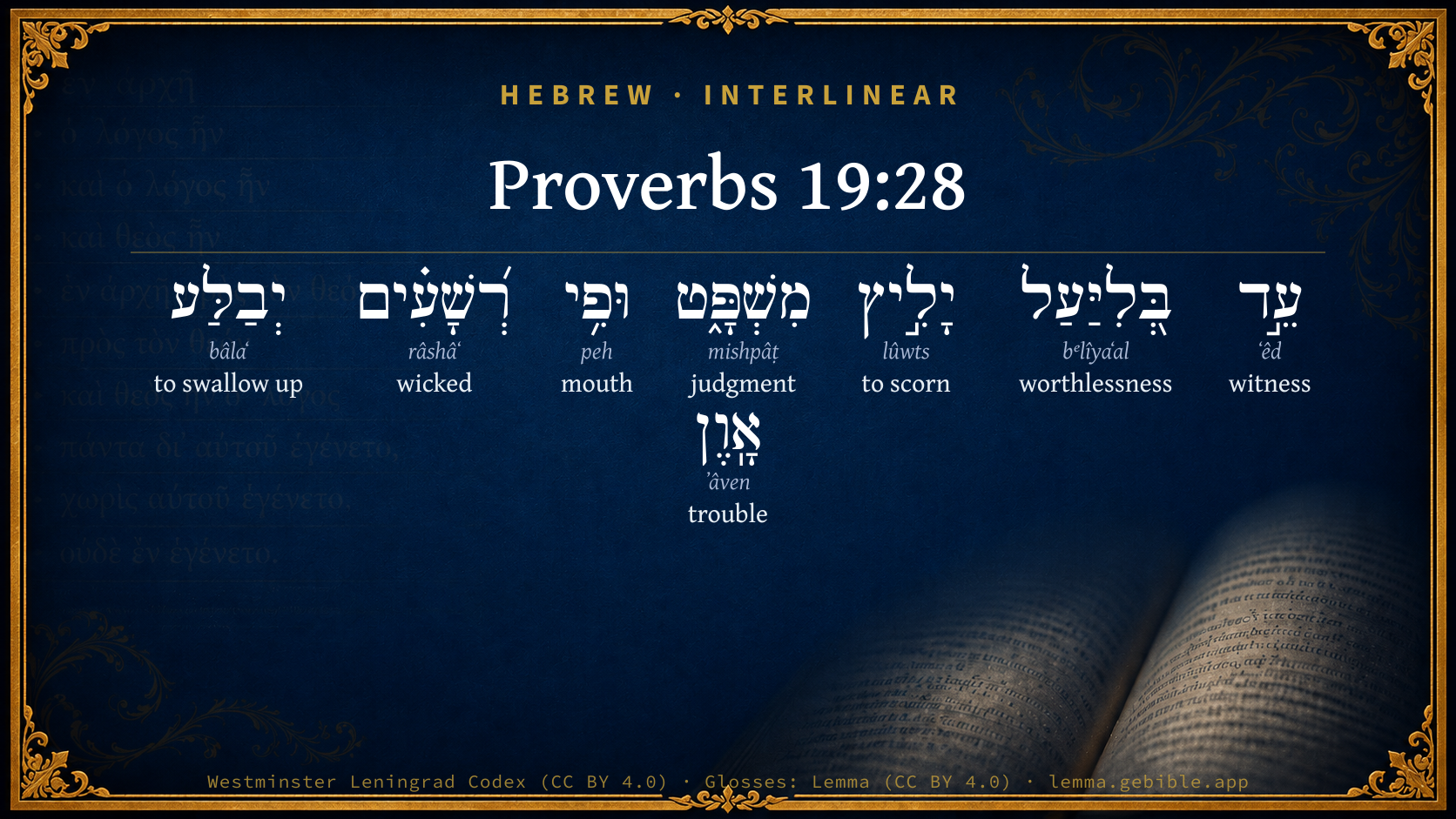
Hebrew (Westminster Leningrad Codex) Proverbs 19:28 appears in the Hebrew Old Testament. The text above is from the Westminster Leningrad Codex. Each word links to its Strong’s number, a concise gloss, and parsing drawn from the Open Scriptures Hebrew Bible morphology. Click any word for its full Brown-Driver-Briggs (BDB) entry.
Download image
Cite this verse

Proverbs 19:28 (World English Bible). Public Domain. Lemma interlinear Bible study tool, https://lemma.gebible.app/v/proverbs/19/28.

Show BibTeX & RIS
BibTeX
RIS
English Translation
A corrupt witness mocks justice, And the mouth of the wicked gulps down iniquity.
World English Bible · Public Domain
Download a study sheet

One document with this verse’s original text, its word-by-word gloss line, the meaning frame, cross-references with their text, attributed commentary, and full source and license credits — printable, and it pastes into notes with its structure intact.

This verse Autodidact and up

Study sheet (.html) Plain text (.txt)

A passage Seminary Student

Up to 50 verses in one chapter. A passage sheet keeps up to 6 commentary sources and 12 cross-references per verse, in the order this page ranks them, and says so on the sheet whenever that leaves anything out. Ask for a single verse and you get the Autodidact verse sheet above.

Everything on this page stays free to read, with no account — the sheet is a download of what is already on screen, not access to it.

Want to remove ads? Support Godless Engineer
Compare translations 3

The same verse in 3 English versions, stacked beneath the original-language interlinear above. Click any original word for its lexicon entry.

Each is an independent rendering of the whole verse — the interlinear is not word-aligned to these translations.

Highlighted words mark where these versions differ — a whole-verse word diff, not a word-by-word alignment.

  • World English Bible Public Domain
    A corrupt witness mocks justice, And the mouth of the wicked gulps down iniquity.
  • King James Version Public Domain
    An ungodly witness scorneth judgment: and the mouth of the wicked devoureth iniquity.
  • unfoldingWord Literal Text CC BY-SA 4.0
    A witness of worthlessness mocks justice, and the mouth of the wicked ones swallows iniquity.

unfoldingWord Literal Text — © unfoldingWord, licensed CC BY-SA 4.0. Word-aligned USFM3 via Door43 (git.door43.org/unfoldingWord/en_ult).

Versions to compare (up to 4)

3 of 4 selected

Show all 18 translations

Every available English version of this verse, each an independent rendering of the whole verse.

  • World English Bible Public Domain
    A corrupt witness mocks justice, And the mouth of the wicked gulps down iniquity.
  • Berean Standard Bible Public Domain
    A corrupt witness mocks justice, and a wicked mouth swallows iniquity.
  • Majority Standard Bible Public Domain
    A corrupt witness mocks justice, and a wicked mouth swallows iniquity.
  • King James Version Public Domain
    An ungodly witness scorneth judgment: and the mouth of the wicked devoureth iniquity.
  • American Standard Version (1901) Public Domain
    A worthless witness mocketh at justice; And the mouth of the wicked swalloweth iniquity.
  • Revised Version (1885) Public Domain
    A worthless witness mocketh at judgment: and the mouth of the wicked swalloweth iniquity.
  • Geneva Bible (1599) Public Domain
    A wicked witnes mocketh at iudgement, and the mouth of ye wicked swalloweth vp iniquitie.
  • Douay-Rheims (1899) Public Domain
    An unjust witness scorneth judgment: and the mouth of the wicked devoureth iniquity.
  • Young's Literal Translation Public Domain
    A worthless witness scorneth judgment, And the mouth of the wicked swalloweth iniquity.
  • Literal Standard Version CC BY-SA 4.0
    A worthless witness scorns judgment, || And the mouth of the wicked swallows iniquity.
  • Unlocked Literal Bible CC BY-SA 4.0
    A corrupt witness mocks justice and the mouth of the wicked swallows iniquity.
  • unfoldingWord Literal Text CC BY-SA 4.0
    A witness of worthlessness mocks justice, and the mouth of the wicked ones swallows iniquity.
  • Darby Bible Public Domain
    A witness of Belial scorneth judgment, and the mouth of the wicked swalloweth down iniquity.
  • World Messianic Bible Public Domain
    A corrupt witness mocks justice, and the mouth of the wicked gulps down iniquity.
  • Webster's Bible Public Domain
    An ungodly witness scorneth judgment: and the mouth of the wicked devoureth iniquity.
  • Free Bible Version CC BY-SA 4.0
    A crooked witness makes a mockery of justice; and the wicked wolf down evil.
  • Bible in Basic English Public Domain
    A good-for-nothing witness makes sport of the judge's decision: and the mouth of evil-doers sends out evil like a stream.
  • JPS Tanakh (1917) Public Domain
    An ungodly witness mocketh at right; and the mouth of the wicked devoureth iniquity.

Literal Standard Version (2020), Covenant Press — licensed CC BY-SA 4.0. Text via the HelloAO Bible API (eBible.org). Unlocked Literal Bible (unfoldingWord) — licensed CC BY-SA 4.0. Text via the HelloAO Bible API (eBible.org). unfoldingWord Literal Text — © unfoldingWord, licensed CC BY-SA 4.0. Word-aligned USFM3 via Door43 (git.door43.org/unfoldingWord/en_ult). Free Bible Version, Dr. Jonathan Gallagher — licensed CC BY-SA 4.0. Text via the HelloAO Bible API (eBible.org).

Word by word

More ways to search: Search by grammar → Find every occurrence → Compare this word →

Practice this passage: Drill this verse → Learn its vocabulary →

About this verse

These counts appear in no published source. They are computed here, from the morphology-tagged text and Lemma’s own curated glosses. What Lemma adds →

8
words
8
distinct lemmas
Wisdom
section

Shared distinctive vocabulary

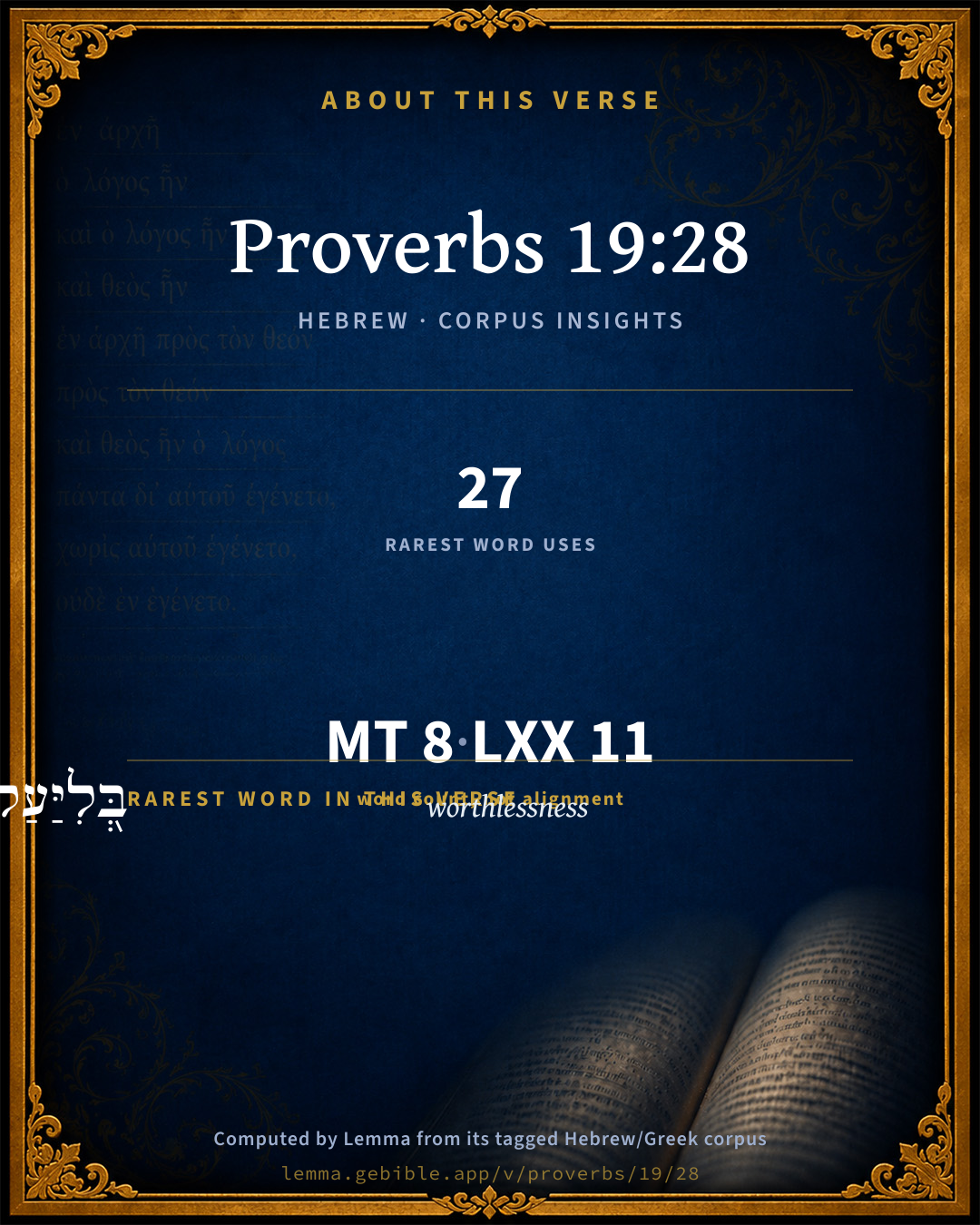
בְּ֭לִיַּעַל worthlessness H1100 occurs in 26 verses of the Hebrew Bible. Also found in:

Grammatical profile

  • 2 verbs
  • 5 nouns
  • 1 adjective

Verb forms

  • יָלִ֣יץ Hiphil · Imperfect
  • יְבַלַּע Piel · Imperfect

Hebrew & Septuagint length

In English translation the verse runs 14 words from the Hebrew and 22 from the Septuagint (LXX English) — the Septuagint runs noticeably longer here. See the side-by-side →

A rough comparison of the two English renderings, which tokenize alike — not a word-level alignment.

Word counts can differ between the Hebrew and the Greek without any difference in meaning — e.g. the Hebrew direct-object marker אֵת has no separate Greek word, and Greek often adds the article ὁ.

In the original languages it is 8 Hebrew tokens and 11 Greek tokens — but the two are counted differently (Hebrew bundles its prefixes and suffixes into one token; the Greek is in lemma form), so that isn’t a like-for-like length.

Cross-references

12

Topical passages linked to Proverbs 19:28 in the Treasury of Scripture Knowledge — connected by theme and wording, ordered by reader-vote popularity; previews shown in the World English Bible.

  • Job 15:16 How much less one who is abominable and corrupt, A man who drinks iniquity like water!
  • Job 34:7 What man is like Job, Who drinks scorn like water,
  • Luke 18:2–4 saying, "There was a judge in a certain city who didn't fear God, and didn't respect man.
  • Acts 6:11–13 Then they secretly induced men to say, "We have heard him speak blasphemous words against Moses and God."
  • 1 Kings 21:13 The two men, the base fellows, came in and sat before him: and the base fellows bore witness against him, even against Naboth, in the presence of the people, saying, Naboth did curse God and the king. Then they carried him forth out of the city, and stoned him to death with stones.
  • Job 20:12–13 "Though wickedness is sweet in his mouth, Though he hide it under his tongue,
  • 1 Kings 21:10 and set two men, base fellows, before him, and let them testify against him, saying, You did curse God and the king. Then carry him out, and stone him to death.
  • Psalms 10:5 His ways are prosperous at all times; He is haughty, and your laws are far from his sight: As for all his adversaries, he sneers at them.
  • Psalms 10:11 He says in his heart, "God has forgotten. He hides his face. He will never see it."
  • Proverbs 15:14 The heart of one who has understanding seeks knowledge, But the mouths of fools feed on folly.
  • Isaiah 28:14–18 Why hear the word of Yahweh, you scoffers, that rule this people that is in Jerusalem:
  • Hosea 4:8 They feed on the sin of my people, And set their heart on their iniquity.

Cross-references courtesy of OpenBible.info (CC BY 4.0).

Hebrew and Greek witnesses Masoretic Hebrew ↔ Greek Septuagint

The same verse in the two great witnesses to the Old Testament, shown verse-for-verse.

Here the Septuagint runs noticeably longer than the Hebrew — LXX2012 (modern English Septuagint) 22 words vs World English Bible 14. A rough length comparison of the two English translations, not a word-level alignment — read both below.

These are two independent witnesses, not word-aligned to each other, and the Septuagint is shown in lemma (dictionary) form.

Hebrew Proverbs 19:28 Masoretic · Westminster Leningrad Codex

עֵ֣ד בְּ֭לִיַּעַל יָלִ֣יץ מִשְׁפָּ֑ט וּפִ֥י רְ֝שָׁעִ֗ים יְבַלַּע אָֽוֶן

A corrupt witness mocks justice, And the mouth of the wicked gulps down iniquity.

World English Bible · Public Domain

Greek LXX Proverbs 19:28 Septuagint · lemma form

ὁ ἐγγυάω παῖς ἄφρων καταὑβρίζω δικαίωμα στόμα δέ ἀσεβής καταπίνω κρίσις

He that becomes surety for a foolish child will despise the ordinance: and the mouth of ungodly men shall drink down judgment.

LXX2012 (modern English Septuagint) · Public Domain

On this verse, The Pulpit Commentary discusses the Septuagint’s reading. Read the note in Commentary ↓

Hebrew: Westminster Leningrad Codex (CC BY 4.0). Greek: Septuagint (public domain); English from LXX2012 (modern English Septuagint) (Public Domain). How the Septuagint differs from the Hebrew →

Commentary

Notes on Proverbs 19:28 from classic Christian and Jewish commentators (each source and its license shown beneath its notes). The classic Christian expositions comment on the surrounding passage and are grouped to its opening verse, so a note may address several verses; the Jewish commentaries on the Tanakh (Rashi and others) are per-verse, so they appear only where the commentator wrote on this verse.

Lemma curates 59 commentaries, every one of them public domain or Creative Commons licensed, each selected and text-cleaned for this edition rather than reprinted as found. About our sources →

Trapp's Complete Commentary

John Trapp

Pro 19:28 An ungodly witness scorneth judgment: and the mouth of the wicked devoureth iniquity.

Ver. 28. An ungodly witness scorneth judgment.] As if he were out of the reach of God’s rod. And because "judgment is not presently executed, therefore his heart is set in him to do wickedly," {Ecc 8:11 Psa 50:21} he looks upon God as an abettor of his perjury. His mouth devoureth iniquity, as some savoury morsel. But know they not that there will be bitterness in the end? Let them but mark what follows.

John Trapp, A Commentary or Exposition upon All the Books of the Old and New Testament (1647–1656) — public domain. Text from a community e-Sword module.

Joseph Benson's Commentary

Pro 19:28. An ungodly witness scorneth judgment — Hath no reverence to the place of justice, nor to the presence of God there, nor to that sacred and solemn work, of executing judgment, but, in spite of all, gives in a false testimony. And the mouth of the wicked devoureth iniquity — Uttereth it with as great greediness, delight, and ease, as they swallow down delicious meats and drinks; or, is as eager to commit it in word and deed, as if it were as necessary to their well-being as the food they eat.

Joseph Benson's Commentary on the Old and New Testaments (1811–1818) — public domain. Text from a community e-Sword module.

Geneva Bible (1599)

Geneva Bible translators

Taketh a pleasure and delight therein, as gluttons and drunkards in delicate meats and drinks.

Geneva Bible (1599) marginal notes — public domain. Text via Bolls.life.

Matthew Henry's Commentary

Here is a description of the worst of sinners, whose hearts are fully set in them to do evil. 1. They set that at defiance which would deter and detain them from sin: An ungodly witness is one that bears false witness against his neighbour, and will forswear himself to do another a mischief, in which there is not only great injustice, but great impiety; this is one of the worst of men. Or an ungodly witness is one that profanely and atheistically witnesses against religion and godliness, whose instructions seduce from the words of knowledge (Pro 19:27); such a one scorns judgment, laughs at the terrors of the Lord, mocks at that fear, Job 15:26. Tell him of law and equity, that the scriptures and an oath are sacred things, and not to be jested with, that there will come a reckoning day; he laughs at it all, and scorns to heed it. 2. They are greedy, and glad of that which gives them an opportunity to sin: The mouth of the wicked eagerly devours iniquity, drinks it in like water, Job 15:16.

Matthew Henry's Commentary on the Whole Bible (1708–1710) — public domain (CC PDM 1.0). Text via the HelloAO Bible API.

Jamieson, Fausset & Brown

Robert Jamieson, A. R. Fausset & David Brown

ungodly witness--(Compare Margin), one false by bad principles (compare Pro 6:12).

scorneth judgment--sets at naught the dictates of justice.

devoureth--literally, "swalloweth," as something delightful.

Jamieson, Fausset & Brown — Commentary Critical and Explanatory on the Whole Bible (1871) — public domain (CC PDM 1.0). Text via the HelloAO Bible API.

Ellicott's Commentary for English Readers

(28) An ungodly (worthless) witness scorneth judgment.—Despises the orders of the Law to avoid perjury (Exo_20:16; Lev_5:1). (Comp. 1Ki_8:31).

The mouth of the wicked devoureth iniquity.—As a dainty morsel. (Comp. Pro_18:8.)

A Bible Commentary for English Readers, edited by Charles John Ellicott (1878–1897) — public domain. Text from a community e-Sword module.

The Cambridge Bible for Schools and Colleges

gen. ed. J. J. S. Perowne

28. ungodly] Rather, worthless. See Pro_6:12, note.

The Cambridge Bible for Schools and Colleges (gen. ed. J. J. S. Perowne; Cambridge University Press, 1878–1918) — public domain. Text from a community e-Sword module.

John Gill's Exposition

An ungodly witness scorneth judgment,.... Or, "a witness of Belial" (z). A false witness is not awed by the place of judgment where he is; nor by the judge before whom he is; nor by the law, the rule of judgment, nor by the punishment of perjury; he scorns all these, and scoffs at them, and proceeds in bearing a false testimony: or he covers that which is right and just, and eludes judgment by specious and sophistic arguments and pretences. Or this may be understood of a false teacher, that scorns the rule of judgment, or colours over things, to make them plausible, and seem to be agreeable to it;

and the mouth of the wicked devoureth iniquity; greedily, and with pleasure commits it; as a hungry man takes in his food; or a thirsty man drinks down water: and in like manner are false doctrines imbibed by men of perverse minds.

(z) "testis Belijahal", Montanus, Tigurine version, Baynus.

John Gill's Exposition of the Whole Bible (1746–1763) — public domain (CC PDM 1.0). Text via the HelloAO Bible API.

Albert Barnes' Notes on the Bible

Ungodly witness - literally, “Witness of Belial,” “worthless,” “untruthful.”

Devoureth iniquity - Seizes on it eagerly, as a dainty, lives on it.

Albert Barnes' Notes on the Bible (1834–1885) — public domain. Text from a community e-Sword/MySword module.

Matthew Poole's English Annotations

Scorneth judgment; hath no reverence to the place of justice, nor to the presence of God there, nor to that sacred and solemn work of executing judgment, but in spite of all gives in a false testimony.

Devoureth iniquity; uttereth with as great greediness, and delight, and ease, as they swallow down delicious meats and drinks. Compare Job 15:16.

Matthew Poole's English Annotations on the Holy Bible (1683–1685) — public domain. Text from a community e-Sword/MySword module.

Whedon's Commentary on the Bible

Daniel D. Whedon

28. An ungodly witness — One not of God, untruthful.

Scorneth judgment — Mocketh, derideth it. He hath no concern that justice be done.

Devoureth iniquity — Greedily, as a dainty morsel.

Daniel D. Whedon (gen. ed.), Commentary on the Old and New Testaments (1874–1909) — public domain. Text from a community e-Sword module.

The Pulpit Commentary

An ungodly (worthless) witness scorneth judgment; derides the Law which denounces perjury and compels a witness to speak truth, (Exo_20:16 Lev_5:1) and, as is implied he bears false testimony, thus proving himself "a witness of Belial," according to the Hebrew term. Septuagint, "He who becometh security for a foolish child outrages judgment." The mouth of the wicked devoureth iniquity; swallows it eagerly as a toothsome morsel. (Pro_18:8) So we have in Job_15:16,"A man that drinketh iniquity like water". see on Pro_26:6) Such a man will lie and slander with the utmost pleasure, living and battening on wickedness. Septuagint, "The mouth of the impious drinketh judgments (kriseiv )," i.e. boldly transgresses the Law.

The Pulpit Commentary (1880–1919), ed. H.D.M. Spence-Jones & Joseph S. Exell — public domain. Text from a community e-Sword module.

John Wesley's Explanatory Notes

Scorneth - Hath no reverence to the place of justice, nor to the presence of God there. Devoureth - Utters it with greediness and delight.

John Wesley, Explanatory Notes Upon the Whole Bible (1754–1765) — public domain. Text via the GEBible commentary corpus.

Keil & Delitzsch

C. F. Keil & F. Delitzsch

28 A worthless witness scoffeth at right;

And the mouth of the godless swalloweth up mischief.

The Mosaic law does not know the oath of witnesses; but the adjuring of witnesses to speak the truth, Lev 4:1, places a false statement almost in the rank of perjury. The משׁפּט, which legally and morally binds witnesses, is just their duty to state the matter in accordance with truth, and without deceitful and malicious reservation; but a worthless witness (vid., regarding בּליּעל, Pro 6:12) despiseth what is right (יליץ with accus.-obj. like Pro 14:9), i.e., scornfully disregards this duty. Under 28b Hitzig remarks that בלע only in Kal means to devour, but in Piel, on the contrary, to absorb = annihilate; therefore he reads with the lxx and Syr. דּין justice instead of און mischief: the mouth of the wicked murders that which is right, properly, swallows down his feeling of right. But בּלּע interchanges with בּלע in the sense of swallowing only, without the connected idea of annihilation; cf. כּבלּע for the continuance [duration] of a gulp = for a moment, Num 4:20 with Job 7:29; and one can thus understand 28b without any alteration of the text after Job 15:16; cf. Pro 20:12-15, as well as with the text altered after Isa 3:12, by no means so that one makes און the subject: mischief swallows up, i.e., destroys, the mouth of the wicked (Rashi); for when "mouth" and "to swallow" stand connected, the mouth is naturally that which swallows, not that which is swallowed (cf. Ecc 10:12 : the mouth of the fool swallows, i.e., destroys, him). Thus 28b means that wickedness, i.e., that which is morally perverse, is a delicious morsel for the mouth of the godless, which he eagerly devours; to practise evil is for him, as we say, "ein wahrer Genuss" [a true enjoyment].

Keil & Delitzsch — Biblical Commentary on the Old Testament (1861–1891) — public domain (CC PDM 1.0). Text via the HelloAO Bible API. (Old Testament only.)

Bridges on Proverbs

Charles Bridges

Justly is the man called a witness of Belial. Satan himself hath suborned him for his own malicious purposes.†1 Scorning, instead of regarding judgment, his testimony is worthless. He has "cast the law behind his back." He devours iniquity with greediness, feeds upon it as his proper food, and, sinning without remorse, he is always ready to trade in his deceit, either for gain or revenge.

But in this greedy devouring he has swallowed the hook with the bait. For such scorners judgments are prepared. For such fools as thus "make a mock of sin" (Pro 14:9 ) — stripes are ready for their backs, often inflicted by men, the instruments of God. Scorners are warned "lest their bands be made strong" (Isa 28:22 ) for judgment, which, however they may despise, they cannot resist. Can thine heart endure, or can thine hands be strong, in the day that I shall deal with thee? Who shall dwell with the devouring fire? Who shall dwell with everlasting burnings? It is a fearful thing to fall into the hands of the living God.†2 Oh! that thoughtless, light-minded young persons would lay such words to heart! When they join in the laugh of their more hardened companions, and learn from them to scorn judgment, in spite of the accusings of a conscience not yet silenced; let them tremble, lest from "standing in the way of sinners," they may go on to "sit in the seat of the scornful" (Psa 1:1 ), and may even exceed their companions in despising the threatenings of God.

And when under these slighted judgments, who is to blame for them? ’Our sin’ — saith Bishop Hall — ’is our own, and the wages of sin is death. He that doth the work, earns the wages. So then the righteous God is cleared both of our sin and our death. Only his justice pays us what our evil deeds deserve. What a wretched thing is a willful sinner, that will needs be guilty of his own death!’†3 Blessed — blessed day! should it ever see him bemoaning himself thus — "Thou hast chastised me, and I was chastised, as a bullock unaccustomed to the yoke; turn thou me, and I shall be turned; for thou art the LORD my God." (Jer 31:18 .)

Footnotes:

†1 1Ki 21:13 . Such was the keen description of the Roman Satirist —

Tam facile et pronum est Superos contemnere testes, &c.

Juven. Sat. xiii. 75.

†2 Eze 22:14. Isa 33:14 . Heb 10:31 .

†3 Works, viii. 156.

Charles Bridges, An Exposition of the Book of Proverbs (1846) — public domain. Text from a community e-Sword module.

Kretzmann's Popular Commentary

Paul E. Kretzmann

v. 28. An ungodly witness, one who is worthless, vain, and wicked in the sight of God, scorneth judgment, scoffing at the righteous punishment which is threatened; and the mouth of the wicked devoureth iniquity, he desires mischief most passionately, he cannot get enough.

Paul E. Kretzmann, Popular Commentary of the Bible (1921–1924) — public domain. Text from a community e-Sword module.

unfoldingWord translationNotes

Door43 World Missions Community

the mouth of the wicked swallows iniquity

This speaks of how wicked people enjoy doing evil by saying that they swallow iniquity as easily as they swallow food. AT: "the wicked enjoy doing evil as much as they enjoy eating food" (See: Metaphor)

the mouth of the wicked swallows

The phrase "the mouth of the wicked" represents wicked people. AT: "wicked people swallow" or "the wicked swallow" (See: Synecdoche)

the wicked

This refers to wicked people. AT: "the wicked person" (See: Nominal Adjectives)

Condemnation is ready for mockers and flogging for

The words "condemnation" and "flogging" may be expressed as verbs. AT: "Yahweh is ready to condemn mockers and to flog" (See: Abstract Nouns)

flogging for the backs of fools

The words "is ready" are understood from the previous phrase and may be repeated. AT: "flogging is ready for the backs of fools" or "he is ready to flog the backs" (See: Ellipsis)

flogging

beating with a whip or stick

translationWords

corrupt witness

mock

just

evil

iniquity

condemn

fool

unfoldingWord translationNotes — © Distant Shores Media and the Door43 World Missions Community, licensed CC BY-SA 4.0. Source: git.door43.org/Door43/en_tn.

Rashi

Rabbi Shlomo Yitzchaki (Rashi)

A godless witness testifies judgment He testifies against a man [with] the rhetoric of the judgments of tortures and death.

but violence will devour the mouth of the wicked The violence will swallow him up.

Rashi on the Tanakh — English translations: “The Judaica Press complete Tanach with Rashi, translated by A. J. Rosenberg” (CC BY 4.0); “Pentateuch with Rashi's commentary by M. Rosenbaum and A.M. Silbermann, 1929-1934” (public domain); “The Metsudah Tanach series, Lakewood, N.J” (CC BY 4.0); and “The Book of Joshua, Metsudah Publications, 1997” (CC BY 4.0). Text via Sefaria.

Lesson kit

Teaching starters — assembled from the data on this page, not authored interpretation. Every prompt links to the verse data it draws on. Edit before teaching.

Proverbs, in the Wisdom, opens this verse with 8 words (8 distinct Hebrew lemmas). Its most distinctive word is bᵉlîyaʻal (“worthlessness”). The Greek Septuagint runs longer here. A historical commentator’s framing appears above. Read the whole chapter for the surrounding context.

Discussion questions

  1. The word bᵉlîyaʻal carries the sense “worthlessness.” How does it shape the verse?
  2. How does Deuteronomy 13:13, which shares the word «worthlessness», read alongside this verse?
  3. The Septuagint runs longer here than the Hebrew. What might account for the difference?
  4. These translations render this verse differently. What is at stake in choosing one wording over another?
  5. «יָלִ֣יץ» is a Hiphil Imperfect verb. How does that grammatical form shape the action described?
  6. Compare how Trapp's Complete Commentary and Joseph Benson's Commentary read this verse. Where do they agree or differ?

Things to notice

Reading settings

Reading text

Shown beneath each verse's original-language words.

Old Testament
Old Testament edition

Read the OT as the Masoretic Hebrew (MT) or the Greek Septuagint (LXX).

English shown for the Greek Septuagint (in the Hebrew ↔ Greek comparison).

Comparing translations? Open the Compare panel on any verse page to stack up to four side by side.