
Psalms 10:13

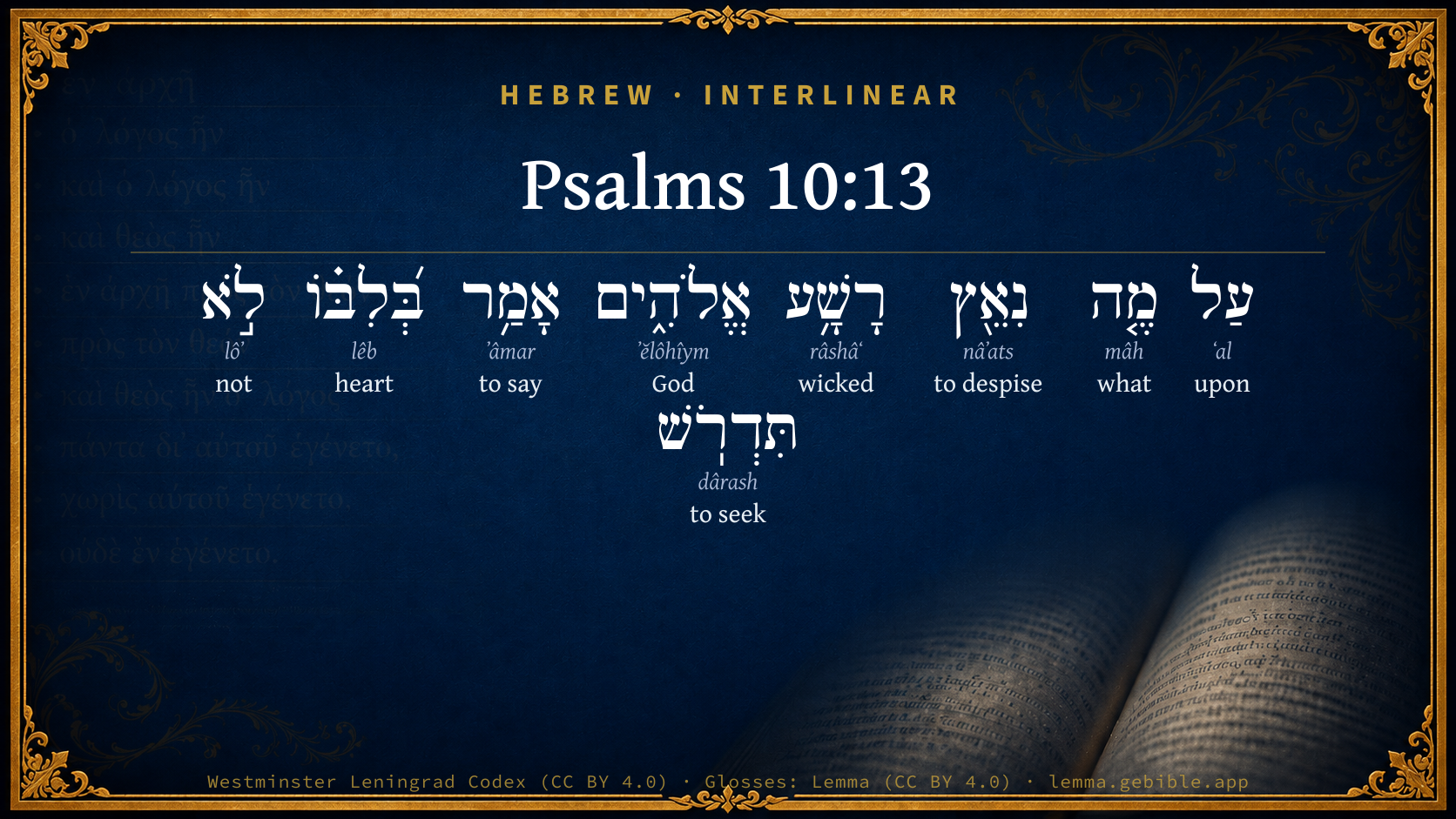
Hebrew (Westminster Leningrad Codex) Psalms 10:13 appears in the Hebrew Old Testament. The text above is from the Westminster Leningrad Codex. Each word links to its Strong’s number, a concise gloss, and parsing drawn from the Open Scriptures Hebrew Bible morphology. Click any word for its full Brown-Driver-Briggs (BDB) entry.
Download image
Cite this verse

Psalms 10:13 (World English Bible). Public Domain. Lemma interlinear Bible study tool, https://lemma.gebible.app/v/psalms/10/13.

Show BibTeX & RIS
BibTeX
RIS
English Translation
Why does the wicked person condemn God, And say in his heart, "God won't call me into account?"
World English Bible · Public Domain
Download a study sheet

One document with this verse’s original text, its word-by-word gloss line, the meaning frame, cross-references with their text, attributed commentary, and full source and license credits — printable, and it pastes into notes with its structure intact.

This verse Autodidact and up

Study sheet (.html) Plain text (.txt)

A passage Seminary Student

Up to 50 verses in one chapter. A passage sheet keeps up to 6 commentary sources and 12 cross-references per verse, in the order this page ranks them, and says so on the sheet whenever that leaves anything out. Ask for a single verse and you get the Autodidact verse sheet above.

Everything on this page stays free to read, with no account — the sheet is a download of what is already on screen, not access to it.

Want to remove ads? Support Godless Engineer
Compare translations 3

The same verse in 3 English versions, stacked beneath the original-language interlinear above. Click any original word for its lexicon entry.

Each is an independent rendering of the whole verse — the interlinear is not word-aligned to these translations.

Highlighted words mark where these versions differ — a whole-verse word diff, not a word-by-word alignment.

  • World English Bible Public Domain
    Why does the wicked person condemn God, And say in his heart, "God won't call me into account?"
  • King James Version Public Domain
    Wherefore doth the wicked contemn God? he hath said in his heart, Thou wilt not require it.
  • unfoldingWord Literal Text CC BY-SA 4.0
    Why does the wicked despise God? He says in his heart, “You will not seek.”

unfoldingWord Literal Text — © unfoldingWord, licensed CC BY-SA 4.0. Word-aligned USFM3 via Door43 (git.door43.org/unfoldingWord/en_ult).

Versions to compare (up to 4)

3 of 4 selected

Show all 17 translations

Every available English version of this verse, each an independent rendering of the whole verse.

  • World English Bible Public Domain
    Why does the wicked person condemn God, And say in his heart, "God won't call me into account?"
  • Berean Standard Bible Public Domain
    Why has the wicked man renounced God? He says to himself, “You will never call me to account.”
  • Majority Standard Bible Public Domain
    Why has the wicked man renounced God? He says to himself, “You will never call me to account.”
  • King James Version Public Domain
    Wherefore doth the wicked contemn God? he hath said in his heart, Thou wilt not require it.
  • American Standard Version (1901) Public Domain
    Wherefore doth the wicked contemn God, And say in his heart, Thou wilt not require `it'?
  • Revised Version (1885) Public Domain
    Wherefore doth the wicked contemn God, and say in his heart, Thou wilt not require it?
  • Geneva Bible (1599) Public Domain
    Wherefore doeth the wicked contemne God? he saith in his heart, Thou wilt not regard.
  • Young's Literal Translation Public Domain
    Wherefore hath the wicked despised God? He hath said in his heart, `It is not required.'
  • Literal Standard Version CC BY-SA 4.0
    Why has the wicked despised God? He has said in his heart, “It is not required.”
  • Unlocked Literal Bible CC BY-SA 4.0
    Why does the wicked man reject God and say in his heart, “You will not hold me accountable”?
  • unfoldingWord Literal Text CC BY-SA 4.0
    Why does the wicked despise God? He says in his heart, “You will not seek.”
  • Darby Bible Public Domain
    Wherefore doth the wicked contemn God? He hath said in his heart, Thou wilt not require [it].
  • World Messianic Bible Public Domain
    Why does the wicked person condemn God, and say in his heart, “God won’t call me into account”?
  • Webster's Bible Public Domain
    Why doth the wicked contemn God? he hath said in his heart, Thou wilt not require it.
  • Free Bible Version CC BY-SA 4.0
    Why do the wicked think they can treat God with such contempt? Why do they think that God won't make them accountable?
  • Bible in Basic English Public Domain
    Why has the evil-doer a low opinion of God, saying in his heart, You will not make search for it?
  • JPS Tanakh (1917) Public Domain
    Wherefore doth the wicked contemn God, and say in his heart: 'Thou wilt not require'?

Literal Standard Version (2020), Covenant Press — licensed CC BY-SA 4.0. Text via the HelloAO Bible API (eBible.org). Unlocked Literal Bible (unfoldingWord) — licensed CC BY-SA 4.0. Text via the HelloAO Bible API (eBible.org). unfoldingWord Literal Text — © unfoldingWord, licensed CC BY-SA 4.0. Word-aligned USFM3 via Door43 (git.door43.org/unfoldingWord/en_ult). Free Bible Version, Dr. Jonathan Gallagher — licensed CC BY-SA 4.0. Text via the HelloAO Bible API (eBible.org).

Word by word

More ways to search: Search by grammar → Find every occurrence → Compare this word →

Practice this passage: Drill this verse → Learn its vocabulary →

About this verse

These counts appear in no published source. They are computed here, from the morphology-tagged text and Lemma’s own curated glosses. What Lemma adds →

9
words
9
distinct lemmas
Wisdom
section

Notable vocabulary

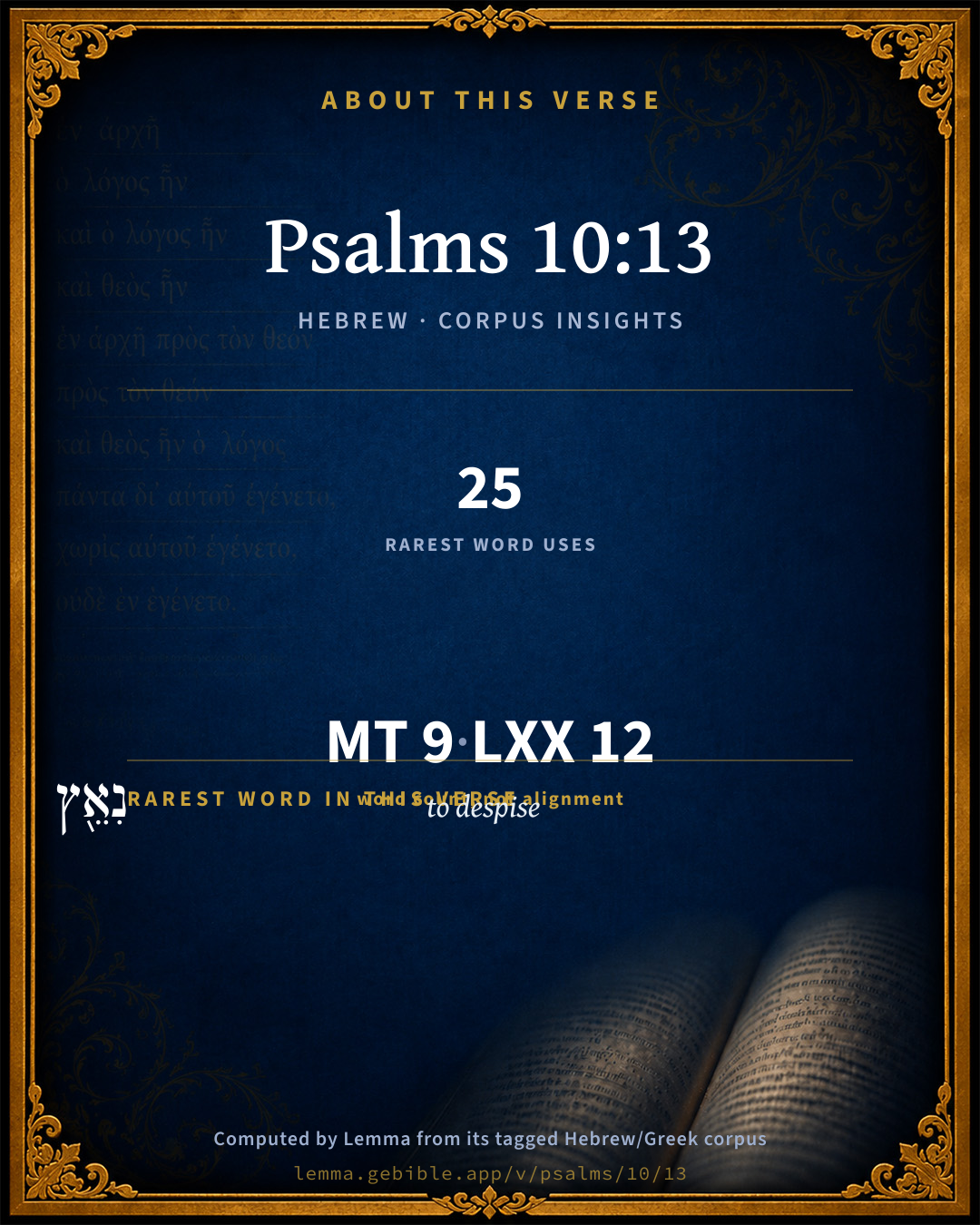
The rarest word here is נִאֵ֖ץ to despise H5006 — appearing just 25 times in the whole Hebrew Bible.

Shared distinctive vocabulary

נִאֵ֖ץ to despise H5006 occurs in 24 verses of the Hebrew Bible. Also found in:

Grammatical profile

  • 3 verbs
  • 2 nouns
  • 1 adjective
  • 1 preposition
  • 2 particles

Verb forms

  • נִאֵ֖ץ Piel · Perfect
  • אָמַ֥ר Qal · Perfect
  • תִּדְרֹֽשׁ Qal · Imperfect

Hebrew & Septuagint length

In English translation the verse runs 18 words from the Hebrew and 26 from the Septuagint (LXX English) — closely comparable.

A rough comparison of the two English renderings, which tokenize alike — not a word-level alignment.

Word counts can differ between the Hebrew and the Greek without any difference in meaning — e.g. the Hebrew direct-object marker אֵת has no separate Greek word, and Greek often adds the article ὁ.

In the original languages it is 9 Hebrew tokens and 12 Greek tokens — but the two are counted differently (Hebrew bundles its prefixes and suffixes into one token; the Greek is in lemma form), so that isn’t a like-for-like length.

Cross-references

10

Topical passages linked to Psalms 10:13 in the Treasury of Scripture Knowledge — connected by theme and wording, ordered by reader-vote popularity; previews shown in the World English Bible.

  • Luke 10:16 Whoever listens to you listens to me, and whoever rejects you rejects me. Whoever rejects me rejects him who sent me."
  • Numbers 11:20 but a whole month, until it come out at your nostrils, and it be loathsome to you; because that you have rejected Yahweh who is among you, and have wept before him, saying, Why came we forth out of Egypt?
  • 2 Samuel 12:9–10 Why have you despised the word of Yahweh, to do that which is evil in his sight? You have struck Uriah the Hittite with the sword, and have taken his wife to be your wife, and have slain him with the sword of the children of Ammon.
  • 2 Chronicles 24:22 Thus Joash the king didn't remember the kindness which Jehoiada his father had done to him, but killed his son. When he died, he said, Yahweh look on it, and require it.
  • Psalms 74:10 How long, God, shall the adversary reproach? Shall the enemy blaspheme your name forever?
  • Psalms 74:18 Remember this, that the enemy has mocked you, Yahweh. Foolish people have blasphemed your name.
  • 1 Thessalonians 4:8 Therefore he who rejects doesn't reject man, but God, who has also given his Holy Spirit to you.
  • Genesis 9:5 I will surely require your blood of your lives. At the hand of every animal I will require it. At the hand of man, even at the hand of every man's brother, I will require the life of man.
  • Genesis 42:22 Reuben answered them, saying, "Didn't I tell you, saying, 'Don't sin against the child,' and you wouldn't listen? Therefore also, behold, his blood is required."
  • Luke 11:50–51 that the blood of all the prophets, which was shed from the foundation of the world, may be required of this generation;

Cross-references courtesy of OpenBible.info (CC BY 4.0).

Hebrew and Greek witnesses Masoretic Hebrew ↔ Greek Septuagint

The same verse in the two great witnesses to the Old Testament, shown verse-for-verse.

You’re reading Greek Psalm 9 (Hebrew Psalm 10). The Septuagint counts the superscription, so verse numbers can differ from the Hebrew — chapter-level alignment, not verse-by-verse. Numbering follows Rahlfs.

These are two independent witnesses, not word-aligned to each other, and the Septuagint is shown in lemma (dictionary) form.

Hebrew Psalms 10:13 Masoretic · Westminster Leningrad Codex

עַל מֶ֤ה נִאֵ֖ץ רָשָׁ֥ע אֱלֹהִ֑ים אָמַ֥ר בְּ֝לִבּ֗וֹ לֹ֣א תִּדְרֹֽשׁ

Why does the wicked person condemn God, And say in his heart, "God won't call me into account?"

World English Bible · Public Domain

Greek LXX Greek Psalm 9:13 Septuagint · lemma form

ὅτι ἐκζητέω ὁ αἷμα αὐτός μιμνήσκω οὐ ἐπιλανθάνω ὁ κραυγή ὁ πένης

Have mercy upon me, O Lord; look upon my affliction which I suffer of my enemies, you that lift me up from the gates of death:

LXX2012 (modern English Septuagint) · Public Domain

Hebrew: Westminster Leningrad Codex (CC BY 4.0). Greek: Septuagint (public domain); English from LXX2012 (modern English Septuagint) (Public Domain). How the Septuagint differs from the Hebrew →

Commentary

Notes on Psalms 10:13 from classic Christian and Jewish commentators (each source and its license shown beneath its notes). The classic Christian expositions comment on the surrounding passage and are grouped to its opening verse, so a note may address several verses; the Jewish commentaries on the Tanakh (Rashi and others) are per-verse, so they appear only where the commentator wrote on this verse.

Lemma curates 59 commentaries, every one of them public domain or Creative Commons licensed, each selected and text-cleaned for this edition rather than reprinted as found. About our sources →

Trapp's Complete Commentary

John Trapp

Psa 10:13 Wherefore doth the wicked contemn God? he hath said in his heart, Thou wilt not require [it].

Ver. 13. Wherefore doth the wicked contemn God?] q.d. It is time for thee, Lord, to arise and bestir thyself; for otherwise what will become of thy great name? The saints cannot endure that God should be slighted.

He hath said in his heart] Psa 10:3-4. This sticks in David’s stomach, and draws this prayer from him, who was now blessedly blown up with a holy zeal for God; as was also good Zuinglius, when he said, In aliis mansnetus ero, in blasphemiis in Christum non ita, In other matters I can be mild and patient, but not so in case of blasphemy against Christ.

John Trapp, A Commentary or Exposition upon All the Books of the Old and New Testament (1647–1656) — public domain. Text from a community e-Sword module.

The Biblical Illustrator

Joseph S. Exell

Psa_10:13

Wherefore do the wicked contemn God?

On the unprincipled contempt of religion

How astonishing that any should be guilty of this. Excellence and station and authority shield men from contempt. But yet the wicked contemn God. Notwithstanding He is unspeakably glorious and great, the blessed and only Potentate possessing vast dominions, sustaining His creatures and glorified in all His works. And all things depend upon Him. Some, allured by His grace, with cheerfulness adore Him; others, constrained by His power, reluctantly Submit; but others are wicked enough to contemn Him. Their conduct and temper--

I. Toward Him show this. They have no delight in Him, they put the world far before Him, they deliberately disobey Him.

II. Towards things relating to Him. His ordinances they count weariness, His word they disregard, His people they scorn, His ministers they despise, His day they neglect.

III. Why do they thus act? Not from superior wisdom, but from depravity of the will, and encouraged by inconsistent Christians and by the strifes amongst such. But what an awful sin it is. Amazing madness! (John Erskine, D. D.)

The wicked contemners of God

Let us examine our hearts, our lives, and the Scriptures of truth.

1. Look at your mind and you will be forced to acknowledge that you seldom think of God.

2. Pass to an examination of your words.

3. Consider your actions.

4. The manner in which you treat the threatenings of God.

5. The regard you pay to the promises of God.

6. Your contempt of God is manifested in your disobedience to His commandments.

7. The declarations of One who perfectly knows you place this matter beyond a doubt. (H. Rollock, D. D.)

Expostulation with contemners of God

I. A question propounded.

1. Somewhat is here implied, something is laid as a charge. The wicked does contemn God. Take the word wicked collectively. Three ways wherein wicked men may be said to contemn God: In His ordinances, in His providences, in His servants. Whence does this proceed from them? Partly from pride, partly from ignorance.

2. Somewhat is expressed. The absurdity of such a temper is seen in this, that no good account can be given of it. See the inequality of it in reference to God. He does not deserve it. See the danger of it. Those that contemn Him, He will contemn them again. And His contemning is followed by His condemning; those whom He despises, He destroys.

II. The ground or occasion of this question. He hath said in his heart, Thou wilt not require it. According to the absolute sense, this is a declaration of the temper of wicked men. According to the relative sense of them, they seem to he either a proof or an account of what was said before concerning such persons, as to their contemning of God. This is a proof that they do so, and this is a reason also why they do so. They say in their heart, God will not require it. (T. Horton, D. D.)

Retribution--the worlds old age in sin

It has been a puzzle to some good men, and a pretext for unbelief to many wicked men, that the sinner, a moral and responsible being, could rest unconcerned in his sins. Why do not wicked men repent? This can only be resolved on the ground suggested in the text, the practical infidelity of wicked men. They do not believe in God as a just and inflexible moral governor. They do not accept the ideal of an exact and certain retribution. A carelessness of retribution. Moral law is held as an abstraction, and the reality, the extent, the terribleness of its sanctions are actually forgotten. Till this general sense of security be assailed, till this general indifference be shown to be causeless, the instances of awakening and conversion among sinners will be few.

I. Explain and illustrate the carelessness of retribution prevalent in the world.

1. The worlds old age in sin. Sin has been producing its appropriate results, modified mainly, and almost alone, by the fact that men exist in successive generations, and not in an uninterrupted, individual life. But as the generations of men all overlap each other, so that everyone includes some members both of preceding and succeeding ones, it follows that each new generation is not cast entirely back to the starting point of its predecessor, but gains a little upon it. It will be found that whatever has characterised one age morally, intellectually, or socially, also has characterised in a less or greater degree the following one. Sin is not an institution peculiar to any age or country. The same corrupt principle is more corrupt in the sons than it was in the fathers. Is not the world wicked now as it never has been before?

II. The worlds prosperity in sin. Existence is in itself a blessing, and an element of prosperity. Mans existence at every period has had much to make it pleasant and desirable. God, as Sovereign and Judge, has benefited the subject and sinner. In this age the world still sins and prospers. Everybody, almost everybody, boasts of a prosperous world. But the world sins as well as prospers. Is not the world, with all its pomp and pride, a wicked world? Individualise the sinner. He has, in these days, so high an idea of personal dignity and independence and irresponsibility to any power that is not a reflection of his own will, as to have become very thoughtless of the Divine law, and very careless of its sanctions. We may examine the growth of this idea, and illustrate its prevalence. When the sinner is thus individualised and made to think so much of his own happiness and rights, is he not apt to forget God? Consider now the judicial hardening of the world. The powers of darkness and the powers of holiness are at enmity with each other by Divine appointment. There is such a thing as a judicial permission and even encouragement to wickedness, whereby God asserts His sovereignty over free moral agents, and makes them ready, and makes all things ready, for the final manifestation of His glory at the coming of the Lord. One great reason why the world is so careless of approaching retribution is, that it is judicially hardened, rendered insensible to the proofs of its coming, and the fear that ought thereby to be awakened. (John H. Lord.)

The day of no judgment dreaded

Because sentence against an evil work is not executed speedily, therefore the heart of the sons of men is fully set in them to do evil. Pitt said, I have no fear for England; she will stand till the day of judgment. Burke answered, It is the day of no judgment that I dread. (The Quiver.)

The reckoning will come to the sinner

The wicked contemn God. Why? Because they say He will not require it. Ah! They forget that it is as true of Gods threatenings as of His promises,, that although He delays He does not deny them. A reprieve is not a pardon. It defers the execution, but does not necessarily cancel the sentence. And how many men in business, hard pressed for money and tottering on the edge of bankruptcy, have known too well that the bill which they had got the money lender to renew was not thereby paid; that, however often renewed, it has still to be paid, and that the oftener, indeed, it is renewed with interest added to the capital the debt but grows the larger, the payment the heavier. Just so will it be with you if you persist in rejecting the Saviour. Every day of mercy here will but aggravate the misery of hereafter, and the reckoning, by being long of coming, will be the more terrible when it comes--as that storm roars with the loudest thunder which has been the longest gathering. (T. Guthrie.)

The Biblical Illustrator, edited by Joseph S. Exell (c. 1880s–1900s) — public domain. Text from a community e-Sword module.

Geneva Bible (1599)

Geneva Bible translators

Therefore thou must needs punish this their blasphemy.

Geneva Bible (1599) marginal notes — public domain. Text via Bolls.life.

Jamieson, Fausset & Brown

Robert Jamieson, A. R. Fausset & David Brown

It is in vain to suppose God will overlook sin, however forbearing; for He carefully examines or beholds all wickedness, and will mark it by His providential (Thine hand) punishment.

Jamieson, Fausset & Brown — Commentary Critical and Explanatory on the Whole Bible (1871) — public domain (CC PDM 1.0). Text via the HelloAO Bible API.

Adam Clarke's Commentary

Verse 13. Wherefore doth the wicked contemn God?] How is it that the Lord permits such persons to triumph in their iniquity? The longsuffering of God leadeth them to repentance.

Adam Clarke's Commentary on the Bible (1810–1826) — public domain. Text from a community e-Sword/MySword module.

John Calvin's Commentaries

13. Why doth the wicked despise God? It is, indeed, superfluous to bring arguments before God, for the purpose of persuading him to grant us what we ask; but still he permits us to make use of them, and to speak to him in prayer, as familiarly as a son speaks to an earthly father. It should always be observed, that the use of praying is, that God may be the witness of all our affections; not that they would otherwise be hidden from him, but when we pour out our hearts before him, our cares are hereby greatly lightened, and our confidence of obtaining our requests increases. Thus David, in the present passage, by setting before himself how unreasonable and intolerable it would be for the wicked to be allowed to despise God according to their pleasure, thinking he will never bring them to an account, “A leur plaisir n’estimans pas que jamais il les amenast le conte.” — Fr.

“Au rang des hommes.” — Fr. “To the rank of men.”

John Calvin's Commentaries (1540-1563) — public domain. Text from the Calvin Translation Society English edition (1840s-50s) via the Christian Classics Ethereal Library (ccel.org). Calvin's coverage is partial (roughly two-thirds of the Bible); uncommented books and verses are honest gaps, never fabricated. The 19th-century editor's footnotes and remarks are omitted so the notes are faithfully Calvin's own voice.

The Cambridge Bible for Schools and Colleges

gen. ed. J. J. S. Perowne

13. Why, urges the Psalmist in support of his appeal, has God so long tolerated the blasphemies of the wicked man (Psa_10:3-4), and by inaction let Himself be misunderstood? The verbs are in the perfect tense, expressing what long has been and still is the case.

he hath said] R.V. and say.

The Cambridge Bible for Schools and Colleges (gen. ed. J. J. S. Perowne; Cambridge University Press, 1878–1918) — public domain. Text from a community e-Sword module.

John Gill's Exposition

Wherefore doth the wicked contemn God?.... God may be said to be contemned or despised, when his being, perfections, and providence are denied, or called in question, or abused, Psa 10:9; when his word is derided, the great things of his law are counted as a strange thing Hos 8:12, and the truths of his Gospel are reckoned foolishness; and instead of these, the decrees, doctrines, and traditions of men, are set up, as by antichrist; and when his ministers, and especially his Son, are treated with disdain, Luk 10:16;

he hath said in his heart, thou wilt not require it, or "seek it" (i); or inquire after it, his iniquity; the sense is, that God will make no inquiry after sin, and bring it into judgment, unto account, and under examination; or will not make inquisition, that is, for blood, for the blood of the saints and martyrs of Jesus, shed by antichrist; or will not require it at his hands, or recompense vengeance for it: all which is false and vain; the contrary to it will be found true.

(i) "te non inquisiturum", Piscator, Michaelis; so Ainsworth.

John Gill's Exposition of the Whole Bible (1746–1763) — public domain (CC PDM 1.0). Text via the HelloAO Bible API.

Albert Barnes' Notes on the Bible

Wherefore doth the wicked contemn God? - That is, despise him; or treat him with contempt and disregard. On what ground is this done? How is it to be accounted for? What is the proper explanation of so strange a fact? It is to be observed here:

(a) that the psalmist assumes this to be a fact, that the wicked do thus contemn or despise God. Of this he had no doubt; of this there can be no doubt now. They act as if this were so; they often speak of Him as if this were so. They pay no respect to his commands, to his presence, or to his character; they violate all His laws as if they were not worth regarding; they spurn all His counsels and entreaties; they go forward to meet Him as if His wrath were not to be apprehended or dreaded.

(b) So strange a fact, the psalmist says, ought to be accounted for. There must be some reason why it occurs; and what that reason is, is worth an earnest inquiry. It could not be possible to believe that man - the creature of God, and a creature so weak and feeble - could do it, unless the fact were so plain that it could not be denied. It is, then, worth inquiry to learn how so strange a fact can be accounted for; and the solution - the thing which will explain this, and which must be assumed to be true in order to explain it - is stated in the concluding part of the verse.

He hath said in his heart - This expression is here repeated for the third time in the psalm. See Psa 10:6, Psa 10:11. The idea is, that all this is the work “of the heart,” and indicates the state of the heart. It cannot be regarded as the dictate of the reason or the judgment; but it is to be traced to the wishes, the feelings, the desires, and is to be regarded as indicating the real condition of the human heart. A man habitually desires this; he practically persuades himself that this is so; he acts as if it were so.

Thou wilt not require it - Thou wilt not require an account of it; thou wilt not inquire into it. The Hebrew is simply: “Thou wilt not seek;” and the idea is, that God would not make an investigation of the matter. This fact, the psalmist says, would account for the conduct of the wicked. This is the actual feeling of wicked men, that they are not to give account of their conduct, or that God will not be strict to mark their deeds. People act as if they were not responsible to their Maker, and as if it were a settled point that he would never call them to account.

Albert Barnes' Notes on the Bible (1834–1885) — public domain. Text from a community e-Sword/MySword module.

Matthew Poole's English Annotations

The sense is either,

1. What is the cause of his contempt of God? To which question the next words give an answer, Thy connivance makes him secure. Therefore show thyself. Or,

2. Why dost thou by giving them impunity suffer and occasion them to despise thee? Do so no longer. Which tacit desire he enforceth by representing their atheistical denial of God’s providence.

Matthew Poole's English Annotations on the Holy Bible (1683–1685) — public domain. Text from a community e-Sword/MySword module.

The Treasury of David

Charles H. Spurgeon

Ver. 13. Future retribution: doubts concerning it.

1. By whom indulged: the wicked. 2. Where fostered: in his heart.

3. For what purpose: quieting of conscience, etc. 4. With what practical tendency: contemn God.

He who disbelieves hell, distrusts heaven.

Ver. 13-14. Divine government in the world.

1. Who doubt it? and why? 2. Who believe it? and what does this faith cause them to do?

Charles H. Spurgeon's The Treasury of David (1869–1885) — public domain. Psalms only. Text from a community e-Sword/MySword module.

Whedon's Commentary on the Bible

Daniel D. Whedon

13. Thou wilt not require it—Thou wilt not search it out, to make men legally answerable for their conduct. On this assumption the hope of the wicked is founded.

Daniel D. Whedon (gen. ed.), Commentary on the Old and New Testaments (1874–1909) — public domain. Text from a community e-Sword module.

The Pulpit Commentary

Wherefore doth the wicked contemn God? God"s long-suffering does but make the wicked despise him. Wherefore is this allowed to continue (comp. ver. 1)? He hath said in his heart, Thou wilt not require it; rather, as in the Prayer-beck Version, while he cloth say in his heart (see vers. 6, 11).

The protest of faith against sin.

"Wherefore doth the wicked contemn God?" etc. This psalm is one of those which utter with burning fervour the protest of faith against unbelief, of righteousness against iniquity, of loyalty to God against rebellion. To understand these utterances, we must try to see sin as it is in itself, apart from the gracious light of forgiving mercy which the gospel sheds as they saw it who had to live the life of faith when no cross had been set up, no sacrifice offered "for the sins of the whole world," no gospel of forgiveness preached to the nations. If the prevalence of sin, and its consequent misery, is so heavy a burden to pious hearts to-day, what must it have been then?

I A TERRIBLE VIEW OF SIN: CONTEMPT OF GOD. Wilful transgressors despise God.

1. They are regardless of his Law. (1Jn_3:4) It is written on their conscience. The blessing of obedience and the curse of disobedience are inwoven in their very nature; for besides that some sins (drunkenness, gluttony, lust, and sloth) destroy even the body, the man himself is worse, mentally, in character, for every sin he commits.

2. They are careless of Gods honour. Sin insults and dishonours God a greater crime than all the injury it does to man.

3. They despise his call to repentance. (Isa_1:18 Act_17:30)

4. They defy his displeasure and are reckless of his judgment. (Luk_13:3, Luk_13:5)

II A QUESTION ASKED AND ANSWERED. "Wherefore," etc.? Because "he hath said in his heart, Thou wilt not require it" (so ver. 11). Men persuade themselves that, as they forget God, so he forgets them. That is all they desire. An ungodly man"s notion of forgiveness is mere omission to punish; neglect of justice; indulgence, not because it is right not to punish, but merely because the thought of punishment is too dreadful and painful. "God," he says, "is too merciful to punish." He does not consider or understand that, as it is impossible for God to forget anything, so there would be no true mercy, but the reverse, in the neglect of justice. This is what is meant by "will by no means clear the guilty," even in the very proclamation of Divine mercy. (Exo_34:6, Exo_34:7)

III THE FATAL MISTAKE. God has seen, does remember, will require and judge. To build hope for eternity on the supposed negligence and injustice of God, is to try to cross an abyss on a cloud. If God forgives sinners, he must do it justly, on good grounds. (Rom_1:17, 18 2:6-9 3:23-26) The gospel is the glorious revelation of God"s pardoning love and grace, not thrust at random on those who continue to despise him, but freely given to each, even the worst, who seeks to "be reconciled to God", (2Co_5:20) and lays hold on his promises in Christ. (Heb_2:3 Heb_10:28, Heb_10:29)

The Pulpit Commentary (1880–1919), ed. H.D.M. Spence-Jones & Joseph S. Exell — public domain. Text from a community e-Sword module.

John Wesley's Explanatory Notes

Contemn - Why dost thou by giving them impunity, suffer and occasion them to despise thee?

John Wesley, Explanatory Notes Upon the Whole Bible (1754–1765) — public domain. Text via the GEBible commentary corpus.

J. A. Alexander on Psalms

Joseph Addison Alexander

13. On what (ground) has the wicked contemned God, has he said in his heart, Thou wilt not require? The question implies the sin and folly of the suffered to go on so long. Contemned, i. e. treated with contempt. The reference is not to inward feeling merely, but to its external manifestation. The second clause shews how the feeling has been manifested. Said in his heart; is here repeated for the third time in this psalm. See Psa 10:6; Psa 10:11, above., The direct address to God in the last clause is peculiarly emphatic. The wicked man not only speaks irreverently of him, but insults him to his face. Thou wilt not require. The Hebrew verb includes the ideas of investigation and exaction. Thou wilt not inquire into my conduct, or require an account of it. See Psa 10:4 above, and compare Psa 9:13 (12). The whole verse contains an indirect expostulation or complaint of the divine forbearance towards such high-handed and incorrigible sinners.

Joseph Addison Alexander, The Psalms Translated and Explained (1850) — public domain. Text from a community e-Sword module.

unfoldingWord translationNotes

Door43 World Missions Community

Why does the wicked man reject God and say ... "You will not hold me accountable"?

The speaker uses this question to show that he is very sad that wicked people do these things. AT: "Wicked people are always rejecting God and saying ... 'You will not hold me accountable.'" (See: Rhetorical Question)

You will not hold me accountable

"You will not require me to tell you why I do what I do." Holding someone accountable here represents punishing him. AT: "You will not punish me" (See: Metonymy)

translationWords

reject

heart

unfoldingWord translationNotes — © Distant Shores Media and the Door43 World Missions Community, licensed CC BY-SA 4.0. Source: git.door43.org/Door43/en_tn.

Rashi

Rabbi Shlomo Yitzchaki (Rashi)

Why did a wicked man blaspheme the Holy One, blessed be He? Because he said in his heart that You do not seek.

Rashi on the Tanakh — English translations: “The Judaica Press complete Tanach with Rashi, translated by A. J. Rosenberg” (CC BY 4.0); “Pentateuch with Rashi's commentary by M. Rosenbaum and A.M. Silbermann, 1929-1934” (public domain); “The Metsudah Tanach series, Lakewood, N.J” (CC BY 4.0); and “The Book of Joshua, Metsudah Publications, 1997” (CC BY 4.0). Text via Sefaria.

Radak

Rabbi David Kimhi (Radak)

Wherefore doth the wicked contemn God, (And) say in his heart, Thou wilt not require? – For why is he despising Thee? Only because he says in his heart that Thou wilt not require, nor regard what he says and does.

Radak on the Tanakh — English translations: “Sefaria Community Translation” (CC0 1.0 (public-domain dedication)); “Eliyahu Munk, HaChut Hameshulash” (CC BY 4.0); “Rabbi Mike Feuer, Jerusalem Anthology” (CC BY 4.0); and “R. David Kimhi on the first book of Psalms, Translated by R.G. Finch, London, 1919” (public domain). Text via Sefaria.

Lesson kit

Teaching starters — assembled from the data on this page, not authored interpretation. Every prompt links to the verse data it draws on. Edit before teaching.

Psalms, in the Wisdom, opens this verse with 9 words (9 distinct Hebrew lemmas). Its most distinctive word is nâʼats (“to despise”). A historical commentator’s framing appears above. Read the whole chapter for the surrounding context.

Discussion questions

  1. What does “to despise” (nâʼats) contribute to the verse as a whole?
  2. How does Numbers 14:11, which shares the word «to despise», read alongside this verse?
  3. The translations on this page render this verse differently — a whole-verse word diff, not a word-by-word alignment. What might account for the different wordings?
  4. «נִאֵ֖ץ» is a Piel Perfect verb. How does that grammatical form shape the action described?
  5. Compare how Trapp's Complete Commentary and The Biblical Illustrator read this verse. Where do they agree or differ?

Things to notice

Reading settings

Reading text

Shown beneath each verse's original-language words.

Old Testament
Old Testament edition

Read the OT as the Masoretic Hebrew (MT) or the Greek Septuagint (LXX).

English shown for the Greek Septuagint (in the Hebrew ↔ Greek comparison).

Comparing translations? Open the Compare panel on any verse page to stack up to four side by side.