
Proverbs 11:7

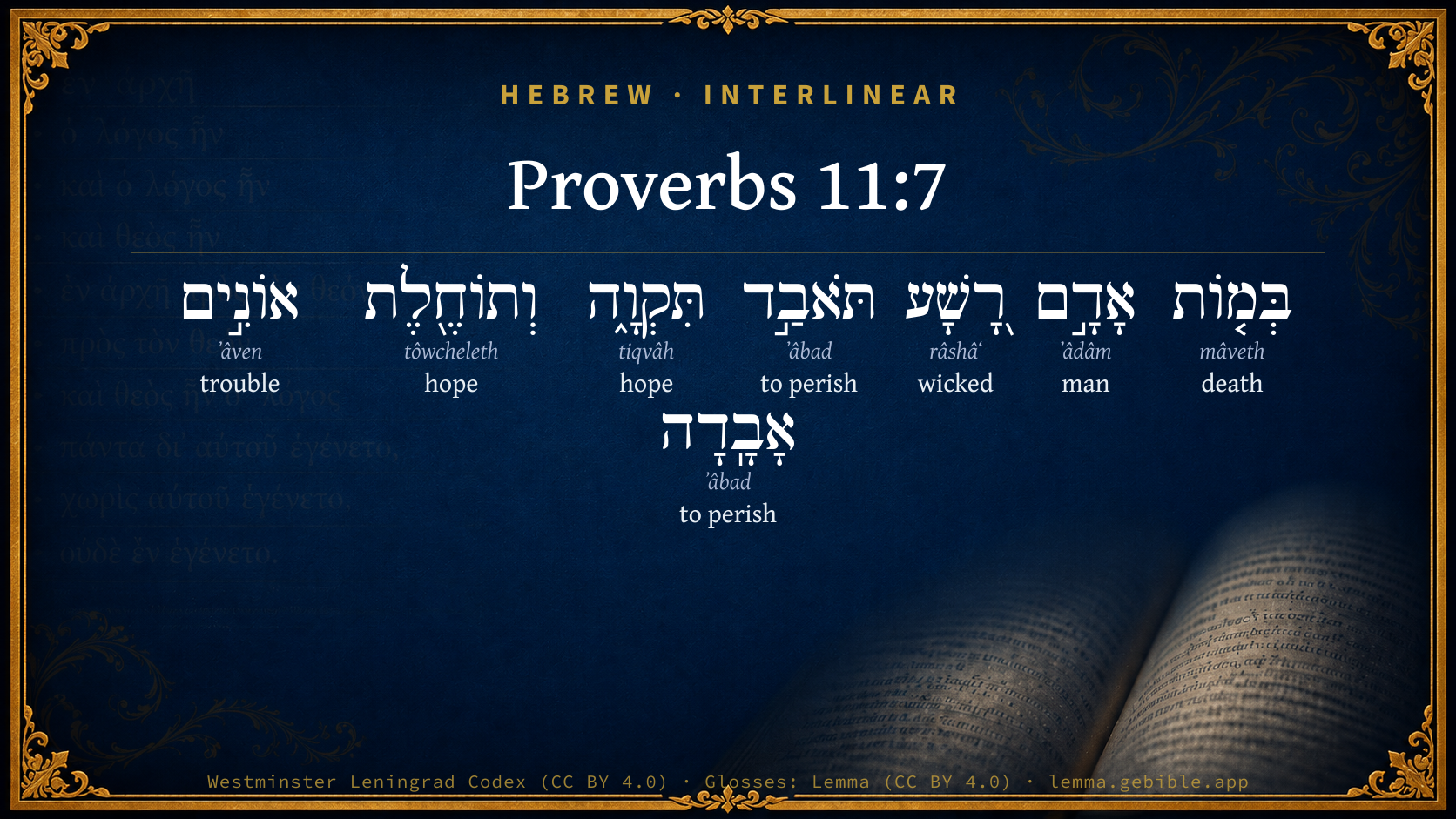
Hebrew (Westminster Leningrad Codex) Proverbs 11:7 appears in the Hebrew Old Testament. The text above is from the Westminster Leningrad Codex. Each word links to its Strong’s number, a concise gloss, and parsing drawn from the Open Scriptures Hebrew Bible morphology. Click any word for its full Brown-Driver-Briggs (BDB) entry.
Download image
Cite this verse

Proverbs 11:7 (World English Bible). Public Domain. Lemma interlinear Bible study tool, https://lemma.gebible.app/v/proverbs/11/7.

Show BibTeX & RIS
BibTeX
RIS
English Translation
When a wicked man dies, hope perishes, And expectation of power comes to nothing.
World English Bible · Public Domain
Download a study sheet

One document with this verse’s original text, its word-by-word gloss line, the meaning frame, cross-references with their text, attributed commentary, and full source and license credits — printable, and it pastes into notes with its structure intact.

This verse Autodidact and up

Study sheet (.html) Plain text (.txt)

A passage Seminary Student

Up to 50 verses in one chapter. A passage sheet keeps up to 6 commentary sources and 12 cross-references per verse, in the order this page ranks them, and says so on the sheet whenever that leaves anything out. Ask for a single verse and you get the Autodidact verse sheet above.

Everything on this page stays free to read, with no account — the sheet is a download of what is already on screen, not access to it.

Want to remove ads? Support Godless Engineer
Compare translations 3

The same verse in 3 English versions, stacked beneath the original-language interlinear above. Click any original word for its lexicon entry.

Each is an independent rendering of the whole verse — the interlinear is not word-aligned to these translations.

Highlighted words mark where these versions differ — a whole-verse word diff, not a word-by-word alignment.

  • World English Bible Public Domain
    When a wicked man dies, hope perishes, And expectation of power comes to nothing.
  • King James Version Public Domain
    When a wicked man dieth, his expectation shall perish: and the hope of unjust men perisheth.
  • unfoldingWord Literal Text CC BY-SA 4.0
    At the death of a wicked man expectation will perish, and the hope of strength perishes.

unfoldingWord Literal Text — © unfoldingWord, licensed CC BY-SA 4.0. Word-aligned USFM3 via Door43 (git.door43.org/unfoldingWord/en_ult).

Versions to compare (up to 4)

3 of 4 selected

Show all 18 translations

Every available English version of this verse, each an independent rendering of the whole verse.

  • World English Bible Public Domain
    When a wicked man dies, hope perishes, And expectation of power comes to nothing.
  • Berean Standard Bible Public Domain
    When the wicked man dies, his hope perishes, and the hope of his strength vanishes.
  • Majority Standard Bible Public Domain
    When the wicked man dies, his hope perishes, and the hope of his strength vanishes.
  • King James Version Public Domain
    When a wicked man dieth, his expectation shall perish: and the hope of unjust men perisheth.
  • American Standard Version (1901) Public Domain
    When a wicked man dieth, `his' expectation shall perish; And the hope of iniquity perisheth.
  • Revised Version (1885) Public Domain
    When a wicked man dieth his expectation shall perish: and the hope of iniquity perisheth.
  • Geneva Bible (1599) Public Domain
    When a wicked man dieth, his hope perisheth, and the hope of the vniust shall perish.
  • Douay-Rheims (1899) Public Domain
    When the wicked man is dead, there shall be no hope any more: and the expectation of the solicitous shall perish.
  • Young's Literal Translation Public Domain
    In the death of a wicked man, hope perisheth, And the expectation of the iniquitous hath been lost.
  • Literal Standard Version CC BY-SA 4.0
    In the death of a wicked man, hope perishes, || And the expectation of the iniquitous has been lost.
  • Unlocked Literal Bible CC BY-SA 4.0
    When a wicked man dies, his hope perishes and the hope that was in his strength comes to nothing.
  • unfoldingWord Literal Text CC BY-SA 4.0
    At the death of a wicked man expectation will perish, and the hope of strength perishes.
  • Darby Bible Public Domain
    When a wicked man dieth, [his] expectation shall perish; and the hope of evil [men] perisheth.
  • World Messianic Bible Public Domain
    When a wicked man dies, hope perishes, and expectation of power comes to nothing.
  • Webster's Bible Public Domain
    When a wicked man dieth, his expectation shall perish: and the hope of unjust men perisheth.
  • Free Bible Version CC BY-SA 4.0
    When a wicked person dies, their hopes die with them; what the godless look forward to is gone.
  • Bible in Basic English Public Domain
    At the death of an upright man his hope does not come to an end, but the hope of the evil-doer comes to destruction.
  • JPS Tanakh (1917) Public Domain
    When a wicked man dieth, his expectation shall perish, and the hope of strength perisheth.

Literal Standard Version (2020), Covenant Press — licensed CC BY-SA 4.0. Text via the HelloAO Bible API (eBible.org). Unlocked Literal Bible (unfoldingWord) — licensed CC BY-SA 4.0. Text via the HelloAO Bible API (eBible.org). unfoldingWord Literal Text — © unfoldingWord, licensed CC BY-SA 4.0. Word-aligned USFM3 via Door43 (git.door43.org/unfoldingWord/en_ult). Free Bible Version, Dr. Jonathan Gallagher — licensed CC BY-SA 4.0. Text via the HelloAO Bible API (eBible.org).

Word by word

More ways to search: Search by grammar → Find every occurrence → Compare this word →

Practice this passage: Drill this verse → Learn its vocabulary →

About this verse

These counts appear in no published source. They are computed here, from the morphology-tagged text and Lemma’s own curated glosses. What Lemma adds →

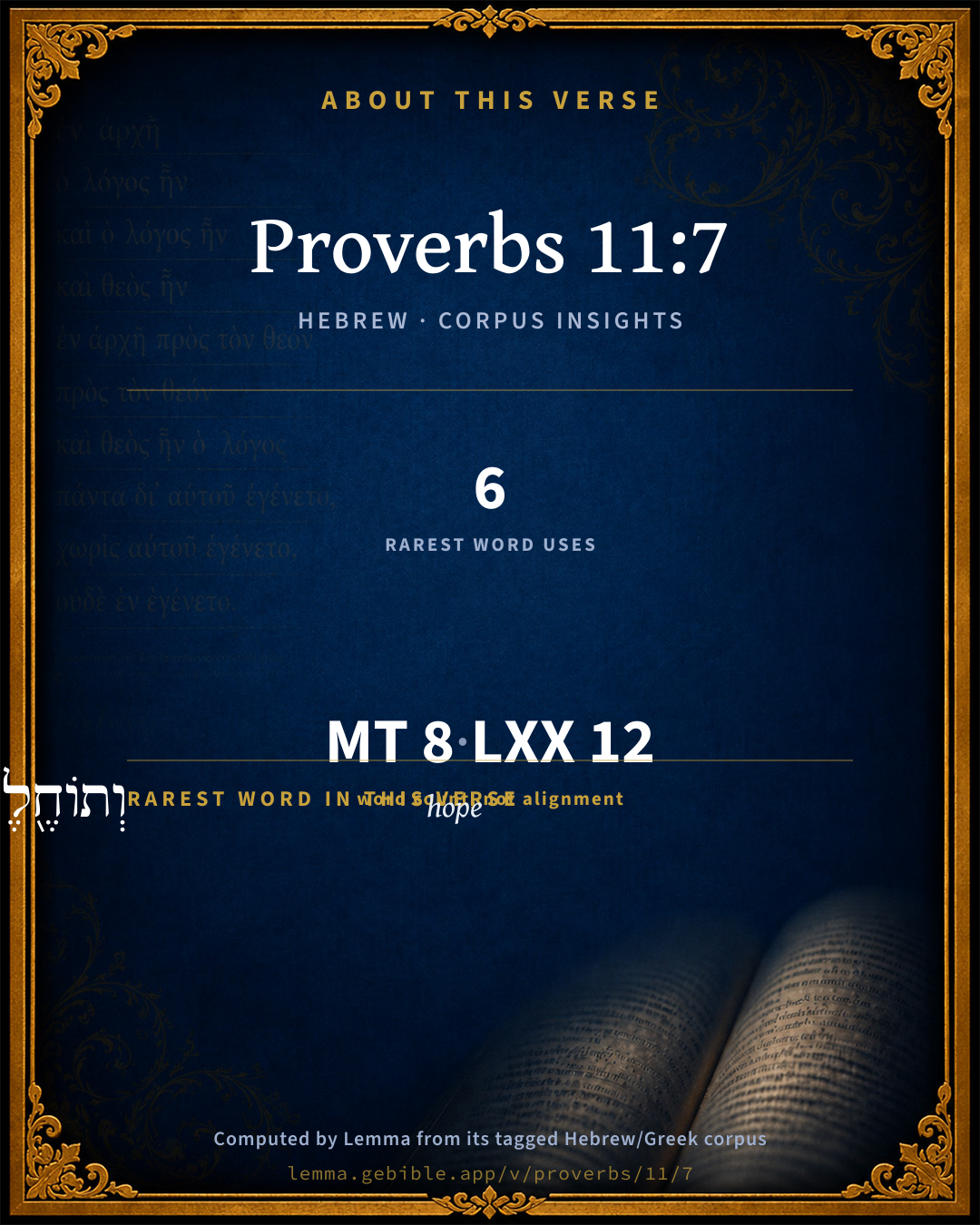
8
words
7
distinct lemmas
Wisdom
section

Notable vocabulary

The rarest word here is וְתוֹחֶ֖לֶת hope H8431 — appearing just 6 times in the whole Hebrew Bible.

Shared distinctive vocabulary

וְתוֹחֶ֖לֶת hope H8431 occurs in 6 verses of the Hebrew Bible. Also found in:

Grammatical profile

  • 2 verbs
  • 5 nouns
  • 1 adjective

Verb forms

  • תֹּאבַ֣ד Qal · Imperfect
  • אָבָֽדָה Qal · Perfect

Repetition

A word recurs within this verse — often emphatic in Hebrew:

  • תֹּאבַ֣ד to perish H6 ×2

Hebrew & Septuagint length

In English translation the verse runs 14 words from the Hebrew and 19 from the Septuagint (LXX English) — closely comparable.

A rough comparison of the two English renderings, which tokenize alike — not a word-level alignment.

Word counts can differ between the Hebrew and the Greek without any difference in meaning — e.g. the Hebrew direct-object marker אֵת has no separate Greek word, and Greek often adds the article ὁ.

In the original languages it is 8 Hebrew tokens and 12 Greek tokens — but the two are counted differently (Hebrew bundles its prefixes and suffixes into one token; the Greek is in lemma form), so that isn’t a like-for-like length.

Cross-references

8

Topical passages linked to Proverbs 11:7 in the Treasury of Scripture Knowledge — connected by theme and wording, ordered by reader-vote popularity; previews shown in the World English Bible.

  • Proverbs 10:28 The prospect of the righteous is joy, But the hope of the wicked will perish.
  • Job 8:13–14 So are the paths of all who forget God. The hope of the godless man shall perish,
  • Job 11:20 But the eyes of the wicked shall fail, They shall have no way to flee; Their hope shall be the giving up of the spirit."
  • Exodus 15:9–10 The enemy said, 'I will pursue, I will overtake, I will divide the spoil. My desire shall be satisfied on them. I will draw my sword, my hand shall destroy them.'
  • Psalms 146:4 His spirit departs, and he returns to the earth. In that very day, his thoughts perish.
  • Proverbs 14:32 The wicked is brought down in his calamity, But in death, the righteous has a refuge.
  • Luke 12:19–20 I will tell my soul, "Soul, you have many goods laid up for many years. Take your ease, eat, drink, be merry."'
  • Ezekiel 28:9 Will you yet say before him who kills you, I am God? but you are man, and not God, in the hand of him who wounds you.

Cross-references courtesy of OpenBible.info (CC BY 4.0).

Hebrew and Greek witnesses Masoretic Hebrew ↔ Greek Septuagint

The same verse in the two great witnesses to the Old Testament, shown verse-for-verse.

These are two independent witnesses, not word-aligned to each other, and the Septuagint is shown in lemma (dictionary) form.

Hebrew Proverbs 11:7 Masoretic · Westminster Leningrad Codex

בְּמ֤וֹת אָדָ֣ם רָ֭שָׁע תֹּאבַ֣ד תִּקְוָ֑ה וְתוֹחֶ֖לֶת אוֹנִ֣ים אָבָֽדָה

When a wicked man dies, hope perishes, And expectation of power comes to nothing.

World English Bible · Public Domain

Greek LXX Proverbs 11:7 Septuagint · lemma form

τελευτάω ἀνήρ δίκαιος οὐ ὄλλυμι ἐλπίς ὁ δέ καύχημα ὁ ἀσεβής ὄλλυμι

At the death of a just man his hope does not perish: but the boast of the ungodly perishes.

LXX2012 (modern English Septuagint) · Public Domain

On this verse, Haydock's Catholic Bible Commentary discusses the Septuagint’s reading. Read the note in Commentary ↓

Hebrew: Westminster Leningrad Codex (CC BY 4.0). Greek: Septuagint (public domain); English from LXX2012 (modern English Septuagint) (Public Domain). How the Septuagint differs from the Hebrew →

Commentary

Notes on Proverbs 11:7 from classic Christian and Jewish commentators (each source and its license shown beneath its notes). The classic Christian expositions comment on the surrounding passage and are grouped to its opening verse, so a note may address several verses; the Jewish commentaries on the Tanakh (Rashi and others) are per-verse, so they appear only where the commentator wrote on this verse.

Lemma curates 59 commentaries, every one of them public domain or Creative Commons licensed, each selected and text-cleaned for this edition rather than reprinted as found. About our sources →

Trapp's Complete Commentary

John Trapp

Pro 11:7 When a wicked man dieth, [his] expectation shall perish: and the hope of unjust [men] perisheth.

Ver. 7. When a wicked man dieth, his expectation shall perish.] He died, perhaps, in strong hopes of heaven, as those seem to have done that came rapping and bouncing at heaven gates, with "Lord, Lord, open unto us," but were sent away with a Non novi vos; "Depart, I know you not." {Mat 7:22-23}

And the hope of unjust men.] Etiam spes valentissima petit. So some render it. His most strong hope shall come to nothing. He made a bridge of his own shadow, and thought to go over it, but is fallen into the brook, he thought he had taken hold of God; but it is but with him as with a child that catcheth at the shadow on the wall, which he thinks he holds fast; but he only thinks so.

John Trapp, A Commentary or Exposition upon All the Books of the Old and New Testament (1647–1656) — public domain. Text from a community e-Sword module.

The Biblical Illustrator

Joseph S. Exell

Pro_11:7

The hope of unjust men perisheth.

The terrible in human history

There are two terrible events in this text.

I. Death meeting the wicked man. The wicked man dieth.

1. Death does not wait for reformation of character.

2. The greatest enemies of God and His universe are overcome. There is a stronger power than that of the wicked.

II. Hope leaving the human soul. What is dearer to the soul than hope? The soul lives in and by hope. Shakespeare Says, The miserable hath no medicine, but only hope. When the wicked man dieth, he loses this hope. Hope of liberty, of improvement, of honour, of happiness. He dieth, and carrieth nothing away. (D. Thomas, D.D.)

The hope of the wicked

Men derive almost the whole of their happiness from hope. The wicked man laughs at the righteous because he lives by hope; but the wicked man himself does the same. The present situation of the wicked man never yields him the pleasure which he wishes and expects, but there is ever something in view, in which, could he but obtain it, he would find rest. If his hopes are deferred, his heart is sick; if they are accomplished he is still unsatisfied; but he comforts himself with some other hope, like a child, who thinks he sees a rainbow on the top of a neighbouring hill, and runs to take hold of it, but sees it as far removed from him as before. Thus the life of a wicked man is spent in vain wishes and toils and hopes, till death kills at once his body, his hope, and his happiness. (G. Lawson.)

The Biblical Illustrator, edited by Joseph S. Exell (c. 1880s–1900s) — public domain. Text from a community e-Sword module.

Joseph Benson's Commentary

Pro 11:7-8. When a wicked man dieth, his expectation shall perish — All his hope and felicity, which he placed wholly in earthly things, are lost and gone with him; and the hope of unjust men, &c. — This clause, according to this translation, is a mere repetition of the former: but the word אונים, here rendered unjust men, is generally translated strengths, or powers, as indeed it properly means. Divers, therefore, interpret the clause, The hope of their strengths, that is, which they place in their riches, children, friends, and other carnal props and defences, perisheth. So this is added by way of aggravation. The righteous are delivered out of trouble — When, perhaps, he hardly expected it, or even was ready to despair of it; and the wicked cometh in his stead — Is, by God’s providence, brought into the same miseries, which the wicked either designed against, or had formerly inflicted on the righteous, but which were now lately removed from them. Thus Mordecai was saved from the gallows, Daniel from the lions’ den, and Peter from the prison, and their persecutors came in their stead. Israel was delivered out of the Red sea, and the Egyptians drowned in it.

Joseph Benson's Commentary on the Old and New Testaments (1811–1818) — public domain. Text from a community e-Sword module.

The Preacher's Complete Homiletical Commentary

Joseph S. Exell (gen. ed.)

CRITICAL NOTES.—

Pro_11:7. His and men are not in the original, and the verse is variously rendered. Stuart reads, “When the wicked die, all the hopes perish; and when they are afflicted, their expectation of recovery or alleviation will be frustrated.” Zöckler—“With the death of the wicked hope cometh to nought, and the unjust expectation has perished.” Miller—“By the death of a wicked man hope is lost, and the expectation of sorrowing ones is lost already.”

MAIN HOMILETICS OF Pro_11:7

THE DEATH OF THE WICKED

I. An inevitable event in relation to a wicked man. “When a wicked man dieth.” He must die. “It is appointed unto men,”—to the good and to the bad—“once to die.” (Heb_9:27).

1. This inevitable event is most undesired by the wicked man. The certainty of any coming event will make it to be dreaded in proportion as it is felt that its advent must be followed by unpleasant consequences. The man who knows that nothing can save him from becoming a bankrupt at no distant period feels the certainty of the fact to be a most unwelcome thought. The man who knows that on a certain day of reckoning he will be unable to meet his liabilities, and that the day will as surely arrive as the planets will hold on their way in the heavens, can only look forward to the future with the most gloomy apprehensions. That coming day is ever hanging over his present, and imparting a sting to every hour in which he allows his thoughts to dwell upon it. The certainty of death is a most painful subject of contemplation for a wicked man. Conscience tells him that he has no resources wherewith to meet the demands of that day—he knows that he is unfit to face that most ruthless of all creditors, and the knowledge that nothing can turn aside his footsteps is often a bitter drop in the cup of his present apparent prosperity and security.

2. The wicked man takes refuge from the thought of the certainty of the event in the uncertainty of the time when it will take place. He indulges in “hopes,” and “expectations,” concerning the present life, because of the indefiniteness of its length. Although he knows that death must come one day, he hopes that it may be many years hence. The rich fool in our Lord’s parable knew that he must die some day—he admitted that certainty. But he made the uncertainty of the time an excuse for taking present ease. He refused to take into account the possibility that the summons had gone forth: “This night thy soul shall be required of thee.”

3. The certainty of the death of the wicked is a most painful subject of thought to good men. They look at the present condition of the ungodly, and, knowing the indispensable and intimate connection between present character and future happiness or misery, the certainty of the death of the wicked man is often a more saddening thought to them than to the man himself. The contemplation of such an event must give pain to a soul in harmony with God and goodness.

4. Yet, looked at with regard to his relation with others, the certainty of the death of the wicked is most desirable. If one portion of the body has become so diseased that the whole body is likely to suffer from it, a severance between the diseased part and the sound body must take place, however painful the operation may be. The loss of the part is indispensable to the salvation of the rest. There have been, and there are, men who are so morally diseased that their removal from the world is to be desired for the sake of others. It must be regarded as a blessing for the world that the death of the wicked is certain. The death of one wicked man is sometimes the means of bringing peace to many to whom his existence was a curse. There are men who do the best thing for the world when they leave it—their exit from it is the greatest benefit they have ever conferred upon it.

II. The wicked man is in his worst condition when he has most need of being in his best. It is at death that his expectation and hope perish. The time when we approach a crisis in our history is a time when we need to be most furnished with all the resources that will be demanded to meet it. It was more necessary that David should be filled with faith and courage when he went forth to meet Goliath than when he was keeping his sheep in his father’s fields. When a youthful candidate for academical honour comes to the day of his examination, he needs to concentrate all his past days of study into one focus. If on that day all his mental powers are not at their very best, he is likely to be overwhelmed with disappointment instead of to be crowned with honour. It is sad indeed to be dragged down by fear and despair at the moment when we need all the inspiration of confidence and hope to bear us up. The day of death is the great crisis to which all human life is tending—it is the day when a man needs every possible support to enable him to meet the solemn fact with which he stands face to face. Hope of a blessed immortality should then bear us up. We ought to be able to say, “I know in whom I have believed;” “I am now ready to be offered and the time of my departure is at hand” (2Ti_4:6). But this is the hour when a wicked man’s hope takes wing and flies away. He is at his worst when he needs to be at his best.

OUTLINES AND SUGGESTIVE COMMENTS

Men derive almost the whole of their happiness from hope. The wicked man laughs at the righteous because he lives by hope; but the wicked man himself does the same with this difference, that whilst the hopes of the one are coeval with eternity, those of the other are bounded by time. The present situation of the wicked man never yields him the pleasure which he wishes and expects.… if his hope is deferred, his heart is sick; if it is accomplished, he is still unsatisfied; but he comforts himself with some other hope, like a child who sees a rainbow on the top of a neighbouring hill, and runs to take hold of it, but sees it as far removed from him as before. Thus the life of a wicked man is spent in vain wishes, and toils, and hopes, till death kills at once his body, his hope, and his happiness.—Lawson.

It is sad to be drawn into ruin by “desire” (see last verse); because it breeds only “hope,” and that is sure to perish. “The world passes away, and the desire of it” (1Jn_2:17).—Miller.

There have been some who have questioned whether the doctrine of a future state was understood under the former dispensation. They have regarded that economy as to such an extent carnal, worldly, and temporary, as to have excluded from it all reference to that subject. I might show, from many passages, the falsity of such a sentiment. In this verse we have one of them. Nothing can be clearer than that, were there not such a future state, the expectation and hope of righteous and wicked alike must perish together, and that the very distinction so evidently made here between the one and the other proceeds upon the assumption of a state beyond the present.—Wardlaw.

He died, perhaps, in strong hopes of heaven, as those seem to have done that came rapping and bouncing at heaven’s gates, with “Lord, Lord, open to us,” but were sent away with a “Depart, I know you not” (Mat_7:22). His most strong hope shall come to nothing. He made a bridge of his own shadow and thought to go over it, but is fallen into the brook. He thought he had taken hold of God; but it is but with him as with a child that catcheth at the shadow on the wall, which he thinks he holds fast. But he only thinks so.—Trapp.

He never had good by any hope, which hath not the fruition of his hope at death. Though a man should never obtain his desire in any earthly thing during his life, yet, if he enjoy salvation after this life, he hath failed of nothing. Though a man should miss of nothing that his heart could wish for, while breath is in his body, yet if he be damned, when the soul goeth out of his body, he hath never gained anything.—Dod.

Hope and expectation are long-lived things; though weak, and sick and blind, yet they hold out. They live with the longest liver, and seldom die in any, until they die themselves in whom they are. But the hope of the wicked doth not only die, but perish, that is, is lost in some unlooked-for, unthought-of manner.—Jermin.

The Preacher's Complete Homiletical Commentary (gen. ed. Joseph S. Exell; Funk & Wagnalls, c. 1892) — public domain (pre-1929). A full-Bible homiletical/sermon-outline anthology covering 65 of 66 books (2 John is absent from the source module). Text from a community e-Sword module.

Matthew Henry's Commentary

Note, 1. Even wicked men, while they live, may keep up a confident expectation of a happiness when they die, or at least a happiness in this world. The hypocrite has his hope, in which he wraps himself as the spider in her web. The worldling expects great matters from his wealth; he calls it goods laid up for many years, and hopes to take his ease in it and to be merry; but in death their expectation will be frustrated: the worldling must leave this world which he expected to continue in and the hypocrite will come short of that world which he expected to remove to, Job 27:8. 2. It will be the great aggravation of the misery of wicked people that their hopes will sink into despair just when they expect them to be crowned with fruition. When a godly man dies his expectations are out-done, and all his fears vanish; but when a wicked man dies his expectations are dashed, dashed to pieces; in that very day his thoughts perish with which he had pleased himself, his hopes vanish.

Matthew Henry's Commentary on the Whole Bible (1708–1710) — public domain (CC PDM 1.0). Text via the HelloAO Bible API.

Jamieson, Fausset & Brown

Robert Jamieson, A. R. Fausset & David Brown

expectation . . . perish--for death cuts short all his plans (Luk 16:25).

hope of unjust--better, "hope of wealth," or "power" (compare Isa 40:29, Hebrew). This gives an advance on the sentiment of the first clause. Even hopes of gain die with him.

Jamieson, Fausset & Brown — Commentary Critical and Explanatory on the Whole Bible (1871) — public domain (CC PDM 1.0). Text via the HelloAO Bible API.

Adam Clarke's Commentary

Verse 7. When a wicked man dieth] HOPE is a great blessing to man in his present state of trial and suffering; because it leads him to expect a favourable termination of his ills. But hope was not made for the wicked; and yet they are the very persons that most abound in it! They hope to be saved, and get at last to the kingdom of God; though they have their face towards perdition, and refuse to turn. But their hope goes no farther than the grave. There the wicked man's expectation is cut off, and his hope perishes. But to the saint, the penitent, and the cross-bearers in general, what a treasure is hope! What a balm through life!

Adam Clarke's Commentary on the Bible (1810–1826) — public domain. Text from a community e-Sword/MySword module.

The Cambridge Bible for Schools and Colleges

gen. ed. J. J. S. Perowne

7. unjust men] iniquity, R.V. Comp. Hos_9:4, where the expression “bread of mourners” (the same Heb. word) may be “the emblem of utter impurity,” because everything connected with death involved ceremonial defilement. See note there in this Series.

Others render, with R.V. marg., strong men, or better, strength, i.e. wealth or worldly resources. The expectation of (i.e. based upon) such strength shall perish. Comp. for the sentiment Pro_11:4 above.

The proverb obviously implies, as a matter of popular knowledge and belief, that there is an expectation which does not perish at death; an expectation, which for the true children of Abraham, as for Abraham himself (Heb_11:9-10), reached beyond remembrance on earth in fame or family, “to all generations” (Psa_49:11).

The Cambridge Bible for Schools and Colleges (gen. ed. J. J. S. Perowne; Cambridge University Press, 1878–1918) — public domain. Text from a community e-Sword module.

John Gill's Exposition

When a wicked man dieth, his expectation shall perish,.... His expectation of a longer life, of getting more riches, attaining to more honour, enjoying more pleasure here, and of having happiness hereafter, and of being delivered from wrath to come; he will then find, when he comes to die, that his expectations in this world are vain, and those which respect happiness in another world are ill-grounded; or when he dies, the expectation of others that depended on him, trusted in him, and looked for great things from him, will then be at an end;

and the hope of unjust men perisheth; which is as the giving up of the ghost, and expires when a man does; it is only in this life, or however it ceases when that does; he has no hope in his death, as the righteous man has; if he does not live without hope in the world, he has none when he goes out of it, or that will be of any use unto him: moreover, the hope of "unjust" men to oppress and injure others ceases when they die, Job 3:17. The word rendered unjust men is by some (h) understood of strength, substance, riches; and so the meaning may be, that such a hope that is placed in strength and riches perishes at death. Jarchi interprets it of children, which are a man's substance; as if the sense was, that the hope of the children of such persons is then cut off.

(h) "expectatio virium", Gejerus; "spes in viribus collocata", Michaelis; "spes confidentium in divitiis", Munster; so some in Vatablus; "divitiarum", Pagniaus, Baynus; "roborum", Montanus, Amama.

John Gill's Exposition of the Whole Bible (1746–1763) — public domain (CC PDM 1.0). Text via the HelloAO Bible API.

Albert Barnes' Notes on the Bible

Significant words, as showing the belief that when the righteous died, his “expectation” (i. e., his hope for the future) did not perish. The second clause is rendered by some, “the expectation that brings sorrow.”

Albert Barnes' Notes on the Bible (1834–1885) — public domain. Text from a community e-Sword/MySword module.

Haydock's Catholic Bible Commentary

Solicitous. Or ambitious. Hebrew, "the potent," or Septuagint, "the impious."

George Leo Haydock (1774–1849), Haydock's Catholic Family Bible and Commentary, 1859 edition — public domain. Excludes Psalms (Douay-Rheims chapter numbering differs from Protestant) and Deuterocanonical books (Catholic canon only).

Matthew Poole's English Annotations

His expectation shall perish; all his hope and felicity, which he placed wholly in earthly things, is lost and gone with him.

The hope of unjust men; so it is a repetition of the same thing in other words. Or, as divers render it, the hope of their strengths, i.e. which they place in their carnal strengths, their riches, children, friends, &c. So this is added by way of aggravation.

Matthew Poole's English Annotations on the Holy Bible (1683–1685) — public domain. Text from a community e-Sword/MySword module.

Whedon's Commentary on the Bible

Daniel D. Whedon

7. Wicked man dieth — This is a difficult verse. Stuart renders, “When a wicked man dieth his hope shall perish, and the expectation of the afflicted perishes.” Conant: “When a wicked man dies expectation shall perish, yea, the hope of wickedness perishes;” so also Noyes, substantially. Stuart gives the meaning thus: “When the wicked see all their hopes of pleasure, riches, etc., perish, and when they are sick and afflicted, their expectations of recovery or alleviation will be frustrated.” So the Vulgate and Bertheau. Whether the Seventy had a different version before them, or whether, having the same difficulty as other translators, they made out of this verse, as they sometimes do, a proverb to suit themselves, we cannot say. But their version is different, and gives a good Christian sense with an antithesis not found in the Hebrew text: “When a righteous man dies, his hope does not perish, but the exultation of wicked men perishes,” that is, when they die. The versions and critics vary, and nothing entirely satisfactory has yet been reached. Zockler translates: “With the death of the wicked his hope cometh to naught, and the unjust expectation hath perished.” Compare Pro_10:28; Psalms 49.

Daniel D. Whedon (gen. ed.), Commentary on the Old and New Testaments (1874–1909) — public domain. Text from a community e-Sword module.

The Pulpit Commentary

His expectation; that which he hoped for and set his heart upon, worldly prosperity, long life, impunity, all are cut off, and the moral government of God is confirmed, by his death. (Psa_73:17-19) (For "the hope of the ungodly," see the forcible expressions in RAPC Wis 5:14) Of unjust men; Vulgate sollicitorum; Septuagint, twn asebwn . The word seems to mean "vanities," i.e. "men of vanity abstract for concrete. Others translate, "godless hope," or "expectation that bringeth grief," or "strong, self-confident men;" "men in the fulness of their vigour." But the rendering of the Authorized Version is well supported, and the two clauses are coordinate. The Septuagint, in order to accentuate the implied antithesis, has seemingly altered the text, and introduced a thought which favours the immortality of the soul, "When a righteous man dieth, hope perisheth not; but the boast of the wicked perisheth". (RAPC Wis 3:18)

Vers. 7-10 (latter part). Two sad aspects of death.

Death is the most unwelcome of all themes for human thought, certainly for the thought of the wicked. Yet has he special reason for considering its approach. For it is likely to arrive sooner than if he were righteous. As we read in this chapter, "Righteousness delivereth from death" (ver. 4); on the other hand, "The wicked shall fall by his own wickedness" (ver. 5). "The wages of sin is death," and every departure from rectitude is a step towards the grave. But how melancholy a thing is the death of the wicked! It means

I A MELANCHOLY EXTINCTION. Not, indeed, of the man himself, but of his work and of his hope. When the wicked dies, everything, except, indeed, the evil influences he has created and circulated, comes to a dreary end. His expectation, his hope, perishes. He can take nothing that he has toiled for into that other world which he is entering. All his laborious exertion, his elaborate contrivances, his selfish schemes, his painful humiliations, come to nothing; they are buried in the grove. He may have a powerful and well stored mind, hut he has cherished no desire, has entertained no ambition which reaches beyond the horizon of mortal life, and with the stopping of his heartbeat, every imagination of his spirit perishes; there is an untimely and utter end of all his brightest hopes. A sad and dismal outlook for a human spirit! How great and how blessed the contrast of a good man! His largest hopes are then on the point of being realized; his purest and brightest expectations are about to be fulfilled. This earth is, more or less, the scene of disappointment; but in the country whose bourne he is about to cross, he will find himself where "Trembling Hope shall realize Her full felicity.

II A PAINFUL RELIEF. "When the wicked perish, there is shouting.

1. It is bad enough when a man"s death is only felt by a very few souls. With the many opportunities we have of connecting ourselves honourably and attaching ourselves strongly to our fellows, we ought to be so much to our neighbours, that when we pass away there will be many to regret us and to speak with a kindly sorrow of our departure. Poor and fruitless must that life have been when this is not so.

2. It is seriously sad when a man"s death excites no regret; when "the mourners" do not mourn; when the only thing that is real about the funereal scene is the drapery of woe. It is a pitiful thing when Christ"s minister cannot pray for Divine comfort, because, though there are those who are bereaved, there is none that is afflicted.

3. It is a most melancholy thing when a man"s death is felt to be a positive relief; when, as he is borne to the grave, those who knew him cannot help being glad that one more root of mischief is plucked up, one more source of sorrow taken away. That a man, created to be a light, a refuge, a blessing, a brother, a deliverer, should be put away with a feeling in every one"s heart of gladness that he will be seen no more, put out of sight with the sentiment that the sooner he is forgotten the better, this is sad indeed. What, then, is

III THE CONCLUSION OF THE WISE? It is this: "Let me die the death of the righteous." But the disappointing career of the author of these words (Num_23:10 Jos_13:22) should be a solemn warning and a powerful incentive to form the firm resolution to live the life of the righteous, lest, as in Balaam"s case, death should overtake us when we are in the ranks of the enemy. C.

The Pulpit Commentary (1880–1919), ed. H.D.M. Spence-Jones & Joseph S. Exell — public domain. Text from a community e-Sword module.

Keil & Delitzsch

C. F. Keil & F. Delitzsch

Three proverbs regarding destruction and salvation:

7 When a godless man dies, his hope cometh to nought,

And the expectation of those who stand in fulness of strength is destroyed.

We have already remarked in the Introduction that אדם is a favourite word of the Chokma, and the terminological distinction of different classes and properties of men (vid., pp. 40, 42); we read, Pro 6:12, אדם בּליּעל, and here, as also Job 20:29; Job 27:13, אדם רשׁע, cf. Pro 21:29, אישׁ רשׁע, but generally only רשׁע is used. A godless man, to whom earthly possessions and pleasure and honour are the highest good, and to whom no means are too base, in order that he may appease this his threefold passion, rocks himself in unbounded and measureless hopes; but with his death, his hope, i.e., all that he hoped for, comes to nought. The lxx translate τελευτήσαντος ἀνδρὸς δικαίου οὐκ ὄλλυται ἐλπίς, which is the converse of that which is here said, 7a: the hope of the righteous expects its fulfilment beyond the grave. The lxx further translate, τὸ δὲ καύχημα (וּתהלּת) τῶν ἀσεβῶν ὄλλυται; but the distich in the Hebr. text is not an antithetic one, and whether אונים may signify the wicked (thus also the Syr., Targ., Venet., and Luther), if we regard it as a brachyology for אנשׁי אונים, or as the plur. of an adj. און, after the form טוב (Elazar b. Jacob in Kimchi), or wickedness (Zckler, with Hitzig, "the wicked expectation"), is very questionable. Yet more improbable is Malbim's (with Rashi's) rendering of this אונים, after Gen 49:3; Psa 78:51, and the Targ. on Job 18:12, of the children of the deceased; children gignuntur ex robore virili, but are not themselves the robur virile. But while אונים is nowhere the plur. of און fo . in its ethical signification, it certainly means in Psa 78:51, as the plur. of און, manly strength, and in Isa 40:26, Isa 40:29 the fulness of strength generally, and once, in Hos 9:4, as plur. of און in its physical signification, derived from its root-meaning anhelitus (Gen 35:18, cf. Hab 3:7), deep sorrow (a heightening of the און, Deu 26:14). This latter signification has also been adopted: Jerome, expectatio solicitorum; Bertheau, "the expectation of the sorrowing;" Ewald, "continuance of sorrow;" but the meaning of this in this connection is so obscure, that one must question the translators what its import is. Therefore we adhere to the other rendering, "fulness of strength," and interpret אונים as the opposite of אין אונים, Isa 40:29, for it signifies, per metonymiam abstracti pro concr., those who are full of strength; and we gain the meaning that there is a sudden end to the expectation of those who are in full strength, and build their prospects thereon. The two synonymous lines complete themselves, in so far as אונים gains by אדם רשׁע the associated idea of self-confidence, and the second strengthens the thought of the first by the transition of the expression from the fut. to the preterite (Fl.). ותוחלת has, for the most part in recent impressions, the Mugrash; the correct accentuation, according to codices and old impressions, is ותוחלת אונים (vid., Baer's Torath Emeth, p. 10, 4).

Keil & Delitzsch — Biblical Commentary on the Old Testament (1861–1891) — public domain (CC PDM 1.0). Text via the HelloAO Bible API. (Old Testament only.)

Kretzmann's Popular Commentary

Paul E. Kretzmann

v. 7. When a wicked man dieth, his expectation shall perish, all his hopes come to naught, his longing for wealth and honor and the gratification of his lusts is cut off, and the hope of unjust men perisheth, literally, "the expectation of wickedness," for death puts an end to all desires of this kind. This verse implies, also, that death cuts off all hopes, every person being judged according to the way in which death finds him; there is no purgatory and therefore no deliverance from purgatory.

Paul E. Kretzmann, Popular Commentary of the Bible (1921–1924) — public domain. Text from a community e-Sword module.

unfoldingWord translationNotes

Door43 World Missions Community

the hope that was in his strength

"the confidence he has in his own power"

comes to nothing

"disappears"

The righteous person is kept away from trouble

This can be stated in active form. AT: "God keeps away from trouble the person who does what is right" (See: Active or Passive)

it comes

"trouble comes"

translationWords

evil

die

perish

hope

strength

unfoldingWord translationNotes — © Distant Shores Media and the Door43 World Missions Community, licensed CC BY-SA 4.0. Source: git.door43.org/Door43/en_tn.

Rashi

Rabbi Shlomo Yitzchaki (Rashi)

When a wicked man dies, hope is lost The hope of all who trust in him.

and the expectation of his children is lost Heb. אונים. The expectation of his children, who are the products of his strength, is lost, for no good will come to them in his merit. But when the righteous die, their children have trust in their righteousness.

Rashi on the Tanakh — English translations: “The Judaica Press complete Tanach with Rashi, translated by A. J. Rosenberg” (CC BY 4.0); “Pentateuch with Rashi's commentary by M. Rosenbaum and A.M. Silbermann, 1929-1934” (public domain); “The Metsudah Tanach series, Lakewood, N.J” (CC BY 4.0); and “The Book of Joshua, Metsudah Publications, 1997” (CC BY 4.0). Text via Sefaria.

Lesson kit

Teaching starters — assembled from the data on this page, not authored interpretation. Every prompt links to the verse data it draws on. Edit before teaching.

Proverbs, in the Wisdom, opens this verse with 8 words (7 distinct Hebrew lemmas). Its most distinctive word is tôwcheleth (“hope”). A historical commentator’s framing appears above. Read the whole chapter for the surrounding context.

Discussion questions

  1. How does “hope” (tôwcheleth) shape what this verse is saying?
  2. Job 41:9 shares the word «hope» with this verse. How do the two illuminate each other?
  3. “to perish” occurs 2× in this one verse. What is the effect of the repetition?
  4. These translations render this verse differently. What is at stake in choosing one wording over another?
  5. The verb «תֹּאבַ֣ד» is Qal Imperfect. How does its form color the action?
  6. Reading how Trapp's Complete Commentary and The Biblical Illustrator read this verse, where do the two commentators agree and where do they part?

Things to notice

Reading settings

Reading text

Shown beneath each verse's original-language words.

Old Testament
Old Testament edition

Read the OT as the Masoretic Hebrew (MT) or the Greek Septuagint (LXX).

English shown for the Greek Septuagint (in the Hebrew ↔ Greek comparison).

Comparing translations? Open the Compare panel on any verse page to stack up to four side by side.