
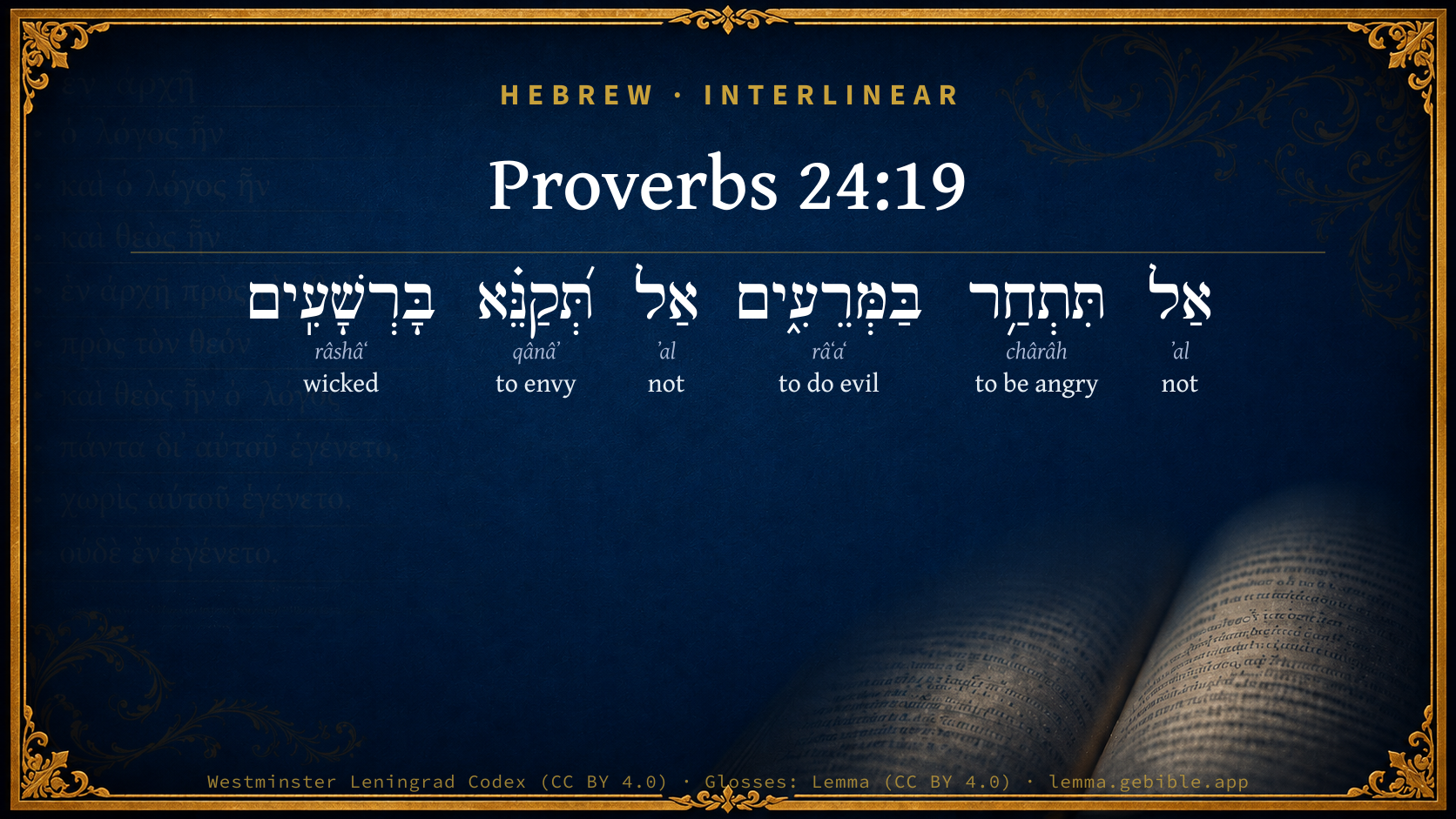
Proverbs 24:19

Hebrew (Westminster Leningrad Codex) Proverbs 24:19 appears in the Hebrew Old Testament. The text above is from the Westminster Leningrad Codex. Each word links to its Strong’s number, a concise gloss, and parsing drawn from the Open Scriptures Hebrew Bible morphology. Click any word for its full Brown-Driver-Briggs (BDB) entry.
Download image
Cite this verse

Proverbs 24:19 (World English Bible). Public Domain. Lemma interlinear Bible study tool, https://lemma.gebible.app/v/proverbs/24/19.

Show BibTeX & RIS
BibTeX
RIS
English Translation
Don't fret yourself because of evildoers; Neither be envious of the wicked:
World English Bible · Public Domain
Download a study sheet

One document with this verse’s original text, its word-by-word gloss line, the meaning frame, cross-references with their text, attributed commentary, and full source and license credits — printable, and it pastes into notes with its structure intact.

This verse Autodidact and up

Study sheet (.html) Plain text (.txt)

A passage Seminary Student

Up to 50 verses in one chapter. A passage sheet keeps up to 6 commentary sources and 12 cross-references per verse, in the order this page ranks them, and says so on the sheet whenever that leaves anything out. Ask for a single verse and you get the Autodidact verse sheet above.

Everything on this page stays free to read, with no account — the sheet is a download of what is already on screen, not access to it.

Want to remove ads? Support Godless Engineer
Compare translations 3

The same verse in 3 English versions, stacked beneath the original-language interlinear above. Click any original word for its lexicon entry.

Each is an independent rendering of the whole verse — the interlinear is not word-aligned to these translations.

Highlighted words mark where these versions differ — a whole-verse word diff, not a word-by-word alignment.

  • World English Bible Public Domain
    Don't fret yourself because of evildoers; Neither be envious of the wicked:
  • King James Version Public Domain
    Fret not thyself because of evil men, neither be thou envious at the wicked:
  • unfoldingWord Literal Text CC BY-SA 4.0
    Do not make yourself hot because of evildoers; do not envy wicked ones.

unfoldingWord Literal Text — © unfoldingWord, licensed CC BY-SA 4.0. Word-aligned USFM3 via Door43 (git.door43.org/unfoldingWord/en_ult).

Versions to compare (up to 4)

3 of 4 selected

Show all 18 translations

Every available English version of this verse, each an independent rendering of the whole verse.

  • World English Bible Public Domain
    Don't fret yourself because of evildoers; Neither be envious of the wicked:
  • Berean Standard Bible Public Domain
    Do not fret over evildoers, and do not be envious of the wicked.
  • Majority Standard Bible Public Domain
    Do not fret over evildoers, and do not be envious of the wicked.
  • King James Version Public Domain
    Fret not thyself because of evil men, neither be thou envious at the wicked:
  • American Standard Version (1901) Public Domain
    Fret not thyself because of evil-doers; Neither be thou envious at the wicked:
  • Revised Version (1885) Public Domain
    Fret not thyself because of evil-doers; neither be thou envious at the wicked:
  • Geneva Bible (1599) Public Domain
    Fret not thy selfe because of the malicious, neither be enuious at the wicked.
  • Douay-Rheims (1899) Public Domain
    Contend not with the wicked, nor seek to be like the ungodly:
  • Young's Literal Translation Public Domain
    Fret not thyself at evil doers, Be not envious at the wicked,
  • Literal Standard Version CC BY-SA 4.0
    Do not fret yourself at evildoers, do not be envious at the wicked,
  • Unlocked Literal Bible CC BY-SA 4.0
    Do not worry because of evildoers, and do not envy wicked people,
  • unfoldingWord Literal Text CC BY-SA 4.0
    Do not make yourself hot because of evildoers; do not envy wicked ones.
  • Darby Bible Public Domain
    Fret not thyself because of evil-doers, [and] be not envious of the wicked:
  • World Messianic Bible Public Domain
    Don’t fret yourself because of evildoers, neither be envious of the wicked;
  • Webster's Bible Public Domain
    Fret not thyself because of evil men, neither be thou envious at the wicked;
  • Free Bible Version CC BY-SA 4.0
    Don't get all upset over the wicked, or be jealous of those who do wrong,
  • Bible in Basic English Public Domain
    Do not be troubled because of evil-doers, or have envy of sinners:
  • JPS Tanakh (1917) Public Domain
    Fret not thyself because of evildoers, neither be thou envious at the wicked;

Literal Standard Version (2020), Covenant Press — licensed CC BY-SA 4.0. Text via the HelloAO Bible API (eBible.org). Unlocked Literal Bible (unfoldingWord) — licensed CC BY-SA 4.0. Text via the HelloAO Bible API (eBible.org). unfoldingWord Literal Text — © unfoldingWord, licensed CC BY-SA 4.0. Word-aligned USFM3 via Door43 (git.door43.org/unfoldingWord/en_ult). Free Bible Version, Dr. Jonathan Gallagher — licensed CC BY-SA 4.0. Text via the HelloAO Bible API (eBible.org).

Word by word

More ways to search: Search by grammar → Find every occurrence → Compare this word →

Practice this passage: Drill this verse → Learn its vocabulary →

About this verse

These counts appear in no published source. They are computed here, from the morphology-tagged text and Lemma’s own curated glosses. What Lemma adds →

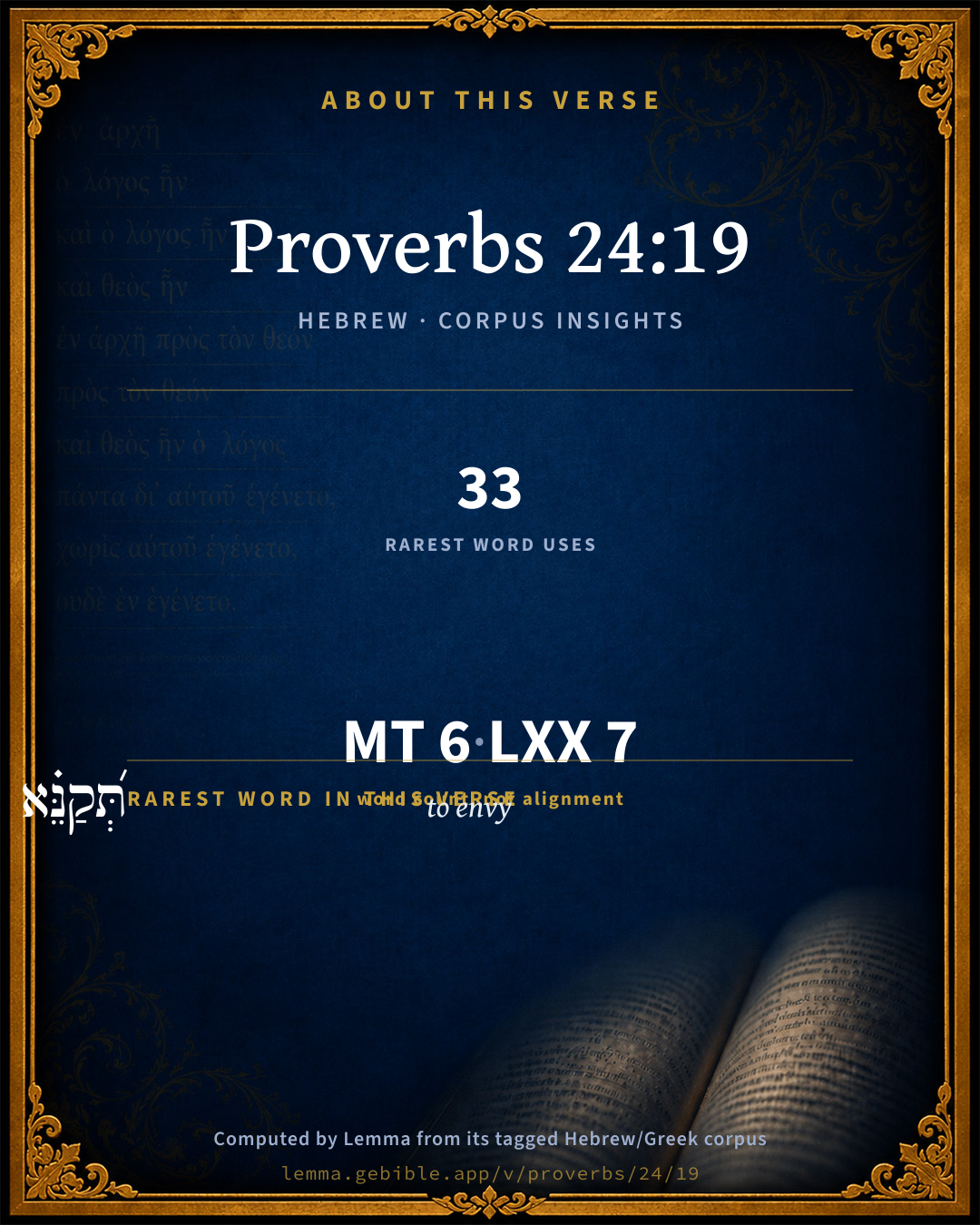
6
words
5
distinct lemmas
Wisdom
section

Shared distinctive vocabulary

תְּ֝קַנֵּ֗א to envy H7065 occurs in 28 verses of the Hebrew Bible. Also found in:

Grammatical profile

  • 3 verbs
  • 1 adjective
  • 2 particles

Verb forms

  • תִּתְחַ֥ר Hithpael · Jussive
  • בַּמְּרֵעִ֑ים Hiphil · Participle Active
  • תְּ֝קַנֵּ֗א Piel · Jussive

Repetition

A word recurs within this verse — often emphatic in Hebrew:

  • אַל not H408 ×2

Hebrew & Septuagint length

In English translation the verse runs 12 words from the Hebrew and 9 from the Septuagint (LXX English) — closely comparable.

A rough comparison of the two English renderings, which tokenize alike — not a word-level alignment.

Word counts can differ between the Hebrew and the Greek without any difference in meaning — e.g. the Hebrew direct-object marker אֵת has no separate Greek word, and Greek often adds the article ὁ.

In the original languages it is 6 Hebrew tokens and 7 Greek tokens — but the two are counted differently (Hebrew bundles its prefixes and suffixes into one token; the Greek is in lemma form), so that isn’t a like-for-like length.

Cross-references

13

Topical passages linked to Proverbs 24:19 in the Treasury of Scripture Knowledge — connected by theme and wording, ordered by reader-vote popularity; previews shown in the World English Bible.

  • Psalms 37:1 Don't fret because of evil-doers, Neither be envious against those who work unrighteousness.
  • Psalms 119:115 Depart from me, you evildoers, That I may keep the commandments of my God.
  • Proverbs 13:20 One who walks with wise men grows wise, But a companion of fools suffers harm.
  • Proverbs 23:17 Don't let your heart envy sinners; But rather fear Yahweh all the day long.
  • Proverbs 24:1 Don't be envious of evil men; Neither desire to be with them:
  • Psalms 1:1 Blessed is the man who doesn't walk in the counsel of the wicked, Nor stand in the way of sinners, Nor sit in the seat of scoffers;
  • Psalms 73:3 For I was envious of the arrogant, When I saw the prosperity of the wicked.
  • Psalms 26:4–5 I have not sat with deceitful men, Neither will I go in with hypocrites.
  • Numbers 16:26 He spoke to the congregation, saying, Depart, I pray you, from the tents of these wicked men, and touch nothing of theirs, lest you be consumed in all their sins.
  • Ephesians 5:11 Have no fellowship with the unfruitful works of darkness, but rather even reprove them.
  • 2 Timothy 3:2–5 For men will be lovers of self, lovers of money, boastful, arrogant, blasphemers, disobedient to parents, unthankful, unholy,
  • 2 Corinthians 6:17 Therefore, "'Come out from among them, And be separate,' says the Lord, 'Touch no unclean thing. I will receive you.
  • Revelation 18:4 I heard another voice from heaven, saying, "Come out of her, my people, that you have no participation in her sins, and that you don't receive of her plagues,

Cross-references courtesy of OpenBible.info (CC BY 4.0).

Hebrew and Greek witnesses Masoretic Hebrew ↔ Greek Septuagint

The same verse in the two great witnesses to the Old Testament, shown verse-for-verse.

These are two independent witnesses, not word-aligned to each other, and the Septuagint is shown in lemma (dictionary) form.

Hebrew Proverbs 24:19 Masoretic · Westminster Leningrad Codex

אַל תִּתְחַ֥ר בַּמְּרֵעִ֑ים אַל תְּ֝קַנֵּ֗א בָּרְשָׁעִֽים

Don't fret yourself because of evildoers; Neither be envious of the wicked:

World English Bible · Public Domain

Greek LXX Proverbs 24:19 Septuagint · lemma form

μή χαίρω ἐπί κακοποιός μηδέ ζηλόω ἁμαρτωλός

Rejoice not in evil-doers, neither be envious of sinners.

LXX2012 (modern English Septuagint) · Public Domain

On this verse, The Pulpit Commentary discusses the Septuagint’s reading. Read the note in Commentary ↓

Hebrew: Westminster Leningrad Codex (CC BY 4.0). Greek: Septuagint (public domain); English from LXX2012 (modern English Septuagint) (Public Domain). How the Septuagint differs from the Hebrew →

Commentary

Notes on Proverbs 24:19 from classic Christian and Jewish commentators (each source and its license shown beneath its notes). The classic Christian expositions comment on the surrounding passage and are grouped to its opening verse, so a note may address several verses; the Jewish commentaries on the Tanakh (Rashi and others) are per-verse, so they appear only where the commentator wrote on this verse.

Lemma curates 59 commentaries, every one of them public domain or Creative Commons licensed, each selected and text-cleaned for this edition rather than reprinted as found. About our sources →

Trapp's Complete Commentary

John Trapp

Pro 24:19 Fret not thyself because of evil [men], neither be thou envious at the wicked;

Ver. 19. Fret not thyself because of evil men.] We are wondrous apt to be sick of the fret; hence so many precepts to this purpose. See Pro 23:17; Pro 24:1.

John Trapp, A Commentary or Exposition upon All the Books of the Old and New Testament (1647–1656) — public domain. Text from a community e-Sword module.

Joseph Benson's Commentary

Pro 24:19-20. Fret not thyself because of evil men — For their present impunity, or good success. For there shall be no reward to the evil man — All his hopes and happiness shall quickly and eternally perish, and he shall have no share in those solid felicities, and blessed recompenses of another life, which thou shalt enjoy. Therefore thou hast no reason to envy him. The candle of the wicked shall be put out — All their comfort and glory shall cease.

Joseph Benson's Commentary on the Old and New Testaments (1811–1818) — public domain. Text from a community e-Sword module.

Tyndale Open Study Notes

Tyndale Open Resources

24:19-20 Saying 29: Don’t envy the apparent prosperity of the wicked (see 24:1-2), because their success is fleeting. • snuffed out: Cp. 13:9; 20:20.

Tyndale Open Study Notes — © Tyndale Open Resources, licensed CC BY-SA 4.0. Text via the HelloAO Bible API.

Geneva Bible (1599)

Geneva Bible translators

Ps. 37:1; Prov. 33:17

Geneva Bible (1599) marginal notes — public domain. Text via Bolls.life.

Matthew Henry's Commentary

Here, 1. He repeats the caution he had before given against envying the pleasures and successes of wicked man in their wicked ways. This he quotes from his father David, Psa 37:1. We must not in any case fret ourselves, or make ourselves uneasy, whatever God does in his providence how disagreeable soever it is to our sentiments, interests, and expectations, we must acquiesce in it. Even that which grieves us must not fret us; nor must our eye be evil against any because God is good. Are we more wise or just than he? If wicked people prosper, we must not therefore incline to do as they do. 2. He gives a reason for this caution, taken from the end of that way which wicked man walk in. Envy not their prosperity; for, (1.) There is no true happiness in it: Thee shall be no reward to the evil man; his prosperity only serves for his present subsistence; these are all the good things he must ever expect: there is none intended him in the world of retribution. He has his reward, Mat 6:2. He shall have none. Those are not to be envied that have their portion in this life and must out-live it, Psa 17:14. (2.) There is no continuance in it; their candle shines brightly, but it shall presently be put out, and a final period put to all their comforts, Job 21:14; Psa 37:1, Psa 37:2.

Matthew Henry's Commentary on the Whole Bible (1708–1710) — public domain (CC PDM 1.0). Text via the HelloAO Bible API.

Jamieson, Fausset & Brown

Robert Jamieson, A. R. Fausset & David Brown

(Psa 37:1, Psa 37:38; Psa 18:28).

Jamieson, Fausset & Brown — Commentary Critical and Explanatory on the Whole Bible (1871) — public domain (CC PDM 1.0). Text via the HelloAO Bible API.

Ellicott's Commentary for English Readers

(19) Fret not thyself because of evil men—i.e., at the sight of their prosperity, the same difficulty which occurred to the Psalmist (Psa_37:1). (Comp. also Psa_73:3 and Jer_12:1.)

A Bible Commentary for English Readers, edited by Charles John Ellicott (1878–1897) — public domain. Text from a community e-Sword module.

The Cambridge Bible for Schools and Colleges

gen. ed. J. J. S. Perowne

19. Comp. Psa_37:1; Psa_37:7.

The Cambridge Bible for Schools and Colleges (gen. ed. J. J. S. Perowne; Cambridge University Press, 1878–1918) — public domain. Text from a community e-Sword module.

John Gill's Exposition

For there shall be no reward to the evil man,.... No reward of good things, such as is for the righteous in a way of grace; but he shall have a reward of evil things, a just recompence of reward for his sins: of "no end" (r); there will be an end of his life in this world, and there will be an end of his prosperity; but, as the Targum is, there will be no "good end" to him; his end will not be like that of the perfect and upright man, for it will be cut off, Psa 37:37; or, as the Vulgate Latin version renders it, "the wicked have no hope of future things"; no good hope of everlasting happiness; they have their good things now, and their evil things hereafter; and therefore are not to be fretted at and envied. Aben Ezra interprets it, they shall have no offspring or issue, son or nephew; the word is sometimes used for posterity;

the candle of the wicked shall be put out; meaning not the dim light of nature in them, nor the light of life before their time, so Aben Ezra; but their prosperity, riches, splendour, and glory, which candle is often put out while they live, and always at death; after which they have no more light, honour, and happiness; even not so much as the light of a candle, to which their prosperity in this life is compared, it being at best but small, and of a short continuance; see Job 18:5; and therefore should not be the object of the envy of good men, who are in a more happy and stable condition than they.

(r) "finis", Pagninus, Vatablus, Baynus, Junius & Tremellius, Mercerus, Gejerus.

John Gill's Exposition of the Whole Bible (1746–1763) — public domain (CC PDM 1.0). Text via the HelloAO Bible API.

Haydock's Catholic Bible Commentary

Contend. Or Hebrew, "associate." --- Like. Ver. 1., and Psalm xxxvi. 1.

George Leo Haydock (1774–1849), Haydock's Catholic Family Bible and Commentary, 1859 edition — public domain. Excludes Psalms (Douay-Rheims chapter numbering differs from Protestant) and Deuterocanonical books (Catholic canon only).

Matthew Poole's English Annotations

Fret not thyself; which translation of the word is confirmed by the parallel word in the following clause.

Because of evil men; for their present impunity and good success.

Matthew Poole's English Annotations on the Holy Bible (1683–1685) — public domain. Text from a community e-Sword/MySword module.

Whedon's Commentary on the Bible

Daniel D. Whedon

19. Fret not thyself — Be not excited, enraged. This proverb may be related to the preceding.

Daniel D. Whedon (gen. ed.), Commentary on the Old and New Testaments (1874–1909) — public domain. Text from a community e-Sword module.

The Pulpit Commentary

Vers. 19, 20. A warning against envying the prosperity of the wicked.

Fret not thyself because of evil men. (comp. Ver. 1 and Psa_37:1) The verb (charah) means "to burn," "to be angry;" so here we may render, "Be not enraged on account of evil doers." The anger would arise on account of the apparent inequitable distribution of blessings.

St. Jerome has, Ne contendas cum pessimis; Septuagint, "Rejoice not over (epi ) evildoers." Neither be thou envious at the wicked; i.e. do not fancy that their prosperity is to be desired, nor be led to imitate their doings in order to secure like success. The new verse shows the solemn reason for this warning.

A needless trouble.

I THERE IS TEMPTATION TO BE DISTRESSED AT THE PROSPERITY OF BAD MEN.

1. It is unjust. This was an ancient source of perplexity and trouble of mind. While good men often suffer, bad men are often exceptionally free from the world"s ills. This pains us as a frightful discord in the psalm of life. It raises doubts as to the presence, or the power, or the justice of God. If the just Lord is in our midst and is almighty to rule, why does he permit such condition of society?

2. It is hurtful. Prosperity confers power. Thus great resources are at the disposal of bad men, who are able to expend them in extensive schemes of wickedness. A successful Napoleon can deluge a continent with blood, and bring misery into thousands of households. The triumph of bad men not only enables them to inflict suffering to a frightful extent; it gives them exceptional opportunities for spreading the infectious malaria of their sin. When a bad man prospers he contaminates his trade, lowers the character of business generally, and tempts his employees to do wrong on a scale that is proportionate to his enterprises.

3. It seems to be enviable. Sin looks like a short cut to success. It is hard for a good man who resists temptations to be rewarded with distresses which he would have escaped if he had yielded.

II IT IS FOOLISH TO BE DISTRESSED AT THE PROSPERITY OF BAD MEN.

1. Prosperity is infinitely inferior to character. The great question is not as to what a man has, but as to what he is. It is far more important to be upright and holy in life than to be rich, successful, and happy in one"s circumstances. Surely he who values true goodness will feel that it is a pearl of great price the cost of which would not be compensated for by all the wealth of the Indies. Therefore to envy the prosperity of the wicked is to turn aside from the higher possession which may be enjoyed in poverty and adversity.

2. The prosperity of the wicked is delusive and unsatisfactory. It professes to give pleasure, but it cannot afford real happiness, for it has nothing in it to respond to the deeper cravings of the soul. He who feasts upon it is like a man who would fill himself with chaff and sawdust. In his very satiety he is miserably hungry. Full, he yet starves. Or worse, he is like one who drinks madly of salt water, and is plunged into an agony of thirst in consequence. If, as may happen, however, he feels a measure of satisfaction, this can only be by deadening his higher nature. Such a state is delusive and more terrible than open complaining.

3. This prosperity is short-lived. "The candle of the wicked shall be put out" (Ver. 20). The psalmist who was alarmed at the prosperity of the wicked saw another picture when he came to consider their end. He who would share the purple and fine linen of Dives on earth must also share his bed of fire after death. It is only the short-sighted, earthly minded man who will much envy the prosperity of the wicked. A deeper thinking man will dread it, and be well satisfied if he has the true blessedness of life eternal.

Vers. 19-22. Religion fortifies the heart against envy.

I THE TEMPTATION TO ENVY THE PROSPERITY OF THE WICKED. It is very marked in the Old Testament. It is a common temptation. For we look at the outside of man"s condition, and are deceived by illusions. A pirate"s venal in the distance, a mansion built and inhabited by infamy, are beautiful objects of aesthetic contemplation. So it is that the show and bravery of success master our senses.

II THE ANTIDOTE TO THESE FEELINGS. (Ver. 20) "Consider the end darkness and the blackness of darkness. The wicked have no future. When this is once clearly seen, the charm on the surface fades away, and the edifice of proud but godless prosperity sinks almost into a smoking ruin.

III RELIGION AND MORALITY THE ONLY FOUNDATION OF SECURITY AND BLESSEDNESS. (Vers. 21, 22) The one comprehensive word for religion is the "fear of Jehovah," reverence for God, and for all that, being true, is of the very nature of God. And obedience to the king includes all those civil and social duties which we incur as members of an ordered commonwealth. Religion and loyalty go together; and the best way to make good subjects to the queen is to make men good servants of God. They will not make conscience of civil duties who make none of Divine. J.

The Pulpit Commentary (1880–1919), ed. H.D.M. Spence-Jones & Joseph S. Exell — public domain. Text from a community e-Sword module.

Keil & Delitzsch

C. F. Keil & F. Delitzsch

Warning against envying the godless for their external prosperity:

19 Be not enraged on account of evil-doers,

Envy not the godless;

20 For the wicked men shall have no future,

The light of the godless is extinguished.

Ver. 19 is a variation of Psa 37:1; cf. also Pro 3:21 (where with בכל־דרכיו following the traditional תבחר is more appropriate than תתחר, which Hupfeld would here insert). תּתחר is fut. apoc. of התחרה, to be heated (to be indignant), distinguished from the Tiphel תּחרה, to be jealous. The ground and occasion of being enraged, and on the other side, of jealousy or envy, is the prosperity of the godless, Psa 73:3; cf. Jer 12:1. This anger at the apparently unrighteous division of fortune, this jealousy at the success in which the godless rejoice, rest on short-sightedness, which regards the present, and looks not on to the end. אחרית, merely as in the expression 'ישׁ אח, 14b (cf. Psa 37:37), always denotes the happy, glorious issue indemnifying for past sufferings. Such an issue the wicked man has not; his light burns brightly on this side, but one day it is extinguished. In 20b is repeated Pro 13:9; cf. Pro 20:20.

Keil & Delitzsch — Biblical Commentary on the Old Testament (1861–1891) — public domain (CC PDM 1.0). Text via the HelloAO Bible API. (Old Testament only.)

Bridges on Proverbs

Charles Bridges

This fretting must be a deep-rooted disease, to need such repeated discipline. (Pro 24:1 ; Pro 23:17 .) One moment’s recollection of our mercies might shew, how little reason there is for it. Mercies infinitely more than we discover might be sufficient to sweep the clouds from our sky, and to make us ashamed of our despondency. Before — the envy of the wicked was checked by the remembrance, that there was an end — surely an happy end to the righteous. (Pro 23:18 .) Let them wait for it. It will not disappoint them. Here we are further reminded, that there is no end,†1 no reward, to the evil man. Leave him to his judge. His candle, notwithstanding all his efforts to keep it burning,†2 shall be put out.†3 Sometimes in bold daring he puts out his own candle. ’I give’ — said the infidel Hobbes — ’my body to the dust, and my soul to the Great Perhaps. I am going to take a leap in the dark.’ Alas! — was it not a leap in the dark, — into "the blackness of darkness for ever"?

Take then the balance of eternity. Learn neither to overvalue the fancied sunshine of the wicked, nor to undervalue our own real happiness. Envy not his lot. Repine not at our own. Ours is far beyond his reach. His is far below our envy. ’His candle burneth; his prosperity flourisheth, until it hath kindled hell-fire; and then it is extinguished; whereas the lamp of the godly is put out here, to shine as a star in heaven.’†4

Footnotes:

†1 Same word in Hebrew as Pro 23:18 . ’There shall be none end of plagues to the evil man.’ — Old version.

†2 1Ki 21:21, with 2Ki 10:1-7 .

†3 Pro 13:9; Pro 20:20 . Job 18:5-6 ; Job 21:17 .

†4 Jermin in loco.

Charles Bridges, An Exposition of the Book of Proverbs (1846) — public domain. Text from a community e-Sword module.

Kretzmann's Popular Commentary

Paul E. Kretzmann

v. 19. Fret not thyself because of evil men, becoming enraged with envy on account of their apparent good fortune, neither be thou envious at the wicked, whose prosperity often seems so great;

Paul E. Kretzmann, Popular Commentary of the Bible (1921–1924) — public domain. Text from a community e-Sword module.

unfoldingWord translationNotes

Door43 World Missions Community

General Information:

These verses continue the "thirty sayings" (Proverbs 22:20).

the lamp of wicked people will go out

The lamp is used as a metaphor for life. The life of wicked people will end just as a lamp goes out. (See: Metaphor)

translationWords

evil

envy

lamp

unfoldingWord translationNotes — © Distant Shores Media and the Door43 World Missions Community, licensed CC BY-SA 4.0. Source: git.door43.org/Door43/en_tn.

Rashi

Rabbi Shlomo Yitzchaki (Rashi)

Do not compete to be like them, as in (Jer. 12:5): “How will you compete (תתחרה)?” Also, (ibid. 22:15): “for you compete (מתחרה) with the cedar.”

Rashi on the Tanakh — English translations: “The Judaica Press complete Tanach with Rashi, translated by A. J. Rosenberg” (CC BY 4.0); “Pentateuch with Rashi's commentary by M. Rosenbaum and A.M. Silbermann, 1929-1934” (public domain); “The Metsudah Tanach series, Lakewood, N.J” (CC BY 4.0); and “The Book of Joshua, Metsudah Publications, 1997” (CC BY 4.0). Text via Sefaria.

Lesson kit

Teaching starters — assembled from the data on this page, not authored interpretation. Every prompt links to the verse data it draws on. Edit before teaching.

Proverbs, in the Wisdom, opens this verse with 6 words (5 distinct Hebrew lemmas). Its most distinctive word is qânâʼ (“to envy”). A historical commentator’s framing appears above. Read the whole chapter for the surrounding context.

Discussion questions

  1. What does “to envy” (qânâʼ) contribute to the verse as a whole?
  2. How does Genesis 26:14, which shares the word «to envy», read alongside this verse?
  3. What does the repetition of “not” (2× in this one verse) do in this verse?
  4. These translations render this verse differently; the difference is in the English rendering, not the original. What questions does that raise?
  5. «תִּתְחַ֥ר» is a Hithpael Jussive verb. How does that grammatical form shape the action described?
  6. Compare how Trapp's Complete Commentary and Joseph Benson's Commentary read this verse. Where do they agree or differ?

Things to notice

Reading settings

Reading text

Shown beneath each verse's original-language words.

Old Testament
Old Testament edition

Read the OT as the Masoretic Hebrew (MT) or the Greek Septuagint (LXX).

English shown for the Greek Septuagint (in the Hebrew ↔ Greek comparison).

Comparing translations? Open the Compare panel on any verse page to stack up to four side by side.