Numbers 35:31

Hebrew (Westminster Leningrad Codex) Numbers 35:31 appears in the Hebrew Old Testament. The text above is from the Westminster Leningrad Codex. Each word links to its Strong’s number, a concise gloss, and parsing drawn from the Open Scriptures Hebrew Bible morphology. Click any word for its full Brown-Driver-Briggs (BDB) entry.
Download image
Cite this verse

Numbers 35:31 (World English Bible). Public Domain. Lemma interlinear Bible study tool, https://lemma.gebible.app/v/numbers/35/31.

Show BibTeX & RIS
BibTeX
RIS
English Translation
Moreover you shall take no ransom for the life of a murderer who is guilty of death; but he shall surely be put to death.
World English Bible · Public Domain
Download a study sheet

One document with this verse’s original text, its word-by-word gloss line, the meaning frame, cross-references with their text, attributed commentary, and full source and license credits — printable, and it pastes into notes with its structure intact.

This verse Autodidact and up

Study sheet (.html) Plain text (.txt)

A passage Seminary Student

Up to 50 verses in one chapter. A passage sheet keeps up to 6 commentary sources and 12 cross-references per verse, in the order this page ranks them, and says so on the sheet whenever that leaves anything out. Ask for a single verse and you get the Autodidact verse sheet above.

Everything on this page stays free to read, with no account — the sheet is a download of what is already on screen, not access to it.

Want to remove ads? Support Godless Engineer
Compare translations 3

The same verse in 3 English versions, stacked beneath the original-language interlinear above. Click any original word for its lexicon entry.

Each is an independent rendering of the whole verse — the interlinear is not word-aligned to these translations.

Highlighted words mark where these versions differ — a whole-verse word diff, not a word-by-word alignment.

  • World English Bible Public Domain
    Moreover you shall take no ransom for the life of a murderer who is guilty of death; but he shall surely be put to death.
  • King James Version Public Domain
    Moreover ye shall take no satisfaction for the life of a murderer, which is guilty of death: but he shall be surely put to death.
  • unfoldingWord Literal Text CC BY-SA 4.0
    And you shall not take a ransom for the life of one who kills, he who is guilty to die, because he shall certainly be put to death.

unfoldingWord Literal Text — © unfoldingWord, licensed CC BY-SA 4.0. Word-aligned USFM3 via Door43 (git.door43.org/unfoldingWord/en_ult).

Versions to compare (up to 4)

3 of 4 selected

Show all 18 translations

Every available English version of this verse, each an independent rendering of the whole verse.

  • World English Bible Public Domain
    Moreover you shall take no ransom for the life of a murderer who is guilty of death; but he shall surely be put to death.
  • Berean Standard Bible Public Domain
    You are not to accept a ransom for the life of a murderer who deserves to die; he must surely be put to death.
  • Majority Standard Bible Public Domain
    You are not to accept a ransom for the life of a murderer who deserves to die; he must surely be put to death.
  • King James Version Public Domain
    Moreover ye shall take no satisfaction for the life of a murderer, which is guilty of death: but he shall be surely put to death.
  • American Standard Version (1901) Public Domain
    Moreover ye shall take no ransom for the life of a murderer, that is guilty of death; but he shall surely be put to death.
  • Revised Version (1885) Public Domain
    Moreover ye shall take no ransom for the life of a manslayer, which is guilty of death: but he shall surely be put to death.
  • Geneva Bible (1599) Public Domain
    Moreouer ye shall take no recompense for the life of the murtherer, which is worthy to die: but he shalbe put to death.
  • Douay-Rheims (1899) Public Domain
    You shall not take money of him that is guilty of blood, but he shall die forthwith.
  • Young's Literal Translation Public Domain
    `And ye take no atonement for the life of a murderer who `is' condemned -- to die, for he is certainly put to death;
  • Literal Standard Version CC BY-SA 4.0
    And you take no atonement for the life of a murderer who [is] condemned to die, for he is certainly put to death;
  • Unlocked Literal Bible CC BY-SA 4.0
    Also, you must not accept ransom for the life of a murderer who is guilty of murder. He must certainly be put to death.
  • unfoldingWord Literal Text CC BY-SA 4.0
    And you shall not take a ransom for the life of one who kills, he who is guilty to die, because he shall certainly be put to death.
  • Darby Bible Public Domain
    And ye shall take no satisfaction for the life of a murderer, who is guilty of death, but he shall certainly be put to death.
  • World Messianic Bible Public Domain
    “‘Moreover you shall take no ransom for the life of a murderer who is guilty of death. He shall surely be put to death.
  • Webster's Bible Public Domain
    Moreover, ye shall take no satisfaction for the life of a murderer, who is guilty of death: but he shall be surely put to death.
  • Free Bible Version CC BY-SA 4.0
    You are not to accept payment instead of executing a murderer who has been found guilty—they must be executed.
  • Bible in Basic English Public Domain
    Further, no price may be given for the life of one who has taken life and whose right reward is death: he is certainly to be put to death.
  • JPS Tanakh (1917) Public Domain
    Moreover ye shall take no ransom for the life of a murderer, that is guilty of death; but he shall surely be put to death.

Literal Standard Version (2020), Covenant Press — licensed CC BY-SA 4.0. Text via the HelloAO Bible API (eBible.org). Unlocked Literal Bible (unfoldingWord) — licensed CC BY-SA 4.0. Text via the HelloAO Bible API (eBible.org). unfoldingWord Literal Text — © unfoldingWord, licensed CC BY-SA 4.0. Word-aligned USFM3 via Door43 (git.door43.org/unfoldingWord/en_ult). Free Bible Version, Dr. Jonathan Gallagher — licensed CC BY-SA 4.0. Text via the HelloAO Bible API (eBible.org).

Word by word

More ways to search: Search by grammar → Find every occurrence → Compare this word →

Practice this passage: Drill this verse → Learn its vocabulary →

כֹ֨פֶר֙
kôpher
H3724
“ransom”
Noun, Common, Masculine, Singular, Absolute
Part of Speech
Noun
Type
Common
Gender
Masculine
Number
Singular
State
Absolute
Full BDB Definition

Origin: from H3722

TWOT: 1025b

price of a life, ransom, bribe - asphalt, pitch (as a covering) - the henna plant, name of a plant (henna?) - village
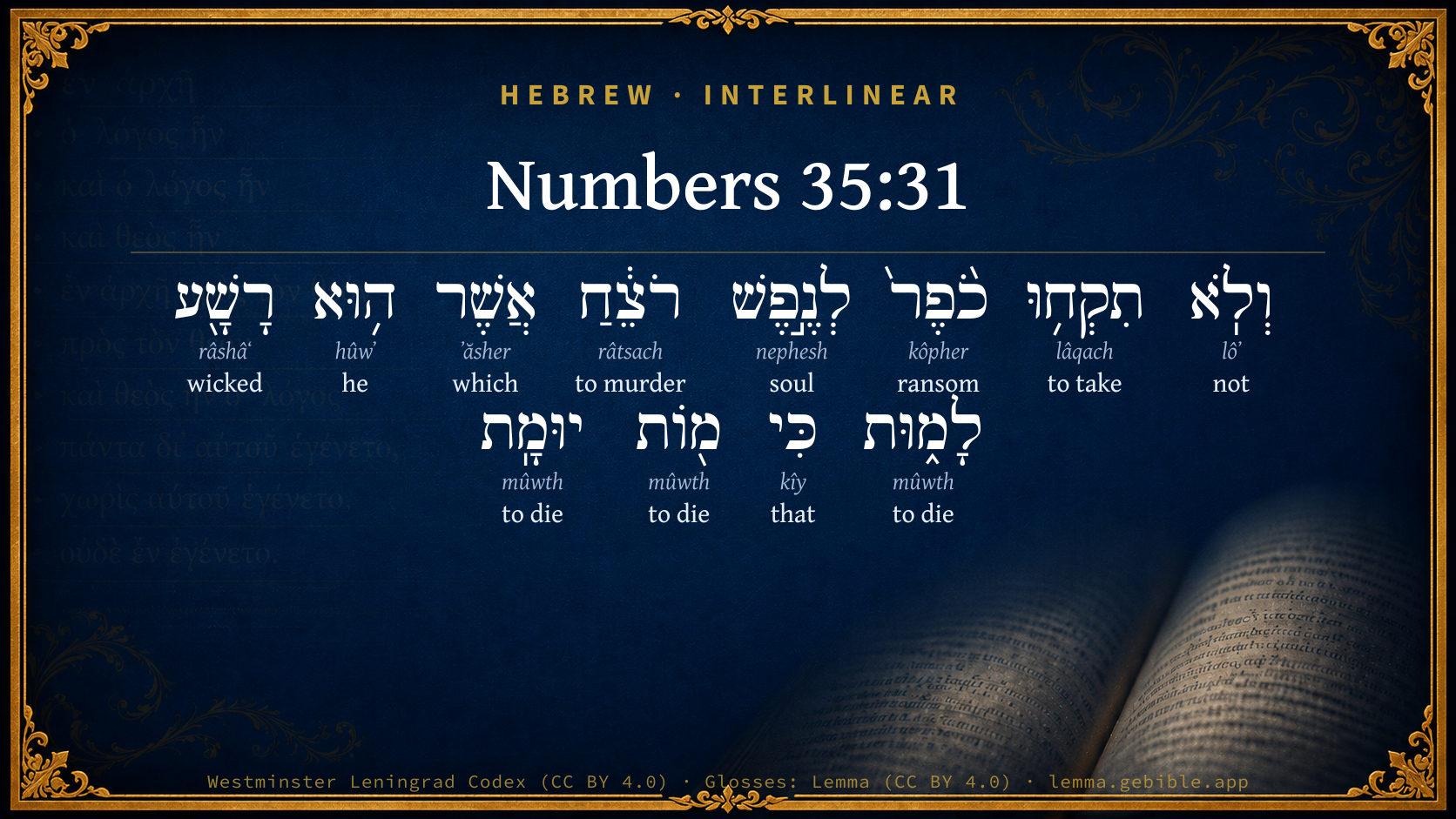
  1. וְלֹֽא lôʼ H3808 “and · not” Conjunction + Particle, Negative
  2. תִקְח֥וּ lâqach H3947 “to take” Verb, Qal, Imperfect, 2nd Person, Masculine, Plural
  3. לְנֶ֣פֶשׁ nephesh H5315 “to/for · soul of” Preposition + Noun, Common, Both, Singular, Construct
  4. רֹצֵ֔חַ râtsach H7523 “murdering” Verb, Qal, Participle Active, Masculine, Singular, Absolute
  5. אֲשֶׁר ʼăsher H834 “which” Particle, Relative
  6. ה֥וּא hûwʼ H1931 “he” Pronoun, Personal, 3rd Person, Masculine, Singular
  7. רָשָׁ֖ע râshâʻ H7563 “wicked” Adjective, Adjective, Masculine, Singular, Absolute
  8. לָמ֑וּת mûwth H4191 “to die” Preposition + Verb, Qal, Infinitive Construct
  9. כִּי kîy H3588 “that” Conjunction
  10. מ֖וֹת mûwth H4191 “to die” Verb, Qal, Infinitive Absolute
  11. יוּמָֽת mûwth H4191 “to die” Verb, Hophal, Imperfect, 3rd Person, Masculine, Singular

About this verse

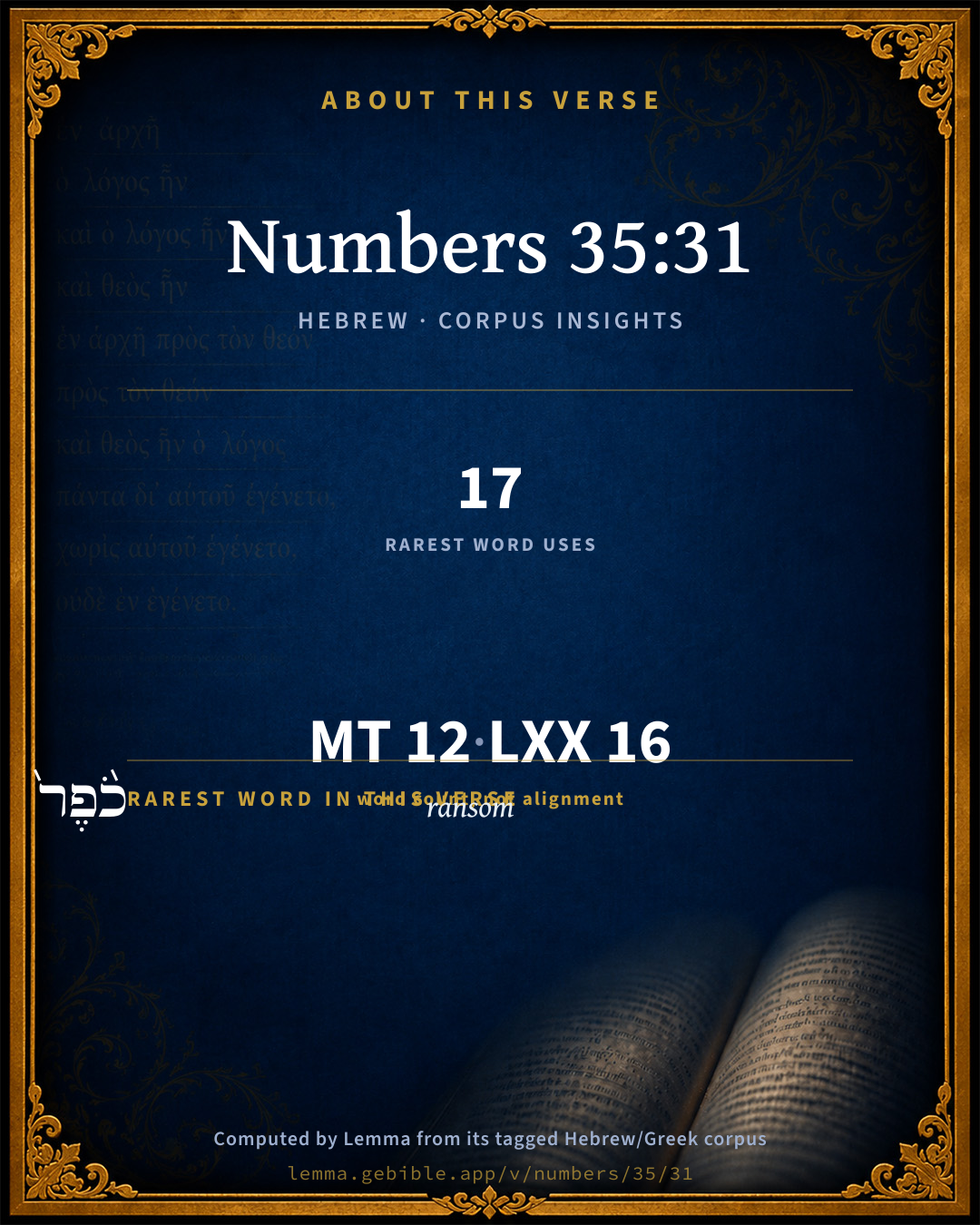
These counts appear in no published source. They are computed here, from the morphology-tagged text and Lemma’s own curated glosses. What Lemma adds →

12
words
10
distinct lemmas
Pentateuch
section

Notable vocabulary

The rarest word here is כֹ֨פֶר֙ ransom H3724 — appearing just 17 times in the whole Hebrew Bible.

Shared distinctive vocabulary

כֹ֨פֶר֙ ransom H3724 occurs in 17 verses of the Hebrew Bible. Also found in:

Grammatical profile

  • 5 verbs
  • 2 nouns
  • 1 adjective
  • 1 pronoun
  • 1 conjunction
  • 2 particles

Verb forms

  • תִקְח֥וּ Qal · Imperfect
  • רֹצֵ֔חַ Qal · Participle Active
  • לָמ֑וּת Qal · Infinitive Construct
  • מ֖וֹת Qal · Infinitive Absolute
  • יוּמָֽת Hophal · Imperfect

Repetition

A word recurs within this verse — often emphatic in Hebrew:

  • לָמ֑וּת to die H4191 ×3

Hebrew & Septuagint length

In English translation the verse runs 25 words from the Hebrew and 24 from the Septuagint (LXX English) — closely comparable.

A rough comparison of the two English renderings, which tokenize alike — not a word-level alignment.

Word counts can differ between the Hebrew and the Greek without any difference in meaning — e.g. the Hebrew direct-object marker אֵת has no separate Greek word, and Greek often adds the article ὁ.

In the original languages it is 12 Hebrew tokens and 16 Greek tokens — but the two are counted differently (Hebrew bundles its prefixes and suffixes into one token; the Greek is in lemma form), so that isn’t a like-for-like length.

Cross-references

6

Topical passages linked to Numbers 35:31 in the Treasury of Scripture Knowledge — connected by theme and wording, ordered by reader-vote popularity; previews shown in the World English Bible.

  • Genesis 9:5–6 I will surely require your blood of your lives. At the hand of every animal I will require it. At the hand of man, even at the hand of every man's brother, I will require the life of man.
  • Exodus 21:14 If a man schemes and comes presumptuously on his neighbor to kill him, you shall take him from my altar, that he may die.
  • Deuteronomy 19:11–13 But if any man hate his neighbor, and lie in wait for him, and rise up against him, and strike him mortally so that he dies, and he flee into one of these cities;
  • 2 Samuel 12:13 David said to Nathan, "I have sinned against Yahweh." Nathan said to David, "Yahweh also has put away your sin. You will not die.
  • 1 Kings 2:28–34 The news came to Joab; for Joab had turned after Adonijah, though he didn't turn after Absalom. Joab fled to the Tent of Yahweh, and caught hold on the horns of the altar.
  • Psalms 51:14 Deliver me from bloodguiltiness, O God, the God of my salvation. My tongue shall sing aloud of your righteousness.

Cross-references courtesy of OpenBible.info (CC BY 4.0).

Hebrew and Greek witnesses Masoretic Hebrew ↔ Greek Septuagint

The same verse in the two great witnesses to the Old Testament, shown verse-for-verse.

These are two independent witnesses, not word-aligned to each other, and the Septuagint is shown in lemma (dictionary) form.

Hebrew Numbers 35:31 Masoretic · Westminster Leningrad Codex

וְלֹֽא תִקְח֥וּ כֹ֨פֶר֙ לְנֶ֣פֶשׁ רֹצֵ֔חַ אֲשֶׁר ה֥וּא רָשָׁ֖ע לָמ֑וּת כִּי מ֖וֹת יוּמָֽת

Moreover you shall take no ransom for the life of a murderer who is guilty of death; but he shall surely be put to death.

World English Bible · Public Domain

Greek LXX Numbers 35:31 Septuagint · lemma form

καί οὐ λαμβάνω λύτρον περί ψυχή παρά ὁ φονεύω ὁ ἔνοχος εἰμί ἀνααἱρέω θάνατος γάρ θανατόω

And you⌃ shall not accept ransoms for life from a murderer who is worthy of death, for he shall be surely put to death.

LXX2012 (modern English Septuagint) · Public Domain

On this verse, Whedon's Commentary on the Bible discusses the Septuagint’s reading. Read the note in Commentary ↓

Hebrew: Westminster Leningrad Codex (CC BY 4.0). Greek: Septuagint (public domain); English from LXX2012 (modern English Septuagint) (Public Domain). How the Septuagint differs from the Hebrew →

Targum (Aramaic paraphrase)

2

The Targum is the ancient Jewish Aramaic paraphrase of the Hebrew Scriptures — an interpretive translation, not the Hebrew text itself. Onkelos (literal) and Pseudo-Jonathan (expansive) render the Torah, and Jonathan the Prophets. Coverage is partial: where no permissively-licensed English translation exists for a verse, only the Aramaic is shown. This is verse-level text, not a word-by-word alignment to the Hebrew.

  1. Targum Onkelos Torah (Genesis–Deuteronomy)
    וְלָא תְקַבְּלוּן מָמוֹן עַל אֱנַשׁ קָטוֹל דִי הוּא חַיָב לְמִקְטָל אֲרֵי אִתְקְטָלָא יִתְקְטֵל

    (no public-domain English translation for this verse)

    Targum Onkelos — Aramaic: “Onkelos Genesis” (public domain); “Onkelos Exodus” (public domain); “Onkelos Leviticus” (public domain); “Onkelos Numbers” (public domain); “Onkelos Deuteronomy” (public domain). English: “Sefaria Community Translation” (CC0 1.0 (public-domain dedication)); “J.W. Etheridge. The Targums of Onkelos and Jonathan Ben Uzziel on the Pentateuch. London: Longmans, Green, 1862” (public domain). Text via Sefaria.

  2. Targum Pseudo-Jonathan Torah (Genesis–Deuteronomy)
    וְלָא תְקַבְּלוּן פּוּרְקַן לְשֵׁיזְבָא בַּר נַשׁ קָטוֹלָא דְהוּא חַיָיב לִמְמָת אֲרוּם אִתְקְטָלָא יִתְקְטֵיל

    You may not take a ransom for the release of a murderer who is guilty of death, for dying he shall die.

    Targum Pseudo-Jonathan — Aramaic: “Targum Jonathan on Genesis” (public domain); “Targum Jonathan on Exodus” (public domain); “Targum Jonathan on Leviticus” (public domain); “Targum Jonathan on Numbers” (public domain); “Targum Jonathan on Deuteronomy” (public domain). English: “The Targum of Jonathan ben Uzziel, trans. J. W. Etheridge, London, 1862” (public domain). Text via Sefaria.

Commentary

Notes on Numbers 35:31 from classic Christian and Jewish commentators (each source and its license shown beneath its notes). The classic Christian expositions comment on the surrounding passage and are grouped to its opening verse, so a note may address several verses; the Jewish commentaries on the Tanakh (Rashi and others) are per-verse, so they appear only where the commentator wrote on this verse.

Lemma curates 59 commentaries, every one of them public domain or Creative Commons licensed, each selected and text-cleaned for this edition rather than reprinted as found. About our sources →

Tyndale Open Study Notes

Tyndale Open Resources

35:31-32 The payment of a ransom (monetary compensation) to free a convicted murderer from execution was prohibited, since the death penalty was required (cp. 2 Sam 21:2-9). Similarly, the slayer in an involuntary manslaughter could not pay a ransom to get around his confinement in a city of refuge.

Tyndale Open Study Notes — © Tyndale Open Resources, licensed CC BY-SA 4.0. Text via the HelloAO Bible API.

Geneva Bible (1599)

Geneva Bible translators

Which purposely hath committed murder.

Geneva Bible (1599) marginal notes — public domain. Text via Bolls.life.

Adam Clarke's Commentary

Verse 31. Ye shall take no satisfaction for the life of a murderer] No atonement could be made for him, nor any commutation, so as to save him from death. All the laws of the civilized world have either adjudged the murderer to death, or to a punishment equivalent to it; such as perpetual imprisonment, in a dungeon, under ground, on a stone floor, without light, and to be fed on a small portion of bread and water. In such circumstances a man could live but a short time; and though it is not called the punishment of death, yet, from its inevitable consequences, it only differed from it by being a little longer respite than was usual where the punishment of death was awarded. See Clarke on Ge 9:6.

Adam Clarke's Commentary on the Bible (1810–1826) — public domain. Text from a community e-Sword/MySword module.

Ellicott's Commentary for English Readers

(31, 32) Moreover ye shall take no satisfaction for the life of a murderer . . . —The Israelites were not allowed to make terms with the relatives of the man who had been slain, as is not unfrequently the case at the present time; nor were they permitted to allow the man who had slain any one unintentionally to return home from the city of refuge before the death of the high priest, on the payment of a sum of money by way of compensation.

A Bible Commentary for English Readers, edited by Charles John Ellicott (1878–1897) — public domain. Text from a community e-Sword module.

The Cambridge Bible for Schools and Colleges

gen. ed. J. J. S. Perowne

31, 32. The murderer’s life may not be ransomed. And the man who has committed accidental homicide may not pay a ransom in lieu of detention in the city of refuge. These prohibitions emphasize the extreme value of human life.

The Cambridge Bible for Schools and Colleges (gen. ed. J. J. S. Perowne; Cambridge University Press, 1878–1918) — public domain. Text from a community e-Sword module.

John Gill's Exposition

Moreover, ye shall take no satisfaction for the life of a murderer,.... Though he would give all his wealth and substance, all his estates and possessions, and whatever he is worth in the world; for all that a man has he will give for his life; but these are not to be taken, nor anything, and everything his friends may offer for him; all is to be rejected, the life of such a man is not to be saved on any consideration:

which is guilty of death; as he is who kills a man willingly and purposely; but one may be guilty of killing another, and yet not be deserving of death, when it is done ignorantly and accidentally with respect to him, for which reason this clause is added: but he shall be surely put to death; by the order of the civil magistrate; and if this is not done either through want of evidence, or the fault of the judge, or the criminal clemency of the chief governor, God sooner or later will take vengeance on such a person.

John Gill's Exposition of the Whole Bible (1746–1763) — public domain (CC PDM 1.0). Text via the HelloAO Bible API.

Albert Barnes' Notes on the Bible

No satisfaction - Rather, ransom (see Exo 21:30). The permission to demand pecuniary compensation for murders (expressly sanctioned by the Koran) undoubtedly mitigates, in practice, the system of private retaliation; but it does so by sacrificing the principle named in Num 35:12, Num 35:33.

Albert Barnes' Notes on the Bible (1834–1885) — public domain. Text from a community e-Sword/MySword module.

Matthew Poole's English Annotations

No intercession nor ransom shall be accepted to save his life, or procure him a pardon.

Matthew Poole's English Annotations on the Holy Bible (1683–1685) — public domain. Text from a community e-Sword/MySword module.

Whedon's Commentary on the Bible

Daniel D. Whedon

31. No satisfaction for… a murderer — In the LXX. the words “satisfaction for the life” are almost exactly those used by Jesus Christ in Mat_20:28, “To give his life a ransom for many.” Human life is too sacred to be paid for in gold and silver. Without the shedding of blood there is no possible atonement for murder. The soul of the murdered man is the possession of God, and not of the avenger of blood; hence he is forbidden to accept ransom money. Imprisonment for life is not a sufficient expiation. Vers. 16-21, note.

Daniel D. Whedon (gen. ed.), Commentary on the Old and New Testaments (1874–1909) — public domain. Text from a community e-Sword module.

The Pulpit Commentary

Ye shall take no satisfaction for the life of a murderer. The passion for vengeance is both bad and good, and is therefore to be carefully purified and restrained; but when the desire for vengeance can be appeased by a money payment, it has become wholly bad, and is only a despicable form of covetousness which insults the justice it pretends to invoke. Such payments or "ransoms" are permitted by the Koran, and have been common among most semi-civilized peoples, notably amongst our old English ancestors.

The Pulpit Commentary (1880–1919), ed. H.D.M. Spence-Jones & Joseph S. Exell — public domain. Text from a community e-Sword module.

unfoldingWord translationNotes

Door43 World Missions Community

He must certainly be put to death

This can be stated in active form. AT: "You must execute him" (See: Active or Passive and Idiom)

You must not ... allow him to reside on his own property

This implied that the man would have left the city of refuge and returned home. AT: "You must not ... allow him to leave the city of refuge and return home to live on his own property" (See: Assumed Knowledge and Implicit Information)

in this way

"by accepting a ransom"

translationWords

ransom

guilt

unfoldingWord translationNotes — © Distant Shores Media and the Door43 World Missions Community, licensed CC BY-SA 4.0. Source: git.door43.org/Door43/en_tn.

Rashi

Rabbi Shlomo Yitzchaki (Rashi)

ולא תקח כפר AND YE SHALL TAKE NO RANSOM — He (the murderer) shall not be freed by a monetary payment (Ketubot 37b).

Rashi on the Tanakh — English translations: “The Judaica Press complete Tanach with Rashi, translated by A. J. Rosenberg” (CC BY 4.0); “Pentateuch with Rashi's commentary by M. Rosenbaum and A.M. Silbermann, 1929-1934” (public domain); “The Metsudah Tanach series, Lakewood, N.J” (CC BY 4.0); and “The Book of Joshua, Metsudah Publications, 1997” (CC BY 4.0). Text via Sefaria.

Ramban (Nachmanides)

Rabbi Moshe ben Nachman (Ramban / Nachmanides)

AND YE SHALL TAKE NO RANSOM FOR THE LIFE OF A MURDERER etc. The correct interpretation of [the repetition of the phrase ye shall take no ransom in Verses 31-32] that at first [i.e., in the verse before us] He warned us against [pardoning] a deliberate murderer, [stating]: And ye shall take no ransom of monetary payment for the life of a murderer, who is guilty of death, for he shall under all circumstances be put to death, and shall not be saved from death by any means, neither by exile nor by stripes nor by any other punishment. And afterwards [in Verse 32] He stated, And ye shall take no ransom to allow him to flee [from the city of refuge] and return to live in the Land, until the death of the priest, and the verse thus refers back to those liable to exile [for unwitting murder] which He had [previously] mentioned, who are the main subject of this section. It is thus as if He would have said: And similarly you shall take no ransom from a murderer [who killed unwittingly] in order that he should flee [from his city of refuge] and return to live in the Land, before the death of the [High] Priest.” It was unnecessary to say that we should take no ransom from him [to free him] altogether from fleeing to the city of refuge, because anyone who kills somebody unwittingly is afraid at first that the avenger of blood might kill him in the heat of his anger, or [might kill him] because he suspected him of deliberate murder [and therefore he will always want at first to flee to the city of refuge]. Scripture, therefore, did not have to speak about [not taking] a ransom to free him altogether, but speaks only about [the prohibition against taking] a ransom after he has fled there, to enable him to return to his land, and so that he should not have to stay there [in the city of refuge] as long as the [High] Priest is alive. For[it is likely that he may desire to leave it, since] after he has fled [there] and stood [trial] before the congregation for judgment and has been acquitted by them [of the charge of deliberate murder], he will no longer be afraid of the avenger of blood, and so he will want to return to his house before the due time [i.e., before the death of the High Priest]. Therefore Scripture warned us against [accepting from him a ransom or bribe for] this [purpose]. Or [it may be] that there is a letter vav “missing” from the word lashuv [in Verse 32 — so that it is as if it said v’lashuv] meaning “or to abide.” to his land before the death of the High Priest. This interpretation is to be preferred apparently because it does not necessitate the introduction of a missing letter into the verse, as mentioned in the text. But the first interpretation appears to me to be the correct one.

Ramban (Nachmanides) on the Tanakh — English translation: “Commentary on the Torah by Ramban (Nachmanides). Translated and annotated by Charles B. Chavel. New York, Shilo Pub. House, 1971-1976” (CC BY 4.0). Text via Sefaria.

Lesson kit

Teaching starters — assembled from the data on this page, not authored interpretation. Every prompt links to the verse data it draws on. Edit before teaching.

Numbers, in the Pentateuch, opens this verse with 12 words (10 distinct Hebrew lemmas). Its most distinctive word is kôpher (“ransom”). A historical commentator’s framing appears above. Read the whole chapter for the surrounding context.

Discussion questions

  1. How does “ransom” (kôpher) shape what this verse is saying?
  2. Genesis 6:14 shares the word «ransom» with this verse. How do the two illuminate each other?
  3. “to die” occurs 3× in this one verse. What is the effect of the repetition?
  4. These translations render this verse differently. What is at stake in choosing one wording over another?
  5. The verb «תִקְח֥וּ» is Qal Imperfect. How does its form color the action?
  6. Reading how Tyndale Open Study Notes and Geneva Bible (1599) read this verse, where do the two commentators agree and where do they part?

Things to notice

Reading settings

Reading text

Shown beneath each verse's original-language words.

Old Testament
Old Testament edition

Read the OT as the Masoretic Hebrew (MT) or the Greek Septuagint (LXX).

English shown for the Greek Septuagint (in the Hebrew ↔ Greek comparison).

Comparing translations? Open the Compare panel on any verse page to stack up to four side by side.