
Psalms 119:53

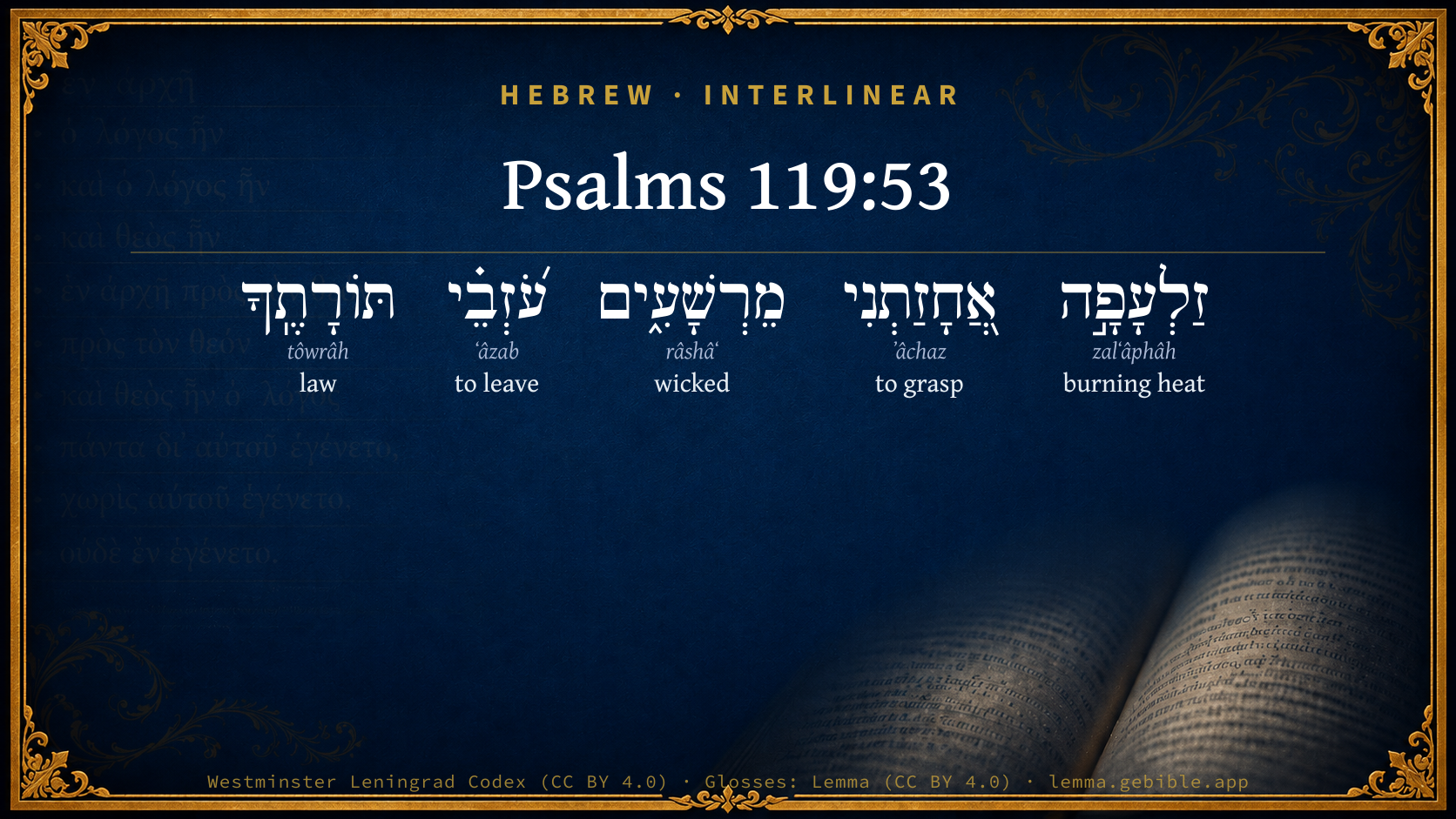
Hebrew (Westminster Leningrad Codex) Psalms 119:53 appears in the Hebrew Old Testament. The text above is from the Westminster Leningrad Codex. Each word links to its Strong’s number, a concise gloss, and parsing drawn from the Open Scriptures Hebrew Bible morphology. Click any word for its full Brown-Driver-Briggs (BDB) entry.
Download image
Cite this verse

Psalms 119:53 (World English Bible). Public Domain. Lemma interlinear Bible study tool, https://lemma.gebible.app/v/psalms/119/53.

Show BibTeX & RIS
BibTeX
RIS
English Translation
Indignation has taken hold on me, Because of the wicked who forsake your law.
World English Bible · Public Domain
Download a study sheet

One document with this verse’s original text, its word-by-word gloss line, the meaning frame, cross-references with their text, attributed commentary, and full source and license credits — printable, and it pastes into notes with its structure intact.

This verse Autodidact and up

Study sheet (.html) Plain text (.txt)

A passage Seminary Student

Up to 50 verses in one chapter. A passage sheet keeps up to 6 commentary sources and 12 cross-references per verse, in the order this page ranks them, and says so on the sheet whenever that leaves anything out. Ask for a single verse and you get the Autodidact verse sheet above.

Everything on this page stays free to read, with no account — the sheet is a download of what is already on screen, not access to it.

Want to remove ads? Support Godless Engineer
Compare translations 3

The same verse in 3 English versions, stacked beneath the original-language interlinear above. Click any original word for its lexicon entry.

Each is an independent rendering of the whole verse — the interlinear is not word-aligned to these translations.

Highlighted words mark where these versions differ — a whole-verse word diff, not a word-by-word alignment.

  • World English Bible Public Domain
    Indignation has taken hold on me, Because of the wicked who forsake your law.
  • King James Version Public Domain
    Horror hath taken hold upon me because of the wicked that forsake thy law.
  • unfoldingWord Literal Text CC BY-SA 4.0
    Rage has seized me from the wicked rejecting your teaching.

unfoldingWord Literal Text — © unfoldingWord, licensed CC BY-SA 4.0. Word-aligned USFM3 via Door43 (git.door43.org/unfoldingWord/en_ult).

Versions to compare (up to 4)

3 of 4 selected

Show all 17 translations

Every available English version of this verse, each an independent rendering of the whole verse.

  • World English Bible Public Domain
    Indignation has taken hold on me, Because of the wicked who forsake your law.
  • Berean Standard Bible Public Domain
    Rage has taken hold of me because of the wicked who reject Your law.
  • Majority Standard Bible Public Domain
    Rage has taken hold of me because of the wicked who reject Your law.
  • King James Version Public Domain
    Horror hath taken hold upon me because of the wicked that forsake thy law.
  • American Standard Version (1901) Public Domain
    Hot indignation hath taken hold upon me, Because of the wicked that forsake thy law.
  • Revised Version (1885) Public Domain
    Hot indignation hath taken hold upon me, because of the wicked that forsake thy law.
  • Geneva Bible (1599) Public Domain
    Feare is come vpon mee for the wicked, that forsake thy Lawe.
  • Young's Literal Translation Public Domain
    Horror hath seized me, Because of the wicked forsaking Thy law.
  • Literal Standard Version CC BY-SA 4.0
    Horror has seized me, || Because of the wicked forsaking Your law.
  • Unlocked Literal Bible CC BY-SA 4.0
    Hot anger has taken hold of me because of the wicked who reject your law.
  • unfoldingWord Literal Text CC BY-SA 4.0
    Rage has seized me from the wicked rejecting your teaching.
  • Darby Bible Public Domain
    Burning indignation hath taken hold upon me because of the wicked who forsake thy law.
  • World Messianic Bible Public Domain
    Indignation has taken hold on me, because of the wicked who forsake your Torah.
  • Webster's Bible Public Domain
    Horror hath taken hold upon me because of the wicked that forsake thy law.
  • Free Bible Version CC BY-SA 4.0
    I am angry with the wicked because they have rejected your law.
  • Bible in Basic English Public Domain
    I am burning with wrath, because of the sinners who have given up your law.
  • JPS Tanakh (1917) Public Domain
    Burning indignation hath taken hold upon me, because of the wicked that forsake Thy law.

Literal Standard Version (2020), Covenant Press — licensed CC BY-SA 4.0. Text via the HelloAO Bible API (eBible.org). Unlocked Literal Bible (unfoldingWord) — licensed CC BY-SA 4.0. Text via the HelloAO Bible API (eBible.org). unfoldingWord Literal Text — © unfoldingWord, licensed CC BY-SA 4.0. Word-aligned USFM3 via Door43 (git.door43.org/unfoldingWord/en_ult). Free Bible Version, Dr. Jonathan Gallagher — licensed CC BY-SA 4.0. Text via the HelloAO Bible API (eBible.org).

Word by word

More ways to search: Search by grammar → Find every occurrence → Compare this word →

Practice this passage: Drill this verse → Learn its vocabulary →

About this verse

These counts appear in no published source. They are computed here, from the morphology-tagged text and Lemma’s own curated glosses. What Lemma adds →

5
words
5
distinct lemmas
Wisdom
section

Notable vocabulary

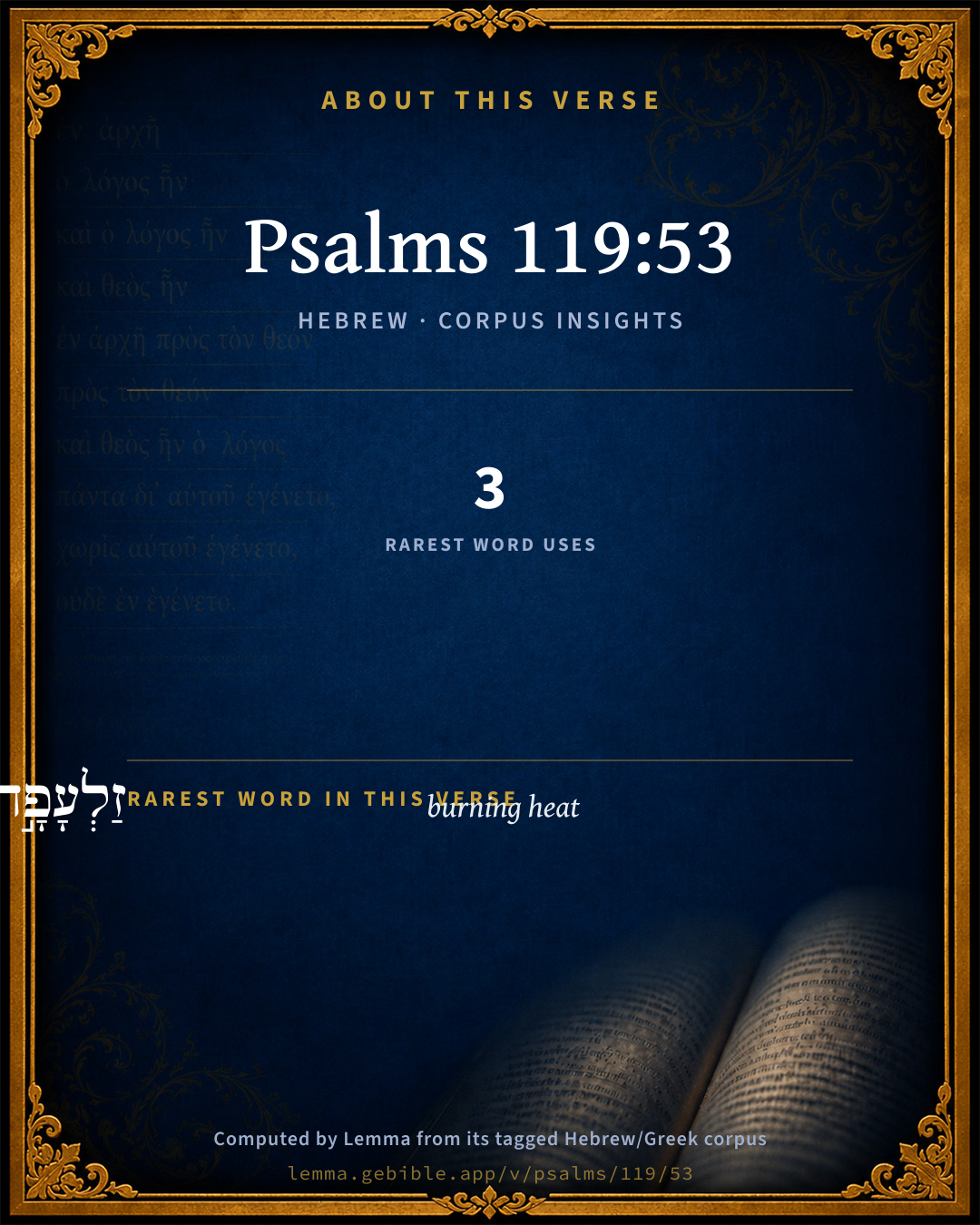
The rarest word here is זַלְעָפָ֣ה burning heat H2152 — appearing just 3 times in the whole Hebrew Bible.

Shared distinctive vocabulary

זַלְעָפָ֣ה burning heat H2152 occurs in 3 verses of the Hebrew Bible. Also found in:

Grammatical profile

  • 2 verbs
  • 2 nouns
  • 1 adjective

Verb forms

  • אֲ֭חָזַתְנִי Qal · Perfect
  • עֹ֝זְבֵ֗י Qal · Participle Active

Hebrew & Septuagint length

In English translation the verse runs 14 words from the Hebrew and 13 from the Septuagint (LXX English) — closely comparable.

A rough comparison of the two English renderings, which tokenize alike — not a word-level alignment.

Word counts can differ between the Hebrew and the Greek without any difference in meaning — e.g. the Hebrew direct-object marker אֵת has no separate Greek word, and Greek often adds the article ὁ.

Cross-references

14

Topical passages linked to Psalms 119:53 in the Treasury of Scripture Knowledge — connected by theme and wording, ordered by reader-vote popularity; previews shown in the World English Bible.

  • Ezra 9:3 When I heard this thing, I tore my garment and my robe, and plucked off the hair of my head and of my beard, and sat down confounded.
  • Psalms 119:158 I look at the faithless with loathing, Because they don't observe your word.
  • Ezra 10:6 Then Ezra rose up from before the house of God, and went into the chamber of Jehohanan the son of Eliashib: and [when] he came there, he ate no bread, nor drink water; for he mourned because of the trespass of them of the captivity.
  • Jeremiah 13:17 But if you will not hear it, my soul shall weep in secret for [your] pride; and my eye shall weep sore, and run down with tears, because Yahweh's flock is taken captive.
  • Philippians 3:18 For many walk, of whom I told you often, and now tell you even weeping, as the enemies of the cross of Christ,
  • Nehemiah 13:25 I contended with them, and cursed them, and struck certain of them, and plucked off their hair, and made them swear by God, [saying], You shall not give your daughters to their sons, nor take their daughters for your sons, or for yourselves.
  • Psalms 119:136 Streams of tears run down my eyes, Because they don't observe your law.
  • Habakkuk 3:16 I heard, and my body trembled. My lips quivered at the voice. Rottenness enters into my bones, and I tremble in my place, Because I must wait quietly for the day of trouble, For the coming up of the people who invade us.
  • Luke 19:41–42 When he drew near, he saw the city and wept over it,
  • Romans 9:1–3 I tell the truth in Christ. I am not lying, my conscience testifying with me in the Holy Spirit,
  • 2 Corinthians 12:21 that again when I come my God would humble me before you, and I would mourn for many of those who have sinned before now, and not repented of the uncleanness and sexual immorality and lustfulness which they committed.
  • Ezra 9:14 shall we again break your commandments, and join in affinity with the peoples that do these abominations? would not you be angry with us until you had consumed us, so that there should be no remnant, nor any to escape?
  • Daniel 4:19 Then Daniel, whose name was Belteshazzar, was stricken mute for a while, and his thoughts troubled him. The king answered, Belteshazzar, don't let the dream, or the interpretation, trouble you. Belteshazzar answered, My lord, the dream be to those who hate you, and the interpretation of it to your adversaries.
  • Psalms 89:30 If his children forsake my law, And don't walk in my ordinances;

Cross-references courtesy of OpenBible.info (CC BY 4.0).

Hebrew and Greek witnesses Masoretic Hebrew ↔ Greek Septuagint

The same verse in the two great witnesses to the Old Testament, shown verse-for-verse.

You’re reading Greek Psalm 118 (Hebrew Psalm 119). The Septuagint counts the superscription, so verse numbers can differ from the Hebrew — chapter-level alignment, not verse-by-verse. Numbering follows Rahlfs.

These are two independent witnesses, not word-aligned to each other, and the Septuagint is shown in lemma (dictionary) form.

Hebrew Psalms 119:53 Masoretic · Westminster Leningrad Codex

זַלְעָפָ֣ה אֲ֭חָזַתְנִי מֵרְשָׁעִ֑ים עֹ֝זְבֵ֗י תּוֹרָתֶֽךָ

Indignation has taken hold on me, Because of the wicked who forsake your law.

World English Bible · Public Domain

Greek LXX Greek Psalm 118:53 Septuagint · lemma form

ἀθυμία καταἔχω ἐγώ ἀπό ἁμαρτωλός ὁ ἐν καταλιμπάνω ὁ νόμος σύ

Despair took hold upon me, because of the sinners who forsake your law.

LXX2012 (modern English Septuagint) · Public Domain

On this verse, The Treasury of David discusses the Septuagint’s reading. Read the note in Commentary ↓

Hebrew: Westminster Leningrad Codex (CC BY 4.0). Greek: Septuagint (public domain); English from LXX2012 (modern English Septuagint) (Public Domain). How the Septuagint differs from the Hebrew →

Commentary

Notes on Psalms 119:53 from classic Christian and Jewish commentators (each source and its license shown beneath its notes). The classic Christian expositions comment on the surrounding passage and are grouped to its opening verse, so a note may address several verses; the Jewish commentaries on the Tanakh (Rashi and others) are per-verse, so they appear only where the commentator wrote on this verse.

Lemma curates 59 commentaries, every one of them public domain or Creative Commons licensed, each selected and text-cleaned for this edition rather than reprinted as found. About our sources →

Trapp's Complete Commentary

John Trapp

Psa 119:53 Horror hath taken hold upon me because of the wicked that forsake thy law.

Ver. 53. Horror hath taken hold upon me] Horripilatio, turbo, vortex, a horrible tempest, Psa 11:6, such as surpriseth holy Habakkuk, Hab 3:16.

Because of the wicked] To think of their heinous sins and horrible punishments, which they dread not, dream not off See Dan 4:19.

John Trapp, A Commentary or Exposition upon All the Books of the Old and New Testament (1647–1656) — public domain. Text from a community e-Sword module.

The Biblical Illustrator

Joseph S. Exell

Psa_119:53

Horror hath taken hold upon me because of the wicked that forsake Thy law.

The most horrible

Of all the horrible things in the universe wickedness is the most horrible.

I. It is most revolting to our sense of the beautiful. The aesthetical element exists in a greater or less degree in all moral minds. And the Creator has provided for it by flooding, the universe with beauty. The hideous and the ugly shock it with inexpressible pain, but what is so incongruous, so horrible as to see puny creatures rising in rebellion against the mighty Creator?

II. It is most revolting to our sense of the reasonable. What is more reasonable than for the greatest Being to be reverenced the most, the kindest Being to be thanked the most, the best Being to be adored the most? Yet wickedness is in antagonism to all this, it is an outrage on all the principles of moral propriety.

III. It is most revolting to our sense of the benevolent. In all moral minds there is implanted by the benevolent Creator a desire for the well-being of self and others. But wickedness strikes right against it, it breathes misery to all. (Homilist.)

The folly of forsaking the Divine law

The wicked that forsake Thy law. Men are like four-year-old children, that, going down to the sea-shore, and finding there a boat with its various appliances, think they will try their hand at navigation. It has been the custom of their elders to have, as a means of navigating boats, sails and oars and a tiller, with a rudder attached; but these children say, Let us not be bound to our fathers notions. And so with might and main they heave the mast and sails overboard, cast away the oars, and, unfastening the boat, they climb into it. And then, laughing and saying, Now for S voyage of the newest fashion, they push off, and when once the boat is set free the tide takes her, and as there is nothing to steer her she goes whirling round and round, or drifting in this direction or that, at the mercy of the waves. And when they are far from the land, and night is coming on, and the sea begins to get turbulent, then, without sails, without oars, without rudder, and without the capacity to manage the boat, with their little palms they try, over the side, to paddle her back. But what can these children do towards paddling that masterly boat with the wind and tide against them, and with no power but that of their little palms? And yet they are mighty to manage that boat, compared to men who unharness faith and throw off its spars, its oars, its ordinary means of navigation, and say, Now, having got rid of these superstitions, we will paddle our new views and systems in our own way. (H. W. Beecher.)

The Biblical Illustrator, edited by Joseph S. Exell (c. 1880s–1900s) — public domain. Text from a community e-Sword module.

Joseph Benson's Commentary

Psa 119:53. Horror hath taken hold upon me — A mixed passion, made up of abhorrence of their sins, and dread and sorrow at the consideration of the judgments of God coming upon them; because of the wicked, &c. — For the dishonour which they bring to God, the scandal and mischief to others, and their own certain ruin.

Joseph Benson's Commentary on the Old and New Testaments (1811–1818) — public domain. Text from a community e-Sword module.

J. A. Alexander on Psalms

Joseph Addison Alexander

53. (Psa 119:53) Rage has seized me from wicked (men) abandoning thy law. No English word is strong enough to represent the first one in the Hebrew of this verse except rage or fury. See above, on Psa 11:6. It here denotes the highest pitch of indignant disapproval. From, i.e. arising or proceed- from, because of. Forsaking thy law, not only refusing in practice to obey it, but avowedly abjuring its authority.

Joseph Addison Alexander, The Psalms Translated and Explained (1850) — public domain. Text from a community e-Sword module.

Geneva Bible (1599)

Geneva Bible translators

That is, a vehement zeal to thy glory and indignation against the wicked.

Geneva Bible (1599) marginal notes — public domain. Text via Bolls.life.

Matthew Henry's Commentary

Here is, 1. The character of wicked people; he means those that are openly and grossly wicked: They forsake thy law. Every sin is a transgression of the law, but a course and way of wilful and avowed sin is downright forsaking it and throwing it off. 2. The impression which the wickedness of the wicked made upon David; it frightened him, it put him into an amazement. He trembled to think of the dishonour thereby done to God, the gratification thereby given to Satan, and the mischiefs thereby done to the souls of men. He dreaded the consequences of it both to the sinners themselves (and cried out, O gather not my soul with sinners! let my enemy be as the wicked) and to the interests of God's kingdom among men, which he was afraid would be thereby sunk and ruined. He does not say, "Horror has taken hold on me because of their cruel designs against me," but "because of the contempt they put on God and his law." Sin is a monstrous horrible thing in the eyes of all that are sanctified, Jer 5:30; Jer 23:14; Hos 6:10; Jer 2:12.

Matthew Henry's Commentary on the Whole Bible (1708–1710) — public domain (CC PDM 1.0). Text via the HelloAO Bible API.

Adam Clarke's Commentary

Verse 53. Horror hath taken hold upon me] The word זלעפה zilaphah, which we render horror, is thought to signify the pestilential burning wind called by the Arabs simoom. Here it strongly marks the idea that the psalmist had of the destructive nature of sin; it is pestilential; it is corrupting, mortal.

Adam Clarke's Commentary on the Bible (1810–1826) — public domain. Text from a community e-Sword/MySword module.

John Calvin's Commentaries

53. Terror seized me This verse may be understood in two senses; either that the prophet was grievously afflicted when he saw God’s law violated by the wicked, or that he was horror-struck at the thought of their perdition. Some would render it ardor, which does not so properly agree with the nature of the passage; I therefore abide by the term fear, by which I think his ardent zeal is pointed out, in that he was not only deeply grieved at the transgressions of the law, but held in the utmost detestation the impious boldness of those who lightly esteemed the law of God. At the same time, it is worthy of notice, that it is no new ground of offense to the faithful, if numbers throw off God’s yoke, and set up the standard of rebellion against him. This, I repeat, must be attended to, because many derive flimsy and frivolous pretexts for it, from the degeneracy of the age, as if they must needs howl while they live among wolves. In the days of David, we see there were many who apostatized from the faith, and yet, so far was he from being discouraged or dismayed by these things, that the fear of God rather kindled a holy indignation in his bosom. What is to be done, then, when surrounded by bad examples, but that we should vie with each other in holding them up to detestation? And here a contrast, if not directly stated, is implied, between the flattering unction which we apply to ourselves, believing that all is lawful which is common, and the horror with which the prophet tells us he was seized. If the wicked, haughtily and without restraint, set themselves in opposition to God, in consequence of our not being alive to his judgments, we convert that into an occasion of perverse confidence and insensibility. On the contrary, the prophet asserts that he was seized with horror, because, though he considered the long-suffering of God, on the one hand, yet, on the other, he was fully persuaded that he must, sooner or later, call for condign punishment.

John Calvin's Commentaries (1540-1563) — public domain. Text from the Calvin Translation Society English edition (1840s-50s) via the Christian Classics Ethereal Library (ccel.org). Calvin's coverage is partial (roughly two-thirds of the Bible); uncommented books and verses are honest gaps, never fabricated. The 19th-century editor's footnotes and remarks are omitted so the notes are faithfully Calvin's own voice.

Ellicott's Commentary for English Readers

(53) Horror.—Rather, violent indignation, a storm of rage, hot and fierce as the simoon. For the word, see Psa_11:6, Note.

A Bible Commentary for English Readers, edited by Charles John Ellicott (1878–1897) — public domain. Text from a community e-Sword module.

The Cambridge Bible for Schools and Colleges

gen. ed. J. J. S. Perowne

53. Horror &c.] Hot indignation seizes me. It was not unmingled with sorrow, Psa_119:136.

that forsake thy law] Careless or apostate Israelites are clearly meant.

The Cambridge Bible for Schools and Colleges (gen. ed. J. J. S. Perowne; Cambridge University Press, 1878–1918) — public domain. Text from a community e-Sword module.

John Gill's Exposition

I have remembered thy name, O Lord, in the night,.... In the night of distress and affliction, as Jarchi; or rather literally, in the night season, when on his bed and awake: while others were asleep, he revolved in his mind the greatness of the divine Being; the perfections of his nature; his wonderful works of creation, providence, and grace; his word and ordinances, by which he was made known unto the sons of men; and these he called to mind and meditated upon in the night watches, to encourage his faith and hope in the Lord, and draw out his love and affection to him;

and have kept thy law: though imperfectly, yet spiritually, sincerely, heartily, and from a principle of love and gratitude, and with a view to the glory of God, and without mercenary and sinister ends.

John Gill's Exposition of the Whole Bible (1746–1763) — public domain (CC PDM 1.0). Text via the HelloAO Bible API.

Albert Barnes' Notes on the Bible

Horror hath taken hold upon me - Has seized me; has overpowered and overwhelmed me. I shudder; I tremble; I am afraid; I am filled with distress. Luther, “I am burnt up.” The Hebrew word - זלעפה zal‛âphâh - is from a verb meaning “to be hot; to glow”; and the idea in the word is that of violent heat; then, a glow or burning, as of a wind - the “simoom” of the desert. See Psa 11:6, where the word is translated “horrible tempest,” in the margin, “burning.” The word occurs only in that passage, in the one before us, and in Lam 5:10, where it is rendered “terrible (famine),” in the margin, “terrors,” or “storms.” The state referred to here is that of one who sees the storm of burning wind and sand approaching; who expects every moment to be overcome and buried; whose soul trembles with consternation.

Because of the wicked ... - Their conduct alarms me. Their danger appals me. Their condition overwhelms me. I see them rebelling against God. I see them exposed to his wrath. I see the grave just before them, and the awful scenes of judgment near. I see them about to be cast off, and to sink to endless woe, and my soul is transfixed with horror. The contemplation overwhelms me with uncontrollable anguish. Can such things be? Can people be thus in danger? And can they be calm and composed, when so near such awful horrors? No man can look on the world of despair without horror; no one can truly realize that his fellow-men are exposed to the horrors of that abode without having his soul filled with anguish. Strange that all people do not feel thus - that impenitent people can walk along on the verge of the grave and of hell “without” horror - that pious people, good people, praying people, can look upon their friends in that condition without having their souls filled with unutterable anguish. Compare Psa 119:136; Rom 9:1-4; Luk 19:41.

Albert Barnes' Notes on the Bible (1834–1885) — public domain. Text from a community e-Sword/MySword module.

Matthew Poole's English Annotations

Horror; a mixed passion made up of indignation at their persons as sinful, and abhorrency of their sins, and dread and sorrow at the consideration of the judgments of God coming upon them.

Because of the wicked that forsake thy law; for the dishonour which they bring to God, the scandal and mischief to others, and their own certain ruin.

Matthew Poole's English Annotations on the Holy Bible (1683–1685) — public domain. Text from a community e-Sword/MySword module.

The Treasury of David

Charles H. Spurgeon

Ver. 53. Horror hath taken hold upon me because of the wicked that forsake thy law. He was horrified at their action, at the pride which led them to it, and at the punishment which would be sure to fall upon them for it. When he thought upon the ancient judgments of God he was filled with terror at the fate of the godless; as well he might be. Their laughter had not distressed him, but he was distressed by a foresight of their overthrow. Truths which were amusement to them caused amazement to him. He saw them utterly turning away from the law of God, and leaving it as a path forsaken and over grown from want of traffic, and this forsaking of the law filled him with the most painful emotions: he was astonished at their wickedness, stunned by their presumption, alarmed by the expectation of their sudden overthrow, amazed by the terror of their certain doom.

See Ps 119:106, 158, and note the tenderness which combined with all this. Those who are the firmest believers in the eternal punishment of the wicked are the most grieved at their doom. It is no proof of tenderness to shut one's eyes to the awful doom of the ungodly. Compassion is far better shown in trying to save sinners than in trying to make things pleasant all round. Oh that we were all more distressed as we think of the portion of the ungodly in the lake of fire! The popular plan is to shut your eyes and forget all about it, or pretend to doubt it; but this is not the way of the faithful servant of God.

Ver. 53. Horror hath taken hold upon me because of the wicked. I have had clear views of eternity; have seen the blessedness of the godly, in some measure; and have longed to share their happy state; as well as been comfortably satisfied that through grace I shall do so; but, oh, what anguish is raised in my mind, to think of an eternity for those who are without Christ, for those who are mistaken, and who bring their false hopes to the grave with them! The sight was so dreadful I could by no means bear it: my thoughts recoiled, and I said, (under a more affecting sense than ever before,)"Who can dwell with everlasting burnings?" David Brainerd, 1718-1747.

Ver. 53. Horror hath taken hold upon me, etc. Oh who can express what the state of a soul in such circumstances is! All that we can possibly say about it gives but a very feeble, faint representation of it; it is inexpressible and inconceivable; for who knows the power of God's anger?

How dreadful is the state of those that are daily and hourly in danger of this great wrath and infinite misery! But this is the dismal case of every soul in this congregation that has not been born again, however moral and strict, sober and religious, they may otherwise be. Oh that you would consider it, whether you be young or old! There is reason to think, that there are many in this congregation now hearing this discourse, that will actually be the subjects of this very misery to all eternity. We know not who they are, or in what seats they sit, or what thoughts they now have. It may be are now at ease, and hear all these things without much disturbance, are now flattering themselves that they are not the persons, promising themselves that they shall escape. If we knew that there was one person, and but one, in the whole congregation, that was to be the subject of misery, what an awful thing would it be to think of! If we knew who was, what an awful sight would it be to see such a person! How might the rest of the congregation lift up a lamentable and bitter cry over But, alas! instead of one, how many is it likely will remember this discourse in hell! Jonathan Edwards, in a Sermon entitled, "Sinners in the Hands

of an angry God."

Ver. 53. Horror. hpelz, zilaphah, properly signifies the pestilential burning wind called by the Arabs simoon (see Ps 11:6); and is here used in a figurative sense for the most horrid mental distress; and strongly marks the idea the Psalmist had of the corrupting, pestilential, and destructive nature of sin. Note in Bagster's Comprehensive Bible.

Ver. 53. Horror. The word for "horror" signifieth also a tempest or storm. Translations vary; some read it, as Junius, "a storm overtaking one"; Ainsworth, "a burning horror hath seized me, "and expounds it a storm of terror and dismay. The Septuagint, aynmia katece me, "faintness and dejection of mind hath possessed me"; our own translation, "I am horribly afraid"; all translations, as well as the original word, imply a great trouble of mind, and a vehement commotion; like a storm, it was matter of disquiet and trembling to David. Thomas Manton.

Ver. 53. Because of the wicked that forsake thy law. David grieved, not because he was himself attacked; but because the law of God was forsaken; and he bewailed the condemnation of those who so did, because they are lost to God. Just as a good father in the madness of his son, when he is ill used by him, mourns not his own but the misery of the diseased; and he grieves at the contumely, not because it is cast on himself, but because the diseased person knows not what he does in his madness: so a good man, when he sees a sinner neither reverence nor honour the grey hairs of a parent, that to his face he can insult him, that he does not know in the madness of sinning what unbecoming and shameful things he does, grieves for him as one on the point of death, laments him as one despaired of by the physicians. As a good physician in the first place advises, then, even if he receive hard words, though he be beaten, nevertheless as the man is ill he bears with him; and if he be cursed he does not leave; and any medicine that may be applied he does not refuse; nor does he go away as from a stubborn fellow, but strives with all diligence to heal him as one that has deserved well from him, exercising not only the skill of science but also benignity of disposition. Even so, a righteous man, when he is treated with contempt, does not turn away, but when he is calumniated he regards it as madness, not as depravity; and desires rather to apply his own remedy to the wound, and sympathises, and grieves not for himself but for him who labours under an incurable disease. Ambrose.

Ver. 53. The wicked that forsake thy law; not only transgress the law of the Lord, as every man does, more or less; but wilfully and obstinately despise it, and cast it behind their backs, and live in a continued course of disobedience to it; or who apostatize from the doctrine of the word of God; wilfully deny the truth, after they have had a speculation knowledge of it, whose punishment is very grievous (Heb 10:26-29); and now partly because of the daring impiety of wicked men, who stretch out their hands against God, and strengthen themselves against the Almighty, and run upon him, even on the thick bosses of his bucklers: because of the shocking nature of their sin, the sad examples thereby set to others, the detriment they are to themselves, and the dishonour they bring to God I and partly because of the dreadful punishment that shall be inflicted on them here, and especially hereafter, when a horrible tempest of wrath will come upon them. Hence such trembling seized the Psalmist: and often so it is, that good men tremble more for the wicked than they do for themselves: see Ps 119:120. John Gill.

Ver. 53. The sensations of godly men at the sight of sinners: horror at their crime, their perseverance in it, their rejection of grace, and their end.

Ver. 53. Horror stricken.

1. The guilt and danger of impenitent sinners.

2. The horror and concern of godly spectators.

3. The prayer and labour which such concern should dictate, G.A.D.

Psalms 119:54*

Charles H. Spurgeon's The Treasury of David (1869–1885) — public domain. Psalms only. Text from a community e-Sword/MySword module.

The Pulpit Commentary

Horror hath taken hold upon me because of the wicked that forsake thy Law. The Revised Version has "hot indignation" instead of "horror;" and so Rosenm Hengstenberg, Cheyne, Professor Alexander, and others; but Dr. Kay well defends the Authorized Version ("The Psalms," Appendix 1. pp. 462, 463). The feeling intended probably resembled that described by Ezra. (Ezr_9:6) The of the LXX does not ill express it.

The Pulpit Commentary (1880–1919), ed. H.D.M. Spence-Jones & Joseph S. Exell — public domain. Text from a community e-Sword module.

John Wesley's Explanatory Notes

Horror - A mixed passion, made up of abhorrence of their sins, and dread and sorrow at the consideration of the judgments of God coming upon them.

John Wesley, Explanatory Notes Upon the Whole Bible (1754–1765) — public domain. Text via the GEBible commentary corpus.

unfoldingWord translationNotes

Door43 World Missions Community

Hot anger has taken hold of me

This is an idiom. Anger is expressed as if it is a person that can grab another person. AT: "I have become very angry" (See: Idiom and Personification)

Your statutes have been my songs

"I have used your statutes as lyrics to my music" or "I have created songs from your statutes"

translationWords

anger

evil

reject

law

statute

life

unfoldingWord translationNotes — © Distant Shores Media and the Door43 World Missions Community, licensed CC BY-SA 4.0. Source: git.door43.org/Door43/en_tn.

Lesson kit

Teaching starters — assembled from the data on this page, not authored interpretation. Every prompt links to the verse data it draws on. Edit before teaching.

Psalms, in the Wisdom, opens this verse with 5 words (5 distinct Hebrew lemmas). Its most distinctive word is zalʻâphâh (“burning heat”). A historical commentator’s framing appears above. Read the whole chapter for the surrounding context.

Discussion questions

  1. How does “burning heat” (zalʻâphâh) shape what this verse is saying?
  2. How does Psalms 11:6, which shares the word «burning heat», read alongside this verse?
  3. These translations render this verse differently. What is at stake in choosing one wording over another?
  4. «אֲ֭חָזַתְנִי» is a Qal Perfect verb. How does that grammatical form shape the action described?
  5. Compare how Trapp's Complete Commentary and The Biblical Illustrator read this verse. Where do they agree or differ?

Things to notice

Reading settings

Reading text

Shown beneath each verse's original-language words.

Old Testament
Old Testament edition

Read the OT as the Masoretic Hebrew (MT) or the Greek Septuagint (LXX).

English shown for the Greek Septuagint (in the Hebrew ↔ Greek comparison).

Comparing translations? Open the Compare panel on any verse page to stack up to four side by side.