
Proverbs 17:23

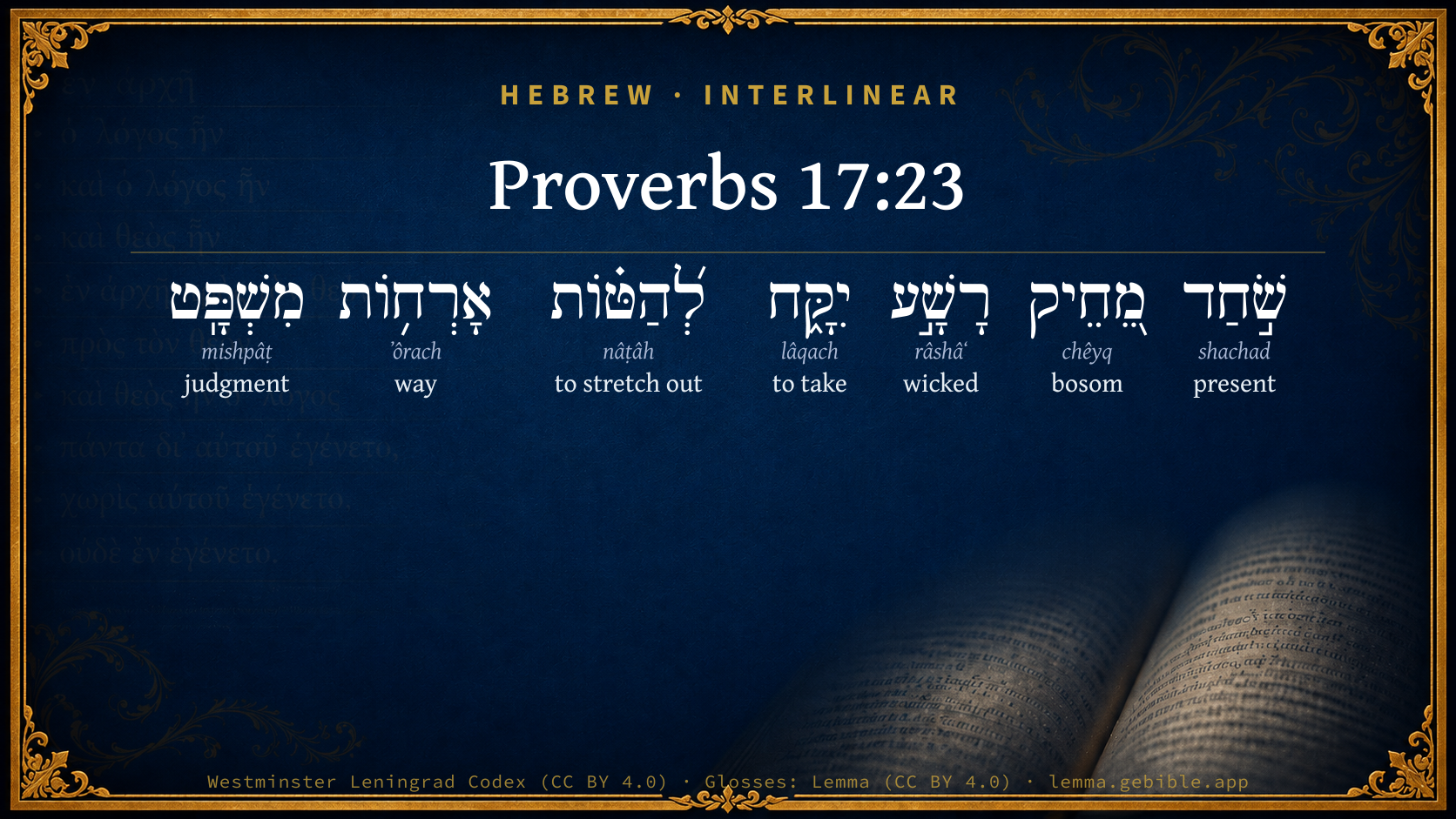
Hebrew (Westminster Leningrad Codex) Proverbs 17:23 appears in the Hebrew Old Testament. The text above is from the Westminster Leningrad Codex. Each word links to its Strong’s number, a concise gloss, and parsing drawn from the Open Scriptures Hebrew Bible morphology. Click any word for its full Brown-Driver-Briggs (BDB) entry.
Download image
Cite this verse

Proverbs 17:23 (World English Bible). Public Domain. Lemma interlinear Bible study tool, https://lemma.gebible.app/v/proverbs/17/23.

Show BibTeX & RIS
BibTeX
RIS
English Translation
A wicked man receives a bribe in secret, To pervert the ways of justice.
World English Bible · Public Domain
Download a study sheet

One document with this verse’s original text, its word-by-word gloss line, the meaning frame, cross-references with their text, attributed commentary, and full source and license credits — printable, and it pastes into notes with its structure intact.

This verse Autodidact and up

Study sheet (.html) Plain text (.txt)

A passage Seminary Student

Up to 50 verses in one chapter. A passage sheet keeps up to 6 commentary sources and 12 cross-references per verse, in the order this page ranks them, and says so on the sheet whenever that leaves anything out. Ask for a single verse and you get the Autodidact verse sheet above.

Everything on this page stays free to read, with no account — the sheet is a download of what is already on screen, not access to it.

Want to remove ads? Support Godless Engineer
Compare translations 3

The same verse in 3 English versions, stacked beneath the original-language interlinear above. Click any original word for its lexicon entry.

Each is an independent rendering of the whole verse — the interlinear is not word-aligned to these translations.

Highlighted words mark where these versions differ — a whole-verse word diff, not a word-by-word alignment.

  • World English Bible Public Domain
    A wicked man receives a bribe in secret, To pervert the ways of justice.
  • King James Version Public Domain
    A wicked man taketh a gift out of the bosom to pervert the ways of judgment.
  • unfoldingWord Literal Text CC BY-SA 4.0
    A wicked one takes a bribe from the bosom to bend the paths of justice.

unfoldingWord Literal Text — © unfoldingWord, licensed CC BY-SA 4.0. Word-aligned USFM3 via Door43 (git.door43.org/unfoldingWord/en_ult).

Versions to compare (up to 4)

3 of 4 selected

Show all 18 translations

Every available English version of this verse, each an independent rendering of the whole verse.

  • World English Bible Public Domain
    A wicked man receives a bribe in secret, To pervert the ways of justice.
  • Berean Standard Bible Public Domain
    A wicked man takes a covert bribe to subvert the course of justice.
  • Majority Standard Bible Public Domain
    A wicked man takes a covert bribe to subvert the course of justice.
  • King James Version Public Domain
    A wicked man taketh a gift out of the bosom to pervert the ways of judgment.
  • American Standard Version (1901) Public Domain
    A wicked man receiveth a bribe out of the bosom, To pervert the ways of justice.
  • Revised Version (1885) Public Domain
    A wicked man taketh a gift out of the bosom, to pervert the ways of judgment.
  • Geneva Bible (1599) Public Domain
    A wicked man taketh a gift out of the bosome to wrest the wayes of iudgement.
  • Douay-Rheims (1899) Public Domain
    The wicked man taketh gifts out of the bosom, that he may pervert the paths of judgment.
  • Young's Literal Translation Public Domain
    A bribe from the bosom the wicked taketh, To turn aside the paths of judgment.
  • Literal Standard Version CC BY-SA 4.0
    The wicked takes a bribe from the bosom, || To turn aside the paths of judgment.
  • Unlocked Literal Bible CC BY-SA 4.0
    A wicked man accepts a secret bribe to pervert the ways of justice.
  • unfoldingWord Literal Text CC BY-SA 4.0
    A wicked one takes a bribe from the bosom to bend the paths of justice.
  • Darby Bible Public Domain
    A wicked [man] taketh a gift out of the bosom, to pervert the paths of judgment.
  • World Messianic Bible Public Domain
    A wicked man receives a bribe in secret, to pervert the ways of justice.
  • Webster's Bible Public Domain
    A wicked man taketh a gift out of the bosom to pervert the ways of judgment.
  • Free Bible Version CC BY-SA 4.0
    The wicked take hidden bribes to pervert the course of justice.
  • Bible in Basic English Public Domain
    A sinner takes an offering out of his robe, to get a decision for himself in a cause.
  • JPS Tanakh (1917) Public Domain
    A wicked man taketh a gift out of the bosom, to pervert the ways of justice.

Literal Standard Version (2020), Covenant Press — licensed CC BY-SA 4.0. Text via the HelloAO Bible API (eBible.org). Unlocked Literal Bible (unfoldingWord) — licensed CC BY-SA 4.0. Text via the HelloAO Bible API (eBible.org). unfoldingWord Literal Text — © unfoldingWord, licensed CC BY-SA 4.0. Word-aligned USFM3 via Door43 (git.door43.org/unfoldingWord/en_ult). Free Bible Version, Dr. Jonathan Gallagher — licensed CC BY-SA 4.0. Text via the HelloAO Bible API (eBible.org).

Word by word

More ways to search: Search by grammar → Find every occurrence → Compare this word →

Practice this passage: Drill this verse → Learn its vocabulary →

About this verse

These counts appear in no published source. They are computed here, from the morphology-tagged text and Lemma’s own curated glosses. What Lemma adds →

7
words
7
distinct lemmas
Wisdom
section

Notable vocabulary

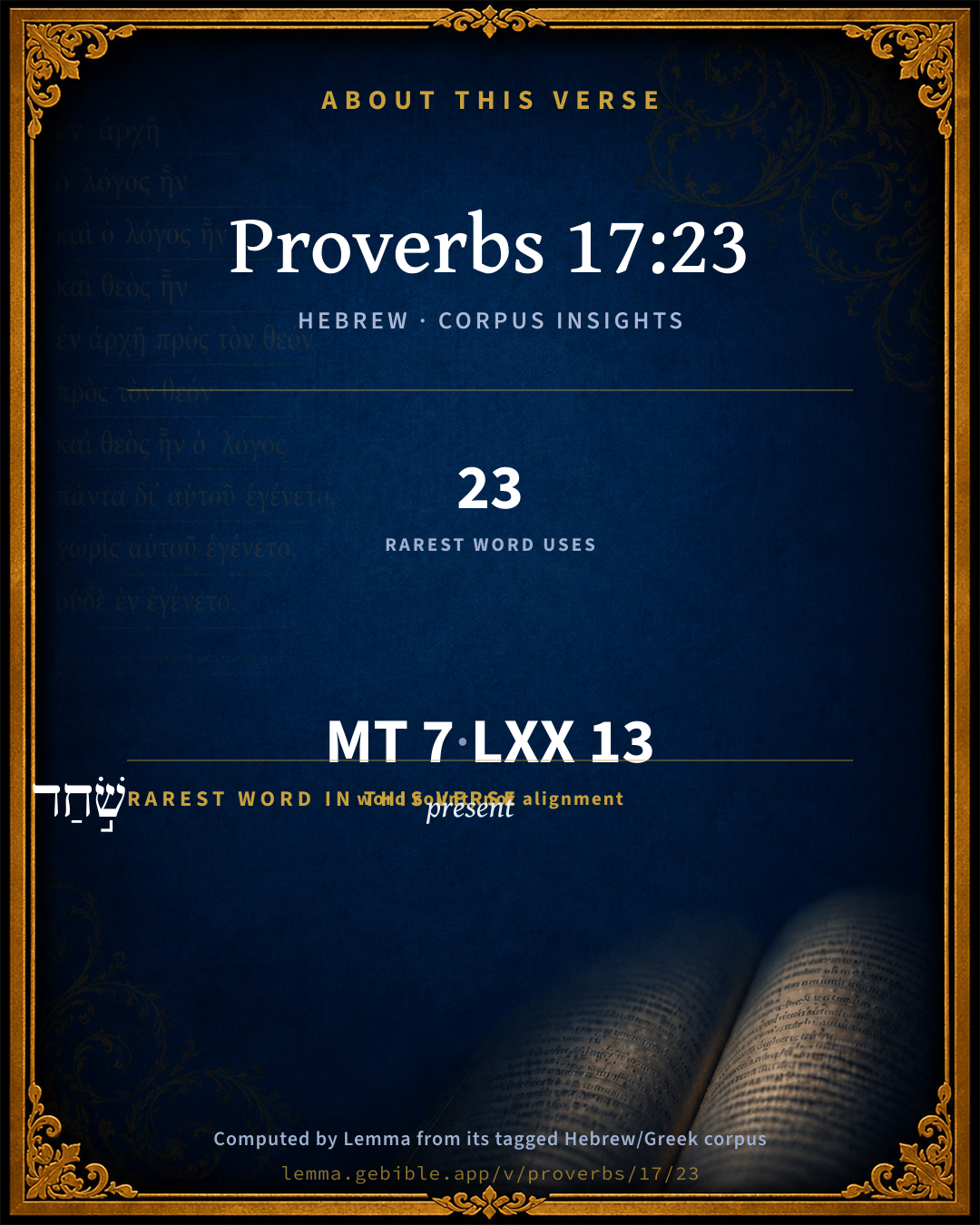
The rarest word here is שֹׁ֣חַד present H7810 — appearing just 23 times in the whole Hebrew Bible.

Shared distinctive vocabulary

שֹׁ֣חַד present H7810 occurs in 21 verses of the Hebrew Bible. Also found in:

Grammatical profile

  • 2 verbs
  • 4 nouns
  • 1 adjective

Verb forms

  • יִקָּ֑ח Qal · Imperfect
  • לְ֝הַטּ֗וֹת Hiphil · Infinitive Construct

Hebrew & Septuagint length

In English translation the verse runs 14 words from the Hebrew and 24 from the Septuagint (LXX English) — the Septuagint runs noticeably longer here. See the side-by-side →

A rough comparison of the two English renderings, which tokenize alike — not a word-level alignment.

Word counts can differ between the Hebrew and the Greek without any difference in meaning — e.g. the Hebrew direct-object marker אֵת has no separate Greek word, and Greek often adds the article ὁ.

In the original languages it is 7 Hebrew tokens and 13 Greek tokens — but the two are counted differently (Hebrew bundles its prefixes and suffixes into one token; the Greek is in lemma form), so that isn’t a like-for-like length.

Cross-references

12

Topical passages linked to Proverbs 17:23 in the Treasury of Scripture Knowledge — connected by theme and wording, ordered by reader-vote popularity; previews shown in the World English Bible.

  • Exodus 23:8 You shall take no bribe, for a bribe blinds those who have sight and perverts the words of the righteous.
  • Deuteronomy 16:19 You shall not wrest justice: you shall not respect persons; neither shall you take a bribe; for a bribe does blind the eyes of the wise, and pervert the words of the righteous.
  • Proverbs 17:8 A bribe is a precious stone in the eyes of him who gives it; Wherever he turns, he prospers.
  • Micah 7:3 Their hands are on that which is evil to do it diligently. The ruler and judge ask for a bribe; And the powerful man dictates the evil desire of his soul. Thus they conspire together.
  • Isaiah 1:23 Your princes are rebellious, and companions of thieves. Everyone loves bribes, and follows after rewards. They don't judge the fatherless, Neither does the cause of the widow come to them.
  • 1 Samuel 8:3 His sons didn't walk in his ways, but turned aside after lucre, and took bribes, and perverted justice.
  • 1 Samuel 12:3 Here I am: witness against me before Yahweh, and before his anointed: whose ox have I taken? or whose donkey have I taken? or whom have I defrauded? whom have I oppressed? or of whose hand have I taken a ransom to blind my eyes therewith? and I will restore it you.
  • Proverbs 18:16 A man's gift makes room for him, And brings him before great men.
  • Proverbs 21:14 A gift in secret pacifies anger; And a bribe in the cloak, strong wrath.
  • Ezekiel 22:12 In you have they taken bribes to shed blood; you have taken interest and increase, and you have greedily gained of your neighbors by oppression, and have forgotten me, says the Lord Yahweh.
  • Micah 3:11 Her leaders judge for bribes, And her priests teach for a price, And her prophets of it tell forturnes for money: Yet they lean on Yahweh, and say, Isn't Yahweh in the midst of us? No disaster will come on us.
  • Mark 14:10–11 Judas Iscariot, who was one of the twelve, went away to the chief priests, that he might deliver him to them.

Cross-references courtesy of OpenBible.info (CC BY 4.0).

Hebrew and Greek witnesses Masoretic Hebrew ↔ Greek Septuagint

The same verse in the two great witnesses to the Old Testament, shown verse-for-verse.

Here the Septuagint runs noticeably longer than the Hebrew — LXX2012 (modern English Septuagint) 24 words vs World English Bible 14. A rough length comparison of the two English translations, not a word-level alignment — read both below.

These are two independent witnesses, not word-aligned to each other, and the Septuagint is shown in lemma (dictionary) form.

Hebrew Proverbs 17:23 Masoretic · Westminster Leningrad Codex

שֹׁ֣חַד מֵ֭חֵיק רָשָׁ֣ע יִקָּ֑ח לְ֝הַטּ֗וֹת אָרְח֥וֹת מִשְׁפָּֽט

A wicked man receives a bribe in secret, To pervert the ways of justice.

World English Bible · Public Domain

Greek LXX Proverbs 17:23 Septuagint · lemma form

λαμβάνω δῶρον ἐν κόλπος ἀδίκως οὐ καταεὐοδόω ὁδός ἀσεβής δέ ἐκκλίνω ὁδός δικαιοσύνη

The ways of a man who unjustly receives gifts in his bosom do not prosper; and an ungodly man perverts the ways of righteousness.

LXX2012 (modern English Septuagint) · Public Domain

On this verse, The Pulpit Commentary discusses the Septuagint’s reading. Read the note in Commentary ↓

Hebrew: Westminster Leningrad Codex (CC BY 4.0). Greek: Septuagint (public domain); English from LXX2012 (modern English Septuagint) (Public Domain). How the Septuagint differs from the Hebrew →

Commentary

Notes on Proverbs 17:23 from classic Christian and Jewish commentators (each source and its license shown beneath its notes). The classic Christian expositions comment on the surrounding passage and are grouped to its opening verse, so a note may address several verses; the Jewish commentaries on the Tanakh (Rashi and others) are per-verse, so they appear only where the commentator wrote on this verse.

Lemma curates 59 commentaries, every one of them public domain or Creative Commons licensed, each selected and text-cleaned for this edition rather than reprinted as found. About our sources →

Trapp's Complete Commentary

John Trapp

Pro 17:23 A wicked [man] taketh a gift out of the bosom to pervert the ways of judgment.

Ver. 23. A wicked man taketh a gift out of the bosom,] i.e., Closely and covertly, as if neither God nor man should see him. The words may be also read thus: ‘He,’ - that is, the corrupt judge - ‘taketh a gift out of the wicked man’s bosom’; there being never a better of them, as Solomon intimateth by this ambiguous expression. Rain is good, and ground is good, yet ex eorum coniunctione fit lutum. {a} So giving is kind, and taking is courteous; yet the mixing of them makes the smooth paths of justice foul and uneven.

{a} Stapleton.

John Trapp, A Commentary or Exposition upon All the Books of the Old and New Testament (1647–1656) — public domain. Text from a community e-Sword module.

Joseph Benson's Commentary

Pro 17:23. A wicked man — Whether judge or witness; taketh a gift out of the bosom — In secret, as this phrase is expounded Pro 21:14, being privily conveyed from the bosom of the giver into his own bosom; to pervert the ways of judgment — To give or procure an unjust sentence. Bishop Patrick’s paraphrase of the verse is, “No man would willingly be known to be so wicked as to be bribed to do injustice, but there are too many that will suffer themselves to be secretly corrupted by presents, to give counsel or judgment contrary to the course of law and equity.”

Joseph Benson's Commentary on the Old and New Testaments (1811–1818) — public domain. Text from a community e-Sword module.

The Preacher's Complete Homiletical Commentary

Joseph S. Exell (gen. ed.)

CRITICAL NOTES.—

Pro_17:23. A gift, i.e., a bribe, judgment. i.e., justice.

MAIN HOMILETICS OF Pro_17:23

BRIBERY

I. Its nature. An act of bribery may be committed without any monetary transaction taking place. It is not necessary that gold should pass from hand to hand to make a man guilty of bribery. It is not even necessary that there should be a distinct promise of any good either in the present or the future. A man bribes another if he merely implies by word or deed that he can make him suffer for speaking what he knows is the truth, and for acting according to the dictates of his conscience. And a man is guilty of accepting a bribe it he abstains from such speech or action from a fear of loss or from a hope of gain, although no distinct promise or threatening has been made by those whom he wishes to propitiate.

II. Its cause. Want of integrity on the part of both the man who offers the bribe and him who accepts it. There are some men in the world to whom even a man who held their lives in his hand would not think of offering a bribe of any kind. He knows it would be as useless to attempt to make such men swerve from the path of right as to try to alter the course of the earth round the sun. There are many, we know, in this country, notwithstanding its many timeservers and place-hunters who, like Samuel of old can say, “Whose ox have I taken, or whose ass have I taken, or whom have I defrauded, whom have I oppressed, or of whose hands have I received any bribe to blind mine eyes therewith? (1Sa_12:3). Only one thing is needed to destroy bribery—in its most impalpable and shadowy forms as well as in its more glaring and shameless manifestations—and that is universal honesty of character. When every man loves truth and right more than he loves material gain then bribery will cease, but not before. Men may be restrained by shame from being guilty of it openly, and will call it by some less obnoxious name, but the spirit of bribery will be at work so long as there are men upon the earth who love gain more than godliness.

III. The universal testimony of the human conscience against it. “The wicked man taketh a gift out of his bosom”—it is a transaction of secrecy—there is a shame connected with the act which proves that conscience condemns it. The man who offers the bribe does not do it openly, which shows that he is fully conscious that he is transgressing the law of right; and the man who accepts it does not boast openly that he has done so for the same reason. Bribery is a sin which is repeatedly denounced by God (Isa_1:23-24; Eze_22:13), but men who have not possessed the light of revelation have denounced bribery as a crime.

IV. Its effect. It “perverts the ways of justice.” Its effect is to bring about that abomination mentioned in Pro_17:15—the justification of the wicked and the condemnation of the just. (See Homiletics on that verse.)

OUTLINES AND SUGGESTIVE COMMENTS

An honest man would rather lose his cause, however just, than gain it by such a base thing as a bribe. It must have been a great bondage for Paul to have been confined in a prison, when he loved the pulpit so well, had not his will been sunk in the will of God; yet he would not offer the least bribe to his covetous judge, who detained him in prison, expecting that money would be offered for his freedom (Act_24:6).—Lawson.

Is not the child of God often pressed with this temptation? Does the influence of a gift, the sense of obligation, never repress the bold consistency of godliness? Does no bias of friendship, no plausible advantage, entice into a crooked path.—Bridges.

There is a gift of thankfulness, there is a gift of reconciliation, there is a gift of goodwill, all these are lawful. Besides these there is a gift of corruption; this is unlawful.—Muffet.

Bribery is an officious fellow, and a special bidder to the fatal banquet. (Pro_9:17-18.) He invites both forward and froward: the forward and yielding by promises of good cheer, secunda dies, that they shall have a fair day of it; the backward, honest man, by terrors and menaces that his cause shall else go westward (indeed, it goes to Westminster!). Yea, with pretence of commiseration and pity, as if the conscience of their right did animate him to their cause. Thus with a show of sanctimony they get a saint’s money; but indeed, argentum fæcundum, argumentum facundum,—there is no persuasion more pathetical than the purse’s. Bribery stands at the stairfoot in the robes of an officer, and helps up injury to the place of audience; thus Judas’s bag is drawn with two strings, made of silk and silver, favour and reward. All officers belong not to one court; their conditions alter with their places. There are some that seem so good that they lament the vices, whereupon they yet inflict but pecuniary punishments. Some of them are like the Israelites, with a sword in one hand and a trowel in the other, with the motto of that old emblem, In utrumque paratus; as the one daubs up justice, so the other cuts breaches of division. They mourn for truth and equity, as the sons of Jacob for Joseph, when themselves sold it; they exclaim against penal transgressions.… If the party be innocent, let his cause be sentenced for his innocence’s sake; if guilty, let not gold buy out his punishment. If the cause be doubtful, the judge shall see it worse when he hath blinded his eyes with bribes. But the will of the giver doth transfer right of the gift to the receiver. No; for it is not a voluntary will. But as a man is willing to give his purse to the thief rather than venture life or limb, so the poor man gives his bribes rather than hazard his cause. Thou sayest the thief has no right to the purse so given; God saith, Nor thou to the bribe … Far be from our souls this wickedness, that the ear which should be open to complaints is thus stopped with the ear-wax of partiality. Alas! poor Truth, that she must now be put to the charges of a golden ear-pick, or she cannot be heard.—T. Adams.

The Preacher's Complete Homiletical Commentary (gen. ed. Joseph S. Exell; Funk & Wagnalls, c. 1892) — public domain (pre-1929). A full-Bible homiletical/sermon-outline anthology covering 65 of 66 books (2 John is absent from the source module). Text from a community e-Sword module.

Geneva Bible (1599)

Geneva Bible translators

That is, secretly and out of the bosom of the rich.

Geneva Bible (1599) marginal notes — public domain. Text via Bolls.life.

Matthew Henry's Commentary

See here, 1. What an evil thing bribery is: He is a wicked man that will take a gift to engage him to give a false testimony, verdict, or judgment; when he does it he is ashamed of it, for he takes it, with all the secresy imaginable, out of the bosom where he knows it is laid ready for him; it is industriously concealed, and so slyly that, if he could, he would hide it from his own conscience. A gift is taken out of the bosom of a wicked man (so some read it); for he is a bad man that gives bribes, as well as he that takes them. 2. What a powerful thing it is. It is of such force that it perverts the ways of judgment. The course of justice is not only obstructed, but turned into injustice; and the greatest wrongs are done under colour of doing right.

Matthew Henry's Commentary on the Whole Bible (1708–1710) — public domain (CC PDM 1.0). Text via the HelloAO Bible API.

Jamieson, Fausset & Brown

Robert Jamieson, A. R. Fausset & David Brown

a gift . . . bosom--Money and other valuables were borne in a fold of the garment, called the bosom.

to pervert--that is, by bribery.

Jamieson, Fausset & Brown — Commentary Critical and Explanatory on the Whole Bible (1871) — public domain (CC PDM 1.0). Text via the HelloAO Bible API.

Adam Clarke's Commentary

Verse 23. A gift out of the bosom] Out of his purse; as in their bosoms, above their girdles, the Asiatics carry their purses. I have often observed this.

Adam Clarke's Commentary on the Bible (1810–1826) — public domain. Text from a community e-Sword/MySword module.

Ellicott's Commentary for English Readers

(23) A wicked man taketh a gift out of the bosom.—Or rather, receives it. “From the bosom” signifies the folds of the dress in which the bribe was concealed, ready to be slipped into the judge’s hand whose favour was to be bought.

A Bible Commentary for English Readers, edited by Charles John Ellicott (1878–1897) — public domain. Text from a community e-Sword module.

The Cambridge Bible for Schools and Colleges

gen. ed. J. J. S. Perowne

23. out of the bosom] i.e. the fold of the garment in which it had been concealed; denoting the stealthy action either of the suitor who proffers, or more probably of the judge who receives the bribe. Comp. Pro_21:14.

The Cambridge Bible for Schools and Colleges (gen. ed. J. J. S. Perowne; Cambridge University Press, 1878–1918) — public domain. Text from a community e-Sword module.

John Gill's Exposition

A wicked man taketh a gift out of the bosom,.... Of another, of a rich man, who takes it out from thence, and offers it to him as a bribe. This he takes in the most secret manner, that it might not be seen by others; though the Arabic version renders it, "he that receives a gift in his own bosom commits iniquity"; it is true of both the giver and the receiver; the one gives out of his bosom, and the other takes if from thence, and puts it into his own, and both are wicked. And the words are by some rendered, though it seems contrary to the accents, "a gift out of the bosom of the wicked he will take" (z); the unjust judge, who is bribed with it:

to pervert the ways of judgment; to turn the course of justice, and hinder it from taking place; favouring a bad cause, and pronouncing a wrong sentence, which is wresting judgment.

(z) "munus de sinu impii accipiet", Baynus.

John Gill's Exposition of the Whole Bible (1746–1763) — public domain (CC PDM 1.0). Text via the HelloAO Bible API.

Albert Barnes' Notes on the Bible

The words “out of the bosom,” from the fold of the garment, rather than from the bag or girdle in which money was usually carried, possibly point to the stealthiness with which the “gift” (or, bribe) is offered to the judge.

Albert Barnes' Notes on the Bible (1834–1885) — public domain. Text from a community e-Sword/MySword module.

Matthew Poole's English Annotations

A wicked man, whether judge or witness.

Out of the bosom; in secret, as this phrase is expounded, Pro 21:14, being privily conveyed from the bosom of the giver into his own bosom.

To pervert the ways of judgment; to give or procure an unjust sentence.

Matthew Poole's English Annotations on the Holy Bible (1683–1685) — public domain. Text from a community e-Sword/MySword module.

Whedon's Commentary on the Bible

Daniel D. Whedon

23. A gift — A bribe.

Out of the bosom — The Asiatics carry their purse in their bosom above their girdle.

To pervert the ways of judgment — To deflect, turn aside, or influence, the course of a judicial decision. The language implies that this is done secretly. Compare Pro_21:14; Pro_18:15.

Daniel D. Whedon (gen. ed.), Commentary on the Old and New Testaments (1874–1909) — public domain. Text from a community e-Sword module.

The Pulpit Commentary

A gift out of the bosom; i.e. secretly from the fold of the garment, and not from the purse or bag wherein money was ostensibly carried. A corrupt judge "taketh," i.e. receives a bribe conveyed to him secretly. (Pro_21:14) To pervert the ways of judgment. The judges had no appointed salaries; hence the unprincipled among them were open to bribery. The strict injunctions of the Law, and the stern denunciations of the prophets, were alike ineffectual in checking corruption. (see Exo_23:8 Deu_16:19 Isa_1:23 Jer_22:17 Eze_13:19 Hos_4:18, etc.) Septuagint, "The man that receiveth gifts in his bosom unjustly, his ways shall not prosper." For, as Job avows, (Job_15:34) "Fire shall consume the tabernacles of bribery." The LXX adds, "The impious turns aside from the ways of righteousness."

The Pulpit Commentary (1880–1919), ed. H.D.M. Spence-Jones & Joseph S. Exell — public domain. Text from a community e-Sword module.

Keil & Delitzsch

C. F. Keil & F. Delitzsch

23 Bribery from the bosom the godless receiveth,

To pervert the ways of justice.

Regarding שׂחד, vid., Pro 17:8. The idea of this word, as well as the clause containing the purpose, demand for the רשׁע a high judicial or administrative post. The bosom, חק (חיק), is, as Pro 16:23, that of the clothing. From the bosom, מחק, where it was kept concealed, the gift is brought forth, and is given into the bosom, בּחק, Pro 21:14, of him whose favour is to be obtained - an event taking place under four eyes, which purposely withdraws itself from the observation of any third person. Since this is done to give to the course of justice a direction contrary to rectitude, the giver of the bribe has not right on his side; and, under the circumstances, the favourable decision which he purchases may be at once the unrighteous sentence of a צדיק, accusing him, or accused by him, Pro 18:5.

Keil & Delitzsch — Biblical Commentary on the Old Testament (1861–1891) — public domain (CC PDM 1.0). Text via the HelloAO Bible API. (Old Testament only.)

Bridges on Proverbs

Charles Bridges

Again we are warned of the corruption of gifts. (Pro 17:8 .) No sin has a deeper stamp of wickedness; none a more awful mark of Divine visitation. (Isa 1:23-24 . Eze 22:13 .) The temptation is the test of principle. Sir M. Hale (as his Biographer writes) ’had learned from Solomon, that a gift perverteth the ways of judgment.’†1 He always therefore rejected it with courteous integrity. Not even a good cause will justify the evil practice. The Apostle, though restrained in bondage from his great and blessed work, would not gratify his covetous judge by purchasing his release. (Act 24:26 .) The rules of the gospel are clear and decisive. Let us not "do evil, that good may come. Let not your good be evil spoken of. Abstain from all appearance of evil." (Rom 3:8 ; Rom 14:16 . 1Th 5:22 .)

Even a corrupt world is ashamed of this sin. The gift is in the bosom (Pro 21:14 ), concealed from the eye of man. But how fearfully uncovered is it to the eye of God, who will not wink at the endeavor to pervert his ways of judgment! How will he one day ’vindicate his Omniscience from all the insults put upon it in the world by those foolish men, who were not ashamed to do those things in the face of God himself, in which they would not have wished the meanest of his creatures to detect them!’†2

Let every child of Abraham hear the command given to his father — "Walk before me, and be thou perfect." (Gen 17:1 .) "He that walketh righteously, and speaketh uprightly — he that shaketh his hands from holding of bribes — he shall dwell on high." (Isa 33:15-16 . Psa 15:1-5 .)

Footnotes:

†1 Bishop Burnet’s Life. What a degrading contrast did Lord Bacon’s character display!

†2 Lawson in loco.

Charles Bridges, An Exposition of the Book of Proverbs (1846) — public domain. Text from a community e-Sword module.

Kretzmann's Popular Commentary

Paul E. Kretzmann

v. 23. A wicked man taketh a gift out of the bosom, rather, "A bribe from the bosom," one given secretly and stealthily, "the wicked will receive," to pervert the ways of judgment, that being the object of bribes.

Paul E. Kretzmann, Popular Commentary of the Bible (1921–1924) — public domain. Text from a community e-Sword module.

unfoldingWord translationNotes

Door43 World Missions Community

to pervert the ways of justice

"to prevent justice from being rendered" or "to pervert justice"

sets his face toward wisdom

This speaks of a person's focus on acting wisely as if he were looking at wisdom. AT: "focuses on acting wisely" (See: Metaphor)

the eyes of a fool are

This refers to a fool by his eyes to emphasize what he is focusing on. AT: "the fool is" (See: Synecdoche)

the ends of the earth

This speaks of a fool's impossible dreams as if they were the ends of the earth to emphasize that they are unrealistic. AT: "strive for things that are as far from him as the ends of the earth" or "focus on impossible things" (See: Metaphor)

translationWords

evil

bribe

just

wise

fool

earth

unfoldingWord translationNotes — © Distant Shores Media and the Door43 World Missions Community, licensed CC BY-SA 4.0. Source: git.door43.org/Door43/en_tn.

Rashi

Rabbi Shlomo Yitzchaki (Rashi)

He will take a bribe from a wicked man’s bosom The Holy One, blessed be He, accepts words of humility and appeasement from the bosom of the wicked; i.e., in secret, between Him and them.

to pervert the roads of justice To overturn his verdict from evil to good.

Rashi on the Tanakh — English translations: “The Judaica Press complete Tanach with Rashi, translated by A. J. Rosenberg” (CC BY 4.0); “Pentateuch with Rashi's commentary by M. Rosenbaum and A.M. Silbermann, 1929-1934” (public domain); “The Metsudah Tanach series, Lakewood, N.J” (CC BY 4.0); and “The Book of Joshua, Metsudah Publications, 1997” (CC BY 4.0). Text via Sefaria.

Lesson kit

Teaching starters — assembled from the data on this page, not authored interpretation. Every prompt links to the verse data it draws on. Edit before teaching.

Proverbs, in the Wisdom, opens this verse with 7 words (7 distinct Hebrew lemmas). Its most distinctive word is shachad (“present”). The Greek Septuagint runs longer here. A historical commentator’s framing appears above. Read the whole chapter for the surrounding context.

Discussion questions

  1. How does “present” (shachad) shape what this verse is saying?
  2. Exodus 23:8 shares the word «present» with this verse. How do the two illuminate each other?
  3. Compared with the Hebrew, the Septuagint runs longer here. What questions does that raise?
  4. These translations render this verse differently; the difference is in the English rendering, not the original. What questions does that raise?
  5. The verb «יִקָּ֑ח» is Qal Imperfect. How does its form color the action?
  6. Reading how Trapp's Complete Commentary and Joseph Benson's Commentary read this verse, where do the two commentators agree and where do they part?

Things to notice

Reading settings

Reading text

Shown beneath each verse's original-language words.

Old Testament
Old Testament edition

Read the OT as the Masoretic Hebrew (MT) or the Greek Septuagint (LXX).

English shown for the Greek Septuagint (in the Hebrew ↔ Greek comparison).

Comparing translations? Open the Compare panel on any verse page to stack up to four side by side.