
Psalms 11:5

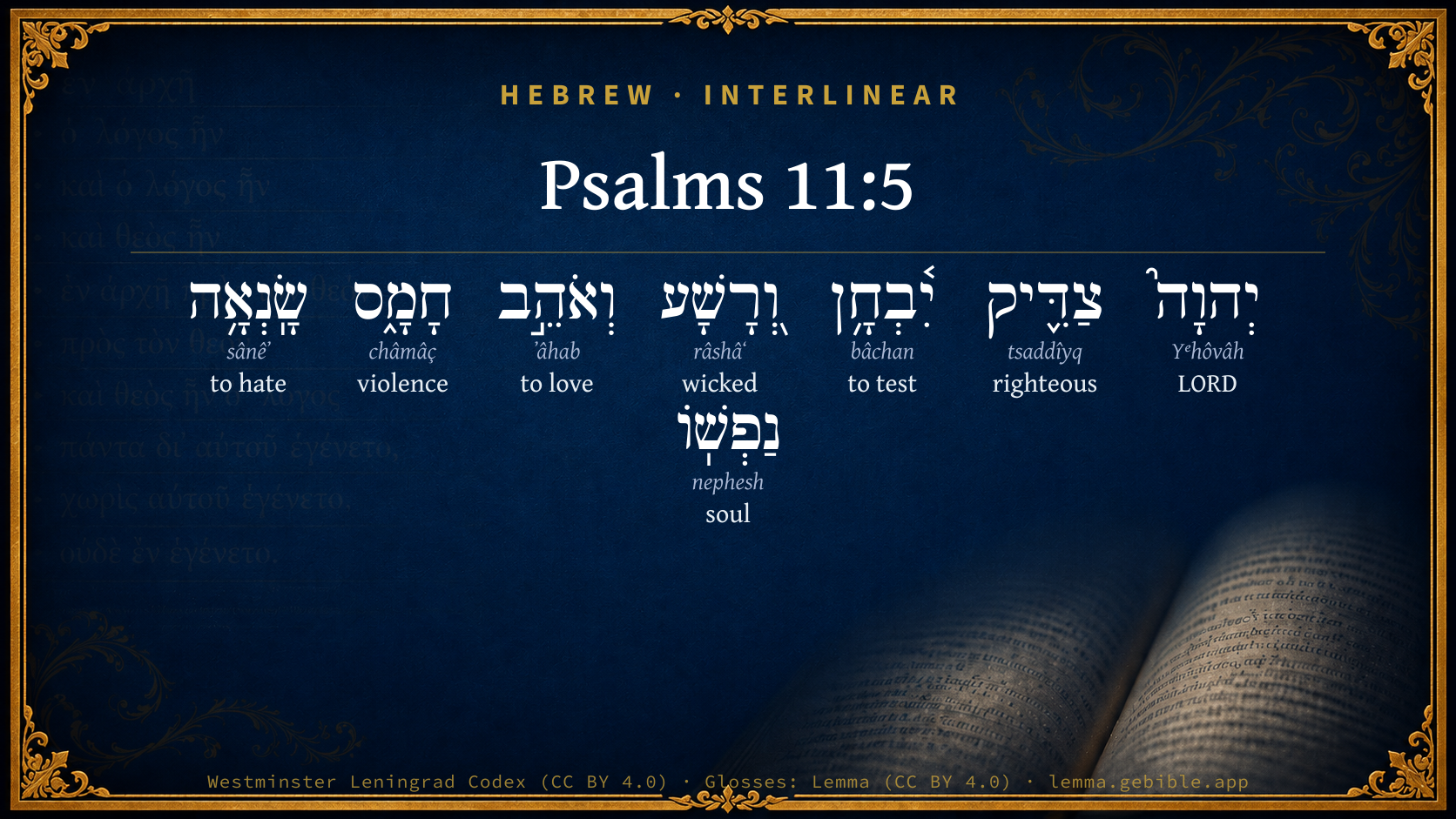
Hebrew (Westminster Leningrad Codex) Psalms 11:5 appears in the Hebrew Old Testament. The text above is from the Westminster Leningrad Codex. Each word links to its Strong’s number, a concise gloss, and parsing drawn from the Open Scriptures Hebrew Bible morphology. Click any word for its full Brown-Driver-Briggs (BDB) entry.
Download image
Cite this verse

Psalms 11:5 (World English Bible). Public Domain. Lemma interlinear Bible study tool, https://lemma.gebible.app/v/psalms/11/5.

Show BibTeX & RIS
BibTeX
RIS
English Translation
Yahweh examines the righteous, But the wicked and him who loves violence his soul hates.
World English Bible · Public Domain
Download a study sheet

One document with this verse’s original text, its word-by-word gloss line, the meaning frame, cross-references with their text, attributed commentary, and full source and license credits — printable, and it pastes into notes with its structure intact.

This verse Autodidact and up

Study sheet (.html) Plain text (.txt)

A passage Seminary Student

Up to 50 verses in one chapter. A passage sheet keeps up to 6 commentary sources and 12 cross-references per verse, in the order this page ranks them, and says so on the sheet whenever that leaves anything out. Ask for a single verse and you get the Autodidact verse sheet above.

Everything on this page stays free to read, with no account — the sheet is a download of what is already on screen, not access to it.

Want to remove ads? Support Godless Engineer
Compare translations 3

The same verse in 3 English versions, stacked beneath the original-language interlinear above. Click any original word for its lexicon entry.

Each is an independent rendering of the whole verse — the interlinear is not word-aligned to these translations.

Highlighted words mark where these versions differ — a whole-verse word diff, not a word-by-word alignment.

  • World English Bible Public Domain
    Yahweh examines the righteous, But the wicked and him who loves violence his soul hates.
  • King James Version Public Domain
    The LORD trieth the righteous: but the wicked and him that loveth violence his soul hateth.
  • unfoldingWord Literal Text CC BY-SA 4.0
    Yahweh tests the righteous and the wicked, and the one loving violence his soul hates.

unfoldingWord Literal Text — © unfoldingWord, licensed CC BY-SA 4.0. Word-aligned USFM3 via Door43 (git.door43.org/unfoldingWord/en_ult).

Versions to compare (up to 4)

3 of 4 selected

Show all 18 translations

Every available English version of this verse, each an independent rendering of the whole verse.

  • World English Bible Public Domain
    Yahweh examines the righteous, But the wicked and him who loves violence his soul hates.
  • Berean Standard Bible Public Domain
    The LORD tests the righteous and the wicked; His soul hates the lover of violence.
  • Majority Standard Bible Public Domain
    The LORD tests the righteous and the wicked; His soul hates the lover of violence.
  • King James Version Public Domain
    The LORD trieth the righteous: but the wicked and him that loveth violence his soul hateth.
  • American Standard Version (1901) Public Domain
    Jehovah trieth the righteous; But the wicked and him that loveth violence his soul hateth.
  • Revised Version (1885) Public Domain
    The LORD trieth the righteous: but the wicked and him that loveth violence his soul hateth.
  • Geneva Bible (1599) Public Domain
    The Lord will try the righteous: but the wicked and him that loueth iniquitie, doeth his soule hate.
  • Douay-Rheims (1899) Public Domain
    For the sinner is praised in the desires of his soul: and the unjust man is blessed.
  • Young's Literal Translation Public Domain
    Jehovah the righteous doth try. And the wicked and the lover of violence, Hath His soul hated,
  • Literal Standard Version CC BY-SA 4.0
    YHWH tries the righteous. And the wicked and the lover of violence, || His soul has hated,
  • Unlocked Literal Bible CC BY-SA 4.0
    Yahweh examines both the righteous and the wicked, but he hates those who love to do violence.
  • unfoldingWord Literal Text CC BY-SA 4.0
    Yahweh tests the righteous and the wicked, and the one loving violence his soul hates.
  • Darby Bible Public Domain
    Jehovah trieth the righteous one; but the wicked, and him that loveth violence, his soul hateth.
  • World Messianic Bible Public Domain
    The LORD examines the righteous, but his soul hates the wicked and him who loves violence.
  • Webster's Bible Public Domain
    The LORD trieth the righteous: but the wicked and him that loveth violence his soul hateth.
  • Free Bible Version CC BY-SA 4.0
    The Lord examines both those who do right and those who do evil, but he hates those who love violence.
  • Bible in Basic English Public Domain
    The Lord puts the upright and the sinner to the test, but he has hate in his soul for the lover of violent acts.
  • JPS Tanakh (1917) Public Domain
    The LORD trieth the righteous; but the wicked and him that loveth violence His soul hateth.

Literal Standard Version (2020), Covenant Press — licensed CC BY-SA 4.0. Text via the HelloAO Bible API (eBible.org). Unlocked Literal Bible (unfoldingWord) — licensed CC BY-SA 4.0. Text via the HelloAO Bible API (eBible.org). unfoldingWord Literal Text — © unfoldingWord, licensed CC BY-SA 4.0. Word-aligned USFM3 via Door43 (git.door43.org/unfoldingWord/en_ult). Free Bible Version, Dr. Jonathan Gallagher — licensed CC BY-SA 4.0. Text via the HelloAO Bible API (eBible.org).

Word by word

More ways to search: Search by grammar → Find every occurrence → Compare this word →

Practice this passage: Drill this verse → Learn its vocabulary →

About this verse

These counts appear in no published source. They are computed here, from the morphology-tagged text and Lemma’s own curated glosses. What Lemma adds →

8
words
8
distinct lemmas
Wisdom
section

Shared distinctive vocabulary

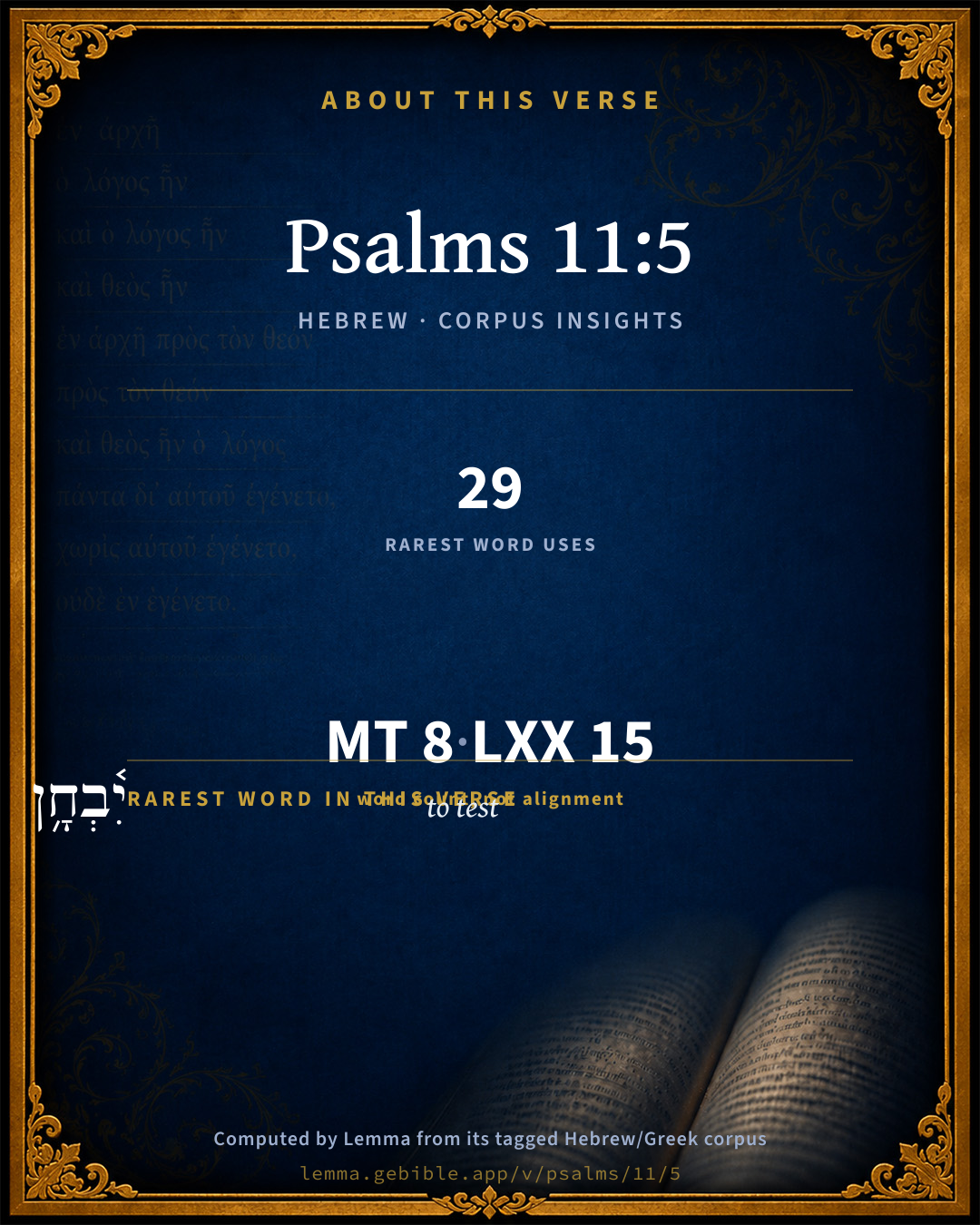
יִ֫בְחָ֥ן to test H974 occurs in 28 verses of the Hebrew Bible. Also found in:

Grammatical profile

  • 3 verbs
  • 3 nouns
  • 2 adjectives

Verb forms

  • יִ֫בְחָ֥ן Qal · Imperfect
  • וְאֹהֵ֣ב Qal · Participle Active
  • שָֽׂנְאָ֥ה Qal · Perfect

Hebrew & Septuagint length

In English translation the verse runs 15 words from the Hebrew and 29 from the Septuagint (LXX English) — closely comparable.

A rough comparison of the two English renderings, which tokenize alike — not a word-level alignment.

Word counts can differ between the Hebrew and the Greek without any difference in meaning — e.g. the Hebrew direct-object marker אֵת has no separate Greek word, and Greek often adds the article ὁ.

In the original languages it is 8 Hebrew tokens and 15 Greek tokens — but the two are counted differently (Hebrew bundles its prefixes and suffixes into one token; the Greek is in lemma form), so that isn’t a like-for-like length.

Cross-references

17

Topical passages linked to Psalms 11:5 in the Treasury of Scripture Knowledge — connected by theme and wording, ordered by reader-vote popularity; previews shown in the World English Bible.

  • Proverbs 6:16–19 There are six things which Yahweh hates; Yes, seven which are an abomination to him:
  • James 1:12 Blessed is the man who endures temptation, for when he has been approved, he will receive the crown of life, which the Lord promised to those who love him.
  • Psalms 7:9 Oh let the wickedness of the wicked come to an end, But establish the righteous; Their minds and hearts are searched by the righteous God.
  • Genesis 22:1 It happened after these things, that God tested Abraham, and said to him, "Abraham!" He said, "Here I am."
  • Psalms 5:4–5 For you are not a God who has pleasure in wickedness. Evil can't live with you.
  • Psalms 21:8 Your hand will find out all of your enemies. Your right hand will find out those who hate you.
  • Psalms 26:2 Examine me, Yahweh, and prove me. Try my heart and my mind.
  • 1 Peter 1:7 that the proof of your faith, which is more precious than gold that perishes even though it is tested by fire, may be found to result in praise, glory, and honor at the revelation of Jesus Christ--
  • Psalms 10:3 For the wicked boasts of his heart's cravings, He blesses the greedy, and condemns Yahweh.
  • Psalms 139:23–24 Search me, God, and know my heart. Try me, and know my thoughts.
  • 1 Peter 4:12 Beloved, don't be astonished at the fiery trial which has come upon you, to test you, as though a strange thing happened to you.
  • Psalms 17:3 You have proved my heart; you have visited me in the night; You have tried me, and found nothing; I have resolved that my mouth shall not disobey.
  • Psalms 139:1 Yahweh, you have searched me, And you know me.
  • Jeremiah 12:8 My heritage is become to me as a lion in the forest: she has uttered her voice against me; therefore I have hated her.
  • Zechariah 11:8 I cut off the three shepherds in one month; for my soul was weary of them, and their soul also loathed me.
  • Zechariah 13:9 I will bring the third part into the fire, And will refine them as silver is refined, And will test them like gold is tested. They will call on my name, and I will hear them. I will say, 'It is my people;' And they will say, 'Yahweh is my God.'"
  • Malachi 3:3 and he will sit as a refiner and purifier of silver, and he will purify the sons of Levi, and refine them as gold and silver; and they shall offer to Yahweh offerings in righteousness.

Cross-references courtesy of OpenBible.info (CC BY 4.0).

Hebrew and Greek witnesses Masoretic Hebrew ↔ Greek Septuagint

The same verse in the two great witnesses to the Old Testament, shown verse-for-verse.

You’re reading Greek Psalm 10 (Hebrew Psalm 11). The Septuagint counts the superscription, so verse numbers can differ from the Hebrew — chapter-level alignment, not verse-by-verse. Numbering follows Rahlfs.

These are two independent witnesses, not word-aligned to each other, and the Septuagint is shown in lemma (dictionary) form.

Hebrew Psalms 11:5 Masoretic · Westminster Leningrad Codex

יְהוָה֮ צַדִּ֪יק יִ֫בְחָ֥ן וְ֭רָשָׁע וְאֹהֵ֣ב חָמָ֑ס שָֽׂנְאָ֥ה נַפְשֽׁוֹ

Yahweh examines the righteous, But the wicked and him who loves violence his soul hates.

World English Bible · Public Domain

Greek LXX Greek Psalm 10:5 Septuagint · lemma form

κύριος ἐκἐτάζω ὁ δίκαιος καί ὁ ἀσεβής ὁ δέ ἀγαπάω ἀδικία μισέω ὁ ἑαυτοῦ ψυχή

The Lord is in his holy temple, as for the Lord, his throne is in heaven: his eyes look upon the poor, his eyelids try the sons of men.

LXX2012 (modern English Septuagint) · Public Domain

Hebrew: Westminster Leningrad Codex (CC BY 4.0). Greek: Septuagint (public domain); English from LXX2012 (modern English Septuagint) (Public Domain). How the Septuagint differs from the Hebrew →

Commentary

Notes on Psalms 11:5 from classic Christian and Jewish commentators (each source and its license shown beneath its notes). The classic Christian expositions comment on the surrounding passage and are grouped to its opening verse, so a note may address several verses; the Jewish commentaries on the Tanakh (Rashi and others) are per-verse, so they appear only where the commentator wrote on this verse.

Lemma curates 59 commentaries, every one of them public domain or Creative Commons licensed, each selected and text-cleaned for this edition rather than reprinted as found. About our sources →

Trapp's Complete Commentary

John Trapp

Psa 11:5 The LORD trieth the righteous: but the wicked and him that loveth violence his soul hateth.

Ver. 5. The Lord trieth the righteous] Or approveth, as Jas 1:12; he justifieth and accepteth him, as appeareth by the opposition here. The Vulgate rendereth it thus: Deus interrogat iustum et impium, sc. quia per interrogatoria veritas dignoscitur: The Lord interrogateth the just and the wicked, sc. that so he may sift out the truth of things. But neither doth the Hebrew word so signify, nor doth God need any such help.

His soul hateth] i.e. He can in no wise away with; and this is spoken of God after the manner of men, for fury, hatred, and the like affections are not in him. If it could be said of Trajan the emperor, that he neither feared nor hated any man, how much more of God! And if of the tribunal at Zante, much better of God’s throne:

Hic locus odit, amat, punit, conservat, honorat,

Nequitiam, pacem, crimina, iura, bonos.

John Trapp, A Commentary or Exposition upon All the Books of the Old and New Testament (1647–1656) — public domain. Text from a community e-Sword module.

The Biblical Illustrator

Joseph S. Exell

Psa_11:5

The Lord trieth the righteous.

The godly discipline

I. The characters tried--the righteous. This word righteous is used for two reasons.

1. Because in Gods sight they are such.

2. Because they are such in the sight of men.

II. The various ways in which the righteous are tried. They have their natural dispositions even as other men. Though trials come to all, they differ in character, and are proportioned in degree. Christians are tried when--

1. They are led to investigate the character and tendency of their life.

2. When special and direct afflictions are sent.

3. When alterations and changes in our family circumstances occur.

4. When temptations of a trying character are permitted to come in their way.

III. The ends that are to be answered by these trials. There is nothing purposeless in the plans of God. We are tried--

1. That we may be corrected.

2. That we may be proved.

3. That we may be purified.

Learn to recognise the Lords hand in our trials, and to distinguish between the results of our own folly and Gods chastisements. Let us rejoice in the anticipation of a world without sorrow, the unsuffering kingdom of our Lord. (W. G. Barrett.)

Trials and their lessons

David was living at the court of Saul, and many were plotting for his destruction. But his support was that God would permit no real harm to come to him, and that his trial was from God. They wanted David to flee away. They said, the foundations were broken up, and what could the righteous do? You never know what you can do when God helps you.

1. Believers are righteous--by the pardon of the past, which conceals it as if it had never been. Because God puts within them a new heart and a new spirit. And practically, by fulfilling Gods commandments.

2. Righteous people are tried. In one sense the probation of the wicked is over. Believing people are on trial. You have accepted mercy--and your trial is whether you will be faithful to the grace given, whether you will persevere to the end. The truth that there is a possibility of your falling away has its practical value. It ought to lead you to caution, vigilance, and self-denial.

3. It is the Lord who tries you. Then you will not be tried too much. The Lord has the control of all your trials, whether they come through prosperity, adversity, bereavements, persecutions, or the sufferings of others.

4. Why does the Lord try the righteous? That they may know themselves, to train and discipline character, to make us more useful, and to advance His own glory. It is Gods opportunity of showing the truth of His promise to help. You ought to learn to get good out of your trials. Glory in tribulations also, that the power of Christ may rest upon you. (Samuel Coley.)

The mission of trial

He tries them for their own good, that they may know themselves. He tries them for the good of others, that the world may learn how powerful a thing faith in God is, when it has once laid fast hold of His promises. It was for this purpose that He tested Abraham when He commanded him to offer up his son Isaac, with his own hand, a burnt offering unto the Lord. The trial taught Abraham--what he could never have known of himself without it--the character of true evangelical obedience, that it falters at no sacrifice known to be required by the will of God. It is these testing trials of the righteous that bring out their graces, develop and perfect their virtues. The hand of God is in them all, seeking higher praise for Himself, and working out a far more exceeding and eternal weight of glory for the believer. The Lord trieth the righteous; only, however, to consume their dross and refine their gold. The wicked have no just cause for triumphing over him, when they see the righteous man in affliction. The hand of God is thus upon him only for his good. His trials are no evidence that the fact is otherwise. The prosperity of the wicked is by no means indicative of the Divine approbation. (David Caldwell, A. M.)

The testing of the perfect

Pure gold may remain in the fire a thousand years without loss of substance, without contracting a single stain or losing an atom of its weight. The fire that burns the oak into ashes, marble into dust, iron into rust, has no power to destroy or even injure a metal that shines but the brighter for the glowing flame. Gold is therefore called in the language of metallurgy--a perfect metal; and were we perfect, perfect in holiness, the only effect of fiery trials would be, not to burn up, but to brighten Gods image. (Thomas Guthrie.)

The test of trial

The sword is not tested until the battle rages, the ship is not proved until the storm blows, even diamonds are now so wondrously imitated that the best judges can only tell them by putting the steel file to their facets--that does no mischief except to shams; the genuine fear nothing, fire only purifies the real gold. So trial will show the real value of Christian character. The general is best estimated in the battle, the skill of the physician in the sick room. (R. Venting.)

The Biblical Illustrator, edited by Joseph S. Exell (c. 1880s–1900s) — public domain. Text from a community e-Sword module.

Joseph Benson's Commentary

Psa 11:5. The Lord trieth the righteous — God may think fit to try the fidelity of him whom he knows to be upright, by many adversities, that he may afterward give him the more illustrious testimonies of his approbation and love, as well as that he may thereby correct the remaining imperfections of his character, may purge away his dross, and more thoroughly refine him for his Master’s use. But the wicked, &c., his soul hateth — Whatever success the wicked, and he that delights in doing mischief, may have for the present, it is certain God abhors his conduct, and, unless he repent, he will, without fail, severely punish him for abusing his power to oppression and violent dealing.

Joseph Benson's Commentary on the Old and New Testaments (1811–1818) — public domain. Text from a community e-Sword module.

J. A. Alexander on Psalms

Joseph Addison Alexander

5. (Psa 11:5) Jehovah the righteous will prove, will prove the righteous, and the wicked and the lover of violence his soul hates. The sentence might also be divided thus: Jehovah will prove the righteous and the wicked, and the lover of violence his soul hates. Different from both is the masoretic interpunction, which seems, however to be rather musical than grammatical or logical.—The divine proof or trial of the righteous implies favour and approval like the knowledge spoken of in Psa 1:6; but in neither case is it expressed. Violence, including the ideas of injustice and cruelty. See above, on Psa 7:17 (16). His soul has hated and still hates. This is not simply equivalent to he hates, but denotes a cordial hatred. Odit ex animo. He hates with all his heart.

Joseph Addison Alexander, The Psalms Translated and Explained (1850) — public domain. Text from a community e-Sword module.

Tyndale Open Study Notes

Tyndale Open Resources

11:5 hates: See 5:4-6; Prov 6:16-18. • Wicked deeds result in destruction and violence (Pss 58:2; 73:6; 74:20).

Tyndale Open Study Notes — © Tyndale Open Resources, licensed CC BY-SA 4.0. Text via the HelloAO Bible API.

Jamieson, Fausset & Brown

Robert Jamieson, A. R. Fausset & David Brown

The trial of the righteous results in their approval, as it is contrasted with God's hatred to the wicked.

Jamieson, Fausset & Brown — Commentary Critical and Explanatory on the Whole Bible (1871) — public domain (CC PDM 1.0). Text via the HelloAO Bible API.

Adam Clarke's Commentary

Verse 5. The Lord trieth the righteous] He does not abandon them; he tries them to show their faithfulness, and he afflicts them for their good.

His soul hateth.] The wicked man must ever be abhorred of the Lord; and the violent man-the destroyer and murderer-his soul hateth; an expression of uncommon strength and energy: all the perfections of the Divine nature have such in abomination.

Adam Clarke's Commentary on the Bible (1810–1826) — public domain. Text from a community e-Sword/MySword module.

The Cambridge Bible for Schools and Colleges

gen. ed. J. J. S. Perowne

5. Each half of the verse is to be completed from the other. God proves and approves the righteous: He proves and rejects the wicked.

trieth] Alloweth in P.B.V. means ‘approveth after trial.’ Cp. Rom_14:22; 1Th_2:4.

his soul hateth] Cp. Isa_1:14. God’s soul is a bold expression for His innermost, essential nature, which cannot do otherwise than hate evil, and of necessity also the evil man, in so far as he surrenders himself to ‘love violence,’ deliberately choosing evil for his good. Cp. Mic_3:2; Rom_1:32.

The Cambridge Bible for Schools and Colleges (gen. ed. J. J. S. Perowne; Cambridge University Press, 1878–1918) — public domain. Text from a community e-Sword module.

John Gill's Exposition

The Lord trieth the righteous,.... As gold is tried in the fire, by afflictive providences; hereby he tries their graces, their faith, and patience, their hope, and love, and fear; and, by so doing, expresses his love to them, since this is all for their good: and therefore, when he suffers the wicked to go great lengths in persecuting and distressing them, this should not weaken, their confidence in him; he still loves them, and loves when he rebukes and chastises them;

but the wicked, and him that loveth violence, his soul hateth; that is, such who live in a course of sin and wickedness, and who not only do injury to the persons, characters, and properties of men, but love it, and delight therein, and also take pleasure in them that do the same: these God has a continued and inward aversion to; sin and wickedness being the abominable thing his righteous soul hates: and he shows his hatred to them, by not chastising them now, as he does his own people, but reserving everlasting punishment for them hereafter; see Pro 13:24.

John Gill's Exposition of the Whole Bible (1746–1763) — public domain (CC PDM 1.0). Text via the HelloAO Bible API.

Albert Barnes' Notes on the Bible

The Lord trieth the righteous - That is, he “proves” them, searches them, tests the reality of their piety. His dealings with them are such as to test the genuineness of their religion, and are designed to show their sincerity and the real power of their religious principles. It is not for the purpose of destroying them, or punishing them, that he deals with them as he does, but it is to show the reality of their attachment to him. This language seems here to be used to show the feeling of the persecuted and afflicted author of the psalm. He understood the reason why these calamities were suffered to come upon him - to wit, as a trial of his faith; and therefore it was his duty to remain and bear these troubles, and not to attempt to escape from them by flight. He says, therefore, that these troubles in the case of the righteous were in strong contrast with the purpose of the divine dealings toward the wicked, on whom God would “rain” snares, fire, and brimstone. In their case his judgments were for the purpose of punishing and destroying; in the case of the righteous it was to “try” them, or to test the reality of their religion.

But the wicked - The wicked in general. All the wicked.

And him that loveth violence - Referring particularly here to those who were engaged in persecuting him who was the author of this psalm. They were contemplating acts of violence toward him Psa 11:2; he says that all such persons were the objects of the divine displeasure, and would be appropriately punished.

His soul hateth - that is, “he” hates. God is often spoken of in language appropriate to man; and he is here referred to as having a soul - as he is elsewhere as having eyes, hands, or feet. The meaning is, that all such persons were the objects of the divine abhorrence, and that the divine dealings with them were not, as with the righteous, to “try” them, but to “punish” and “destroy” them. Knowing this, the persecuted author of the psalm, instead of fleeing, calmly committed himself and his cause to God.

Albert Barnes' Notes on the Bible (1834–1885) — public domain. Text from a community e-Sword/MySword module.

Matthew Poole's English Annotations

The Lord trieth the righteous; either,

1. He examines them, and knows them to be righteous, and consequently approveth, and loveth, and will preserve and bless them; which may be gathered from the contrary condition of the wicked, whom God is supposed to try, though that be not expressed, and upon trial finds them to be wicked, and therefore hates and punisheth them, as it follows. The like ellipsis of a whole sentence, see on Psa 1:6. Or,

2. He trieth and exerciseth them and their graces by afflictions, or he corrects them for their sins; which is oft called trying, as Psa 66:10; Zec 13:9; Jam 1:12; 1Pe 4:12. So this is spoken by way of concession, and to remove the offence which some men might take at David, whose person and cause they might be apt to condemn because of his troubles. Therefore he saith, God tries, i.e. chastens, even righteous persons; yet still he loves them, and therefore will in due time deliver them. But as for the wicked, let not them rejoice in my trials, for far worse things are appointed for them; God hates them, and will severely punish them.

Him that loveth violence; by which character he describes and brands his enemies, and aggravates their malice, because they chose and practised violence against him, not for any need which they had of it, (for David was a most peaceable and harmless man, and neither pretended nor endeavoured to do any more than to defend himself, and that, as far as was possible, without the offence or injury of any other man,) but merely from their love to injustice and violence, and their implacable hatred against goodness and good men.

His soul hateth; he hateth with or from his soul, i.e. inwardly and ardently.

Matthew Poole's English Annotations on the Holy Bible (1683–1685) — public domain. Text from a community e-Sword/MySword module.

The Treasury of David

Charles H. Spurgeon

Ver. 5. The Lord trieth the righteous: he doth not hate them, but only tries them. They are precious to him, and therefore he refines them with afflictions. None of the Lord's children may hope to escape from trial, nor, indeed, in our right minds, would any of us desire to do so, for trial is the channel of many blessings.

"It is my happiness below

Not to live without the cross;

But the Saviour's power to know,

Sanctifying every loss."

"Trials make the promise sweet;

Trials give new life to prayer; Trials bring me to his feet

Lay me low, and keep me there."

"Did I meet no trials here

No chastisement by the way Might I not, with reason, fear

I should prove a cast away?"

"Bastards may escape the rod,

Sunk in earthly vain delight; But the true born child of God

Must not would not, if he might." William Cowper.

Is not this a very cogent reason why we should not distrustfully endeavour to shun a trial? for in so doing we are seeking to avoid a blessing.

Ver. 5. The Lord trieth the righteous. Except our sins, there is not such plenty of anything in all the world as there is of troubles which come from sin, as one heavy messenger came to Job after another. Since we are not in paradise, but in the wilderness, we must look for one trouble after another. As a bear came to David after a lion, and a giant after a bear, and a king after a giant, and Philistines after a king, so, when believers have fought with poverty, they shall fight with envy; when they have fought with envy, they shall fight with infamy; when the have fought with infamy, they shall fight with sickness; they shall be like a labourer who is never out of work. Henry Smith.

Ver. 5. The Lord trieth the righteous. Times of affliction and persecution will distinguish the precious from the vile, it will difference the counterfeit professor from the true. Persecution is a Christian's touchstone, it is a lapis lydius that will try what metal men are made of, whether they be silver or tin, gold or dross, wheat or chaff, shadow or substance, carnal or spiritual, sincere or hypocritical. Nothing speaks out more soundness and uprightness than a pursuing after holiness, even then when holiness is most afflicted, pursued, and persecuted in the world: to stand fast in fiery trials argues much integrity within. Thomas Brooks.

Ver. 5. Note the singular opposition of the two sentences. God hates the wicked, and therefore in contrast he loves the righteous; but it is here said that he tries them: therefore it follows that to try and to love are with God the same thing. C.H.S.

Ver. 5. The Lord trieth the righteous.

1. Who are tried?

2. What in them is tried? Faith, love, etc.

3. In what manner? Trials of every sort.

4. How long?

5. For what purpose?

Ver. 5. His soul hateth. The thoroughness of God's hatred of sin. Illustrate by providential judgments, threatenings, sufferings of the Surety, and the terrors of hell.

Ver. 5. The trying of the gold, and the sweeping out of the refuse.

Charles H. Spurgeon's The Treasury of David (1869–1885) — public domain. Psalms only. Text from a community e-Sword/MySword module.

Whedon's Commentary on the Bible

Daniel D. Whedon

5. Trieth the righteous—An early and fundamental Hebrew doctrine. The trials of the righteous are not punishments for sin, but fatherly and corrective chastisements for their profit. Heb_12:6-8.

But the wicked—Very different are the judgments of God upon the “wicked,” whom he treats as violators of his laws. See on Psa_7:11-13

Daniel D. Whedon (gen. ed.), Commentary on the Old and New Testaments (1874–1909) — public domain. Text from a community e-Sword module.

The Pulpit Commentary

The Lord trieth the righteous. God tries the righteous, scrutinizing them with his penetrating glance, but a glance wherein there is protection and love. When he tries (or closely scrutinizes) the wicked, the result is different the wicked and him that loveth violence his soul hateth.

The Pulpit Commentary (1880–1919), ed. H.D.M. Spence-Jones & Joseph S. Exell — public domain. Text from a community e-Sword module.

John Wesley's Explanatory Notes

Trieth - He chastens even righteous persons, yet still he loves them, and therefore will in due time deliver them. But as for the wicked, God hates them, and will severely punish them.

John Wesley, Explanatory Notes Upon the Whole Bible (1754–1765) — public domain. Text via the GEBible commentary corpus.

unfoldingWord translationNotes

Door43 World Missions Community

Yahweh examines

"Yahweh watches carefully"

do violence

"hurt others"

He rains burning coals and brimstone upon the wicked; a scorching wind will be their portion from his cup!

God's punishment is described as if it were burning coals and brimstone from a volcano. AT: "He punishes the wicked; there will be no relief for them!" (See: Metaphor)

brimstone

sulphur

see his face

"be in his presence"

translationWords

evil

love

face

unfoldingWord translationNotes — © Distant Shores Media and the Door43 World Missions Community, licensed CC BY-SA 4.0. Source: git.door43.org/Door43/en_tn.

Rashi

Rabbi Shlomo Yitzchaki (Rashi)

The Lord tries the righteous And if, because I suffer and am pursued by you, you boast, saying (below 71:11), “God has forsaken him,” it is not so, but so is the custom of the Holy One, blessed be He, to chasten and to test the righteous but not the wicked. This flax worker as long as he knows that his flax is of high quality, he beats it, but when it is not of high quality, he crushes it only a little because it breaks.

His soul hates He lays away the recompense for his iniquities for the “long world,” and then He showers [punishment] upon them [sic] in Gehinnom.

Rashi on the Tanakh — English translations: “The Judaica Press complete Tanach with Rashi, translated by A. J. Rosenberg” (CC BY 4.0); “Pentateuch with Rashi's commentary by M. Rosenbaum and A.M. Silbermann, 1929-1934” (public domain); “The Metsudah Tanach series, Lakewood, N.J” (CC BY 4.0); and “The Book of Joshua, Metsudah Publications, 1997” (CC BY 4.0). Text via Sefaria.

Lesson kit

Teaching starters — assembled from the data on this page, not authored interpretation. Every prompt links to the verse data it draws on. Edit before teaching.

Psalms, in the Wisdom, opens this verse with 8 words (8 distinct Hebrew lemmas). Its most distinctive word is bâchan (“to test”). A historical commentator’s framing appears above. Read the whole chapter for the surrounding context.

Discussion questions

  1. What does “to test” (bâchan) contribute to the verse as a whole?
  2. How does Genesis 42:15, which shares the word «to test», read alongside this verse?
  3. The translations on this page render this verse differently — a whole-verse word diff, not a word-by-word alignment. What might account for the different wordings?
  4. «יִ֫בְחָ֥ן» is a Qal Imperfect verb. How does that grammatical form shape the action described?
  5. Compare how Trapp's Complete Commentary and The Biblical Illustrator read this verse. Where do they agree or differ?

Things to notice

Reading settings

Reading text

Shown beneath each verse's original-language words.

Old Testament
Old Testament edition

Read the OT as the Masoretic Hebrew (MT) or the Greek Septuagint (LXX).

English shown for the Greek Septuagint (in the Hebrew ↔ Greek comparison).

Comparing translations? Open the Compare panel on any verse page to stack up to four side by side.