Ezekiel 7:21

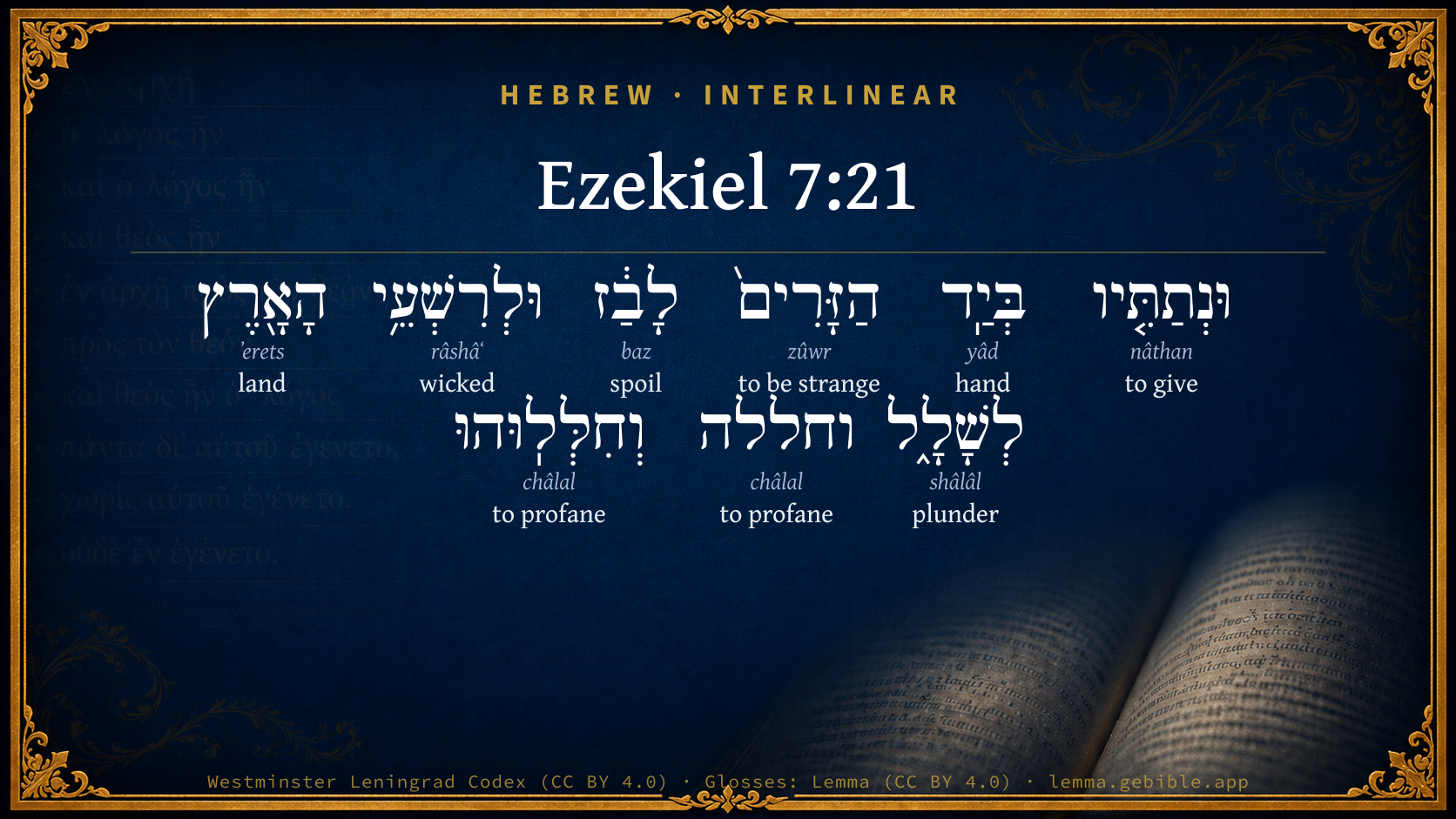
Hebrew (Westminster Leningrad Codex) Ezekiel 7:21 appears in the Hebrew Old Testament. The text above is from the Westminster Leningrad Codex. Each word links to its Strong’s number, a concise gloss, and parsing drawn from the Open Scriptures Hebrew Bible morphology. Click any word for its full Brown-Driver-Briggs (BDB) entry.
Download image
Cite this verse

Ezekiel 7:21 (World English Bible). Public Domain. Lemma interlinear Bible study tool, https://lemma.gebible.app/v/ezekiel/7/21.

Show BibTeX & RIS
BibTeX
RIS
English Translation
I will give it into the hands of the strangers for a prey, and to the wicked of the earth for a spoil; and they shall profane it.
World English Bible · Public Domain
Download a study sheet

One document with this verse’s original text, its word-by-word gloss line, the meaning frame, cross-references with their text, attributed commentary, and full source and license credits — printable, and it pastes into notes with its structure intact.

This verse Autodidact and up

Study sheet (.html) Plain text (.txt)

A passage Seminary Student

Up to 50 verses in one chapter. A passage sheet keeps up to 6 commentary sources and 12 cross-references per verse, in the order this page ranks them, and says so on the sheet whenever that leaves anything out. Ask for a single verse and you get the Autodidact verse sheet above.

Everything on this page stays free to read, with no account — the sheet is a download of what is already on screen, not access to it.

Want to remove ads? Support Godless Engineer
Compare translations 3

The same verse in 3 English versions, stacked beneath the original-language interlinear above. Click any original word for its lexicon entry.

Each is an independent rendering of the whole verse — the interlinear is not word-aligned to these translations.

Highlighted words mark where these versions differ — a whole-verse word diff, not a word-by-word alignment.

  • World English Bible Public Domain
    I will give it into the hands of the strangers for a prey, and to the wicked of the earth for a spoil; and they shall profane it.
  • King James Version Public Domain
    And I will give it into the hands of the strangers for a prey, and to the wicked of the earth for a spoil; and they shall pollute it.
  • unfoldingWord Literal Text CC BY-SA 4.0
    Then I will give those things into the hand of strangers as plunder and to the wicked of the earth as plunder, and they will defile them.

unfoldingWord Literal Text — © unfoldingWord, licensed CC BY-SA 4.0. Word-aligned USFM3 via Door43 (git.door43.org/unfoldingWord/en_ult).

Versions to compare (up to 4)

3 of 4 selected

Show all 18 translations

Every available English version of this verse, each an independent rendering of the whole verse.

  • World English Bible Public Domain
    I will give it into the hands of the strangers for a prey, and to the wicked of the earth for a spoil; and they shall profane it.
  • Berean Standard Bible Public Domain
    And I will hand these things over as plunder to foreigners and loot to the wicked of the earth, who will defile them.
  • Majority Standard Bible Public Domain
    And I will hand these things over as plunder to foreigners and loot to the wicked of the earth, who will defile them.
  • King James Version Public Domain
    And I will give it into the hands of the strangers for a prey, and to the wicked of the earth for a spoil; and they shall pollute it.
  • American Standard Version (1901) Public Domain
    And I will give it into the hands of the strangers for a prey, and to the wicked of the earth for a spoil; and they shall profane it.
  • Revised Version (1885) Public Domain
    And I will give it into the hands of the strangers for a prey, and to the wicked of the earth for a spoil; and they shall profane it.
  • Geneva Bible (1599) Public Domain
    And I will giue it into the handes of the strangers to be spoyled, and to the wicked of the earth to be robbed, and they shall pollute it.
  • Douay-Rheims (1899) Public Domain
    And I will give it into the hands of strangers for spoil, and to the wicked of the earth for a prey, and they shall defile it.
  • Young's Literal Translation Public Domain
    And I have given it into the hand of the strangers for a prey, And to the wicked of the land for a spoil, And they have polluted it.
  • Literal Standard Version CC BY-SA 4.0
    And I have given it into the hand of the strangers for a prey, || And to the wicked of the land for a spoil, || And they have defiled it.
  • Unlocked Literal Bible CC BY-SA 4.0
    Then I will give those things into the hand of strangers as plunder and to the wicked of the earth as plunder, and they will defile them.
  • unfoldingWord Literal Text CC BY-SA 4.0
    Then I will give those things into the hand of strangers as plunder and to the wicked of the earth as plunder, and they will defile them.
  • Darby Bible Public Domain
    And I will give it into the hands of strangers for a prey, and to the wicked of the earth for a spoil; and they shall profane it.
  • World Messianic Bible Public Domain
    I will give it into the hands of the strangers for a prey, and to the wicked of the earth for a plunder; and they will profane it.
  • Webster's Bible Public Domain
    And I will give it into the hands of the strangers for a prey, and to the wicked of the earth for a spoil; and they shall pollute it.
  • Free Bible Version CC BY-SA 4.0
    I'm going to hand these things over as plunder to foreigners and as loot to the wicked people of the earth, who will make them unclean.
  • Bible in Basic English Public Domain
    And I will give it into the hands of men from strange lands who will take it by force, and to the evil-doers of the earth to have for themselves; and they will make it unholy.
  • JPS Tanakh (1917) Public Domain
    And I will give it into the hands of the strangers for a prey, and to the wicked of the earth for a spoil; and they shall profane it.

Literal Standard Version (2020), Covenant Press — licensed CC BY-SA 4.0. Text via the HelloAO Bible API (eBible.org). Unlocked Literal Bible (unfoldingWord) — licensed CC BY-SA 4.0. Text via the HelloAO Bible API (eBible.org). unfoldingWord Literal Text — © unfoldingWord, licensed CC BY-SA 4.0. Word-aligned USFM3 via Door43 (git.door43.org/unfoldingWord/en_ult). Free Bible Version, Dr. Jonathan Gallagher — licensed CC BY-SA 4.0. Text via the HelloAO Bible API (eBible.org).

Word by word

More ways to search: Search by grammar → Find every occurrence → Compare this word →

Practice this passage: Drill this verse → Learn its vocabulary →

לָבַ֔ז
baz
H957
“to/for · spoil”
Preposition + Noun, Common, Masculine, Singular, Absolute
Part of Speech
Preposition + Noun
Type
Common
Gender
Masculine
Number
Singular
State
Absolute
Full BDB Definition

Origin: from H962

TWOT: 225a

spoil, booty, robbery, spoiling
  1. וּנְתַתִּ֤יו nâthan H5414 “and · to give · him” Conjunction + Verb, Qal, Sequential Perfect, 1st Person, Common, Singular + Suffix, Personal, 3rd Person, Masculine, Singular
  2. בְּיַֽד yâd H3027 “in/at · hand of” Preposition + Noun, Common, Both, Singular, Construct
  3. הַזָּרִים֙ zûwr H2114 “the · strange” Particle, Definite Article + Adjective, Adjective, Masculine, Plural, Absolute
  4. וּלְרִשְׁעֵ֥י râshâʻ H7563 “and · to/for · wicked of” Conjunction + Preposition + Adjective, Adjective, Masculine, Plural, Construct
  5. הָאָ֖רֶץ ʼerets H776 “the · land” Particle, Definite Article + Noun, Common, Both, Singular, Absolute
  6. לְשָׁלָ֑ל shâlâl H7998 “to/for · plunder” Preposition + Noun, Common, Masculine, Singular, Absolute
  7. וחללה châlal H2490 “and · to profane · her” Conjunction + Verb, Piel, Sequential Perfect, 3rd Person, Masculine, Singular + Suffix, Personal, 3rd Person, Feminine, Singular
  8. וְחִלְּלֽוּהוּ châlal H2490 “and · to profane · him” Conjunction + Verb, Piel, Sequential Perfect, 3rd Person, Common, Plural + Suffix, Personal, 3rd Person, Masculine, Singular

About this verse

These counts appear in no published source. They are computed here, from the morphology-tagged text and Lemma’s own curated glosses. What Lemma adds →

9
words
8
distinct lemmas
Prophets
section

Notable vocabulary

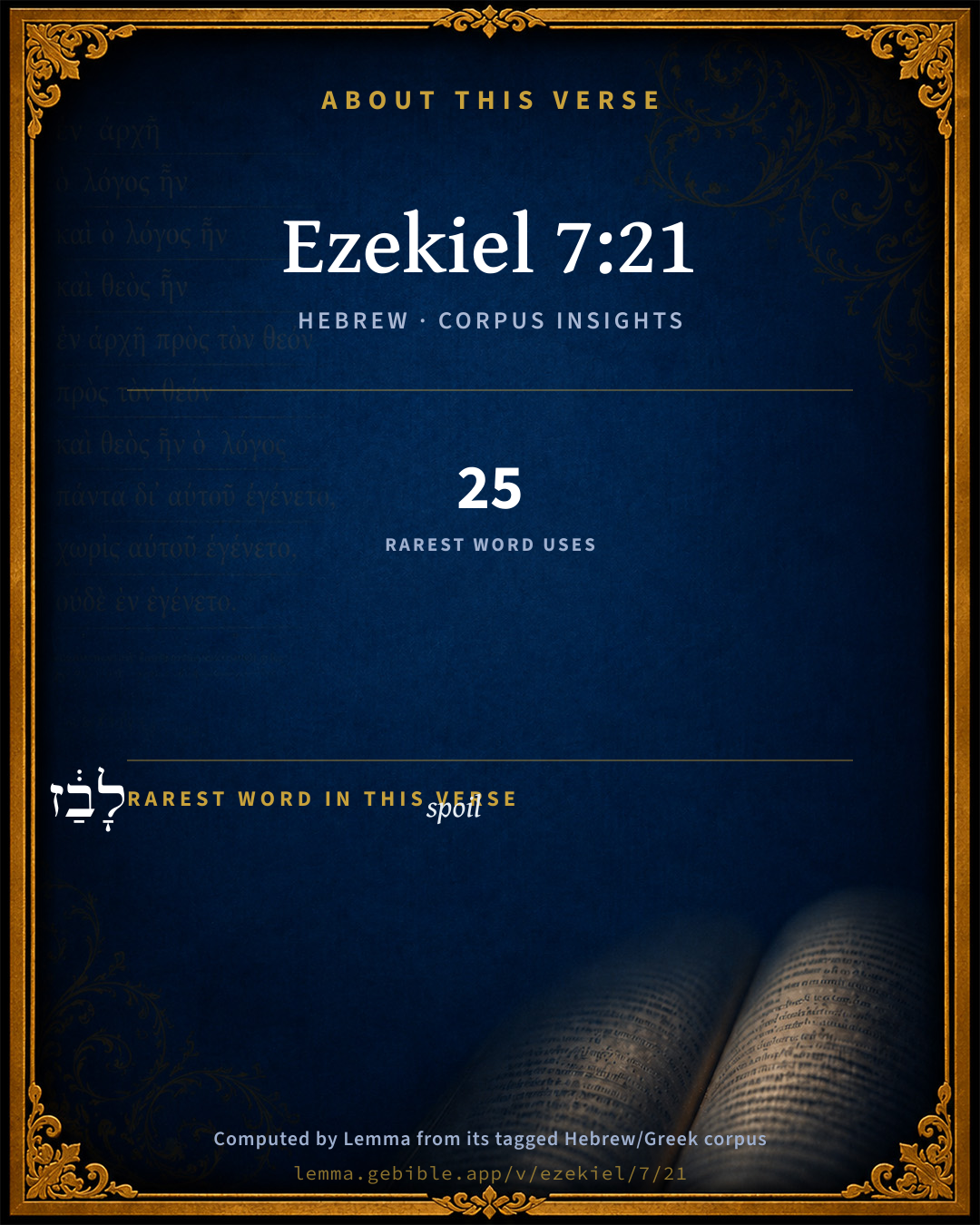
The rarest word here is לָבַ֔ז spoil H957 — appearing just 25 times in the whole Hebrew Bible.

Shared distinctive vocabulary

לָבַ֔ז spoil H957 occurs in 25 verses of the Hebrew Bible. Also found in:

Grammatical profile

  • 3 verbs
  • 4 nouns
  • 2 adjectives

Verb forms

  • וּנְתַתִּ֤יו Qal · Sequential Perfect
  • וחללה Piel · Sequential Perfect
  • וְחִלְּלֽוּהוּ Piel · Sequential Perfect

Repetition

A word recurs within this verse — often emphatic in Hebrew:

  • וחללה to profane H2490 ×2

Hebrew & Septuagint length

In English translation the verse runs 28 words from the Hebrew and 30 from the Septuagint (LXX English) — closely comparable.

A rough comparison of the two English renderings, which tokenize alike — not a word-level alignment.

Word counts can differ between the Hebrew and the Greek without any difference in meaning — e.g. the Hebrew direct-object marker אֵת has no separate Greek word, and Greek often adds the article ὁ.

Cross-references

7

Topical passages linked to Ezekiel 7:21 in the Treasury of Scripture Knowledge — connected by theme and wording, ordered by reader-vote popularity; previews shown in the World English Bible.

  • 2 Kings 24:13 He carried out there all the treasures of the house of Yahweh, and the treasures of the king's house, and cut in pieces all the vessels of gold, which Solomon king of Israel had made in the temple of Yahweh, as Yahweh had said.
  • Psalms 74:2–8 Remember your congregation, which you purchased of old, Which you have redeemed to be the tribe of your inheritance; Mount Zion, in which you have lived.
  • 2 Kings 25:9 He burnt the house of Yahweh, and the king's house; and all the houses of Jerusalem, even every great house, burnt he with fire.
  • 2 Kings 25:13–16 The pillars of brass that were in the house of Yahweh, and the bases and the brazen sea that were in the house of Yahweh, did the Chaldeans break in pieces, and carried the brass of them to Babylon.
  • 2 Chronicles 36:18–19 All the vessels of the house of God, great and small, and the treasures of the house of Yahweh, and the treasures of the king, and of his princes, all these he brought to Babylon.
  • Psalms 79:1 God, the nations have come into your inheritance. They have defiled your holy temple. They have laid Jerusalem in heaps.
  • Jeremiah 52:13–23 and he burned the house of Yahweh, and the king's house; and all the houses of Jerusalem, even every great house, burned he with fire.

Cross-references courtesy of OpenBible.info (CC BY 4.0).

Hebrew and Greek witnesses Masoretic Hebrew ↔ Greek Septuagint

The same verse in the two great witnesses to the Old Testament, shown verse-for-verse.

These are two independent witnesses, not word-aligned to each other, and the Septuagint is shown in lemma (dictionary) form.

Hebrew Ezekiel 7:21 Masoretic · Westminster Leningrad Codex

וּנְתַתִּ֤יו בְּיַֽד הַזָּרִים֙ לָבַ֔ז וּלְרִשְׁעֵ֥י הָאָ֖רֶץ לְשָׁלָ֑ל וחללה וְחִלְּלֽוּהוּ

I will give it into the hands of the strangers for a prey, and to the wicked of the earth for a spoil; and they shall profane it.

World English Bible · Public Domain

Greek LXX Ezekiel 7:21 Septuagint · lemma form

καί παραδίδωμι αὐτός εἰς χείρ ἀλλότριος ὁ διαἁρπάζω αὐτός καί ὁ λοιμός ὁ γῆ εἰς σκῦλον καί βεβηλόω αὐτός

And I will deliver them into the hands of strangers to make them a prey, and to the pests of the earth for a spoil; and they shall profane them.

LXX2012 (modern English Septuagint) · Public Domain

Hebrew: Westminster Leningrad Codex (CC BY 4.0). Greek: Septuagint (public domain); English from LXX2012 (modern English Septuagint) (Public Domain). How the Septuagint differs from the Hebrew →

Targum (Aramaic paraphrase)

1

The Targum is the ancient Jewish Aramaic paraphrase of the Hebrew Scriptures — an interpretive translation, not the Hebrew text itself. Onkelos (literal) and Pseudo-Jonathan (expansive) render the Torah, and Jonathan the Prophets. Coverage is partial: where no permissively-licensed English translation exists for a verse, only the Aramaic is shown. This is verse-level text, not a word-by-word alignment to the Hebrew.

  1. Targum Jonathan Prophets (Joshua–Malachi)
    וְאֶמְסְרִנֵיהּ בְּיַד רַשִׁיעִין לְמִבַז וּלְחַיָבֵי אַרְעָא לַעֲדִי וְיַחֲלוּנֵיהּ:

    (no public-domain English translation for this verse)

    Targum Jonathan — Aramaic: “Mikraot Gedolot” (public domain). English: “Sefaria Community Translation” (CC0 1.0 (public-domain dedication)); “London "Chaldee Paraphrase," 1871” (public domain). Text via Sefaria.

Commentary

Notes on Ezekiel 7:21 from classic Christian and Jewish commentators (each source and its license shown beneath its notes). The classic Christian expositions comment on the surrounding passage and are grouped to its opening verse, so a note may address several verses; the Jewish commentaries on the Tanakh (Rashi and others) are per-verse, so they appear only where the commentator wrote on this verse.

Lemma curates 59 commentaries, every one of them public domain or Creative Commons licensed, each selected and text-cleaned for this edition rather than reprinted as found. About our sources →

Trapp's Complete Commentary

John Trapp

Eze 7:21 And I will give it into the hands of the strangers for a prey, and to the wicked of the earth for a spoil; and they shall pollute it.

Ver. 21. And I will give it into the hands.] So he did the pleasant land to be plundered, the sanctuary also to be rifled and ransacked by the Babylonians, Syrians, Romans, &c. See Lam 1:10, {See Trapp on "Lam 1:10"}

And to the wicked of the earth.] Sept., To the pests of the earth.

John Trapp, A Commentary or Exposition upon All the Books of the Old and New Testament (1647–1656) — public domain. Text from a community e-Sword module.

Geneva Bible (1599)

Geneva Bible translators

That is, of the Babylonians.

Geneva Bible (1599) marginal notes — public domain. Text via Bolls.life.

Jamieson, Fausset & Brown

Robert Jamieson, A. R. Fausset & David Brown

strangers--barbarous and savage nations.

Jamieson, Fausset & Brown — Commentary Critical and Explanatory on the Whole Bible (1871) — public domain (CC PDM 1.0). Text via the HelloAO Bible API.

John Calvin's Commentaries

I have said that I do not approve of twisting these words to the sanctuary, as some interpreters do. Hence I do not doubt that the Prophet still speaks of the people. He changed indeed the number in the former verse, for at the beginning he had used the singular number: now he returns again to the singular number, and designates the people. I will deliver it, says he, into the hand of strangers. This was more severe than if they had been oppressed by any domestic tyranny: nor do I doubt that by strangers the Prophet signifies remote and barbarous nations, as we know that those with whom we have no communication are more savage against us. First, therefore, he says, they shall be the slaves of strangers; he adds, the impious of the earth: he means that their enemies should be so cruel and wicked, that no pity or equity was to be expected from them. The sum is, that God’s wrath would be terrible since he had borne the iniquities of the people so long. Hence we gather that wicked and abandoned men are God’s scourges, and are governed by his will and hand. Since it is so, we gather that God so works by them that he is pure from all alliance with their faults, because he so exercises his judgments by means of them, that he appears without blame with regard to them; but they are condemned deservedly, because either their own avarice or ambition, or other lusts destroy them. I shall give them therefore into the hands of strangers to destroy them: then, to the wicked of the earth for a prey, and they shall profane them By this word interpreters have been induced to take this verse with reference to the sanctuary. But we know that חלל, chelel, is taken in another sense — to slay. This word therefore may be explained, that there shall be a general slaughter of the people: because the enemies not content with the booty and spoil, shall also slay the captives when they have obtained the victory. But I willingly retain the sense “profane,” which means the same as “render vile,” because the Prophet seems to me to allude to all kinds of abuse, as when we do not consider for what purpose things are intended, but rashly and thoughtlessly, contemptuously, and even insultingly dissipate them. It means therefore that such should be the insolence of their enemies, that they should waste and lay in ruins not only the people’s substance, but also their persons: although this may be here referred to the substance itself: for a robber is said to prey upon a man when he takes away whatever he has and leaves him naked: in this sense we may conveniently explain what the Prophet now says. But that simple explanation satisfies me, namely, that the enemy shall so disperse the people generally, that there shall be no difference. It follows —

John Calvin's Commentaries (1540-1563) — public domain. Text from the Calvin Translation Society English edition (1840s-50s) via the Christian Classics Ethereal Library (ccel.org). Calvin's coverage is partial (roughly two-thirds of the Bible); uncommented books and verses are honest gaps, never fabricated. The 19th-century editor's footnotes and remarks are omitted so the notes are faithfully Calvin's own voice.

The Cambridge Bible for Schools and Colleges

gen. ed. J. J. S. Perowne

21. Because of this abuse of their silver and gold in making it into idols it shall become the prey of the Chaldeans, who shall profane it, turning it from a sacred to a common use. In a certain sense all that was in Israel was sacred, and the mere fact of the heathen taking possession of it profaned it. Hos_10:6, It (the calf) shall be carried unto Assyria for a present to king Jareb; cf. Isa_46:1-2; Mic_1:7.

The Cambridge Bible for Schools and Colleges (gen. ed. J. J. S. Perowne; Cambridge University Press, 1878–1918) — public domain. Text from a community e-Sword module.

John Gill's Exposition

My face will one turn also from them,.... Deny them his presence, and withdraw his protection from them; show them no favour, nor afford them any help and succour in their distress, when they cry unto him; so the Targum,

"I will cause my Shechinah to remove from them:''

unless the Chaldeans are meant, as some think, whose robberies and ravages the Lord would wink at, and not restrain, but suffer them to plunder and spoil at pleasure: since it follows,

and they shall pollute my secret place; the holy of holies, by going into it, which none but the high priest might do, and he but once a year; though the Targum understands this of the Jews, and makes it to be a reason of what is threatened in the preceding clause, rendering it thus,

"because they have profaned the land of the house of my Shechinah:''

for the robbers shall enter into it, and defile it; as did the king of Babylon and his army; and afterwards, in the second temple, Antiochus, Pompey, and Titus Vespasian.

John Gill's Exposition of the Whole Bible (1746–1763) — public domain (CC PDM 1.0). Text via the HelloAO Bible API.

Matthew Poole's English Annotations

I will give it, my temple,

into the hands, power and possession,

of the strangers, foreigners, who by direction of my law were excluded coming to it, they now shall enter into it, and take the riches of it as lawful prey.

To the wicked: this description of these men, strangers by their distance of place, and the worst of men on earth, by their proud, cruel, and fierce disposition.

Pollute it; enter, spoil, tear down, and use the temple as a vile place, and make no difference between this and other places. This I think the proper sense; some say the text speaks of the rich idols which the idolaters accounted most holy, and on which they laid out their treasure, and which now the Chaldeans should plunder and pollute.

Matthew Poole's English Annotations on the Holy Bible (1683–1685) — public domain. Text from a community e-Sword/MySword module.

Whedon's Commentary on the Bible

Daniel D. Whedon

21. These golden gods, upon which they have depended for help, will be captured by the enemy and the vessels of sacrifice will be turned to base uses (Mic_1:7; Hos_10:6).

Daniel D. Whedon (gen. ed.), Commentary on the Old and New Testaments (1874–1909) — public domain. Text from a community e-Sword module.

The Pulpit Commentary

I will give it. The "it" refers to the silver and gold, the "beauty of the ornaments" thus desecrated in their use. The strangers, i.e. the Chaldean invaders, should in their turn pollute (better, with the Revised Version, profane it) by making it their prey. For them the idols which Israel had worshipped would be simply as booty to be plundered.

The Pulpit Commentary (1880–1919), ed. H.D.M. Spence-Jones & Joseph S. Exell — public domain. Text from a community e-Sword module.

John Wesley's Explanatory Notes

It - My temple.

John Wesley, Explanatory Notes Upon the Whole Bible (1754–1765) — public domain. Text via the GEBible commentary corpus.

Lesson kit

Teaching starters — assembled from the data on this page, not authored interpretation. Every prompt links to the verse data it draws on. Edit before teaching.

Ezekiel, in the Prophets, opens this verse with 9 words (8 distinct Hebrew lemmas). Its most distinctive word is baz (“spoil”). A historical commentator’s framing appears above. Read the whole chapter for the surrounding context.

Discussion questions

  1. How does “spoil” (baz) shape what this verse is saying?
  2. How does Numbers 14:3, which shares the word «spoil», read alongside this verse?
  3. What does the repetition of “to profane” (2× in this one verse) do in this verse?
  4. These translations render this verse differently; the difference is in the English rendering, not the original. What questions does that raise?
  5. «וּנְתַתִּ֤יו» is a Qal Sequential Perfect verb. How does that grammatical form shape the action described?
  6. Compare how Trapp's Complete Commentary and Geneva Bible (1599) read this verse. Where do they agree or differ?

Things to notice

  • These translations choose different wording for 10 words in this verse.
  • “to profane” occurs 2× in this single verse.
  • 8 distinct Hebrew lemmas span 9 words in this verse.

Reading settings

Reading text

Shown beneath each verse's original-language words.

Old Testament
Old Testament edition

Read the OT as the Masoretic Hebrew (MT) or the Greek Septuagint (LXX).

English shown for the Greek Septuagint (in the Hebrew ↔ Greek comparison).

Comparing translations? Open the Compare panel on any verse page to stack up to four side by side.