
Psalms 75:4

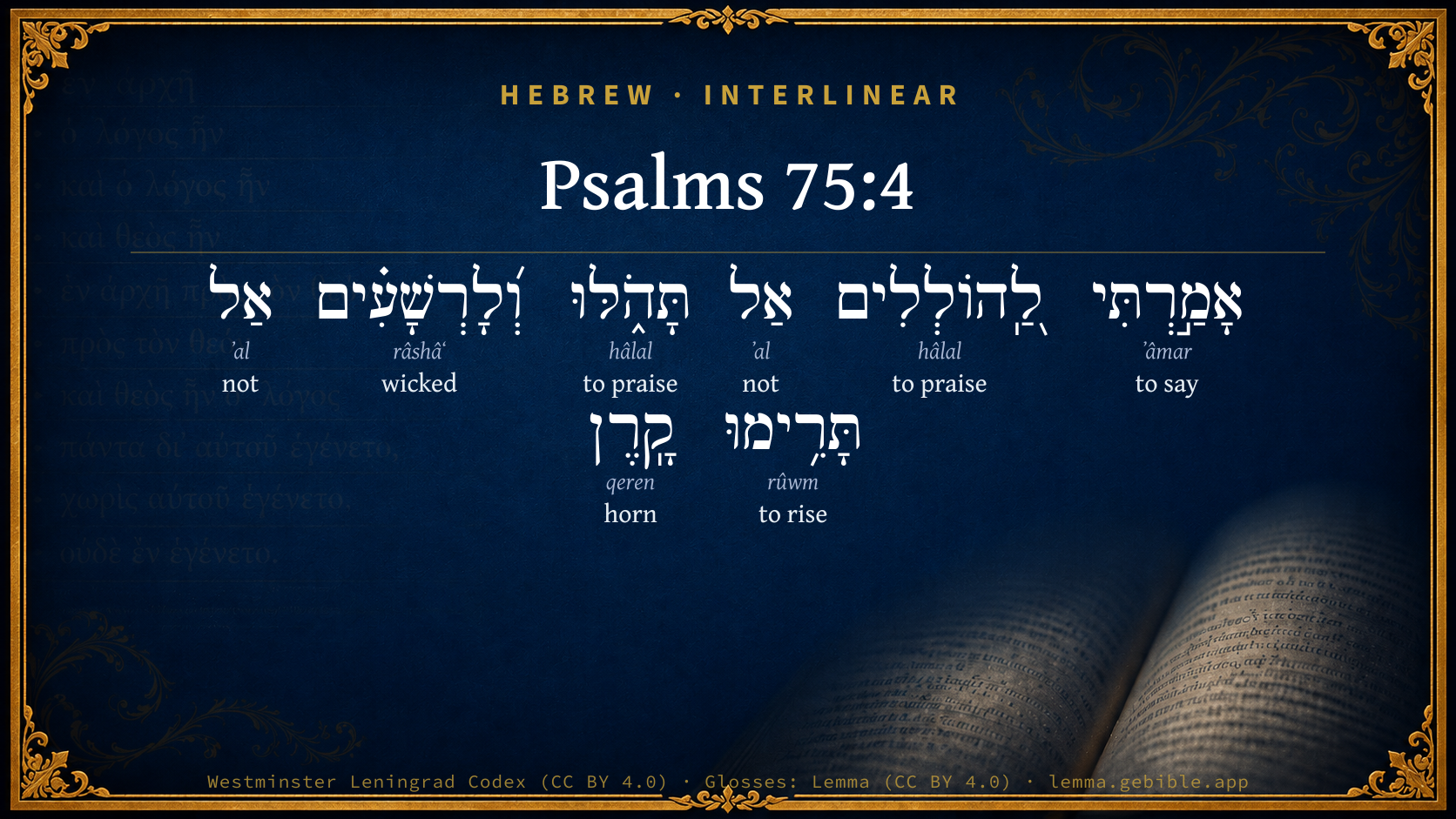
Hebrew (Westminster Leningrad Codex) Psalms 75:4 appears in the Hebrew Old Testament. The text above is from the Westminster Leningrad Codex. Each word links to its Strong’s number, a concise gloss, and parsing drawn from the Open Scriptures Hebrew Bible morphology. Click any word for its full Brown-Driver-Briggs (BDB) entry.
Download image
Cite this verse

Psalms 75:4 (World English Bible). Public Domain. Lemma interlinear Bible study tool, https://lemma.gebible.app/v/psalms/75/4.

Show BibTeX & RIS
BibTeX
RIS
English Translation
I said to the arrogant, "Don't boast;" To the wicked, "Don't lift up the horn.
World English Bible · Public Domain
Download a study sheet

One document with this verse’s original text, its word-by-word gloss line, the meaning frame, cross-references with their text, attributed commentary, and full source and license credits — printable, and it pastes into notes with its structure intact.

This verse Autodidact and up

Study sheet (.html) Plain text (.txt)

A passage Seminary Student

Up to 50 verses in one chapter. A passage sheet keeps up to 6 commentary sources and 12 cross-references per verse, in the order this page ranks them, and says so on the sheet whenever that leaves anything out. Ask for a single verse and you get the Autodidact verse sheet above.

Everything on this page stays free to read, with no account — the sheet is a download of what is already on screen, not access to it.

Want to remove ads? Support Godless Engineer
Compare translations 3

The same verse in 3 English versions, stacked beneath the original-language interlinear above. Click any original word for its lexicon entry.

Each is an independent rendering of the whole verse — the interlinear is not word-aligned to these translations.

Highlighted words mark where these versions differ — a whole-verse word diff, not a word-by-word alignment.

  • World English Bible Public Domain
    I said to the arrogant, "Don't boast;" To the wicked, "Don't lift up the horn.
  • King James Version Public Domain
    I said unto the fools, Deal not foolishly: and to the wicked, Lift not up the horn:
  • unfoldingWord Literal Text CC BY-SA 4.0
    I said to the boasters, “Do not boast,” and to the wicked, “Do not lift up a horn.

unfoldingWord Literal Text — © unfoldingWord, licensed CC BY-SA 4.0. Word-aligned USFM3 via Door43 (git.door43.org/unfoldingWord/en_ult).

Versions to compare (up to 4)

3 of 4 selected

Show all 18 translations

Every available English version of this verse, each an independent rendering of the whole verse.

  • World English Bible Public Domain
    I said to the arrogant, "Don't boast;" To the wicked, "Don't lift up the horn.
  • Berean Standard Bible Public Domain
    I say to the proud, ‘Do not boast,’ and to the wicked, ‘Do not lift up your horn.
  • Majority Standard Bible Public Domain
    I say to the proud, ‘Do not boast,’ and to the wicked, ‘Do not lift up your horn.
  • King James Version Public Domain
    I said unto the fools, Deal not foolishly: and to the wicked, Lift not up the horn:
  • American Standard Version (1901) Public Domain
    I said unto the arrogant, Deal not arrogantly; And to the wicked, Lift not up the horn:
  • Revised Version (1885) Public Domain
    I said unto the arrogant, Deal not arrogantly: and to the wicked, Lift not up the horn:
  • Geneva Bible (1599) Public Domain
    I saide vnto the foolish, Be not so foolish, and to the wicked, Lift not vp the horne.
  • Douay-Rheims (1899) Public Domain
    The earth is melted, and all that dwell therein: I have established the pillars thereof.
  • Young's Literal Translation Public Domain
    I have said to the boastful, `Be not boastful,' And to the wicked, `Raise not up a horn.'
  • Literal Standard Version CC BY-SA 4.0
    I have said to the boastful, “Do not be boastful,” || And to the wicked, “Do not raise up a horn.”
  • Unlocked Literal Bible CC BY-SA 4.0
    I said to the arrogant, “Do not be arrogant,” and to the wicked, “Do not lift up the horn.
  • unfoldingWord Literal Text CC BY-SA 4.0
    I said to the boasters, “Do not boast,” and to the wicked, “Do not lift up a horn.
  • Darby Bible Public Domain
    I said unto the boastful, Boast not; and to the wicked, Lift not up the horn:
  • World Messianic Bible Public Domain
    I said to the arrogant, “Don’t boast!” I said to the wicked, “Don’t lift up the horn.
  • Webster's Bible Public Domain
    \\75:3\\The earth and all its inhabitants are dissolved: I bear up the pillars of it. Selah.
  • Free Bible Version CC BY-SA 4.0
    To those who boast I say, ‘Don't boast!’ I tell the wicked, ‘Don't be proud!’
  • Bible in Basic English Public Domain
    I say to the men of pride, Let your pride be gone: and to the sinners, Let not your horn be lifted up.
  • JPS Tanakh (1917) Public Domain
    (75-5) I say unto the arrogant: 'Deal not arrogantly'; and to the wicked: 'Lift not up the horn.'

Literal Standard Version (2020), Covenant Press — licensed CC BY-SA 4.0. Text via the HelloAO Bible API (eBible.org). Unlocked Literal Bible (unfoldingWord) — licensed CC BY-SA 4.0. Text via the HelloAO Bible API (eBible.org). unfoldingWord Literal Text — © unfoldingWord, licensed CC BY-SA 4.0. Word-aligned USFM3 via Door43 (git.door43.org/unfoldingWord/en_ult). Free Bible Version, Dr. Jonathan Gallagher — licensed CC BY-SA 4.0. Text via the HelloAO Bible API (eBible.org).

Word by word

More ways to search: Search by grammar → Find every occurrence → Compare this word →

Practice this passage: Drill this verse → Learn its vocabulary →

About this verse

These counts appear in no published source. They are computed here, from the morphology-tagged text and Lemma’s own curated glosses. What Lemma adds →

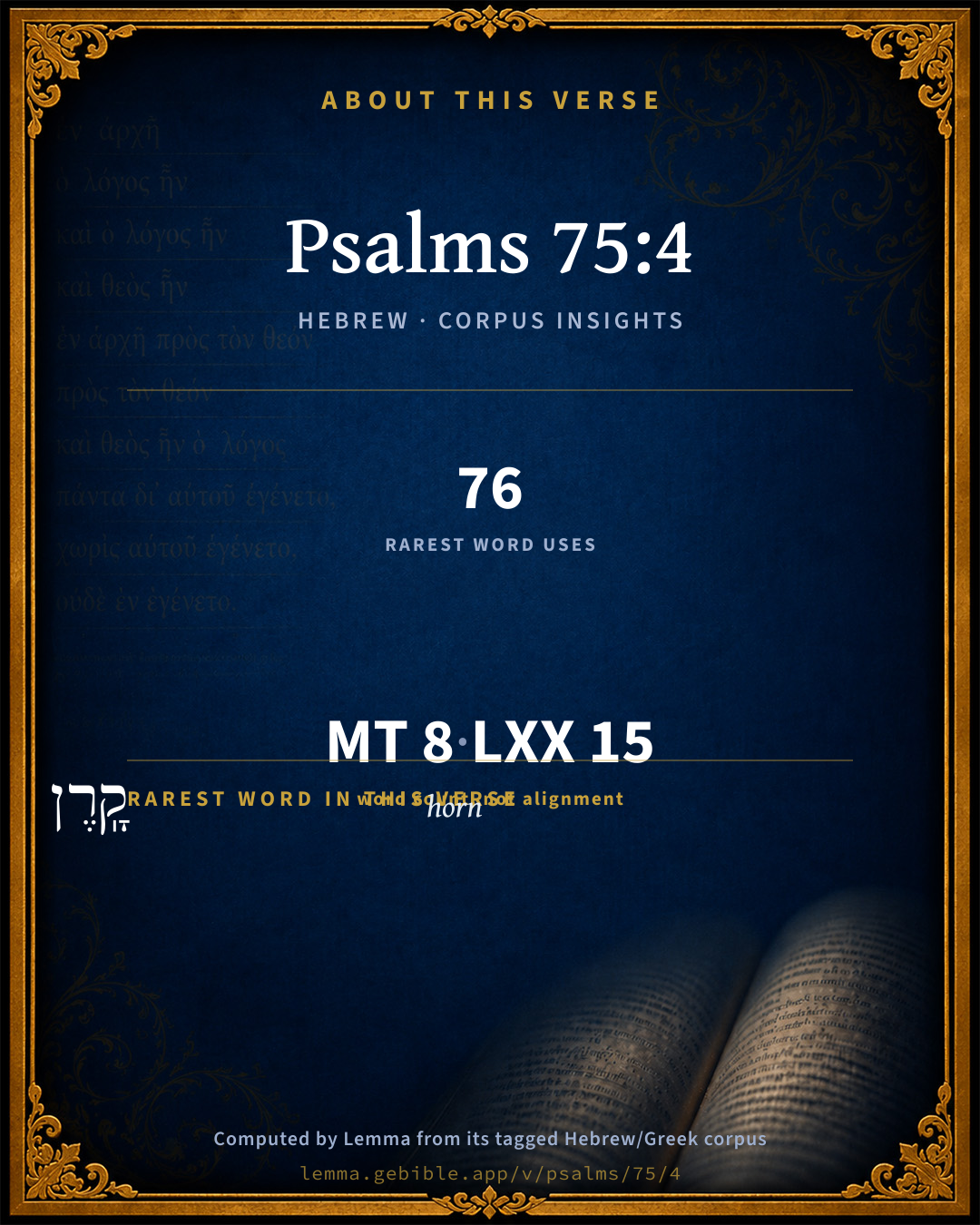
8
words
6
distinct lemmas
Wisdom
section

Grammatical profile

  • 4 verbs
  • 1 noun
  • 1 adjective
  • 2 particles

Verb forms

  • אָמַ֣רְתִּי Qal · Perfect
  • לַֽ֭הוֹלְלִים Qal · Participle Active
  • תָּהֹ֑לּוּ Qal · Jussive
  • תָּרִ֥ימוּ Hiphil · Jussive

Repetition

Words recur within this verse — often emphatic in Hebrew:

  • לַֽ֭הוֹלְלִים to praise H1984 ×2
  • אַל not H408 ×2

Hebrew & Septuagint length

In English translation the verse runs 15 words from the Hebrew and 17 from the Septuagint (LXX English) — closely comparable.

A rough comparison of the two English renderings, which tokenize alike — not a word-level alignment.

Word counts can differ between the Hebrew and the Greek without any difference in meaning — e.g. the Hebrew direct-object marker אֵת has no separate Greek word, and Greek often adds the article ὁ.

In the original languages it is 8 Hebrew tokens and 15 Greek tokens — but the two are counted differently (Hebrew bundles its prefixes and suffixes into one token; the Greek is in lemma form), so that isn’t a like-for-like length.

Cross-references

9

Topical passages linked to Psalms 75:4 in the Treasury of Scripture Knowledge — connected by theme and wording, ordered by reader-vote popularity; previews shown in the World English Bible.

  • Zechariah 1:21 Then I asked, "What are these coming to do?" He said, "These are the horns which scattered Judah, so that no man lifted up his head; but these have come to terrify them, to cast down the horns of the nations, which lifted up their horn against the land of Judah to scatter it."
  • Proverbs 1:22 "How long, you simple ones, will you love simplicity? How long will mockers delight themselves in mockery, And fools hate knowledge?
  • Proverbs 8:5 You simple, understand prudence. You fools, be of an understanding heart.
  • Psalms 82:2–8 "How long will you judge unjustly, And show partiality to the wicked?" Selah.
  • Psalms 89:17 For you are the glory of their strength. In your favor, our horn will be exalted.
  • Psalms 94:8 Consider, you senseless among the people; You fools, when will you be wise?
  • Psalms 148:14 He has lifted up the horn of his people, The praise of all his saints; Even of the children of Israel, a people near to him. Praise Yah!
  • Proverbs 9:6 Leave your simple ways, and live. Walk in the way of understanding."
  • Daniel 7:20–21 and concerning the ten horns that were on its head, and the other [horn] which came up, and before which three fell, even that horn that had eyes, and a mouth that spoke great things, whose look was more stout than its fellows.

Cross-references courtesy of OpenBible.info (CC BY 4.0).

Hebrew and Greek witnesses Masoretic Hebrew ↔ Greek Septuagint

The same verse in the two great witnesses to the Old Testament, shown verse-for-verse.

You’re reading Greek Psalm 74 (Hebrew Psalm 75). The Septuagint counts the superscription, so verse numbers can differ from the Hebrew — chapter-level alignment, not verse-by-verse. Numbering follows Rahlfs.

These are two independent witnesses, not word-aligned to each other, and the Septuagint is shown in lemma (dictionary) form.

Hebrew Psalms 75:4 Masoretic · Westminster Leningrad Codex

אָמַ֣רְתִּי לַֽ֭הוֹלְלִים אַל תָּהֹ֑לּוּ וְ֝לָרְשָׁעִ֗ים אַל תָּרִ֥ימוּ קָֽרֶן

I said to the arrogant, "Don't boast;" To the wicked, "Don't lift up the horn.

World English Bible · Public Domain

Greek LXX Greek Psalm 74:4 Septuagint · lemma form

τήκω ὁ γῆ καί πᾶς ὁ καταοἰκέω ἐν αὐτός ἐγώ στερεόω ὁ στῦλος αὐτός διάψαλμα

I said to the transgressors, Do not transgress; and to the sinners, Lift not up the horn.

LXX2012 (modern English Septuagint) · Public Domain

Hebrew: Westminster Leningrad Codex (CC BY 4.0). Greek: Septuagint (public domain); English from LXX2012 (modern English Septuagint) (Public Domain). How the Septuagint differs from the Hebrew →

Commentary

Notes on Psalms 75:4 from classic Christian and Jewish commentators (each source and its license shown beneath its notes). The classic Christian expositions comment on the surrounding passage and are grouped to its opening verse, so a note may address several verses; the Jewish commentaries on the Tanakh (Rashi and others) are per-verse, so they appear only where the commentator wrote on this verse.

Lemma curates 59 commentaries, every one of them public domain or Creative Commons licensed, each selected and text-cleaned for this edition rather than reprinted as found. About our sources →

Trapp's Complete Commentary

John Trapp

Psa 75:4 I said unto the fools, Deal not foolishly: and to the wicked, Lift not up the horn:

Ver. 4. I said unto the fools, Deal not foolishly] Boast not yourselves so proudly and petulantly, but submit to God’s decree, and my government; how much more to Christ’s!

Lift not up the horn] Metaphora a tauris cornupetis.

John Trapp, A Commentary or Exposition upon All the Books of the Old and New Testament (1647–1656) — public domain. Text from a community e-Sword module.

Joseph Benson's Commentary

Psa 75:4-5. I said — With authority and command; unto the fools — The wicked: I charged them; Deal not foolishly — Desist from your impious and injurious practices, which shall not now go unpunished as they have done. Lift not up your horn, &c. — Do not carry yourselves with pride and arrogance, boasting of your own strength; or with scorn and contempt toward me or any others of God’s people. It is a metaphor taken from untamed oxen, which will not bow their heads to receive the yoke, but lift up their heads and horns to avoid it. Or, למרום, lammarom, rendered, on high, means, against the high one, that is, against God, who is mentioned under this same title, Psa 56:2; Isa 57:15. Speak not —

Against me and my government; with a stiff neck — With pride and contempt of my person, and with rebellion against God’s will declared concerning my advancement, of which you are not ignorant: see 2Sa 3:17-18.

Joseph Benson's Commentary on the Old and New Testaments (1811–1818) — public domain. Text from a community e-Sword module.

J. A. Alexander on Psalms

Joseph Addison Alexander

5. (Psa 75:4). I said to the boasters, Boast not, and to the wicked, Lift not up the horn! Some regard these as the words of the psalmist, speaking again in the person of the church. The sense will then be that, encouraged by God's promise of protection and deliverance, his people warn their adversaries not to triumph. It seems more natural, however, to explain them as a continuation of the words of God himself, whose very assurance of protection to his people was in fact a warning of destruction to his enemies. The objection, that what follows must then be referred to the same speaker, is of little weight, as the transition from one person to another, in the psalms of a dramatic structure, is not commonly a marked one, and is often quite insensible. The concluding metaphor is borrowed from the habits of horned animals, and nearly equivalent to the act of holding the head high, as a sign of human pride. For a different application of the figure, see above, on Psa 18:2.

Joseph Addison Alexander, The Psalms Translated and Explained (1850) — public domain. Text from a community e-Sword module.

Tyndale Open Study Notes

Tyndale Open Resources

75:4-5 The wicked arrogantly defy the heavens—the dwelling place of God. Through their boasting they insist that they are wiser than God.

Tyndale Open Study Notes — © Tyndale Open Resources, licensed CC BY-SA 4.0. Text via the HelloAO Bible API.

Adam Clarke's Commentary

Verse 4. I said unto the fools] I have given the idolatrous Chaldeans sufficient warning to abandon their idols, and worship the true God; but they would not. I have also charged the wicked, to whom for a season I have delivered you because of your transgressions, not to lift up their horn-not to use their power to oppress and destroy. They have, notwithstanding, abused their power in the persecutions with which they have afflicted you. For all these things they shall shortly be brought to an awful account. On the term horn, See Clarke on Lu 1:69.

Adam Clarke's Commentary on the Bible (1810–1826) — public domain. Text from a community e-Sword/MySword module.

John Calvin's Commentaries

4. I said to the fools, Act not foolishly. After he has set the office of God full in his own view and in the view of the faithful, he now triumphs over all the ungodly, whom he impeaches of madness and blind rage, the effect of their despising God, which leads them to indulge to excess in pride and self-gloriation. This holy boasting to which he gives utterance depends upon the judgment, which in the name of God he denounced to be at hand; for when the people of God expect that he is coming to execute judgment, and are persuaded that he will not long delay his coming, they glory even in the midst of their oppressions. The madness of the wicked may boil over and swell with rage, and pour forth floods to overwhelm them; but it is enough for them to know that their life is protected by the power of God, who can with the most perfect ease humble all pride, and restrain the most daring and presumptuous attempts. The faithful here deride and despise whatever the wicked plot and conspire to execute, and bid them desist from their madness; and in calling upon them to do this, they intimate that they are making all this stir and commotion in vain, resembling madmen, who are drawn hither and thither by their own distempered imaginations. It is to be observed, that the Psalmist represents pride as the cause or mother of all rash and audacious enterprises. The reason why men rush with such recklessness upon unlawful projects most certainly is, that blinded by pride, they form an undue and exaggerated estimate of their own power. This being a malady which is not easily eradicated from the hearts of men, the admonition, Lift not up your horn on high is repeated once and again. They are next enjoined not to speak with a fat or a stiff neck; by which is meant that they should not speak harshly and injuriously; for it is usual with proud persons to erect the neck and raise the head when they pour forth their menaces. Others translate the words, Speak not stiffly with your neck; but the other translation is the more correct.

John Calvin's Commentaries (1540-1563) — public domain. Text from the Calvin Translation Society English edition (1840s-50s) via the Christian Classics Ethereal Library (ccel.org). Calvin's coverage is partial (roughly two-thirds of the Bible); uncommented books and verses are honest gaps, never fabricated. The 19th-century editor's footnotes and remarks are omitted so the notes are faithfully Calvin's own voice.

Ellicott's Commentary for English Readers

(4) Fools . . . foolishly.—Better, arrogant . . . arrogantly. See Psa_73:3. (Comp. 1Sa_2:3.)

A Bible Commentary for English Readers, edited by Charles John Ellicott (1878–1897) — public domain. Text from a community e-Sword module.

The Cambridge Bible for Schools and Colleges

gen. ed. J. J. S. Perowne

4. I say unto the arrogant, Deal not arrogantly. Cp. Psa_73:3; Psa_5:5. Rabshakeh and his colleagues and the Assyrians in general were the very type of such boastful, defiant arrogance (Isa_37:23; Isa_10:7 ff.; Nah_1:11).

Lift not up the horn] A metaphor, derived from animals tossing their heads, to denote overweening, defiant self-consciousness of strength.

4, 5. A warning to all presumptuous braggarts, based on the Divine utterances of Psa_75:2-3. It is disputed whether the speaker is still God, as in Psa_75:2-3, or the poet, but the latter alternative is preferable. The interposition of Selah marks the end of the Divine speech, and I said naturally introduces a fresh speaker. Moreover there is no break between Psa_75:5 and Psa_75:6, but it is clear that God is no longer speaking in Psa_75:6-7.

The Cambridge Bible for Schools and Colleges (gen. ed. J. J. S. Perowne; Cambridge University Press, 1878–1918) — public domain. Text from a community e-Sword module.

John Gill's Exposition

I said unto the fools,.... To the vain gloriosos, proud boasters, mockers, and scoffers at the day of judgment, and burning of the world:

deal not foolishly; by glorying in themselves, boasting of their riches, and trusting in them; singing a requiem to themselves on account of their abundance, and by putting away the evil day far from them:

and to the wicked, lift not up the horn; of power, grandeur, and wealth, and use it to the injury of others; or be so elated with it as to look with disdain on others; or imagine they shall always continue in this exalted state, as antichrist the horned beast does, Rev 18:7, the allusion is to horned beasts, particularly harts, which lift up their heads and horns in great pride (p): the phrase signifies to behave proudly and haughtily.

(p) Vid. "Suidam in voce"

John Gill's Exposition of the Whole Bible (1746–1763) — public domain (CC PDM 1.0). Text via the HelloAO Bible API.

Albert Barnes' Notes on the Bible

I said unto the fools - To the wicked people in rebellion. Folly and wickedness in the Bible are synonymous terms, as they are identical in fact. See the notes at Psa 14:1.

Deal not foolishly - Act not foolishly; carry not out your wicked plans. Do not pursue your schemes of wickedness and folly, for they cannot be successful, and they will only tend to involve you in ruin.

And to the wicked - The wicked people engaged in rebellion - either against a lawful human government, or against God.

Lift not up the horn - The horn is a symbol of strength. Compare Job 16:15; Dan 7:7-8, Dan 7:11, Dan 7:21; Dan 8:5, Dan 8:8-9, Dan 8:21. This is to be understood as the language of the person represented as speaking in the psalm - whether a prince, or whether God himself. It is counsel addressed to the wicked, that they should not attempt to put forth their strength in the accomplishment of their evil purposes. The reason given for this is stated in Psa 75:6, namely, that success does not depend on chance, or on human power, but must come from God.

Albert Barnes' Notes on the Bible (1834–1885) — public domain. Text from a community e-Sword/MySword module.

Matthew Poole's English Annotations

I said, with authority and command; I charged them.

The fools, i.e. the wicked, as that is explained in the next clause.

Deal not foolishly; desist from your impious and injurious practices, which shall not now go unpunished, as they have done.

Lift not up the horn; do not carry yourselves either arrogantly, boasting of your own strength, or scornfully and maliciously towards me or others of God’s people.

Matthew Poole's English Annotations on the Holy Bible (1683–1685) — public domain. Text from a community e-Sword/MySword module.

The Treasury of David

Charles H. Spurgeon

Ver. 4. I said unto the fools, Deal not foolishly. The Lord bids the boasters boast not, and commands the mad oppressors to stay their folly. How calm is he, how quiet are his words, yet how divine the rebuke. If the wicked were not insane, they would even now hear in their consciences the still small voice bidding them cease from evil, and forbear their pride.

And to the wicked, Lift not up the horn. He bids the ungodly stay their haughtiness. The horn was the emblem of boastful power; only the foolish, like wild and savage beasts, will lift it high; but they assail heaven itself with it, as if they would gore the Almighty himself. In dignified majesty he rebukes the inane glories of the wicked, who beyond measure exalt themselves in the day of their fancied power.

Ver. 4. Fools. The ungodly are spiritual fools. If one had a child very beautiful, yet if he were a fool, the parent would have little joy in him. The Scripture hath dressed the sinner in a fool's coat: and let me tell you, better be a fool void of reason, than a fool void of grace: this is the devil's fool. Pr 14:9. Is not he a fool who refuseth a rich portion? God offers Christ and salvation, but the sinner refuseth this portion: "Israel would none of me." Ps 81:11. Is not he a fool who prefers an annuity before an inheritance? Is not he a fool who tends his mortal part, and neglects his angelical part? As if one should paint the wall of his house, and let the timber rot. Is not he a fool who will feed the devil with his soul? As that emperor who fed his lion with a pheasant. Is not he a fool who lays a snare for himself? Pr 1:18. Who consults his own shame? Hab 2:10. Who loves death? Pr 8:36. Thomas Watson.

Ver. 4.

I. Who spoke to them? I.

II. Who were they? Fools, wicked.

III. What did you say?

IV. What was the good of it? Or, Rebuke of sin, a duty.

Ver. 4. The unhallowed trio: --wickedness, folly, pride.

Psalms 75:5*

Charles H. Spurgeon's The Treasury of David (1869–1885) — public domain. Psalms only. Text from a community e-Sword/MySword module.

Whedon's Commentary on the Bible

Daniel D. Whedon

4. I said unto the fools—The king still speaks as God’s vicar. I said to the haughty, who by reason of their successes had grown insolent.

Deal not foolishly—Scornfully, boastfully.

Lift not up the horn—Toss not high your horn defiantly, as the infuriated bull, “from a sense of your strength, and with intention to strike.”—Hengstenberg.

Speak not with a stiff neck—With an arrogant neck, a hard neck, a neck of impudence. The allusion is to the lofty tossing of the head of the bison, (when brought to bay,) displaying the pride and strength of his powerful neck.

Daniel D. Whedon (gen. ed.), Commentary on the Old and New Testaments (1874–1909) — public domain. Text from a community e-Sword module.

The Pulpit Commentary

I said. It is doubtful who is the speaker. Professor Cheyne regards the entire passage from the beginning of ver. 2 to the end of ver. 5 as spoken by the Almighty; but most commentators assign vers. 4 and 5 to the psalmist or the people of Israel. Unto the fools; i.e. to the enemy which was attacking Israel; literally, to the boasters, or to the arrogant ones (see Revised Version). Deal not foolishly; rather, deal not so arrogantly. Do not set yourselves so proudly against the Almighty. And to the wicked, Lift not up the horn; i.e. be not fierce and menacing, like a bull who threatens with his horns.

The self-lifted horn.

Perhaps the most suggestive explanation of this figure is that given by Mr. Munro, in his "Summer Rambles in Syria." He is writing concerning the females in a Maronite village of Mount Lebanon. "The most remarkable peculiarities of their dress are the immense silver earrings hanging forward upon the neck, and the tantoura, or "horn," which supports the veil. This latter ornament varies in form, material, and position, according to the dignity, taste, and circumstances of the wearer. Horns are of gold, silver-gilt, and silver, and sometimes of wood. The former are either plain or figured in low relief, and occasionally set with jewels; but the length and position of them is that upon which the traveller looks with the greatest interest, as illustrating and explaining a familiar expression of Scripture. The young, the rich, and the vain wear the tantoura of great length, standing straight up from the top of the forehead; whereas the humble, the poor, and the aged place it upon the side of the head, much shorter, and spreading at the end like a trumpet. I do not mean to say that these distinctions are universal, but I was told that they are very general, and thus the "exalted horn" still remains a mark of power and confidence, as it was in the days of Israel"s glory." The appeal of the text is to those who unduly exalt themselves, as party leaders in times of civil commotion are in constant danger of doing. They "think of themselves above that they ought to think." This is clearly indicated in the marginal alternative of the Revised Version, "Speak not insolently with a haughty neck". (see Hannah"s song, 1Sa_2:3)

I THE SELF-IMPORTANT MAN DOES NOT WORTHILY ESTIMATE HIMSELF. The most difficult work for any man to do is honestly to criticize himself. Men shrink from that work. Men incapacitate themselves for it. Men spoil their own vision, and when they look in on themselves only find what they wished to find. "To thine own self be true," even if the truth humbles you in the dust. Illustrate from the case of Shebna.

II THE SELF-IMPORTANT MAN TAKES NO ACCOUNT OF GOD"S ESTIMATE OF HIM. "Be not deceived: God is not mocked." A man can never delude God with any braggings, or mere appearances. He searcheth the heart and trieth the reins. (see Isa_2:10-17) See the confession of a psalmist," My goodness extendeth not to thee." Only the humble man can dare to consider the Divine searchings. Of the proud man it must be said, "God is not in all his thoughts." He would be glad if there were no God.

III THE SELF-IMPORTANT MAN DELUDES HIMSELF CONCERNING OTHER PEOPLE"S ESTIMATE OF HIM. Because he will only give heed to the flatterers. He blinds himself to the mistrust and fear all prudent and good men show in relation to him. R.T.

The Pulpit Commentary (1880–1919), ed. H.D.M. Spence-Jones & Joseph S. Exell — public domain. Text from a community e-Sword module.

John Wesley's Explanatory Notes

I said - I charged them. Deal not - Desist from your practices. Lift not up - Do not carry yourselves scornfully and maliciously.

John Wesley, Explanatory Notes Upon the Whole Bible (1754–1765) — public domain. Text via the GEBible commentary corpus.

unfoldingWord translationNotes

Door43 World Missions Community

I said to the arrogant ... and to the wicked

The words "the arrogant" and "the wicked" are nominal adjectives that can be translated with nouns. The verb for the second phrase may be supplied from the first. AT: "I said to the arrogant people ... and I said to the wicked people" (See: Nominal Adjectives and Ellipsis)

I said

Possible meanings are 1) God is speaking or 2) Asaph is speaking.

Do not be arrogant ... Do not lift ... Do not lift up your ... do not speak

The speaker is speaking to many wicked people, so these forms are all plural. (See: Pronouns)

Do not lift up the horn

Asaph speaks of wicked people as if they were animals with horns on their heads, stretching their necks and holding their heads high to frighten other animals. AT: "Do not be confident" or "Do not boast about how strong you are" (See: Metaphor)

Do not lift up your horn to the heights

Asaph speaks of wicked people as if they were animals with horns on their heads, stretching their necks and holding their heads as high as they can to frighten other animals. AT: "Be especially sure not to boast that you are greater than God" (See: Metaphor)

with an insolent neck

Asaph speaks of wicked people who defy or challenge God as if they were animals with horns on their heads, stretching their necks and holding their heads high to frighten other animals. AT: "arrogantly" (See: Idiom and Metaphor)

It is not from the east ... that lifting up comes

Asaph speaks of the one who lifts up as if he were the action of lifting up. He also speaks of God giving strength and honor to a person as if God were physically lifting that person up. AT: "The one who will lift you up will not be someone who comes from the east" or "The one who will make you strong and have people honor you will not be someone who comes from the east" (See: Metonymy)

translationWords

arrogant

evil

desert

unfoldingWord translationNotes — © Distant Shores Media and the Door43 World Missions Community, licensed CC BY-SA 4.0. Source: git.door43.org/Door43/en_tn.

Rashi

Rabbi Shlomo Yitzchaki (Rashi)

When the earth and all its inhabitants were melting away, etc. On the day of the giving of the Torah, when the earth and all its inhabitants were melting away because of the condition You made with the Creation: that if Israel did not accept the Torah, you would return it [the earth] to void and chaos.

I Your people, Israel. established its pillars when I said, “We will do and we will hear.”

Rashi on the Tanakh — English translations: “The Judaica Press complete Tanach with Rashi, translated by A. J. Rosenberg” (CC BY 4.0); “Pentateuch with Rashi's commentary by M. Rosenbaum and A.M. Silbermann, 1929-1934” (public domain); “The Metsudah Tanach series, Lakewood, N.J” (CC BY 4.0); and “The Book of Joshua, Metsudah Publications, 1997” (CC BY 4.0). Text via Sefaria.

Lesson kit

Teaching starters — assembled from the data on this page, not authored interpretation. Every prompt links to the verse data it draws on. Edit before teaching.

Psalms, in the Wisdom, opens this verse with 8 words (6 distinct Hebrew lemmas). Its most distinctive word is qeren (“horn”). A historical commentator’s framing appears above. Read the whole chapter for the surrounding context.

Discussion questions

  1. How does “horn” (qeren) shape what this verse is saying?
  2. Zechariah 1:21 shares this passage’s theme. How do the two illuminate each other?
  3. “to praise” occurs 2× in this one verse. What is the effect of the repetition?
  4. The translations on this page render this verse differently — a whole-verse word diff, not a word-by-word alignment. What might account for the different wordings?
  5. The verb «אָמַ֣רְתִּי» is Qal Perfect. How does its form color the action?
  6. Reading how Trapp's Complete Commentary and Joseph Benson's Commentary read this verse, where do the two commentators agree and where do they part?

Things to notice

Reading settings

Reading text

Shown beneath each verse's original-language words.

Old Testament
Old Testament edition

Read the OT as the Masoretic Hebrew (MT) or the Greek Septuagint (LXX).

English shown for the Greek Septuagint (in the Hebrew ↔ Greek comparison).

Comparing translations? Open the Compare panel on any verse page to stack up to four side by side.