

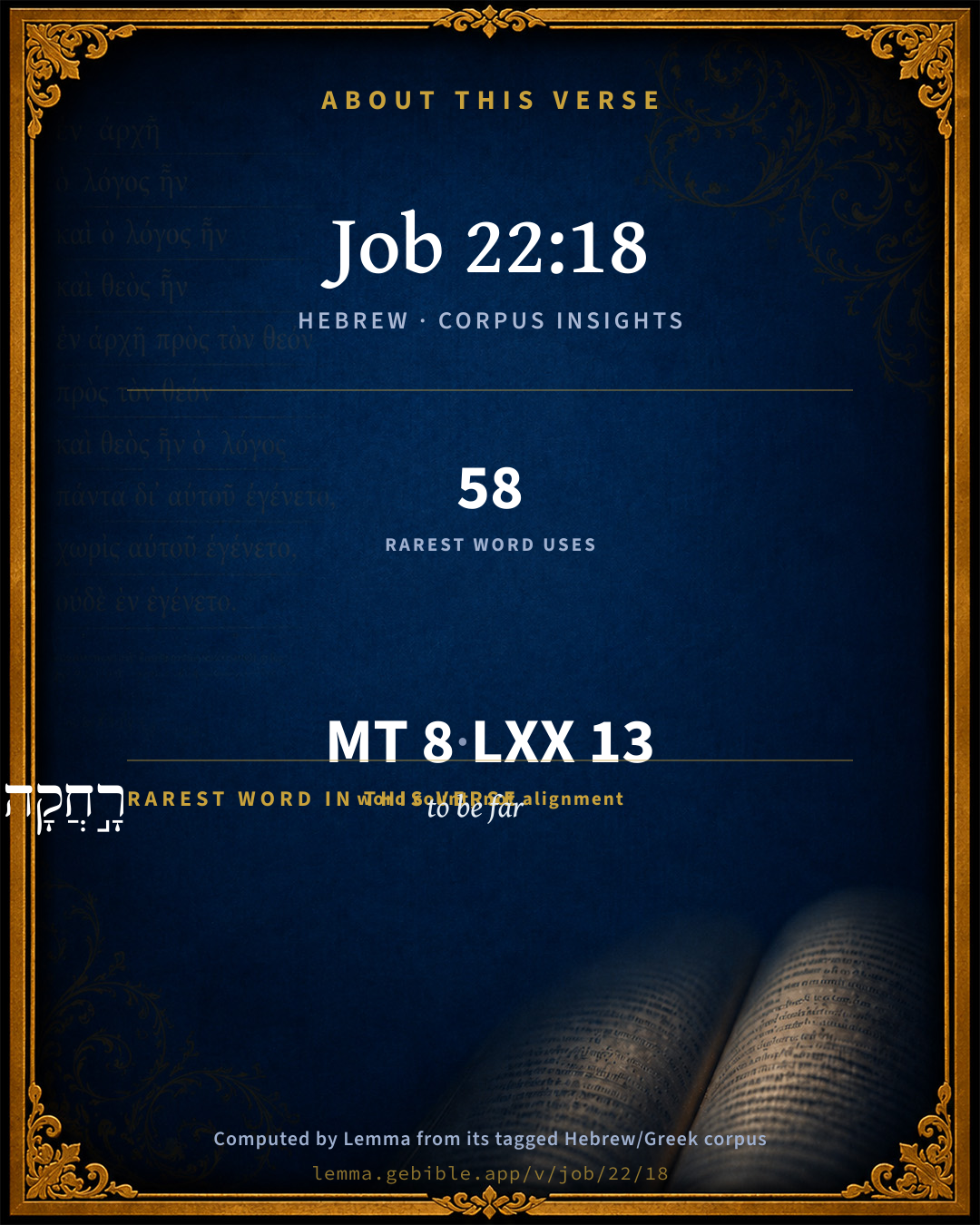
Job 22:18

Hebrew (Westminster Leningrad Codex) Job 22:18 appears in the Hebrew Old Testament. The text above is from the Westminster Leningrad Codex. Each word links to its Strong’s number, a concise gloss, and parsing drawn from the Open Scriptures Hebrew Bible morphology. Click any word for its full Brown-Driver-Briggs (BDB) entry.
Download image
Cite this verse

Job 22:18 (World English Bible). Public Domain. Lemma interlinear Bible study tool, https://lemma.gebible.app/v/job/22/18.

Show BibTeX & RIS
BibTeX
RIS
English Translation
Yet he filled their houses with good things, But the counsel of the wicked is far from me.
World English Bible · Public Domain
Download a study sheet

One document with this verse’s original text, its word-by-word gloss line, the meaning frame, cross-references with their text, attributed commentary, and full source and license credits — printable, and it pastes into notes with its structure intact.

This verse Autodidact and up

Study sheet (.html) Plain text (.txt)

A passage Seminary Student

Up to 50 verses in one chapter. A passage sheet keeps up to 6 commentary sources and 12 cross-references per verse, in the order this page ranks them, and says so on the sheet whenever that leaves anything out. Ask for a single verse and you get the Autodidact verse sheet above.

Everything on this page stays free to read, with no account — the sheet is a download of what is already on screen, not access to it.

Want to remove ads? Support Godless Engineer
Compare translations 3

The same verse in 3 English versions, stacked beneath the original-language interlinear above. Click any original word for its lexicon entry.

Each is an independent rendering of the whole verse — the interlinear is not word-aligned to these translations.

Highlighted words mark where these versions differ — a whole-verse word diff, not a word-by-word alignment.

  • World English Bible Public Domain
    Yet he filled their houses with good things, But the counsel of the wicked is far from me.
  • King James Version Public Domain
    Yet he filled their houses with good things: but the counsel of the wicked is far from me.
  • unfoldingWord Literal Text CC BY-SA 4.0
    Yet he filled their houses with good, so the counsel of the wicked far from me!

unfoldingWord Literal Text — © unfoldingWord, licensed CC BY-SA 4.0. Word-aligned USFM3 via Door43 (git.door43.org/unfoldingWord/en_ult).

Versions to compare (up to 4)

3 of 4 selected

Show all 18 translations

Every available English version of this verse, each an independent rendering of the whole verse.

  • World English Bible Public Domain
    Yet he filled their houses with good things, But the counsel of the wicked is far from me.
  • Berean Standard Bible Public Domain
    But it was He who filled their houses with good things; so I stay far from the counsel of the wicked.
  • Majority Standard Bible Public Domain
    But it was He who filled their houses with good things; so I stay far from the counsel of the wicked.
  • King James Version Public Domain
    Yet he filled their houses with good things: but the counsel of the wicked is far from me.
  • American Standard Version (1901) Public Domain
    Yet he filled their houses with good things: But the counsel of the wicked is far from me.
  • Revised Version (1885) Public Domain
    Yet he fired their houses with good things: but the counsel of the wicked is far from me.
  • Geneva Bible (1599) Public Domain
    Yet hee filled their houses with good things: but let the counsell of the wicked be farre from me.
  • Douay-Rheims (1899) Public Domain
    Whereas he had filled their houses with good things: whose way of thinking be far from me.
  • Young's Literal Translation Public Domain
    And he hath filled their houses `with' good: (And the counsel of the wicked Hath been far from me.)
  • Literal Standard Version CC BY-SA 4.0
    And He has filled their houses [with] good (And the counsel of the wicked || Has been far from me).
  • Unlocked Literal Bible CC BY-SA 4.0
    Yet he filled their houses with good things; the plans of wicked people are far from me.
  • unfoldingWord Literal Text CC BY-SA 4.0
    Yet he filled their houses with good, so the counsel of the wicked far from me!
  • Darby Bible Public Domain
    Yet he filled their houses with good. But the counsel of the wicked is far from me.
  • World Messianic Bible Public Domain
    Yet he filled their houses with good things, but the counsel of the wicked is far from me.
  • Webster's Bible Public Domain
    Yet he filled their houses with good things: but the counsel of the wicked is far from me.
  • Free Bible Version CC BY-SA 4.0
    And yet he was the one who had filled their homes with good things—but I don't accept their way of thinking.
  • Bible in Basic English Public Domain
    Though he made their houses full of good things: but the purpose of the evil-doers is far from me!
  • JPS Tanakh (1917) Public Domain
    Yet He filled their houses with good things — but the counsel of the wicked is far from me.

Literal Standard Version (2020), Covenant Press — licensed CC BY-SA 4.0. Text via the HelloAO Bible API (eBible.org). Unlocked Literal Bible (unfoldingWord) — licensed CC BY-SA 4.0. Text via the HelloAO Bible API (eBible.org). unfoldingWord Literal Text — © unfoldingWord, licensed CC BY-SA 4.0. Word-aligned USFM3 via Door43 (git.door43.org/unfoldingWord/en_ult). Free Bible Version, Dr. Jonathan Gallagher — licensed CC BY-SA 4.0. Text via the HelloAO Bible API (eBible.org).

Word by word

More ways to search: Search by grammar → Find every occurrence → Compare this word →

Practice this passage: Drill this verse → Learn its vocabulary →

רָ֣חֲקָה
râchaq
H7368
“to be far”
Verb, Qal, Perfect, 3rd Person, Feminine, Singular
Part of Speech
Verb
Stem
Qal
Form
Perfect
Person
3rd Person
Gender
Feminine
Number
Singular
Full BDB Definition

Origin: a primitive root

TWOT: 2151

to be or become far, be or become distant, be removed, go far away (verb) - (Qal) to be far, be distant - (Piel) to send far away, extend - (Hiphil) - to make or exhibit distance, be gone far - to remove, put far away - (Niphal) loose (verb) - at a distance (verbal infinitive [as adverb])
  1. וְה֤וּא hûwʼ H1931 “and · he” Conjunction + Pronoun, Personal, 3rd Person, Masculine, Singular
  2. מִלֵּ֣א mâlêʼ H4390 “to fill” Verb, Piel, Perfect, 3rd Person, Masculine, Singular
  3. בָתֵּיהֶ֣ם bayith H1004 “houses · their” Noun, Common, Masculine, Plural, Construct + Suffix, Personal, 3rd Person, Masculine, Plural
  4. ט֑וֹב ṭôwb H2896 “good” Adjective, Adjective, Masculine, Singular, Absolute
  5. וַעֲצַ֥ת ʻêtsâh H6098 “and · counsel of” Conjunction + Noun, Common, Feminine, Singular, Construct
  6. רְ֝שָׁעִ֗ים râshâʻ H7563 “wicked” Adjective, Adjective, Masculine, Plural, Absolute
  7. מֶֽנִּי min H4480 “from · me” Preposition + Suffix, Personal, 1st Person, Common, Singular

About this verse

These counts appear in no published source. They are computed here, from the morphology-tagged text and Lemma’s own curated glosses. What Lemma adds →

8
words
8
distinct lemmas
Wisdom
section

Shared distinctive vocabulary

רָ֣חֲקָה to be far H7368 occurs in 56 verses of the Hebrew Bible. Also found in:

Grammatical profile

  • 2 verbs
  • 2 nouns
  • 2 adjectives
  • 1 pronoun
  • 1 preposition

Verb forms

  • מִלֵּ֣א Piel · Perfect
  • רָ֣חֲקָה Qal · Perfect

Hebrew & Septuagint length

In English translation the verse runs 18 words from the Hebrew and 18 from the Septuagint (LXX English) — the same length.

A rough comparison of the two English renderings, which tokenize alike — not a word-level alignment.

Word counts can differ between the Hebrew and the Greek without any difference in meaning — e.g. the Hebrew direct-object marker אֵת has no separate Greek word, and Greek often adds the article ὁ.

In the original languages it is 8 Hebrew tokens and 13 Greek tokens — but the two are counted differently (Hebrew bundles its prefixes and suffixes into one token; the Greek is in lemma form), so that isn’t a like-for-like length.

Cross-references

8

Topical passages linked to Job 22:18 in the Treasury of Scripture Knowledge — connected by theme and wording, ordered by reader-vote popularity; previews shown in the World English Bible.

  • Job 21:16 Behold, their prosperity is not in their hand: The counsel of the wicked is far from me.
  • Job 12:6 The tents of robbers prosper, Those who provoke God are secure; Who carry their God in their hands.
  • 1 Samuel 2:7 Yahweh makes poor, and makes rich: He brings low, he also lifts up.
  • Psalms 17:14 From men by your hand, Yahweh, From men of the world, whose portion is in this life. You fill the belly of your cherished ones. Your sons have plenty, And they store up wealth for their children.
  • Jeremiah 12:2 You have planted them, yes, they have taken root; they grow, yes, they bring forth fruit: you are near in their mouth, and far from their heart.
  • Acts 14:17 Yet he didn't leave himself without witness, in that he did good and gave you rains from the sky and fruitful seasons, filling our hearts with food and gladness."
  • Psalms 1:1 Blessed is the man who doesn't walk in the counsel of the wicked, Nor stand in the way of sinners, Nor sit in the seat of scoffers;
  • Acts 15:16 'After these things I will return. I will again build the tent of David, which has fallen. I will again build its ruins. I will set it up,

Cross-references courtesy of OpenBible.info (CC BY 4.0).

Hebrew and Greek witnesses Masoretic Hebrew ↔ Greek Septuagint

The same verse in the two great witnesses to the Old Testament, shown verse-for-verse.

These are two independent witnesses, not word-aligned to each other, and the Septuagint is shown in lemma (dictionary) form.

Hebrew Job 22:18 Masoretic · Westminster Leningrad Codex

וְה֤וּא מִלֵּ֣א בָתֵּיהֶ֣ם ט֑וֹב וַעֲצַ֥ת רְ֝שָׁעִ֗ים רָ֣חֲקָה מֶֽנִּי

Yet he filled their houses with good things, But the counsel of the wicked is far from me.

World English Bible · Public Domain

Greek LXX Job 22:18 Septuagint · lemma form

ὅς δέ ἐνπίμπλημι ὁ οἶκος αὐτός ἀγαθός βουλή δέ ἀσεβής πόρρω ἀπό αὐτός

Yet he filled their houses with good things: but the counsel for the wicked is far from him.

LXX2012 (modern English Septuagint) · Public Domain

On this verse, Haydock's Catholic Bible Commentary discusses the Septuagint’s reading. Read the note in Commentary ↓

Hebrew: Westminster Leningrad Codex (CC BY 4.0). Greek: Septuagint (public domain); English from LXX2012 (modern English Septuagint) (Public Domain). How the Septuagint differs from the Hebrew →

Commentary

Notes on Job 22:18 from classic Christian and Jewish commentators (each source and its license shown beneath its notes). The classic Christian expositions comment on the surrounding passage and are grouped to its opening verse, so a note may address several verses; the Jewish commentaries on the Tanakh (Rashi and others) are per-verse, so they appear only where the commentator wrote on this verse.

Lemma curates 59 commentaries, every one of them public domain or Creative Commons licensed, each selected and text-cleaned for this edition rather than reprinted as found. About our sources →

Trapp's Complete Commentary

John Trapp

Job 22:18 Yet he filled their houses with good [things]: but the counsel of the wicked is far from me.

Ver. 18. Yet he filled their houses with good things] Heb. With good; that is, with all precious and pleasant riches, whereof he gave them both plenty and propriety, but no otherwise than as Joseph caused his cup to be conveyed into Benjamin’s sack, the better to furnish out an indictment against him. And as Benjamin’s pretended theft was held more heinous, by how much his welcome was the greater, for he had a five fold portion; so shall it one day fare with such rich wretches, as whose bellies God filleth with his hidden treasure, and whose houses he filleth top-full with good things.

- Eutrapelus cuicunque nocere volebat.

Vestimenta dabat pretiosa - (Horat.)

Well might Eliphaz add, all things reckoned.

But (or yet) the counsel of the wicked is (or be) far from me] See these words expounded Job 20:16, where Job hath the very same. Sed ea vult illi eripere Eliphaz, saith a learned interpreter. But Eliphaz will needs take them away from him, and it is as if be should say, Thou, O Job, seemest by thy words and with thy mouth to detest the counsel of the wicked; but thy doings declare the contrary, while thou so many ways celebrate the prosperity of the ungodly. To me, therefore, and to all righteous men, who do heartily hate the wicked, and do seriously set forth God’s just judgments against them, doth this speech better agree and more truly appertain, &c. And as for these righteous men, let me tell thee further,

John Trapp, A Commentary or Exposition upon All the Books of the Old and New Testament (1647–1656) — public domain. Text from a community e-Sword module.

Joseph Benson's Commentary

Job 22:18. Yet he filled their houses with good things — Yet it is true, that for a time God did prosper them, but, at last, cut them off in a tremendous manner. But the counsel of the wicked, &c. — He repeats Job’s words, (Job 21:16,) not without reflection: thou didst say so, but against thy own principle, that God carries himself indifferently toward good and bad; but I, who have observed God’s terrible judgments upon wicked men, have much more reason to abhor their counsels.

Joseph Benson's Commentary on the Old and New Testaments (1811–1818) — public domain. Text from a community e-Sword module.

Tyndale Open Study Notes

Tyndale Open Resources

22:18 I will have nothing to do with that kind of thinking: Eliphaz threw Job’s words back at him (21:16b).

Tyndale Open Study Notes — © Tyndale Open Resources, licensed CC BY-SA 4.0. Text via the HelloAO Bible API.

Geneva Bible (1599)

Geneva Bible translators

He answereth to that which Job had said, Job 21:7, that the wicked have prosperity in this world: desiring that he might not be partaker of the like.

Geneva Bible (1599) marginal notes — public domain. Text via Bolls.life.

Jamieson, Fausset & Brown

Robert Jamieson, A. R. Fausset & David Brown

"Yet" you say (see on Job 21:16) that it is "He who filled their houses with good"--"their good is not in their hand," but comes from God.

but the counsel . . . is--rather, "may the counsel be," &c. Eliphaz sarcastically quotes in continuation Job's words (Job 21:16). Yet, after uttering this godless sentiment, thou dost hypocritically add, "May the counsel," &c.

Jamieson, Fausset & Brown — Commentary Critical and Explanatory on the Whole Bible (1871) — public domain (CC PDM 1.0). Text via the HelloAO Bible API.

Adam Clarke's Commentary

Verse 18. But the counsel of the wicked is far from me.] Sarcastically quoting Job's words, Job 21:14; Job 21:16. Job, having in the preceding chapter described the wicked, who said unto the Almighty, "Depart from us," &c., adds, But the counsel of the wicked is far from me. Eliphaz here, having described the impious, among whom he evidently ranks Job, makes use of the same expression, as if he had said, "Thank God, I have no connection with you nor your companions, nor is my mind contaminated by your creed."

Adam Clarke's Commentary on the Bible (1810–1826) — public domain. Text from a community e-Sword/MySword module.

Ellicott's Commentary for English Readers

(18) Yet he filled their houses.—The bitterness of his irony now reaches its climax in that he adopts the very formula of repudiation Job had himself used (Job_14:16).

A Bible Commentary for English Readers, edited by Charles John Ellicott (1878–1897) — public domain. Text from a community e-Sword module.

The Cambridge Bible for Schools and Colleges

gen. ed. J. J. S. Perowne

18. Eliphaz expresses his abhorrence of the ingratitude and evil principles of such men, repeating the words employed by Job, ch. Job_21:16 (far be from me the counsel of the wicked); but while Job referred to the worldly prosperity of such persons, in spite of their ungodliness, Eliphaz lays stress upon their sure destruction, and how the righteous see in their downfall an illustration of God’s righteous rule of the world (Job_22:19-20).

The Cambridge Bible for Schools and Colleges (gen. ed. J. J. S. Perowne; Cambridge University Press, 1878–1918) — public domain. Text from a community e-Sword module.

John Gill's Exposition

The righteous see it, and are glad,.... Not the counsel of the wicked, nor their outward prosperity, but their ruin and destruction, which is sure and certain; though it may sometimes seem to linger, it is often public and visible to the view of every man, being made public examples, see Psa 91:8; and which is matter of joy and gladness to truly good and righteous men; who have the righteousness of Christ on them, his grace in them, and in consequence of that live soberly, righteously, and godly; these rejoice at the vengeance of God on wicked men, Psa 52:5; not that the misery of their fellow creatures is pleasing to them as such; this would be brutish and inhuman, as well as contrary to the grace of God, and to their character as good men, and also would be displeasing to God, Pro 24:17; but partly because they themselves, through the grace and goodness of God, have been kept from such sins as bring to ruin and destruction; and partly because they are delivered out of the hands of these wicked men, who were distressing to them; and chiefly because of the glory of the divine perfections, particularly the holiness and justice of God displayed herein; for God is known and glorified by the judgments which he executeth, see Psa 9:16;

and the innocent laugh them to scorn; such as are upright and sincere, live holy and harmless lives and conversations, though not entirely free from sin; these deride them for their impieties, and observe to them the justness of the divine judgments upon them. The Jewish writers, many of them (f), restrain these words to Noah and his sons, who saw with their eyes the flood that destroyed the world of the ungodly, and rejoiced at it, and in their turn had them in derision, who had made a mock at Noah's building of the ark, and at his exhortations to them; but though the characters of righteous and innocent agree with Noah, who was just and perfect in his generation, yet not with all his sons; and it is best to understand this of good men in general; though it must be observed and owned, that the destruction of the wicked by the flood is before spoken of, and their character described. The word "saying" is by some supplied at the close of this verse, and so the following words are what the righteous are represented as saying, upon sight of the destruction of the wicked.

(f) Aben Ezra, Ben Gersom, Sephorno, et alii.

John Gill's Exposition of the Whole Bible (1746–1763) — public domain (CC PDM 1.0). Text via the HelloAO Bible API.

Albert Barnes' Notes on the Bible

Yet he filled their houses with good things - This is undoubtedly a biting sarcasm. Job had maintained that such people were prosperous. “Yes,” says Eliphaz, “their houses were well filled! They were signally blessed and prospered!”

But the counsel of the wicked is far from me - This is the very language of Job, Job 21:16. It is used here sarcastically. “Far from me,” you say, “be the counsel of the wicked. Thus you defend them, and attempt to show that they are the favorites of heaven! You attempt to prove that God must and will bless them! Far from me, say I, be the counsel of the wicked! With them I have no part, no lot. I will not defend them ... I will not be their advocate!” The object is, to show that, notwithstanding all that Job had said, he was secretly the advocate of the wicked, and stood up as their friend.

Albert Barnes' Notes on the Bible (1834–1885) — public domain. Text from a community e-Sword/MySword module.

Haydock's Catholic Bible Commentary

From me. He thus insinuates that Job entertained such sentiments, though he seemed to condemn them, chap. xxi. 16. (Calmet) --- Septuagint, "is far from him," God.

George Leo Haydock (1774–1849), Haydock's Catholic Family Bible and Commentary, 1859 edition — public domain. Excludes Psalms (Douay-Rheims chapter numbering differs from Protestant) and Deuterocanonical books (Catholic canon only).

Matthew Poole's English Annotations

Yet it is true that for a time God did prosper them, as he did thee; which also was the aggravation of their sin, and that which hastened their ruin: but at last, and in due time, God cut them off in a tremendous and exemplary manner; as he will also do thee, if thou dost not repent.

But the counsel of the wicked is far from me; he repeats Job’s words, Job 21:16, not without reflection and some kind of derision. Thou didst say so, but without sufficient reason, and against thy own principle, that God carries himself indifferently towards good and bad; but I, who have observed God’s terrible judgments upon wicked men, have much more reason to abhor their counsels which had so sad an issue.

Matthew Poole's English Annotations on the Holy Bible (1683–1685) — public domain. Text from a community e-Sword/MySword module.

Whedon's Commentary on the Bible

Daniel D. Whedon

18. Good things — Job had said their good is not in their hand, Job_21:16. Eliphaz goes further, and admits that God “filled the houses” of the antediluvians with like “good,” but only that their destruction might be the more complete. In irony he retorts upon Job still further his own words, But far from me be the counsel of the wicked.

Daniel D. Whedon (gen. ed.), Commentary on the Old and New Testaments (1874–1909) — public domain. Text from a community e-Sword module.

The Pulpit Commentary

Yet he filled their houses with good things. The "he" is emphatic (aWh). Translate, Yet it was he that filled their houses with good things; and comp. Job_21:16, where the prosperity of the wicked is said not to have proceeded from themselves. But the counsel of the wicked is far from me; or, but let the counsel of the wicked be far from me. Again, Job"s words in Job_21:16 are echoed, perhaps that Eliphaz may show himself to be at least as pious as Job.

The Pulpit Commentary (1880–1919), ed. H.D.M. Spence-Jones & Joseph S. Exell — public domain. Text from a community e-Sword module.

John Wesley's Explanatory Notes

Yet - Yet it is true, that for a time God did prosper them, but at last, cut them off in a tremendous manner, But - He repeals Job's words, chap. xxi, 16, not without reflection: thou didst say so, but against thy own principle, that God carries himself indifferently towards good and bad; but I who have observed God's terrible judgments upon wicked men, have much more reason to abhor their counsels.

John Wesley, Explanatory Notes Upon the Whole Bible (1754–1765) — public domain. Text via the GEBible commentary corpus.

unfoldingWord translationNotes

Door43 World Missions Community

Connecting Statement:

Eliphaz continues speaking to Job.

Yet he filled

"Yet God filled"

the plans of wicked people are far from me

The idiom "far from me" means Eliphaz rejects them. AT: "but I will not listen to their wicked plans" (See: Idiom)

see their fate

"know what will happen to the wicked"

laugh them to scorn

"mock the wicked people"

They say

"The righteous say"

Surely those who rose up against us are cut off

Here "those who rose up" refers to the wicked people. This can be stated in active form. AT: "Surely God has destroyed the wicked people who harmed us" (See: Active or Passive)

translationWords

evil

righteous

innocent

raise

cut off

fire

consume

possess

unfoldingWord translationNotes — © Distant Shores Media and the Door43 World Missions Community, licensed CC BY-SA 4.0. Source: git.door43.org/Door43/en_tn.

Lesson kit

Teaching starters — assembled from the data on this page, not authored interpretation. Every prompt links to the verse data it draws on. Edit before teaching.

Job, in the Wisdom, opens this verse with 8 words (8 distinct Hebrew lemmas). Its most distinctive word is râchaq (“to be far”). A historical commentator’s framing appears above. Read the whole chapter for the surrounding context.

Discussion questions

  1. What does “to be far” (râchaq) contribute to the verse as a whole?
  2. Genesis 21:16 shares the word «to be far» with this verse. How do the two illuminate each other?
  3. These translations render this verse differently; the difference is in the English rendering, not the original. What questions does that raise?
  4. The verb «מִלֵּ֣א» is Piel Perfect. How does its form color the action?
  5. Reading how Trapp's Complete Commentary and Joseph Benson's Commentary read this verse, where do the two commentators agree and where do they part?

Things to notice

Reading settings

Reading text

Shown beneath each verse's original-language words.

Old Testament
Old Testament edition

Read the OT as the Masoretic Hebrew (MT) or the Greek Septuagint (LXX).

English shown for the Greek Septuagint (in the Hebrew ↔ Greek comparison).

Comparing translations? Open the Compare panel on any verse page to stack up to four side by side.