
Proverbs 10:32

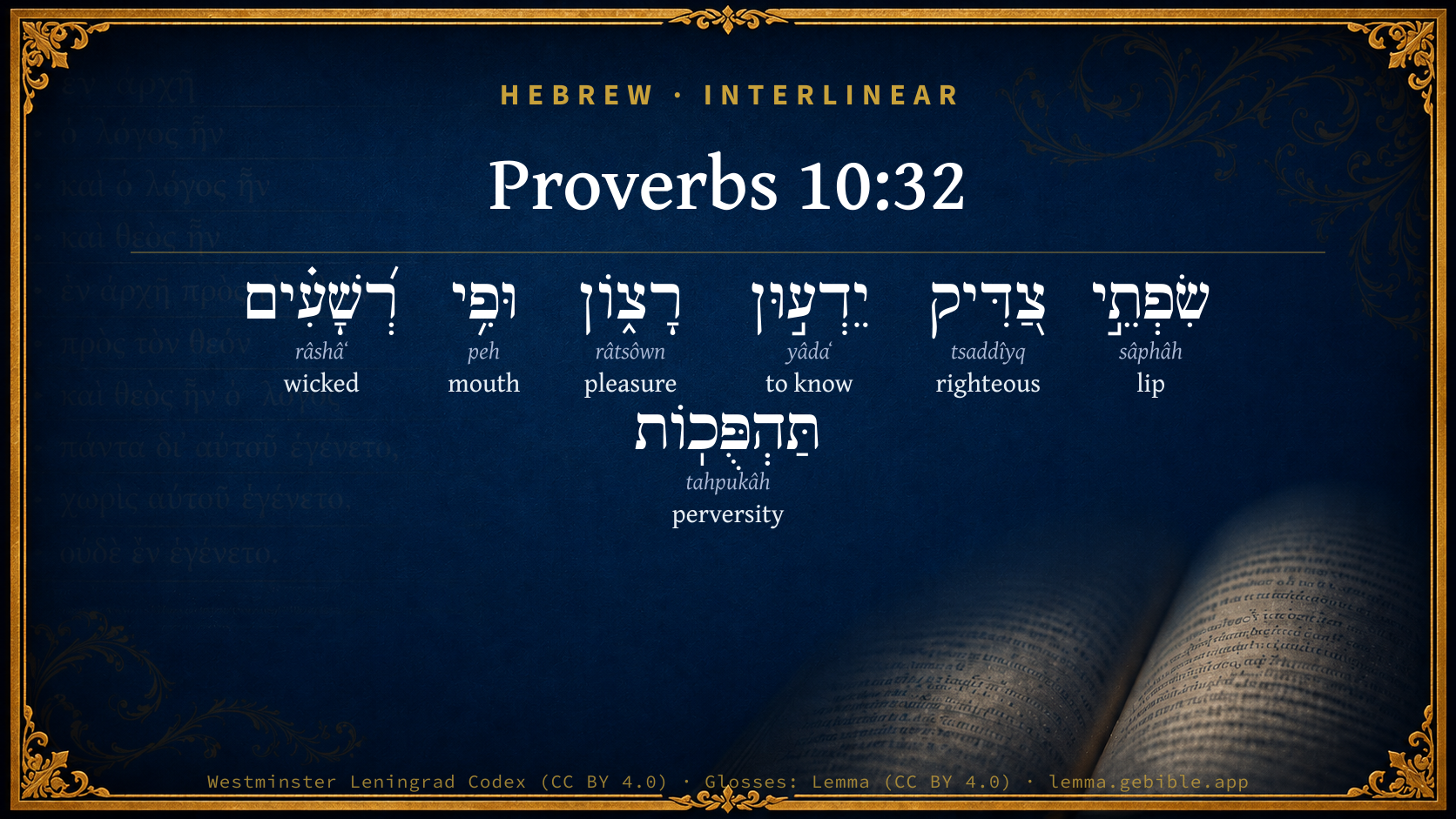
Hebrew (Westminster Leningrad Codex) Proverbs 10:32 appears in the Hebrew Old Testament. The text above is from the Westminster Leningrad Codex. Each word links to its Strong’s number, a concise gloss, and parsing drawn from the Open Scriptures Hebrew Bible morphology. Click any word for its full Brown-Driver-Briggs (BDB) entry.
Download image
Cite this verse

Proverbs 10:32 (World English Bible). Public Domain. Lemma interlinear Bible study tool, https://lemma.gebible.app/v/proverbs/10/32.

Show BibTeX & RIS
BibTeX
RIS
English Translation
The lips of the righteous know what is acceptable, But the mouth of the wicked is perverse.
World English Bible · Public Domain
Download a study sheet

One document with this verse’s original text, its word-by-word gloss line, the meaning frame, cross-references with their text, attributed commentary, and full source and license credits — printable, and it pastes into notes with its structure intact.

This verse Autodidact and up

Study sheet (.html) Plain text (.txt)

A passage Seminary Student

Up to 50 verses in one chapter. A passage sheet keeps up to 6 commentary sources and 12 cross-references per verse, in the order this page ranks them, and says so on the sheet whenever that leaves anything out. Ask for a single verse and you get the Autodidact verse sheet above.

Everything on this page stays free to read, with no account — the sheet is a download of what is already on screen, not access to it.

Want to remove ads? Support Godless Engineer
Compare translations 3

The same verse in 3 English versions, stacked beneath the original-language interlinear above. Click any original word for its lexicon entry.

Each is an independent rendering of the whole verse — the interlinear is not word-aligned to these translations.

Highlighted words mark where these versions differ — a whole-verse word diff, not a word-by-word alignment.

  • World English Bible Public Domain
    The lips of the righteous know what is acceptable, But the mouth of the wicked is perverse.
  • King James Version Public Domain
    The lips of the righteous know what is acceptable: but the mouth of the wicked speaketh frowardness.
  • unfoldingWord Literal Text CC BY-SA 4.0
    The lips of the righteous one know favor, but the mouth of the wicked ones, perverse things.

unfoldingWord Literal Text — © unfoldingWord, licensed CC BY-SA 4.0. Word-aligned USFM3 via Door43 (git.door43.org/unfoldingWord/en_ult).

Versions to compare (up to 4)

3 of 4 selected

Show all 18 translations

Every available English version of this verse, each an independent rendering of the whole verse.

  • World English Bible Public Domain
    The lips of the righteous know what is acceptable, But the mouth of the wicked is perverse.
  • Berean Standard Bible Public Domain
    The lips of the righteous know what is fitting, but the mouth of the wicked is perverse.
  • Majority Standard Bible Public Domain
    The lips of the righteous know what is fitting, but the mouth of the wicked is perverse.
  • King James Version Public Domain
    The lips of the righteous know what is acceptable: but the mouth of the wicked speaketh frowardness.
  • American Standard Version (1901) Public Domain
    The lips of the righteous know what is acceptable; But the mouth of the wicked `speaketh' perverseness.
  • Revised Version (1885) Public Domain
    The lips of the righteous know what is acceptable: but the mouth of the wicked speaketh frowardness.
  • Geneva Bible (1599) Public Domain
    The lips of the righteous knowe what is acceptable: but the mouth of the wicked speaketh froward things.
  • Douay-Rheims (1899) Public Domain
    The lips of the just consider what is acceptable: and the mouth of the wicked uttereth perverse things.
  • Young's Literal Translation Public Domain
    The lips of the righteous know a pleasing thing, And the mouth of the wicked perverseness!
  • Literal Standard Version CC BY-SA 4.0
    The lips of the righteous know a pleasing thing, || And the mouth of the wicked perverseness!
  • Unlocked Literal Bible CC BY-SA 4.0
    The lips of the righteous person know what is acceptable, but the mouth of the wicked, they know what is perverse.
  • unfoldingWord Literal Text CC BY-SA 4.0
    The lips of the righteous one know favor, but the mouth of the wicked ones, perverse things.
  • Darby Bible Public Domain
    The lips of a righteous [man] know what is acceptable; but the mouth of the wicked is frowardness.
  • World Messianic Bible Public Domain
    The lips of the righteous know what is acceptable, but the mouth of the wicked is perverse.
  • Webster's Bible Public Domain
    The lips of the righteous know what is acceptable: but the mouth of the wicked speaketh frowardness.
  • Free Bible Version CC BY-SA 4.0
    Good people know the right thing to say, but the wicked always lie.
  • Bible in Basic English Public Domain
    The lips of the upright man have knowledge of what is pleasing, but twisted are the mouths of evil-doers.
  • JPS Tanakh (1917) Public Domain
    The lips of the righteous know what is acceptable; but the mouth of the wicked is all frowardness.

Literal Standard Version (2020), Covenant Press — licensed CC BY-SA 4.0. Text via the HelloAO Bible API (eBible.org). Unlocked Literal Bible (unfoldingWord) — licensed CC BY-SA 4.0. Text via the HelloAO Bible API (eBible.org). unfoldingWord Literal Text — © unfoldingWord, licensed CC BY-SA 4.0. Word-aligned USFM3 via Door43 (git.door43.org/unfoldingWord/en_ult). Free Bible Version, Dr. Jonathan Gallagher — licensed CC BY-SA 4.0. Text via the HelloAO Bible API (eBible.org).

Word by word

More ways to search: Search by grammar → Find every occurrence → Compare this word →

Practice this passage: Drill this verse → Learn its vocabulary →

About this verse

These counts appear in no published source. They are computed here, from the morphology-tagged text and Lemma’s own curated glosses. What Lemma adds →

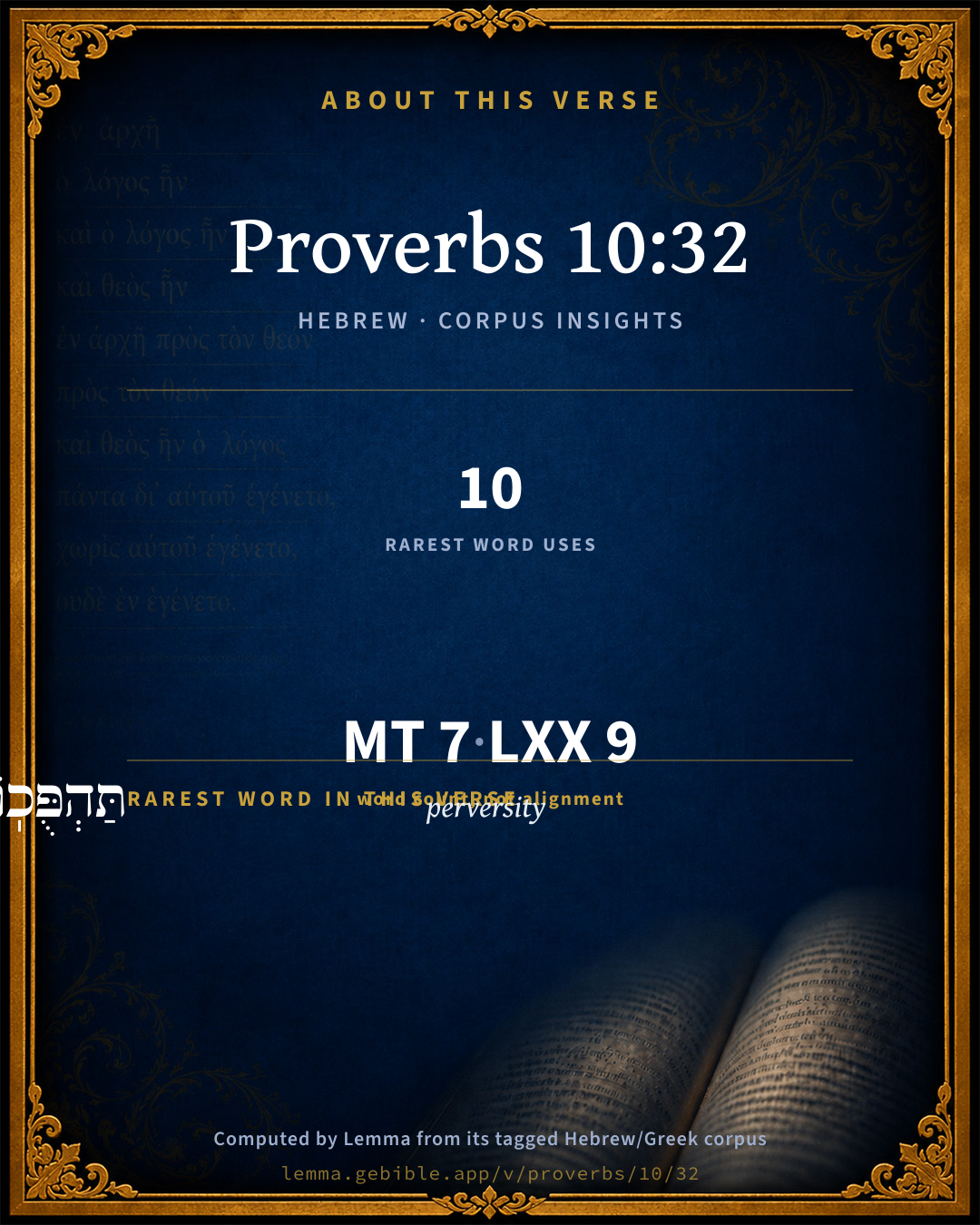
7
words
7
distinct lemmas
Wisdom
section

Notable vocabulary

The rarest word here is תַּהְפֻּכֽוֹת perversity H8419 — appearing just 10 times in the whole Hebrew Bible.

Shared distinctive vocabulary

תַּהְפֻּכֽוֹת perversity H8419 occurs in 10 verses of the Hebrew Bible. Also found in:

Grammatical profile

  • 1 verb
  • 4 nouns
  • 2 adjectives

Verb forms

  • יֵדְע֣וּן Qal · Imperfect

Hebrew & Septuagint length

In English translation the verse runs 17 words from the Hebrew and 15 from the Septuagint (LXX English) — closely comparable.

A rough comparison of the two English renderings, which tokenize alike — not a word-level alignment.

Word counts can differ between the Hebrew and the Greek without any difference in meaning — e.g. the Hebrew direct-object marker אֵת has no separate Greek word, and Greek often adds the article ὁ.

In the original languages it is 7 Hebrew tokens and 9 Greek tokens — but the two are counted differently (Hebrew bundles its prefixes and suffixes into one token; the Greek is in lemma form), so that isn’t a like-for-like length.

Cross-references

11

Topical passages linked to Proverbs 10:32 in the Treasury of Scripture Knowledge — connected by theme and wording, ordered by reader-vote popularity; previews shown in the World English Bible.

  • Proverbs 11:11 By the blessing of the upright, the city is exalted, But it is overthrown by the mouth of the wicked.
  • Proverbs 12:6 The words of the wicked are about lying in wait for blood, But the speech of the upright rescues them.
  • Proverbs 12:18 There is one who speaks rashly like the piercing of a sword, But the tongue of the wise heals.
  • Proverbs 15:28 The heart of the righteous weighs answers, But the mouth of the wicked gushes out evil.
  • Proverbs 2:12 To deliver you from the way of evil, From the men who speak perverse things;
  • Proverbs 15:2 The tongue of the wise commends knowledge, But the mouth of fools gush out folly.
  • Proverbs 18:6–8 A fool's lips come into strife, And his mouth invites beatings.
  • Ecclesiastes 12:10 The Preacher sought to find out acceptable words, and that which was written blamelessly, words of truth.
  • Ecclesiastes 10:12 The words of a wise man's mouth are gracious; but a fool is swallowed by his own lips.
  • Daniel 4:27 Therefore, O king, let my counsel be acceptable to you, and break off your sins by righteousness, and your iniquities by showing mercy to the poor; if there may be a lengthening of your tranquillity.
  • Titus 2:8 and soundness of speech that can't be condemned; that he who opposes you may be ashamed, having no evil thing to say about us.

Cross-references courtesy of OpenBible.info (CC BY 4.0).

Hebrew and Greek witnesses Masoretic Hebrew ↔ Greek Septuagint

The same verse in the two great witnesses to the Old Testament, shown verse-for-verse.

These are two independent witnesses, not word-aligned to each other, and the Septuagint is shown in lemma (dictionary) form.

Hebrew Proverbs 10:32 Masoretic · Westminster Leningrad Codex

שִׂפְתֵ֣י צַ֭דִּיק יֵדְע֣וּן רָצ֑וֹן וּפִ֥י רְ֝שָׁעִ֗ים תַּהְפֻּכֽוֹת

The lips of the righteous know what is acceptable, But the mouth of the wicked is perverse.

World English Bible · Public Domain

Greek LXX Proverbs 10:32 Septuagint · lemma form

χεῖλος ἀνήρ δίκαιος ἀποστάζω χάρις στόμα δέ ἀσεβής ἀποστρέφω

The lips of just men drop grace: but the mouth of the ungodly is perverse.

LXX2012 (modern English Septuagint) · Public Domain

On this verse, The Pulpit Commentary discusses the Septuagint’s reading. Read the note in Commentary ↓

Hebrew: Westminster Leningrad Codex (CC BY 4.0). Greek: Septuagint (public domain); English from LXX2012 (modern English Septuagint) (Public Domain). How the Septuagint differs from the Hebrew →

Commentary

Notes on Proverbs 10:32 from classic Christian and Jewish commentators (each source and its license shown beneath its notes). The classic Christian expositions comment on the surrounding passage and are grouped to its opening verse, so a note may address several verses; the Jewish commentaries on the Tanakh (Rashi and others) are per-verse, so they appear only where the commentator wrote on this verse.

Lemma curates 59 commentaries, every one of them public domain or Creative Commons licensed, each selected and text-cleaned for this edition rather than reprinted as found. About our sources →

Trapp's Complete Commentary

John Trapp

Pro 10:32 The lips of the righteous know what is acceptable: but the mouth of the wicked [speaketh] frowardness.

Ver. 32. The lips of the righteous.] He carries, as it were, a pair of balances between his lips, and weighs his words before he utters them. Et prodesse volens et delectare - willing to speak things both acceptable and profitable. The wicked throws out anything that lies uppermost, though never so absurd, obscene, defamatory, &c.

“ Aera puto nosci tinnitu, sed pestora verbis:

Sic est, namque id sunt utraque quale sonant. ”

John Trapp, A Commentary or Exposition upon All the Books of the Old and New Testament (1647–1656) — public domain. Text from a community e-Sword module.

The Preacher's Complete Homiletical Commentary

Joseph S. Exell (gen. ed.)

MAIN HOMILETICS OF Pro_10:32

ACCEPTABLE WORDS

I. The righteous man knows what words are acceptable to God from a study of Divine laws. The courtier knows how to approach his king—in what words to address him—because he has made himself acquainted with the laws of the court. The righteous man is well acquainted with the laws of the kingdom of God, and, being so, he knows how to draw near to the Divine King—he sets his words in order before Him as the wood is laid in order upon the altar for the sacrifice. God has not left man in ignorance of what kind of words are acceptable to Him (Hos_14:2; Mal_3:16; Mat_6:9; Eph_5:19-20, etc).

II. He knows what words are acceptable to men from a study of their character. Man’s character is a prophecy of the kind of words that will be acceptable. The righteous man makes it his business, and regards it as his duty to frame his speech—so far as is consistent with righteousness—in such a manner that those to whom he speaks will be won to listen to his words.

III. He speaks what are acceptable words from the habit of his heart. It is natural for a good tree to bear good fruit, and it is the nature of a righteous man to speak words of humility and faith to his God and of kindness to his fellow-men. As the tree is, so is the fruit. As the man’s heart is, so, with rare exceptions, are his words. (See on Pro_10:20).

OUTLINES AND SUGGESTIVE COMMENTS

Pro_10:32. The plain sense is, that the righteous speak those things whereby they have the favour both of God and man, and whereby they are in friendship and peace both with heaven and earth. But the mouth of the wicked careth not to offend either God or man, and seeketh not for love anywhere, being wholly pleased in perverseness. But many know what is acceptable to God and man, but their lips do not know it. So the liar knoweth truth to be acceptable to God and man, but their lips do not know it: the profane person knoweth prayer to be acceptable, but his lips do not know it: the ill governor knoweth the reproof of vice to be acceptable, but his lips do not know it: the brawler knoweth mildness of speech to be acceptable, but his lips do not know it. Yea, the lips also of many speak that which is acceptable, but their lips do not know it; their speaking of it being in such a manner as maketh that which is acceptable not to be acceptable. But the righteous man speaketh that which pleaseth God and pleaseth man, and he speaks it in a pleasing manner. Or else as Clemens Alexandrinus readeth, the lips of the righteous know high things in speaking the high praises of the highest God, and in opening the truth of high things unto men.—Jermin.

How, what, when, to whom to speak, is a matter of great wisdom. Yet this consideration of acceptableness must involve no sacrifice of principle. Let it be a considerate accommodation of mode to the diversities of tastes; a forbearance with lesser prejudices and constitutional infirmities; avoiding not all offences (which faithfulness to our Divine Master forbids), but all needless offences, all uncalled-for occasions of design and irritation. “The meekness of wisdom” should be clearly manifested in Christian faithfulness (Jas_3:13.) Thus Gideon melted the frowardness of the men of Ephraim (Jdg_8:2-3). Abigail restrained David’s hands from blood (1Sa_25:23; 1Sa_25:33). Daniel stood fearless before the mighty monarch of Babylon (Dan_4:27). Their lips knew what was acceptable, and their God honoured them.—Bridges.

HOMILY ON THE ENTIRE CHAPTER. The pious and ungodly compared in respect—

1. To their earthly good; 2 To their worth in the eyes of men;

3. To their outward demeanour in intercourse with others;

4. To their disposition of heart as this appears in their mien, their words, their Acts 5. To their diverse fruits, that which they produce in their moral influence upon others;

6. To their different fates as awarded to them at last in the retribution of eternity.—Lange’s Commentary.

The Preacher's Complete Homiletical Commentary (gen. ed. Joseph S. Exell; Funk & Wagnalls, c. 1892) — public domain (pre-1929). A full-Bible homiletical/sermon-outline anthology covering 65 of 66 books (2 John is absent from the source module). Text from a community e-Sword module.

Jamieson, Fausset & Brown

Robert Jamieson, A. R. Fausset & David Brown

know--regard and provide for (Psa 1:6).

frowardness--all kinds of deceit and ill-nature. The word is plural.

Next: Proverbs Chapter 11

Jamieson, Fausset & Brown — Commentary Critical and Explanatory on the Whole Bible (1871) — public domain (CC PDM 1.0). Text via the HelloAO Bible API.

Adam Clarke's Commentary

Verse 32. The lips of the righteous know what is acceptable] And what they believe to be most pleasing and most profitable, that they speak, but the wicked man knows as well what is perverse, and that he speaketh forth. As the love of God is not in his heart, so the law of kindness is not on his lips.

Adam Clarke's Commentary on the Bible (1810–1826) — public domain. Text from a community e-Sword/MySword module.

Ellicott's Commentary for English Readers

(32) What is acceptable.—To God and man. (Comp. the gracious words which proceeded out of Christ’s lips, Luk_4:22.)

Speaketh frowardness.—Rather, is mere falsehood, misrepresentation. (See above on Pro_8:30.)

A Bible Commentary for English Readers, edited by Charles John Ellicott (1878–1897) — public domain. Text from a community e-Sword module.

The Cambridge Bible for Schools and Colleges

gen. ed. J. J. S. Perowne

32. speaketh] So R.V. text: “is,” R.V. marg. Others supply the verb “knoweth” from the first clause, as in Pro_10:29.

The Cambridge Bible for Schools and Colleges (gen. ed. J. J. S. Perowne; Cambridge University Press, 1878–1918) — public domain. Text from a community e-Sword module.

John Gill's Exposition

The lips of the righteous know what is acceptable,.... To God and man; what is well pleasing to, God, and what ministers grace to the hearers, or what is grateful: and such things they will deliver out; they are used and accustomed to them; not only the righteous know in their judgment what is acceptable, but they use themselves to say those things; they not only know them in theory, but practise them: some men know what is acceptable, but their lips do not know it; they are not used to it, but the contrary;

but the mouth of the wicked speaketh frowardness; or perverse things, as before. Or, "the mouth of the wicked knoweth frowardness" (b); or perverse things; or is used only to speak froward things; things contrary to truth and righteousness, and which they know to be so; their mouth speaks things contrary to their hearts; their hearts and mouths do not agree, when they both flatter and lie.

(b) "Novit tantum perversa", Michaelis,

Next: Proverbs Chapter 11

John Gill's Exposition of the Whole Bible (1746–1763) — public domain (CC PDM 1.0). Text via the HelloAO Bible API.

Albert Barnes' Notes on the Bible

Know - i. e., “Know, and therefore utter.” So, in like manner, the “mouth of the wicked” knows, and therefore speaks frowardness, and that only.

Albert Barnes' Notes on the Bible (1834–1885) — public domain. Text from a community e-Sword/MySword module.

Matthew Poole's English Annotations

Know, to wit, practically, so as to consider and speak. Knowledge is here ascribed to the lips, as it is to the hands Psa 78:72, because they are conducted by knowledge and wisdom.

What is acceptable to God and good men, or what is truly worthy of acceptation; for this is opposed to what is froward or wicked in the next clause.

Matthew Poole's English Annotations on the Holy Bible (1683–1685) — public domain. Text from a community e-Sword/MySword module.

Whedon's Commentary on the Bible

Daniel D. Whedon

32. Lips of the righteous know — Distinguish and relish — have a taste for that which is רצון, (ratson,) acceptable, pleasing, that which is good, right, and kind.

But… speaketh frowardness — Relishes perversities — that which is bad. The righteous finds, as if instinctively, what is acceptable; his lips naturally utter it, while the wicked man knows only that which is distorted or perverse, and his mouth speaks only this. As is his character so is his speech. Miller’s translation is worthy of respect: “The lips of the righteous man are instinct with kindness, but the mouth of the wicked with subversive things.” Compare Ecc_12:10; Mal_2:7.

Daniel D. Whedon (gen. ed.), Commentary on the Old and New Testaments (1874–1909) — public domain. Text from a community e-Sword module.

The Pulpit Commentary

Know. A good man"s lips are conversant with what is acceptable to God and man. Such a person considers what will please God and edify his neighbour, and speaks in conformity therewith. The LXX has," The lips of the righteous distil graces;" apostazei caritav , but probably the right verb is epistatai , which is found in some manuscripts. Speaketh frowardnsss; rather, knoweth, or is perverseness; (comp. Eph_4:29) Septuagint, apostrefetai , or, according to the Sinaitic correcter and some other scribes, katastrefetai , "is turned aside," or "is overthrown." Delitszch translates, "is mere falsehood."

The Pulpit Commentary (1880–1919), ed. H.D.M. Spence-Jones & Joseph S. Exell — public domain. Text from a community e-Sword module.

John Wesley's Explanatory Notes

The lips - Knowledge is here ascribed to the lips, as it is to the hands, Psalm lxxviii, 72, because they are conducted by knowledge and wisdom. Acceptable - What is truly worthy of acceptation.

John Wesley, Explanatory Notes Upon the Whole Bible (1754–1765) — public domain. Text via the GEBible commentary corpus.

Keil & Delitzsch

C. F. Keil & F. Delitzsch

21 The lips of the righteous edify many;

But fools die through want of understanding.

Keil & Delitzsch — Biblical Commentary on the Old Testament (1861–1891) — public domain (CC PDM 1.0). Text via the HelloAO Bible API. (Old Testament only.)

Kretzmann's Popular Commentary

Paul E. Kretzmann

v. 32. The lips of the righteous know what is acceptable, they are familiar with it, they are continually meditating upon it; but the mouth of the wicked speaketh frowardness, only such things as are full of distortion, malice, and deceit. He who follows the precepts of God’s eternal wisdom in His Word will avoid both foolishness and deceit.

Paul E. Kretzmann, Popular Commentary of the Bible (1921–1924) — public domain. Text from a community e-Sword module.

Rashi

Rabbi Shlomo Yitzchaki (Rashi)

the lips of a righteous man know how to please They know how to please and placate his Creator, and they know how to please the people and how to make peace among them.

Rashi on the Tanakh — English translations: “The Judaica Press complete Tanach with Rashi, translated by A. J. Rosenberg” (CC BY 4.0); “Pentateuch with Rashi's commentary by M. Rosenbaum and A.M. Silbermann, 1929-1934” (public domain); “The Metsudah Tanach series, Lakewood, N.J” (CC BY 4.0); and “The Book of Joshua, Metsudah Publications, 1997” (CC BY 4.0). Text via Sefaria.

Lesson kit

Teaching starters — assembled from the data on this page, not authored interpretation. Every prompt links to the verse data it draws on. Edit before teaching.

Proverbs, in the Wisdom, opens this verse with 7 words (7 distinct Hebrew lemmas). Its most distinctive word is tahpukâh (“perversity”). A historical commentator’s framing appears above. Read the whole chapter for the surrounding context.

Discussion questions

  1. How does “perversity” (tahpukâh) shape what this verse is saying?
  2. How does Deuteronomy 32:20, which shares the word «perversity», read alongside this verse?
  3. These translations render this verse differently. What is at stake in choosing one wording over another?
  4. «יֵדְע֣וּן» is a Qal Imperfect verb. How does that grammatical form shape the action described?
  5. Compare how Trapp's Complete Commentary and The Preacher's Complete Homiletical Commentary read this verse. Where do they agree or differ?

Things to notice

Reading settings

Reading text

Shown beneath each verse's original-language words.

Old Testament
Old Testament edition

Read the OT as the Masoretic Hebrew (MT) or the Greek Septuagint (LXX).

English shown for the Greek Septuagint (in the Hebrew ↔ Greek comparison).

Comparing translations? Open the Compare panel on any verse page to stack up to four side by side.