
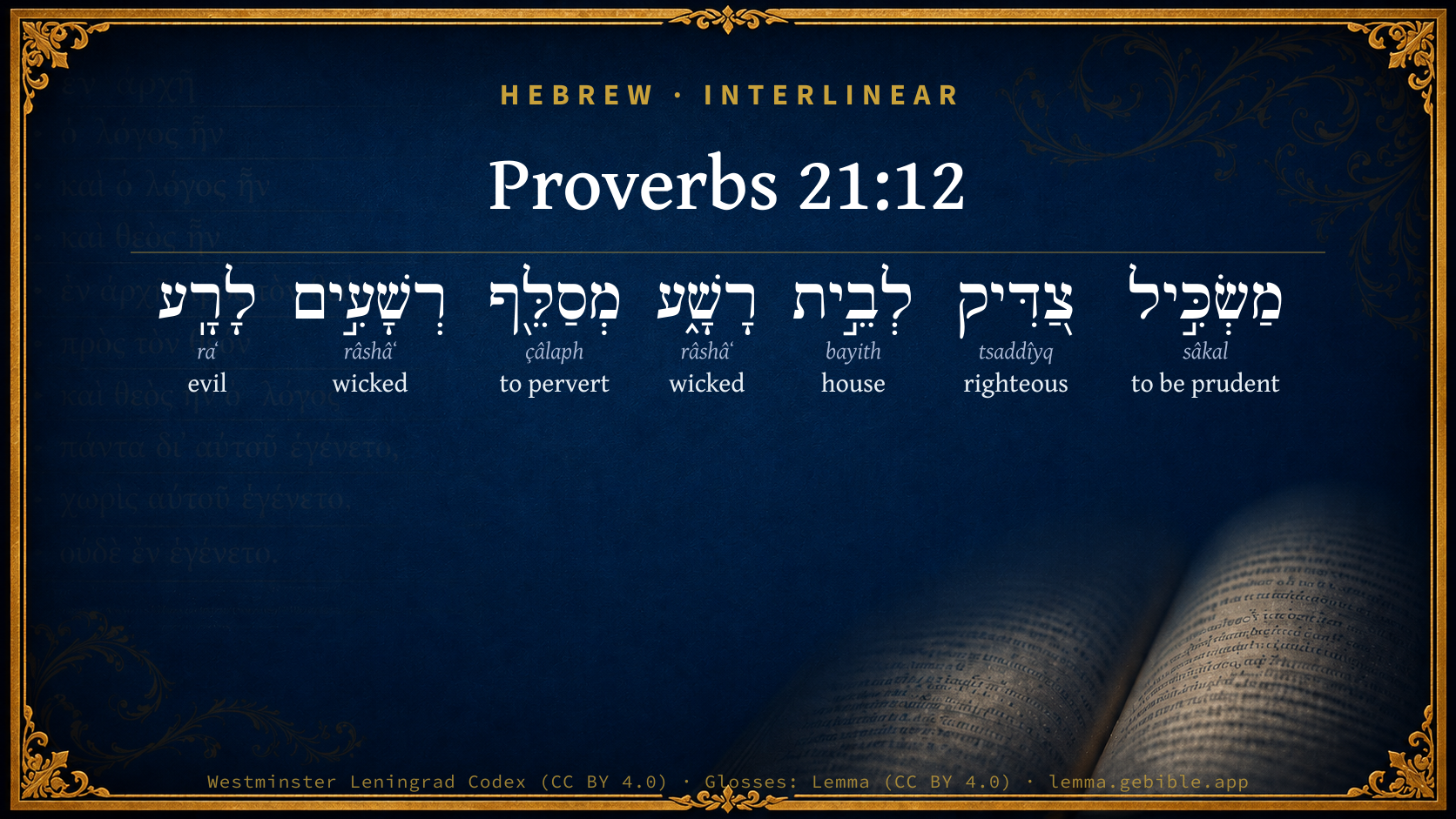
Proverbs 21:12

Hebrew (Westminster Leningrad Codex) Proverbs 21:12 appears in the Hebrew Old Testament. The text above is from the Westminster Leningrad Codex. Each word links to its Strong’s number, a concise gloss, and parsing drawn from the Open Scriptures Hebrew Bible morphology. Click any word for its full Brown-Driver-Briggs (BDB) entry.
Download image
Cite this verse

Proverbs 21:12 (World English Bible). Public Domain. Lemma interlinear Bible study tool, https://lemma.gebible.app/v/proverbs/21/12.

Show BibTeX & RIS
BibTeX
RIS
English Translation
The Righteous One considers the house of the wicked, And brings the wicked to ruin.
World English Bible · Public Domain
Download a study sheet

One document with this verse’s original text, its word-by-word gloss line, the meaning frame, cross-references with their text, attributed commentary, and full source and license credits — printable, and it pastes into notes with its structure intact.

This verse Autodidact and up

Study sheet (.html) Plain text (.txt)

A passage Seminary Student

Up to 50 verses in one chapter. A passage sheet keeps up to 6 commentary sources and 12 cross-references per verse, in the order this page ranks them, and says so on the sheet whenever that leaves anything out. Ask for a single verse and you get the Autodidact verse sheet above.

Everything on this page stays free to read, with no account — the sheet is a download of what is already on screen, not access to it.

Want to remove ads? Support Godless Engineer
Compare translations 3

The same verse in 3 English versions, stacked beneath the original-language interlinear above. Click any original word for its lexicon entry.

Each is an independent rendering of the whole verse — the interlinear is not word-aligned to these translations.

Highlighted words mark where these versions differ — a whole-verse word diff, not a word-by-word alignment.

  • World English Bible Public Domain
    The Righteous One considers the house of the wicked, And brings the wicked to ruin.
  • King James Version Public Domain
    The righteous man wisely considereth the house of the wicked: but God overthroweth the wicked for their wickedness.
  • unfoldingWord Literal Text CC BY-SA 4.0
    A righteous evaluates the house of a wicked; overturning the wicked to evil.

unfoldingWord Literal Text — © unfoldingWord, licensed CC BY-SA 4.0. Word-aligned USFM3 via Door43 (git.door43.org/unfoldingWord/en_ult).

Versions to compare (up to 4)

3 of 4 selected

Show all 18 translations

Every available English version of this verse, each an independent rendering of the whole verse.

  • World English Bible Public Domain
    The Righteous One considers the house of the wicked, And brings the wicked to ruin.
  • Berean Standard Bible Public Domain
    The Righteous One considers the house of the wicked and brings the wicked to ruin.
  • Majority Standard Bible Public Domain
    The Righteous One considers the house of the wicked and brings the wicked to ruin.
  • King James Version Public Domain
    The righteous man wisely considereth the house of the wicked: but God overthroweth the wicked for their wickedness.
  • American Standard Version (1901) Public Domain
    The righteous man considereth the house of the wicked, `How' the wicked are overthrown to `their' ruin.
  • Revised Version (1885) Public Domain
    The righteous man considereth the house of the wicked; how the wicked are overthrown to their ruin.
  • Geneva Bible (1599) Public Domain
    The righteous teacheth the house of the wicked: but God ouerthroweth the wicked for their euill.
  • Douay-Rheims (1899) Public Domain
    The just considereth seriously the house of the wicked, that he may withdraw the wicked from evil.
  • Young's Literal Translation Public Domain
    The Righteous One is acting wisely Towards the house of the wicked, He is overthrowing the wicked for wickedness.
  • Literal Standard Version CC BY-SA 4.0
    The Righteous One is acting wisely || Toward the house of the wicked, || He is overthrowing the wicked for wickedness.
  • Unlocked Literal Bible CC BY-SA 4.0
    The righteous person watches the house of the wicked person; he brings wicked people to disaster.
  • unfoldingWord Literal Text CC BY-SA 4.0
    A righteous evaluates the house of a wicked; overturning the wicked to evil.
  • Darby Bible Public Domain
    One that is righteous wisely considereth the house of the wicked: he overthroweth the wicked to [their] ruin.
  • World Messianic Bible Public Domain
    The Righteous One considers the house of the wicked, and brings the wicked to ruin.
  • Webster's Bible Public Domain
    The righteous man wisely considereth the house of the wicked: but God overthroweth the wicked for their wickedness.
  • Free Bible Version CC BY-SA 4.0
    The God of justice sees what happens in the homes of the wicked, and brings the wicked down in disaster.
  • Bible in Basic English Public Domain
    The Upright One, looking on the house of the evil-doer, lets sinners be overturned to their destruction.
  • JPS Tanakh (1917) Public Domain
    The Righteous One considereth the house of the wicked; overthrowing the wicked to their ruin.

Literal Standard Version (2020), Covenant Press — licensed CC BY-SA 4.0. Text via the HelloAO Bible API (eBible.org). Unlocked Literal Bible (unfoldingWord) — licensed CC BY-SA 4.0. Text via the HelloAO Bible API (eBible.org). unfoldingWord Literal Text — © unfoldingWord, licensed CC BY-SA 4.0. Word-aligned USFM3 via Door43 (git.door43.org/unfoldingWord/en_ult). Free Bible Version, Dr. Jonathan Gallagher — licensed CC BY-SA 4.0. Text via the HelloAO Bible API (eBible.org).

Word by word

More ways to search: Search by grammar → Find every occurrence → Compare this word →

Practice this passage: Drill this verse → Learn its vocabulary →

About this verse

These counts appear in no published source. They are computed here, from the morphology-tagged text and Lemma’s own curated glosses. What Lemma adds →

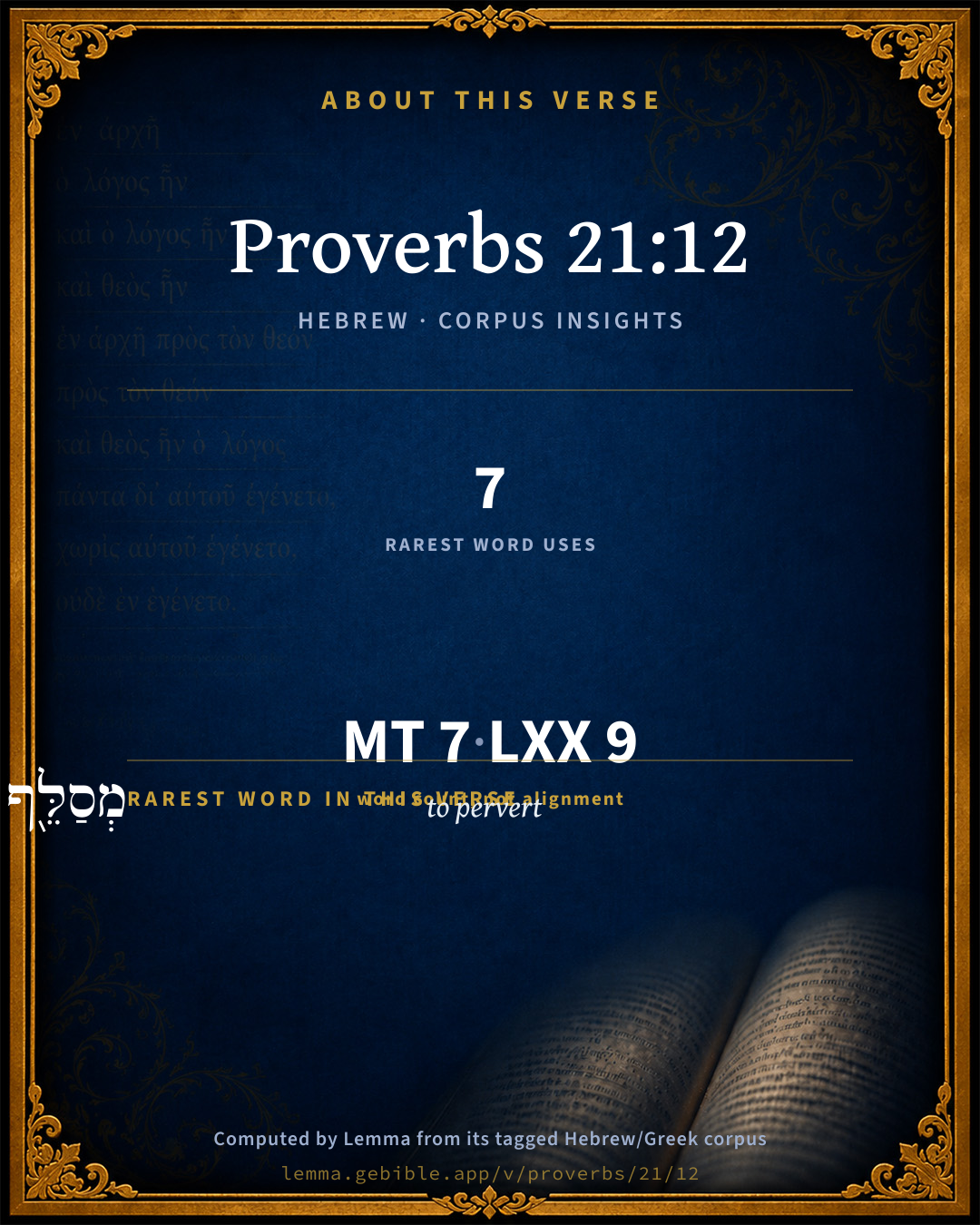
7
words
6
distinct lemmas
Wisdom
section

Notable vocabulary

The rarest word here is מְסַלֵּ֖ף to pervert H5557 — appearing just 7 times in the whole Hebrew Bible.

Shared distinctive vocabulary

מְסַלֵּ֖ף to pervert H5557 occurs in 7 verses of the Hebrew Bible. Also found in:

Grammatical profile

  • 2 verbs
  • 1 noun
  • 4 adjectives

Verb forms

  • מַשְׂכִּ֣יל Hiphil · Participle Active
  • מְסַלֵּ֖ף Piel · Participle Active

Repetition

A word recurs within this verse — often emphatic in Hebrew:

  • רָשָׁ֑ע wicked H7563 ×2

Hebrew & Septuagint length

In English translation the verse runs 15 words from the Hebrew and 16 from the Septuagint (LXX English) — closely comparable.

A rough comparison of the two English renderings, which tokenize alike — not a word-level alignment.

Word counts can differ between the Hebrew and the Greek without any difference in meaning — e.g. the Hebrew direct-object marker אֵת has no separate Greek word, and Greek often adds the article ὁ.

In the original languages it is 7 Hebrew tokens and 9 Greek tokens — but the two are counted differently (Hebrew bundles its prefixes and suffixes into one token; the Greek is in lemma form), so that isn’t a like-for-like length.

Cross-references

19

Topical passages linked to Proverbs 21:12 in the Treasury of Scripture Knowledge — connected by theme and wording, ordered by reader-vote popularity; previews shown in the World English Bible.

  • Psalms 37:35–36 I have seen the wicked in great power, Spreading himself like a green tree in its native soil.
  • Proverbs 14:11 The house of the wicked will be overthrown, But the tent of the upright will flourish.
  • Psalms 107:43 Whoever is wise will pay attention to these things. They will consider the loving kindnesses of Yahweh.
  • 2 Peter 3:6–7 by which means the world that then was, being overflowed with water, perished.
  • Job 5:3 I have seen the foolish taking root, But suddenly I cursed his habitation.
  • Job 8:15 He shall lean on his house, but it shall not stand. He shall cling to it, but it shall not endure.
  • Psalms 52:5 God will likewise destroy you forever. He will take you up, and pluck you out of your tent, And root you out of the land of the living. Selah.
  • Proverbs 11:3–5 The integrity of the upright shall guide them, But the perverseness of the treacherous shall destroy them.
  • Proverbs 14:32 The wicked is brought down in his calamity, But in death, the righteous has a refuge.
  • Hosea 14:9 Who is wise, that he may understand these things? Who is prudent, that he may know them? For the ways of Yahweh are right, And the righteous walk in them; But the rebellious stumble in them.
  • Amos 4:11 "I have overthrown some of you, As when God overthrew Sodom and Gomorrah, And you were like a burning stick plucked out of the fire; Yet you haven't returned to me," says Yahweh.
  • 1 Corinthians 10:5 However with most of them, God was not well pleased, for they were overthrown in the wilderness.
  • 2 Peter 2:4–9 For if God didn't spare angels when they sinned, but cast them down to Tartarus, and committed them to pits of darkness, to be reserved to judgment;
  • Genesis 19:29 It happened, when God destroyed the cities of the plain, that God remembered Abraham, and sent Lot out of the midst of the overthrow, when he overthrew the cities in which Lot lived.
  • Job 18:14–21 He shall be rooted out of his tent where he trusts. He shall be brought to the king of terrors.
  • Job 21:28–30 For you say, 'Where is the house of the prince? Where is the tent in which the wicked lived?'
  • Proverbs 13:6 Righteousness guards the way of integrity, But wickedness overthrows the sinner.
  • Habakkuk 2:9–12 Woe to him who gets an evil gain for his house, that he may set his nest on high, that he may be delivered from the hand of evil!
  • Job 27:13–23 "This is the portion of a wicked man with God, The heritage of oppressors, which they receive from the Almighty.

Cross-references courtesy of OpenBible.info (CC BY 4.0).

Hebrew and Greek witnesses Masoretic Hebrew ↔ Greek Septuagint

The same verse in the two great witnesses to the Old Testament, shown verse-for-verse.

These are two independent witnesses, not word-aligned to each other, and the Septuagint is shown in lemma (dictionary) form.

Hebrew Proverbs 21:12 Masoretic · Westminster Leningrad Codex

מַשְׂכִּ֣יל צַ֭דִּיק לְבֵ֣ית רָשָׁ֑ע מְסַלֵּ֖ף רְשָׁעִ֣ים לָרָֽע

The Righteous One considers the house of the wicked, And brings the wicked to ruin.

World English Bible · Public Domain

Greek LXX Proverbs 21:12 Septuagint · lemma form

συνἵημι δίκαιος καρδία ἀσεβής καί φαυλίζω ἀσεβής ἐν κακός

A righteous man understands the hearts of the ungodly: and despises the ungodly for their wickedness.

LXX2012 (modern English Septuagint) · Public Domain

On this verse, The Cambridge Bible for Schools and Colleges discusses the Septuagint’s reading. Read the note in Commentary ↓

Hebrew: Westminster Leningrad Codex (CC BY 4.0). Greek: Septuagint (public domain); English from LXX2012 (modern English Septuagint) (Public Domain). How the Septuagint differs from the Hebrew →

Commentary

Notes on Proverbs 21:12 from classic Christian and Jewish commentators (each source and its license shown beneath its notes). The classic Christian expositions comment on the surrounding passage and are grouped to its opening verse, so a note may address several verses; the Jewish commentaries on the Tanakh (Rashi and others) are per-verse, so they appear only where the commentator wrote on this verse.

Lemma curates 59 commentaries, every one of them public domain or Creative Commons licensed, each selected and text-cleaned for this edition rather than reprinted as found. About our sources →

Trapp's Complete Commentary

John Trapp

Pro 21:12 The righteous [man] wisely considereth the house of the wicked: [but God] overthroweth the wicked for [their] wickedness.

Ver. 12. The righteous man wisely considereth, &c.] He foreseeth its fearful fall, and is not offended at their present prosperity; for God, he knows, will shortly overturn it. This consideration cures him of the fret, as it did David {Psa 37:1-2} It doth also instruct him in many points of heavenly wisdom, as it did the Church. {Isa 26:11 1Co 10:11} The destruction of others should be an instruction to us, that we may wash our feet in the blood of the wicked. {Psa 52:6}

John Trapp, A Commentary or Exposition upon All the Books of the Old and New Testament (1647–1656) — public domain. Text from a community e-Sword module.

The Preacher's Complete Homiletical Commentary

Joseph S. Exell (gen. ed.)

CRITICAL NOTES.—

Pro_21:12. The words man and God are both supplied by the translators. The verse should be “The righteous considereth the house of the wicked (and) overthroweth, etc. Some understand it, therefore, to mean “The righteous man gives instruction to the house of the wicked to turn them away from evil.” But Stuart remarks that the verb of the second clause is a very strong word, to precipitate, to cast down headlong, and refers the righteous (one) of the first clause to God. This is Zöckler’s rendering also.

MAIN HOMILETICS OF Pro_21:12

GOD’S SURVEILLANCE OF THE WICKED

We follow here the rendering now generally given of this verse. (See Critical Notes.)

I. We have a reference to a mystery in the government of God. It is mysterious that the wicked are permitted to live at large—to pursue their plans and carry on their iniquitous work. Under human governors, men who break the laws of the State and endanger life and property are not allowed to have liberty. If they are permitted to live, they live under restraint—their activities are confined within narrow limits, and so their power to do mischief is taken from them. The prisons scattered throughout our land declare that our rulers only permit those who break our laws to have a very narrow sphere of action; they live where all their freedom is taken from them, and where their rule of life is not their own will but that of others. But God allows those who break His laws a larger amount of freedom—He permits them to mingle freely with righteous men, and to exercise their influence upon the world, and to carry out designs which are often in defiance of His commands. This has often perplexed the good in the world, and they have again and again asked the question, “Wherefore do the wicked live—become old; yea, are mighty in power?” (Job_21:7.)

II. The wicked living thus at large have God for a sentinel. There are many men living at large who are known to be dangerous characters—who, although they do not come within the reach of the law, are known to cherish feelings and intentions which are antagonistic to it. Such people need a more vigilant supervision than those in the prison cells, just because their freedom is greater. An ordinary man can watch a criminal who is secure in a prison, but much greater watchfulness and skill is needed to supervise the actions of one at liberty. Every house of the wicked contains a lawbreaker at liberty, and often one house contains many such who have a large amount of freedom in the execution of their wicked designs. God is the only Being capable of being the sentinel over such a house. They need one who knows the heart as only God knows it—one who sees all their plans before they become actions. They need a sleepless sentinel—one who can be awake at all hours, and so can never be taken by surprise. And this they have in God. None enters or departs from the house of the wicked, and no plot is concocted within it that is not marked by this everwakeful sentinel. The wicked have what it is indispensable they should have—an omniscient and omnipresent eye ever upon them.

III. After the watch has been kept for a given time, the house is marked for falling. We know why God gives such men freedom, for He has told us. It is that they shall have opportunities of repentance—that they “shall turn from their way and live” (Eze_33:11). He spares the house of the godless, for the same reason that the vine-dresser desired that the fruitless fig-tree should be spared (Luk_13:6-9). He gives men time to bring forth fruits of holiness, to their own profit and to His glory. So He considered the house of the sinners, before the flood. His “longsuffering waited while the ark was a preparing” (1Pe_3:20) for some tokens of a change of disposition towards Himself, and consequently towards His laws. But none came, and so the day came when the flood came, and swept away both the houses and their inhabitants. So He considered the house of the Jewish nation, after the death of Christ. In the days of John the Baptist, the “axe was laid unto the root of the tree” (Mat_3:10), but the hand was not lifted to strike, until the rejection of the Messiah, and of the ministry of His apostles, had proved that there was no hope of a moral change. The wicked shall be overthrown, but God considereth their house long before He gives the final blow.

OUTLINES AND SUGGESTIVE COMMENTS

(It will be seen that these read the verse as in our version.)

The punishment of the wicked reads a lesson not only of love and trembling, but of wise consideration. Yet many are the perplexing mysteries of Providence. The righteous man does not always see with his right eyes. The prosperity of the wicked staggers his faith, excites his envy, and induces hard thoughts of God. (Psa_73:2-14.) But when he looks with the eye of faith, he sees far beyond the dazzling glory of the present moment. He wisely considereth their house; not its external splendour and appurtenances, but how it will end. He justifies God, and puts himself to shame, (Ib. Pro_21:16-22.) “Shall not the Judge of all the earth do right?” (Gen_18:25.) Here we rest, until He shall “arise, and plead His own cause,” and “with the breath of His mouth, and the brightness of His coming, destroy” the very existence of evil. Meanwhile, where the superficial eye sees nothing but confusion, let the righteous man wisely consider lessons of deep and practical profit. The shortness of the prosperity, and the certainty of the overthrow, of the wicked; the assurance of a day of recompense; the contrast of the substance of the godly for time and for eternity—these are the apprehensions of faith. Do they not marvellously set out the perfections of God, and call to each of His children—“My son, give glory to God?”—Bridges.

The Preacher's Complete Homiletical Commentary (gen. ed. Joseph S. Exell; Funk & Wagnalls, c. 1892) — public domain (pre-1929). A full-Bible homiletical/sermon-outline anthology covering 65 of 66 books (2 John is absent from the source module). Text from a community e-Sword module.

Tyndale Open Study Notes

Tyndale Open Resources

21:12 The Righteous One: God sees what the wicked do in the privacy of their homes and will punish them for their sins. Alternatively, the Righteous One might refer to the insight of any righteous individual.

Tyndale Open Study Notes — © Tyndale Open Resources, licensed CC BY-SA 4.0. Text via the HelloAO Bible API.

Geneva Bible (1599)

Geneva Bible translators

Though the godly admonish them both by words and example of life, yet the wicked will not amend, till God destroy them.

Geneva Bible (1599) marginal notes — public domain. Text via Bolls.life.

Matthew Henry's Commentary

1. As we read this verse, it shows why good men, when they come to understand things aright, will not envy the prosperity of evil-doers. When they see the house of the wicked, how full it is perhaps of all the good things of this life, they are tempted to envy; but when they wisely consider it, when they look upon it with an eye of faith, when they see God overthrowing the wicked for their wickedness, that there is a curse upon their habitation which will certainly be the ruin of it ere long, they see more reason to despise them, or pity them, than to fear or envy them. 2. Some give another sense of it: The righteous man (the judge or magistrate, that is entrusted with the execution of justice, and the preservation of public peace) examines the house of the wicked, searches it for arms or for stolen goods, makes a diligent enquiry concerning his family and the characters of those about him, that he may by his power overthrow the wicked for their wickedness and prevent their doing any further mischief, that he may fire the nests where the birds of prey are harboured or the unclean birds.

Matthew Henry's Commentary on the Whole Bible (1708–1710) — public domain (CC PDM 1.0). Text via the HelloAO Bible API.

Jamieson, Fausset & Brown

Robert Jamieson, A. R. Fausset & David Brown

(Compare Psa 37:35-38; Psa 73:17, Psa 73:20).

house--family or interests.

overthroweth--either supply "God" (compare Pro 10:24), or the word is used impersonally.

Jamieson, Fausset & Brown — Commentary Critical and Explanatory on the Whole Bible (1871) — public domain (CC PDM 1.0). Text via the HelloAO Bible API.

Adam Clarke's Commentary

Verse 12. The righteous man wisely considereth] This verse is understood as implying the pious concern of a righteous man, for a wicked family, whom he endeavours by his instructions to bring into the way of knowledge and peace.

Adam Clarke's Commentary on the Bible (1810–1826) — public domain. Text from a community e-Sword/MySword module.

Ellicott's Commentary for English Readers

(12) The righteous man wisely considereth the house of the wicked.—Rather, A Righteous one (God) marks the house of the wicked and overthroweth the wicked for (their) destruction. He watches the evil to see whether they will repent (Luk_13:8), and if they will not, at last overthrows them when their iniquity has become full (Gen_15:16).

A Bible Commentary for English Readers, edited by Charles John Ellicott (1878–1897) — public domain. Text from a community e-Sword module.

The Cambridge Bible for Schools and Colleges

gen. ed. J. J. S. Perowne

12. God overthroweth] The difficulty of this proverb lies in the elliptical character of the second clause, which leaves a subject of necessity to be supplied. The A.V. makes man the subject of the first clause, and God of the second. But it is better to render, either with R.V. text:

The righteous man considereth the house of the wicked;

How the wicked are overthrown to their ruin;

or with Ewald and others, and R.V. marg., taking the Righteous One in the first clause to be God (Job_34:17), and retaining the same subject throughout.

One that is righteous considereth the house of the wicked;

He overthroweth the wicked to their ruin.

Both LXX. and Vulg., though differing from one another and from our present Heb. text, make “the righteous” the subject of both clauses.

The Cambridge Bible for Schools and Colleges (gen. ed. J. J. S. Perowne; Cambridge University Press, 1878–1918) — public domain. Text from a community e-Sword module.

John Gill's Exposition

The righteous man wisely considereth the house of the wicked,.... Not so much the stately palace he lives in, and the furniture of it, as the glory, splendour, riches, and largeness of his family; the flourishing condition he and they are in: he considers how they came into it, the short continuance of it, and what the end will be, which in a short time wilt be ruin and destruction; and therefore be does not envy their present happiness, or fret at it. Gersom renders it,

"the righteous maketh the house of the wicked to prosper;''

as Joseph did Potiphar's, and Jacob Laban's; or rather the Lord made them to prosper for their sakes. Jarchi interprets the righteous of God himself; who gives his heart, or has it in his heart to cut off the house of the wicked, as follows;

but God overthroweth the wicked for their wickedness; or removes them into evil, as the Targum; into the evil of punishment, for the evil of sin. Aben Ezra supplies the word "God", as we do; and understands it of God's destroying wicked men for their sins, though they have flourished for a while in this world: but some interpret it of the righteous man, even of a righteous magistrate, who is prudent and diligent in his office; who looks into the houses of wicked men, and inquires who they are that are in them, and how they live; and what they have in their houses, whether stolen goods, the properties of others; or arms, either for treasonable practices or for robberies; and takes them and punishes them according to the laws of God and men.

John Gill's Exposition of the Whole Bible (1746–1763) — public domain (CC PDM 1.0). Text via the HelloAO Bible API.

Albert Barnes' Notes on the Bible

Or, The Righteous One (Yahweh) regardeth well the house of the wicked, and maketh the wicked fall into mischief.

Albert Barnes' Notes on the Bible (1834–1885) — public domain. Text from a community e-Sword/MySword module.

Haydock's Catholic Bible Commentary

Evil. He tries every expedient to save him. --- That. Septuagint, "he despises." Symmachus, "throws down."

George Leo Haydock (1774–1849), Haydock's Catholic Family Bible and Commentary, 1859 edition — public domain. Excludes Psalms (Douay-Rheims chapter numbering differs from Protestant) and Deuterocanonical books (Catholic canon only).

Matthew Poole's English Annotations

Wisely considereth the house of the wicked; he looketh through its present power and glory (which dazzleth the eyes of others) unto that ruin to which it is designed. But, or now, or that, this being the thing which he wisely considereth,

God overthroweth, or will overthrow in his due time, though for a season he bear with them.

Matthew Poole's English Annotations on the Holy Bible (1683–1685) — public domain. Text from a community e-Sword/MySword module.

Whedon's Commentary on the Bible

Daniel D. Whedon

12. The righteous — Either the “righteous” man, as our version, or the “righteous” God, as others interpret the passage. There is nothing in the original to determine the reading. “The Just One.” — Conant. Patrick understands it of magistrates. There is a general consent of the critics on the sense thus: “The Righteous One considers the house of the wicked.” The Judge of all the earth is not unmindful of the evil doers.

Daniel D. Whedon (gen. ed.), Commentary on the Old and New Testaments (1874–1909) — public domain. Text from a community e-Sword module.

The Pulpit Commentary

The righteous man wisely considereth the house of the wicked: but God overthroweth the wicked for their wickedness. The Authorized Version introduces the words "but God" in order to eke out the sense desired; the Revised Version, for the same reason, has, "how the wicked are overthrown;" and both versions signify that the good man contemplates the fortunes and seeming prosperity of the wicked, and, looking to the end of these men, sees how hollow is their success and what a fatal issue awaits them. The Vulgate refers the passage to the zeal of the righteous for the salvation of sinners a thought quite foreign to the present subject thus: Excogitat justus de domo impii, ut detrahat impios a malo, "The righteous man reflects concerning the house of the wicked how he may deliver them from evil. " The Hebrew is literally, A righteous one looketh on the house of the wicked: he precipitates the wicked to destruction. There is no change of subject in the two clauses, and "a righteous One" (tsaddik) is God, put indeterminately to excite the greater awe. (comp. Job_34:17) The Lord keeps the sinners under his eye, that he may punish them at the fit moment. (comp. Pro_22:12Jo Pro_12:19) The notion of God"s moral government of the universe prevails most strongly in every pronouncement of the writer. The LXX interprets "the house" as heart and conscience, and renders, "A righteous man understands the hearts of the godless, and despises the impious in their wickednesses;" he sees through their outward felicity, knows well its unreality, and despises them for the low aims and pursuits which satisfy them.

The Pulpit Commentary (1880–1919), ed. H.D.M. Spence-Jones & Joseph S. Exell — public domain. Text from a community e-Sword module.

John Wesley's Explanatory Notes

Considereth - He looks through its present glory to that ruin for which it is designed.

John Wesley, Explanatory Notes Upon the Whole Bible (1754–1765) — public domain. Text via the GEBible commentary corpus.

Keil & Delitzsch

C. F. Keil & F. Delitzsch

12 A righteous One marketh the house of the godless;

He hurleth the godless to destruction.

If we understand by the word צדּיק a righteous man, then 12a would introduce the warning which he gives, and the unexpressed subject of 12b must be God (Umbreit). But after such an introitus, יהוה ought not to be wanting. If in 12a "the righteous man" is the subject, then it presents itself as such also for the second parallel part. But the thought that the righteous, when he takes notice of the house of the godless, shows attention which of itself hurls the godless into destruction (Lwenstein), would require the sing. רשׁע in the conclusion; also, instead of מסלּף the fut. יסלּף would have been found; and besides, the judicial סלּף (vid., regarding this word at Pro 11:3; Pro 19:3) would not be a suitable word for this confirmation in evil. Thus by צדיק the proverb means God, and מסלף has, as at Pro 22:12, Job 12:19, this word as its subject. "A righteous One" refers to the All-righteous, who is called, Job 34:17, "the All-just One," and by Rashi, under the passage before us, צדּיקו שׁל־עולם. Only do not translate with Bertheau and Zckler: the Righteous One (All-righteous), for (1) this would require הצּדּיק, and (2) הצדיק is never by itself used as an attributive designation of God. Rightly, Fleischer and Ewald: a Righteous One, viz., God. It is the indetermination which seeks to present the idea of the great and dreadful: a Righteous One, and such a Righteous One!

(Note: The Arabs call this indetermination âlnkrt lalt'ẓym wallthwyl. Vid., under Psa 2:12.)

השׂכיל with על, Pro 16:20, or אל, Psa 41:2; Neh 8:13, here with ל, signifies to give attention to anything, to look attentively on it. The two participles stand in the same line: animum advertit ... evertit. Hitzig changes לבּית רשׁע into לבּיתו, and makes רשׁע the subject of 12b; but the proverb as it lies before us is far more intelligible.

Keil & Delitzsch — Biblical Commentary on the Old Testament (1861–1891) — public domain (CC PDM 1.0). Text via the HelloAO Bible API. (Old Testament only.)

Bridges on Proverbs

Charles Bridges

The punishment of the wicked reads a lesson not only of love and trembling, but of wise consideration. Yet many are the perplexing mysteries of Providence. The righteous man does not always see with his right eyes. The prosperity of the wicked staggers his faith, excites his envy, and induces hard thoughts of God. (Psa 73:2-14 .) But when he looks with the eye of faith, he sees far beyond the dazzling glory of the present moment. He wisely considereth their house; not its external splendor and appurtenances, but how it will end. He justifies God, and puts himself to shame. (Psa 73:16-22 .) "Shall not the Judge of all the earth do right?" (Gen 18:25 .) Here we rest, until he shall "arise and plead his own cause," and "with the breath of his mouth, and the brightness of his coming, destroy"†1 the very existence of evil. Meanwhile, where the superficial eye sees nothing but confusion, let the righteous man wisely consider lessons of deep and practical profit. The shortness of the prosperity,†2 and the certainty of the overthrow, of the wicked;†3 the assurance of a day of recompense;†4 the contrast of the substance of the godly for time and for eternity†5 — these are the apprehensions of faith. Do they not marvelously set out the perfections of God, and call to each of his children — "My son, give glory to God"?

Footnotes:

†1 Psa 74:22; Psa 82:8 . 2Th 2:8 .

†2 Job 20:4-5. Psa 37:35-36 .

†3 Pro 12:7; Pro 13:3-6 ; Pro 15:25 . 2Pe 2:4-9 .

†4 Job 21:28-30. Psa 58:10-11 .

†5 Job 22:15-20. Psa 73:23-26 .

Charles Bridges, An Exposition of the Book of Proverbs (1846) — public domain. Text from a community e-Sword module.

Kretzmann's Popular Commentary

Paul E. Kretzmann

v. 12. The righteous man wisely considereth the house of the wicked, the reference evidently being to God, who marks the house of the ungodly, noting every sign of wickedness, every deed of violence; but God overthroweth the wicked for their wickedness, He plunges them into misfortune and destruction.

Paul E. Kretzmann, Popular Commentary of the Bible (1921–1924) — public domain. Text from a community e-Sword module.

Rashi

Rabbi Shlomo Yitzchaki (Rashi)

The Righteous One considers The Righteous One of the world sets His heart to destroy the house of the wicked, e.g. the remembrance of Amalek.

Rashi on the Tanakh — English translations: “The Judaica Press complete Tanach with Rashi, translated by A. J. Rosenberg” (CC BY 4.0); “Pentateuch with Rashi's commentary by M. Rosenbaum and A.M. Silbermann, 1929-1934” (public domain); “The Metsudah Tanach series, Lakewood, N.J” (CC BY 4.0); and “The Book of Joshua, Metsudah Publications, 1997” (CC BY 4.0). Text via Sefaria.

Lesson kit

Teaching starters — assembled from the data on this page, not authored interpretation. Every prompt links to the verse data it draws on. Edit before teaching.

Proverbs, in the Wisdom, opens this verse with 7 words (6 distinct Hebrew lemmas). Its most distinctive word is çâlaph (“to pervert”). A historical commentator’s framing appears above. Read the whole chapter for the surrounding context.

Discussion questions

  1. The word çâlaph carries the sense “to pervert.” How does it shape the verse?
  2. How does Exodus 23:8, which shares the word «to pervert», read alongside this verse?
  3. What does the repetition of “wicked” (2× in this one verse) do in this verse?
  4. These translations render this verse differently; the difference is in the English rendering, not the original. What questions does that raise?
  5. «מַשְׂכִּ֣יל» is a Hiphil Participle Active verb. How does that grammatical form shape the action described?
  6. Compare how Trapp's Complete Commentary and The Preacher's Complete Homiletical Commentary read this verse. Where do they agree or differ?

Things to notice

Reading settings

Reading text

Shown beneath each verse's original-language words.

Old Testament
Old Testament edition

Read the OT as the Masoretic Hebrew (MT) or the Greek Septuagint (LXX).

English shown for the Greek Septuagint (in the Hebrew ↔ Greek comparison).

Comparing translations? Open the Compare panel on any verse page to stack up to four side by side.