
Job 3:17

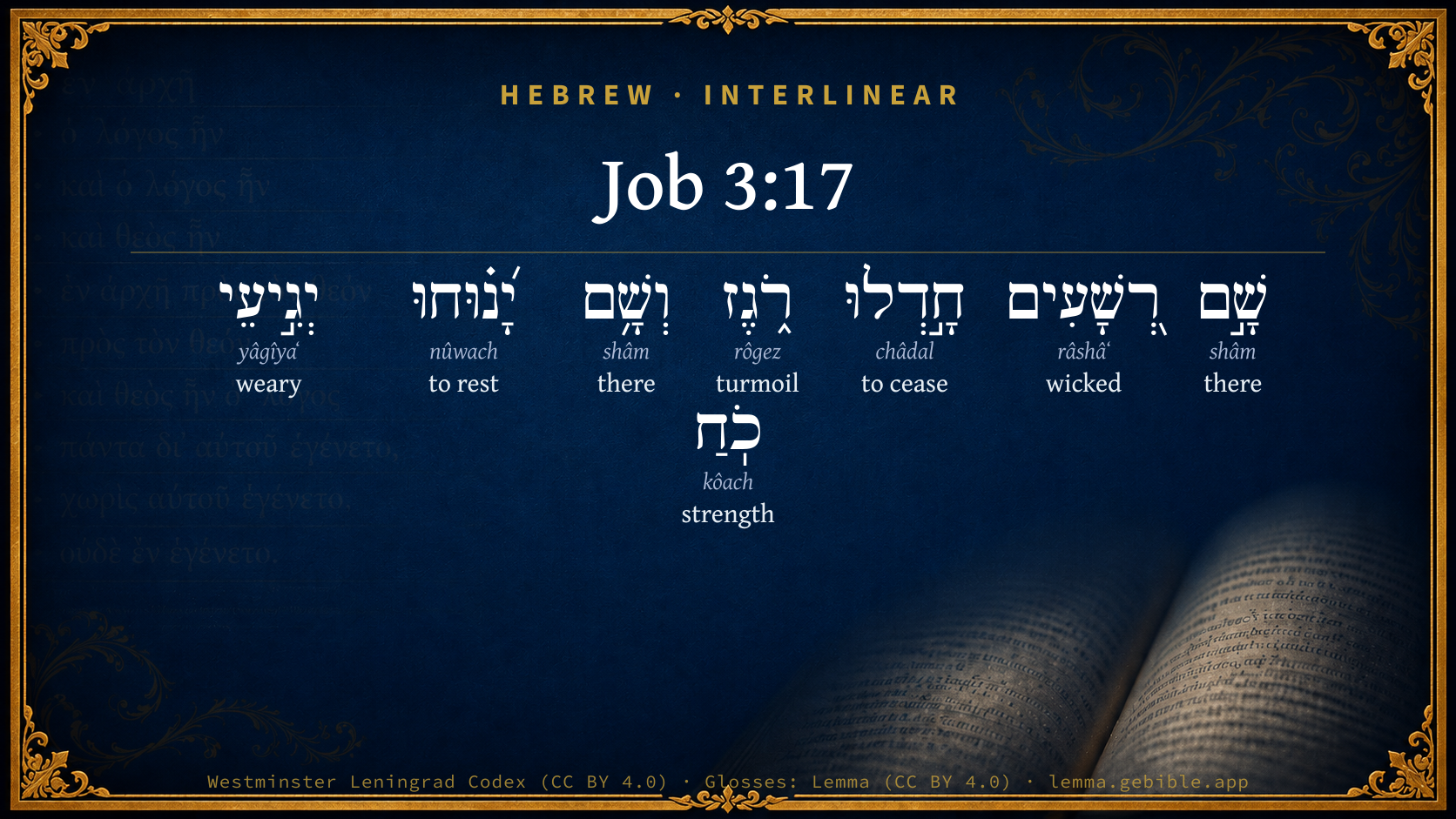
Hebrew (Westminster Leningrad Codex) Job 3:17 appears in the Hebrew Old Testament. The text above is from the Westminster Leningrad Codex. Each word links to its Strong’s number, a concise gloss, and parsing drawn from the Open Scriptures Hebrew Bible morphology. Click any word for its full Brown-Driver-Briggs (BDB) entry.
Download image
Cite this verse

Job 3:17 (World English Bible). Public Domain. Lemma interlinear Bible study tool, https://lemma.gebible.app/v/job/3/17.

Show BibTeX & RIS
BibTeX
RIS
English Translation
There the wicked cease from troubling; There the weary are at rest.
World English Bible · Public Domain
Highlights
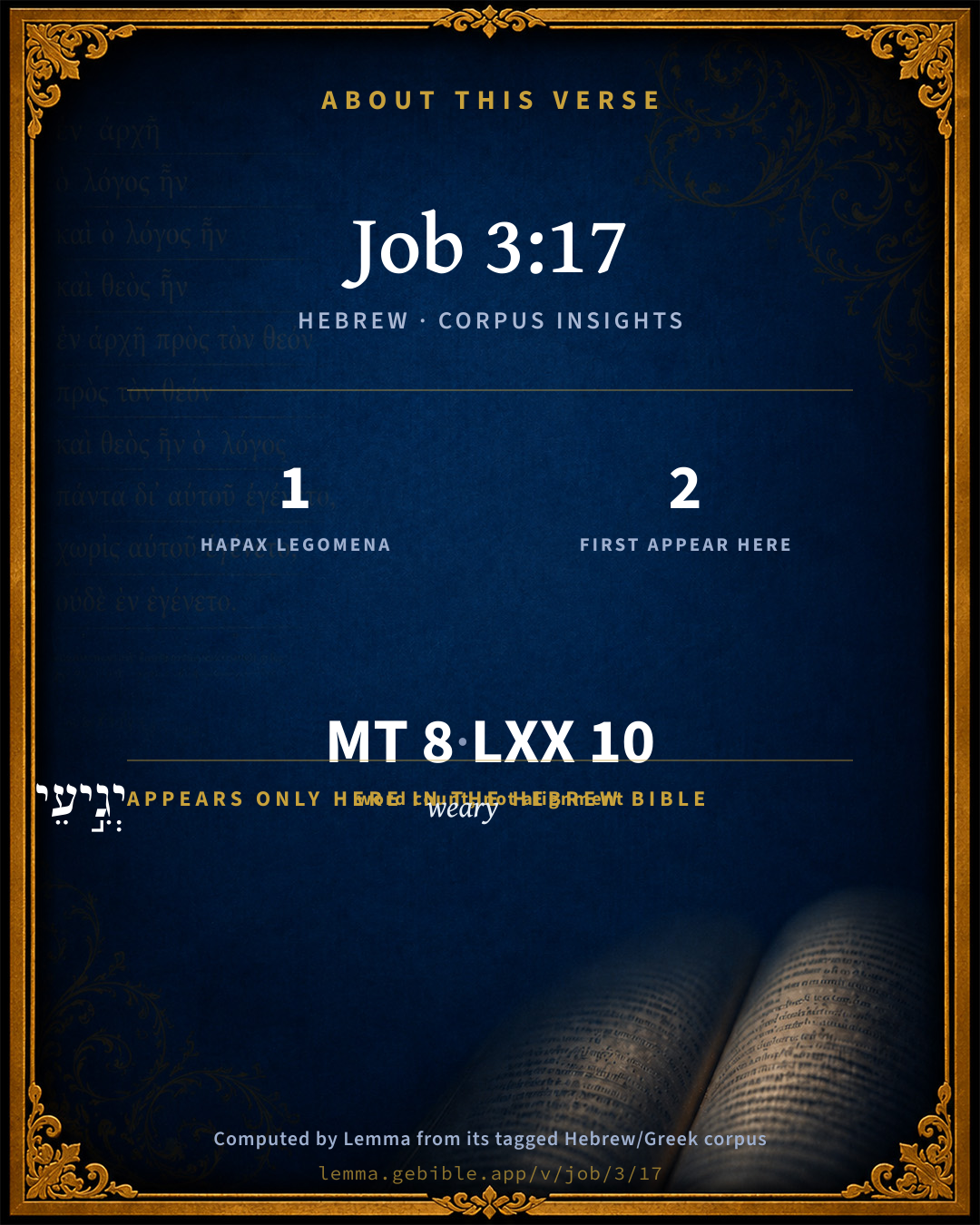
  • 1 hapax legomenon — only here in the Hebrew Bible
  • 2 first appearances in the Hebrew Bible
Full analysis ↓
Download a study sheet

One document with this verse’s original text, its word-by-word gloss line, the meaning frame, cross-references with their text, attributed commentary, and full source and license credits — printable, and it pastes into notes with its structure intact.

This verse Autodidact and up

Study sheet (.html) Plain text (.txt)

A passage Seminary Student

Up to 50 verses in one chapter. A passage sheet keeps up to 6 commentary sources and 12 cross-references per verse, in the order this page ranks them, and says so on the sheet whenever that leaves anything out. Ask for a single verse and you get the Autodidact verse sheet above.

Everything on this page stays free to read, with no account — the sheet is a download of what is already on screen, not access to it.

Want to remove ads? Support Godless Engineer
Compare translations 3

The same verse in 3 English versions, stacked beneath the original-language interlinear above. Click any original word for its lexicon entry.

Each is an independent rendering of the whole verse — the interlinear is not word-aligned to these translations.

Highlighted words mark where these versions differ — a whole-verse word diff, not a word-by-word alignment.

  • World English Bible Public Domain
    There the wicked cease from troubling; There the weary are at rest.
  • King James Version Public Domain
    There the wicked cease from troubling; and there the weary be at rest.
  • unfoldingWord Literal Text CC BY-SA 4.0
    There the wicked stop troubling, and there the weary in strength rest.

unfoldingWord Literal Text — © unfoldingWord, licensed CC BY-SA 4.0. Word-aligned USFM3 via Door43 (git.door43.org/unfoldingWord/en_ult).

Versions to compare (up to 4)

3 of 4 selected

Show all 18 translations

Every available English version of this verse, each an independent rendering of the whole verse.

  • World English Bible Public Domain
    There the wicked cease from troubling; There the weary are at rest.
  • Berean Standard Bible Public Domain
    There the wicked cease from raging, and there the weary find rest.
  • Majority Standard Bible Public Domain
    There the wicked cease from raging, and there the weary find rest.
  • King James Version Public Domain
    There the wicked cease from troubling; and there the weary be at rest.
  • American Standard Version (1901) Public Domain
    There the wicked cease from troubling; And there the weary are at rest.
  • Revised Version (1885) Public Domain
    There the wicked cease from troubling; and there the weary be at rest.
  • Geneva Bible (1599) Public Domain
    The wicked haue there ceased from their tyrannie, and there they that laboured valiantly, are at rest.
  • Douay-Rheims (1899) Public Domain
    There the wicked cease from tumult, and there the wearied in strength are at rest.
  • Young's Literal Translation Public Domain
    There the wicked have ceased troubling, And there rest do the wearied in power.
  • Literal Standard Version CC BY-SA 4.0
    There the wicked have ceased troubling, || And there the wearied rest in power.
  • Unlocked Literal Bible CC BY-SA 4.0
    There the wicked cease from trouble; there the weary are at rest.
  • unfoldingWord Literal Text CC BY-SA 4.0
    There the wicked stop troubling, and there the weary in strength rest.
  • Darby Bible Public Domain
    There the wicked cease from troubling; and there the wearied are at rest.
  • World Messianic Bible Public Domain
    There the wicked cease from troubling. There the weary are at rest.
  • Webster's Bible Public Domain
    There the wicked cease from troubling; and there the weary are at rest.
  • Free Bible Version CC BY-SA 4.0
    There in the grave the wicked give no more trouble, and those whose strength is gone have their rest.
  • Bible in Basic English Public Domain
    There the passions of the evil are over, and those whose strength has come to an end have rest.
  • JPS Tanakh (1917) Public Domain
    There the wicked cease from troubling; and there the weary are at rest.

Literal Standard Version (2020), Covenant Press — licensed CC BY-SA 4.0. Text via the HelloAO Bible API (eBible.org). Unlocked Literal Bible (unfoldingWord) — licensed CC BY-SA 4.0. Text via the HelloAO Bible API (eBible.org). unfoldingWord Literal Text — © unfoldingWord, licensed CC BY-SA 4.0. Word-aligned USFM3 via Door43 (git.door43.org/unfoldingWord/en_ult). Free Bible Version, Dr. Jonathan Gallagher — licensed CC BY-SA 4.0. Text via the HelloAO Bible API (eBible.org).

Word by word

More ways to search: Search by grammar → Find every occurrence → Compare this word →

Practice this passage: Drill this verse → Learn its vocabulary →

About this verse

These counts appear in no published source. They are computed here, from the morphology-tagged text and Lemma’s own curated glosses. What Lemma adds →

8
words
7
distinct lemmas
Wisdom
section

Notable vocabulary

1 hapax legomenon — a word that appears only here in the entire Hebrew Bible:

  • יְגִ֣יעֵי weary H3019

First appearance in Scripture

These words make their first canonical appearance in the Hebrew Bible here:

  • רֹ֑גֶז turmoil H7267
  • יְגִ֣יעֵי weary H3019

Shared distinctive vocabulary

רֹ֑גֶז turmoil H7267 occurs in 7 verses of the Hebrew Bible. Also found in:

Grammatical profile

  • 2 verbs
  • 2 nouns
  • 2 adjectives
  • 2 adverbs

Verb forms

  • חָ֣דְלוּ Qal · Perfect
  • יָ֝נ֗וּחוּ Qal · Imperfect

Repetition

A word recurs within this verse — often emphatic in Hebrew:

  • שָׁ֣ם there H8033 ×2

Hebrew & Septuagint length

In English translation the verse runs 12 words from the Hebrew and 16 from the Septuagint (LXX English) — closely comparable.

A rough comparison of the two English renderings, which tokenize alike — not a word-level alignment.

Word counts can differ between the Hebrew and the Greek without any difference in meaning — e.g. the Hebrew direct-object marker אֵת has no separate Greek word, and Greek often adds the article ὁ.

In the original languages it is 8 Hebrew tokens and 10 Greek tokens — but the two are counted differently (Hebrew bundles its prefixes and suffixes into one token; the Greek is in lemma form), so that isn’t a like-for-like length.

Cross-references

11

Topical passages linked to Job 3:17 in the Treasury of Scripture Knowledge — connected by theme and wording, ordered by reader-vote popularity; previews shown in the World English Bible.

  • Revelation 14:13 I heard the voice from heaven saying, "Write, 'Blessed are the dead who die in the Lord from now on.'" "Yes," says the Spirit, "that they may rest from their labors; for their works follow with them."
  • Job 17:16 Shall it go down with me to the gates of Sheol, Or descend together into the dust?"
  • Job 14:13 "Oh that you would hide me in Sheol, That you would keep me secret, until your wrath is past, That you would appoint me a set time, and remember me!
  • Isaiah 57:1–2 The righteous perishes, and no man lays it to heart; and merciful men are taken away, none considering that the righteous is taken away from the evil [to come].
  • Hebrews 4:9 There remains therefore a Sabbath rest for the people of God.
  • Hebrews 4:11 Let us therefore give diligence to enter into that rest, lest anyone fall after the same example of disobedience.
  • Psalms 55:5–8 Fearfulness and trembling have come on me. Horror has overwhelmed me.
  • Matthew 10:28 Don't be afraid of those who kill the body, but are not able to kill the soul. Rather, fear him who is able to destroy both soul and body in Gehenna.
  • Luke 12:4 "I tell you, my friends, don't be afraid of those who kill the body, and after that have no more that they can do.
  • 2 Thessalonians 1:6–7 Since it is a righteous thing with God to repay affliction to those who afflict you,
  • 2 Peter 2:8 (for that righteous man dwelling among them, was tormented in his righteous soul from day to day with seeing and hearing lawless deeds):

Cross-references courtesy of OpenBible.info (CC BY 4.0).

Hebrew and Greek witnesses Masoretic Hebrew ↔ Greek Septuagint

The same verse in the two great witnesses to the Old Testament, shown verse-for-verse.

These are two independent witnesses, not word-aligned to each other, and the Septuagint is shown in lemma (dictionary) form.

Hebrew Job 3:17 Masoretic · Westminster Leningrad Codex

שָׁ֣ם רְ֭שָׁעִים חָ֣דְלוּ רֹ֑גֶז וְשָׁ֥ם יָ֝נ֗וּחוּ יְגִ֣יעֵי כֹֽחַ

There the wicked cease from troubling; There the weary are at rest.

World English Bible · Public Domain

Greek LXX Job 3:17 Septuagint · lemma form

ἐκεῖ ἀσεβής ἐκκαίω θυμός ὀργή ἐκεῖ ἀναπαύω κατάκοπος ὁ σῶμα

There the ungodly have burnt out the fury of rage; there the wearied in body rest.

LXX2012 (modern English Septuagint) · Public Domain

On this verse, Haydock's Catholic Bible Commentary discusses the Septuagint’s reading. Read the note in Commentary ↓

Hebrew: Westminster Leningrad Codex (CC BY 4.0). Greek: Septuagint (public domain); English from LXX2012 (modern English Septuagint) (Public Domain). How the Septuagint differs from the Hebrew →

Commentary

Notes on Job 3:17 from classic Christian and Jewish commentators (each source and its license shown beneath its notes). The classic Christian expositions comment on the surrounding passage and are grouped to its opening verse, so a note may address several verses; the Jewish commentaries on the Tanakh (Rashi and others) are per-verse, so they appear only where the commentator wrote on this verse.

Lemma curates 59 commentaries, every one of them public domain or Creative Commons licensed, each selected and text-cleaned for this edition rather than reprinted as found. About our sources →

The Cambridge Bible for Schools and Colleges

gen. ed. J. J. S. Perowne

17. cease from troubling] That is, probably, not from troubling others, but from the unquiet of their own evil. Job_3:17-19 contain the two main ideas, first, that all, evil and good, great and small, are the same in the place of the dead; and second, that this common condition is one of profound rest. Even the wicked there are no more agitated by the turbulence of their passions. Comp. Isa_57:20.

the weary] lit. the wearied as to strength, the exhausted.

The Cambridge Bible for Schools and Colleges (gen. ed. J. J. S. Perowne; Cambridge University Press, 1878–1918) — public domain. Text from a community e-Sword module.

Trapp's Complete Commentary

John Trapp

Job 3:17 There the wicked cease [from] troubling; and there the weary be at rest.

Ver. 17. There the wicked cease from troubling] Here they are restless, as being acted and agitated by the devil, who being a discontented, turbulent creature, maketh ado in the world, and setteth his imps awork to do mischief, and to vex others, רשׁעים The word here rendered wicked signifieth vexatious persons, that worry and weary out others, molestuous and mischievous. In the grave they shall cease from so doing. That was a strange mind of our Edward I, who adjured his son and nobles, that if he died in his journey into Scotland, they should carry his corpse with them about Scotland, and not suffer it to be interred till they had absolutely subdued the country (Daniel’s Hist. 201). This was a desire more martial than Christian, saith the chronicler, showing a mind so bent to the world, as he would not make an end when he had done with it, but designeth his travel beyond his life.

And there the weary be at rest] Hence some heathens also have counted mortality a mercy, and some of them appointed contrary ceremonies to those now in use; for they brought their friends into the world with mournful obsequies, but they carried them out of the world with joyful exequies, all sorts of sports and pastimes, because then they conceived they were at rest, and out of gunshot (Plotin. ap. Aug. de C. D. l. 9, c. 10; Quintil. Inst. lib. 5; Herod. l. 5; Val. Max.).

John Trapp, A Commentary or Exposition upon All the Books of the Old and New Testament (1647–1656) — public domain. Text from a community e-Sword module.

The Biblical Illustrator

Joseph S. Exell

Job_3:17

There the wicked cease from troubling.

Wicked men trouble the world

True rest and wickedness never meet; rest and the wicked meet but seldom. And it is but half a rest, and it is rest but to half a wicked man, to his bones in the grave; and it is rest to that half but for a little time, only till the resurrection. The word here used, and in divers other places, signifieth wickedness in the height, and men most active in wickedness. So that when Job saith, There the wicked are at rest, he means those who had been restless in sin, who could not sleep till they had done mischief, nor scarce sleep for doing mischief; he means those who had outrun others in the sinful activity (Act_26:11).

1. Wicked men are troublers both of themselves and others. There the wicked cease from troubling; as if the wicked did nothing in the world, but trouble the world. Wicked ones are the troublers of all; they are troublers of their own families, troublers of the places and cities where they live, the troublers of a whole kingdom, troublers of the Churches of Christ, and the troublers of their own souls.

2. Wicked men, by troubling others, do as much weary and tire out themselves.

3. Wicked men will never cease troubling until they cease to live. In the grave they cease troubling, there they are at rest. If they should live an eternity in this world, they would trouble the world to eternity. As a godly man never gives over doing good, he will do good as long as he lives, though he fetches many a weary step; so wicked men never give over doing evil, until they step into the grave. And the reason of it is, because it is their nature to do evil. The wicked will sin while they have any light to sin by; therefore God puts out their candle, and sends them down into darkness, and there they will be quiet. The wicked shall be silent in darkness. (J. Caryl.)

And the weary are at rest.--

The rest of the grave

In the grave--where kings and princes and infants lie. This verse is often applied to heaven, and the language is such as will express the condition of that blessed world. But, as used by Job, it had no such reference. It relates only to the grave. It is language which beautifully expresses the condition of the dead, and the desirableness even of an abode in the tomb. They who are there are free from the vexations and annoyances to which men are exposed in this life; the wicked cannot torture their limbs by the fires of persecution, or wound their feelings by slander, or oppress and harass them in regard to their property, or distress them by thwarting their plans, or injure them by impugning their motives. All is peaceful and calm in the grave, and there is a place where the malicious designs of wicked men cannot reach us. The object of this verse and the two following is to show the reasons why it was desirable to be in the grave, rather than to live and to suffer the ills of this life. We are not to suppose that Job referred exclusively to his own case in all this. He is describing, in general, the happy condition of the dead, and we have no reason to think that he had been particularly annoyed by wicked men. But the pious often are; and hence it should be a matter of gratitude that there is one place, at least, where the wicked cannot annoy the good, and where the persecuted, the oppressed, and the slandered, may lie down in peace. For there the weary be at rest, the margin has wearied in strength. And the margin is according to the Hebrew. The meaning is, those whose strength is exhausted, who are worn down with the toils and cares of life, and who feel the need of rest. Never was more beautiful language employed than occurs in this verse. What a charm such language throws even over the grave--like strewing flowers and planting roses around the tomb! Who should fear to die, if prepared, when such is to be the condition of the dead? Who is there that is not in some way troubled by the wicked--by their thoughtless, godless life by persecution, contempt, and slander? (comp. 2Pe_2:8; Psa_39:1) Who is there that is not at some time weary with his load of care, anxiety, and trouble? Who is there whose strength does not become exhausted, and to whom rest is not grateful and refreshing? And who is there, therefore, to whom, if prepared for heaven, the grave would not be a place of calm and grateful rest? And though true religion will not prompt us to wish that we had lain down there in early childhood, as Job wished, yet no dictate of piety is violated when we look forward with calm delight to the time when we may repose where the wicked cease from troubling, and where the weary are at rest. O grave, thou art a peaceful spot! Thy rest is calm; thy slumbers are sweet. (Albert Barnes.)

Desire to depart

Thorns in our nest make us take to our wings; the embittering of this cup makes us earnestly desire to drink of the new wine of the kingdom. We are very much like our poor, who would stay at home in England, and put up with their lot, hard though it be; but when at last there comes a worse distress than usual, then straightway they talk of emigrating to those fair and boundless fields across the Atlantic, where a kindred nation will welcome them with joy, So here we are in our poverty, and we make the best of it we can; but a sharp distress wounds our spirit, and then we say we will away to Canaan, to the land that floweth with milk and honey, for there we shall suffer no distress, neither shall our spirits hunger any more. (J. Trapp.)

Departed trouble, and welcome rest

There the winked cease from troubling; and there the weary be at rest. The day was, when it was thought fit that the Christians last resting place should be surrounded by gloomy and repulsive associations. It is not of peaceful rest that the burying place of the Middle Ages would remind you. We all remember the locked up, deserted, neglected churchyard, all grown over with great weeds and nettles, and not like Gods acre at all. How much more appropriate are the quiet, beautiful, open, carefully tended cemeteries of today! It is not merely better judgment but sounder faith that is here. It is a thoroughly Christian thing, to scatter the beauties of nature around the Christian grave. In the text I see something that is like turning the ghastly, neglected, nettle-grown churchyard which we may remember in childhood, into the quiet, sweet, thoughtful sleeping place which we find so common now. The text speaks to us over nearly four thousand years. Job lived in days when the light of truth was dim; Jesus had not yet brought life and immortality to light; so it is possible that we are able to understand Jobs words more fully and better than he understood them himself. The text may be read first of the grave; but in its best meaning it speaks of a better world, to which the grave is the portal.

I. These words as spoken of the grave, the house appointed for all living. We need not justify the impatient burst in which Job wished, as many others have wished since, that he had never been born. Job speaks of the rest to which he would gladly have gone. He would have slumbered with the wise, the great, and the good: how he would have lain still and been quiet, where trouble could never come, in the peaceful grave. There the wicked cease from troubling. There is one place into which the suffering can escape, where their persecutors have no power. There is nothing more striking about the state of those who have gone into the unseen world than the completeness of their escape from all worldly enemies, however malignant and however powerful. But there is something beyond the mere escape from worldly evil. Now the busy heart is quiet at last, and the weary head lies still. What a multitude there is of these weary ones. But there is a certain delusion in thinking of the grave as a place of quiet rest. The soul lives still, and is awake and conscious, though the body sleeps; and it is our souls that are ourselves. We have no warrant for believing that in the other world there will be any season of unconsciousness to the soul.

II. Take the words in their higher and truer meaning. They speak of a better world, whose two great characteristics are safety and peace.

1. There is safety and the sense of safety. Everything wicked--evil spirits, evil thoughts, evil influences cease from troubling. Everything evil, whether within us or around us, shall be done with. If evil were gone, trouble would go too. The great thing about evil and trouble here is not so much the pain and suffering they cause us, as the terrible power they have to do us fearful spiritual harm.

2. Besides the negative assurance, that trouble will be done with in heaven, we have the promise of a positive blessing. There the weary are at rest. The peace and happiness of the better world are summed up in that word. The end of work is to enjoy rest, said one of the wisest of heathen. Doubtless there will be rest from sin, from sorrow, from toil, from anxiety, from temptation, from pain; but all that fails to convey the whole unspeakable truth; it will be the beatific presence of the Saviour that will make the weary soul feel it never knew rest before! In that world the bliss will be restful, calm, satisfied, self-possessed, sublime. The only rest that can ever truly and permanently quiet the human heart is that which the Saviour gives. His peace. And He gives it only to His own. (A. K. H. Boyd.)

The Biblical Illustrator, edited by Joseph S. Exell (c. 1880s–1900s) — public domain. Text from a community e-Sword module.

Joseph Benson's Commentary

Job 3:17. There the wicked cease from troubling — In the grave the great oppressors and troublers of the world cease from their vexatious rapines and murders; and there the weary be at rest — Those who were here molested, and tired out with their tyrannies, oppressions, and injuries, now quietly sleep with them.

Joseph Benson's Commentary on the Old and New Testaments (1811–1818) — public domain. Text from a community e-Sword module.

Whedon's Commentary on the Bible

Daniel D. Whedon

c. Then and there, for the first time, the inequalities in life’s allotments are brought to an end, Job_3:17-19.

17. There — In the grave.

The wicked — The man who rages. According to Kimchi, such is the idea of the root of the word רשׁע, to rage, to storm. He is inwardly torn by passions and appetites. The ocean is a befitting emblem of his ever-restless soul. (Isa_57:20.) His inward trouble leads him to trouble others. His present life — an unceasing source of misery to himself and of pain to friends — casts a dark shadow upon his own eternal condition and its relationship to others. To such a heart there is but one Being who can give rest. (Mat_11:28.)

The weary be at rest — Dr. Chalmers says of this verse, that “it is one of the Scripture’s prime memorabilia.” The ancient Egyptian called the abode of the dead “the covering of the weary.” — Brugsch. Compare Bryant’s “Thanatopsis.” Those wasted by toil, and those stricken of sorrow, alike long for the grave as a place of rest. There is danger, however, lest the morbid spirit exaggerate the real evils of life, and, sighing for the grave, be guilty of bringing reproach upon the ways of God, his goodness, and his love. We may learn a lesson from the wounded soldier, who, absorbed in the battle, heeds little, and often knows not, the wounds he may have received, but fights on till the battle is over, and then, only then, asks for rest. Life’s soldier, (Job_7:1,) his soul each day filled with duty and laborious love, either heeds not or counts as small the present evil, and looks for repose only when God’s will shall have completed his existence. Those “wearied in strength” (see margin) may be referred to an incident in the life of Arnauld, the intrepid antagonist of the Vatican, and of “the grand monarque.” His friend Nicole, a companion in arms, expressed a wish to retire from the field, and to enjoy repose. “Repose!” replied Arnauld, “will you not have the whole of eternity to repose in?” — Encyclop. Britannica, 8th ed., 1:81.

Daniel D. Whedon (gen. ed.), Commentary on the Old and New Testaments (1874–1909) — public domain. Text from a community e-Sword module.

Geneva Bible (1599)

Geneva Bible translators

That is, by death the cruelty of the tyrants hath ceased.

Geneva Bible (1599) marginal notes — public domain. Text via Bolls.life.

Jamieson, Fausset & Brown

Robert Jamieson, A. R. Fausset & David Brown

the wicked--the original meaning, "those ever restless," "full of desires" (Isa 57:20-21).

the weary--literally, "those whose strength is wearied out" (Rev 14:13).

Jamieson, Fausset & Brown — Commentary Critical and Explanatory on the Whole Bible (1871) — public domain (CC PDM 1.0). Text via the HelloAO Bible API.

Adam Clarke's Commentary

Verse 17. There the wicked cease] In the grave the oppressors of men cease from irritating, harassing, and distressing their fellow creatures and dependents.

And there the weary be at rest.] Those who were worn out with the cruelties and tyrannies of the above. The troubles and the troubled, the restless and the submissive, the toils of the great and the labours of the slave, are here put in opposition.

Adam Clarke's Commentary on the Bible (1810–1826) — public domain. Text from a community e-Sword/MySword module.

Ellicott's Commentary for English Readers

(17) There—i.e., in the grave, the place indicated, but not distinctly expressed.

A Bible Commentary for English Readers, edited by Charles John Ellicott (1878–1897) — public domain. Text from a community e-Sword module.

John Gill's Exposition

There the wicked cease from troubling,.... At death, and in the grave; such who have been like the troubled sea, that cannot rest, have always been either devising or doing mischief while living, in the grave can do neither; there is no work nor device there; such who are never easy, and cannot sleep unless they do mischief, when dead have no power to do any, and are quite still and inactive; such who have been troublers of good men, as profane persons by their ungodly lives, false teachers by their pernicious doctrines and blasphemies, cruel persecutors by their hard speeches, bitter calumnies and reproaches, and severe usage; those, when they die themselves, cease from giving further trouble, or when the righteous die, they can disturb them no more; yea, a good man at death is not only no more troubled by wicked men, but no more by his own wicked heart, nor any more by that wicked one Satan; there and then all these cease from giving him any further molestation:

and there the weary be at rest; wicked men, either who here tire and weary themselves with committing sin, to which they are slaves and drudges, and especially with persecuting and troubling the saints, shall rest front such acts of sin and wickedness, of which they will be no more capable; or else good men, who are weary of sin, and long to be rid of it, to whom it is a burden, and under which they groan, and are weary of the troubles and afflictions they meet with in the world; and what with one thing and another are weary of their lives, and desire to depart and be with Christ; these at death and in the grave are at rest, their bodies from toil and labour, and from all painful disorder, and pressing afflictions, and from all the oppressions and vexations of wicked and ungodly men; their souls rest in the arms of Jesus, from sin and all consciousness of it, from the temptations of Satan, from all doubts and fears, and every spiritual enemy, by whom they can be no more annoyed: some render the words, "there rest the labours of strength" (u): such toils are over that break the strength of men; or "the labours of violence" (w), which are imposed upon them through violence, by cruel and imperious men; but at death and in the grave will cease and be no more, even labour of all sorts; see Rev 14:13.

(u) "labores roboris", Michaelis. (w) "Labores violentiae", Schmidt.

John Gill's Exposition of the Whole Bible (1746–1763) — public domain (CC PDM 1.0). Text via the HelloAO Bible API.

Albert Barnes' Notes on the Bible

There the wicked cease - from “troubling.” In the grave - where kings and princes and infants lie. This verse is often applied to heaven, and the language is such as will express the condition of that blessed world. But as used by Job it had no such reference. It relates only to the grave. It is language which beautifully expresses the condition of the dead, and the “desirableness” even of an abode in the tomb. They who are there, are free from the vexations and annoyances to which people are exposed in this life. The wicked cannot torture their limbs by the fires of persecution, or wound their feelings by slander, or oppress and harass them in regard to their property, or distress them by thwarting their plans, or injure them by impugnlug their motives. All is peaceful and calm in the grave, and “there” is a place where the malicious designs of wicked people cannot reach us. The object of this verse and the two following is! to show the “reasons” why it was desirable to be in the grave, rather than to live and to suffer the ills of this life. We are not to suppose that Job referred exclusively to his own case in all this. tie is describing, in general, the happy condition of the dead, and we have no reason to think that he had been particularly annoyed by wicked people. But the pious often are, and hence, it should be a matter of gratitude that there is one place, at least, where the wicked cannot annoy the good; and where the persecuted, the oppressed, and the slandered may lie down in peace.

And there the weary be at rest - Margin, “Wearied in strength.” The margin is in accordance with the Hebrew. The meaning is, those whose strength is exhausted; who are worn down by the toils and eares of life, and who feel the need of rest. Never was more beautiful language employed than occurs in this verse. What a charm such language throws even over the grave - like strewing flowers, and planting roses around the tomb! Who should fear to die, if prepared, when such is to be the condition of the dead? Who is there that is not in some way troubled by the wicked - by their thoughtless, ungodly life; by persecution, contempt, and slander? compare 2Pe 2:8; Psa 39:1. Who is there that is not at some time weary with his load of care, anxiety, and trouble? Who is there whose strength does not become exhausted, and to whom rest is not grateful and refreshing? And who is there, therefore, to whom, if prepared for heaven, the grave would not be a place of calm and grateful rest? And though true religion will not prompt us to wish that we had lain down there in early childhood, as Job wished, yet no dictate of piety is violated when “we” look forward with calm delight to the time when we may repose where the wicked cease from troubling, and where the weary be at rest. O grave, thou art a peaceful spot! Thy rest is calm: thy slumbers are sweet.

Nor pain, nor grief, nor anxious fear

Invade thy bounds. No mortal woes

Can reach the peaceful sleeper here,

While angels watch the soft repose.

So Jesus slept; God’s dying Son

Passed through the grave, and blest the bed.

Albert Barnes' Notes on the Bible (1834–1885) — public domain. Text from a community e-Sword/MySword module.

Haydock's Catholic Bible Commentary

Tumult. In the grave they can no longer disturb the world. (Menochius) --- In strength. Septuagint, "in body." Both heroes and labourers then find rest, (Calmet) if they have lived virtuously. (Haydock)

George Leo Haydock (1774–1849), Haydock's Catholic Family Bible and Commentary, 1859 edition — public domain. Excludes Psalms (Douay-Rheims chapter numbering differs from Protestant) and Deuterocanonical books (Catholic canon only).

Matthew Poole's English Annotations

There, i.e. in the grave, which though not expressed, yet is clearly implied in the foregoing verses.

The wicked cease from troubling; the great oppressors and troublers of the world cease from all those vexations, rapines, and murders which here they procured.

There the weary be at rest; those who were here molested and tired out with their tyrannies, now quietly sleep with them, or by them.

Matthew Poole's English Annotations on the Holy Bible (1683–1685) — public domain. Text from a community e-Sword/MySword module.

The Pulpit Commentary

There. The word has no expressed antecedent, but the general tenor of the passage supplies one. "There" is equivalent to "in the grave." The wicked cease from troubling; i.e. " cease from their state of continual perturbation and unrest". (comp. Isa_57:20, "But the wicked are like the troubled sea, when it cannot rest, whose waters cast up mire and dirt This is their condition, so long as they live; nothing satisfies them; they are always in trouble themselves, and always causing trouble to others. In the grave alone do they rest, or seem to rest. And there the weary be at rest; literally, the weary in strength"or "in respect of strength;" i.e. those whose strength is utterly exhausted and worn out. Here Job undoubtedly alludes to himself. He looks to the grave as his only refuge, the only hope he has of recovering peace and tranquility.

The peace of the grave.

I TROUBLE ANTICIPATES THE PEACE OF THE GRAVE. There is a famous picture of Orcagna"s in the Campo Santa at Florence, representing Death suddenly appearing in a motley crowd of men and women, and producing the most opposite effects. The rich, the young, and the gay flee in terror; but the poor, the miserable, and the sick stretch forth arms of longing welcome to their deliverer. When life is despaired of, death is sweet. Seeing that all must die, this is some compensation for the inequalities of life. The sleep of the tired toiler is deep and calm; and the footsore pilgrim on life"s highway looks forward at times to his final rest with unspeakable eagerness. He can endure in view of the delicious repose which he sees beyond all his sufferings a repose, however, which has no attraction for the healthy end happy. It is only a false sentimentalism that leads vigorous young people to apply the well-known words of the text to themselves.

II WICKEDNESS IS AT THE ROOT OF THE TROUBLE THAT MAKES THE PEACE OF THE GRAVE DESIRABLE. Job"s first thought is that the wicked cease from troubling in the land of the dead. There the captive no longer hears the odious voice of his oppressor. Injustice and heartless selfishness make a hell of this earth, which would be a very paradise if all men lived in the atmosphere of 1Co 13. It is horrible to think how often man"s cruelty to man has turned the natural love of life into a yearning for the release of death. Certainly this wrong cannot continue beyond the grave. And yet there is a deeper and more personal truth. Our own sin is our greatest trouble. Too often we are ourselves the wicked who trouble our own hearts.

III CHRISTIANITY OFFERS SOMETHING BETTER THAN THE PEACE OF THE GRAVE. We must remember that we have not here a complete Divine oracle concerning the future. Job is merely giving utterance to his despair. There is a certain truth in what he says, but it is not the whole truth. It is true that "there remaineth a rest to the people of". (Heb_4:9) But Christ offers more than negative relief from the troubles of this life. He brings to us eternal life. To the Christian death is not sinking into silence for ever, but sleeping in Christ to awake in a new resurrection-life. Job looked forward to the still grave. We can anticipate the blessed heaven,

IV THE CHRISTIAN HOPE RESTS ON MORE THAN THE EXPERIENCE OF DEATH. To die was all that Job hoped for; to die as an embryo dies who has never known life seems to him far better than to drag out such a weary existence as he now sees before him. Thus the mere dying and ceasing to be are enough. But for the larger Christian hope more is needed. Death is not the door to heaven; Christ is that Door. There is no certain road to peace through death; for death may lead to darker distress in a future of banishment from God. There is no peace in the "outer darkness," but "weeping and gnashing of teeth." For future rest even, and for the life eternal which is better than rest, we have to be born from above, and w be walking on earth in the footsteps of Christ. If we are doing this, it is not for us to long for death, but to "work while it is day; for the night cometh, wherein no man can work. W.F.A.

The Pulpit Commentary (1880–1919), ed. H.D.M. Spence-Jones & Joseph S. Exell — public domain. Text from a community e-Sword module.

John Wesley's Explanatory Notes

There - In the grave. The wicked - The great oppressors and troublers of the world cease from their vexations, rapins and murders. Weary - Those who were here molested and tired out with their tyrannies, now quietly sleep with them.

John Wesley, Explanatory Notes Upon the Whole Bible (1754–1765) — public domain. Text via the GEBible commentary corpus.

Keil & Delitzsch

C. F. Keil & F. Delitzsch

17 There the wicked cease from troubling,

And the weary are at rest.

18 The captives dwell together in tranquillity;

They hear not the voice of the taskmaster.

19 The small and great, - they are alike there;

And the servant is free from his lord.

There, i.e., in the grave, all enjoy the rest they could not find here: the troublers and the troubled ones alike. רגן corresponds to the radical idea of looseness, broken in pieces, want of restraint, therefore of Turba (comp. Isa 57:20; Jer 6:7), contained etymologically in רשׁע. The Pilel שׁאנן vid., Ges. 55, 2) signifies perfect freedom from care. In הוּא שׁם, הוּא is more than the sign of the copula (Hirz., Hahn, Schlottm.); the rendering of the lxx, Vulg., and Luther., ibi sunt, is too feeble. As it is said of God, Isa 41:4; Isa 43:13; Psa 102:28, that He is הוּא, i.e., He who is always the same, ὁ αὐτός; so here, הוּא, used purposely instead of המּה, signifies that great and small are like one another in the grave: all distinction has ceased, it has sunk to the equality of their present lot. Correctly Ewald: Great and small are there the same. יחד, Job 3:18, refers to this destiny which brings them together.

Keil & Delitzsch — Biblical Commentary on the Old Testament (1861–1891) — public domain (CC PDM 1.0). Text via the HelloAO Bible API. (Old Testament only.)

unfoldingWord translationNotes

Door43 World Missions Community

General Information:

Job changes his talk from dying to life after death.

There the wicked cease from trouble; there the weary are at rest

Job uses parallelism to emphasize that the lowly will find rest from those causing them hardship. (See: Parallelism)

There the wicked cease from trouble

Job is talking about the place where people go after they stop living. AT: "In that place, evil people stop causing trouble" (See: Assumed Knowledge and Implicit Information)

the voice of the slave driver

Here "voice" is a metonym for the power that the slave drivers have over the slaves. AT: "They are no longer under the control of the slave drivers" (See: Metonymy)

small and great people

This is a figure of speech which means "all people, both poor people and rich people." (See: Merism)

the servant is free from his master

A servant is no longer obligated to serve his master.

translationWords

evil

trouble

prison

servant

lord

unfoldingWord translationNotes — © Distant Shores Media and the Door43 World Missions Community, licensed CC BY-SA 4.0. Source: git.door43.org/Door43/en_tn.

Rashi

Rabbi Shlomo Yitzchaki (Rashi)

cease from anger They restrain their anger, with which they were accustomed and wont to cause anger in the earth.

and there...rest Heb. ינוחו, and there rested. Something that occurs regularly is written in the future tense.

Rashi on the Tanakh — English translations: “The Judaica Press complete Tanach with Rashi, translated by A. J. Rosenberg” (CC BY 4.0); “Pentateuch with Rashi's commentary by M. Rosenbaum and A.M. Silbermann, 1929-1934” (public domain); “The Metsudah Tanach series, Lakewood, N.J” (CC BY 4.0); and “The Book of Joshua, Metsudah Publications, 1997” (CC BY 4.0). Text via Sefaria.

Lesson kit

Teaching starters — assembled from the data on this page, not authored interpretation. Every prompt links to the verse data it draws on. Edit before teaching.

Job, in the Wisdom, opens this verse with 8 words (7 distinct Hebrew lemmas). Its most distinctive word is yâgîyaʻ (“weary”). A historical commentator’s framing appears above. Read the whole chapter for the surrounding context.

Discussion questions

  1. How does “weary” (yâgîyaʻ) shape what this verse is saying?
  2. This verse holds 1 word here found nowhere else in the Hebrew Bible. What might the rare word draw attention to?
  3. 2 words here appear for the first time in Scripture. What is being introduced at this debut?
  4. Job 3:26 shares the word «turmoil» with this verse. How do the two illuminate each other?
  5. “there” occurs 2× in this one verse. What is the effect of the repetition?
  6. These translations render this verse differently; the difference is in the English rendering, not the original. What questions does that raise?
  7. The verb «חָ֣דְלוּ» is Qal Perfect. How does its form color the action?
  8. Reading how The Cambridge Bible for Schools and Colleges and Trapp's Complete Commentary read this verse, where do the two commentators agree and where do they part?

Things to notice

  • 1 word in this verse appears nowhere else in the Hebrew Bible.
  • 2 words make their first canonical appearance in Scripture here.
  • This verse counts 8 Hebrew ↔ 10 Greek words.
  • These translations choose different wording for 3 words in this verse.
  • “there” occurs 2× in this single verse.

Reading settings

Reading text

Shown beneath each verse's original-language words.

Old Testament
Old Testament edition

Read the OT as the Masoretic Hebrew (MT) or the Greek Septuagint (LXX).

English shown for the Greek Septuagint (in the Hebrew ↔ Greek comparison).

Comparing translations? Open the Compare panel on any verse page to stack up to four side by side.