
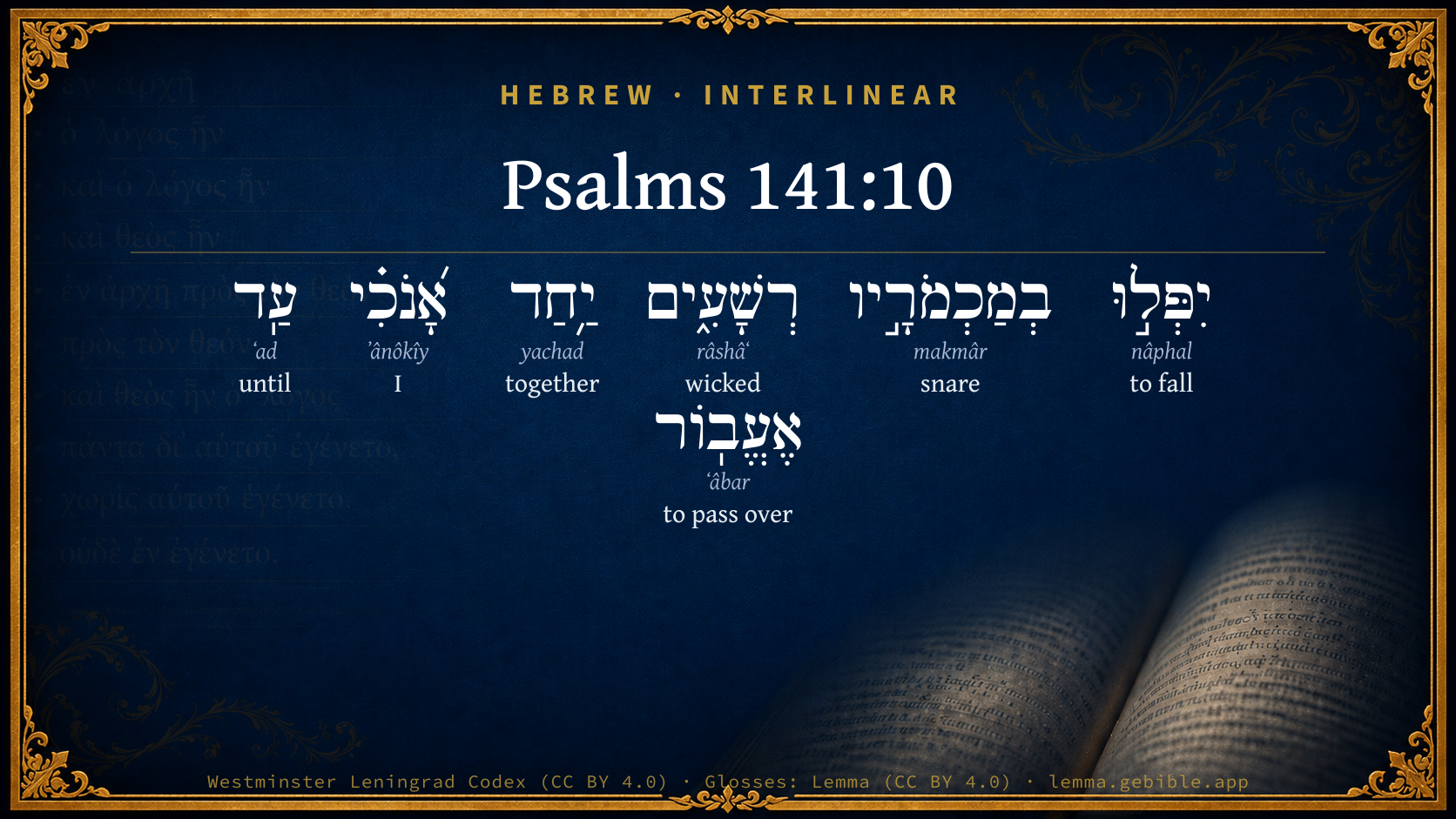
Psalms 141:10

Hebrew (Westminster Leningrad Codex) Psalms 141:10 appears in the Hebrew Old Testament. The text above is from the Westminster Leningrad Codex. Each word links to its Strong’s number, a concise gloss, and parsing drawn from the Open Scriptures Hebrew Bible morphology. Click any word for its full Brown-Driver-Briggs (BDB) entry.
Download image
Cite this verse

Psalms 141:10 (World English Bible). Public Domain. Lemma interlinear Bible study tool, https://lemma.gebible.app/v/psalms/141/10.

Show BibTeX & RIS
BibTeX
RIS
English Translation
Let the wicked fall together into their own nets, While I pass by.
World English Bible · Public Domain
Highlights
  • 1 first appearance in the Hebrew Bible
Full analysis ↓
Download a study sheet

One document with this verse’s original text, its word-by-word gloss line, the meaning frame, cross-references with their text, attributed commentary, and full source and license credits — printable, and it pastes into notes with its structure intact.

This verse Autodidact and up

Study sheet (.html) Plain text (.txt)

A passage Seminary Student

Up to 50 verses in one chapter. A passage sheet keeps up to 6 commentary sources and 12 cross-references per verse, in the order this page ranks them, and says so on the sheet whenever that leaves anything out. Ask for a single verse and you get the Autodidact verse sheet above.

Everything on this page stays free to read, with no account — the sheet is a download of what is already on screen, not access to it.

Want to remove ads? Support Godless Engineer
Compare translations 3

The same verse in 3 English versions, stacked beneath the original-language interlinear above. Click any original word for its lexicon entry.

Each is an independent rendering of the whole verse — the interlinear is not word-aligned to these translations.

Highlighted words mark where these versions differ — a whole-verse word diff, not a word-by-word alignment.

  • World English Bible Public Domain
    Let the wicked fall together into their own nets, While I pass by.
  • King James Version Public Domain
    Let the wicked fall into their own nets, whilst that I withal escape.
  • unfoldingWord Literal Text CC BY-SA 4.0
    Let the wicked fall into his nets together, I, while I cross over.

unfoldingWord Literal Text — © unfoldingWord, licensed CC BY-SA 4.0. Word-aligned USFM3 via Door43 (git.door43.org/unfoldingWord/en_ult).

Versions to compare (up to 4)

3 of 4 selected

Show all 18 translations

Every available English version of this verse, each an independent rendering of the whole verse.

  • World English Bible Public Domain
    Let the wicked fall together into their own nets, While I pass by.
  • Berean Standard Bible Public Domain
    Let the wicked fall into their own nets, while I pass by in safety.
  • Majority Standard Bible Public Domain
    Let the wicked fall into their own nets, while I pass by in safety.
  • King James Version Public Domain
    Let the wicked fall into their own nets, whilst that I withal escape.
  • American Standard Version (1901) Public Domain
    Let the wicked fall into their own nets, Whilst that I withal escape. Psalm 142 Maschil of David, when he was in the cave; a Prayer.
  • Revised Version (1885) Public Domain
    Let the wicked fall into their own nets, whilst that I withal escape.
  • Geneva Bible (1599) Public Domain
    Let the wicked fall into his nettes together, whiles I escape.
  • Douay-Rheims (1899) Public Domain
    The head of them compassing me about: the labour of their lips shall overwhelm them.
  • Young's Literal Translation Public Domain
    The wicked fall in their nets together, till I pass over!
  • Literal Standard Version CC BY-SA 4.0
    The wicked fall in their dragnets together, until I pass over!
  • Unlocked Literal Bible CC BY-SA 4.0
    Let the wicked fall into their own nets while I escape.
  • unfoldingWord Literal Text CC BY-SA 4.0
    Let the wicked fall into his nets together, I, while I cross over.
  • Darby Bible Public Domain
    Let the wicked fall into their own nets, whilst that *I* withal pass over.
  • World Messianic Bible Public Domain
    Let the wicked fall together into their own nets while I pass by.
  • Webster's Bible Public Domain
    Let the wicked fall into their own nets, whilst I escape.
  • Free Bible Version CC BY-SA 4.0
    Let them fall into their own traps while I pass by unharmed.
  • Bible in Basic English Public Domain
    Let the sinners be taken in the nets which they themselves have put down, while I go free.
  • JPS Tanakh (1917) Public Domain
    Let the wicked fall into their own nets, whilst I withal escape.

Literal Standard Version (2020), Covenant Press — licensed CC BY-SA 4.0. Text via the HelloAO Bible API (eBible.org). Unlocked Literal Bible (unfoldingWord) — licensed CC BY-SA 4.0. Text via the HelloAO Bible API (eBible.org). unfoldingWord Literal Text — © unfoldingWord, licensed CC BY-SA 4.0. Word-aligned USFM3 via Door43 (git.door43.org/unfoldingWord/en_ult). Free Bible Version, Dr. Jonathan Gallagher — licensed CC BY-SA 4.0. Text via the HelloAO Bible API (eBible.org).

Word by word

More ways to search: Search by grammar → Find every occurrence → Compare this word →

Practice this passage: Drill this verse → Learn its vocabulary →

About this verse

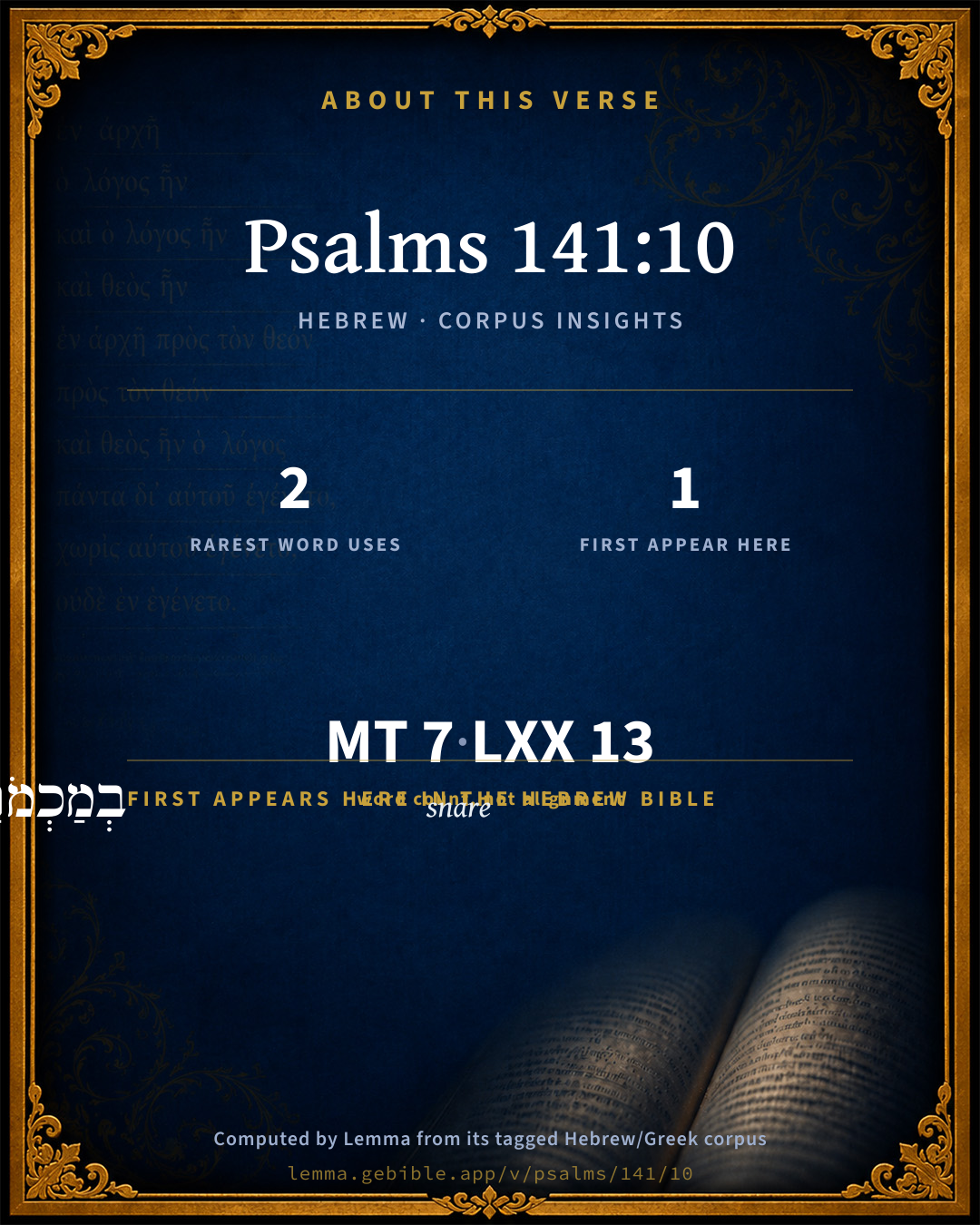
These counts appear in no published source. They are computed here, from the morphology-tagged text and Lemma’s own curated glosses. What Lemma adds →

7
words
7
distinct lemmas
Wisdom
section

Notable vocabulary

The rarest word here is בְמַכְמֹרָ֣יו snare H4364 — appearing just 2 times in the whole Hebrew Bible.

First appearance in Scripture

This word makes its first canonical appearance in the Hebrew Bible here:

  • בְמַכְמֹרָ֣יו snare H4364

Shared distinctive vocabulary

בְמַכְמֹרָ֣יו snare H4364 occurs in 2 verses of the Hebrew Bible. Also found in:

Grammatical profile

  • 2 verbs
  • 1 noun
  • 1 adjective
  • 1 pronoun
  • 1 preposition
  • 1 adverb

Verb forms

  • יִפְּל֣וּ Qal · Imperfect
  • אֶעֱבֽוֹר Qal · Imperfect

Hebrew & Septuagint length

In English translation the verse runs 13 words from the Hebrew and 14 from the Septuagint (LXX English) — closely comparable.

A rough comparison of the two English renderings, which tokenize alike — not a word-level alignment.

Word counts can differ between the Hebrew and the Greek without any difference in meaning — e.g. the Hebrew direct-object marker אֵת has no separate Greek word, and Greek often adds the article ὁ.

In the original languages it is 7 Hebrew tokens and 13 Greek tokens — but the two are counted differently (Hebrew bundles its prefixes and suffixes into one token; the Greek is in lemma form), so that isn’t a like-for-like length.

Cross-references

7

Topical passages linked to Psalms 141:10 in the Treasury of Scripture Knowledge — connected by theme and wording, ordered by reader-vote popularity; previews shown in the World English Bible.

  • Psalms 35:8 Let destruction come on him unawares. Let his net that he has hidden catch himself. Let him fall into that destruction.
  • Psalms 140:9 As for the head of those who surround me, Let the mischief of their own lips cover them.
  • Esther 7:10 So they hanged Haman on the gallows that he had prepared for Mordecai. Then was the king's wrath pacified.
  • Psalms 7:15–16 He has dug a hole, And has fallen into the pit which he made.
  • Psalms 64:7–8 But God will shoot at them. They will be suddenly struck down with an arrow.
  • Proverbs 11:8 A righteous person is delivered out of trouble, And the wicked takes his place.
  • Psalms 37:14–15 The wicked have drawn out the sword, and have bent their bow, To cast down the poor and needy, To kill those who are upright in the way.

Cross-references courtesy of OpenBible.info (CC BY 4.0).

Hebrew and Greek witnesses Masoretic Hebrew ↔ Greek Septuagint

The same verse in the two great witnesses to the Old Testament, shown verse-for-verse.

You’re reading Greek Psalm 140 (Hebrew Psalm 141). The Septuagint counts the superscription, so verse numbers can differ from the Hebrew — chapter-level alignment, not verse-by-verse. Numbering follows Rahlfs.

These are two independent witnesses, not word-aligned to each other, and the Septuagint is shown in lemma (dictionary) form.

Hebrew Psalms 141:10 Masoretic · Westminster Leningrad Codex

יִפְּל֣וּ בְמַכְמֹרָ֣יו רְשָׁעִ֑ים יַ֥חַד אָ֝נֹכִ֗י עַֽד אֶעֱבֽוֹר

Let the wicked fall together into their own nets, While I pass by.

World English Bible · Public Domain

Greek LXX Greek Psalm 140:10 Septuagint · lemma form

πίπτω ἐν ἀμφίβληστρον αὐτός ἁμαρτωλός κατά μόνος εἰμί ἐγώ ἕως ὅς ἄν παραἔρχομαι

Sinners shall fall by their own net: I am alone until I shall escape.

LXX2012 (modern English Septuagint) · Public Domain

Hebrew: Westminster Leningrad Codex (CC BY 4.0). Greek: Septuagint (public domain); English from LXX2012 (modern English Septuagint) (Public Domain). How the Septuagint differs from the Hebrew →

Commentary

Notes on Psalms 141:10 from classic Christian and Jewish commentators (each source and its license shown beneath its notes). The classic Christian expositions comment on the surrounding passage and are grouped to its opening verse, so a note may address several verses; the Jewish commentaries on the Tanakh (Rashi and others) are per-verse, so they appear only where the commentator wrote on this verse.

Lemma curates 59 commentaries, every one of them public domain or Creative Commons licensed, each selected and text-cleaned for this edition rather than reprinted as found. About our sources →

Trapp's Complete Commentary

John Trapp

Psa 141:10 Let the wicked fall into their own nets, whilst that I withal escape.

Ver. 10. Let the wicked fall] Metaphora a piscibus, saith Tremellius, as fishes in casting nets, Isa 19:8.

Whilst that I withal escape] The righteous is delivered out of trouble, and the wicked cometh in his stead, Pro 9:8. It appeareth at length that simple honesty is the best policy, and wicked policy the greatest simplicity, and most self-destructive.

John Trapp, A Commentary or Exposition upon All the Books of the Old and New Testament (1647–1656) — public domain. Text from a community e-Sword module.

J. A. Alexander on Psalms

Joseph Addison Alexander

10. (Psa 141:10) Let the wicked .fall into their own traps, while I at the same time escape. Compare Psa 7:15. The combination of the singular and plural in the first clause—wicked (men) and his snares—shews that the singular denotes not a real but ideal person, representing a whole class. The best construction of the last clause is that given in the English Bible and retained above, with the single change of withal to the synonymous but less ambiguous expression, at the same time. The transpositions of this clause are unusual, even in Hebrew—at the same time I until (or while) I pass, i.e. pass by uninjured or escape.

Joseph Addison Alexander, The Psalms Translated and Explained (1850) — public domain. Text from a community e-Sword module.

Geneva Bible (1599)

Geneva Bible translators

So that none of them escape.

Into God’s nets, whereby he catcheth the wicked in their own malice.

Geneva Bible (1599) marginal notes — public domain. Text via Bolls.life.

Adam Clarke's Commentary

Verse 10. Let the wicked fall into their own nets] This is generally the case; those who lay snares for others fall into them themselves. Harm watch, harm catch, says the old adage. How many cases have occurred where the spring guns that have been set for thieves have shot some of the family! I have known some dismal cases of this kind, where some of the most amiable lives have been sacrificed to this accursed machine.

Whilst - I withal escape.] They alone are guilty; they alone spread the nets and gins; I am innocent, and God will cause me to escape.

ANALYSIS OF THE HUNDRED AND FORTY-FIRST PSALM

The contents and sum of the Psalm are the following: -

I. His prayer, Ps 141:1-2.

II. That God would restrain his tongue, and compose his mind, that through anger or impatience he offend not, Ps 141:3-4.

III. He prays that if he must be reproved, it be by the just, not the unjust man, Ps 141:5; whose judgment he declares, Ps 141:5-6, and will not have any society with him.

IV. He shows the malice of the wicked to good men, Ps 141:6-7.

V. He puts his trust in God, and prays to be delivered from snares, Ps 141:8-10.

I. 1. "Lord, I cry unto thee," c. Speedily hear my prayer, which is fervently and affectionately addressed to thee.

2. "Let my prayer be set forth before thee," &c. Which was offered with the sacrifice. Why does David pray that his prayer might be accepted as the evening rather than the morning sacrifice? Perhaps the evening sacrifice might be more noble, as a figure of Christ's sacrifice on the cross, which was in the evening.

II. His second petition is, that God would restrain his tongue, that he might know when to speak and when to be silent. The metaphor is taken from the watch and gate of a city, which, to be safely kept, no one must be suffered to go in or out that ought not. The gate will not be sufficient without the watch for it will be always shut, or ever open.

His third petition is for his heart, because it is deceitful above all things. Man is weak without the grace of God.

1. "Incline not my heart," c. Suffer it not to be bent, or set on any evil thing.

2. "Incline not my heart to practices," &c. To do iniquity, being invited by their example.

3. "Let me not eat," &c. Partake with them in their feasts, doctrines, feigned sanctity, power, riches, or dignities.

III. His fourth petition is, that if reproved, it may be in the kindness of friendship, not revenge or bitterness.

1. "Let the righteous smite me," &c. Smite with a reproof.

2. "It shall be a kindness," &c. I shall account it an act of charity, and I will love him for it.

3. "And let him reprove me," &c. An excellent oil, to heal my wounds of sin.

IV. His next petition he prefaces thus: "Let my prayer," &c. "When their judges are overthrown," &c., refers to the judicature: the chief seats, authorities, &c., are swallowed up, as men are by the sea as the ship is dashed against the rock, and broken to pieces.

And this sense the following verse will justify: "Our bones are scattered," c. They beset me and my company so closely, that we despair of life and our bones must be scattered here and there in the wilderness, except thou, O Lord, succour us.

V. Therefore he presents his last petition, which has two parts. 1. "But mine eyes are unto thee," &c. 2. "Leave not my soul destitute."

1. For his own safety: "Leave not my soul," &c. Let me not fall into their hands.

2. Which prayer is grounded on his confidence in God: "Mine eyes are unto thee," &c. I depend on and look to thee alone for deliverance.

3. "Keep me from the snares," &c. From their frauds and ambushes.

Lastly, he imprecates confusion on the heads of his enemies.

1. "Let the wicked fall," &c.

2. "Whilst that I withal escape." Pass by or through them unhurt.

Adam Clarke's Commentary on the Bible (1810–1826) — public domain. Text from a community e-Sword/MySword module.

Ellicott's Commentary for English Readers

(10) Comp. Psa_7:15.

Withal.—Probably, altogether (“whilst I altogether escape”), which some join with the previous clause, “Let the wicked fall into their own nets together, whilst I escape.”

A Bible Commentary for English Readers, edited by Charles John Ellicott (1878–1897) — public domain. Text from a community e-Sword module.

The Cambridge Bible for Schools and Colleges

gen. ed. J. J. S. Perowne

10. into their own nets] Heb. into his own nets, i.e. each into his own net. “The enginer” is “hoist with his own petar.” For the thought that the plots of the wicked recoil upon themselves cp. Psa_140:11; Psa_7:15-16; Psa_9:16.

withal escape] Lit. pass on unharmed, at the same time as they are caught in their own snare.

Additional Note

The P.B.V. of Psa_141:5-7 gives a striking example of the use which Coverdale made of S. Münster’s version in revising his translation of 1535 for the ‘Great Bible’ of 1539 (see Introd. p. lxxiii), and also of the variations between the editions of the Great Bible.

Coverdale’s version of 1535 is: “Let the rightuous (rather) smite me frendly, and reprove me: so wil I take it, as though he had poured oyle upô my heade: it shal not hurte my heade, yee I wil praye yet for their wickednesse. Their iudges stôble at the stone, yet heare they my wordes, ye they be ioyfull. Oure bones lye scatered before ye pytt, like as when one graueth and dyggeth vp the grounde.”

In the Great Bible of 1539, reprinted in April 1540, the only change (with the exception of variations of spelling) is in Psa_141:6, which runs: “Let theyr judges stomble in stony places: that they may heare my wordes, for they are swete.”

But in the second Great Bible, also published in 1540, all the changes with which we are familiar in the P.B.V. have been introduced. The passage runs thus: “Let the ryghteous rather smyte me frendly and reproue me. But let not ther preciouse balmes: breake myne heed, yee, I wyll praye yet agaynste theyr wyckednesse. Lett theyr judges be overthrowen in stony places: that they may heare my wordes: for they are swete. Our bones lye scatered before the pit, lyke as whç one breaketh and heweth wood upô ye erth.”

The substantial changes are all taken from Münster’s version: “Percutiat me justus in pietate atque redarguat me, oleum autem praecipuum non frangat caput meum: quia adhuc oratio mea contra mala eorum. Praecipitentur in locis petrosis judices illorum, ut audiant sermones meos, quoniam suaves sunt. Sicut qui frangit et dissecat (ligna) in terra, dispersa sunt ossa nostra iuxta sepulchrum.”

The Cambridge Bible for Schools and Colleges (gen. ed. J. J. S. Perowne; Cambridge University Press, 1878–1918) — public domain. Text from a community e-Sword module.

John Gill's Exposition

Let the wicked fall into their own nets,.... Which they have laid for others, as they very often do; see Psa 7:15; or "into his net" (k), either Saul into his own net, and others with him, so Kimchi and Ben Melech; or the wicked into the net which God has laid for them; see Eze 12:13;

whilst that I withal escape; or "whilst I together escape", or "pass over" (l); that is, while he, together with his companions, passed over the net laid; or,

"till I pass over safe and sound,''

will all mine, as Noldius (m); not only pass over and escape the snares of the wicked, but pass out of this world into a state of happiness and glory in another.

(k) "in retiacula ejus", Pagninus, Montanus; "in retia ejus", Vatablus, Cocceius; so Ainsworth. (l) "simul transeam", Montanus, Vatablus, Musculus; "una cum meis transiturus sum", Piscator. (m) Concord. Partic. Ebr. Chald. p. 363. No. 1279. so Michaelis.

Next: Psalms Chapter 142

John Gill's Exposition of the Whole Bible (1746–1763) — public domain (CC PDM 1.0). Text via the HelloAO Bible API.

Albert Barnes' Notes on the Bible

Let the wicked fall into their own nets - See the notes at Psa 35:8. Compare Psa 7:15-16.

While that I withal escape - Margin, as in Hebrew, “pass over.” While I safely pass over the net or snare which has been secretly laid for me. The word “withal” means, in the Hebrew, “together, at the same time;” that is, At the same time that they fall into the net, let me pass over it in safety. See the notes at Job 5:13.

Albert Barnes' Notes on the Bible (1834–1885) — public domain. Text from a community e-Sword/MySword module.

Matthew Poole's English Annotations

Into their own nets, Heb. into his nets; either into God’s nets, the relative being put without the antecedent, as is usual in such cases, where it is easily understood; or, each

into his own nets, to wit, the mischiefs which he designs against me.

Withal, or, together, to wit, with my followers; or, in like manner, as I have done formerly. But this word may seem to be more fitly joined to the foregoing clause, to which it is next placed in the Hebrew, and the verse may be and is by divers, both ancient and later translators, thus rendered, Let the wicked fall (or, the wicked shall fall) into their own nets together, (altogether, or alike, one as well as another, Saul himself not excepted, whom though I dare not destroy, God will judge,)

whilst that I escape; am preserved from that common calamity in which mine enemies shall perish; which was verified by the event. For David was strangely kept out of harm’s way when Saul and others of David’s enemies were cut off by the Philistines, 1Sa 31.

Matthew Poole's English Annotations on the Holy Bible (1683–1685) — public domain. Text from a community e-Sword/MySword module.

The Treasury of David

Charles H. Spurgeon

Ver. 10. Let the wicked fall into their own nets, whilst that I withal escape. It may not be a Christian prayer, but it is a very just one, and it takes a great deal of grace to refrain from crying Amen to it; in fact, grace does not work towards making us wish otherwise concerning the enemies of holy men. Do we not all wish the innocent to be delivered, and the guilty to reap the result of their own malice? Of course we do, if we are just men. There can be no wrong in desiring that to happen in our own case which we wish for all good men. Yet is there a more excellent way.

Ver. 10. Into their own nets. The word rendered "nets" occurs only in this place, as the closely corresponding word in Ps 140:10, which is rendered "deep pits", occurs there only. Speaker's Commentary.

Charles H. Spurgeon's The Treasury of David (1869–1885) — public domain. Psalms only. Text from a community e-Sword/MySword module.

Whedon's Commentary on the Bible

Daniel D. Whedon

10. Let the wicked fall, etc.—The verb is in the declarative future—the wicked shall fall into their own nets.

Whilst that I withal escape—The Hebrew pointing seems at fault here. Yahad, “together,” (English version “withal,”) belongs to the previous hemistich, and the whole should read:—

The wicked together shall fall into their own nets;

Meanwhile I shall pass over [safely.]

Daniel D. Whedon (gen. ed.), Commentary on the Old and New Testaments (1874–1909) — public domain. Text from a community e-Sword module.

The Pulpit Commentary

Let the wicked fall into their own nets. (comp. Psa_7:15 Psa_35:8 Psa_57:6 Pro_5:22) The moral sense is always satisfied when the wicked man falls into his own trap, or is "hoist with his own petard." Even a heathen poet could say"Nec lex justior ulla est, Quam necis artifices arte perire sun. Whilst that I withal escape; literally, until that I pass over; i.e. whilst I pass over the nets, or traps, in safety.

The Pulpit Commentary (1880–1919), ed. H.D.M. Spence-Jones & Joseph S. Exell — public domain. Text from a community e-Sword module.

Rashi

Rabbi Shlomo Yitzchaki (Rashi)

May the wicked fall...into his nets May the wicked man himself fall into his nets that he spreads at my feet.

Rashi on the Tanakh — English translations: “The Judaica Press complete Tanach with Rashi, translated by A. J. Rosenberg” (CC BY 4.0); “Pentateuch with Rashi's commentary by M. Rosenbaum and A.M. Silbermann, 1929-1934” (public domain); “The Metsudah Tanach series, Lakewood, N.J” (CC BY 4.0); and “The Book of Joshua, Metsudah Publications, 1997” (CC BY 4.0). Text via Sefaria.

Lesson kit

Teaching starters — assembled from the data on this page, not authored interpretation. Every prompt links to the verse data it draws on. Edit before teaching.

Psalms, in the Wisdom, opens this verse with 7 words (7 distinct Hebrew lemmas). Its most distinctive word is makmâr (“snare”). A historical commentator’s framing appears above. Read the whole chapter for the surrounding context.

Discussion questions

  1. How does “snare” (makmâr) shape what this verse is saying?
  2. This is the first place “snare” appears in Scripture (first appears here). What does its debut here establish?
  3. How does Isaiah 51:20, which shares the word «snare», read alongside this verse?
  4. These translations render this verse differently. What is at stake in choosing one wording over another?
  5. «יִפְּל֣וּ» is a Qal Imperfect verb. How does that grammatical form shape the action described?
  6. Compare how Trapp's Complete Commentary and J. A. Alexander on Psalms read this verse. Where do they agree or differ?

Things to notice

Reading settings

Reading text

Shown beneath each verse's original-language words.

Old Testament
Old Testament edition

Read the OT as the Masoretic Hebrew (MT) or the Greek Septuagint (LXX).

English shown for the Greek Septuagint (in the Hebrew ↔ Greek comparison).

Comparing translations? Open the Compare panel on any verse page to stack up to four side by side.