
Proverbs 10:7

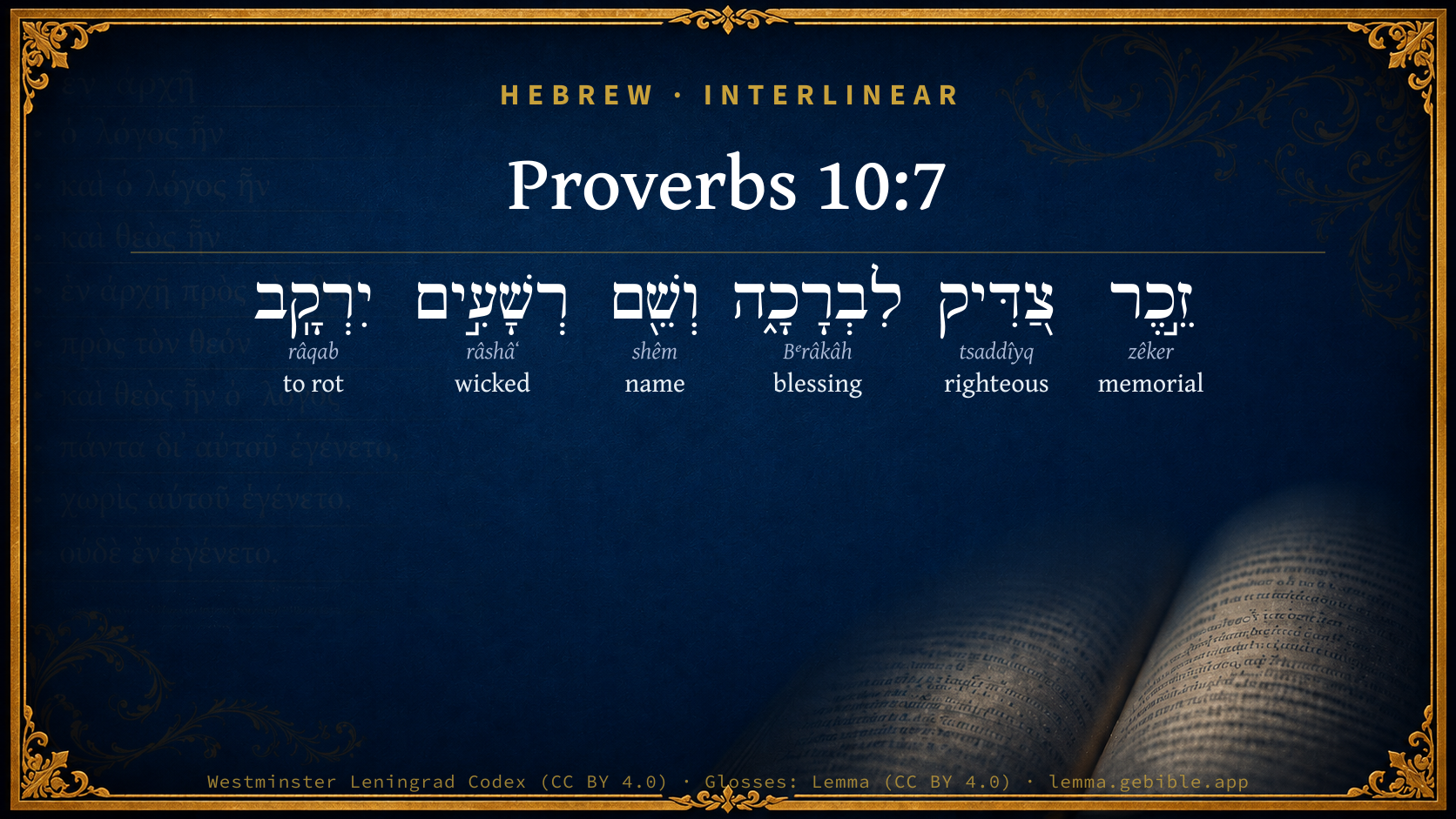
Hebrew (Westminster Leningrad Codex) Proverbs 10:7 appears in the Hebrew Old Testament. The text above is from the Westminster Leningrad Codex. Each word links to its Strong’s number, a concise gloss, and parsing drawn from the Open Scriptures Hebrew Bible morphology. Click any word for its full Brown-Driver-Briggs (BDB) entry.
Download image
Cite this verse

Proverbs 10:7 (World English Bible). Public Domain. Lemma interlinear Bible study tool, https://lemma.gebible.app/v/proverbs/10/7.

Show BibTeX & RIS
BibTeX
RIS
English Translation
The memory of the righteous is blessed, But the name of the wicked will rot.
World English Bible · Public Domain
Highlights
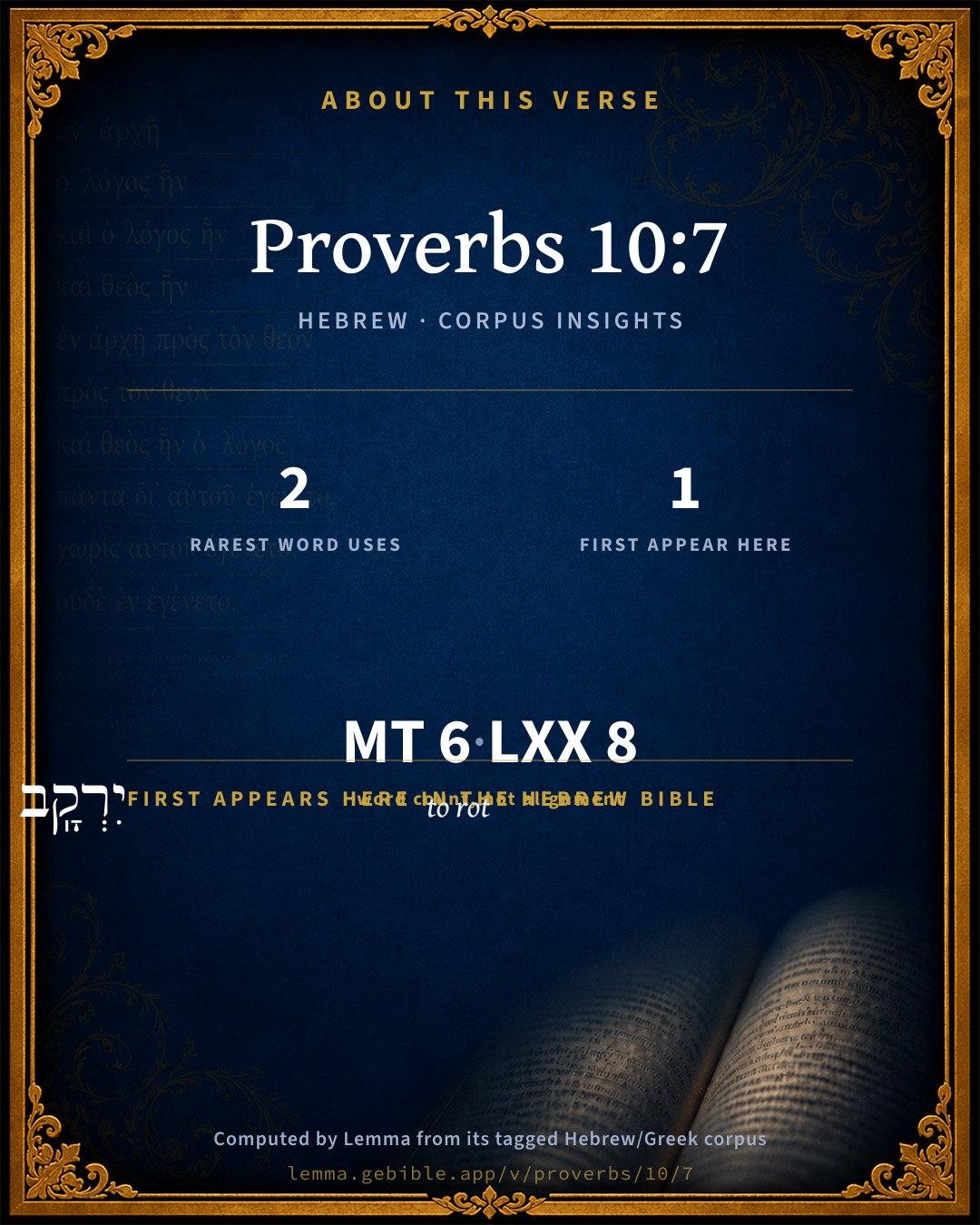
  • 1 first appearance in the Hebrew Bible
Full analysis ↓
Download a study sheet

One document with this verse’s original text, its word-by-word gloss line, the meaning frame, cross-references with their text, attributed commentary, and full source and license credits — printable, and it pastes into notes with its structure intact.

This verse Autodidact and up

Study sheet (.html) Plain text (.txt)

A passage Seminary Student

Up to 50 verses in one chapter. A passage sheet keeps up to 6 commentary sources and 12 cross-references per verse, in the order this page ranks them, and says so on the sheet whenever that leaves anything out. Ask for a single verse and you get the Autodidact verse sheet above.

Everything on this page stays free to read, with no account — the sheet is a download of what is already on screen, not access to it.

Want to remove ads? Support Godless Engineer
Compare translations 3

The same verse in 3 English versions, stacked beneath the original-language interlinear above. Click any original word for its lexicon entry.

Each is an independent rendering of the whole verse — the interlinear is not word-aligned to these translations.

Highlighted words mark where these versions differ — a whole-verse word diff, not a word-by-word alignment.

  • World English Bible Public Domain
    The memory of the righteous is blessed, But the name of the wicked will rot.
  • King James Version Public Domain
    The memory of the just is blessed: but the name of the wicked shall rot.
  • unfoldingWord Literal Text CC BY-SA 4.0
    The memory of the righteous one for a blessing, but the name of the wicked ones will rot.

unfoldingWord Literal Text — © unfoldingWord, licensed CC BY-SA 4.0. Word-aligned USFM3 via Door43 (git.door43.org/unfoldingWord/en_ult).

Versions to compare (up to 4)

3 of 4 selected

Show all 18 translations

Every available English version of this verse, each an independent rendering of the whole verse.

  • World English Bible Public Domain
    The memory of the righteous is blessed, But the name of the wicked will rot.
  • Berean Standard Bible Public Domain
    The memory of the righteous is a blessing, but the name of the wicked will rot.
  • Majority Standard Bible Public Domain
    The memory of the righteous is a blessing, but the name of the wicked will rot.
  • King James Version Public Domain
    The memory of the just is blessed: but the name of the wicked shall rot.
  • American Standard Version (1901) Public Domain
    The memory of the righteous is blessed; But the name of the wicked shall rot.
  • Revised Version (1885) Public Domain
    The memory of the just is blessed: but the name of the wicked shall rot.
  • Geneva Bible (1599) Public Domain
    The memoriall of the iust shalbe blessed: but the name of the wicked shall rotte.
  • Douay-Rheims (1899) Public Domain
    The memory of the just is with praises: and the name of the wicked shall rot.
  • Young's Literal Translation Public Domain
    The remembrance of the righteous `is' for a blessing, And the name of the wicked doth rot.
  • Literal Standard Version CC BY-SA 4.0
    The remembrance of the righteous [is] for a blessing, || And the name of the wicked rots.
  • Unlocked Literal Bible CC BY-SA 4.0
    The righteous person makes those who remember him happy, but the name of the wicked will rot away.
  • unfoldingWord Literal Text CC BY-SA 4.0
    The memory of the righteous one for a blessing, but the name of the wicked ones will rot.
  • Darby Bible Public Domain
    The memory of the righteous [man] shall be blessed; but the name of the wicked shall rot.
  • World Messianic Bible Public Domain
    The memory of the righteous is blessed, but the name of the wicked will rot.
  • Webster's Bible Public Domain
    The memory of the just is blessed: but the name of the wicked shall perish.
  • Free Bible Version CC BY-SA 4.0
    The good are remembered as a blessing, but the reputation of the wicked will rot.
  • Bible in Basic English Public Domain
    The memory of the upright is a blessing, but the name of the evil-doer will be turned to dust.
  • JPS Tanakh (1917) Public Domain
    The memory of the righteous shall be for a blessing; but the name of the wicked shall rot.

Literal Standard Version (2020), Covenant Press — licensed CC BY-SA 4.0. Text via the HelloAO Bible API (eBible.org). Unlocked Literal Bible (unfoldingWord) — licensed CC BY-SA 4.0. Text via the HelloAO Bible API (eBible.org). unfoldingWord Literal Text — © unfoldingWord, licensed CC BY-SA 4.0. Word-aligned USFM3 via Door43 (git.door43.org/unfoldingWord/en_ult). Free Bible Version, Dr. Jonathan Gallagher — licensed CC BY-SA 4.0. Text via the HelloAO Bible API (eBible.org).

Word by word

More ways to search: Search by grammar → Find every occurrence → Compare this word →

Practice this passage: Drill this verse → Learn its vocabulary →

About this verse

These counts appear in no published source. They are computed here, from the morphology-tagged text and Lemma’s own curated glosses. What Lemma adds →

6
words
6
distinct lemmas
Wisdom
section

Notable vocabulary

The rarest word here is יִרְקָֽב to rot H7537 — appearing just 2 times in the whole Hebrew Bible.

First appearance in Scripture

This word makes its first canonical appearance in the Hebrew Bible here:

  • יִרְקָֽב to rot H7537

Shared distinctive vocabulary

יִרְקָֽב to rot H7537 occurs in 2 verses of the Hebrew Bible. Also found in:

Grammatical profile

  • 1 verb
  • 3 nouns
  • 2 adjectives

Verb forms

  • יִרְקָֽב Qal · Imperfect

Hebrew & Septuagint length

In English translation the verse runs 15 words from the Hebrew and 16 from the Septuagint (LXX English) — closely comparable.

A rough comparison of the two English renderings, which tokenize alike — not a word-level alignment.

Word counts can differ between the Hebrew and the Greek without any difference in meaning — e.g. the Hebrew direct-object marker אֵת has no separate Greek word, and Greek often adds the article ὁ.

In the original languages it is 6 Hebrew tokens and 8 Greek tokens — but the two are counted differently (Hebrew bundles its prefixes and suffixes into one token; the Greek is in lemma form), so that isn’t a like-for-like length.

Cross-references

11

Topical passages linked to Proverbs 10:7 in the Treasury of Scripture Knowledge — connected by theme and wording, ordered by reader-vote popularity; previews shown in the World English Bible.

  • Psalms 112:6 For he will never be shaken. The righteous will be remembered forever.
  • Luke 1:48 For he has looked at the humble state of his handmaid. For behold, from now on, all generations will call me blessed.
  • Mark 14:9 Most assuredly I tell you, wherever this Gospel may be preached throughout the whole world, that which this woman has done will also be spoken of for a memorial of her."
  • Psalms 109:13 Let his posterity be cut off. In the generation following let their name be blotted out.
  • 2 Chronicles 24:16 They buried him in the city of David among the kings, because he had done good in Israel, and toward God and his house.
  • Psalms 109:15 Let them be before Yahweh continually, That he may cut off the memory of them from the earth;
  • Job 18:17 His memory shall perish from the earth. He shall have no name in the street.
  • Psalms 9:5–6 You have rebuked the nations. You have destroyed the wicked. You have blotted out their name forever and ever.
  • 1 Kings 11:36 To his son will I give one tribe, that David my servant may have a lamp always before me in Jerusalem, the city which I have chosen me to put my name there.
  • 2 Kings 19:34 For I will defend this city to save it, for my own sake, and for my servant David's sake.
  • Ecclesiastes 8:10 So I saw the wicked buried. Indeed they came also from holiness. They went and were forgotten in the city where they did this. This also is vanity.

Cross-references courtesy of OpenBible.info (CC BY 4.0).

Hebrew and Greek witnesses Masoretic Hebrew ↔ Greek Septuagint

The same verse in the two great witnesses to the Old Testament, shown verse-for-verse.

These are two independent witnesses, not word-aligned to each other, and the Septuagint is shown in lemma (dictionary) form.

Hebrew Proverbs 10:7 Masoretic · Westminster Leningrad Codex

זֵ֣כֶר צַ֭דִּיק לִבְרָכָ֑ה וְשֵׁ֖ם רְשָׁעִ֣ים יִרְקָֽב

The memory of the righteous is blessed, But the name of the wicked will rot.

World English Bible · Public Domain

Greek LXX Proverbs 10:7 Septuagint · lemma form

μνήμη δίκαιος μετά ἐγκώμιονς ὄνομα δέ ἀσεβής σβέννυμι

The memory of the just is praised; but the name of the ungodly man is extinguished.

LXX2012 (modern English Septuagint) · Public Domain

On this verse, Whedon's Commentary on the Bible discusses the Septuagint’s reading. Read the note in Commentary ↓

Hebrew: Westminster Leningrad Codex (CC BY 4.0). Greek: Septuagint (public domain); English from LXX2012 (modern English Septuagint) (Public Domain). How the Septuagint differs from the Hebrew →

Commentary

Notes on Proverbs 10:7 from classic Christian and Jewish commentators (each source and its license shown beneath its notes). The classic Christian expositions comment on the surrounding passage and are grouped to its opening verse, so a note may address several verses; the Jewish commentaries on the Tanakh (Rashi and others) are per-verse, so they appear only where the commentator wrote on this verse.

Lemma curates 59 commentaries, every one of them public domain or Creative Commons licensed, each selected and text-cleaned for this edition rather than reprinted as found. About our sources →

Trapp's Complete Commentary

John Trapp

Pro 10:7 The memory of the just [is] blessed: but the name of the wicked shall rot.

Ver. 7. The memory of the just is blessed.] "Demetrius had a good report of the truth." {3Jn 1:12} In the Hebrew tongue the same word signifieth "a good name," and "a blessing." This is one of those blessings mentioned in Pro 10:6, that shall be heaped upon holy men. "Holy and reverend is his name." {Psa 111:9} How comes God’s name to be "reverend," but by being "holy?" Be good, and do good, so shall thy name be heir to thy life; yea, when thou art laid in thy grave, thy stock remains, goes forward, and shall do till the day of doom.

But the name of the wicked shall rot.] And stink as putrefied flesh. Hypocrites then must be detected, though they carry it never so clearly; how else shall they be detested, and stink above ground Simon Magus so handled the matter, that Philip mistook him for a believer, and baptized him; but Peter soon smelt him out, and laid him open in his colours. "He that perverteth his ways shall be known"; {Pro 10:9} "The Lord shall lead them forth with the workers of iniquity," for all their cunning contrivances. {Psa 125:5}

John Trapp, A Commentary or Exposition upon All the Books of the Old and New Testament (1647–1656) — public domain. Text from a community e-Sword module.

The Biblical Illustrator

Joseph S. Exell

Pro_10:7

The memory of the just is blessed: but the name of the wicked shall rot.

The remembrance of good and forgetting of bad men

I. How great a concern men naturally have to leave an honourable memory behind them. This idea is implied in the text, not expressed. All men in all ages have desired and endeavoured that others should entertain a good opinion of them, and if possible a great one. To this pursuit, multitudes have sacrificed their ease, their interest, the dearest of their other passions, and their lives themselves. They who know they have forfeited their title to a good character labour hard, by concealing and palliating matters, to retain as much as they can of it. A truly good person will always, in the first place, seek the honour which cometh from God only. But still, desire of being esteemed by our fellow-creatures is a natural, and therefore an innocent passion, prompts us to what is right, and supports us in it. And we have also earnest desire of being remembered, as much to our advantage as possible, after we are gone. Though we shall not be within reach of hearing what is said of us, nor shall we be benefited by praise or hurt by reproach. Therefore some treat all concern far posthumous praise and fame as a mere absurdity. But as virtuous and beneficent actions are by far the most certain way of procuring any durable esteem from mankind, so planting in us a desire of such esteem as may endure when we are gone is providing no small security for our good behaviour here. And so this desire becomes an important blessing to us. A good life hath but a few days; but a good name endureth for ever (Son of Sirach)

.

All this must be cautiously understood of such reputation only as is truly good; sought from proper motives, and pursued by proper means. If people affect to be admired for excellences, which they have not, their attempt at cheating mankind will probably be as vain as it is certainly unjust. Scripture not only stigmatises those whose glory is in their shame, but warns against so excessive an admiration, even of things in themselves valuable, as interferes with the superior regard we owe to real piety and virtue.

II. What care the goodness and justice of God have taken that by worthy conduct we shall obtain our desire and by a criminal one fail of it entirely. There is a particular providence causing the memory of the just and good to flourish out of their ashes, and blasting that of the wicked. Worthy men would be pleased to have present respect paid to their characters, as well as future to their memories. And it is paid in good measure, though the deficiencies in this respect are great: due often to imperfections or eccentricities in the goodness, often to party zeal and to envy. It would probably not be to the advantage of good persons, but far from it, to have all the debt which mankind owes them paid immediately. It might endanger their humility, lead them to an uncharitable contempt of others, and a hazardous confidence in themselves. When once good men are removed to another state, all the reasons which made it unsafe for them to receive praise in this are over; and most of the reasons that made others unwilling to bestow it are over too. Generally speaking, they who deserve well have at length due acknowledgments paid to their memory. The undeserved regard of the ungodly in this life seldom outlasts them any considerable time; the name of the wicked soon rots.

III. In what manner may we best contribute to the due payment of those very different regards which belong to the memory of the bad and the good. Vehemence and bitterness in speaking of those whom we dislike, either when they are living or when dead, is opposed to the spirit of our religion. Yet we are not prevented from forming and expressing just judgments at suitable times. For the most part the name of the wicked, if let alone, will rot of itself; and all that we shall need to do is, not to undertake the nauseous and fruitless office of embalming it. The regards due to the just are briefly these: that we believe them, on good evidence, to be the good persons they were in reality; that we consider their virtues with due esteem, and their imperfections with due candour; that we vindicate their names from unjust imputations, and make honourable mention of them whenever a fit opportunity offers; that we warn and arm ourselves against the temptations, both of prosperity and adversity, by observing how they have gone through each; that we incite ourselves to aim at more perfection in all Christian graces, by seeing in them what heights of piety and goodness are attainable; that we learn watchfulness from their falls; and that we thank God, in our retirements, for the instructions which His providence hath vouchsafed to us in their good lives. (T. Seeker.)

The memory of the just

So far as this world is concerned, every one of us will soon cease to be a man, and be no more than a memory. Every man leaves behind him some kind of a memory; and it depends entirely on what the man has been as to what the memory shall be. There are memories that do rot; those that dwell on them, and take a delight in them, are poisoned by the contact, and all whose feelings are healthy and pure keep at a distance, and feel as if in the presence of something that was corrupt and evil. But however short life may be, it is long enough for a man to do something that will leave a memory in the world which, when he is gone, shall be a blessing to other men.

I. The memory of the just is blessed as an example of holy living. We never can see the force of precept fully if we never see precept embodied in action. You can never give a man a clear notion of what the image of God is unless you give him an opportunity of watching for years the life of a man who has walked with God. The memory of such s man acts as a restraint, both upon the unconverted and upon the child of God, when he is pressed by temptation. The memory of such a man acts as an encouragement. We are apt to think that the law of God is too high for us, that we cannot expect to be thoroughly consistent Christians. And yet, why not? We think those men that we see so good must be different in nature from us. But the grace that made them so holy is as free for us as it was for them. The memory is not only an encouragement, it is also a stimulus. When we hear what the good have done we feel a reproach that we have not done more. That memory is blessed which comes acting upon the spirits of men after a man is gone, and impelling them to follow him in the ways of usefulness and goodness. Such a memory is a stimulus to early consecration to God; to full and laborious consecration to God.

II. The memory of the just is blessed as an example of holy dying. Even those who do not care about living well would like to die well. Others look upon a happy death only in the light of s suitable close of a good life. There is something blessed in seeing the last days of good men.

III. The memory of the just is blessed as a tie to another world. Are there not many of us to whom God has given ties of this kind to that better lend? The blessing in this way counteracts the curse; the curse strikes right and left with the stroke of death, and we see our dearest objects falling before our eyes. But then the blessing comes; they are redeemed; their spirits are in heaven; and our affections turn to the same objects as before. But now those affections, instead of being a tie to earth, are a tie to heaven, where those we love have gone. (William Arthur, M.A.)

The remembrance of a noble name

Who would not preserve a noble name? The recollection of such a name is a continual inspiration. From that recollection many things may be shed that are mere matters of detail, but the substance and the honour, the real quality and worth, abide with us evermore. Who need be ashamed to own that he had a just father and a virtuous mother? No man blushes when he cites the name of a conqueror who worked heroically and succeeded perfectly in the great warfare of life. Just memories are flowers we cannot allow to fade; we water them with our tears; by them we enrich and ennoble our prayers, and by them we animate ourselves as by a sacred stimulus. Blessed are they who have a noble past, a yesterday crowded with memories of things beautiful end lovable; they can never be lonely, they can never be sad; they walk in the company of the just and true, and the silence of the communion does not diminish its music. Here is a fame which is possible to every man. It is not possible for us all to win renown in fields of battle, in walks of literature, in lives of adventure, or in regions of discovery and enterprise--that kind of renown must be left to the few, the elect who are created to lead the worlds civilisation; but the renown of goodness, the fame of purity, the reputation of excellence--these lie within the power of the poorest man that lives. (J. Parker, D.D.)

The memory of the just

The mind often goes back in review of the past human world. On this great field there are presented all the grand varieties of character. They come to view in great divisions and assemblages--in mass, as it were--bearing the broad distinctions of their respective ages, nations, and religions. Here and there individuals stand up conspicuously to view--of extraordinary and pre-eminent character and action. What an odious and horrid character rests upon some. They seem to bear eternal curses on their heads. And these have gone in that same character, unaltered, into another world, and that a state of retribution. But there has been a multitude that no man can number, bearing on earth and bearing away from it the true image of their Father in heaven. The saints of God in the past time are presented as a general comprehensive object to our memory. And we have many of the just retained in memory as individuals. They abide in memory, and ever will, kept alive, as it were, the images, the examples, the personifications of what we approve, admire, and feel that we ought to love and to be. Now, their memory is blessed, self-evidently so, for the mind blesses it, reverts to it with complacency mingled with solemnity. It is blessed when we consider them as practical illustrations, verifying examples of the excellence of genuine religion. Their memory is blessed while we regard them as diminishing to our view the repulsiveness and horror of death, and as associated with the most blessed things through all time. (J. Foster.)

The two memories

It is a trite saying that the present is the only period of time we can call our own; but it is a saying not less true than trite. Now is the moment of action. By our acts in this living present we shall become a power as a memory. In our footsteps our successors will trace our characters as the geologist traces those of the beasts end birds of antediluvian fame.

I. What does the text assert of the name and memory of the wicked?

1. A wicked mans memory lives in his children. Sometimes as a beacon to warn of danger.

2. In their sins the wicked perpetuate their memory. Those who are not content to be in the road to hell themselves, but must inveigle others into the same accursed paths, surely fasten their memories on the souls of their victims. What putrid animal matter is to our physical senses the memory of the wicked shall be to our moral sensibilities when they are gone.

II. The memory of the righteous is blessed. True, as a rule, in the case of the children of the good men. Exceptions prove the rule. Let our children find us faithful to our principles, to our professions, to our Saviour, and when we are gone our memory shall be blessed. The memory of the just shall be blessed in their actions--their acts live long after they are gone, in their effects. Illustrate by the memories of the martyrs end reformers. And there are martyrs in humble life. We have, then, a work to do, that our memories may be a blessing and not a curse, that we may leave footprints behind for others to walk in. (W. Morris.)

Blessed memories

I. The memory of the just is blessed in their inherent worth. Contrast Abraham, Moses, Daniel, Paul, Luther, etc., with Pharaoh, Voltaire, Paine, etc. Of the former, the mention of their names is as ointment poured forth, beautiful, fragrant, and costly; while the latter are only regarded with pity and regretted as a waste.

II. The memory of the just is blessed in their influential words. Their words are blessed--

1. In Christian conversation.

2. In the public mention of them.

3. In quiet meditation.

And they are influential, as is evident--

(1) In the history of the Christian Church.

(2) In the annals of profane history.

(3) In the efforts of human progress.

III. The memory of the just is blessed in their important works.

1. In the books they have written.

2. In the inspiration they have given.

3. In the effects they have produced.

Application: What sort of memory are we weaving for ourselves? One to be blessed, and that will remain unforgotten in the world? or one that will decay, rot, and around which there will cling no loving and permanent memories of Divine or human blessedness? (T. Colclough.)

The Biblical Illustrator, edited by Joseph S. Exell (c. 1880s–1900s) — public domain. Text from a community e-Sword module.

Tyndale Open Study Notes

Tyndale Open Resources

10:7 the name of a wicked person rots away: In ancient Israel, as is still true today in the Middle East, honor and shame were powerful motivators.

Tyndale Open Study Notes — © Tyndale Open Resources, licensed CC BY-SA 4.0. Text via the HelloAO Bible API.

Geneva Bible (1599)

Geneva Bible translators

Shall be vile and abhorred both of God and man, contrary to their own expectation, which think to make their name immortal.

Geneva Bible (1599) marginal notes — public domain. Text via Bolls.life.

Matthew Henry's Commentary

Both the just and the wicked, when their days are fulfilled, must die. Between their bodies in the grave thee is no visible difference; between the souls of the one and the other, in the world of spirits, thee is a vast difference, and so there is, or ought to be, between their memories, which survive them.

I. Good men are and ought to be well spoken of when they are gone; it is one of the blessings that comes upon the head of the just, even when their head is laid. Blessed men leave behind them blessed memories. 1. It is part of the dignity of the saints, especially those who excel in virtue and are eminently useful, that they are remembered with respect when they are dead. Their good name, their name with good men, for good things, is then in a special manner as precious ointment, Ecc 7:1. Those that honour God he will thus honour, Psa 112:3, Psa 112:6, Psa 112:9. The elders by faith obtained a good report (Heb 11:2), and, being dead, are yet spoken of. 2. It is part of the duty of the survivors: Let the memory of the just be blessed, so the Jews read it, and observe it as a precept, not naming an eminently just man that is dead without adding, Let his memory be blessed. We must delight in making an honourable mention of good men that are gone, bless God for them, and for his gifts and graces that appeared in them, and especially be followers of them in that which is good.

II. Bad men are and shall be forgotten, or spoken of with contempt. When their bodies are putrefying in the grave their names also shall rot. Either they shall not be preserved at all, but buried in oblivion (no good can be said of them, and therefore the greatest kindness that can be done them will be to say nothing of them), or they shall be loathsome, and mentioned with detestation, and that rule of honour, De mortuis nil nisi bonum - Say nothing to the disadvantage of the dead, will not protect them. Where the wickedness has been notorious, and cannot but be mentioned, it ought to be mentioned with abhorrence.

Matthew Henry's Commentary on the Whole Bible (1708–1710) — public domain (CC PDM 1.0). Text via the HelloAO Bible API.

Jamieson, Fausset & Brown

Robert Jamieson, A. R. Fausset & David Brown

blessed--literally, "for a blessing," or praise.

shall rot--literally, "be worm-eaten," useless and disgusting.

Jamieson, Fausset & Brown — Commentary Critical and Explanatory on the Whole Bible (1871) — public domain (CC PDM 1.0). Text via the HelloAO Bible API.

Adam Clarke's Commentary

Verse 7. The memory of the just is blessed] Or, is a blessing.

But the name of the wicked shall rot.] This is another antithesis; but there are only two antithetic terms, for memory and name are synonymous.-Lowth. The very name of the wicked is as offensive as putrid carrion.

Adam Clarke's Commentary on the Bible (1810–1826) — public domain. Text from a community e-Sword/MySword module.

John Gill's Exposition

The memory of the just is blessed,.... Men to whom he has been useful, either in temporals or spirituals, bless him, or wish all blessings to him while alive, whenever they make mention of his name; and after death they speak well of him, and pronounce him blessed; for such are had in everlasting remembrance; the memory of them is sweet and precious; their name is famous and valuable, and always spoken of with honour and commendation; see Psa 112:6. The Jewish writers take it for a command, and render it, "let the memory of the just be blessed"; and say, that he that transgresses it breaks an affirmative precept; they make an abbreviation of the word by the initial letters, and join them to the names of their celebrated men;

but the name of the wicked shall rot; shall be forgotten, be buried in oblivion, and never mentioned: and though they may call their houses, lands, and cities, by their own names, in order to transmit their memory to posterity; yet these, by one means or another, are destroyed, and their memorials perish with them; see Ecc 8:10; and if their names are mentioned after they are gone, it is with detestation and abhorrence, as things putrefied are abhorred; so they leave an ill savour behind them, when the good name of the righteous is as precious ointment, Ecc 7:1. It is a saying of Cicero (a), that

"the life of the dead lies in the memory of the living.''

(a) Orat. 51. Philip. 9.

John Gill's Exposition of the Whole Bible (1746–1763) — public domain (CC PDM 1.0). Text via the HelloAO Bible API.

Haydock's Catholic Bible Commentary

Rot. Hebrew, "stink." His reputation shall be lost, Genesis xxxiv. 20. (Calmet)

George Leo Haydock (1774–1849), Haydock's Catholic Family Bible and Commentary, 1859 edition — public domain. Excludes Psalms (Douay-Rheims chapter numbering differs from Protestant) and Deuterocanonical books (Catholic canon only).

Matthew Poole's English Annotations

Is blessed, i.e. honourable and acceptable to those who mention them. Compare Job 31:20; Psa 62:5.

Shall rot; shall perish, and be cursed and detestable amongst men, shall stink above ground.

Matthew Poole's English Annotations on the Holy Bible (1683–1685) — public domain. Text from a community e-Sword/MySword module.

Whedon's Commentary on the Bible

Daniel D. Whedon

7. Blessed — Literally, for a blessing; which some understand to be such to others. “He blesses after he is dead.” Comp. Psalm 9:56; Ecc_8:10; Psa_112:6.

Shall rot — Shall be rotten, carious, worm-eaten; that is, loathsome. The Septuagint reads, “Shall be extinguished.” It stands opposed to the honours paid to the righteous.

Daniel D. Whedon (gen. ed.), Commentary on the Old and New Testaments (1874–1909) — public domain. Text from a community e-Sword module.

The Pulpit Commentary

The memory. The lasting, fragrant perfume of a holy life is contrasted with the noisomeness and quick decay of an evil name. (comp. Psa_72:17) As a commentator asks, "Who ever thinks of calling a child Judas or Nero?

"The memory of the just.

I THE WORLD CONCERNS ITSELF WITH THE REPUTATION OF THE DEAD. The words of our text describe a fact to which all history bears witness. No study is more absorbing than history including biography; and the most interesting part of history is that which deals with individuals and discusses character. In spite of the protests of the philosophers, we are all more attracted by Shakespeare and Scott than by Hallam and Buckle. Statistics, generalizations, great laws and principles of national growth, all have their claims on our attention; but the characters of individual men appeal to us with a quite different human interest. Even the most commonplace gossip of the street corner has some justification in the element of sympathy with things human that it presupposes.

II THE MOST IMPORTANT ELEMENT IN POSTHUMOUS REPUTATION IS CHARACTER. Who cares for Croesus? But the slave Epictetus takes a high place in the world"s thoughts. The reputation for wealth that brings fawning flatterers in a man"s lifetime is the first to fade after death. So is that of empty titles. The present duke say the seventh is treated with the deference considered due to rank, but no one cares to ask in what the third duke differed from the fourth duke. Even the dazzling conqueror"s renown soon tarnishes if it is not preserved by higher qualities. Few men now envy the reputation of Napoleon. Genius, perhaps, carries off amongst men the palm of fame; the first place, which is due to character, is reserved for the next world. Still, moral character counts for more in common human reputation than the cynical are ready to admit. At all events, in that inner circle where a man would most care for his reputation this takes its right place. If it is better to be loved at home than to be admired abroad, it is better to leave a fragrant memory for goodness in one"s own circle than to leave sorrow in the home and to reap grand funeral honours in the outside world. It is remarkable to observe how fair is the verdict of history. A hypocrite may deceive his contemporaries. He can rarely deceive future generations.

III IT IS OUR DUTY TO CHERISH THE MEMORY OF THE JUST. This is a duty we owe to them, to righteousness, and to succeeding ages. The honest canonization that comes from no papal authority, but from the honest conviction of admiring multitudes, is worthy tribute to goodness. Still, let us beware of the mockery of substituting this for our duty to the living building splendid tombs to the prophets whom we have slain. How often have great men been slighted, misunderstood, cruelly wronged, during their lifetime; and then honoured by a chorus of repentant praise as soon as death has taken them beyond the reach of it! On the other hand, beware of indiscriminate adulation of the dead. There is wholesome truth in the words, "The name of the wicked shall rot." Nothing is more false than the common style of epitaphs. A visit to a graveyard would suggest that the world was a paradise of immaculate saints. Where you cannot justly praise, at least be decently silent. Left to itself, the name of the wicked will melt away and vanish as all rotten things do.

IV IT IS PROFITABLE TO CONSIDER THE LESSONS LEFT BY THE LIVES OF THE DEPARTED. We need not go the length of the early Christians, who, beginning by meeting in the catacombs where the martyrs were buried, soon came to worship the martyrs as demi-gods. But we may gain great good by contemplating the beauty of good lives. If we cherish the memory of those who have gone "to join the choir invisible," we may be helped to emulate their noble qualities.

"The memory of the just.

It is a fact that the name of the good man is fragrant, and that long after his departure there lingers in the memories and hearts of men a sense of loss, a feeling "Which is but akin to pain And resembles sorrow only As the mist resembles the rain; a feeling of tender regret not unmingled with sacred joy and reverent gratitude, This fact is

I A STRENGTH TO THE JUST MAN WHILE HE LIVES. "What has posterity done for us?" asks the cynic. "The idea of posterity has done great things for us," replies the moralist. That idea and the hope to which it gives birth have done much to fortify virtue, to establish character, to enlarge and ennoble the good man"s life. That thought has been fruitful of earnest work, and has helped men to gird themselves for heroic suffering. Good men have been better, noble lives have been nobler, because we care to be tenderly remembered and kindly spoken of when we are no longer among the living.

II A COMFORT TO THOSE WHO MOURN HIM.

1. It is true that the more admirable and loving a man is, the greater is our loss when he is taken from us.

2. But it is also true that they are blessed who lose the worthiest and the best.

3. For the sorrow we feel at such loss is a very sacred thing; it comes from God himself; it can be borne with simple and pure resignation; it is unembittered with the most painful regrets; it works for the renewal and purification of our spirit and character.

4. And it is attended with a very precious mitigation; we have a pure and holy joy in the recollection of what the departed one was, what he did, how he laboured and triumphed, how many hearts he comforted, how many lives he brightened, what he was to ourselves. And these remembrances bring sunshine over the shadowed fields; they sweeten the bitter cup; they give "the garment of praise for the spirit of heaviness.

III AN INSPIRATION TO ALL WHO KNEW HIM. For the completion of a true and godly life is an inspiration.

1. It is another proof that goodness can triumph over every obstacle and persevere to the end.

2. It is an unspoken, but not inaudible summons, saying, "Follow me.

3. It is a thing of beauty as well as worth; and it attracts all who have an eye to see as well as a heart to feel.

(1) Resolve that, whatever else you leave (or fail to leave) behind, you will bequeath the memory of a just man; that is the best legacy to leave.

(2) Be drawn, as by a Powerful fascination, toward the character and the destiny of the good and wise who have gone before you. C.

The Pulpit Commentary (1880–1919), ed. H.D.M. Spence-Jones & Joseph S. Exell — public domain. Text from a community e-Sword module.

Keil & Delitzsch

C. F. Keil & F. Delitzsch

Thus, as Pro 10:6 says how it goes with the righteous and the wicked in this life, so this verse tells how it fares with them after death:

The memory of the righteous remains in blessings,

And the name of the godless rots.

The tradition regarding the writing of זכר with five (זכר) or six points (זכר) is doubtful (vid., Heidenheim in his ed. of the Pentateuch, Mer Enajim, under Exo 17:14); the Cod. 1294 and old printed copies have here זכר. Instead of לברכה, יברך might be used; the phrase היה לברכה (opp. היה לקללה, often used by Jeremiah), subordinate to the substantival clause, paraphrases the passive, for it expresses a growing to something, and thus the entrance into a state of endurance. The remembrance of the righteous endures after his death, for he is thought of with thankfulness (צל''ז = זכר צדיק לברכה, the usual appendix to the name of an honoured, beloved man who has died), because his works, rich in blessing, continue; the name of the godless, on the contrary, far from continuing fresh and green (Psa 62:1-12 :17) after his departure, becomes corrupt (רקב, from רק, to be or to become thin, to dissolve in fine parts, tabescere), like a worm-eaten decayed tree (Isa 40:20). The Talmud explains it thus, Joma 38b: foulness comes over their name, so that we call no one after their name. Also the idea suggests itself, that his name becomes corrupt, as it were, with his bones; the Mishnah, at least Ohaloth ii. 1, uses רקב of the dust of corruption.

Keil & Delitzsch — Biblical Commentary on the Old Testament (1861–1891) — public domain (CC PDM 1.0). Text via the HelloAO Bible API. (Old Testament only.)

Kretzmann's Popular Commentary

Paul E. Kretzmann

v. 7. The memory of the Just is blessed, he is spoken of with esteem, mentioned with praise after his death; but the name of the wicked shall rot, the figure pointing to the disgust and loathing which the mention of his name will excite in all men after his death.

Paul E. Kretzmann, Popular Commentary of the Bible (1921–1924) — public domain. Text from a community e-Sword module.

Rashi

Rabbi Shlomo Yitzchaki (Rashi)

The mention of a righteous man is for a blessing Whoever mentions a righteous man blesses him.

but the name of the wicked shall rot Decay develops in their name, for no one wishes to mention his [the wicked man’s] name, and it is automatically forgotten.

Rashi on the Tanakh — English translations: “The Judaica Press complete Tanach with Rashi, translated by A. J. Rosenberg” (CC BY 4.0); “Pentateuch with Rashi's commentary by M. Rosenbaum and A.M. Silbermann, 1929-1934” (public domain); “The Metsudah Tanach series, Lakewood, N.J” (CC BY 4.0); and “The Book of Joshua, Metsudah Publications, 1997” (CC BY 4.0). Text via Sefaria.

Lesson kit

Teaching starters — assembled from the data on this page, not authored interpretation. Every prompt links to the verse data it draws on. Edit before teaching.

Proverbs, in the Wisdom, opens this verse with 6 words (6 distinct Hebrew lemmas). Its most distinctive word is râqab (“to rot”). A historical commentator’s framing appears above. Read the whole chapter for the surrounding context.

Discussion questions

  1. How does “to rot” (râqab) shape what this verse is saying?
  2. This is the first place “to rot” appears in Scripture (first appears here). What does its debut here establish?
  3. How does Isaiah 40:20, which shares the word «to rot», read alongside this verse?
  4. The translations on this page render this verse differently — a whole-verse word diff, not a word-by-word alignment. What might account for the different wordings?
  5. «יִרְקָֽב» is a Qal Imperfect verb. How does that grammatical form shape the action described?
  6. Compare how Trapp's Complete Commentary and The Biblical Illustrator read this verse. Where do they agree or differ?

Things to notice

Reading settings

Reading text

Shown beneath each verse's original-language words.

Old Testament
Old Testament edition

Read the OT as the Masoretic Hebrew (MT) or the Greek Septuagint (LXX).

English shown for the Greek Septuagint (in the Hebrew ↔ Greek comparison).

Comparing translations? Open the Compare panel on any verse page to stack up to four side by side.