
Proverbs 4:19

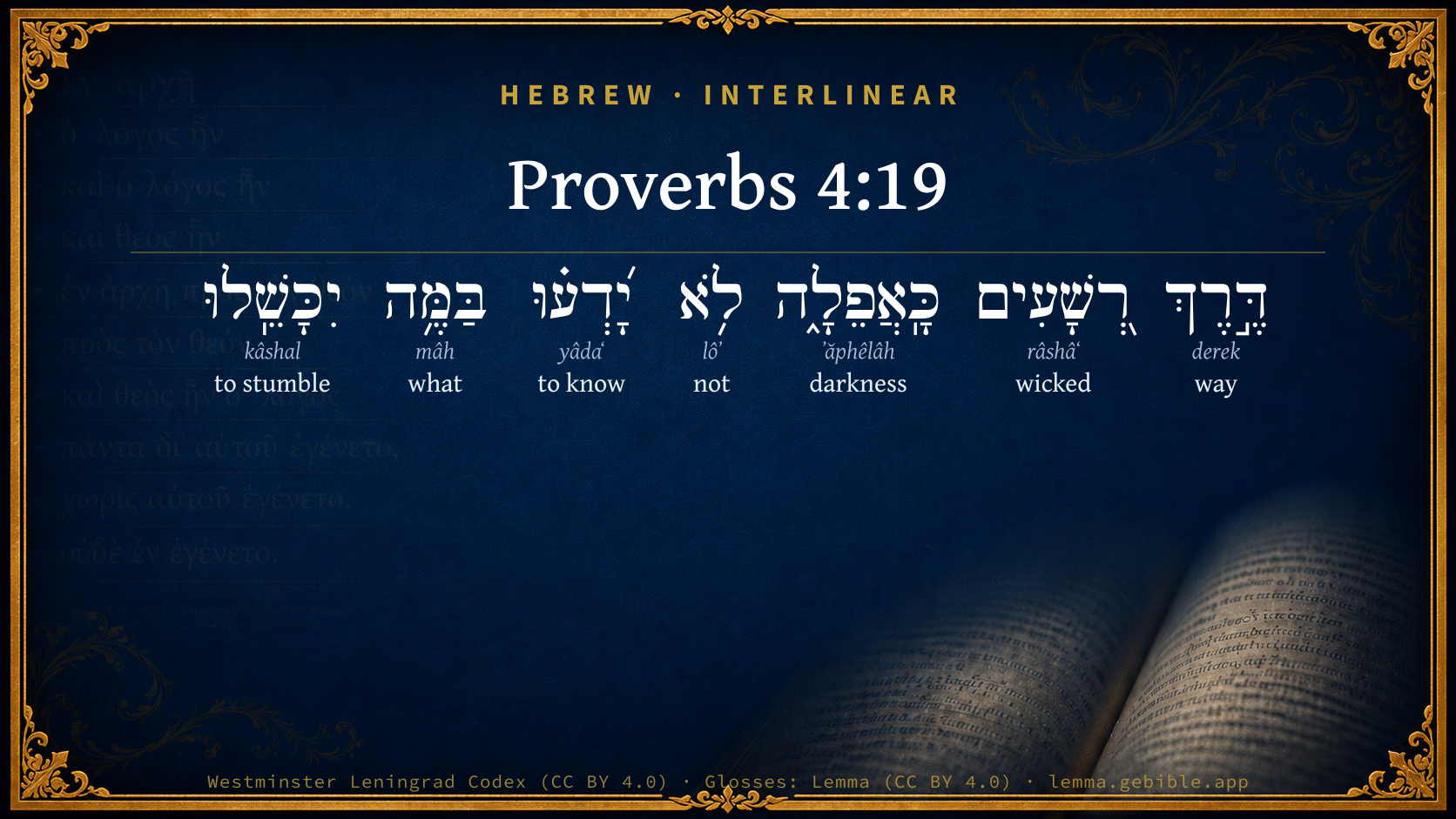
Hebrew (Westminster Leningrad Codex) Proverbs 4:19 appears in the Hebrew Old Testament. The text above is from the Westminster Leningrad Codex. Each word links to its Strong’s number, a concise gloss, and parsing drawn from the Open Scriptures Hebrew Bible morphology. Click any word for its full Brown-Driver-Briggs (BDB) entry.
Download image
Cite this verse

Proverbs 4:19 (World English Bible). Public Domain. Lemma interlinear Bible study tool, https://lemma.gebible.app/v/proverbs/4/19.

Show BibTeX & RIS
BibTeX
RIS
English Translation
The way of the wicked is like darkness. They don't know what they stumble over.
World English Bible · Public Domain
Download a study sheet

One document with this verse’s original text, its word-by-word gloss line, the meaning frame, cross-references with their text, attributed commentary, and full source and license credits — printable, and it pastes into notes with its structure intact.

This verse Autodidact and up

Study sheet (.html) Plain text (.txt)

A passage Seminary Student

Up to 50 verses in one chapter. A passage sheet keeps up to 6 commentary sources and 12 cross-references per verse, in the order this page ranks them, and says so on the sheet whenever that leaves anything out. Ask for a single verse and you get the Autodidact verse sheet above.

Everything on this page stays free to read, with no account — the sheet is a download of what is already on screen, not access to it.

Want to remove ads? Support Godless Engineer
Compare translations 3

The same verse in 3 English versions, stacked beneath the original-language interlinear above. Click any original word for its lexicon entry.

Each is an independent rendering of the whole verse — the interlinear is not word-aligned to these translations.

Highlighted words mark where these versions differ — a whole-verse word diff, not a word-by-word alignment.

  • World English Bible Public Domain
    The way of the wicked is like darkness. They don't know what they stumble over.
  • King James Version Public Domain
    The way of the wicked is as darkness: they know not at what they stumble.
  • unfoldingWord Literal Text CC BY-SA 4.0
    The way of the wicked like the darkness; they do not know on what they stumble.

unfoldingWord Literal Text — © unfoldingWord, licensed CC BY-SA 4.0. Word-aligned USFM3 via Door43 (git.door43.org/unfoldingWord/en_ult).

Versions to compare (up to 4)

3 of 4 selected

Show all 18 translations

Every available English version of this verse, each an independent rendering of the whole verse.

  • World English Bible Public Domain
    The way of the wicked is like darkness. They don't know what they stumble over.
  • Berean Standard Bible Public Domain
    But the way of the wicked is like the darkest gloom; they do not know what makes them stumble.
  • Majority Standard Bible Public Domain
    But the way of the wicked is like the darkest gloom; they do not know what makes them stumble.
  • King James Version Public Domain
    The way of the wicked is as darkness: they know not at what they stumble.
  • American Standard Version (1901) Public Domain
    The way of the wicked is as darkness: They know not at what they stumble.
  • Revised Version (1885) Public Domain
    The way of the wicked is as darkness: they know not at what they stumble.
  • Geneva Bible (1599) Public Domain
    The way of the wicked is as the darkenes: they knowe not wherein they shall fall.
  • Douay-Rheims (1899) Public Domain
    The way of the wicked is darksome: they know not where they fall.
  • Young's Literal Translation Public Domain
    The way of the wicked `is' as darkness, They have not known at what they stumble.
  • Literal Standard Version CC BY-SA 4.0
    The way of the wicked [is] as darkness, || They have not known at what they stumble.
  • Unlocked Literal Bible CC BY-SA 4.0
    The way of the wicked is like darkness— they do not know what it is they stumble over.
  • unfoldingWord Literal Text CC BY-SA 4.0
    The way of the wicked like the darkness; they do not know on what they stumble.
  • Darby Bible Public Domain
    The way of the wicked is as darkness: they know not at what they stumble.
  • World Messianic Bible Public Domain
    The way of the wicked is like darkness. They don’t know what they stumble over.
  • Webster's Bible Public Domain
    The way of the wicked is as darkness: they know not at what they stumble.
  • Free Bible Version CC BY-SA 4.0
    But the way of life of the wicked is like complete darkness; they don't even know what they're tripping over.
  • Bible in Basic English Public Domain
    The way of sinners is dark; they see not the cause of their fall.
  • JPS Tanakh (1917) Public Domain
    The way of the wicked is as darkness; they know not at what they stumble.

Literal Standard Version (2020), Covenant Press — licensed CC BY-SA 4.0. Text via the HelloAO Bible API (eBible.org). Unlocked Literal Bible (unfoldingWord) — licensed CC BY-SA 4.0. Text via the HelloAO Bible API (eBible.org). unfoldingWord Literal Text — © unfoldingWord, licensed CC BY-SA 4.0. Word-aligned USFM3 via Door43 (git.door43.org/unfoldingWord/en_ult). Free Bible Version, Dr. Jonathan Gallagher — licensed CC BY-SA 4.0. Text via the HelloAO Bible API (eBible.org).

Word by word

More ways to search: Search by grammar → Find every occurrence → Compare this word →

Practice this passage: Drill this verse → Learn its vocabulary →

About this verse

These counts appear in no published source. They are computed here, from the morphology-tagged text and Lemma’s own curated glosses. What Lemma adds →

7
words
7
distinct lemmas
Wisdom
section

Notable vocabulary

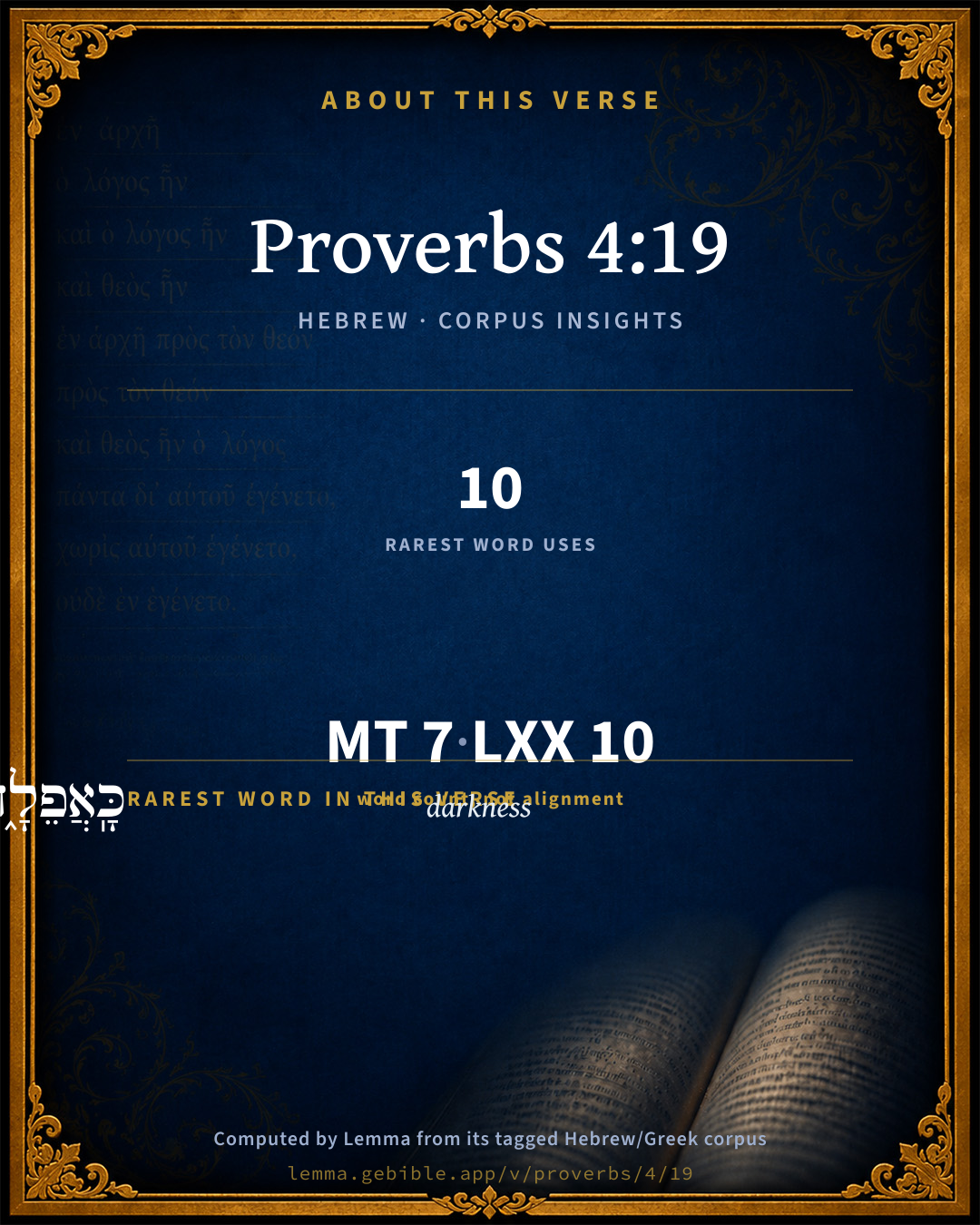
The rarest word here is כָּֽאֲפֵלָ֑ה darkness H653 — appearing just 10 times in the whole Hebrew Bible.

Shared distinctive vocabulary

כָּֽאֲפֵלָ֑ה darkness H653 occurs in 10 verses of the Hebrew Bible. Also found in:

Grammatical profile

  • 2 verbs
  • 2 nouns
  • 1 adjective
  • 2 particles

Verb forms

  • יָ֝דְע֗וּ Qal · Perfect
  • יִכָּשֵֽׁלוּ Niphal · Imperfect

Hebrew & Septuagint length

In English translation the verse runs 15 words from the Hebrew and 14 from the Septuagint (LXX English) — closely comparable.

A rough comparison of the two English renderings, which tokenize alike — not a word-level alignment.

Word counts can differ between the Hebrew and the Greek without any difference in meaning — e.g. the Hebrew direct-object marker אֵת has no separate Greek word, and Greek often adds the article ὁ.

In the original languages it is 7 Hebrew tokens and 10 Greek tokens — but the two are counted differently (Hebrew bundles its prefixes and suffixes into one token; the Greek is in lemma form), so that isn’t a like-for-like length.

Cross-references

14

Topical passages linked to Proverbs 4:19 in the Treasury of Scripture Knowledge — connected by theme and wording, ordered by reader-vote popularity; previews shown in the World English Bible.

  • John 12:35 Jesus therefore said to them, "Yet a little while the light is with you. Walk while you have the light, that darkness doesn't overtake you. He who walks in the darkness doesn't know where he is going.
  • Isaiah 59:9–10 Therefore is justice far from us, neither does righteousness overtake us: we look for light, but, behold, darkness; for brightness, but we walk in obscurity.
  • Job 18:5–6 "Yes, the light of the wicked shall be put out, The spark of his fire shall not shine.
  • Jeremiah 23:12 Therefore their way shall be to them as slippery places in the darkness: they shall be driven on, and fall therein; for I will bring evil on them, even the year of their visitation, says Yahweh.
  • 1 Samuel 2:9 He will keep the feet of his holy ones; But the wicked shall be put to silence in darkness; For by strength shall no man prevail.
  • Jeremiah 13:16 Give glory to Yahweh your God, before he cause darkness, and before your feet stumble on the dark mountains, and, while you look for light, he turn it into the shadow of death, and make it gross darkness.
  • Job 5:14 They meet with darkness in the day-time, And grope at noonday as in the night.
  • Job 12:25 They grope in the dark without light. He makes them stagger like a drunken man.
  • Job 18:18 He shall be driven from light into darkness, And chased out of the world.
  • Proverbs 2:13 Who forsake the paths of uprightness, To walk in the ways of darkness;
  • Matthew 7:23 Then I will tell them, 'I never knew you. Depart from me, you who work iniquity.'
  • John 11:10 But if a man walks in the night, he stumbles, because the light isn't in him."
  • Matthew 15:14 Leave them alone. They are blind guides of the blind. If the blind guide the blind, both will fall into a pit."
  • 1 John 2:11 But he who hates his brother is in the darkness, and walks in the darkness, and doesn't know where he is going, because the darkness has blinded his eyes.

Cross-references courtesy of OpenBible.info (CC BY 4.0).

Hebrew and Greek witnesses Masoretic Hebrew ↔ Greek Septuagint

The same verse in the two great witnesses to the Old Testament, shown verse-for-verse.

These are two independent witnesses, not word-aligned to each other, and the Septuagint is shown in lemma (dictionary) form.

Hebrew Proverbs 4:19 Masoretic · Westminster Leningrad Codex

דֶּ֣רֶךְ רְ֭שָׁעִים כָּֽאֲפֵלָ֑ה לֹ֥א יָ֝דְע֗וּ בַּמֶּ֥ה יִכָּשֵֽׁלוּ

The way of the wicked is like darkness. They don't know what they stumble over.

World English Bible · Public Domain

Greek LXX Proverbs 4:19 Septuagint · lemma form

ὁ δέ ὁδός ὁ ἀσεβής σκοτεινός οὐ οἶδα πῶς προςκόπτω

But the ways of the ungodly are dark; they know not how they stumble.

LXX2012 (modern English Septuagint) · Public Domain

Hebrew: Westminster Leningrad Codex (CC BY 4.0). Greek: Septuagint (public domain); English from LXX2012 (modern English Septuagint) (Public Domain). How the Septuagint differs from the Hebrew →

Commentary

Notes on Proverbs 4:19 from classic Christian and Jewish commentators (each source and its license shown beneath its notes). The classic Christian expositions comment on the surrounding passage and are grouped to its opening verse, so a note may address several verses; the Jewish commentaries on the Tanakh (Rashi and others) are per-verse, so they appear only where the commentator wrote on this verse.

Lemma curates 59 commentaries, every one of them public domain or Creative Commons licensed, each selected and text-cleaned for this edition rather than reprinted as found. About our sources →

Trapp's Complete Commentary

John Trapp

Pro 4:19 The way of the wicked [is] as darkness: they know not at what they stumble.

Ver. 19. Is as darkness.] That little light they had by nature they imprison, {κατεχοντωυ, Rom 1:18} and are justly deprived of. And as for those sparkles of the light of joy and comfort that hypocrites have, it is but as a flash of lightning which is followed with a thunder clap, or like the light smitten out of the flint; (1.) they cannot warm themselves by it, nor see to direct their ways; (2.) it will quickly go out; (3.) and after that they must "lie down in sorrow." {Isa 50:11}

They know not at what they stumble.] They stumble sometimes at Christ himself, and at his word, "being disobedient, whereunto also they were appointed." {1Pe 2:8} A shrewd sign of reprobation. The Vulgate renders it, Ne sciunt ubi corruant. They know not how soon they may drop into hell, which even gapes for them. {Isa 14:9}

John Trapp, A Commentary or Exposition upon All the Books of the Old and New Testament (1647–1656) — public domain. Text from a community e-Sword module.

The Biblical Illustrator

Joseph S. Exell

Pro_4:19

The way of the wicked is as darkness: they know not at what they stumble.

The blindness of sinners their destruction

All men are either saints or sinners; and they are all walking in paths as different as the characters they sustain. The text indicates that sinners are in such darkness that they are insensible of the objects which are leading them to ruin.

I. The darkness which sinners are involved. It cannot be owing to any deficiency in their natural powers, nor to any want of intellectual information. The darkness is moral darkness; it lies not in their understandings, but in their hearts. Moral depravity always produces moral blindness. While sinners remain under the entire dominion of a wicked heart, they are altogether blind to the moral beauty of the character, of the works, of the providence of God.

II. Sinners abe insensible of the objects over which they are stumbling and falling. Spiritual blindness is the same in all sinners, at all times; and has the same dangerous and destructive tendency.

1. They are insensible that they stumble at the great deceiver.

2. They are not sensible that they are stumbling at one another.

3. That they stumble at Divine providence.

4. That their common employments are dangerous objects, over which they are stumbling and falling.

5. They are no less blind to the nature and tendency of their religious performances.

6. The moral blindness of sinners insensibly leads them to stumble at the preaching they hear.

7. They are blind to the blindness of their own hearts, which are insensibly leading them to blackness and darkness for ever.

Improvement--

1. If sinners are so blind and insensible to the dangerous objects with which they are surrounded, and over which they are stumbling, it is not strange, that they generally live so securely and joyfully.

2. If all sinners are involved in such moral darkness as makes them insensible of their dangerous and perishing condition, then it is not strange that they are so displeased at having their danger clearly pointed out.

3. If sinners are blind to the objects which are insensibly leading them to destruction, then they are in extreme danger of being finally lost. All things conspire to destroy them, because they abuse all things with which they are connected and concerned.

4. If sinners are constantly growing blinder and blinder, and more insensible of the things which are leading them to ruin, then they are entirely in the sovereign hand of God, who may save or destroy them, according to His holy and righteous pleasure.

5. It is owing to the distinguishing and astonishing grace of God that any are saved.

6. Inquire whether sinners have ever been made the subjects of Gods special grace. (N. Emmons, D.D.)

The obscurity and uncertainty of the way of the wicked

1. We will consider the man who admits the principles of religion in speculation, but contradicts them in practice. His way is darkness. Light, indeed, has come to him; but he loves darkness rather than light. He is not guided by the dictates of reason, or the precepts of revelation; but pursues a course in direct opposition to both. He never knows what course he shall next pursue; for he cannot tell what the next impulse will be--what gust of passion will take him, or what wind of temptation will drive him away.

2. Let us consider the hypocrite, who, without integrity of heart, assumes the external form of religion His way is dark and slippery. He believes that there is such a thing as religion, and that it is a matter in which he is really concerned. He views a future state as certain, and preparation for it as immediately important. His heart is, indeed, full of love to this world; but, since he must leave it, he wishes to have a good hope in the view of another. He is sure he should enjoy himself and his earthly treasures much better if he could only free his mind from this painful bondage to the fear of death--this troublesome apprehension of the wrath to come. He applies himself to obtain that tranquil state which seems so desirable. He has no more love to religion than he used to have. Terror only has awakened him from his guilty slumbers. It is not the temper of godliness, it is only the pleasure of a good hope, which is the immediate object of his desire. He gains his hope by self-deception, and maintains it by self-flattery.

3. To consider the wicked man in another point of view; as believing the great truths of natural religion, but discarding revelation. His way is covered with darkness. He has no light to direct his eye or guide his steps. With respect to the nature, condition, and means of future happiness, an awful uncertainty attends him. There is no ground on which his faith can stand; no support on which his hope can lean.

4. There is another view which we are to take of the wicked. We will consider them as renouncing the great principles of natural religion, the existence and government of God, moral obligation, and a future retribution. There are some such infidels as these; but their way is covered with darkness, more gloomy and dismal than that which involves the path of other transgressors. What peace and satisfaction can a mortal feel without a persuasion that there is a wise, just, and good Being, who made and governs the world, and that this Being is his friend? With this persuasion he may possess a cheerful serenity amidst all the vicissitudes of life; for to the virtuous God is a present help in trouble, and all things will He turn to their advantage. (J. Lathrop, D.D.)

The way of the wicked

There is a castle on the Lake of Geneva which stands upon a rock, and the lake is underneath. In the old, cruel days great atrocities were perpetrated there, and one was this: There is a shaft from that prison to the lake. Looking down it, you see the water glittering far away below. In those days they used to plant in that shaft spikes or sharp knives. Then they came in the darkness, and, opening the door, whispered to the prisoners, Three steps and liberty. And the poor prisoner took his leap in the dark--as he thought, to liberty; but he fell amongst these knives, and in a few moments dropped, a bleeding corpse, into the lake below. Yes; three steps and liberty--to be cut up, and drop, a mangled body, into the abyss. I tell you that is like the liberty of sin. A man who fancies he is going to live after his passions takes a leap in the dark, and, pierced through with many sorrows, drops into the gulf of darkness. (W. L. Watkinson.)

The Biblical Illustrator, edited by Joseph S. Exell (c. 1880s–1900s) — public domain. Text from a community e-Sword module.

MacLaren's Expositions of Holy Scripture

Alexander MacLaren

Proverbs

THE TWO PATHS

Pro 4:10 - Pro 4:19.

This passage includes much more than temperance or any other single virtue. It is a perfectly general exhortation to that practical wisdom which walks in the path of righteousness. The principles laid down here are true in regard to drunkenness and abstinence, but they are intended to receive a wider application, and to that wider application we must first look. The theme is the old, familiar one of the two paths, and the aim is to recommend the better way by setting forth the contrasted effects of walking in it and in the other.

The general call to listen in Pro 4:10 is characteristically enforced by the Old Testament assurance that obedience prolongs life. That is a New Testament truth as well; for there is nothing more certain than that a life in conformity with God’s will, which is the same thing as a life in conformity with physical laws, tends to longevity. The experience of any doctor will show that. Here in England we have statistics which prove that total abstainers are a long-lived people, and some insurance offices construct their tables accordingly.

After that general call to listen comes, in Pro 4:11, the description of the path in which long life is to be found. It is ‘the way of Wisdom’-that is, that which Wisdom prescribes, and in which therefore it is wise to walk. It is always foolish to do wrong. The rough title of an old play is The Devil is an Ass, and if that is not true about him, it is absolutely true about those who listen to his lies. Sin is the stupidest thing in the universe, for it ignores the plainest facts, and never gets what it flings away so much to secure.

Another aspect of the path is presented in the designation ‘paths of uprightness,’ which seems to be equivalent to those which belong to, or perhaps which consist of, uprightness. The idea of straightness or evenness is the primary meaning of the word, and is, of course, appropriate to the image of a path. In the moral view, it suggests how much more simple and easy a course of rectitude is than one of sin. The one goes straight and unswerving to its end; the other is crooked, devious, intricate, and wanders from the true goal. A crooked road is a long road, and an up-and-down road is a tiring road. Wisdom’s way is straight, level, and steadily approaches its aim.

In Pro 4:13 the image of the path is dropped for the moment, and the picture of the way of uprightness and its travellers is translated into the plain exhortation to keep fast hold of ‘instruction,’ which is substantially equivalent to the queenly Wisdom of these early chapters of Proverbs. The earnestness of the repeated exhortations implies the strength of the forces that tend to sweep us, especially those of us who are young, from our grasp of that Wisdom. Hands become slack, and many a good gift drops from nerveless fingers; thieves abound who will filch away ‘instruction,’ if we do not resolutely hold tight by it. Who would walk through the slums of a city holding jewels with a careless grasp, and never looking at them? How many would he have left if he did? We do not need to do anything to lose instruction. If we will only do nothing to keep it, the world and our own hearts will make sure that we lose it. And if we lose it, we lose ourselves; for ‘she is thy life,’ and the mere bodily life, that is lived without her, is not worth calling the life of a man.

Pro 4:14 - Pro 4:17 give the picture of the other path, in terrible contrast with the preceding. It is noteworthy that, while in the former the designation was the ‘path of uprightness’ or of ‘wisdom,’ and the description therefore was mainly of the characteristics of the path, here the designation is ‘the path of the wicked,’ and the description is mainly of the travellers on it. Righteousness was dealt with, as it were, in the abstract; but wickedness is too awful and dark to be painted thus, and is only set forth in the concrete, as seen in its doers. Now, it is significant that the first exhortation here is of a negative character. In contrast with the reiterated exhortations to keep wisdom, here are reiterated counsels to steer clear of evil. It is all about us, and we have to make a strong effort to keep it at arm’s-length. ‘Whom resist’ is imperative. True, negative virtue is incomplete, but there will be no positive virtue without it. We must be accustomed to say ‘No,’ or we shall come to little good. An outer belt of firs is sometimes planted round a centre of more tender and valuable wood to shelter the young trees; so we have to make a fence of abstinences round our plantation of positive virtues. The decalogue is mostly prohibitions. ‘So did not I, because of the fear of God’ must be our motto. In this light, entire abstinence from intoxicants is seen to be part of the ‘way of Wisdom.’ It is one, and, in the present state of England and America, perhaps the most important, of the ways by which we can ‘turn from’ the path of the wicked and ‘pass on.’

The picture of the wicked in Pro 4:16 - Pro 4:17 is that of very grossly criminal sinners. They are only content when they have done harm, and delight in making others as bad as themselves. But, diabolical as such a disposition is, one sees it only too often in full operation. How many a drunkard or impure man finds a fiendish pleasure in getting hold of some innocent lad, and ‘putting him up to a thing or two,’ which means teaching him the vices from which the teacher has ceased to get much pleasure, and which he has to spice with the condiment of seeing an unaccustomed sinner’s eagerness! Such people infest our streets, and there is only one way for a young man to be safe from them,-’avoid, pass not by, turn from, and pass on.’ The reference to ‘bread’ and ‘wine’ in Pro 4:17 seems simply to mean that the wicked men’s living is won by their ‘wickedness,’ which procures bread, and by their ‘violence,’ which brings them wine. It is the way by which these are obtained that is culpable. We may contrast this foul source of a degraded living with Pro 4:13, where ‘instruction’ is set forth as ‘the life’ of the upright.

Pro 4:18 - Pro 4:19 bring more closely together the two paths, and set them in final, forcible contrast. The phrase ‘the perfect day’ might be rendered, vividly though clumsily, ‘the steady of the day’-that is, noon, when the sun seems to stand still in the meridian. So the image compares the path of the just to the growing brightness of morning dawn, becoming more and more fervid and lustrous, till the climax of an Eastern midday. No more sublime figure of the continuous progress in goodness, brightness, and joy, which is the best reward of walking in the paths of uprightness, can be imagined; and it is as true as it is sublime. Blessed they who in the morning of their days begin to walk in the way of wisdom; for, in most cases, years will strengthen their uprightness, and to that progress there will be no termination, nor will the midday sun have to decline westward to diminishing splendour or dismal setting, but that noontide glory will be enhanced, and made eternal in a new heaven. The brighter the light, the darker the shadow. That blaze of growing glory, possible for us all, makes the tragic gloom to which evil men condemn themselves the thicker and more doleful, as some dungeon in an Eastern prison seems pitch dark to one coming in from the blaze outside. ‘How great is that darkness!’ It is the darkness of sin, of ignorance, of sorrow, and what adds deeper gloom to it is that every soul that sits in that shadow of death might have been shining, a sun, in the spacious heaven of God’s love.

Alexander MacLaren, Expositions of Holy Scripture (1904–1910) — public domain. Text from a community e-Sword module.

Ellicott's Commentary for English Readers

(19) The way of the wicked is as darkness.—By refusing to “walk in the light” of God’s Word, and conscience (1Jn_1:7), the light that was in them has become darkness (Mat_6:23); they know not whither they are going (Joh_12:35), and stumble (Pro_11:10) over difficulties which in the light they might have avoided.

A Bible Commentary for English Readers, edited by Charles John Ellicott (1878–1897) — public domain. Text from a community e-Sword module.

The Cambridge Bible for Schools and Colleges

gen. ed. J. J. S. Perowne

19. as darkness] Comp., for the contrast with the preceding verse, Pro_13:9.

The Cambridge Bible for Schools and Colleges (gen. ed. J. J. S. Perowne; Cambridge University Press, 1878–1918) — public domain. Text from a community e-Sword module.

John Gill's Exposition

The way of the wicked is as darkness,.... They are in the darkness of sin, ignorance, error, and unbelief; their works are works of darkness; the way in which they are leads to eternal darkness, ruin, and misery, and so must be most uncomfortable and dangerous;

they know not at what they stumble; they stumble at the word, which they are ignorant of, and at Christ, whom they have no knowledge of; and through the temptations of Satan and snares of the world, which they are not aware of, nor upon their guard against.

John Gill's Exposition of the Whole Bible (1746–1763) — public domain (CC PDM 1.0). Text via the HelloAO Bible API.

Haydock's Catholic Bible Commentary

Fall. They are unconcerned about sin, and neither avoid it, nor strive to repent. (Calmet)

George Leo Haydock (1774–1849), Haydock's Catholic Family Bible and Commentary, 1859 edition — public domain. Excludes Psalms (Douay-Rheims chapter numbering differs from Protestant) and Deuterocanonical books (Catholic canon only).

Matthew Poole's English Annotations

As darkness; full of gross ignorance and error, of uncertainty and confusion, of wickedness, of danger and misery; all which come under the name of darkness in Scripture use, and suit well with the context.

Stumble, Heb. shall stumble. Though they are always in danger, yet they are always secure, and do not discern their danger, nor the cause, or manner, or time of their ruin, till they be surprised with it.

Matthew Poole's English Annotations on the Holy Bible (1683–1685) — public domain. Text from a community e-Sword/MySword module.

Whedon's Commentary on the Bible

Daniel D. Whedon

19. As darkness — Thick or dense darkness, the opposite of the shining of the righteous. See Pro_4:18; also Joh_11:9-10; Joh_12:35.

Daniel D. Whedon (gen. ed.), Commentary on the Old and New Testaments (1874–1909) — public domain. Text from a community e-Sword module.

The Pulpit Commentary

The way of the wicked is as darkness. In contrast with the path of the just is the way of the wicked, which is described as darkness itself: i.e. so deeply enveloped in gloom that the wicked are not able even to see the obstacles and impediments against which they stumble, and which are the cause of their ruin. It is a way dark throughout a via tenebrosa (Vulgate) terminating at length in "the blackness of darkness." As light is emblematical of knowledge, holiness, and joy, so darkness represents ignorance, unholiness, and misery. (see Isa_8:22) Darkness (aphelah); strictly, thick darkness, midnight gloom, the entire absence of light. It is the word used of the plague of "thick darkness" that settled over all the land of Egypt, even a darkness that "might be felt," when the Egyptians "saw not one another, nor any arose from his place for three days". (Exo_10:21-23) It occurs again in Pro_7:9, "in the black and dark night." In this darkness the wicked cannot help but stumble. Compare our Lord"s teaching, "But if a man walk in the night, he stumbleth, because there is no light in him". (Joh_11:10 Joh_12:36) The expression, they know not at what they stumble, carries with it the idea that they are so ignorant that they neither know wickedness as wickedness, nor do they apprehend the destruction which it involves. "Sins, however great and detestable they may be, are looked upon as trivial, or as not sins at all, when men get accustomed to them" (St. Augustine, "Enchiridion," cap. 80). On "stumble" (kashal), see ver. 12; and on the destruction of the wicked implied in the stumbling, see Pro_1:27, Pro_2:18-22 Pro_3:35.

The way of darkness.

The way of sin is in all respects one of darkness. It is dark in its origin, dark in its course, and dark in its end.

I THE WAY OF SIN STARTS FROM A DARK ORIGIN.

1. Ignorance. Most criminals are deplorably ignorant. Vicious men are generally men whose mental cultivation has been neglected by others or by themselves. Ignorance of Divine truth leads the way to wickedness. The first preventative of evil is the religious teaching of children.

2. Inherited tendencies to evil. These awful consequences of a parent"s sin are a dark heritage which heavily handicaps the child from the first.

3. Satanic influences. Temptations are all dark in their origin. Evil suggestions come up from the pit of darkness.

4. The lower nature. When a man gives way to sin he sacrifices his higher to his lower self. He sinks from the sunlit mountain heights of purity to gloomy depths of baser living.

II THE WAY OF SIN PURSUES A DARK COURSE. It is a road that runs through sombre passes, like some of those Welsh paths far in the heart of the mountains, on which the sun never shines. This is worse than the Valley of the Shadow of Death, for in the fearful path of sin there is no guiding hand and no protecting staff. The darkness of this course is exhaled from the evil committed upon it.

1. Perverted conscience. Sin distorts a man"s thoughts, blinds his eyes to the highest truth, raises a mist about the old landmarks of right and wrong, and plunges the soul into a stupor of moral indifference. From neglecting to follow the light of God, the sinner comes at last to be incapable of beholding it.

2. Spiritual desertion. God"s Spirit will not always strive with the sons of men. (Gen_6:3) There comes a time when God leaves the self-abandoned soul to its own devices. Then, indeed, a darkness as of winter midnight sinks upon the lost being.

3. Corrupt conduct. Following the way of evil, the sinner continues to blacken it with the guilt of his own misdeeds. He plunges into the spiritual darkness of wicked living the degradation, the loss of the joy and purity of heavenly light that sin always induces.

III THE WAY OF SIN ISSUES IN A DARK END. The sinner cannot see his way upon it, and therefore he is sure to stumble. Bruised and confused, he may still persist in his sombre career. But he has no prospect of light beyond. There are no Beulah heights for him at the further end of the gloomy valley. His night of sin will be followed by no dawn of blessed light. He presses on only to deeper and yet deeper darkness. If he will not return there is nothing before him but the darkness of death. The one way of escape is backwards to retrace his steps in humble penitence. Then, indeed, he may see the welcome light of his Father"s home, and even earlier the Light of the world, the Saviour who has come out into the darkness to lead him back to God. For the sinner who persists in his evil course there can be no better prospect than that described by Byron in his poem on "Darkness"The world was void, The populous and the powerful was a lump, Seasonless, herbless, treeless, manless, lifeless A lump of death a chaos of hard clay. The rivers, lakes, and ocean all stood still, And nothing stirred within their silent depths; Ships sailorless lay rotting on the sea, And their masts fell down piecemeal: as they dropped They slept on the abyss without a surge The waves were dead; the tides were in their grave, The moon, their mistress, had expired before; The winds were withered in the stagnant air. And the clouds perished; Darkness had no need Of aid from them she was the Universe.

The Pulpit Commentary (1880–1919), ed. H.D.M. Spence-Jones & Joseph S. Exell — public domain. Text from a community e-Sword module.

John Wesley's Explanatory Notes

Darkness - Full of ignorance and error, of uncertainty and confusion, of danger and misery.

John Wesley, Explanatory Notes Upon the Whole Bible (1754–1765) — public domain. Text via the GEBible commentary corpus.

Bridges on Proverbs

Charles Bridges

The contrast is more clearly repeated.†1 Each has his own way. The path of the just is glowing light and joy. The way of the wicked is darkness; without direction, comfort, safety, or peace, till "his feet at last stumble on the dark mountains;" till he falls into "the blackness of darkness for ever." (Jer 13:16 . Jud 1:13 . Compare Job 18:5-6, Job 18:18 .) His way is not only dark, but as darkness, a compound of ignorance, error, sin and misery. The love of sin "rebels against the light." (Job 24:13 . Joh 3:19 . Compare Isa 5:20 .) The darkness is willful, and therefore accountable. There is no stumbling in the path of the just. So far as he is upright, the Lord keeps him. (Pro 4:12 ; Pro 3:23 . Psa 91:11-12 .) The wicked go on, "groping on as if they had no eyes" (Isa 59:10 ); hurrying on blindly into misery, that they can neither foresee nor avoid. (Job 5:14 ; Job 12:25 . Jer 23:12 . Zep 1:17 .) They know not at what they stumble. Oh! if they did, would they not startle, and shrink back? For they stumble on the very foundation of the Gospel! making the rock of salvation a rock of offense. (Rom 9:32-33 . 1Pe 2:8 .) Would they but listen to the merciful warning of their Lord — "Yet a little time the light is with you: walk while ye have the light, lest darkness come upon you; for he that walketh in darkness knoweth not whither he goeth." (Joh 12:35-36 .)

Footnotes

†1 See the same contrast drawn by our Lord, Mat 6:22-23 . — Schultens considers the original to express increasing darkness, answering to the increasing light of the opposite path. Comment. in Prov. 4to. 1748. Compare Job 15:23 .

Charles Bridges, An Exposition of the Book of Proverbs (1846) — public domain. Text from a community e-Sword module.

Rashi

Rabbi Shlomo Yitzchaki (Rashi)

The way of the wicked is like pitch darkness; they do not know on what they stumble Suddenly, an obstacle will come to them, and they will not know how to beware of it.

Rashi on the Tanakh — English translations: “The Judaica Press complete Tanach with Rashi, translated by A. J. Rosenberg” (CC BY 4.0); “Pentateuch with Rashi's commentary by M. Rosenbaum and A.M. Silbermann, 1929-1934” (public domain); “The Metsudah Tanach series, Lakewood, N.J” (CC BY 4.0); and “The Book of Joshua, Metsudah Publications, 1997” (CC BY 4.0). Text via Sefaria.

Lesson kit

Teaching starters — assembled from the data on this page, not authored interpretation. Every prompt links to the verse data it draws on. Edit before teaching.

Proverbs, in the Wisdom, opens this verse with 7 words (7 distinct Hebrew lemmas). Its most distinctive word is ʼăphêlâh (“darkness”). A historical commentator’s framing appears above. Read the whole chapter for the surrounding context.

Discussion questions

  1. How does “darkness” (ʼăphêlâh) shape what this verse is saying?
  2. How does Exodus 10:22, which shares the word «darkness», read alongside this verse?
  3. These translations render this verse differently; the difference is in the English rendering, not the original. What questions does that raise?
  4. «יָ֝דְע֗וּ» is a Qal Perfect verb. How does that grammatical form shape the action described?
  5. Compare how Trapp's Complete Commentary and The Biblical Illustrator read this verse. Where do they agree or differ?

Things to notice

Reading settings

Reading text

Shown beneath each verse's original-language words.

Old Testament
Old Testament edition

Read the OT as the Masoretic Hebrew (MT) or the Greek Septuagint (LXX).

English shown for the Greek Septuagint (in the Hebrew ↔ Greek comparison).

Comparing translations? Open the Compare panel on any verse page to stack up to four side by side.