
Ezekiel 33:8

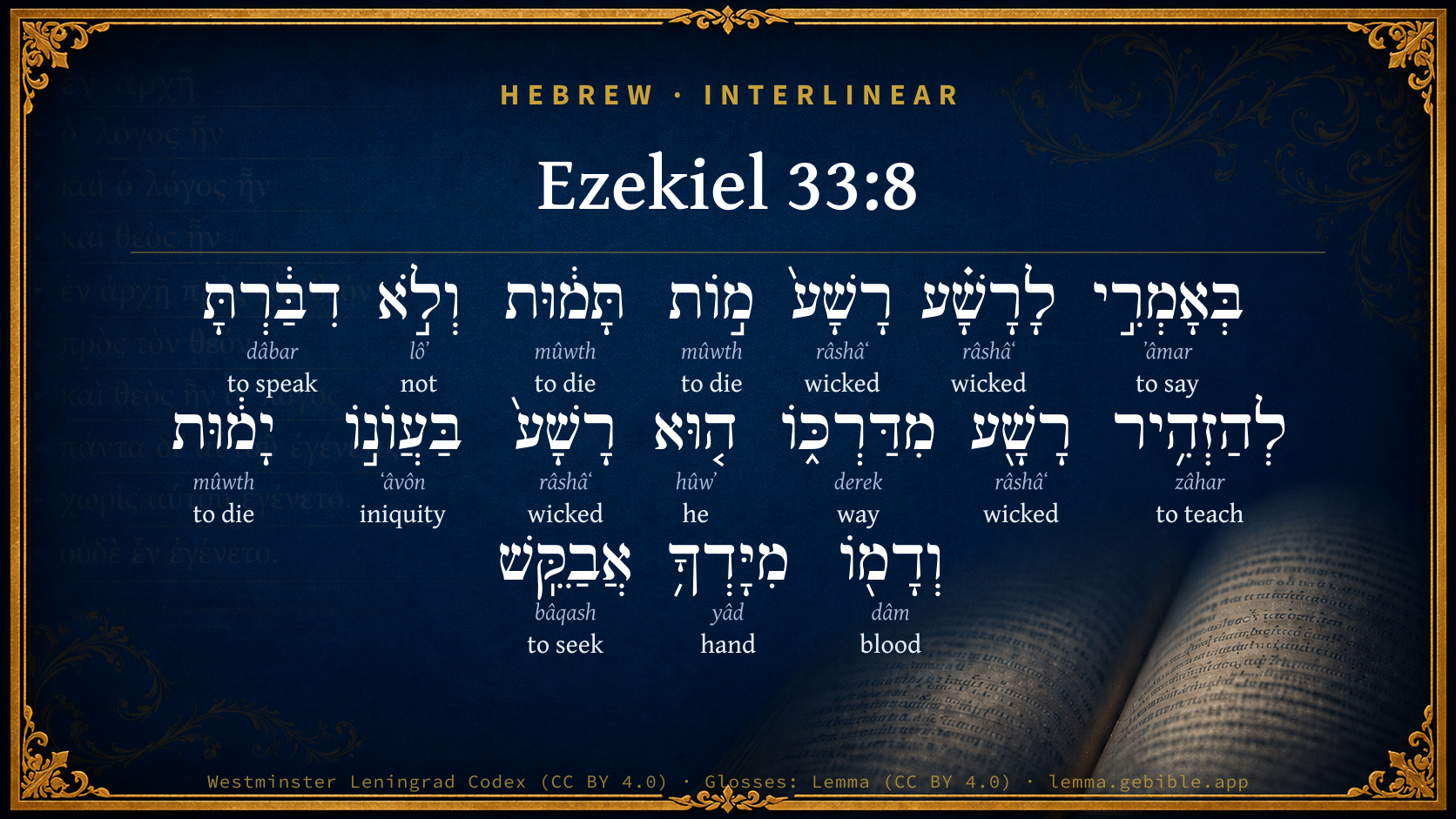
Hebrew (Westminster Leningrad Codex) Ezekiel 33:8 appears in the Hebrew Old Testament. The text above is from the Westminster Leningrad Codex. Each word links to its Strong’s number, a concise gloss, and parsing drawn from the Open Scriptures Hebrew Bible morphology. Click any word for its full Brown-Driver-Briggs (BDB) entry.
Download image
Cite this verse

Ezekiel 33:8 (World English Bible). Public Domain. Lemma interlinear Bible study tool, https://lemma.gebible.app/v/ezekiel/33/8.

Show BibTeX & RIS
BibTeX
RIS
English Translation
When I tell the wicked, O wicked man, you shall surely die, and you don't speak to warn the wicked from his way; that wicked man shall die in his iniquity, but his blood will I require at your hand.
World English Bible · Public Domain
Download a study sheet

One document with this verse’s original text, its word-by-word gloss line, the meaning frame, cross-references with their text, attributed commentary, and full source and license credits — printable, and it pastes into notes with its structure intact.

This verse Autodidact and up

Study sheet (.html) Plain text (.txt)

A passage Seminary Student

Up to 50 verses in one chapter. A passage sheet keeps up to 6 commentary sources and 12 cross-references per verse, in the order this page ranks them, and says so on the sheet whenever that leaves anything out. Ask for a single verse and you get the Autodidact verse sheet above.

Everything on this page stays free to read, with no account — the sheet is a download of what is already on screen, not access to it.

Want to remove ads? Support Godless Engineer
Compare translations 3

The same verse in 3 English versions, stacked beneath the original-language interlinear above. Click any original word for its lexicon entry.

Each is an independent rendering of the whole verse — the interlinear is not word-aligned to these translations.

Highlighted words mark where these versions differ — a whole-verse word diff, not a word-by-word alignment.

  • World English Bible Public Domain
    When I tell the wicked, O wicked man, you shall surely die, and you don't speak to warn the wicked from his way; that wicked man shall die in his iniquity, but his blood will I require at your hand.
  • King James Version Public Domain
    When I say unto the wicked, O wicked man, thou shalt surely die; if thou dost not speak to warn the wicked from his way, that wicked man shall die in his iniquity; but his blood will I require at thine hand.
  • unfoldingWord Literal Text CC BY-SA 4.0
    If I say to a wicked person, ‘Wicked one, you will surely die!’ but if you do not announce this so as to warn the wicked about his way, then he who is wicked will die in his sin, but I will require his blood from your hand!

unfoldingWord Literal Text — © unfoldingWord, licensed CC BY-SA 4.0. Word-aligned USFM3 via Door43 (git.door43.org/unfoldingWord/en_ult).

Versions to compare (up to 4)

3 of 4 selected

Show all 18 translations

Every available English version of this verse, each an independent rendering of the whole verse.

  • World English Bible Public Domain
    When I tell the wicked, O wicked man, you shall surely die, and you don't speak to warn the wicked from his way; that wicked man shall die in his iniquity, but his blood will I require at your hand.
  • Berean Standard Bible Public Domain
    If I say to the wicked, ‘O wicked man, you will surely die,’ but you do not speak out to dissuade him from his way, then that wicked man will die in his iniquity, yet I will hold you accountable for his blood.
  • Majority Standard Bible Public Domain
    If I say to the wicked, ‘O wicked man, you will surely die,’ but you do not speak out to dissuade him from his way, then that wicked man will die in his iniquity, yet I will hold you accountable for his blood.
  • King James Version Public Domain
    When I say unto the wicked, O wicked man, thou shalt surely die; if thou dost not speak to warn the wicked from his way, that wicked man shall die in his iniquity; but his blood will I require at thine hand.
  • American Standard Version (1901) Public Domain
    When I say unto the wicked, O wicked man, thou shalt surely die, and thou dost not speak to warn the wicked from his way; that wicked man shall die in his iniquity, but his blood will I require at thy hand.
  • Revised Version (1885) Public Domain
    When I say unto the wicked, O wicked man, thou shalt surely die, and thou dost not speak to warn the wicked from his way; that wicked man shall die in his iniquity, but his blood will I require at thine hand.
  • Geneva Bible (1599) Public Domain
    When I shall say vnto the wicked, O wicked man, thou shalt die the death, if thou doest not speake, and admonish the wicked of his way, that wicked man shall die for his iniquitie, but his blood will I require at thine hand.
  • Douay-Rheims (1899) Public Domain
    When I say to the wicked: O wicked man, thou shalt surely die: if thou dost not speak to warn the wicked man from his way: that wicked man shall die in his iniquity, but I will require his blood at thy hand.
  • Young's Literal Translation Public Domain
    In My saying to the wicked, O wicked one -- thou dost surely die, And thou hast not spoken to warn the wicked from his way, He -- the wicked -- in his iniquity doth die, And his blood from thy hand I require.
  • Literal Standard Version CC BY-SA 4.0
    In My saying to the wicked, O wicked one—you surely die, || And you have not spoken to warn the wicked from his way, || He—the wicked—dies in his iniquity, || And I require his blood from your hand.
  • Unlocked Literal Bible CC BY-SA 4.0
    If I say to a wicked person, 'Wicked one, you will surely die!' but if you do not announce this so as to warn the wicked about his way, then he who is wicked will die in his sin, but I will require his blood from your hand!
  • unfoldingWord Literal Text CC BY-SA 4.0
    If I say to a wicked person, ‘Wicked one, you will surely die!’ but if you do not announce this so as to warn the wicked about his way, then he who is wicked will die in his sin, but I will require his blood from your hand!
  • Darby Bible Public Domain
    When I say unto the wicked, Wicked [man], thou shalt certainly die; and thou speakest not to warn the wicked from his way, that wicked [man] shall die in his iniquity; but his blood will I require at thy hand.
  • World Messianic Bible Public Domain
    When I tell the wicked, ‘O wicked man, you will surely die,’ and you don’t speak to warn the wicked from his way, that wicked man will die in his iniquity, but I will require his blood at your hand.
  • Webster's Bible Public Domain
    When I say to the wicked, O wicked man, thou shalt surely die; if thou dost not speak to warn the wicked from his way, that wicked man shall die in his iniquity; but his blood will I require at thy hand.
  • Free Bible Version CC BY-SA 4.0
    If I tell the wicked ‘You're wicked; you're going to die’; but you don't warn them to change what they're doing, then they'll die in their sins and I will hold your responsible for their deaths.
  • Bible in Basic English Public Domain
    When I say to the evil-doer, Death will certainly overtake you; and you say nothing to make clear to the evil-doer the danger of his way; death will overtake that evil man in his evil-doing, but I will make you responsible for his blood.
  • JPS Tanakh (1917) Public Domain
    When I say unto the wicked: O wicked man, thou shalt surely die, and thou dost not speak to warn the wicked from his way; that wicked man shall die in his iniquity, but his blood will I require at thy hand.

Literal Standard Version (2020), Covenant Press — licensed CC BY-SA 4.0. Text via the HelloAO Bible API (eBible.org). Unlocked Literal Bible (unfoldingWord) — licensed CC BY-SA 4.0. Text via the HelloAO Bible API (eBible.org). unfoldingWord Literal Text — © unfoldingWord, licensed CC BY-SA 4.0. Word-aligned USFM3 via Door43 (git.door43.org/unfoldingWord/en_ult). Free Bible Version, Dr. Jonathan Gallagher — licensed CC BY-SA 4.0. Text via the HelloAO Bible API (eBible.org).

Word by word

More ways to search: Search by grammar → Find every occurrence → Compare this word →

Practice this passage: Drill this verse → Learn its vocabulary →

לְהַזְהִ֥יר
zâhar
H2094
“to teach”
Preposition + Verb, Hiphil, Infinitive Construct
Part of Speech
Preposition + Verb
Stem
Hiphil
Form
Infinitive Construct
Full BDB Definition

Origin: a primitive root

TWOT: 531 , 532

to admonish, warn, teach, shine, send out light, be light, be shining - (Niphal) to be taught, be admonished - (Hiphil) - to teach, warn - to shine, send out light (figuratively)
  1. בְּאָמְרִ֣י ʼâmar H559 “in/at · to say · me” Preposition + Verb, Qal, Infinitive Construct + Suffix, Personal, 1st Person, Common, Singular
  2. לָרָשָׁ֗ע râshâʻ H7563 “to/for the · wicked” Preposition, Determined + Adjective, Adjective, Masculine, Singular, Absolute
  3. רָשָׁע֙ râshâʻ H7563 “wicked” Adjective, Adjective, Masculine, Singular, Absolute
  4. מ֣וֹת mûwth H4191 “to die” Verb, Qal, Infinitive Absolute
  5. תָּמ֔וּת mûwth H4191 “to die” Verb, Qal, Imperfect, 2nd Person, Masculine, Singular
  6. וְלֹ֣א lôʼ H3808 “and · not” Conjunction + Particle, Negative
  7. דִבַּ֔רְתָּ dâbar H1696 “to speak” Verb, Piel, Perfect, 2nd Person, Masculine, Singular
  8. רָשָׁ֖ע râshâʻ H7563 “wicked” Adjective, Adjective, Masculine, Singular, Absolute
  9. מִדַּרְכּ֑וֹ derek H1870 “from · way · his” Preposition + Noun, Common, Both, Singular, Construct + Suffix, Personal, 3rd Person, Masculine, Singular
  10. ה֤וּא hûwʼ H1931 “he” Pronoun, Personal, 3rd Person, Masculine, Singular
  11. רָשָׁע֙ râshâʻ H7563 “wicked” Adjective, Adjective, Masculine, Singular, Absolute
  12. בַּעֲוֺנ֣וֹ ʻâvôn H5771 “in/at · iniquity · his” Preposition + Noun, Common, Both, Singular, Construct + Suffix, Personal, 3rd Person, Masculine, Singular
  13. יָמ֔וּת mûwth H4191 “to die” Verb, Qal, Imperfect, 3rd Person, Masculine, Singular
  14. וְדָמ֖וֹ dâm H1818 “and · blood · his” Conjunction + Noun, Common, Masculine, Singular, Construct + Suffix, Personal, 3rd Person, Masculine, Singular
  15. מִיָּדְךָ֥ yâd H3027 “from · hand · your” Preposition + Noun, Common, Both, Singular, Construct + Suffix, Personal, 2nd Person, Masculine, Singular
  16. אֲבַקֵּֽשׁ bâqash H1245 “to seek” Verb, Piel, Imperfect, 1st Person, Common, Singular

About this verse

These counts appear in no published source. They are computed here, from the morphology-tagged text and Lemma’s own curated glosses. What Lemma adds →

17
words
12
distinct lemmas
Prophets
section

Notable vocabulary

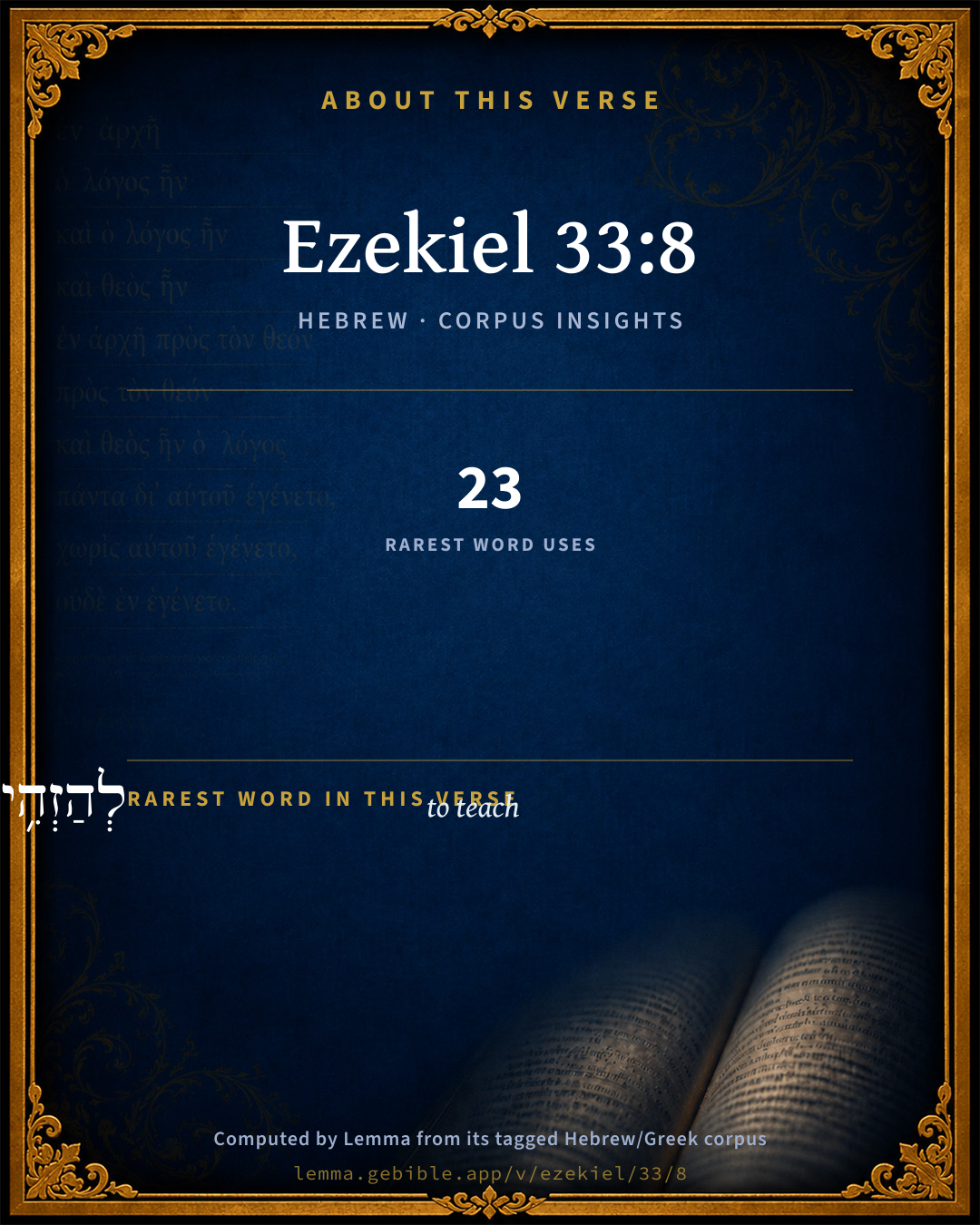
The rarest word here is לְהַזְהִ֥יר to teach H2094 — appearing just 23 times in the whole Hebrew Bible.

Shared distinctive vocabulary

לְהַזְהִ֥יר to teach H2094 occurs in 19 verses of the Hebrew Bible. Also found in:

Grammatical profile

  • 7 verbs
  • 4 nouns
  • 4 adjectives
  • 1 pronoun
  • 1 particle

Verb forms

  • בְּאָמְרִ֣י Qal · Infinitive Construct
  • מ֣וֹת Qal · Infinitive Absolute
  • תָּמ֔וּת Qal · Imperfect
  • דִבַּ֔רְתָּ Piel · Perfect
  • לְהַזְהִ֥יר Hiphil · Infinitive Construct
  • יָמ֔וּת Qal · Imperfect
  • אֲבַקֵּֽשׁ Piel · Imperfect

Repetition

Words recur within this verse — often emphatic in Hebrew:

  • לָרָשָׁ֗ע wicked H7563 ×4
  • מ֣וֹת to die H4191 ×3

Hebrew & Septuagint length

In English translation the verse runs 40 words from the Hebrew and 38 from the Septuagint (LXX English) — closely comparable.

A rough comparison of the two English renderings, which tokenize alike — not a word-level alignment.

Word counts can differ between the Hebrew and the Greek without any difference in meaning — e.g. the Hebrew direct-object marker אֵת has no separate Greek word, and Greek often adds the article ὁ.

Cross-references

15

Topical passages linked to Ezekiel 33:8 in the Treasury of Scripture Knowledge — connected by theme and wording, ordered by reader-vote popularity; previews shown in the World English Bible.

  • Acts 20:26–27 Therefore I testify to you this day that I am clean from the blood of all men,
  • Ezekiel 33:6 But if the watchman sees the sword come, and doesn't blow the trumpet, and the people aren't warned, and the sword comes, and take any person from among them; he is taken away in his iniquity, but his blood will I require at the watchman's hand.
  • Ezekiel 33:14 Again, when I say to the wicked, You shall surely die; if he turn from his sin, and do that which is lawful and right;
  • Ezekiel 18:4 Behold, all souls are mine; as the soul of the father, so also the soul of the son is mine: the soul who sins, he shall die.
  • Genesis 3:4 The serpent said to the woman, "You won't surely die,
  • Ezekiel 18:20 The soul who sins, he shall die: the son shall not bear the iniquity of the father, neither shall the father bear the iniquity of the son; the righteousness of the righteous shall be on him, and the wickedness of the wicked shall be on him.
  • Proverbs 11:21 Most assuredly, the evil man will not be unpunished, But the seed of the righteous will be delivered.
  • Isaiah 3:11 Woe to the wicked! Disaster is upon them; For the deeds of his hands will be paid back to him.
  • Jeremiah 8:11–13 They have healed the hurt of the daughter of my people slightly, saying, Peace, peace; when there is no peace.
  • Ezekiel 18:18 As for his father, because he cruelly oppressed, robbed his brother, and did that which is not good among his people, behold, he shall die in his iniquity.
  • Numbers 27:3 Our father died in the wilderness, and he was not among the company of those who gathered themselves together against Yahweh in the company of Korah: but he died in his own sin; and he had no sons.
  • Ecclesiastes 8:13 But it shall not be well with the wicked, neither shall he lengthen days like a shadow; because he doesn't fear God.
  • Jeremiah 14:13–16 Then said I, Ah, Lord Yahweh! behold, the prophets tell them, You shall not see the sword, neither shall you have famine; but I will give you assured peace in this place.
  • Ezekiel 13:9–10 My hand shall be against the prophets who see false visions, and who divine lies: they shall not be in the council of my people, neither shall they be written in the writing of the house of Israel, neither shall they enter into the land of Israel; and you shall know that I am the Lord Yahweh.
  • Ezekiel 18:10–13 If he fathers a son who is a robber, a shedder of blood, and who does any one of these things,

Cross-references courtesy of OpenBible.info (CC BY 4.0).

Hebrew and Greek witnesses Masoretic Hebrew ↔ Greek Septuagint

The same verse in the two great witnesses to the Old Testament, shown verse-for-verse.

These are two independent witnesses, not word-aligned to each other, and the Septuagint is shown in lemma (dictionary) form.

Hebrew Ezekiel 33:8 Masoretic · Westminster Leningrad Codex

בְּאָמְרִ֣י לָרָשָׁ֗ע רָשָׁע֙ מ֣וֹת תָּמ֔וּת וְלֹ֣א דִבַּ֔רְתָּ לְהַזְהִ֥יר רָשָׁ֖ע מִדַּרְכּ֑וֹ ה֤וּא רָשָׁע֙ בַּעֲוֺנ֣וֹ יָמ֔וּת וְדָמ֖וֹ מִיָּדְךָ֥ אֲבַקֵּֽשׁ

When I tell the wicked, O wicked man, you shall surely die, and you don't speak to warn the wicked from his way; that wicked man shall die in his iniquity, but his blood will I require at your hand.

World English Bible · Public Domain

Greek LXX Ezekiel 33:8 Septuagint · lemma form

ἐν ὁ εἶπον ἐγώ ὁ ἁμαρτωλός θάνατος θανατόω καί μή λαλέω ὁ φυλάσσω ὁ ἀσεβής ἀπό ὁ ὁδός αὐτός αὐτός ὁ ἄνομος ὁ ἀνομία αὐτός ἀποθνήσκω ὁ δέ αἷμα αὐτός ἐκ ὁ χείρ σύ ἐκζητέω

When I say to the sinner, You shall surely die; if you speak not to warn the wicked from his way, the wicked himself shall die in his iniquity; but his blood will I require at your hand.

LXX2012 (modern English Septuagint) · Public Domain

Hebrew: Westminster Leningrad Codex (CC BY 4.0). Greek: Septuagint (public domain); English from LXX2012 (modern English Septuagint) (Public Domain). How the Septuagint differs from the Hebrew →

Targum (Aramaic paraphrase)

1

The Targum is the ancient Jewish Aramaic paraphrase of the Hebrew Scriptures — an interpretive translation, not the Hebrew text itself. Onkelos (literal) and Pseudo-Jonathan (expansive) render the Torah, and Jonathan the Prophets. Coverage is partial: where no permissively-licensed English translation exists for a verse, only the Aramaic is shown. This is verse-level text, not a word-by-word alignment to the Hebrew.

  1. Targum Jonathan Prophets (Joshua–Malachi)
    בִּדְאֲמָרֵית לְרַשִׁיעָא רַשִׁיעָא מְמָת תְּמוּת וְלָא מַלֵילְתָּא לְאַזְהָרָה רַשִׁיעָא מֵאוֹרְחֵיהּ הוּא רַשִׁיעָא בְּחוֹבֵהּ יְמוּת וּדְמֵיהּ מִן יְדָךְ אֶתְבַּע:

    (no public-domain English translation for this verse)

    Targum Jonathan — Aramaic: “Mikraot Gedolot” (public domain). English: “Sefaria Community Translation” (CC0 1.0 (public-domain dedication)); “London "Chaldee Paraphrase," 1871” (public domain). Text via Sefaria.

Commentary

Notes on Ezekiel 33:8 from classic Christian and Jewish commentators (each source and its license shown beneath its notes). The classic Christian expositions comment on the surrounding passage and are grouped to its opening verse, so a note may address several verses; the Jewish commentaries on the Tanakh (Rashi and others) are per-verse, so they appear only where the commentator wrote on this verse.

Lemma curates 59 commentaries, every one of them public domain or Creative Commons licensed, each selected and text-cleaned for this edition rather than reprinted as found. About our sources →

Trapp's Complete Commentary

John Trapp

Eze 33:8 When I say unto the wicked, O wicked [man], thou shalt surely die; if thou dost not speak to warn the wicked from his way, that wicked [man] shall die in his iniquity; but his blood will I require at thine hand.

Ver. 8. {See Trapp on "Eze 3:18"}

John Trapp, A Commentary or Exposition upon All the Books of the Old and New Testament (1647–1656) — public domain. Text from a community e-Sword module.

Geneva Bible (1599)

Geneva Bible translators

The watchman must answer for the blood of all that perish through his negligence.

Geneva Bible (1599) marginal notes — public domain. Text via Bolls.life.

Jamieson, Fausset & Brown

Robert Jamieson, A. R. Fausset & David Brown

thou shalt surely die--by a violent death, the earnest of everlasting death; the qualification being supposed, "if thou dost not repent."

Jamieson, Fausset & Brown — Commentary Critical and Explanatory on the Whole Bible (1871) — public domain (CC PDM 1.0). Text via the HelloAO Bible API.

John Gill's Exposition

When I say unto the wicked, O wicked man,.... Order the prophet to say so to him, and as follows; See Gill on Eze 3:18.

.

Ezekiel 33:9

eze 33:9

eze 33:9

eze 33:9Nevertheless, if thou warn the wicked of his way,.... See Gill on Eze 3:19.

John Gill's Exposition of the Whole Bible (1746–1763) — public domain (CC PDM 1.0). Text via the HelloAO Bible API.

Haydock's Catholic Bible Commentary

Surely die a temporal, (Theodoret) or rather an eternal death. (St. Jerome)

George Leo Haydock (1774–1849), Haydock's Catholic Family Bible and Commentary, 1859 edition — public domain. Excludes Psalms (Douay-Rheims chapter numbering differs from Protestant) and Deuterocanonical books (Catholic canon only).

The Pulpit Commentary

Vers. 8, 9. The responsibility of the watchman.

It was well that the prophet should be given clearly to understand what was expected and required of him, not by men to whom he was sent, but by God who sent him. Plainer language could not have been used than this, in which Ezekiel is not only told the nature of his message to the house of Israel, but is informed of the responsibility attaching to the manner in which the commission was fulfilled.

I THE DUTY. The special duty of the watchman or guardian, as here explained, concerns the treatment of the wicked. More particularly it is for him

(1) to warn the wicked;

(2) to assure the inattentive and impenitent that the punishment of death awaits him;

(3) to admonish him to repent.

II THE POSSIBILITY OF FAILURE. Enthusiasm sometimes loses sight of this. Many a young minister of religion commences his work with the conviction that God"s message has only to be delivered in order to its acceptance; that the moral Law is so beautiful that it has but to be exhibited in order to be revered and honored; that the gospel is so precious and glorious that no one who hears it can fail to embrace it. Experience dispels many of our illusions; and it is soon found that there are men capable of listening to the threats of the Law and to the promises of the gospel with utter indifference and unconcern. Ezekiel was reminded that some of the wicked might not turn, might die in their iniquity. Doubtless he found that this was actually the case. It is no discredit either to the message or to the messenger that men do not accept the Word and act upon it. Our Lord Jesus had occasion to marvel at the unbelief of those to whom he ministered; and when St. Paul preached, "some believed, and some believed not.

III THE UNFAITHFUL WATCHCASE. This is the appointed guardian who "does not speak to warn the wicked of his way." This unfaithfulness may be accounted for by indolence, or by undue fear, or by a desire to conciliate and please his hearers. But all such motives should be consumed by a burning desire on the part of the spiritual guardian to commend himself to his Master. The watchman is assured that if, through his unfaithfulness, the wicked dies unwarned and impenitent in his iniquity, the blood of the perishing shall be required at the watchman"s hand.

IV THE FAITHFUL WATCHMAN. Faithfulness does not involve uniform or even usual success. The earnestly and frequently warned may nevertheless die in his iniquity, The fervent prophet, the zealous preacher, the diligent pastor, may have the inexpressible sorrow of seeing little fruit of their labor. It may be necessary that the testimony should be borne, even though rejected and despised. But the servant of the Lord is assured, for his encouragement, that, if he does his duty, he delivers his soul His workmanship may perish in the flames; yet he himself may be saved, though through the fire. T.

The Pulpit Commentary (1880–1919), ed. H.D.M. Spence-Jones & Joseph S. Exell — public domain. Text from a community e-Sword module.

Lesson kit

Teaching starters — assembled from the data on this page, not authored interpretation. Every prompt links to the verse data it draws on. Edit before teaching.

Ezekiel, in the Prophets, opens this verse with 17 words (12 distinct Hebrew lemmas). Its most distinctive word is zâhar (“to teach”). A historical commentator’s framing appears above. Read the whole chapter for the surrounding context.

Discussion questions

  1. How does “to teach” (zâhar) shape what this verse is saying?
  2. How does Exodus 18:20, which shares the word «to teach», read alongside this verse?
  3. What does the repetition of “wicked” (4× in this one verse) do in this verse?
  4. These translations render this verse differently. What is at stake in choosing one wording over another?
  5. «בְּאָמְרִ֣י» is a Qal Infinitive Construct verb. How does that grammatical form shape the action described?
  6. Compare how Trapp's Complete Commentary and Geneva Bible (1599) read this verse. Where do they agree or differ?

Things to notice

Reading settings

Reading text

Shown beneath each verse's original-language words.

Old Testament
Old Testament edition

Read the OT as the Masoretic Hebrew (MT) or the Greek Septuagint (LXX).

English shown for the Greek Septuagint (in the Hebrew ↔ Greek comparison).

Comparing translations? Open the Compare panel on any verse page to stack up to four side by side.