
Proverbs 10:20

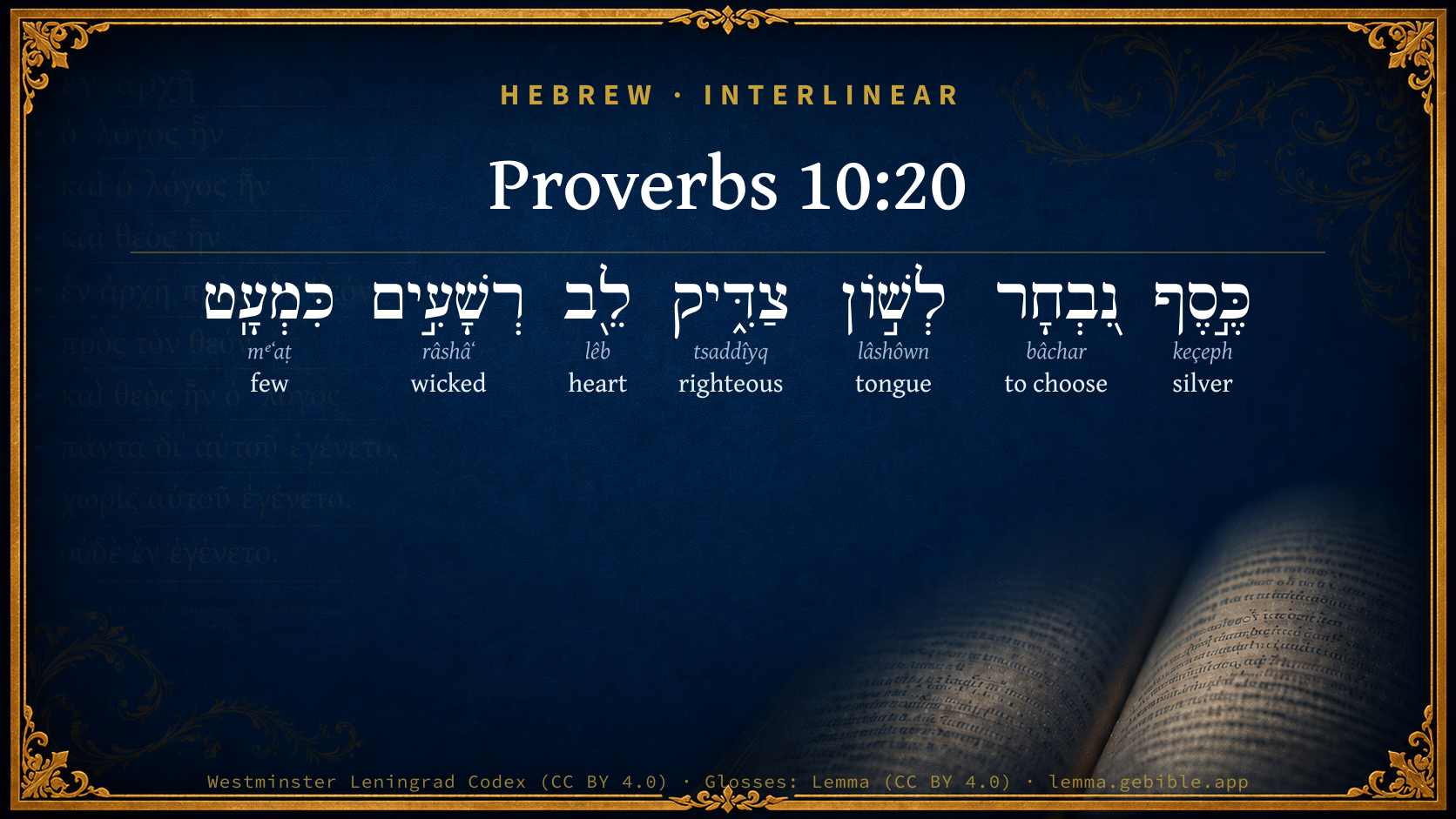
Hebrew (Westminster Leningrad Codex) Proverbs 10:20 appears in the Hebrew Old Testament. The text above is from the Westminster Leningrad Codex. Each word links to its Strong’s number, a concise gloss, and parsing drawn from the Open Scriptures Hebrew Bible morphology. Click any word for its full Brown-Driver-Briggs (BDB) entry.
Download image
Cite this verse

Proverbs 10:20 (World English Bible). Public Domain. Lemma interlinear Bible study tool, https://lemma.gebible.app/v/proverbs/10/20.

Show BibTeX & RIS
BibTeX
RIS
English Translation
The tongue of the righteous is like choice silver. The heart of the wicked is of little worth.
World English Bible · Public Domain
Download a study sheet

One document with this verse’s original text, its word-by-word gloss line, the meaning frame, cross-references with their text, attributed commentary, and full source and license credits — printable, and it pastes into notes with its structure intact.

This verse Autodidact and up

Study sheet (.html) Plain text (.txt)

A passage Seminary Student

Up to 50 verses in one chapter. A passage sheet keeps up to 6 commentary sources and 12 cross-references per verse, in the order this page ranks them, and says so on the sheet whenever that leaves anything out. Ask for a single verse and you get the Autodidact verse sheet above.

Everything on this page stays free to read, with no account — the sheet is a download of what is already on screen, not access to it.

Want to remove ads? Support Godless Engineer
Compare translations 3

The same verse in 3 English versions, stacked beneath the original-language interlinear above. Click any original word for its lexicon entry.

Each is an independent rendering of the whole verse — the interlinear is not word-aligned to these translations.

Highlighted words mark where these versions differ — a whole-verse word diff, not a word-by-word alignment.

  • World English Bible Public Domain
    The tongue of the righteous is like choice silver. The heart of the wicked is of little worth.
  • King James Version Public Domain
    The tongue of the just is as choice silver: the heart of the wicked is little worth.
  • unfoldingWord Literal Text CC BY-SA 4.0
    Choice silver the tongue of the righteous one; the heart of the wicked ones like little.

unfoldingWord Literal Text — © unfoldingWord, licensed CC BY-SA 4.0. Word-aligned USFM3 via Door43 (git.door43.org/unfoldingWord/en_ult).

Versions to compare (up to 4)

3 of 4 selected

Show all 18 translations

Every available English version of this verse, each an independent rendering of the whole verse.

  • World English Bible Public Domain
    The tongue of the righteous is like choice silver. The heart of the wicked is of little worth.
  • Berean Standard Bible Public Domain
    The tongue of the righteous is choice silver, but the heart of the wicked has little worth.
  • Majority Standard Bible Public Domain
    The tongue of the righteous is choice silver, but the heart of the wicked has little worth.
  • King James Version Public Domain
    The tongue of the just is as choice silver: the heart of the wicked is little worth.
  • American Standard Version (1901) Public Domain
    The tongue of the righteous is `as' choice silver: The heart of the wicked is little worth.
  • Revised Version (1885) Public Domain
    The tongue of the righteous is as choice silver: the heart of the wicked is little worth.
  • Geneva Bible (1599) Public Domain
    The tongue of the iust man is as fined siluer: but the heart of the wicked is litle worth.
  • Douay-Rheims (1899) Public Domain
    The tongue of the just is as choice silver: but the heart of the wicked is nothing worth.
  • Young's Literal Translation Public Domain
    The tongue of the righteous `is' chosen silver, The heart of the wicked -- as a little thing.
  • Literal Standard Version CC BY-SA 4.0
    The tongue of the righteous [is] chosen silver, || The heart of the wicked—as a little thing.
  • Unlocked Literal Bible CC BY-SA 4.0
    The tongue of the righteous person is pure silver; there is little value in the heart of the wicked.
  • unfoldingWord Literal Text CC BY-SA 4.0
    Choice silver the tongue of the righteous one; the heart of the wicked ones like little.
  • Darby Bible Public Domain
    The tongue of the righteous [man] is [as] choice silver; the heart of the wicked is little worth.
  • World Messianic Bible Public Domain
    The tongue of the righteous is like choice silver. The heart of the wicked is of little worth.
  • Webster's Bible Public Domain
    The tongue of the just is as choice silver: the heart of the wicked is little worth.
  • Free Bible Version CC BY-SA 4.0
    What good people say is like the best silver, but the mind of the wicked isn't worth much.
  • Bible in Basic English Public Domain
    The tongue of the upright man is like tested silver: the heart of the evil-doer is of little value.
  • JPS Tanakh (1917) Public Domain
    The tongue of the righteous is as choice silver; the heart of the wicked is little worth.

Literal Standard Version (2020), Covenant Press — licensed CC BY-SA 4.0. Text via the HelloAO Bible API (eBible.org). Unlocked Literal Bible (unfoldingWord) — licensed CC BY-SA 4.0. Text via the HelloAO Bible API (eBible.org). unfoldingWord Literal Text — © unfoldingWord, licensed CC BY-SA 4.0. Word-aligned USFM3 via Door43 (git.door43.org/unfoldingWord/en_ult). Free Bible Version, Dr. Jonathan Gallagher — licensed CC BY-SA 4.0. Text via the HelloAO Bible API (eBible.org).

Word by word

More ways to search: Search by grammar → Find every occurrence → Compare this word →

Practice this passage: Drill this verse → Learn its vocabulary →

About this verse

These counts appear in no published source. They are computed here, from the morphology-tagged text and Lemma’s own curated glosses. What Lemma adds →

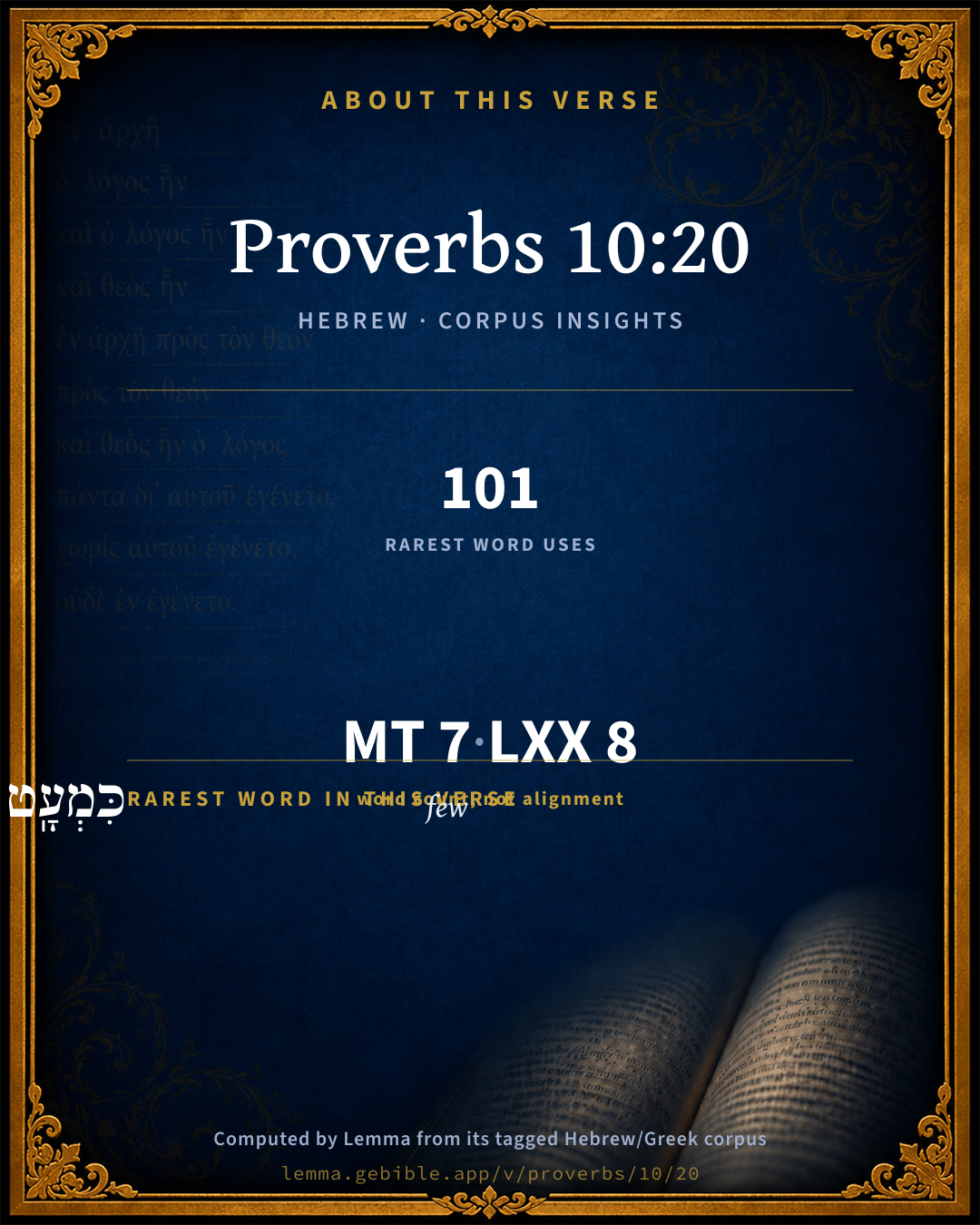
7
words
7
distinct lemmas
Wisdom
section

Grammatical profile

  • 1 verb
  • 4 nouns
  • 2 adjectives

Verb forms

  • נִ֭בְחָר Niphal · Participle Active

Hebrew & Septuagint length

In English translation the verse runs 18 words from the Hebrew and 16 from the Septuagint (LXX English) — closely comparable.

A rough comparison of the two English renderings, which tokenize alike — not a word-level alignment.

Word counts can differ between the Hebrew and the Greek without any difference in meaning — e.g. the Hebrew direct-object marker אֵת has no separate Greek word, and Greek often adds the article ὁ.

In the original languages it is 7 Hebrew tokens and 8 Greek tokens — but the two are counted differently (Hebrew bundles its prefixes and suffixes into one token; the Greek is in lemma form), so that isn’t a like-for-like length.

Cross-references

10

Topical passages linked to Proverbs 10:20 in the Treasury of Scripture Knowledge — connected by theme and wording, ordered by reader-vote popularity; previews shown in the World English Bible.

  • Genesis 6:5 Yahweh saw that the wickedness of man was great in the earth, and that every imagination of the thoughts of his heart was only evil continually.
  • Proverbs 12:18 There is one who speaks rashly like the piercing of a sword, But the tongue of the wise heals.
  • Jeremiah 17:9 The heart is deceitful above all things, and it is exceedingly corrupt: who can know it?
  • Matthew 12:34–35 You offspring of vipers, how can you, being evil, speak good things? For out of the abundance of the heart, the mouth speaks.
  • Genesis 8:21 Yahweh smelled the sweet savor. Yahweh said in his heart, "I will not again curse the ground any more for man's sake, because the imagination of man's heart is evil from his youth; neither will I ever again strike everything living, as I have done.
  • Proverbs 8:19 My fruit is better than gold, yes, than fine gold; My yield than choice silver.
  • Proverbs 15:4 A gentle tongue is a tree of life, But deceit in it crushes the spirit.
  • Proverbs 16:13 Righteous lips are the delight of kings. They value one who speaks the truth.
  • Proverbs 23:7 For as he thinks about the cost, so he is. "Eat and drink!" he says to you, But his heart is not with you.
  • Proverbs 25:11–12 A word fitly spoken Is like apples of gold in settings of silver.

Cross-references courtesy of OpenBible.info (CC BY 4.0).

Hebrew and Greek witnesses Masoretic Hebrew ↔ Greek Septuagint

The same verse in the two great witnesses to the Old Testament, shown verse-for-verse.

These are two independent witnesses, not word-aligned to each other, and the Septuagint is shown in lemma (dictionary) form.

Hebrew Proverbs 10:20 Masoretic · Westminster Leningrad Codex

כֶּ֣סֶף נִ֭בְחָר לְשׁ֣וֹן צַדִּ֑יק לֵ֖ב רְשָׁעִ֣ים כִּמְעָֽט

The tongue of the righteous is like choice silver. The heart of the wicked is of little worth.

World English Bible · Public Domain

Greek LXX Proverbs 10:20 Septuagint · lemma form

ἄργυρος πυρόω γλῶσσα δίκαιος καρδία δέ ἀσεβής ἐκλείπω

The tongue of the just is tried silver; but the heart of the ungodly shall fail.

LXX2012 (modern English Septuagint) · Public Domain

On this verse, The Pulpit Commentary discusses the Septuagint’s reading. Read the note in Commentary ↓

Hebrew: Westminster Leningrad Codex (CC BY 4.0). Greek: Septuagint (public domain); English from LXX2012 (modern English Septuagint) (Public Domain). How the Septuagint differs from the Hebrew →

Commentary

Notes on Proverbs 10:20 from classic Christian and Jewish commentators (each source and its license shown beneath its notes). The classic Christian expositions comment on the surrounding passage and are grouped to its opening verse, so a note may address several verses; the Jewish commentaries on the Tanakh (Rashi and others) are per-verse, so they appear only where the commentator wrote on this verse.

Lemma curates 59 commentaries, every one of them public domain or Creative Commons licensed, each selected and text-cleaned for this edition rather than reprinted as found. About our sources →

Trapp's Complete Commentary

John Trapp

Pro 10:20 The tongue of the just [is as] choice silver: the heart of the wicked [is] little worth.

Ver. 20. The tongue of the just is as choice silver.] He scattereth "pearls," {Mat 7:6} he throws abroad "treasure," {Mat 12:35} even "apples of gold in shrines of silver." {Pro 25:11} "I will turn to the people a pure language," saith God, {Zep 3:9} a "lip of excellency," {Pro 17:7} the language of heaven. As William the Conqueror sought to bring in the French tongue here, by enjoining children to use no other in schools, lawyers to practise in French; no man was graced but he that spake French, &c. {a}

The heart of the wicked is little worth.] Est quasi parum, is as little as need to be. He is ever either hatching cockatrice’ eggs or weaving spiders’ webs, as the prophet hath it. {Isa 59:5} Vanity or villainy is his whole study, and his daily discourse.

{a} Daniel’s Hist.

John Trapp, A Commentary or Exposition upon All the Books of the Old and New Testament (1647–1656) — public domain. Text from a community e-Sword module.

The Biblical Illustrator

Joseph S. Exell

Pro_10:20

The heart of the wicked is little worth.

The heart not good where the practice is evil

It is a dangerous opinion that however a man may deviate in his general practice from the habits of morality and religion, yet still he may be possessed of a good heart at bottom. If we trace the rise and progress of this baneful opinion, we shall find its origin in the confusion of ideas prevalent relative to the determination of what is to be called good, and what evil. This has given rise to so untoward and irreligious s separation of the heart of a man from his outward actions, as to decide that the former may continue to be good, while the latter are continually evil. This notion is supported by much irreligious literature. There are writers who affect to measure the worth of every action by the standard of sensibility--an ambiguous word, that is made to overleap every fence of judgment, to throw down every bulwark of rational conviction, and to exalt itself above everything that is serious, solid and virtuous. The heart of such an one as pursues wicked courses, notwithstanding all the insinuations, assertions, and misrepresentations of most dangerous and deceitful writers of every kind, is of little worth, and yet it is a false and sinful principle to maintain the contrary. If such a heart can be called good, then must virtue and vice have changed their names and qualities; then must religion consist in a total disregard for all serious impression and an absolute forgetfulness of Almighty God; then did our blessed Saviour deliver the admirable precepts of Christianity, to be corrected, revised, altered, and overturned by the maxims of worldly honour. As youthful folly is but too generally the foundation of sin, so is infidelity but too often its superstructure or final result; and the heart is undoubtedly the seat or fruitful parent of both. The heart, in a natural sense, is the seat of life and action. The heart signifies, in a moral sense, the vital principle of all good and evil, of all that purifies or defiles a man, of all that procures him blame or praise, and that renders him justly liable to reward or punishment, either in this life or another. As a man thinketh in his heart, so is he, so are his actions. Is, then, every one who doeth any evil corrupt at heart? No; every one doth evil at times. But it any one should think he might do much evil without corrupting his heart, he is grievously mistaken, and will soon find himself so. May not a mans actions be so poised between good and evil, that it is hard to determine which preponderates? There is a mixture of good and evil in every character, but this is seldom in such equal proportions as makes it difficult to ascertain whether the good or evil preponderates. It is hardly possible for any length of time to keep the balance even betwixt the good and the evil. Either good habits will ere long gain the ascendancy in the heart, or evil ones. Another objection is--Do we not say there are no hopes of reclaiming such an one, he is bad at heart; and does not this seem to imply that a man may have committed a great deal of evil before he can be said to be bad at heart? While the heart is balancing between good and evil, we may not call it bad; when it bends down and keeps down on the evil side, it is bad, and most difficult to be reclaimed by any human means. Yet we may not say that any heart becomes so bad as to be beyond all convicting and converting influences. But it may be said--Is there not a degree of evil actions where the heart is manifestly good? The persons hinted at in this objection are those who have the best intentions in the world, the best dispositions, but whose understandings and judgments do not keep pace with the excess of their goodness. Such persons do not always plan with discretion, or execute with prudence. And they are often the dupes of crafty and designing persons. A good heart is liable to error. Since, then, there is no foundation for that pernicious opinion that a mans heart may be good whilst the general tenor of his actions is immoral and evil, let us earnestly avoid being misled by such idle sophistry, such false reasoning. Let us not listen to the specious allurements of refined sentiment, or to the subtleties of vain philosophy. Let us not set up the imaginations of man above the plain doctrines and precepts of God. (C. Moore, M.A.)

The Biblical Illustrator, edited by Joseph S. Exell (c. 1880s–1900s) — public domain. Text from a community e-Sword module.

Joseph Benson's Commentary

Pro 10:20-21. The tongue of the just is as choice silver — Of great worth and use, bringing credit to himself, and great benefit to others; the heart of the wicked is little worth — And consequently his tongue, which speaketh out of the abundance of the heart, Mat 12:34. The lips of the righteous feed many — By their wise and pious discourses, counsels, and comforts, which are so many evidences of their wisdom: but fools die for want of wisdom — They have not wisdom to preserve themselves, much less to feed others.

Joseph Benson's Commentary on the Old and New Testaments (1811–1818) — public domain. Text from a community e-Sword module.

Tyndale Open Study Notes

Tyndale Open Resources

10:20 Words are an expression of the heart.

Tyndale Open Study Notes — © Tyndale Open Resources, licensed CC BY-SA 4.0. Text via the HelloAO Bible API.

Matthew Henry's Commentary

We are here taught how to value men, not by their wealth and preferment in the world, but by their virtue.

I. Good men are good for something. Though they may be poor and low in the world, and may not have power and riches to do good with, yet, as long as they have a mouth to speak, that will make them valuable and useful, and upon that account we must honour those that fear the Lord, because out of the good treasure of their heart they bring forth good things. 1. This makes them valuable: The tongue of the just is as choice silver; they are sincere, freed from the dross of guile and evil design. God's words are compared to silver purified (Psa 12:6), for they may be relied on; and such are the words of just men. They are of weight and worth, and will enrich those that hear them with wisdom, which is better than choice silver. 2. It makes them useful: The lips of the righteous feed many; for they are full of the word of God, which is the bread of life, and that sound doctrine wherewith souls are nourished up. Pious discourse is spiritual food to the needy, to the hungry.

II. Bad men are good for nothing. 1. One can get no good by them: The heart of the wicked is little worth, and therefore that which comes out of the abundance of his heart cannot be worth much. His principles, his notions, his thoughts, his purposes, and all the things that fill him, and affect him, are worldly and carnal, and therefore of no value. He that is of the earth speaks of the earth, and neither understands nor relishes the things of God, Joh 3:31; Co1 2:14. The wicked man pretends that, though he does not talk of religion as the just do, yet he has it within him, and thanks God that his heart is good; but he that searches the heart here says the contrary: It is nothing worth. 2. One can do no good to them. While many are fed by the lips of the righteous, fools die for want of wisdom; and fools indeed they are to die for want of that which they might so easily come by. Fools die for want of a heart (so the word is); they perish for want of consideration and resolution; they have no heart to do any thing for their own good. While the righteous feed others fools starve themselves.

Matthew Henry's Commentary on the Whole Bible (1708–1710) — public domain (CC PDM 1.0). Text via the HelloAO Bible API.

Jamieson, Fausset & Brown

Robert Jamieson, A. R. Fausset & David Brown

Right speech is the fruit of a good heart, but the wicked show theirs to be useless.

Jamieson, Fausset & Brown — Commentary Critical and Explanatory on the Whole Bible (1871) — public domain (CC PDM 1.0). Text via the HelloAO Bible API.

Adam Clarke's Commentary

Verse 20. The heart of the wicked is little worth] כמעט kimat, is like little or nothing; or is like dross, while the tongue of the just is like silver. A sinner's heart is worth nothing, and is good for nothing; and yet because it is his most hidden part, he vaunts of its honesty, goodness, c.! Yes, yes it is very honest and good, only the devil is in it! that is all.

Adam Clarke's Commentary on the Bible (1810–1826) — public domain. Text from a community e-Sword/MySword module.

The Cambridge Bible for Schools and Colleges

gen. ed. J. J. S. Perowne

20. tongue … heart] The force of the antithesis lies in these two words: even the tongue of the one, but the very heart of the other.

The Cambridge Bible for Schools and Colleges (gen. ed. J. J. S. Perowne; Cambridge University Press, 1878–1918) — public domain. Text from a community e-Sword module.

John Gill's Exposition

The tongue of the just is as choice silver,.... Which utters things precious, pure, pleasant, and profitable; things for worth and value as choice silver; the doctrines of the Gospel, the power of which he has felt upon his heart; the precious promises of it, which have been applied unto him; and the rich experience of grace he has been favoured with: things pure and incorrupt, like silver free from dross; as the doctrines of grace, fetched out of the mines of the sacred Scripture, free from the dross of error, without any human mixture; consistent and all of a piece, and which tend to purity of heart and life; things the reverse of a corrupt communication, nothing filthy and unclean; a pure language, the language of Canaan; the language of repentance, faith, and love, of prayer and thankfulness: things which are grateful and acceptable, are with grace, and minister grace to the hearers; things profitable and edifying; for the righteous man's mouth speaks wisdom, and his tongue talks of judgment; and his lips feed many, as in Pro 10:21; see Psa 37:30;

the heart of the wicked is little worth; good for nothing, as the Vulgate Latin version. The righteous man's tongue is better than the wicked man's heart; there is no good thing in his heart naturally; all manner of evil is in it, and comes out of it; no sin can be named but what is in his heart; all that is in it is sinful; the thoughts of it, and the imagination of his thoughts, are only evil, and that continually; the affections are inordinate, and set on sinful lusts and pleasures; the mind and conscience are defiled with sin; the understanding is darkened with it, and the will is obstinate and perverse, and bent upon it: his heart is wicked, and exceedingly wicked; it is wickedness itself, very wickedness, desperately wicked, incurably so without the grace of God. Such therefore know not their hearts who say they have good hearts; and they are fools that trust in them: this shows the necessity of regeneration, and that powerful and efficacious grace is requisite to it.

John Gill's Exposition of the Whole Bible (1746–1763) — public domain (CC PDM 1.0). Text via the HelloAO Bible API.

Albert Barnes' Notes on the Bible

The tongue, the instrument of the mind is contrasted with the heart or mind itself, the just with the wicked, the choice silver with the worthless “little,” the Hebrew word being possibly taken in its primary sense as a “filing” or “scraping” of dross or worthless metal. If the tongue is precious, how much more the mind! If the heart is worthless, how much more the speech!

Albert Barnes' Notes on the Bible (1834–1885) — public domain. Text from a community e-Sword/MySword module.

Matthew Poole's English Annotations

As choice silver; of great worth and use, bringing credit to himself, and much benefit to others.

The heart, and consequently the tongue, which speaketh out of the abundance of the heart, Mat 12:34.

Matthew Poole's English Annotations on the Holy Bible (1683–1685) — public domain. Text from a community e-Sword/MySword module.

Whedon's Commentary on the Bible

Daniel D. Whedon

20. Tongue of the just — The words, discourse.

Choice silver — See Pro_8:19.

Heart — Intelligence or thought. The heart and the tongue have a common relation to discourse in producing it. The one conceives, the other utters.

Little worth — A little thing, a scrap, a filing, as we say, of little account.

Daniel D. Whedon (gen. ed.), Commentary on the Old and New Testaments (1874–1909) — public domain. Text from a community e-Sword module.

The Pulpit Commentary

Choice; (Pro_8:10, Pro_8:19) tested, purified by fire; pepurwmenov , Septuagint. Is little worth; mere dross, in contradistinction to choice silver. So the tongue is contrasted with the heart, out of whose abundance it speaketh (Ecc 21:26, "The heart of fools is in their mouth; but the mouth of the wise is in their heart"). Septuagint, "The heart of the godless shall fail (ekleiqei )."

The Pulpit Commentary (1880–1919), ed. H.D.M. Spence-Jones & Joseph S. Exell — public domain. Text from a community e-Sword module.

John Wesley's Explanatory Notes

Is - Of great worth and use. Heart - And consequently the tongue.

John Wesley, Explanatory Notes Upon the Whole Bible (1754–1765) — public domain. Text via the GEBible commentary corpus.

Keil & Delitzsch

C. F. Keil & F. Delitzsch

20 Choice silver is the tongue of the righteous;

But the heart of the godless is little worth.

Choice silver is, as Pro 8:19, cf. 10, pure, freed from all base mixtures. Like it, pure and noble, is whatever the righteous speaks; the heart, i.e., the manner of thought and feeling, of the godless is, on the contrary, like little instar nihili, i.e., of little or no worth, Arab. yasway kâlyla (Fl.). lxx: the heart of the godless ἐκλείψει, i.e., ימעט, at first arrogant and full of lofty plans, it becomes always the more dejected, discouraged, empty. But 20a leads us to expect some designation of its worth. The Targ. (according to which the Peshito is to be corrected; vid., Levy's Wrterbuch, ii. 26): the heart of the godless is מחתא (from נחת), refuse, dross. The other Greek versions accord with the text before us.

Keil & Delitzsch — Biblical Commentary on the Old Testament (1861–1891) — public domain (CC PDM 1.0). Text via the HelloAO Bible API. (Old Testament only.)

Bridges on Proverbs

Charles Bridges

The wisdom of refraining our lips must always be connected with diligence in improving our talent. If our tongue be our shame in the overflowing of sin (Pro 10:18-19 ): is it not also our glory? (Psa 57:8 ; Psa 108:1 .) When "speaking of the things touching the king" (Psa 45:1 ), or sketching the features of his transcendent loveliness (Psa 45:2 . Song of Son 5:10-16 ); is it not then as choice silver, refined from this world’s dross, and shining with heavenly brightness? Who would not eagerly gather up the silver scattered in the streets? And shall not we enrich our store from the choice silver of the just man’s tongue, pouring out its precious instruction before us? If, as regards this world’s wealth, the Lord’s poor must say — "Silver and gold have I none;" at least they may scatter choice silver with a widely-extended blessing — "As poor, yet making many rich." (Act 3:6 . 2Co 6:10 .)

Observe also the usefulness of this member. If we be living with God, it will diffuse a salt, a heavenly leaven, a rich propagation of holiness in our various circles. The lips of the righteous feed many from the rich stores of "the indwelling word" (Col 3:16 ); "ministering to them grace," the soul’s true and proper nourishment! (Eph 4:29 . Job 4:3-4 ; Job 29:22-23 .) ’Their breath is food to others, as well as life to them.’†1 When "the priest’s lips keep knowledge, and they seek the law at his mouth," he feeds the church of God.†2 And as our great Master broke the bread, and gave it to his disciples for their distribution (Joh 6:11 ); so does he now dispense to his servants heavenly provision, suitable, and abundantly sufficient for the need of their charge. And every Sabbath is the wondrous miracle displayed before our eyes. The imperishable bread multiplies in the breaking. The hungry, the mourners, the weary and fainting; yea, all that feel their need, are refreshed and invigorated.

The wicked — his coffers may be full. But his heart, being empty of the choice silver, is little worth. (Jer 22:28 .) So far from feeding others, the fool dies himself for want of wisdom; or rather for want of heart to seek it. He despises the lips that would feed him, and ’dies of famine in the midst of the rich pastures of the Gospel.’†3 Oh! how often are we reminded that sin is self-destruction! (Hos 13:9 .)

Footnotes:

†1 Flavel On Soul of Man. — Works, 8vo. ii. 551.

†2 Mal 2:7, with Jer 3:15 . Joh 21:15 . Act 20:28 . 1Pe 5:2 . Of Bishop Ridley our Martyrologist records in his own beautiful style, that ’to his Sermon the people resorted, swarming about him like bees, and coveting the sweet flowers and wholesome juice of his fruitful doctrine.’ — Foxe, vii. 407.

†3 Schultens. Compare Act 13:41, Act 13:45-46 .

Charles Bridges, An Exposition of the Book of Proverbs (1846) — public domain. Text from a community e-Sword module.

Kretzmann's Popular Commentary

Paul E. Kretzmann

v. 20. The tongue of the just, the speech of the righteous, is as choice silver, his words and advice are of great value; the heart of the wicked is little worth, it is a trifle, it is no good.

Paul E. Kretzmann, Popular Commentary of the Bible (1921–1924) — public domain. Text from a community e-Sword module.

unfoldingWord translationNotes

Door43 World Missions Community

The tongue of the righteous person

"Tongue" represents what a person says. AT: "Whatever a righteous person says" (See: Metonymy)

is pure silver

"Silver" represents valuable sayings. AT: "is extremely valuable" (See: Metaphor)

The lips of the righteous

"Lips" represents what a person says. AT: "The sayings of a righteous man" (See: Metonymy)

nourish

cause them to develop or grow stronger

translationWords

pure

silver

heart

evil

fool

die

unfoldingWord translationNotes — © Distant Shores Media and the Door43 World Missions Community, licensed CC BY-SA 4.0. Source: git.door43.org/Door43/en_tn.

Rashi

Rabbi Shlomo Yitzchaki (Rashi)

The tongue of the righteous is choice silver for he knows how to reprove.

the heart of the wicked is worth little for he does not heed the reproof of the righteous man. Midrash Rabbi Tanhuma (Ki Thissa 6) states: This was stated concerning Iddo the prophet, who called [in prophecy] about the altar in Beth-El, and Jeroboam, although his hand had become stiff, did not heed the reproof, as it is said (I Kings 13:6): “Entreat now the Lord your God, etc.”; but not “my God, etc”; (ad loc.): “and the king’s hand was drawn back to him, and it was as before.” Just as before, he was standing and burning sacrifices to idols, so was it at the end.

Rashi on the Tanakh — English translations: “The Judaica Press complete Tanach with Rashi, translated by A. J. Rosenberg” (CC BY 4.0); “Pentateuch with Rashi's commentary by M. Rosenbaum and A.M. Silbermann, 1929-1934” (public domain); “The Metsudah Tanach series, Lakewood, N.J” (CC BY 4.0); and “The Book of Joshua, Metsudah Publications, 1997” (CC BY 4.0). Text via Sefaria.

Lesson kit

Teaching starters — assembled from the data on this page, not authored interpretation. Every prompt links to the verse data it draws on. Edit before teaching.

Proverbs, in the Wisdom, opens this verse with 7 words (7 distinct Hebrew lemmas). Its most distinctive word is mᵉʻaṭ (“few”). A historical commentator’s framing appears above. Read the whole chapter for the surrounding context.

Discussion questions

  1. How does “few” (mᵉʻaṭ) shape what this verse is saying?
  2. Genesis 6:5 shares this passage’s theme. How do the two illuminate each other?
  3. These translations render this verse differently; the difference is in the English rendering, not the original. What questions does that raise?
  4. The verb «נִ֭בְחָר» is Niphal Participle Active. How does its form color the action?
  5. Reading how Trapp's Complete Commentary and The Biblical Illustrator read this verse, where do the two commentators agree and where do they part?

Things to notice

Reading settings

Reading text

Shown beneath each verse's original-language words.

Old Testament
Old Testament edition

Read the OT as the Masoretic Hebrew (MT) or the Greek Septuagint (LXX).

English shown for the Greek Septuagint (in the Hebrew ↔ Greek comparison).

Comparing translations? Open the Compare panel on any verse page to stack up to four side by side.