
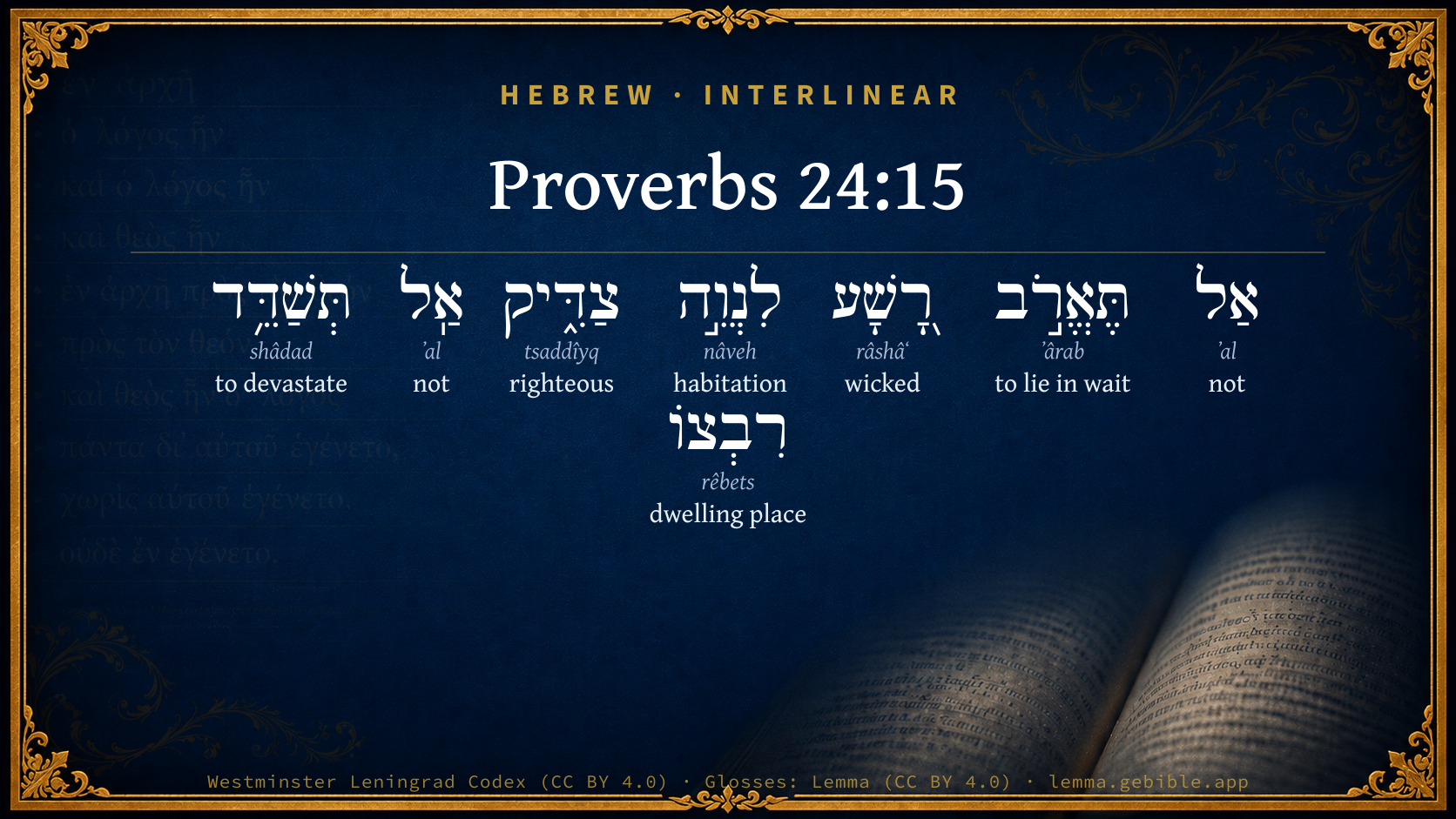
Proverbs 24:15

Hebrew (Westminster Leningrad Codex) Proverbs 24:15 appears in the Hebrew Old Testament. The text above is from the Westminster Leningrad Codex. Each word links to its Strong’s number, a concise gloss, and parsing drawn from the Open Scriptures Hebrew Bible morphology. Click any word for its full Brown-Driver-Briggs (BDB) entry.
Download image
Cite this verse

Proverbs 24:15 (World English Bible). Public Domain. Lemma interlinear Bible study tool, https://lemma.gebible.app/v/proverbs/24/15.

Show BibTeX & RIS
BibTeX
RIS
English Translation
Don't lay in wait, wicked man, against the habitation of the righteous. Don't destroy his resting-place:
World English Bible · Public Domain
Highlights
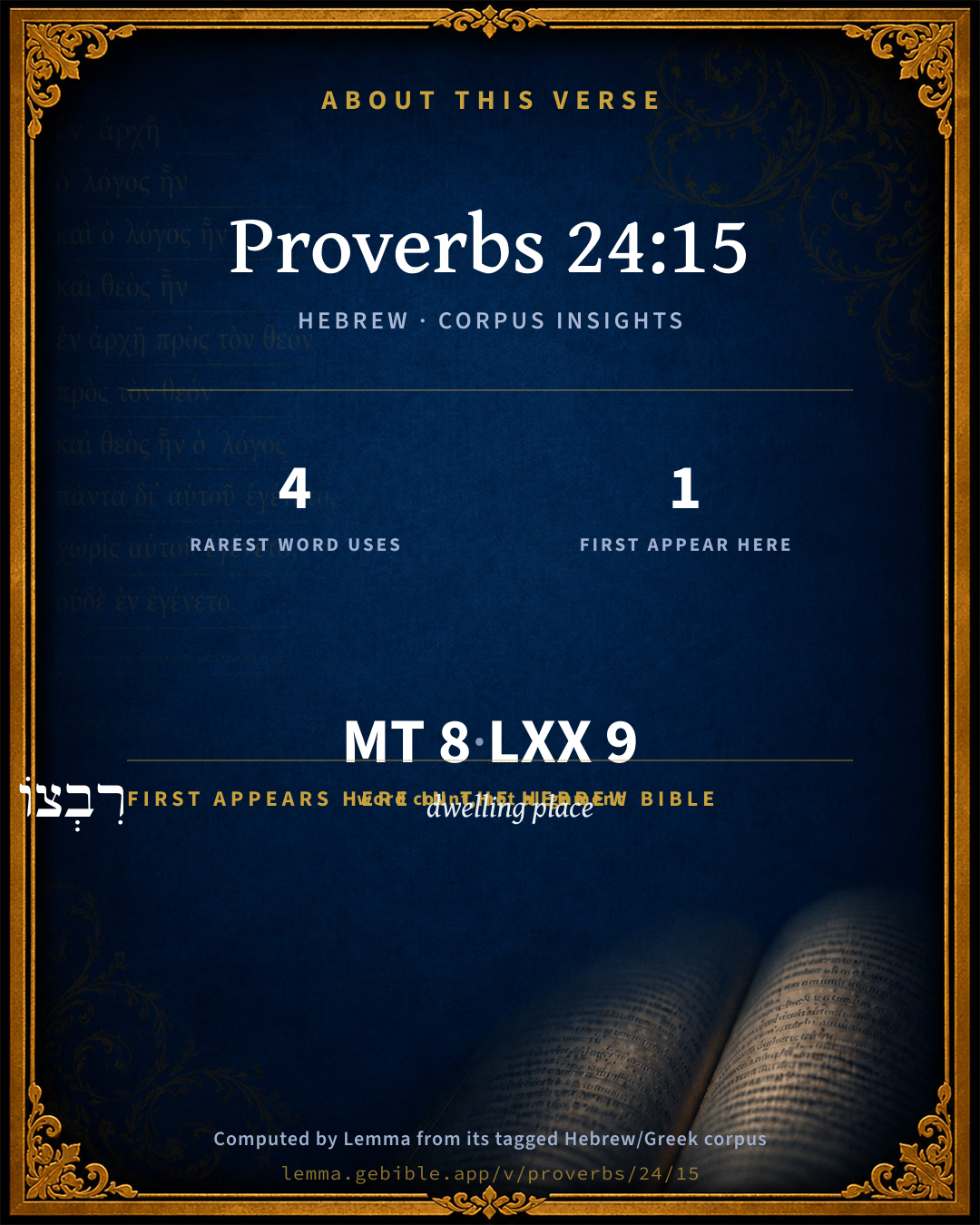
  • 1 first appearance in the Hebrew Bible
Full analysis ↓
Download a study sheet

One document with this verse’s original text, its word-by-word gloss line, the meaning frame, cross-references with their text, attributed commentary, and full source and license credits — printable, and it pastes into notes with its structure intact.

This verse Autodidact and up

Study sheet (.html) Plain text (.txt)

A passage Seminary Student

Up to 50 verses in one chapter. A passage sheet keeps up to 6 commentary sources and 12 cross-references per verse, in the order this page ranks them, and says so on the sheet whenever that leaves anything out. Ask for a single verse and you get the Autodidact verse sheet above.

Everything on this page stays free to read, with no account — the sheet is a download of what is already on screen, not access to it.

Want to remove ads? Support Godless Engineer
Compare translations 3

The same verse in 3 English versions, stacked beneath the original-language interlinear above. Click any original word for its lexicon entry.

Each is an independent rendering of the whole verse — the interlinear is not word-aligned to these translations.

Highlighted words mark where these versions differ — a whole-verse word diff, not a word-by-word alignment.

  • World English Bible Public Domain
    Don't lay in wait, wicked man, against the habitation of the righteous. Don't destroy his resting-place:
  • King James Version Public Domain
    Lay not wait, O wicked man, against the dwelling of the righteous; spoil not his resting place:
  • unfoldingWord Literal Text CC BY-SA 4.0
    Do not lie in wait a wicked against the abode of the righteous; do not assault his resting place.

unfoldingWord Literal Text — © unfoldingWord, licensed CC BY-SA 4.0. Word-aligned USFM3 via Door43 (git.door43.org/unfoldingWord/en_ult).

Versions to compare (up to 4)

3 of 4 selected

Show all 18 translations

Every available English version of this verse, each an independent rendering of the whole verse.

  • World English Bible Public Domain
    Don't lay in wait, wicked man, against the habitation of the righteous. Don't destroy his resting-place:
  • Berean Standard Bible Public Domain
    Do not lie in wait, O wicked man, near the dwelling of the righteous; do not destroy his resting place.
  • Majority Standard Bible Public Domain
    Do not lie in wait, O wicked man, near the dwelling of the righteous; do not destroy his resting place.
  • King James Version Public Domain
    Lay not wait, O wicked man, against the dwelling of the righteous; spoil not his resting place:
  • American Standard Version (1901) Public Domain
    Lay not wait, O wicked man, against the habitation of the righteous; Destroy not his resting-place:
  • Revised Version (1885) Public Domain
    Lay not wait, O wicked man, against the habitation of the righteous; spoil not his resting place:
  • Geneva Bible (1599) Public Domain
    Laye no waite, O wicked man, against the house of the righteous, and spoyle not his resting place.
  • Douay-Rheims (1899) Public Domain
    Lie not in wait, nor seek after wickedness in the house of the just, nor spoil his rest.
  • Young's Literal Translation Public Domain
    Lay not wait, O wicked one, At the habitation of the righteous. Do not spoil his resting-place.
  • Literal Standard Version CC BY-SA 4.0
    Do not lay wait, O wicked one, || At the habitation of the righteous. Do not spoil his resting place.
  • Unlocked Literal Bible CC BY-SA 4.0
    Do not lie in wait like the wicked person who attacks the house of the righteous person. Do not destroy his home!
  • unfoldingWord Literal Text CC BY-SA 4.0
    Do not lie in wait a wicked against the abode of the righteous; do not assault his resting place.
  • Darby Bible Public Domain
    Lay not wait, O wicked [man], against the dwelling of the righteous; lay not waste his resting-place.
  • World Messianic Bible Public Domain
    Don’t lay in wait, wicked man, against the habitation of the righteous. Don’t destroy his resting place;
  • Webster's Bible Public Domain
    Lay not wait, O wicked man, against the dwelling of the righteous; destroy not his resting-place:
  • Free Bible Version CC BY-SA 4.0
    Don't be like a criminal waiting to ambush the home of good people; don't attack the place where they live.
  • Bible in Basic English Public Domain
    Do not keep a secret watch, O evil-doer, against the fields of the upright man, or send destruction on his resting-place:
  • JPS Tanakh (1917) Public Domain
    Lie not in wait, O wicked man, against the dwelling of the righteous, spoil not his resting-place;

Literal Standard Version (2020), Covenant Press — licensed CC BY-SA 4.0. Text via the HelloAO Bible API (eBible.org). Unlocked Literal Bible (unfoldingWord) — licensed CC BY-SA 4.0. Text via the HelloAO Bible API (eBible.org). unfoldingWord Literal Text — © unfoldingWord, licensed CC BY-SA 4.0. Word-aligned USFM3 via Door43 (git.door43.org/unfoldingWord/en_ult). Free Bible Version, Dr. Jonathan Gallagher — licensed CC BY-SA 4.0. Text via the HelloAO Bible API (eBible.org).

Word by word

More ways to search: Search by grammar → Find every occurrence → Compare this word →

Practice this passage: Drill this verse → Learn its vocabulary →

About this verse

These counts appear in no published source. They are computed here, from the morphology-tagged text and Lemma’s own curated glosses. What Lemma adds →

8
words
7
distinct lemmas
Wisdom
section

Notable vocabulary

The rarest word here is רִבְצוֹ dwelling place H7258 — appearing just 4 times in the whole Hebrew Bible.

First appearance in Scripture

This word makes its first canonical appearance in the Hebrew Bible here:

  • רִבְצוֹ dwelling place H7258

Shared distinctive vocabulary

רִבְצוֹ dwelling place H7258 occurs in 4 verses of the Hebrew Bible. Also found in:

Grammatical profile

  • 2 verbs
  • 2 nouns
  • 2 adjectives
  • 2 particles

Verb forms

  • תֶּאֱרֹ֣ב Qal · Jussive
  • תְּשַׁדֵּ֥ד Piel · Jussive

Repetition

A word recurs within this verse — often emphatic in Hebrew:

  • אַל not H408 ×2

Hebrew & Septuagint length

In English translation the verse runs 16 words from the Hebrew and 20 from the Septuagint (LXX English) — closely comparable.

A rough comparison of the two English renderings, which tokenize alike — not a word-level alignment.

Word counts can differ between the Hebrew and the Greek without any difference in meaning — e.g. the Hebrew direct-object marker אֵת has no separate Greek word, and Greek often adds the article ὁ.

In the original languages it is 8 Hebrew tokens and 9 Greek tokens — but the two are counted differently (Hebrew bundles its prefixes and suffixes into one token; the Greek is in lemma form), so that isn’t a like-for-like length.

Cross-references

16

Topical passages linked to Proverbs 24:15 in the Treasury of Scripture Knowledge — connected by theme and wording, ordered by reader-vote popularity; previews shown in the World English Bible.

  • 1 Samuel 23:20–23 Now therefore, O king, come down, according to all the desire of your soul to come down; and our part shall be to deliver him up into the king's hand.
  • Psalms 140:5 The proud have hidden a snare for me, They have spread the cords of a net by the path. They have set traps for me. Selah.
  • Isaiah 32:18 My people shall abide in a peaceable habitation, and in safe dwellings, and in quiet resting-places.
  • Jeremiah 11:19 But I was like a gentle lamb that is led to the slaughter; and I didn't know that they had devised devices against me, [saying], Let us destroy the tree with the fruit of it, and let us cut him off from the land of the living, that his name may be no more remembered.
  • Acts 9:24 but their plot became known to Saul. They watched the gates both day and night that they might kill him,
  • 1 Samuel 9:11 As they went up the ascent to the city, they found young maidens going out to draw water, and said to them, Is the seer here?
  • 1 Samuel 22:18–19 The king said to Doeg, Turn you, and fall on the priests. Doeg the Edomite turned, and he fell on the priests, and he killed on that day eighty-five persons who wore a linen ephod.
  • Psalms 37:32 The wicked watches the righteous, And seeks to kill him.
  • Psalms 56:6 They conspire and lurk, Watching my steps, they are eager to take my life.
  • Psalms 59:3 For, behold, they lie in wait for my soul. The mighty gather themselves together against me, Not for my disobedience, nor for my sin, Yahweh.
  • Proverbs 1:11 If they say, "Come with us, Let's lay in wait for blood; Let's lurk secretly for the innocent without cause;
  • Proverbs 22:28 Don't move the ancient boundary stone, Which your fathers have set up.
  • Matthew 26:4 They took counsel together that they might take Jesus by deceit, and kill him.
  • Acts 23:16 But Paul's sister's son heard of their lying in wait, and he came and entered into the barracks and told Paul.
  • Acts 25:3 asking a favor against him, that he would summon him to Jerusalem; plotting to kill him on the way.
  • Psalms 10:8–10 He lies in wait near the villages. From ambushes, he murders the innocent. His eyes are secretly set against the helpless.

Cross-references courtesy of OpenBible.info (CC BY 4.0).

Hebrew and Greek witnesses Masoretic Hebrew ↔ Greek Septuagint

The same verse in the two great witnesses to the Old Testament, shown verse-for-verse.

These are two independent witnesses, not word-aligned to each other, and the Septuagint is shown in lemma (dictionary) form.

Hebrew Proverbs 24:15 Masoretic · Westminster Leningrad Codex

אַל תֶּאֱרֹ֣ב רָ֭שָׁע לִנְוֵ֣ה צַדִּ֑יק אַֽל תְּשַׁדֵּ֥ד רִבְצוֹ

Don't lay in wait, wicked man, against the habitation of the righteous. Don't destroy his resting-place:

World English Bible · Public Domain

Greek LXX Proverbs 24:15 Septuagint · lemma form

μή προςἄγω ἀσεβής νομή δίκαιος μηδέ ἀπατάω χορτασία κοιλία

Bring not an ungodly man into the dwelling of the righteous: neither be deceived by the feeding of the belly.

LXX2012 (modern English Septuagint) · Public Domain

On this verse, The Pulpit Commentary discusses the Septuagint’s reading. Read the note in Commentary ↓

Hebrew: Westminster Leningrad Codex (CC BY 4.0). Greek: Septuagint (public domain); English from LXX2012 (modern English Septuagint) (Public Domain). How the Septuagint differs from the Hebrew →

Commentary

Notes on Proverbs 24:15 from classic Christian and Jewish commentators (each source and its license shown beneath its notes). The classic Christian expositions comment on the surrounding passage and are grouped to its opening verse, so a note may address several verses; the Jewish commentaries on the Tanakh (Rashi and others) are per-verse, so they appear only where the commentator wrote on this verse.

Lemma curates 59 commentaries, every one of them public domain or Creative Commons licensed, each selected and text-cleaned for this edition rather than reprinted as found. About our sources →

Trapp's Complete Commentary

John Trapp

Pro 24:15 Lay not wait, O wicked [man], against the dwelling of the righteous; spoil not his resting place:

Ver. 15. Lay not wait, O wicked man, &c.] Eνθα γαρ οι Yεοι, as that heathen said - God dwells with the righteous; molest him not therefore, beat not up his quarters. The Scythians, saith he in Plutarch, {a} though they have no music or vines among them, yet they have gods. So, whatever the saints want, they want not God’s gracious presence with them. And if wicked men had but so much knowledge of God as Pilate’s wife had in a dream, they would take heed of having anything to do with these just men.

{a} Plut., Sυμπος. επτα σοφων.

John Trapp, A Commentary or Exposition upon All the Books of the Old and New Testament (1647–1656) — public domain. Text from a community e-Sword module.

Joseph Benson's Commentary

Pro 24:15-16. Lay not wait, &c., against the dwelling of the righteous — Against his person, or family, or possessions. Do him no injury, either by subtle and secret devices, or, as it follows, by manifest violence. For a just man falleth — Into calamities, of which he evidently speaks both in the foregoing verse, and in the opposite and following branch of this verse; and in this sense the same word, נפל, is used in the next verse, and in many other places. It is never applied to sin; but, when set in opposition to the word riseth up, implies affliction or calamity, as Mic 7:8; Amo 8:4; Jer 25:27; Psa 34:19-20. These words are commonly, not only in sermons, but in books, applied to the falling into sin; and, that men may the more securely indulge themselves in their sins, and yet think themselves good men, they have added something to them; for the words are commonly cited thus: A just man falleth seven times a day, which last words, a day: or, in a day, are not in any translation of the Bible, much less in the original, but only in some corrupt editions of the vulgar Latin, which, against the plain scope of the context, and the meaning of the words, seems to understand this place of falling into sin. See Bishop Patrick. But the plain meaning is that which is given above, and seven times is put for frequently. The righteous fall frequently into trouble. But the wicked shall fall into mischief — Into unavoidable and irrecoverable destruction, ofttimes in this life, and infallibly in the next.

Joseph Benson's Commentary on the Old and New Testaments (1811–1818) — public domain. Text from a community e-Sword module.

The Preacher's Complete Homiletical Commentary

Joseph S. Exell (gen. ed.)

CRITICAL NOTES.—

Pro_24:16. The wicked shall fall. Delitzsch reads, “the wicked are overthrown when calamity falls on them, i.e., they do not rise again and again as the just man does.

MAIN HOMILETICS OF Pro_24:15-16

A SOCIAL AMBUSH

I. A common practice of the wicked man in relation to the good. When we think of an ambush of men lying in wait to spring upon their foes at a fitting opportunity, two hostile parties are at once brought before us, we feel that there must be deep enmity on one side at least, or men would not be at such pains to overthrow their fellow-men. And this is indeed the case in society as a whole. Men are divided into two great parties. On one side stand the lovers of righteousness, and on the other the lovers of sin; and the latter must ever be more or less actively opposed to the former. But their favourite and most common method of attack is that indicated in the text. Wrong-doers are naturally cowards, and in their endeavours to injure better men than themselves they shrink from open attack. They are fully conscious that they could not stand their ground in a fair fight in the open field, and so they try to fall upon their foe in a moment when he is off his guard and in a place where he least expects to meet them. In other words, evil men do not often openly assail either the character or the position of a good man, but by lying words spoken in his absence they try to blacken the first, and by secret schemes to overthrow the second.

II. An utterly useless attempt of the wicked man in relation to the good. It is useless to try to kill a tree by lopping off the branches. Such a process may for a time deprive it of its beauty and stop its growth, but while the root has its hold upon the soil and can draw nourishment to itself from unseen sources beneath the surface it will live, and as soon as the axe has ceased to strike it will begin again to clothe itself in greenness and beauty. So it is with a righteous man. His enemies may succeed in bringing about his temporary overthrow and in depriving his outward life of much comfort, but the springs of his existence are fed from an invisible and unfailing source, and his well-being is not dependent upon external circumstances. And so even if the malice of the wicked is permitted to strip him of some things which made his life more apparently prosperous and secure, there is an inner life which they cannot touch, and which enables him in due time to recover from the wounds which they inflict either upon his character or his circumstances. For “This is the heritage of the servants of the Lord. No weapon that is formed against thee shall prosper; and every tongue that shall rise against thee in judgment thou shall condemn.” (Isa_54:17.)

OUTLINES AND SUGGESTIVE COMMENTS

Pro_24:15. Because it spites the wicked, that the godly dwell in safety, therefore they lay wait against their dwelling, by affliction and miseries seeking to throw it down, and … because the virtues of the godly condemn the vices of the wicked, therefore they lay wait and search into their dwelling houses to espy out their faults, because the goodness of the righteous shameth the naughtiness of the wicked, therefore they seek to break in even into their bedchambers and places of rest, and there to discover their errors and infirmities. Solomon forbidding them to do it, showeth it to be their manner to do it.—Jermin.

Pro_24:16. Perhaps you will say, had I fallen only once, I would not be much afraid; but I have often fallen before the enemy, and one day I must perish. But hear what God says:—The righteous man falls not once or twice, but many times, and still he rises. Your experience of former deliverances should encourage your hopes of new deliverances, for the salvations of the Lord are never exhausted. In six troubles He will deliver, and in seven there shall no evil touch you.—Lawson.

God’s saints are bound to “rejoice when they fall into divers temptations.” What though they fall into them? not go in step by step, but be precipitated, plunged over head and ears. Say they fall not into one, but into many crosses—as they seldom come single—yet “be exceeding glad” says the apostle, as the merchant is to see his ships come laden in.—Trapp.

The Preacher's Complete Homiletical Commentary (gen. ed. Joseph S. Exell; Funk & Wagnalls, c. 1892) — public domain (pre-1929). A full-Bible homiletical/sermon-outline anthology covering 65 of 66 books (2 John is absent from the source module). Text from a community e-Sword module.

Keil & Delitzsch

C. F. Keil & F. Delitzsch

15 Lie not in wait, oh wicked man, against the dwelling of the righteous;

Assault not his resting-place.

16 For seven times doth the righteous fall and rise again,

But the wicked are overthrown when calamity falls on them.

The ארב [lying in wait] and שׁדּד [practising violence], against which the warning is here given, are not directed, as at Pro 1:11; Pro 19:26, immediately against the person, but against the dwelling-place and resting-place (רבץ, e.g., Jer 50:6, as also נוה, 3:33) of the righteous, who, on his part, does injustice and wrong to no one; the warning is against coveting his house, Exo 20:17, and driving him by cunning and violence out of it. Instead of רשׁע, Symmachus and Jerome have incorrectly read רשׁע daer, and from this misunderstanding have here introduced a sense without sense into Pro 24:15; many interpreters (Lwenstein, Ewald, Elster, and Zckler) translate with Luther appositionally: as a wicked man, i.e., "with mischievous intent," like one stealthily lurking for the opportunity of taking possession of the dwelling of another, as if this could be done with a good intent: רשׁע is the vocative (Syr., Targ., Venet.: ἀσεβές), and this address (cf. Psa 75:5.) sharpens the warning, for it names him who acts in this manner by the right name. The reason, 16a, sounds like an echo of Job 5:19. שׁבע signifies, as at Psa 119:164, seven times; cf. מאה, Pro 17:10. וקם (not וקם) is perf. consec., as וחי, e.g., Gen 3:22 : and he rises afterwards (notwithstanding), but the transgressors come to ruin; בּרעה, if a misfortune befall them (cf. Pro 14:32), they stumble and fall, and rise no more.

Keil & Delitzsch — Biblical Commentary on the Old Testament (1861–1891) — public domain (CC PDM 1.0). Text via the HelloAO Bible API. (Old Testament only.)

Tyndale Open Study Notes

Tyndale Open Resources

24:15-16 Saying 27: Those who are godly will not allow a setback to keep them down. • Seven times is symbolic for “many times.”

Tyndale Open Study Notes — © Tyndale Open Resources, licensed CC BY-SA 4.0. Text via the HelloAO Bible API.

Matthew Henry's Commentary

This is spoken, not so much by way of counsel to wicked men (they will not receive instruction, Pro 23:9), but rather in defiance of them, for the encouragement of good people that are threatened by them. See here, 1. The designs of the wicked against the righteous, and the success they promise themselves in those designs. The plot is laid deeply: They lay wait against the dwelling of the righteous, thinking to charge some iniquity upon it, or compass dome design against it; they lie in wait at the door, to catch him when he stirs out, as David's persecutors, Ps. 59 title. The hope is raised high; they doubt not but to spoil his dwelling-place because he is weak and cannot support it, because his condition is low and distressed, and he is almost down already. All this is a fruit of the old enmity in the seed of the serpent against the seed of the woman. The blood-thirsty hate the upright. 2. The folly and frustration of these designs (1.) The righteous man, whose ruin was expected, recovers himself. He falls seven times into trouble, but, by the blessing of God upon his wisdom and integrity, he rises again, sees through his troubles and sees better times after them. The just man falls, sometimes falls seven times perhaps, into sin, sins of infirmity, through the surprise of temptation; but he rises again by repentance, finds mercy with God, and regains his peace. (2.) The wicked man, who expected to see his ruin and to help it forward, is undone. He falls into mischief; his sins and his troubles are his utter destruction.

Matthew Henry's Commentary on the Whole Bible (1708–1710) — public domain (CC PDM 1.0). Text via the HelloAO Bible API.

Jamieson, Fausset & Brown

Robert Jamieson, A. R. Fausset & David Brown

The plots of the wicked against the good, though partially, shall not be fully successful (Psa 37:24); while the wicked, falling under penal evil, find no help.

Jamieson, Fausset & Brown — Commentary Critical and Explanatory on the Whole Bible (1871) — public domain (CC PDM 1.0). Text via the HelloAO Bible API.

Adam Clarke's Commentary

Verse 15. The dwelling of the righteous] צדיק tsaddik, the man who is walking unblameably in all the testimonies of God; who is rendering to every man his due.

Adam Clarke's Commentary on the Bible (1810–1826) — public domain. Text from a community e-Sword/MySword module.

The Cambridge Bible for Schools and Colleges

gen. ed. J. J. S. Perowne

15. O wicked man], Or, as a wicked man.

dwelling … resting place] or pasture … fold (R.V. marg.); making the picture pastoral.

The Cambridge Bible for Schools and Colleges (gen. ed. J. J. S. Perowne; Cambridge University Press, 1878–1918) — public domain. Text from a community e-Sword module.

John Gill's Exposition

For a just man falleth seven times, and riseth up again,.... This is to be understood of a truly just man; not of one that is only outwardly and seemingly so, or of temporary believers and nominal professors; but of such who are thoroughly convinced of their own unrighteousness, and believe in Christ for righteousness, and have it applied and imputed to them; as well as have principles of grace and righteousness implanted in them, and live righteously in this evil world; these often fall either into troubles or into sins, and indeed into both, and the one is the cause of the other; and both senses may be retained: the former seems more agreeable to the context, and runs thus, lay not wait to a just man's dwelling to do him any hurt; for though he should be ensnared, and stumble, and fall into distress and calamity, yet he will rise again out of it, and so all attempts upon him are vain and fruitless; many are the righteous man's afflictions he falls into, but the Lord delivers out of all; he delivers him in six troubles, and even in seven, Psa 34:19; or in many, one after another; he rises out of them all; he comes out of great tribulations, and at last safely enters the kingdom of heaven; and therefore it is to no purpose to lie in wait for him: and this sense is strengthened by the words following, "rejoice not when thine enemy falleth", Pro 24:17; but the latter sense of falling into sin has been anciently received, and not to be rejected; and which generally precedes and is the cause of falling into trouble. A just man, though he does not fall from his righteousness, which is an everlasting one, nor from the grace of God; yet he may fall into temptation, and by it he may fall into sin, as every just man does; "for there is not a just man upon earth that doeth good and sinneth not", Ecc 7:20; and that frequently, even every day; and therefore stands every day in need of fresh application of pardoning grace, for which he is directed to pray daily; and he may be left to fall foully into very gross sins, as David, Peter, and others; but not totally and finally, so as to perish; being on the heart of God, in the hands of Christ, on him the foundation, united to him, and kept by the power of God, he shall and does rise again sooner or later; not by his own power and strength, but by the strength of the Lord; he rises by renewed repentance, and under the fresh discoveries of pardoning grace and mercy to heal his backslidings;

but the wicked shall fall into mischief; or "evil" (q); into the evil of sin, and there lie and wallow in it, as the swine in the mire, and never rise out of it; and into the evil of punishment, into hell itself, from whence there will be no deliverance; and oftentimes they fall into mischief in this world, into trouble and distress, into poverty and want, in which they live and die, and never recover out of it; to which agrees what follows.

(q) "in malum", Pagninus, Montanus, Tigurine version, Mercerus, Gejerus, Michaelis, Schultens.

John Gill's Exposition of the Whole Bible (1746–1763) — public domain (CC PDM 1.0). Text via the HelloAO Bible API.

Albert Barnes' Notes on the Bible

The teaching of the proverb warns men not to attack or plot against the righteous. They will lose their labor, “Though the just man fall (not into sin, but into calamities), yet he riseth up.” The point of the teaching is not the liability of good men to err, but God’s providential care over them (compare the margin reference). “Seven times” is a certain for an uncertain number (compare Job 5:19). In contrast with this is the fate of the evildoers, who fall utterly even in a single distress.

Albert Barnes' Notes on the Bible (1834–1885) — public domain. Text from a community e-Sword/MySword module.

Matthew Poole's English Annotations

Lay not wait; do him no injury, either by subtle and secret devices, or, as it follows, by manifest violence.

Against the dwelling of the righteous; against his person, or family, or possession.

Matthew Poole's English Annotations on the Holy Bible (1683–1685) — public domain. Text from a community e-Sword/MySword module.

Whedon's Commentary on the Bible

Daniel D. Whedon

15, 16. Falleth seven times — The falling, here, is not into sin, but into calamity of any kind. Stuart, who, as a Calvinist, thinks the rising again from moral lapses is also true, yet remarks that the sense here does not point to moral lapses, but to misfortunes. The annotators are generally agreed on this point. The Hebrew verb here used for falling is never used of falling into sin. “Seven times” means an indefinite number — several or many. Compare Pro_4:19. The text is sometimes misquoted — “seven times a day” — and applied as an excuse by men who indulge themselves in sin and yet think themselves good, or wish to be thought so. The point of the teaching is, not the liability of even good men to err, but God’s providential care over them; as in Psa_34:19. So Speaker’s Commentary. Compare Job_5:19; Psa_34:19; Psa_37:24.

Daniel D. Whedon (gen. ed.), Commentary on the Old and New Testaments (1874–1909) — public domain. Text from a community e-Sword module.

The Pulpit Commentary

Vers. 15, 16. A warning against plotting for the ruin of a good man"s house, with a view doubtless of profiting by the disaster.

Lay not wait, O wicked man, against the dwelling of the righteous. vr (rasha) is vocative; (comp. Eze_33:8) taken appositionally, as in Revised Version margin, "as a wicked man," it is senseless; for how could he lay wait in any other character? Spoil not his resting-place. "Spoil," as Pro_19:26 (where see note). Drive him not from his house by violence and chicanery. Vulgate, "Seek not impiety in the house of the righteous;" do not attempt to cloak your insidious designs by detecting some evil in the good man, and making yourself the instrument of retribution, as if you were doing God service in afflicting him Joh_16:2). Septuagint, "Bring not an ungodly man into the pasture (nomh ) of the righteous, neither be thou deceived by the feasting of the belly.

Vers. 15-18. Violence and shameful joy defeated.

I THE ATTITUDE OF THE MAN OF FRAUD AND VIOLENCE DEPICTED. (Ver. 15) He is like the prowling wild beast, seeking whom he may devour. God the Creator has not armed us with tooth or tusk or other means of defence, like the wild beasts which are formed for making war on others. We are strongly furnished for defence, not for attack. Ferocity is distinctly an unnatural vice in us.

II HIS ACTIVITY IS DEVASTATING. Here, again, he resembles the wild beast in his blind fury, the boar that uproots and overturns in the cultivated garden.

III THE SELF-RECOVERY OF THE RIGHTEOUS. (Ver. 16) To fall into sin and to fall into trouble are two different things. Avoid the former, and God will not forsake thee in the latter. Seven falls stand for many an indefinite number of falls. There is an elasticity in rectitude like that of the young sapling; bent to the earth, it rebounds with strong upspring. "It may calm the apprehension of calamity to see how quiet a bound nature has set to the utmost infliction of malice. We rapidly approach a brink over which no enemy can follow us." But evil, being purely negative, a zero, the absence of internal power and virtue, has but an illusory existence, and quickly passes sway.

IV BASE JOY TURNED INTO SHAME. (Vers. 17, 19) He who rejoices in the trouble of another, his own trouble stands behind the door. Why should he fear who takes his post with Omnipotence at his back? "Souls that of God"s own good life partake He loves as his own self: dear as his eye They are to him; he"ll never them forsake. When they shall die, then God himself shall die; They live they live in blest eternity.

The tyrant and his victim are made to change sides. The "wrath" which seems expressed in the calamities of the latter is transformed into the revelation of an "everlasting kindness," while terror strikes the heart of him who sought to infuse it into his foe (compare R. Browning"s striking poem, "Instans Tyrannus"). J.

The Pulpit Commentary (1880–1919), ed. H.D.M. Spence-Jones & Joseph S. Exell — public domain. Text from a community e-Sword module.

Bridges on Proverbs

Charles Bridges

Lay not wait, O wicked man, against the dwelling of the righteous; spoil not his resting place: 16 For a just man falleth seven times,†a and riseth up again: but the wicked shall fall into mischief.

The wise man breaks off his affectionate counsel to the children of God, with a solemn warning to the wicked man. Should we exclude him from the circle of instruction? If he be left unconverted, it is his own guilt. But if he be unwarned, uninstructed, beware lest "blood-guiltiness" be charged.

Hatred to the righteous is deeply rooted in the wicked man.†1 He imagines, especially if he be in power,†2 that he can tyrannize over them with impunity. But it is venturing upon a hazardous course — "He that toucheth you, toucheth the apple of mine eye." (Zec 2:8 .) "I am Jesus, whom thou persecutest!" — struck the most relentless persecutor "trembling"†3 to the earth. The plots against their dwelling, the spoiling of their resting-place, may prosper for a while;†4 but if the just man falleth seven times, overwhelmed with the assault, he riseth again (Psa 37:24 ), falling into trouble, not falling under it; yea, rather standing firm under it. Courage, then, — poor afflicted soul! Look thy foe in the face, and sing triumphant — "Rejoice not against me, O mine enemy, though I fall I shall rise again. (Mic 7:8 .) He shall deliver thee in six troubles; yea in seven shall no evil touch thee. Who delivered us from so great a death, and doth deliver; in whom we trust, that he will yet deliver. Cast down, but not destroyed."†5 Here is our conflict, and our security. The life is untouched; yea — it is strengthened, and "made manifest," by the successive supplies of upholding mercy.†6 Many trials cannot overwhelm the righteous.†7 But one is sufficient to sweep away the wicked. He falleth into mischief;†8 and there is no rising again;†9 no recovery, no remedy. He lies where he falls, and he perishes where he lies. Sinner! whatever be thy wickedness; the LORD save thee from the millstone of condemnation — the persecuting of the saints of God!†10

Footnotes:

†a The common quotation of this is seven times a day; for which Bp. Patrick observes there is no authority but some corrupt edition of the Vulgate.

†1 Pro 29:27. Gen 3:15 . Psa 37:12, Psa 37:32 . 1Jn 3:12 .

†2 1Sa 19:11 . Act 12:1-3 .

†3 Act 9:5-6.

†4 Psalm 59. Title ({For the Chief Musician; set to Al-tashheth. A Psalm of David. Michtam; when Saul sent, and they watched the house to kill him.}. Act 8:3-4 .

†5 Job 5:19. 2Co 1:10 ; 2Co 4:9 .

†6 2Co 4:11 .

†7 Psa 34:19; Psa 37:39-40 . 1Co 10:13 .

†8 Psa 7:13-16; Psa 9:16 .

†9 Job 15:30. Amo 8:14 .

†10 The just man rising from his fall is most unwarrantably applied to the perseverance of the saints. The word fall frequently occurs in this book; but always in reference to trouble, not sin. (Pro 11:5, Pro 11:14 ; Pro 13:17 ; Pro 17:20 ; Pro 26:27 ; Pro 28:10, Pro 28:14, Pro 28:18 .) The antithesis obviously fixes this meaning. ’There are plain texts enough to prove every scriptural doctrine. But pressing texts into any particular service, contrary to their plain meaning, not only serves to deceive the inconsiderate, but to rivet the prejudices, and confirm the suspicions, of opposers; just as bringing forward a few witnesses of suspicious character would cause all those, however deserving of credit, who should be examined in the same cause, to be suspected also, and create a prejudice against it in the minds of the court and of all present.’ — Scott.

Charles Bridges, An Exposition of the Book of Proverbs (1846) — public domain. Text from a community e-Sword module.

Kretzmann's Popular Commentary

Paul E. Kretzmann

v. 15. Lay not wait, O wicked man, with the intention of performing mischief and malice, against the dwelling of the righteous; spoil not his resting-place, where he is leading a quiet and peaceable life in all godliness and honesty;

Paul E. Kretzmann, Popular Commentary of the Bible (1921–1924) — public domain. Text from a community e-Sword module.

unfoldingWord translationNotes

Door43 World Missions Community

General Information:

These verses continue the "thirty sayings" (Proverbs 22:20).

Do not lie in wait

The words "lie in wait" are an idiom. Translate "lie in wait" as in Proverbs 1:11. AT: "Do not hide and wait for the right time" (See: Idiom)

his home

the home of the righteous person

rises again

"gets back on his feet" or "stands up again"

wicked people are brought down by calamity

The writer speaks as if "calamity" were a person who could do bad things to other people. These words can be translated in active form. AT: "God will use calamity to bring down the wicked people" (See: Personification and Active or Passive)

are brought down

This is a metaphor of a person who was standing but someone has brought him down to the ground or made him fall. (See: Metaphor)

calamity

times when bad things happen to people and their property

translationWords

evil

house

unfoldingWord translationNotes — © Distant Shores Media and the Door43 World Missions Community, licensed CC BY-SA 4.0. Source: git.door43.org/Door43/en_tn.

Lesson kit

Teaching starters — assembled from the data on this page, not authored interpretation. Every prompt links to the verse data it draws on. Edit before teaching.

Proverbs, in the Wisdom, opens this verse with 8 words (7 distinct Hebrew lemmas). Its most distinctive word is rêbets (“dwelling place”). A historical commentator’s framing appears above. Read the whole chapter for the surrounding context.

Discussion questions

  1. The word rêbets carries the sense “dwelling place.” How does it shape the verse?
  2. This is the first place “dwelling place” appears in Scripture (first appears here). What does its debut here establish?
  3. How does Isaiah 35:7, which shares the word «dwelling place», read alongside this verse?
  4. What does the repetition of “not” (2× in this one verse) do in this verse?
  5. These translations render this verse differently. What is at stake in choosing one wording over another?
  6. «תֶּאֱרֹ֣ב» is a Qal Jussive verb. How does that grammatical form shape the action described?
  7. Compare how Trapp's Complete Commentary and Joseph Benson's Commentary read this verse. Where do they agree or differ?

Things to notice

Reading settings

Reading text

Shown beneath each verse's original-language words.

Old Testament
Old Testament edition

Read the OT as the Masoretic Hebrew (MT) or the Greek Septuagint (LXX).

English shown for the Greek Septuagint (in the Hebrew ↔ Greek comparison).

Comparing translations? Open the Compare panel on any verse page to stack up to four side by side.