
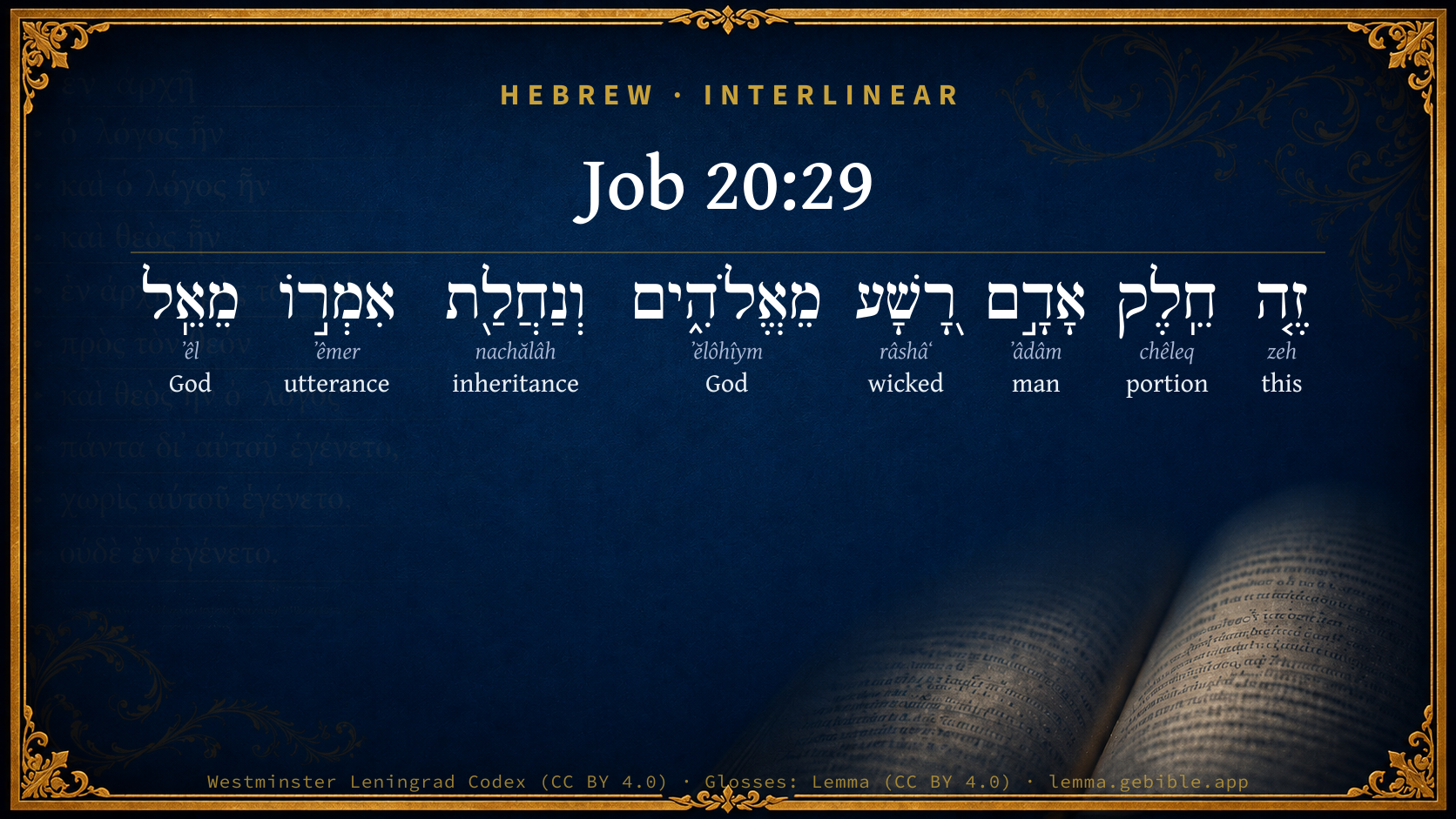
Job 20:29

Hebrew (Westminster Leningrad Codex) Job 20:29 appears in the Hebrew Old Testament. The text above is from the Westminster Leningrad Codex. Each word links to its Strong’s number, a concise gloss, and parsing drawn from the Open Scriptures Hebrew Bible morphology. Click any word for its full Brown-Driver-Briggs (BDB) entry.
Download image
Cite this verse

Job 20:29 (World English Bible). Public Domain. Lemma interlinear Bible study tool, https://lemma.gebible.app/v/job/20/29.

Show BibTeX & RIS
BibTeX
RIS
English Translation
This is the portion of a wicked man from God, The heritage appointed to him by God."
World English Bible · Public Domain
Download a study sheet

One document with this verse’s original text, its word-by-word gloss line, the meaning frame, cross-references with their text, attributed commentary, and full source and license credits — printable, and it pastes into notes with its structure intact.

This verse Autodidact and up

Study sheet (.html) Plain text (.txt)

A passage Seminary Student

Up to 50 verses in one chapter. A passage sheet keeps up to 6 commentary sources and 12 cross-references per verse, in the order this page ranks them, and says so on the sheet whenever that leaves anything out. Ask for a single verse and you get the Autodidact verse sheet above.

Everything on this page stays free to read, with no account — the sheet is a download of what is already on screen, not access to it.

Want to remove ads? Support Godless Engineer
Compare translations 3

The same verse in 3 English versions, stacked beneath the original-language interlinear above. Click any original word for its lexicon entry.

Each is an independent rendering of the whole verse — the interlinear is not word-aligned to these translations.

Highlighted words mark where these versions differ — a whole-verse word diff, not a word-by-word alignment.

  • World English Bible Public Domain
    This is the portion of a wicked man from God, The heritage appointed to him by God."
  • King James Version Public Domain
    This is the portion of a wicked man from God, and the heritage appointed unto him by God.
  • unfoldingWord Literal Text CC BY-SA 4.0
    This the portion of the wicked man from God, and the heritage of his appointment from God.”

unfoldingWord Literal Text — © unfoldingWord, licensed CC BY-SA 4.0. Word-aligned USFM3 via Door43 (git.door43.org/unfoldingWord/en_ult).

Versions to compare (up to 4)

3 of 4 selected

Show all 18 translations

Every available English version of this verse, each an independent rendering of the whole verse.

  • World English Bible Public Domain
    This is the portion of a wicked man from God, The heritage appointed to him by God."
  • Berean Standard Bible Public Domain
    This is the wicked man’s portion from God, the inheritance God has appointed him.”
  • Majority Standard Bible Public Domain
    This is the wicked man’s portion from God, the inheritance God has appointed him.”
  • King James Version Public Domain
    This is the portion of a wicked man from God, and the heritage appointed unto him by God.
  • American Standard Version (1901) Public Domain
    This is the portion of a wicked man from God, And the heritage appointed unto him by God.
  • Revised Version (1885) Public Domain
    This is the portion of a wicked man from God, and the heritage appointed unto him by God.
  • Geneva Bible (1599) Public Domain
    This is the portion of the wicked man from God, and the heritage that he shall haue of God for his wordes.
  • Douay-Rheims (1899) Public Domain
    This is the portion of a wicked man from God, and the inheritance of his doings from the Lord.
  • Young's Literal Translation Public Domain
    This `is' the portion of a wicked man from God. And an inheritance appointed him by God.
  • Literal Standard Version CC BY-SA 4.0
    This [is] the portion of a wicked man from God. And an inheritance appointed him by God.”
  • Unlocked Literal Bible CC BY-SA 4.0
    This is the wicked man's portion from God, the heritage reserved for him by God.”
  • unfoldingWord Literal Text CC BY-SA 4.0
    This the portion of the wicked man from God, and the heritage of his appointment from God.”
  • Darby Bible Public Domain
    This is the portion of the wicked man from God, and the heritage appointed to him by ùGod.
  • World Messianic Bible Public Domain
    This is the portion of a wicked man from God, the heritage appointed to him by God.”
  • Webster's Bible Public Domain
    This is the portion of a wicked man from God, and the heritage appointed to him by God.
  • Free Bible Version CC BY-SA 4.0
    This is the share the wicked receive from God, the inheritance God says they should have.”
  • Bible in Basic English Public Domain
    This is the reward of the evil man, and the heritage given to him by God.
  • JPS Tanakh (1917) Public Domain
    This is the portion of a wicked man from God, and the heritage appointed unto him by God.

Literal Standard Version (2020), Covenant Press — licensed CC BY-SA 4.0. Text via the HelloAO Bible API (eBible.org). Unlocked Literal Bible (unfoldingWord) — licensed CC BY-SA 4.0. Text via the HelloAO Bible API (eBible.org). unfoldingWord Literal Text — © unfoldingWord, licensed CC BY-SA 4.0. Word-aligned USFM3 via Door43 (git.door43.org/unfoldingWord/en_ult). Free Bible Version, Dr. Jonathan Gallagher — licensed CC BY-SA 4.0. Text via the HelloAO Bible API (eBible.org).

Word by word

More ways to search: Search by grammar → Find every occurrence → Compare this word →

Practice this passage: Drill this verse → Learn its vocabulary →

About this verse

These counts appear in no published source. They are computed here, from the morphology-tagged text and Lemma’s own curated glosses. What Lemma adds →

8
words
8
distinct lemmas
Wisdom
section

Shared distinctive vocabulary

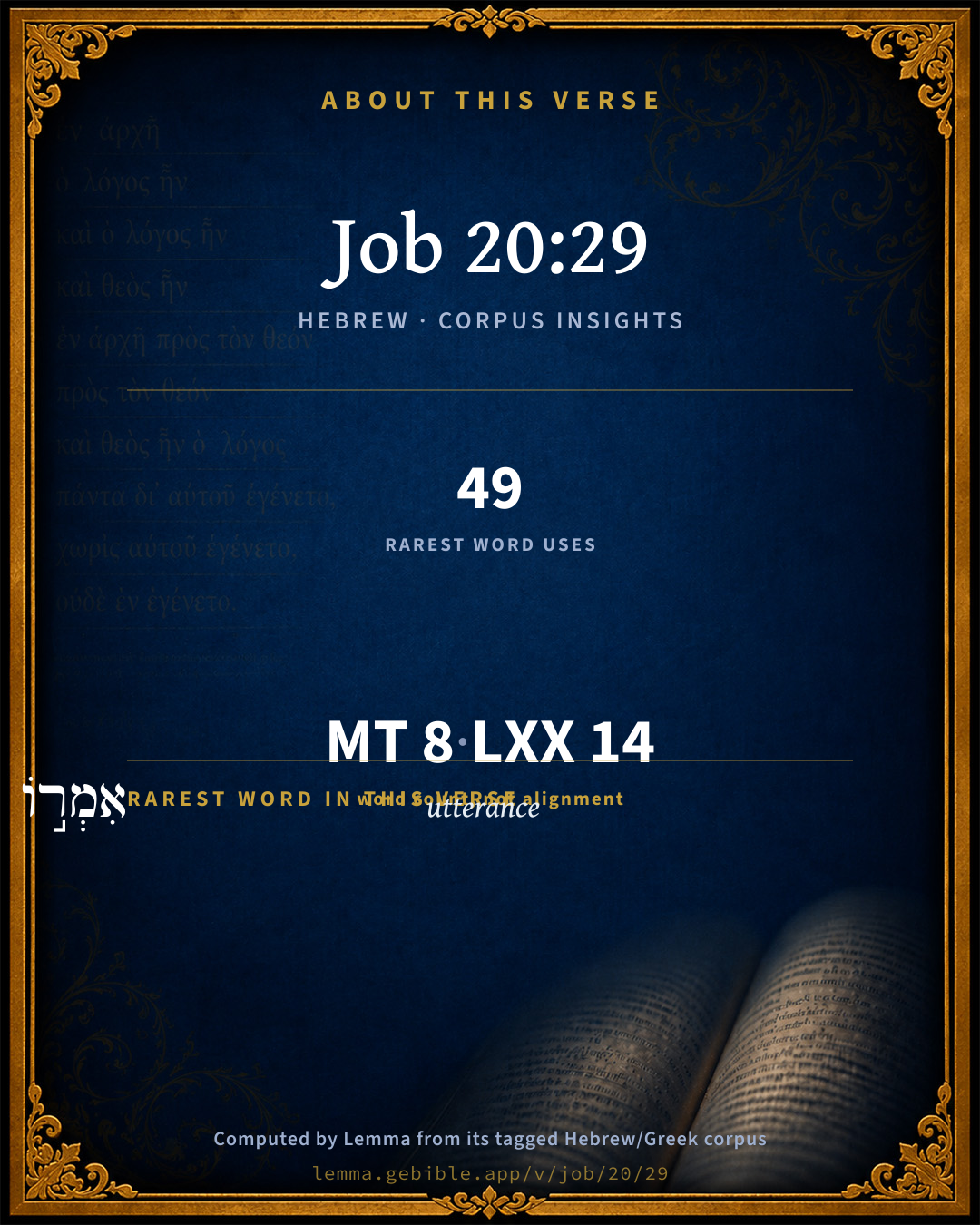
אִמְר֣וֹ utterance H561 occurs in 47 verses of the Hebrew Bible. Also found in:

Grammatical profile

  • 6 nouns
  • 1 adjective
  • 1 pronoun

Hebrew & Septuagint length

In English translation the verse runs 17 words from the Hebrew and 23 from the Septuagint (LXX English) — closely comparable.

A rough comparison of the two English renderings, which tokenize alike — not a word-level alignment.

Word counts can differ between the Hebrew and the Greek without any difference in meaning — e.g. the Hebrew direct-object marker אֵת has no separate Greek word, and Greek often adds the article ὁ.

In the original languages it is 8 Hebrew tokens and 14 Greek tokens — but the two are counted differently (Hebrew bundles its prefixes and suffixes into one token; the Greek is in lemma form), so that isn’t a like-for-like length.

Cross-references

7

Topical passages linked to Job 20:29 in the Treasury of Scripture Knowledge — connected by theme and wording, ordered by reader-vote popularity; previews shown in the World English Bible.

  • Job 27:13 "This is the portion of a wicked man with God, The heritage of oppressors, which they receive from the Almighty.
  • Job 31:2–3 For what is the portion from God above, And the heritage from the Almighty on high?
  • Job 18:21 Surely such are the dwellings of the unrighteous, This is the place of him who doesn't know God."
  • Psalms 11:5–6 Yahweh examines the righteous, But the wicked and him who loves violence his soul hates.
  • Lamentations 3:38 Doesn't evil and good come out of the mouth of the Most High?
  • Matthew 24:51 and will cut him in pieces, and appoint his portion with the hypocrites; there is where the weeping and grinding of teeth will be.
  • Deuteronomy 29:20–28 Yahweh will not pardon him, but then the anger of Yahweh and his jealousy will smoke against that man, and all the curse that is written in this book shall lie on him, and Yahweh will blot out his name from under the sky.

Cross-references courtesy of OpenBible.info (CC BY 4.0).

Hebrew and Greek witnesses Masoretic Hebrew ↔ Greek Septuagint

The same verse in the two great witnesses to the Old Testament, shown verse-for-verse.

These are two independent witnesses, not word-aligned to each other, and the Septuagint is shown in lemma (dictionary) form.

Hebrew Job 20:29 Masoretic · Westminster Leningrad Codex

זֶ֤ה חֵֽלֶק אָדָ֣ם רָ֭שָׁע מֵאֱלֹהִ֑ים וְנַחֲלַ֖ת אִמְר֣וֹ מֵאֵֽל

This is the portion of a wicked man from God, The heritage appointed to him by God."

World English Bible · Public Domain

Greek LXX Job 20:29 Septuagint · lemma form

οὗτος ὁ μερίς ἄνθρωπος ἀσεβής παρά κύριος καί κτῆμα ὑποἄρχω αὐτός παρά ὁ ἐπισκοπός

This is the portion of an ungodly man from the Lord, and the possession of his goods appointed him by the all-seeing God.

LXX2012 (modern English Septuagint) · Public Domain

Hebrew: Westminster Leningrad Codex (CC BY 4.0). Greek: Septuagint (public domain); English from LXX2012 (modern English Septuagint) (Public Domain). How the Septuagint differs from the Hebrew →

Commentary

Notes on Job 20:29 from classic Christian and Jewish commentators (each source and its license shown beneath its notes). The classic Christian expositions comment on the surrounding passage and are grouped to its opening verse, so a note may address several verses; the Jewish commentaries on the Tanakh (Rashi and others) are per-verse, so they appear only where the commentator wrote on this verse.

Lemma curates 59 commentaries, every one of them public domain or Creative Commons licensed, each selected and text-cleaned for this edition rather than reprinted as found. About our sources →

Trapp's Complete Commentary

John Trapp

Job 20:29 This [is] the portion of a wicked man from God, and the heritage appointed unto him by God.

Ver. 29. This is the portion of a wicked man from God] A portion God alloweth the wicked in this life, Psa 17:14; as a king, when he reprieveth a traitor, alloweth him a subsistence, prisoner’s pittance at least. Yea, the worst of men divide the wealth and honours of the world between them for a time. Nebuchadnezzar had Tyre as pay for his pains in Egypt. And the whole Turkish empire is nothing else but a crust cast to his dogs by the great housekeeper of the world, saith Luther. But besides this, God hath provided a far other portion for them (saitb one), and that by way of inheritance, never to be parted from them; viz. all the forementioned miseries, and many more, all torments here, and tortures in hell. This is the inheritance, Quam nunquam deserere, non magis quam seipsos, poterunt, which will stick to them as close as the skin to the fesh or the flesh to the bones; it falls to them as the inheritance doth to the heir, Job 27:13; Job 31:2, or as the mess of meat doth to the invited guest. Misery is the heritage of the wicked, as they are children of disobedience; and their wages, as they are workers of iniquity; their present prosperity also is a piece of their punishment, Isa 1:5 Pro 1:32. The words of Zophar are ended. Let others reply as they please, but he hath done. Praestat herbam dare, quam turpiter pugnare. No surer sign of an evil cause than a powerless pertinace.

John Trapp, A Commentary or Exposition upon All the Books of the Old and New Testament (1647–1656) — public domain. Text from a community e-Sword module.

Joseph Benson's Commentary

Job 20:29. This is the portion of the wicked man from God — Allotted to him, designed for him, as his portion: and he will have it for a perpetuity; it is what he must abide by. And the heritage appointed unto him by God — Hebrew, נחלת אמרו, nachalath imro, the heritage of his word; that is, appointed by the word or sentence of God; and termed a heritage, to signify the stability and assurance of it; that it is as firm and certain to him as an inheritance to the right heir; and in opposition to that inheritance which he had gotten by fraud and violence. Though impenitent sinners do not always fall under such temporal judgments as are here described, and in that Zophar was mistaken; yet the wrath of God abides upon them: and they are made miserable by spiritual judgments, which are much worse; their consciences being either, on the one hand, a terror to them, and then they are in continual amazement; or, on the other hand, seared and silenced, and then they are given up to a reprobate mind, and bound over to eternal ruin. “Never was any doctrine better explained,” says Henry, “nor worse applied, than this here by Zophar: who intended by all this to prove Job to be a hypocrite. Let us receive the good explication, and make a better application, for warning to ourselves to stand in awe and not to sin.”

Joseph Benson's Commentary on the Old and New Testaments (1811–1818) — public domain. Text from a community e-Sword module.

Geneva Bible (1599)

Geneva Bible translators

Against God, thinking to excuse himself, and to escape God’s hand.

Thus God will plague the wicked.

Geneva Bible (1599) marginal notes — public domain. Text via Bolls.life.

Jamieson, Fausset & Brown

Robert Jamieson, A. R. Fausset & David Brown

appointed--not as a matter of chance, but by the divine "decree" (Margin) and settled principle.

Next: Job Chapter 21

Jamieson, Fausset & Brown — Commentary Critical and Explanatory on the Whole Bible (1871) — public domain (CC PDM 1.0). Text via the HelloAO Bible API.

Adam Clarke's Commentary

Verse 29. This is the portion] As God has dealt with the murmuring Israelites, and with the rebellious sons of Korah, so will he deal with those who murmur against the dispensations of his providence, and rebel against his authority. Instead of an earthly portion, and an ecclesiastical heritage, such as Korah, Dathan, and Abiram sought; they shall have fire from God to scorch them, and the earth to swallow them up.

Dr. Stock, bishop of Killala, who has noticed the allusion to the quails, and for which he has been most unmeritedly ridiculed, gives us the following note on the passage:-

"Here I apprehend is a fresh example of the known usage of Hebrew poets, in adorning their compositions by allusions to facts in the history of their own people. It has escaped all the interpreters; and it is the more important, because it fixes the date of this poem, so far as to prove its having been composed subsequently to the transgression of Israel, at Kibroth Hattaavah, recorded in Nu 11:33-34. Because the wicked acknowledges not the quail, that is, the meat with which God has filled his stomach; but, like the ungrateful Israelites, crammed, and blasphemed his feeder, as Milton finely expresses it, he shall experience the same punishment with them, and be cut off in the midst of his enjoyment, as Moses tells us the people were who lusted."

If I mistake not, I have added considerable strength to the prelate's reasoning, by showing that there is a reference also to the history of the manna, and to that which details the rebellion of Korah and his company; and if so, (and they may dispute who please,) it is a proof that the Book of Job is not so old as, much less older than, the Pentateuch, as some have endeavoured to prove, but with no evidence of success, at least to my mind: a point which never has been, and I am certain never can be, proved; which has multitudes of presumptions against it, and not one clear incontestable fact for it. Mr. Good has done more in this case than any of his predecessors, and yet Mr. Good has failed; no wonder then that others, unmerciful criticisers of the bishop of Killala, have failed also, who had not a tenth part of Mr. Good's learning, nor one-hundredth part of his critical acumen.

It is, however, strange that men cannot suffer others to differ from them on a subject of confessed difficulty and comparatively little importance, without raising up the cry of heresy against them, and treating them with superciliousness and contempt! These should know, if they are clergymen, whether dignified or not, that such conduct ill becomes the sacerdotal character; and that ante barbam docet senes cannot be always spoken to the teacher's advantage.

As a good story is not the worse for being twice told, the following lines from a clergyman, who, for his humility and piety, was as much an honour to his vocation as he was to human nature, may not be amiss, in point of advice to all Warburtonian spirits: -

"Be calm in arguing, for fierceness makes

Error a fault, and truth discourtesy.

Why should I feel another man's mistakes

More than his sickness or his poverty?

In love I should: but anger is not love

Nor wisdom neither; therefore, gently move.

Calmness is great advantage: he that lets

Another chafe, may warm him at his fire,

Mark all his wanderings, and enjoy his frets;

As cunning fencers suffer heat to tire.

Truth dwells not in the clouds: the bow that's there

Doth often aim at, never hit, the sphere."

HERBERT.

Dr. Stock's work on the Book of Job will stand honourably on the same shelf with the best on this difficult subject.

Adam Clarke's Commentary on the Bible (1810–1826) — public domain. Text from a community e-Sword/MySword module.

The Cambridge Bible for Schools and Colleges

gen. ed. J. J. S. Perowne

29. Like all the speakers in this second round of debate Zophar concludes by pointing with an impressive gesture to the picture he has drawn. Job should see himself there. He finishes by saying “from God.” This forces Job into the arena; he has no help, however unwilling he may be, but face this argument (ch. Job_21:27), and he shews that that which comes “from God” (ch. Job_21:22) is something very different.

The Cambridge Bible for Schools and Colleges (gen. ed. J. J. S. Perowne; Cambridge University Press, 1878–1918) — public domain. Text from a community e-Sword module.

John Gill's Exposition

This is the portion of a wicked man from God,.... All before related, and which is very different from the portion of a good man, which is God himself, both here and hereafter; the wicked man has indeed his portion from God, which he has assigned him, but his portion is not himself; nor is it with him, nor with his people, but it is at most and best in this life, and but a worldly one, and hereafter will be with devils and damned spirits; and a dreadful portion it is to be banished from the presence of God to all eternity, and take up an everlasting abode with such company:

and the heritage appointed unto him by God; it is not only a portion allotted to him, but an inheritance to abide continually with him; and this by the irreversible decree and appointment of God, who has foreordained ungodly men to condemnation, and made, appointed, and reserved them to the day of wrath and destruction. Some choose to render the clause, "and the inheritance of his word or words (i) is unto him by God"; that is, punishment shall be inflicted upon him, and continue with him as an inheritance, because of his words, his indecent words, hard speeches and blasphemies uttered by him; referring, as it is thought, to the words which had dropped from the lips of Job.

(i) "haereditas eloquii ejus", Pagninus, Montanus; "verborum ejus", V. L. "impie dictorum ejus", Codurcus.

Next: Job Chapter 21

John Gill's Exposition of the Whole Bible (1746–1763) — public domain (CC PDM 1.0). Text via the HelloAO Bible API.

Albert Barnes' Notes on the Bible

This is the portion of a wicked man - This conclusion is similar to that which Bildad drew at the close of his speech, Job 18:21. Zophar intended, undoubtedly, that Job should apply it to himself, and that he should draw the inference, that one who had been treated in this manner, must be a wicked man.

And the heritage appointed - Margin, “of his decree from.” The Hebrew is,” Of his word” (אמרוּ 'êmerô ) - that is, of his “purpose.” The idea is, that this is the divine rule, or arrangement. It is not a matter of chance. It is the result of appointment, and when people are afflicted in this manner, we are to conclude that “God” regards them as guilty. The whole object of the discussion was to arrive at the principles of the divine administration. Nothing is attributed to chance; and nothing is ascribed to second causes, except as indicating the will of God. It is assumed, that the course of events in the world was a sufficient exponent of the divine intention, and that when they understood how God “treated” a man, they could clearly understand how he regarded his character. The principle is a good one, when “the whole of existence” is taken into the account; the fault here was in taking in only a small part of existence - this short life - and hastening to the conclusion, that the character could be certainly determined by the manner in which God deals with people here.

Albert Barnes' Notes on the Bible (1834–1885) — public domain. Text from a community e-Sword/MySword module.

Haydock's Catholic Bible Commentary

CHAPTER XX.

Doings. Literally, "words." Hebrew, "of his decree." (Haydock) --- This is what he may expect for him impiety both in words and actions. (Calmet)

George Leo Haydock (1774–1849), Haydock's Catholic Family Bible and Commentary, 1859 edition — public domain. Excludes Psalms (Douay-Rheims chapter numbering differs from Protestant) and Deuterocanonical books (Catholic canon only).

Matthew Poole's English Annotations

From God; who like a wise master of a feast gives to every man his proper portion, and as a just judge distributes to him according to his deserts.

The heritage appointed unto him by God, Heb. the heritage (i.e. the portion, as before; called here a heritage; partly to note the stability and assurance of it, that it is as firm as an inheritance to the right heir; and partly in opposition to that inheritance which he had gotten by fraud and violence) of his word; either,

1. Of God’s word, i.e. which is allotted to him by the word or sentence of God. Or,

2. Of the wicked man’s word, the reward of his speeches; which, like his actions, are and may well be presumed to be wicked and blasphemous, and many ways offensive to God: and he instanceth in his speeches rather than his actions, to meet with Job, who, though he had made some colourable excuses for his actions, yet was manifestly guilty of hard and sinful speeches against God, which he would hereby intimate that they were not such harmless and excusable things as Job pretended, as appeared by these severe judgments which they brought upon wicked men.

Matthew Poole's English Annotations on the Holy Bible (1683–1685) — public domain. Text from a community e-Sword/MySword module.

Whedon's Commentary on the Bible

Daniel D. Whedon

29. The closing verse, for the greater emphasis, lies outside of the strophic arrangement as in Job_5:27.

Appointed unto him — Literally, And the heritage of his word from God. Word, in the sense of appointment. Such a doom brought upon the wicked by his own sins is spoken from God. For he is the author of the scheme that entails such results.

Daniel D. Whedon (gen. ed.), Commentary on the Old and New Testaments (1874–1909) — public domain. Text from a community e-Sword module.

The Pulpit Commentary

This is the portion of a wicked man from God; i.e. the lot, or possession of a wicked man that which God makes over to him as his own in the last resort, and which is all that he has to look for. In other words, it is the heritage appointed unto him by God. (comp. Job_27:13) As to some God, at the last, will assign an inheritance of good, so to others he will appoint an inheritance of evil.

The Pulpit Commentary (1880–1919), ed. H.D.M. Spence-Jones & Joseph S. Exell — public domain. Text from a community e-Sword module.

John Wesley's Explanatory Notes

Heritage - Hebrew. the heritage; so called, to denote the stability and assurance of it, that it is as firm as an inheritance to the right heir; and in opposition to that inheritance which he had gotten by fraud and violence.

John Wesley, Explanatory Notes Upon the Whole Bible (1754–1765) — public domain. Text via the GEBible commentary corpus.

Rashi

Rabbi Shlomo Yitzchaki (Rashi)

appointed him by God Heb. אִמְרוֹ. What was said about him from before the Omnipresent. The word אִמְרוֹ is in the masculine gender, from the form of (Ps. 5:2), “Give ear to my words (אַמָרַי).” אִמְרָתוֹ appears (ibid. 147:15) in the feminine gender, from the form of (ibid. 12:7) “pure words (אַמָרוֹת).”

Rashi on the Tanakh — English translations: “The Judaica Press complete Tanach with Rashi, translated by A. J. Rosenberg” (CC BY 4.0); “Pentateuch with Rashi's commentary by M. Rosenbaum and A.M. Silbermann, 1929-1934” (public domain); “The Metsudah Tanach series, Lakewood, N.J” (CC BY 4.0); and “The Book of Joshua, Metsudah Publications, 1997” (CC BY 4.0). Text via Sefaria.

Lesson kit

Teaching starters — assembled from the data on this page, not authored interpretation. Every prompt links to the verse data it draws on. Edit before teaching.

Job, in the Wisdom, opens this verse with 8 words (8 distinct Hebrew lemmas). Its most distinctive word is ʼêmer (“utterance”). A historical commentator’s framing appears above. Read the whole chapter for the surrounding context.

Discussion questions

  1. How does “utterance” (ʼêmer) shape what this verse is saying?
  2. Genesis 49:21 shares the word «utterance» with this verse. How do the two illuminate each other?
  3. These translations render this verse differently; the difference is in the English rendering, not the original. What questions does that raise?
  4. Reading how Trapp's Complete Commentary and Joseph Benson's Commentary read this verse, where do the two commentators agree and where do they part?

Things to notice

Reading settings

Reading text

Shown beneath each verse's original-language words.

Old Testament
Old Testament edition

Read the OT as the Masoretic Hebrew (MT) or the Greek Septuagint (LXX).

English shown for the Greek Septuagint (in the Hebrew ↔ Greek comparison).

Comparing translations? Open the Compare panel on any verse page to stack up to four side by side.