
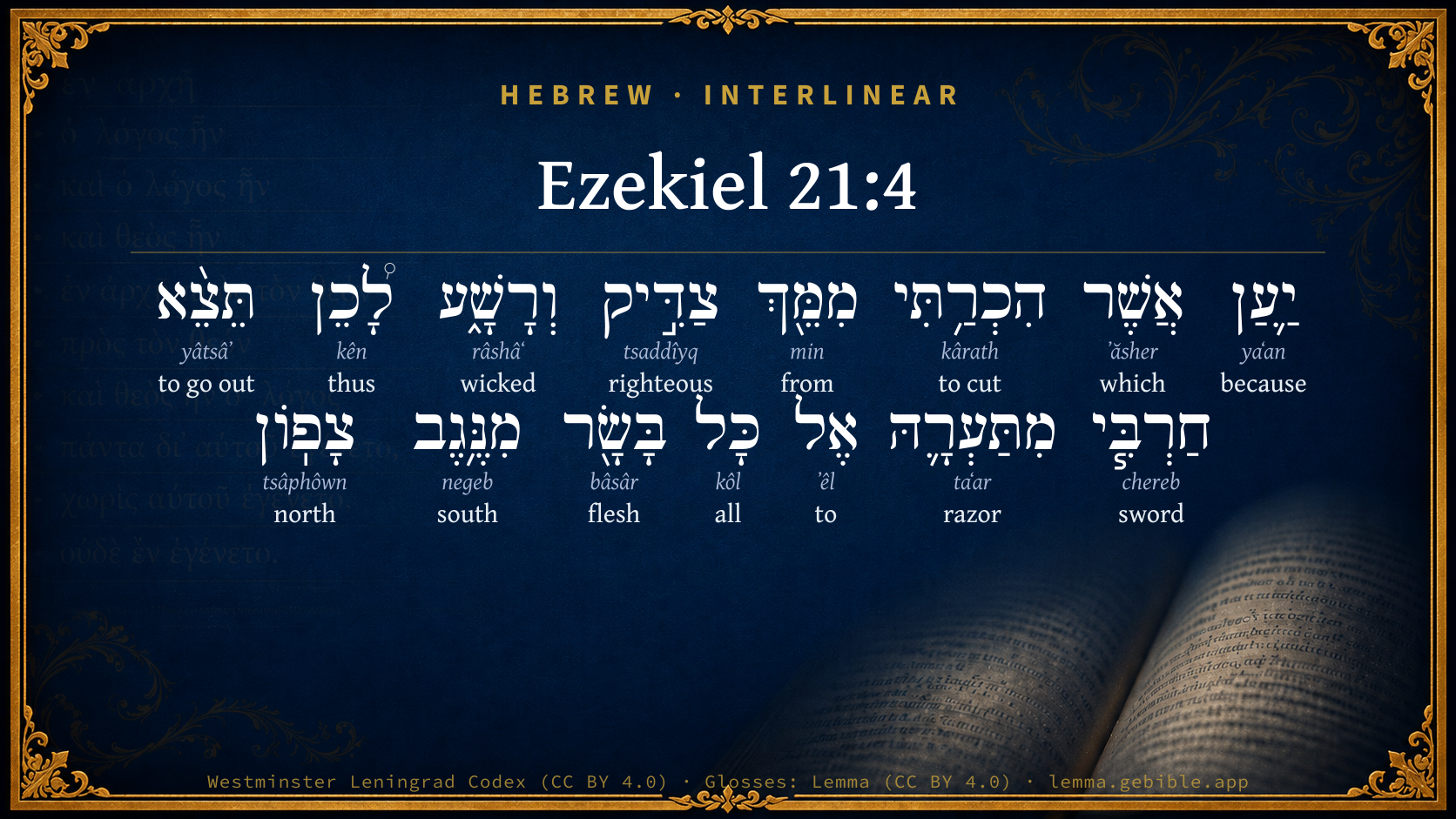
Ezekiel 21:4

Hebrew (Westminster Leningrad Codex) Ezekiel 21:4 appears in the Hebrew Old Testament. The text above is from the Westminster Leningrad Codex. Each word links to its Strong’s number, a concise gloss, and parsing drawn from the Open Scriptures Hebrew Bible morphology. Click any word for its full Brown-Driver-Briggs (BDB) entry.
Download image
Cite this verse

Ezekiel 21:4 (World English Bible). Public Domain. Lemma interlinear Bible study tool, https://lemma.gebible.app/v/ezekiel/21/4.

Show BibTeX & RIS
BibTeX
RIS
English Translation
Seeing then that I will cut off from you the righteous and the wicked, therefore shall my sword go forth out of its sheath against all flesh from the south to the north:
World English Bible · Public Domain
Download a study sheet

One document with this verse’s original text, its word-by-word gloss line, the meaning frame, cross-references with their text, attributed commentary, and full source and license credits — printable, and it pastes into notes with its structure intact.

This verse Autodidact and up

Study sheet (.html) Plain text (.txt)

A passage Seminary Student

Up to 50 verses in one chapter. A passage sheet keeps up to 6 commentary sources and 12 cross-references per verse, in the order this page ranks them, and says so on the sheet whenever that leaves anything out. Ask for a single verse and you get the Autodidact verse sheet above.

Everything on this page stays free to read, with no account — the sheet is a download of what is already on screen, not access to it.

Want to remove ads? Support Godless Engineer
Compare translations 3

The same verse in 3 English versions, stacked beneath the original-language interlinear above. Click any original word for its lexicon entry.

Each is an independent rendering of the whole verse — the interlinear is not word-aligned to these translations.

Highlighted words mark where these versions differ — a whole-verse word diff, not a word-by-word alignment.

  • World English Bible Public Domain
    Seeing then that I will cut off from you the righteous and the wicked, therefore shall my sword go forth out of its sheath against all flesh from the south to the north:
  • King James Version Public Domain
    Seeing then that I will cut off from thee the righteous and the wicked, therefore shall my sword go forth out of his sheath against all flesh from the south to the north:
  • unfoldingWord Literal Text CC BY-SA 4.0
    In order for me to cut off both the righteous and the wicked from you, my sword will go out from its sheath against all flesh from the south to the north.

unfoldingWord Literal Text — © unfoldingWord, licensed CC BY-SA 4.0. Word-aligned USFM3 via Door43 (git.door43.org/unfoldingWord/en_ult).

Versions to compare (up to 4)

3 of 4 selected

Show all 18 translations

Every available English version of this verse, each an independent rendering of the whole verse.

  • World English Bible Public Domain
    Seeing then that I will cut off from you the righteous and the wicked, therefore shall my sword go forth out of its sheath against all flesh from the south to the north:
  • Berean Standard Bible Public Domain
    Because I will cut off both the righteous and the wicked, My sword will be unsheathed against everyone from south to north.
  • Majority Standard Bible Public Domain
    Because I will cut off both the righteous and the wicked, My sword will be unsheathed against everyone from south to north.
  • King James Version Public Domain
    Seeing then that I will cut off from thee the righteous and the wicked, therefore shall my sword go forth out of his sheath against all flesh from the south to the north:
  • American Standard Version (1901) Public Domain
    Seeing then that I will cut off from thee the righteous and the wicked, therefore shall my sword go forth out of its sheath against all flesh from the south to the north:
  • Revised Version (1885) Public Domain
    Seeing then that I will cut off from thee the righteous and the wicked, therefore shall my sword go forth out of its sheath against all flesh from the south to the north:
  • Geneva Bible (1599) Public Domain
    Seeing then that I will cut off from thee both the righteous and wicked, therefore shall my sworde goe out of his sheath against all flesh from the South to the North,
  • Douay-Rheims (1899) Public Domain
    And forasmuch as I have cut off in thee the just, and the wicked, therefore shall my sword go forth out of its sheath against all flesh, from the south even to the north.
  • Young's Literal Translation Public Domain
    Because that I have cut off from thee righteous and wicked, Therefore go out doth My sword from its scabbard, Unto all flesh, from south to north.
  • Literal Standard Version CC BY-SA 4.0
    Because that I have cut off righteous and wicked from you, || Therefore My sword goes out from its scabbard, || To all flesh, from south to north.
  • Unlocked Literal Bible CC BY-SA 4.0
    In order for me to cut off both the righteous and the wicked from you, my sword will go out from its sheath against all flesh from the south to the north.
  • unfoldingWord Literal Text CC BY-SA 4.0
    In order for me to cut off both the righteous and the wicked from you, my sword will go out from its sheath against all flesh from the south to the north.
  • Darby Bible Public Domain
    Seeing that I will cut off from thee the righteous and the wicked, therefore shall my sword go forth out of its sheath against all flesh, from the south to the north;
  • World Messianic Bible Public Domain
    Seeing then that I will cut off from you the righteous and the wicked, therefore my sword will go out of its sheath against all flesh from the south to the north.
  • Webster's Bible Public Domain
    Seeing then that I will cut off from thee the righteous and the wicked, therefore shall my sword go forth from its sheath against all flesh from the south to the north:
  • Free Bible Version CC BY-SA 4.0
    Because I'm going to destroy both the good and the bad, I will attack everyone from the north to the south.
  • Bible in Basic English Public Domain
    Because I am going to have the upright and the evil cut off from you, for this cause my sword will go out from its cover against all flesh from the south to the north:
  • JPS Tanakh (1917) Public Domain
    (21-9) Seeing then that I will cut off from thee the righteous and the wicked, therefore shall My sword go forth out of its sheath against all flesh from the south to the north;

Literal Standard Version (2020), Covenant Press — licensed CC BY-SA 4.0. Text via the HelloAO Bible API (eBible.org). Unlocked Literal Bible (unfoldingWord) — licensed CC BY-SA 4.0. Text via the HelloAO Bible API (eBible.org). unfoldingWord Literal Text — © unfoldingWord, licensed CC BY-SA 4.0. Word-aligned USFM3 via Door43 (git.door43.org/unfoldingWord/en_ult). Free Bible Version, Dr. Jonathan Gallagher — licensed CC BY-SA 4.0. Text via the HelloAO Bible API (eBible.org).

Word by word

More ways to search: Search by grammar → Find every occurrence → Compare this word →

Practice this passage: Drill this verse → Learn its vocabulary →

מִתַּעְרָ֛הּ
taʻar
H8593
“from · razor · her”
Preposition + Noun, Common, Both, Singular, Construct + Suffix, Personal, 3rd Person, Feminine, Singular
Part of Speech
Preposition + Noun
Type
Common
Gender
Both
Number
Singular
State
Construct
Full BDB Definition

Origin: from H6168

TWOT: 1692e

razor, sheath (making naked) - razor - sheath (of sword)
  1. יַ֛עַן yaʻan H3282 “because” Conjunction
  2. אֲשֶׁר ʼăsher H834 “which” Particle, Relative
  3. הִכְרַ֥תִּי kârath H3772 “to cut” Verb, Hiphil, Perfect, 1st Person, Common, Singular
  4. מִמֵּ֖ךְ min H4480 “from · you” Preposition + Suffix, Personal, 2nd Person, Feminine, Singular
  5. צַדִּ֣יק tsaddîyq H6662 “righteous” Adjective, Adjective, Masculine, Singular, Absolute
  6. וְרָשָׁ֑ע râshâʻ H7563 “and · wicked” Conjunction + Adjective, Adjective, Masculine, Singular, Absolute
  7. לָ֠כֵן kên H3651 “to/for · thus” Preposition + Adverb
  8. תֵּצֵ֨א yâtsâʼ H3318 “to go out” Verb, Qal, Imperfect, 3rd Person, Feminine, Singular
  9. חַרְבִּ֧י chereb H2719 “sword · my” Noun, Common, Feminine, Singular, Construct + Suffix, Personal, 1st Person, Common, Singular
  10. אֶל ʼêl H413 “to” Preposition
  11. כָּל kôl H3605 “all of” Noun, Common, Masculine, Singular, Construct
  12. בָּשָׂ֖ר bâsâr H1320 “flesh” Noun, Common, Masculine, Singular, Absolute
  13. מִנֶּ֥גֶב negeb H5045 “from · south” Preposition + Noun, Common, Masculine, Singular, Absolute
  14. צָפֽוֹן tsâphôwn H6828 “north” Noun, Common, Feminine, Singular, Absolute

About this verse

These counts appear in no published source. They are computed here, from the morphology-tagged text and Lemma’s own curated glosses. What Lemma adds →

15
words
15
distinct lemmas
Prophets
section

Notable vocabulary

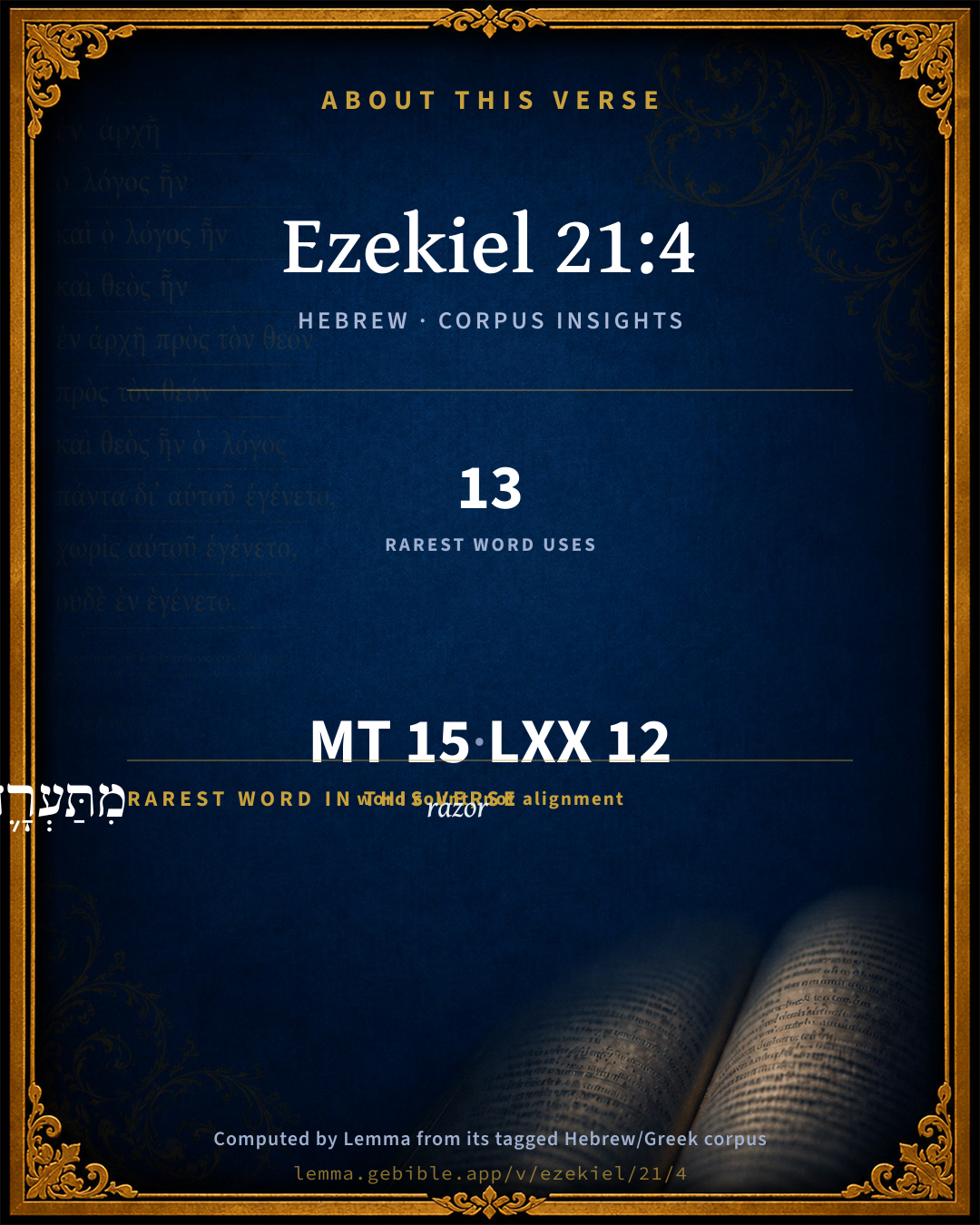
The rarest word here is מִתַּעְרָ֛הּ razor H8593 — appearing just 13 times in the whole Hebrew Bible.

Shared distinctive vocabulary

מִתַּעְרָ֛הּ razor H8593 occurs in 13 verses of the Hebrew Bible. Also found in:

Grammatical profile

  • 2 verbs
  • 6 nouns
  • 2 adjectives
  • 2 prepositions
  • 1 conjunction
  • 1 adverb
  • 1 particle

Verb forms

  • הִכְרַ֥תִּי Hiphil · Perfect
  • תֵּצֵ֨א Qal · Imperfect

Hebrew & Septuagint length

In English translation the verse runs 33 words from the Hebrew and 32 from the Septuagint (LXX English) — closely comparable.

A rough comparison of the two English renderings, which tokenize alike — not a word-level alignment.

Word counts can differ between the Hebrew and the Greek without any difference in meaning — e.g. the Hebrew direct-object marker אֵת has no separate Greek word, and Greek often adds the article ὁ.

In the original languages it is 15 Hebrew tokens and 12 Greek tokens — but the two are counted differently (Hebrew bundles its prefixes and suffixes into one token; the Greek is in lemma form), so that isn’t a like-for-like length.

Cross-references

3

Topical passages linked to Ezekiel 21:4 in the Treasury of Scripture Knowledge — connected by theme and wording, ordered by reader-vote popularity; previews shown in the World English Bible.

  • Ezekiel 20:47 and tell the forest of the South, Hear the word of Yahweh: Thus says the Lord Yahweh, Behold, I will kindle a fire in you, and it shall devour every green tree in you, and every dry tree: the flaming flame shall not be quenched, and all faces from the south to the north shall be burnt thereby.
  • Ezekiel 7:2 You, son of man, thus says the Lord Yahweh to the land of Israel, An end: the end is come on the four corners of the land.
  • Ezekiel 6:11–14 Thus says the Lord Yahweh: Smite with your hand, and stamp with your foot, and say, Alas! because of all the evil abominations of the house of Israel; for they shall fall by the sword, by the famine, and by the pestilence.

Cross-references courtesy of OpenBible.info (CC BY 4.0).

Hebrew and Greek witnesses Masoretic Hebrew ↔ Greek Septuagint

The same verse in the two great witnesses to the Old Testament, shown verse-for-verse.

These are two independent witnesses, not word-aligned to each other, and the Septuagint is shown in lemma (dictionary) form.

Hebrew Ezekiel 21:4 Masoretic · Westminster Leningrad Codex

יַ֛עַן אֲשֶׁר הִכְרַ֥תִּי מִמֵּ֖ךְ צַדִּ֣יק וְרָשָׁ֑ע לָ֠כֵן תֵּצֵ֨א חַרְבִּ֧י מִתַּעְרָ֛הּ אֶל כָּל בָּשָׂ֖ר מִנֶּ֥גֶב צָפֽוֹן

Seeing then that I will cut off from you the righteous and the wicked, therefore shall my sword go forth out of its sheath against all flesh from the south to the north:

World English Bible · Public Domain

Greek LXX Ezekiel 21:4 Septuagint · lemma form

καί ἐπιγιγνώσκω πᾶς σάρξ ὅτι ἐγώ κύριος ἐκκαίω αὐτός καί οὐ σβέννυμι

Because I will destroy out of you the unrighteous and the transgressor, therefore so shall my sword come forth out of its sheath against all flesh from the south to the north:

LXX2012 (modern English Septuagint) · Public Domain

On this verse, Trapp's Complete Commentary discusses the Septuagint’s reading. Read the note in Commentary ↓

Hebrew: Westminster Leningrad Codex (CC BY 4.0). Greek: Septuagint (public domain); English from LXX2012 (modern English Septuagint) (Public Domain). How the Septuagint differs from the Hebrew →

Targum (Aramaic paraphrase)

1

The Targum is the ancient Jewish Aramaic paraphrase of the Hebrew Scriptures — an interpretive translation, not the Hebrew text itself. Onkelos (literal) and Pseudo-Jonathan (expansive) render the Torah, and Jonathan the Prophets. Coverage is partial: where no permissively-licensed English translation exists for a verse, only the Aramaic is shown. This is verse-level text, not a word-by-word alignment to the Hebrew.

  1. Targum Jonathan Prophets (Joshua–Malachi)
    וְיֶחֱזוּן כָּל בְּנֵי בִסְרָא אֲרֵי אֲנָא יְיָ אַדְלִיקְתָּהּ לָא תִטְפֵי:

    (no public-domain English translation for this verse)

    Targum Jonathan — Aramaic: “Mikraot Gedolot” (public domain). English: “Sefaria Community Translation” (CC0 1.0 (public-domain dedication)); “London "Chaldee Paraphrase," 1871” (public domain). Text via Sefaria.

Commentary

Notes on Ezekiel 21:4 from classic Christian and Jewish commentators (each source and its license shown beneath its notes). The classic Christian expositions comment on the surrounding passage and are grouped to its opening verse, so a note may address several verses; the Jewish commentaries on the Tanakh (Rashi and others) are per-verse, so they appear only where the commentator wrote on this verse.

Lemma curates 59 commentaries, every one of them public domain or Creative Commons licensed, each selected and text-cleaned for this edition rather than reprinted as found. About our sources →

Trapp's Complete Commentary

John Trapp

Eze 21:4 Seeing then that I will cut off from thee the righteous and the wicked, therefore shall my sword go forth out of his sheath against all flesh from the south to the north:

Ver. 4. Seeing then that I will cut off from thee the righteons.] Velut eodem contubernio deprehensos. This is repeated for more assurance, because it might seem strange. The Septuagint hath it, The unrighteous and the wicked. The Chaldee, I will make the righteous flee, and destroy the wicked. But the Hebrew verity is as before; neither need we wonder, since the best have their infirmities.

John Trapp, A Commentary or Exposition upon All the Books of the Old and New Testament (1647–1656) — public domain. Text from a community e-Sword module.

Geneva Bible (1599)

Geneva Bible translators

Meaning, through all the land.

Geneva Bible (1599) marginal notes — public domain. Text via Bolls.life.

Jamieson, Fausset & Brown

Robert Jamieson, A. R. Fausset & David Brown

The "sword" did not, literally, slay all; but the judgments of God by the foe swept through the land "from the south to the north."

Jamieson, Fausset & Brown — Commentary Critical and Explanatory on the Whole Bible (1871) — public domain (CC PDM 1.0). Text via the HelloAO Bible API.

Adam Clarke's Commentary

Verse 4. From the south to the north] The whole land shall be ravaged from one end to the other.

Adam Clarke's Commentary on the Bible (1810–1826) — public domain. Text from a community e-Sword/MySword module.

John Gill's Exposition

That all flesh may know that I the Lord have drawn forth my sword out of his sheath,.... The same with kindling a fire in Judea; see Gill on Eze 20:48,

it shall not return any more; that is, into its sheath, until it has done all its work; meaning that the Chaldean army should not return to their own land until they had executed the whole will of God upon the Jews; this is the fire that should not be quenched, Eze 20:48 and here ends the explanation of the said prophecy.

John Gill's Exposition of the Whole Bible (1746–1763) — public domain (CC PDM 1.0). Text via the HelloAO Bible API.

Albert Barnes' Notes on the Bible

The righteous and the wicked - take the place of “every green tree and every dry tree” Eze 20:47; “all faces” that of “all flesh:” to show the universality of the destructions. National judgment involves the innocent in the temporal ruin of the guilty. The equity of God is vindicated by the ruin being only temporal.

From the south to the north - From one end of the holy land to the other; the seer is in the north, and looks at once on the whole extent of the ruin.

Albert Barnes' Notes on the Bible (1834–1885) — public domain. Text from a community e-Sword/MySword module.

Haydock's Catholic Bible Commentary

North, including all the country belonging to Israel.

George Leo Haydock (1774–1849), Haydock's Catholic Family Bible and Commentary, 1859 edition — public domain. Excludes Psalms (Douay-Rheims chapter numbering differs from Protestant) and Deuterocanonical books (Catholic canon only).

Matthew Poole's English Annotations

I will cut off; it is both my purpose and threat, to do that by the Chaldeans in such manner as that it shall appear I did it.

The righteous, signified by the green tree, Eze 20:47.

The wicked; the dry tree, Eze 20:47. Go forth; have a commission, such as I gave Nebuchadnezzar, as large as is necessary for this work.

All flesh; all the Jews that dwell in the land; it may somewhat reflect upon the nations near about the Jews, as Moab and Ammon.

From the south; as it doth certainly denote the whole of the land of Judea, it may intimate the rise and spring of this evil from the south, i.e. Babylon, and its progress northward.

Matthew Poole's English Annotations on the Holy Bible (1683–1685) — public domain. Text from a community e-Sword/MySword module.

The Pulpit Commentary

HOMILETICS.

The common fate of righteous and wicked.

Both the righteous and the wicked are to be cut off. Though not equal in moral character, they are to share in the same general calamities.

I IT IS A FACT THAT THE RIGHTEOUS SUFFER WITH THE WICKED. We see this fact in everyday experience, and it would be a falsehood to formulate a doctrine which seemed to our short-sighted judgment more just, if it did interpret events.

1. From human conduct. The bad policy of a king brings war and its attendant miseries on a whole nation. The crime of a father bequeaths poverty, shame, and misery to his whole family.

2. From natural calamities. An earthquake will shake down a church upon the heads of the most devout worshippers, with as terrible a slaughter as that which follows the overthrow of some theatre of sinful revelry.

II THE COMMON LIFE OF MANKIND NECESSITATES THIS COMMON FATE. There is a certain solidarity of man. We are members one of another, so that if one member suffers, all the members suffer. This is one penalty we pay for the union with our fellow men which on the whole is immensely helpful Without such a union there would be no society, no organic connection between individuals. The rich, full life that grows out of the mutual ministries of man would then be impossible.

III IT IS AN AGGRAVATION OF A CALAMITY THAT THE RIGHTEOUS SHARE THE FATE OF THE WICKED. The wicked could well be spared, and it might seem to be a good thing for the world that their places should be vacant; but every good man has his good work which suffers when he is taken away. The guilt of those who bring disaster on the innocent is all the greater on this account. No worse thing can happen to a people than that its saving elements should be taken away. They are the salt of the land.

IV THE RIGHTEOUS WHO SUFFER WITH THE WICKED ARE NOT ULTIMATELY INJURED, The injustice is temporary.

1. The outward suffering is an inward blessing. The physical nature of the suffering may be the same in both eases; but its moral character differs entirely according as it is deserved or not. When it falls on innocent men it is not punishment; there is no curse in it; it comes as the fire that purges the silver.

2. The temporary suffering will be followed by eternal blessedness. We may say of the righteous and the sinful who were victims of a common calamity, "In their death they were not divided." But after death there is a swift and searching separation. Then it is seen that the righteous were taken from the evil to come.

V THE COMMON FATE OF THE RIGHTEOUS AND WICKED MAY BE A MEANS OF SAVING BOTH. It was so in the Captivity. Good men like Daniel and "The Three Children" were taken to Babylon together with the corrupt courtiers of Jerusalem, and there they maintained the flame of ancient Hebrew piety, so as to prepare for a renewed people"s restoration. Christ died the sinner"s death that he might save the sinner, after he himself had been raised up from the dead in victory over sin.

The Pulpit Commentary (1880–1919), ed. H.D.M. Spence-Jones & Joseph S. Exell — public domain. Text from a community e-Sword module.

John Wesley's Explanatory Notes

All flesh - All the Jews that dwell in the land.

John Wesley, Explanatory Notes Upon the Whole Bible (1754–1765) — public domain. Text via the GEBible commentary corpus.

unfoldingWord translationNotes

Door43 World Missions Community

General Information:

Yahweh continues giving Ezekiel his message to the land of Israel.

cut off

This is a euphemism that means to kill. AT: "kill" (See: Euphemism)

the righteous ... the wicked

This refers to righteous and wicked people. AT: "those who are righteous ... those who are wicked" or "the righteous people ... the wicked people" (See: Nominal Adjectives)

from you

"among you"

my sword will go out from its sheath against

This speaks of Yahweh causing these people to die as if he actually killed them with his own sword. AT: "it will be as though I pull my sword from its sheath and strike" (See: Metaphor)

all flesh

Here "flesh" is a metonym for "people." AT: "all people" (See: Metonymy)

from the south to the north

This is a merism that refers to the area to the north, and to the south, and all places in between. AT: "in every direction" or "everywhere" (See: Merism)

that I, Yahweh, have drawn my sword from its sheath

This speaks of Yahweh causing people to die as if he actually killed them with his own sword. AT: "it is as though I, Yahweh, have struck people with my sword" (See: Metaphor)

It will no longer hold back

This speaks of Yahweh not holding back his sword from attacking people as if his sword were a person that was no longer holding itself back from attacking. AT: "and I will not put it back in its sheath again" or "I will not hold back from attacking people" (See: Personification)

translationWords

cut off

righteous

evil

sword

flesh

Yahweh

unfoldingWord translationNotes — © Distant Shores Media and the Door43 World Missions Community, licensed CC BY-SA 4.0. Source: git.door43.org/Door43/en_tn.

Lesson kit

Teaching starters — assembled from the data on this page, not authored interpretation. Every prompt links to the verse data it draws on. Edit before teaching.

Ezekiel, in the Prophets, opens this verse with 15 words (15 distinct Hebrew lemmas). Its most distinctive word is taʻar (“razor”). A historical commentator’s framing appears above. Read the whole chapter for the surrounding context.

Discussion questions

  1. How does “razor” (taʻar) shape what this verse is saying?
  2. Numbers 6:5 shares the word «razor» with this verse. How do the two illuminate each other?
  3. The translations on this page render this verse differently — a whole-verse word diff, not a word-by-word alignment. What might account for the different wordings?
  4. The verb «הִכְרַ֥תִּי» is Hiphil Perfect. How does its form color the action?
  5. Reading how Trapp's Complete Commentary and Geneva Bible (1599) read this verse, where do the two commentators agree and where do they part?

Things to notice

Reading settings

Reading text

Shown beneath each verse's original-language words.

Old Testament
Old Testament edition

Read the OT as the Masoretic Hebrew (MT) or the Greek Septuagint (LXX).

English shown for the Greek Septuagint (in the Hebrew ↔ Greek comparison).

Comparing translations? Open the Compare panel on any verse page to stack up to four side by side.