Psalms 92:7

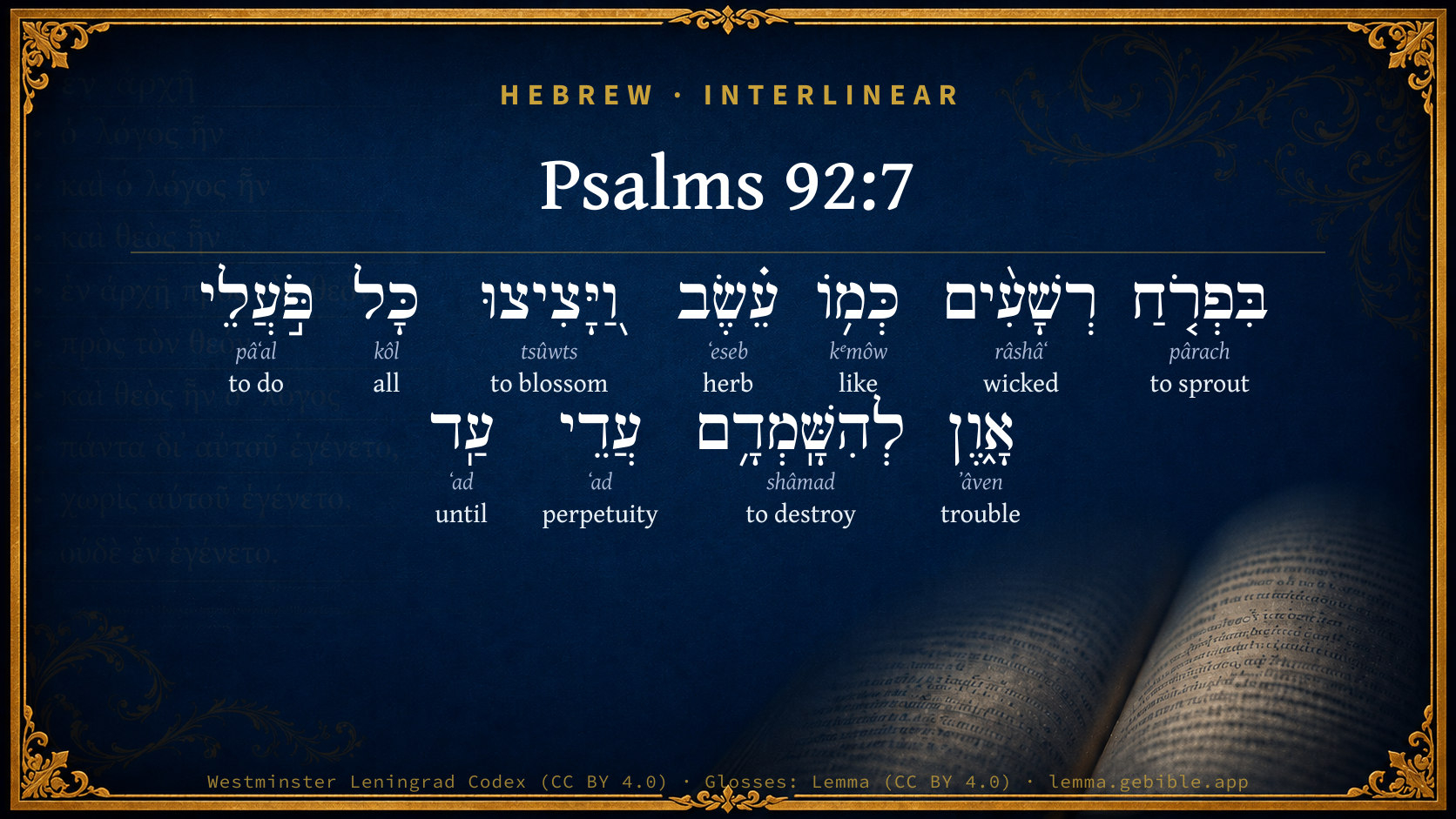
Hebrew (Westminster Leningrad Codex) Psalms 92:7 appears in the Hebrew Old Testament. The text above is from the Westminster Leningrad Codex. Each word links to its Strong’s number, a concise gloss, and parsing drawn from the Open Scriptures Hebrew Bible morphology. Click any word for its full Brown-Driver-Briggs (BDB) entry.
Download image
Cite this verse

Psalms 92:7 (World English Bible). Public Domain. Lemma interlinear Bible study tool, https://lemma.gebible.app/v/psalms/92/7.

Show BibTeX & RIS
BibTeX
RIS
English Translation
Though the wicked spring up as the grass, And all the evil-doers flourish, They will be destroyed forever.
World English Bible · Public Domain
Download a study sheet

One document with this verse’s original text, its word-by-word gloss line, the meaning frame, cross-references with their text, attributed commentary, and full source and license credits — printable, and it pastes into notes with its structure intact.

This verse Autodidact and up

Study sheet (.html) Plain text (.txt)

A passage Seminary Student

Up to 50 verses in one chapter. A passage sheet keeps up to 6 commentary sources and 12 cross-references per verse, in the order this page ranks them, and says so on the sheet whenever that leaves anything out. Ask for a single verse and you get the Autodidact verse sheet above.

Everything on this page stays free to read, with no account — the sheet is a download of what is already on screen, not access to it.

Want to remove ads? Support Godless Engineer
Compare translations 3

The same verse in 3 English versions, stacked beneath the original-language interlinear above. Click any original word for its lexicon entry.

Each is an independent rendering of the whole verse — the interlinear is not word-aligned to these translations.

Highlighted words mark where these versions differ — a whole-verse word diff, not a word-by-word alignment.

  • World English Bible Public Domain
    Though the wicked spring up as the grass, And all the evil-doers flourish, They will be destroyed forever.
  • King James Version Public Domain
    When the wicked spring as the grass, and when all the workers of iniquity do flourish; it is that they shall be destroyed for ever:
  • unfoldingWord Literal Text CC BY-SA 4.0
    When the wicked sprout like grass, and all evildoers thrive, they will be destroyed for eternity.

unfoldingWord Literal Text — © unfoldingWord, licensed CC BY-SA 4.0. Word-aligned USFM3 via Door43 (git.door43.org/unfoldingWord/en_ult).

Versions to compare (up to 4)

3 of 4 selected

Show all 18 translations

Every available English version of this verse, each an independent rendering of the whole verse.

  • World English Bible Public Domain
    Though the wicked spring up as the grass, And all the evil-doers flourish, They will be destroyed forever.
  • Berean Standard Bible Public Domain
    that though the wicked sprout like grass, and all evildoers flourish, they will be forever destroyed.
  • Majority Standard Bible Public Domain
    that though the wicked sprout like grass, and all evildoers flourish, they will be forever destroyed.
  • King James Version Public Domain
    When the wicked spring as the grass, and when all the workers of iniquity do flourish; it is that they shall be destroyed for ever:
  • American Standard Version (1901) Public Domain
    When the wicked spring as the grass, And when all the workers of iniquity do flourish; It is that they shall be destroyed for ever.
  • Revised Version (1885) Public Domain
    When the wicked spring as the grass, and when all the workers of iniquity do flourish; it is that they shall be destroyed for ever:
  • Geneva Bible (1599) Public Domain
    (When the wicked growe as the grasse, and all the workers of wickednesse doe flourish) that they shall be destroyed for euer.
  • Douay-Rheims (1899) Public Domain
    The senseless man shall not know: nor will the fool understand these things.
  • Young's Literal Translation Public Domain
    When the wicked flourish as a herb, And blossom do all workers of iniquity -- For their being destroyed for ever and ever!
  • Literal Standard Version CC BY-SA 4.0
    When the wicked flourish as an herb, || And all workers of iniquity blossom—For their being destroyed forever and ever!
  • Unlocked Literal Bible CC BY-SA 4.0
    When the wicked sprout like the grass, and even when all the evildoers thrive, still they are doomed to eternal destruction.
  • unfoldingWord Literal Text CC BY-SA 4.0
    When the wicked sprout like grass, and all evildoers thrive, they will be destroyed for eternity.
  • Darby Bible Public Domain
    When the wicked spring as the grass, and when all the workers of iniquity flourish, it is that they may be destroyed for ever.
  • World Messianic Bible Public Domain
    though the wicked spring up as the grass, and all the evildoers flourish, they will be destroyed forever.
  • Webster's Bible Public Domain
    \\92:6\\A brutish man knoweth not; neither doth a fool understand this.
  • Free Bible Version CC BY-SA 4.0
    even though the wicked grow up quickly like grass, and even though people who do evil flourish, they will be destroyed forever!
  • Bible in Basic English Public Domain
    When the sinners come up like the grass, and all the workers of evil do well for themselves, it is so that their end may be eternal destruction.
  • JPS Tanakh (1917) Public Domain
    (92-8) When the wicked spring up as the grass, and when all the workers of iniquity do flourish; it is that they may be destroyed for ever.

Literal Standard Version (2020), Covenant Press — licensed CC BY-SA 4.0. Text via the HelloAO Bible API (eBible.org). Unlocked Literal Bible (unfoldingWord) — licensed CC BY-SA 4.0. Text via the HelloAO Bible API (eBible.org). unfoldingWord Literal Text — © unfoldingWord, licensed CC BY-SA 4.0. Word-aligned USFM3 via Door43 (git.door43.org/unfoldingWord/en_ult). Free Bible Version, Dr. Jonathan Gallagher — licensed CC BY-SA 4.0. Text via the HelloAO Bible API (eBible.org).

Word by word

More ways to search: Search by grammar → Find every occurrence → Compare this word →

Practice this passage: Drill this verse → Learn its vocabulary →

וַ֭יָּצִיצוּ
tsûwts
H6692
“and · to blossom”
Conjunction + Verb, Hiphil, Sequential Imperfect, 3rd Person, Masculine, Plural
Part of Speech
Conjunction + Verb
Stem
Hiphil
Form
Sequential Imperfect
Person
3rd Person
Gender
Masculine
Number
Plural
Full BDB Definition

Origin: a primitive root

TWOT: 1893 , 1894

to blossom, shine, sparkle - (Qal) - to flourish - to shine, gleam - (Hiphil) to blossom, put forth blossoms, produce blossoms - (Hiphil) to gaze, peep, glance, make the eyes sparkle
  1. בִּפְרֹ֤חַ pârach H6524 “in/at · to sprout” Preposition + Verb, Qal, Infinitive Construct
  2. רְשָׁעִ֨ים râshâʻ H7563 “wicked” Adjective, Adjective, Masculine, Plural, Absolute
  3. כְּמ֥וֹ kᵉmôw H3644 “like” Preposition
  4. עֵ֗שֶׂב ʻeseb H6212 “herb” Noun, Common, Masculine, Singular, Absolute
  5. כָּל kôl H3605 “all of” Noun, Common, Masculine, Singular, Construct
  6. פֹּ֣עֲלֵי pâʻal H6466 “doing” Verb, Qal, Participle Active, Masculine, Plural, Construct
  7. אָ֑וֶן ʼâven H205 “trouble” Noun, Common, Masculine, Singular, Absolute
  8. לְהִשָּֽׁמְדָ֥ם shâmad H8045 “to destroy · them” Preposition + Verb, Niphal, Infinitive Construct + Suffix, Personal, 3rd Person, Masculine, Plural
  9. עֲדֵי ʻad H5703 “perpetuity of” Noun, Common, Masculine, Plural, Construct
  10. עַֽד ʻad H5704 “until” Noun, Common, Masculine, Singular, Absolute

About this verse

These counts appear in no published source. They are computed here, from the morphology-tagged text and Lemma’s own curated glosses. What Lemma adds →

11
words
11
distinct lemmas
Wisdom
section

Notable vocabulary

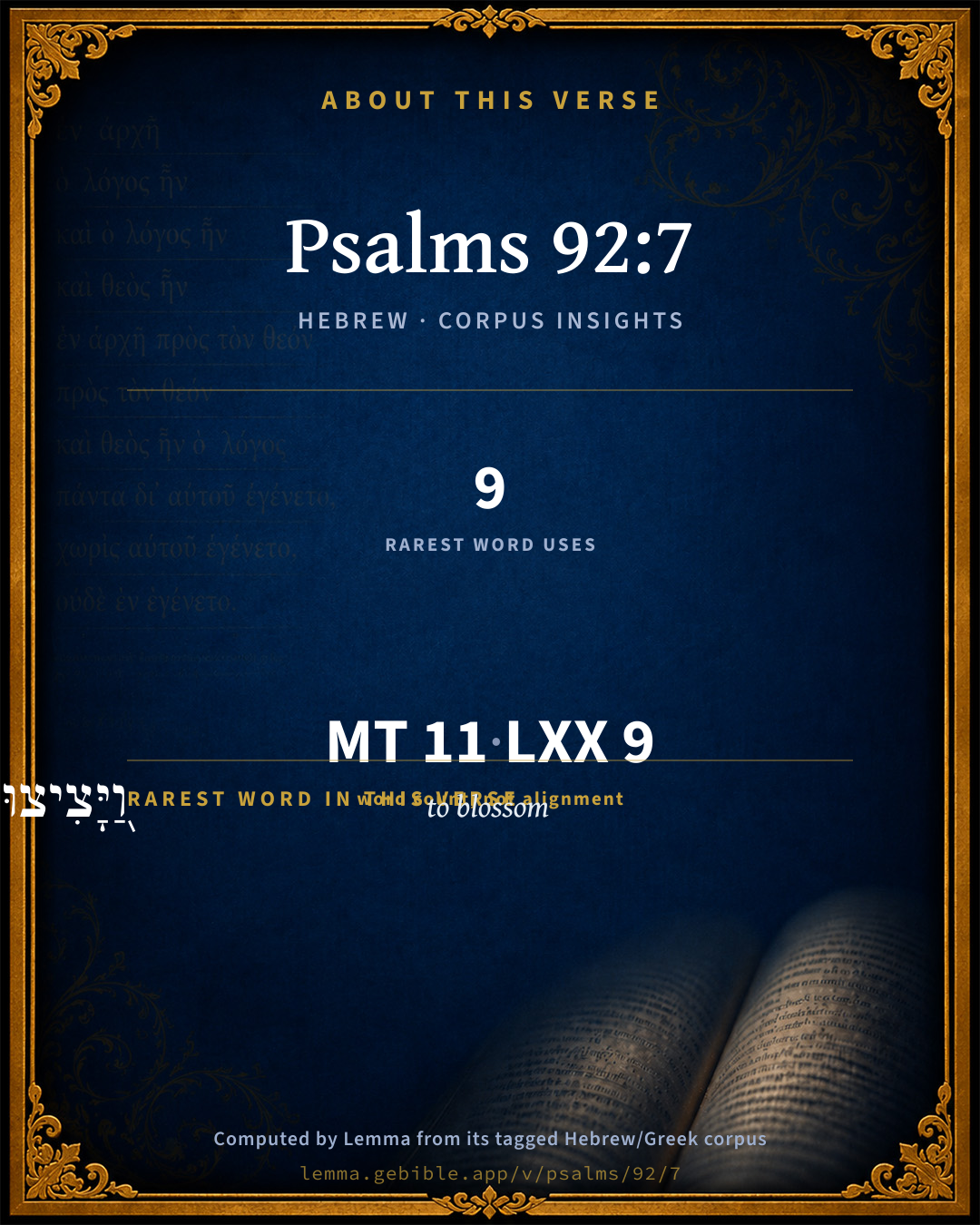
The rarest word here is וַ֭יָּצִיצוּ to blossom H6692 — appearing just 9 times in the whole Hebrew Bible.

Shared distinctive vocabulary

וַ֭יָּצִיצוּ to blossom H6692 occurs in 9 verses of the Hebrew Bible. Also found in:

Grammatical profile

  • 4 verbs
  • 5 nouns
  • 1 adjective
  • 1 preposition

Verb forms

  • בִּפְרֹ֤חַ Qal · Infinitive Construct
  • וַ֭יָּצִיצוּ Hiphil · Sequential Imperfect
  • פֹּ֣עֲלֵי Qal · Participle Active
  • לְהִשָּֽׁמְדָ֥ם Niphal · Infinitive Construct

Hebrew & Septuagint length

In English translation the verse runs 18 words from the Hebrew and 26 from the Septuagint (LXX English) — closely comparable.

A rough comparison of the two English renderings, which tokenize alike — not a word-level alignment.

Word counts can differ between the Hebrew and the Greek without any difference in meaning — e.g. the Hebrew direct-object marker אֵת has no separate Greek word, and Greek often adds the article ὁ.

In the original languages it is 11 Hebrew tokens and 9 Greek tokens — but the two are counted differently (Hebrew bundles its prefixes and suffixes into one token; the Greek is in lemma form), so that isn’t a like-for-like length.

Cross-references

20

Topical passages linked to Psalms 92:7 in the Treasury of Scripture Knowledge — connected by theme and wording, ordered by reader-vote popularity; previews shown in the World English Bible.

  • Psalms 37:38 As for transgressors, they shall be destroyed together. The future of the wicked shall be cut off.
  • Psalms 73:18–20 Surely you set them in slippery places. You throw them down to destruction.
  • Psalms 37:1–2 Don't fret because of evil-doers, Neither be envious against those who work unrighteousness.
  • Psalms 37:35–36 I have seen the wicked in great power, Spreading himself like a green tree in its native soil.
  • Jeremiah 12:1–2 Righteous are you, Yahweh, when I contend with you; yet would I reason the cause with you: why does the way of the wicked prosper? why are all they at ease who deal very treacherously?
  • 1 Peter 1:24 For, "All flesh is like grass, And all of man's glory like the flower in the grass. The grass withers, and its flower falls;
  • Psalms 73:12 Behold, these are the wicked. Being always at ease, they increase in riches.
  • Malachi 3:15 Now we call the proud happy; yes, those who work wickedness are built up; yes, they tempt God, and escape.'
  • Malachi 4:1 "For, behold, the day comes, it burns as a furnace; and all the proud, and all who work wickedness, will be stubble; and the day that comes will burn them up," says Yahweh of Hosts, "that it shall leave them neither root nor branch.
  • James 1:10–11 and the rich, in that he is made humble, because like the flower in the grass, he will pass away.
  • Job 12:6 The tents of robbers prosper, Those who provoke God are secure; Who carry their God in their hands.
  • Job 21:7–12 "Why do the wicked live, Become old, yes, and grow mighty in power?
  • Luke 16:19–25 "Now there was a certain rich man, and he was clothed in purple and fine linen, living in luxury every day.
  • Psalms 94:4 They pour out arrogant words. All the evil-doers boast.
  • Isaiah 37:27 Therefore their inhabitants were of small power, they were dismayed and confounded; they were as the grass of the field, and as the green herb, as the grass on the housetops, and as a field [of grain] before it is grown up.
  • Psalms 90:5–6 You sweep them away as they sleep. In the morning they sprout like new grass.
  • Psalms 103:15–16 As for man, his days are like grass. As a flower of the field, so he flourishes.
  • Proverbs 1:32 For the backsliding of the simple will kill them. The careless ease of fools will destroy them.
  • Isaiah 40:6–7 The voice of one saying, Cry. One said, What shall I cry? All flesh is grass, and all the glory of it is as the flower of the field.
  • 1 Samuel 25:36–38 Abigail came to Nabal; and, behold, he held a feast in his house, like the feast of a king; and Nabal's heart was merry within him, for he was very drunken: therefore she told him nothing, less or more, until the morning light.

Cross-references courtesy of OpenBible.info (CC BY 4.0).

Hebrew and Greek witnesses Masoretic Hebrew ↔ Greek Septuagint

The same verse in the two great witnesses to the Old Testament, shown verse-for-verse.

You’re reading Greek Psalm 91 (Hebrew Psalm 92). The Septuagint counts the superscription, so verse numbers can differ from the Hebrew — chapter-level alignment, not verse-by-verse. Numbering follows Rahlfs.

These are two independent witnesses, not word-aligned to each other, and the Septuagint is shown in lemma (dictionary) form.

Hebrew Psalms 92:7 Masoretic · Westminster Leningrad Codex

בִּפְרֹ֤חַ רְשָׁעִ֨ים כְּמ֥וֹ עֵ֗שֶׂב וַ֭יָּצִיצוּ כָּל פֹּ֣עֲלֵי אָ֑וֶן לְהִשָּֽׁמְדָ֥ם עֲדֵי עַֽד

Though the wicked spring up as the grass, And all the evil-doers flourish, They will be destroyed forever.

World English Bible · Public Domain

Greek LXX Greek Psalm 91:7 Septuagint · lemma form

ἀνήρ ἄφρων οὐ γιγνώσκω καί ἀσύνετος οὐ συνἵημι οὗτος

When the sinners spring up as the grass, and all the workers of iniquity have watched; it is that they may be utterly destroyed for ever.

LXX2012 (modern English Septuagint) · Public Domain

On this verse, Matthew Henry's Commentary discusses the Septuagint’s reading. Read the note in Commentary ↓

Hebrew: Westminster Leningrad Codex (CC BY 4.0). Greek: Septuagint (public domain); English from LXX2012 (modern English Septuagint) (Public Domain). How the Septuagint differs from the Hebrew →

Commentary

Notes on Psalms 92:7 from classic Christian and Jewish commentators (each source and its license shown beneath its notes). The classic Christian expositions comment on the surrounding passage and are grouped to its opening verse, so a note may address several verses; the Jewish commentaries on the Tanakh (Rashi and others) are per-verse, so they appear only where the commentator wrote on this verse.

Lemma curates 59 commentaries, every one of them public domain or Creative Commons licensed, each selected and text-cleaned for this edition rather than reprinted as found. About our sources →

Matthew Henry's Commentary

The psalmist had said (Psa 92:4) that from the works of God he would take occasion to triumph; and here he does so.

I. He triumphs over God's enemies (Psa 92:7, Psa 92:9, Psa 92:11), triumphs in the foresight of their destruction, not as it would be the misery of his fellow-creatures, but as it would redound to the honour of God's justice and holiness. He is confident of the ruin of sinners, 1. Though they are flourishing (Psa 92:7): When the wicked spring as the grass in spring (so numerous, so thickly sown, so green, and growing so fast), and all the workers of iniquity do flourish in pomp, and power, and all the instances of outward prosperity, are easy and many, and succeed in their enterprises, one would think that all this was in order to their being happy, that it was a certain evidence of God's favour and an earnest of something as good or better in reserve: but it is quite otherwise; it is that they shall be destroyed for ever. The very prosperity of fools shall slay them, Pro 1:32. The sheep that are designed for the slaughter are put into the fattest pasture. 2. Though they are daring, Psa 92:9. They are thy enemies, and impudently avow themselves to be so. They are contrary to God, and they fight against God. They are in rebellion against his crown and dignity, and therefore it is easy to foresee that they shall perish; for who ever hardened his heart against God and prospered? Note, All the impenitent workers of iniquity shall be deemed and taken as God's enemies, and as such they shall perish and be scattered. Christ reckons those his enemies that will not have him to reign over them; and they shall be brought forth and slain before him. The workers of iniquity are now associated, and closely linked together, in a combination against God and religion; but they shall be scattered, and disabled to help one another against the just judgment of God. In the world to come they shall be separated from the congregation of the righteous; so the Chaldee, Psa 1:5. 3. Though they had a particular malice against the psalmist, and, upon that account, he might be tempted to fear them, yet he triumphs over them (Psa 92:11): "My eye shall see my desire on my enemies that rise up against me; I shall see them not only disabled from doing me any further mischief, but reckoned with for the mischief they have done me, and brought either to repentance or ruin:" and this was his desire concerning them. In the Hebrew it is no more than thus, My eye shall look on my enemies, and my ear shall hear of the wicked. He does not say what he shall see or what he shall hear, but he shall see and hear that in which God will be glorified and in which he will therefore be satisfied. This perhaps has reference to Christ, to his victory over Satan, death, and hell, the destruction of those that persecuted and crucified him, and opposed his gospel, and to the final ruin of the impenitent at the last day. Those that rise up against Christ will fall before him and be made his footstool.

II. He triumphs in God, and his glory and grace. 1. In the glory of God (Psa 92:8): "But thou, O Lord! art most high for evermore. The workers of iniquity who fight against us may be high for a time, and think to carry all before them with a high hand, but thou art high, most high, for evermore. Their height will be humbled and brought down, but thine is everlasting." Let us not therefore fear the pride and power of evil men, nor be discouraged by their impotent menaces, for the moth shall eat them up as a garment, but God's righteousness shall be for ever, Isa 51:7, Isa 51:8. 2. In the grace of God, his favour and the fruits of it, (1.) To himself (Psa 92:10): "Thou, O Lord! that art thyself most high, shalt exalt my horn." The great God is the fountain of honour, and he, being high for evermore, himself will exalt his people for ever, for he is the praise of all his saints, Psa 148:14. The wicked are forbidden to lift up the horn (Psa 75:4, Psa 75:5), but those that serve God and the interest of his kingdom with their honour or power, and commit it to him to keep it, to raise it, to use it, and to dispose of it, as he pleases, may hope that he will exalt their horn as the horn of a unicorn, to the greatest height, either in this world or the other: My horn shalt thou exalt, when thy enemies perish; for then shall the righteous shine forth as the sun, when the wicked shall be doomed to shame and everlasting contempt. He adds, I shall be anointed with fresh oil, which denotes a fresh confirmation in his office to which he had been anointed, or abundance of plenty, so that he should have fresh oil as often as he pleased, or renewed comforts to revive him when his spirits drooped. Grace is the anointing of the Spirit; when this is given to help in the time of need, and is received, as there is occasion, from the fulness that is in Christ Jesus, we are then anointed with fresh oil. Some read it, When I grow old thou shalt anoint me with fresh oil. My old age shalt thou exalt with rich mercy; so the Septuagint. Compare Psa 92:14, They shall bring forth fruit in old age. The comforts of God's Spirit, and the joys of his salvation, shall be a refreshing oil to the hoary heads that are found in the way of righteousness. (2.) To all the saints. They are here represented as trees of righteousness, Isa 61:3; Psa 1:3. Observe, [1.] The good place they are fixed in; they are planted in the house of the Lord, Psa 92:13. The trees of righteousness do not grow of themselves; they are planted, not in common soil, but in paradise, in the house of the Lord. Trees are not usually planted in a house; but God's trees are said to be planted in his house because it is from his grace, by his word and Spirit, that they receive all the sap and virtue that keep them alive and make them fruitful. They fix themselves to holy ordinances, take root in them, abide by them, put themselves under the divine protection, and bring forth all their fruits to God's honour and glory. [2.] The good plight they shall be kept in. It is here promised, First, That they shall grow, Psa 92:12. Where God gives true grace he will give more grace. God's trees shall grow higher, like the cedars, the tall cedars in Lebanon; they shall grow nearer heaven, and with a holy ambition shall aspire towards the upper world; they shall grow stronger, like the cedars, and fitter for use. He that has clean hands shall be stronger and stronger. Secondly, That they shall flourish, both in the credit of their profession and in the comfort and joy of their own souls. They shall be cheerful themselves and respected by all about them. They shall flourish like the palm-tree, which has a stately body (Sol 7:7), and large boughs, Lev 23:40; Jdg 4:5. Dates, the fruit of it, are very pleasant, but it is especially alluded to here as being ever green. The wicked flourish as the grass (Psa 92:7), which is soon withered, but the righteous as the palm-tree, which is long-lived and which the winter does not change. It has been said of the palm-tree, Sub pondere crescit - The more it is pressed down the more it grows; so the righteous flourish under their burdens; the more they are afflicted the more they multiply. Being planted in the house of the Lord (there their root is), they flourish in the courts of our God - there their branches spread. Their life is hid with Christ in God. But their light also shines before men. It is desirable that those who have a place should have a name in God's house, and within his walls, Isa 56:5. Let good Christians aim to excel, that they may be eminent and may flourish, and so may adorn the doctrine of God our Saviour, as flourishing trees adorn the courts of a house. And let those who flourish in God's courts give him the glory of it; it is by virtue of this promise, They shall be fat and flourishing. Their flourishing without is from a fatness within, from the root and fatness of the good olive, Rom 11:17. Without a living principle of grace in the heart the profession will not be long flourishing; but where that is the leaf also shall not wither, Psa 1:3. The trees of the Lord are full of sap, Psa 104:16. See Hos 14:5, Hos 14:6. Thirdly, That they shall be fruitful. Were there nothing but leaves upon them, they would not be trees of any value; but they shall still bring forth fruit. The products of sanctification, all the instances of a lively devotion and a useful conversation, good works, by which God is glorified and others are edified, these are the fruits of righteousness, in which it is the privilege, as well as the duty, of the righteous to abound; and their abounding in them is the matter of a promise as well as of a command. It is promised that they shall bring forth fruit in old age. Other trees, when they are old, leave off bearing, but in God's trees the strength of grace does not fail with the strength of nature. The last days of the saints are sometimes their best days, and their last work is their best work. This indeed shows that they are upright; perseverance is the surest evidence of sincerity. But it is here said to show that the Lord is upright (Psa 92:15), that he is true to his promises and faithful to every word that he has spoken, and that he is constant to the work which he has begun. As it is by the promises that believers first partake of a divine nature, so it is by the promises that that divine nature is preserved and kept up; and therefore the power it exerts is an evidence that the Lord is upright, and so he will show himself with an upright man, Psa 18:25. This the psalmist triumphs in: "He is my rock and there is no unrighteousness in him. I have chosen him for my rock on which to build, in the clefts of which to take shelter, on the top of which to set my feet. I have found him a rock, strong and stedfast, and his word as firm as a rock. I have found" (and let every one speak as he finds) "that there is no unrighteousness in him." He is as able, and will be as kind, as his word makes him to be. All that ever trusted in God found him faithful and all-sufficient, and none were ever made ashamed of their hope in him.

Matthew Henry's Commentary on the Whole Bible (1708–1710) — public domain (CC PDM 1.0). Text via the HelloAO Bible API.

The Cambridge Bible for Schools and Colleges

gen. ed. J. J. S. Perowne

7, 8. The tenses in Psa_92:7 (cp. Psa_92:10-11) do not merely express a general truth, but point to some particular event.

When the wicked did flourish as the herbage,

And all the workers of iniquity did blossom,

It was that they might be destroyed for ever:

But thou art on high for evermore, Jehovah.

The simile suggests the rapid growth and equally rapid ruin of the wicked. See note on Psa_90:5. Their triumph is the preparation for their fall. Cp. Psa_37:35 ff.; Psa_73:18 ff.

The simple stately rhythm of Psa_92:8—a single line—well expresses the contrast of the unchanging supremacy of Jehovah to the upstart pretentiousness of the wicked. They deify themselves, claiming all power in earth and heaven (Psa_73:8-9), only to vanish and leave Jehovah’s sovereignty more openly manifested (Psa_83:17-18).

There is an obvious reminiscence of this verse in 1Ma_9:23, “And it came to pass after the death of Judas that the lawless flourished and all the workers of iniquity sprang up.”

The Cambridge Bible for Schools and Colleges (gen. ed. J. J. S. Perowne; Cambridge University Press, 1878–1918) — public domain. Text from a community e-Sword module.

Trapp's Complete Commentary

John Trapp

Psa 92:7 When the wicked spring as the grass, and when all the workers of iniquity do flourish; [it is] that they shall be destroyed for ever:

Ver. 7. When the wicked spring as the grass, &c.] This the fool admireth, calling the proud happy, &c., Mal 3:15, and not considering that that proud grass shall be mown down, and that that flourish shall soon perish.

It is that they shall be destroyed for ever] Not grow again, as mown grass doth: Exoriuntur ut exurantur. It is but as Haman’s banquet before execution.

John Trapp, A Commentary or Exposition upon All the Books of the Old and New Testament (1647–1656) — public domain. Text from a community e-Sword module.

The Treasury of David

Charles H. Spurgeon

Ver. 7. When the wicked spring as the grass, in abundance, and apparent strength, hastening on their progress like verdant plants, which come to perfection in a day,

and when all the workers of iniquity do flourish; flowering in their prime and pride, their pomp and their prosperity;

it is that they shall be destroyed for ever. They grow to die, they blossom to be blasted. They flower for a short space to wither without end. Greatness and glory are to them but the prelude of their overthrow. Little does their opposition matter, the Lord reigns on as if they had never blasphemed him; as a mountain abides the same though the meadows at its feet bloom or wither, even so the Most High is unaffected by the fleeting mortals who dare oppose him; they shall soon vanish for ever from among the living. But as for the wicked how can our minds endure the contemplation of their doom "for ever." Destruction "for ever" is a portion far too terrible for the mind to realise. Eye hath not seen, nor ear heard, the full terror of the wrath to come!

Ver. 7. When the wicked spring as the grass, etc. Their felicity is the greatest infelicity. Adam Clarke.

Ver. 7. Little do they think that they are suffered to prosper that like beasts they may be fitter for slaughter. The fatter they are, the fitter for slaughter, and the sooner slain: "He slew the fattest of them." Ps 78:31. Zachary Bogan.

Ver. 7. Great prosperity the frequent forerunner of destruction to wicked men, for it leads them to provoke divine wrath

1. By hardness of heart, as Pharaoh.

2. By pride, as Nebuchadnezzar.

3. By haughty hatred of the saints, as Haman.

4. By carnal security, as the rich fool.

5. By self exaltation, as Herod.

Ver. 7-10. Contrasts. Between the wicked and God, Ps 92:7-8. Between God's enemies and his friends, Ps 92:9-10. C.A. Davis.

Ver. 7, 12-14. The wicked and the righteous pourtrayed. C.A. Davis.

Psalms 92:8*

Charles H. Spurgeon's The Treasury of David (1869–1885) — public domain. Psalms only. Text from a community e-Sword/MySword module.

Joseph Benson's Commentary

Psa 92:7-8. When the wicked spring, &c. — Many interpreters connect this with the preceding verse, thus: A brutish man knoweth not, &c., that when the wicked spring as the grass, and when all the workers of iniquity do flourish, it is that they shall be destroyed for ever: “they are only nourishing themselves, like senseless cattle, in plentiful pastures, for the approaching day of slaughter.” Their present worldly prosperity is a presage and occasion of their utter ruin. But thou, O Lord, art most high for evermore — That is, they shall perish, but thou shalt endure, as is said in a like comparison, Psa 102:26. They flourish for a season, but thou rulest for ever, to judge and punish them. So this verse is added by way of opposition to the former.

Joseph Benson's Commentary on the Old and New Testaments (1811–1818) — public domain. Text from a community e-Sword module.

J. A. Alexander on Psalms

Joseph Addison Alexander

8. (Psa 92:7) In the springing up of wicked (men) like grass, and (when) all the doers of iniquity bloom, (it is) that they may be destroyed for ever. The infinitive, as well as the future, indicates the time of action. The literal translation of the last words is, for them to be destroyed until eternity.

Joseph Addison Alexander, The Psalms Translated and Explained (1850) — public domain. Text from a community e-Sword module.

Tyndale Open Study Notes

Tyndale Open Resources

92:7 Even when the ungodly seem to grow luxuriantly (73:3-5), they have no future (92:9; see 1:6; 90:5-6; Isa 40:6-8).

Tyndale Open Study Notes — © Tyndale Open Resources, licensed CC BY-SA 4.0. Text via the HelloAO Bible API.

Adam Clarke's Commentary

Verse 7. When the wicked spring as the grass] This is a lesson which is frequently inculcated in the sacred writings. The favour of God towards man is not to be known by outward prosperity; nor is his disapprobation to be known by the adverse circumstances in which any person may be found. When, however, we see the wicked flourish, we may take for granted that their abuse of God's mercies will cause him to cut them off as cumberers of the ground; and, dying in their sins, they are destroyed for ever.

Adam Clarke's Commentary on the Bible (1810–1826) — public domain. Text from a community e-Sword/MySword module.

John Calvin's Commentaries

7 When the wicked flourish as the grass. He points out, and exposes, by a striking and appropriate figure, the folly of imagining that the wicked obtain a triumph over God, when he does not, it may be, immediately bring them under restraint. He makes an admission so far — he grants that they spring up and flourish — but adds immediately, by way of qualification, that they flourish, like the grass, only for a moment, their prosperity being brief and evanescent. In this way he removes what has been almost a universal stumbling-block and ground of offense; for it would be ridiculous to envy the happiness of men who are doomed to be speedily destroyed, and of whom it may be said, that to-day they flourish, and to-morrow they are cut down and wither, (Psalm 129:6.) It will be shown, when we come to consider the psalm now quoted, that the herbs to which the wicked are compared are such as grow on the roofs of houses, which want depth of soil, and die of themselves, for lack of nourishment. In the passage now before us, the Psalmist satisfies himself with using simply the figure, that the prosperity of the wicked draws after it the speedier destruction, as the grass when it is full grown is ready for the scythe. There is an antithesis drawn, too, between the shortness of their continuance and the everlasting destruction which awaits them; for they are not said to be cut down that they may flourish again, as withered plants will recover their vigor, but to be condemned to eternal perdition. When he says of God, that he sits exalted for evermore, some understand him to mean, that God holds the power and office of governing the world, and that we may be certain nothing can happen by chance when such a righteous governor and judge administers the affairs of the world. Various other meanings have been suggested. But it seems to me that the Psalmist compares the stability of God’s throne with the fluctuating and changeable character of this world, reminding us that we must not judge of Him by what we see in the world, where there is nothing of a fixed and enduring nature. God looks down undisturbed from the altitude of heaven upon all the changes of this earthly scene, which neither affect nor have any relation to him. And this the Psalmist brings forward with another view than simply to teach us to distinguish God from his creatures, and put due honor upon his majesty; he would have us learn in our contemplations upon the wonderful and mysterious providence of God, to lift our conceptions above ourselves and this world, since it is only a dark and confused view which our earthly minds can take up. It is with the purpose of leading us into a proper discovery of the Divine judgments which are not seen in the world, that the Psalmist, in making mention of the majesty of God, would remind us, that he does not work according to our ideas, but in a manner corresponding to his own eternal being. We, short-lived creatures as we are, often thwarted in our attempts, embarrassed and interrupted by many intervening difficulties, and too glad to embrace the first opportunity which offers, are accustomed to advance with precipitation; but we are taught here to lift our eyes unto that eternal and unchangeable throne on which God sits, and in wisdom defers the execution of his judgments. The words accordingly convey more than a simple commendation of the glorious being of God; they are meant to help our faith, and tell us that, although his people may sigh under many an anxious apprehension, God himself, the guardian of their safety, reigns on high, and shields them with his everlasting power.

John Calvin's Commentaries (1540-1563) — public domain. Text from the Calvin Translation Society English edition (1840s-50s) via the Christian Classics Ethereal Library (ccel.org). Calvin's coverage is partial (roughly two-thirds of the Bible); uncommented books and verses are honest gaps, never fabricated. The 19th-century editor's footnotes and remarks are omitted so the notes are faithfully Calvin's own voice.

Ellicott's Commentary for English Readers

(7) This verse apparently introduces the statement of the truth which the sensualist does not understand, viz., that the prosperity of the wicked is only momentary, and will render their destruction all the more impressive. The Authorised Version is incorrect in introducing the second conjunction “when.” Literally, In the springing of the wicked like grass, flourish all the workers of iniquity to be destroyed for ever, i.e., the prosperity of an evil class or community gives an impulse to evil, and apparently for a time iniquity seems to have the upper hand, but it is only that the inevitable destruction may be more signal. For the emblematic use of vegetable life in the psalter see Note, Psa_1:3-4.

A Bible Commentary for English Readers, edited by Charles John Ellicott (1878–1897) — public domain. Text from a community e-Sword module.

John Gill's Exposition

When the wicked spring as the grass,.... Out of the earth, as they do, and are of the earth earthly, and become numerous as spires of grass, and look pleasant and beautiful for a while, as that does; but, like it, weak and unstable, and of a short continuance:

and when all the workers of iniquity do flourish; in the health of their bodies; not being afflicted as other men, and their eyes standing out with fatness; while a Job, an upright man, is smitten with boils from the crown of the head to the sole of the foot: in wealth and riches, in which they increase often to such a degree, as to think of pulling down their barns, and building greater, to put their substance in; in their progeny and offspring, having a numerous issue; as well as in their cattle, and the standing of them, and in other stores; likewise in their power and authority, grandeur and glory, being set in high places of honour and profit, though slippery ones: these are the godly, who are "wicked" at heart, and show it by their wicked works; who are continually committing sin, it is the course of their conversation, and yet prosper in the world; which is sometimes a stumblingblock to God's people, and a hardening of sinners, who consider not that

it is that they shall be destroyed for ever they are like brute beasts, made to be taken and destroyed, and as lambs and other creatures are nourished and fattened for the day of slaughter, Pe2 2:12, and as land is manured and cultivated, and grass springs up and flourishes, that it may be, when grown, cut down, and become the fodder of beasts, or the fuel of fire; so the prosperity of the wicked issues in their ruin, and is an aggravation of their damnation; their destruction is of soul and body in hell, and is an everlasting one; the Targum is,

"and it shall be that God shall destroy them for ever,''

John Gill's Exposition of the Whole Bible (1746–1763) — public domain (CC PDM 1.0). Text via the HelloAO Bible API.

Albert Barnes' Notes on the Bible

When the wicked spring as the grass - When they grow up as plants do; when they seem to flourish and prosper. Compare Psa 90:5-6; Psa 37:2, Psa 37:35, Psa 37:38. The word “grass” here refers to the vegetable creation generally, embracing plants and flowers of all kinds.

And when all the workers of iniquity do flourish - As plants and flowers do. They are like vigorous plants; not like the stunted and dry shrubs of the desert.

It is that they shall be destroyed for ever - The meaning here is, not that the design of their being thus made to flourish is that they should be destroyed, or that they are made to flourish for that purpose, but that such “will be” the result. They will not be made happy in another world by their prosperous and prospered wickedness here, as if God approved of their course; but the end will be that they will be destroyed forever. The design of the psalmist seems to be to turn the mind from the idea that mere external prosperity is necessarily connected with happiness; or that one who is prospered in this life is on that account safe. There is another world, and “there” ample justice will be done to all. See Psa 73:16-20.

Albert Barnes' Notes on the Bible (1834–1885) — public domain. Text from a community e-Sword/MySword module.

Matthew Poole's English Annotations

Their present worldly prosperity is a presage and occasion of their utter and eternal ruin.

Matthew Poole's English Annotations on the Holy Bible (1683–1685) — public domain. Text from a community e-Sword/MySword module.

Whedon's Commentary on the Bible

Daniel D. Whedon

7. Wicked spring as the grass—Suddenly, and with greenness and freshness of hope.

Destroyed for ever—And at the moment when their hope springs forth like the fresh grass. The brutish man does not consider this.

Daniel D. Whedon (gen. ed.), Commentary on the Old and New Testaments (1874–1909) — public domain. Text from a community e-Sword module.

The Pulpit Commentary

When the wicked spring as the grass; i.e. "spring up (see ver. 12). The difficulty is that which disturbed Job (Job_21:7-21) and Asaph, (Psa_73:2-15) viz. the prosperity of the wicked. The present writer, however, is not disturbed he sees in their prosperous condition nothing but a prelude to their overthrow. And when all the workers of iniquity do flourish; or, "do blossom." It is that they shall be destroyed forever; literally, it is for their destruction forever. (comp. Psa_73:18-20)

The instability of the success of the ungodly.

"Spring as the grass." In Eastern countries, after a time of drought, the grass responds with marvellous suddenness to the refreshing rains. But the grass which grows so swiftly is as swiftly cut down by the blazing sunshine or the scorching wind. The sudden success of the ungodly was a surprise and distress to God"s people, who looked on temporal success as a special sign of Divine approval. It seemed to them as if, after all, God was practically on the side of the wicked. In drearier moments they might even think that God made fair promises to the good, but gave the actual blessings to the ungodly. The relief which the saints of olden time found for this their distress is not just the relief which we should provide now. They, like Asaph, went into the sanctuary of God, and there they came to understand the end of the wicked. Really, their high places were slippery places; and in God"s time they were "cast into destruction." There is a certain measure of comfort in the thought that things gained by unrighteousness are insecure. But it is a higher standpoint that enables us to see that no success is worth having that has no righteousness at the heart of it. God is the secret of all stability, and God is not in a thing, unless goodness is the characteristic of the thing. Goodness always tends to permanency. Bible history is full of illustrations of the instability of all success attained by the ungodly. If a man"s gains are secure for his own life, they are squandered by his sons. In the north of England the uncertainty of sudden prosperity is enshrined in a popular saying, "The first generation buys the carriage; the second generation rides in the carnage; the third generation pawns the carriage." See the cases of Pharaoh, Nebuchadnezzar, Haman, Herod; and note also our Lord"s parable of the "rich fool.

I THE SUCCESS OF THE WICKED IS UNSTABLE IN THE NATURE OF THINGS.

1. They who overreach are always in danger of being overreached.

2. The wicked are always making enemies, who are quick to avenge themselves, if opportunity offers.

3. The wicked make mistakes which dissipate all their gains.

II THE SUCCESS OF THE WICKED IS UNSTABLE BECAUSE, SOONER OR LATER, GOD IS SURE TO DEAL WITH IT. He tests foundations; if they are not found righteous, the grandest houses of attainment will surely fall. R.T.

The Pulpit Commentary (1880–1919), ed. H.D.M. Spence-Jones & Joseph S. Exell — public domain. Text from a community e-Sword module.

Keil & Delitzsch

C. F. Keil & F. Delitzsch

Upon closer examination the prosperity of the ungodly is only a semblance that lasts for a time. The infinitive construction in Psa 92:8 is continued in the historic tense, and it may also be rendered as historical. זאת היתה (Saadia: Arab. fânnh) is to be supplied in thought before להשּׁמדם, as in Job 27:14. What is spoken of is an historical occurrence which, in its beginning, course, and end, has been frequently repeated even down to the present day, and ever confirmed afresh. And thus, too, in time to come and once finally shall the ungodly succumb to a peremptory, decisive (עדי־עד) judgment of destruction. Jahve is מרום לעלם, by His nature and by His rule He is "a height for ever;" i.e., in relation to the creature and all that goes on here below He has a nature beyond and above all this (Jenseitigkeit), ever the same and absolute; He is absolutely inaccessible to the God-opposed one here below who vaunts himself in stupid pride and rebelliously exalts himself as a titan, and only suffers it to last until the term of his barren blossoming is run out. Thus the present course of history will and must in fact end in a final victory of good over evil: for lo Thine enemies, Jahve - for lo Thine enemies.... הנּה points as it were with the finger to the inevitable end; and the emotional anadiplosis breathes forth a zealous love for the cause of God as if it were his own. God's enemies shall perish, all the workers of evil shall be disjointed, scattered, יתפּרדוּ (cf. Job 4:11). Now they form a compact mass, which shall however fall to pieces, when one day the intermingling of good and evil has an end.

Keil & Delitzsch — Biblical Commentary on the Old Testament (1861–1891) — public domain (CC PDM 1.0). Text via the HelloAO Bible API. (Old Testament only.)

Rashi

Rabbi Shlomo Yitzchaki (Rashi)

A boorish man does not know What is stated below.

Rashi on the Tanakh — English translations: “The Judaica Press complete Tanach with Rashi, translated by A. J. Rosenberg” (CC BY 4.0); “Pentateuch with Rashi's commentary by M. Rosenbaum and A.M. Silbermann, 1929-1934” (public domain); “The Metsudah Tanach series, Lakewood, N.J” (CC BY 4.0); and “The Book of Joshua, Metsudah Publications, 1997” (CC BY 4.0). Text via Sefaria.

Lesson kit

Teaching starters — assembled from the data on this page, not authored interpretation. Every prompt links to the verse data it draws on. Edit before teaching.

Psalms, in the Wisdom, opens this verse with 11 words (11 distinct Hebrew lemmas). Its most distinctive word is tsûwts (“to blossom”). A historical commentator’s framing appears above. Read the whole chapter for the surrounding context.

Discussion questions

  1. What does “to blossom” (tsûwts) contribute to the verse as a whole?
  2. Numbers 17:8 shares the word «to blossom» with this verse. How do the two illuminate each other?
  3. These translations render this verse differently. What is at stake in choosing one wording over another?
  4. The verb «בִּפְרֹ֤חַ» is Qal Infinitive Construct. How does its form color the action?
  5. Reading how Matthew Henry's Commentary and The Cambridge Bible for Schools and Colleges read this verse, where do the two commentators agree and where do they part?

Things to notice

Reading settings

Reading text

Shown beneath each verse's original-language words.

Old Testament
Old Testament edition

Read the OT as the Masoretic Hebrew (MT) or the Greek Septuagint (LXX).

English shown for the Greek Septuagint (in the Hebrew ↔ Greek comparison).

Comparing translations? Open the Compare panel on any verse page to stack up to four side by side.