
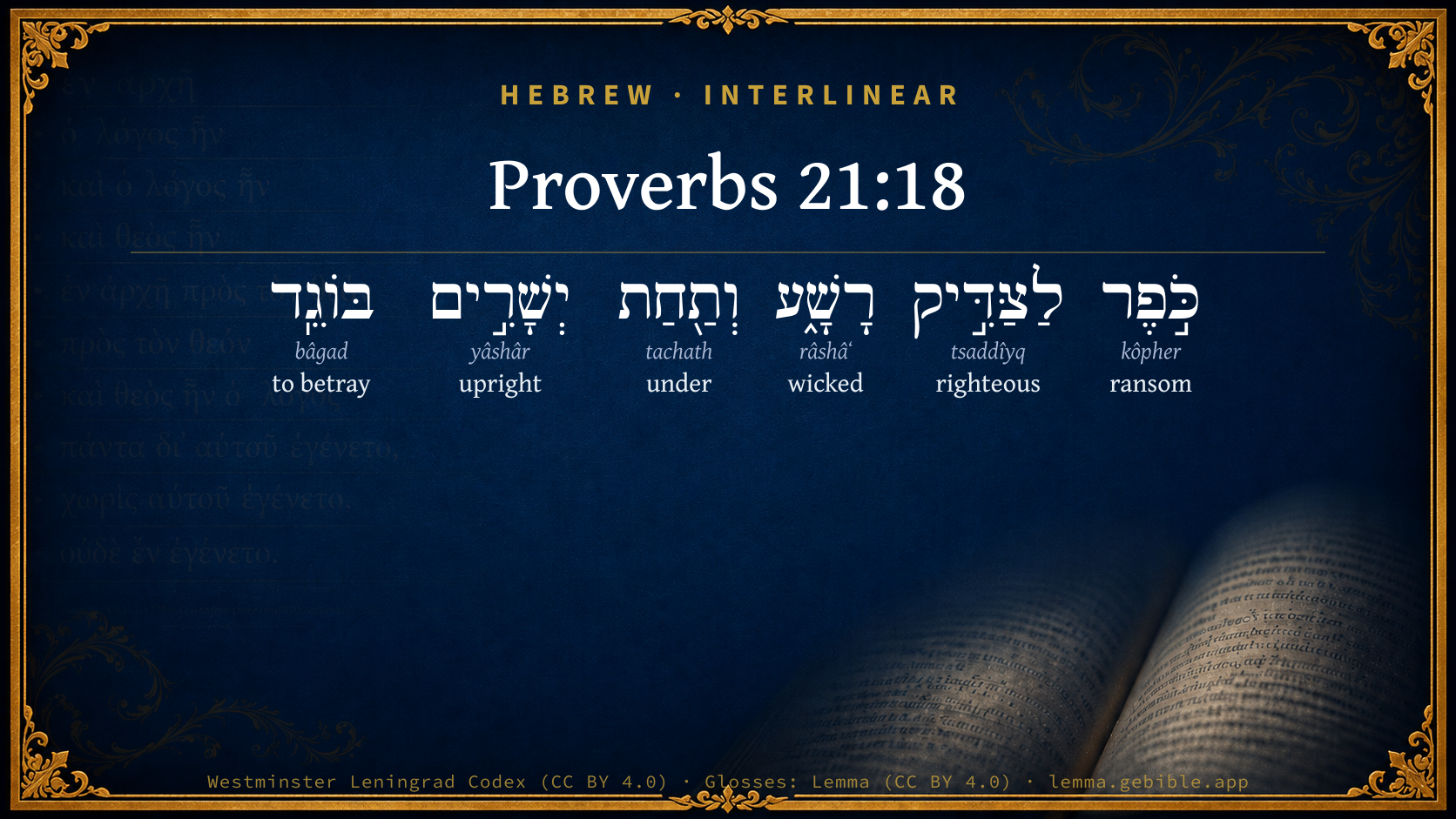
Proverbs 21:18

Hebrew (Westminster Leningrad Codex) Proverbs 21:18 appears in the Hebrew Old Testament. The text above is from the Westminster Leningrad Codex. Each word links to its Strong’s number, a concise gloss, and parsing drawn from the Open Scriptures Hebrew Bible morphology. Click any word for its full Brown-Driver-Briggs (BDB) entry.
Download image
Cite this verse

Proverbs 21:18 (World English Bible). Public Domain. Lemma interlinear Bible study tool, https://lemma.gebible.app/v/proverbs/21/18.

Show BibTeX & RIS
BibTeX
RIS
English Translation
The wicked is a ransom for the righteous; The treacherous for the upright.
World English Bible · Public Domain
Download a study sheet

One document with this verse’s original text, its word-by-word gloss line, the meaning frame, cross-references with their text, attributed commentary, and full source and license credits — printable, and it pastes into notes with its structure intact.

This verse Autodidact and up

Study sheet (.html) Plain text (.txt)

A passage Seminary Student

Up to 50 verses in one chapter. A passage sheet keeps up to 6 commentary sources and 12 cross-references per verse, in the order this page ranks them, and says so on the sheet whenever that leaves anything out. Ask for a single verse and you get the Autodidact verse sheet above.

Everything on this page stays free to read, with no account — the sheet is a download of what is already on screen, not access to it.

Want to remove ads? Support Godless Engineer
Compare translations 3

The same verse in 3 English versions, stacked beneath the original-language interlinear above. Click any original word for its lexicon entry.

Each is an independent rendering of the whole verse — the interlinear is not word-aligned to these translations.

Highlighted words mark where these versions differ — a whole-verse word diff, not a word-by-word alignment.

  • World English Bible Public Domain
    The wicked is a ransom for the righteous; The treacherous for the upright.
  • King James Version Public Domain
    The wicked shall be a ransom for the righteous, and the transgressor for the upright.
  • unfoldingWord Literal Text CC BY-SA 4.0
    A ransom for the righteous a wicked, and instead of the upright, one who acts treacherously.

unfoldingWord Literal Text — © unfoldingWord, licensed CC BY-SA 4.0. Word-aligned USFM3 via Door43 (git.door43.org/unfoldingWord/en_ult).

Versions to compare (up to 4)

3 of 4 selected

Show all 18 translations

Every available English version of this verse, each an independent rendering of the whole verse.

  • World English Bible Public Domain
    The wicked is a ransom for the righteous; The treacherous for the upright.
  • Berean Standard Bible Public Domain
    The wicked become a ransom for the righteous, and the faithless for the upright.
  • Majority Standard Bible Public Domain
    The wicked become a ransom for the righteous, and the faithless for the upright.
  • King James Version Public Domain
    The wicked shall be a ransom for the righteous, and the transgressor for the upright.
  • American Standard Version (1901) Public Domain
    The wicked is a ransom for the righteous; And the treacherous `cometh' in the stead of the upright.
  • Revised Version (1885) Public Domain
    The wicked is a ransom for the righteous; and the treacherous cometh in the stead of the upright.
  • Geneva Bible (1599) Public Domain
    The wicked shalbe a ransome for the iust, and the transgressour for the righteous.
  • Douay-Rheims (1899) Public Domain
    The wicked is delivered up for the just: and the unjust for the righteous.
  • Young's Literal Translation Public Domain
    The wicked `is' an atonement for the righteous, And for the upright the treacherous dealer.
  • Literal Standard Version CC BY-SA 4.0
    The wicked [is] an atonement for the righteous, || And the treacherous dealer for the upright.
  • Unlocked Literal Bible CC BY-SA 4.0
    A wicked person is ransom for the righteous person, and the treacherous person is ransom for upright people.
  • unfoldingWord Literal Text CC BY-SA 4.0
    A ransom for the righteous a wicked, and instead of the upright, one who acts treacherously.
  • Darby Bible Public Domain
    The wicked is a ransom for the righteous, and a treacherous [man] in the stead of the upright.
  • World Messianic Bible Public Domain
    The wicked is a ransom for the righteous, the treacherous for the upright.
  • Webster's Bible Public Domain
    The wicked shall be a ransom for the righteous, and the transgressor for the upright.
  • Free Bible Version CC BY-SA 4.0
    The wicked pay the price and not the good; those who are deceitful and not those who live right.
  • Bible in Basic English Public Domain
    The evil-doer will be given as a price for the life of the good man, and the worker of deceit in the place of the upright.
  • JPS Tanakh (1917) Public Domain
    The wicked is a ransom for the righteous; and the faithless cometh in the stead of the upright.

Literal Standard Version (2020), Covenant Press — licensed CC BY-SA 4.0. Text via the HelloAO Bible API (eBible.org). Unlocked Literal Bible (unfoldingWord) — licensed CC BY-SA 4.0. Text via the HelloAO Bible API (eBible.org). unfoldingWord Literal Text — © unfoldingWord, licensed CC BY-SA 4.0. Word-aligned USFM3 via Door43 (git.door43.org/unfoldingWord/en_ult). Free Bible Version, Dr. Jonathan Gallagher — licensed CC BY-SA 4.0. Text via the HelloAO Bible API (eBible.org).

Word by word

More ways to search: Search by grammar → Find every occurrence → Compare this word →

Practice this passage: Drill this verse → Learn its vocabulary →

About this verse

These counts appear in no published source. They are computed here, from the morphology-tagged text and Lemma’s own curated glosses. What Lemma adds →

6
words
6
distinct lemmas
Wisdom
section

Notable vocabulary

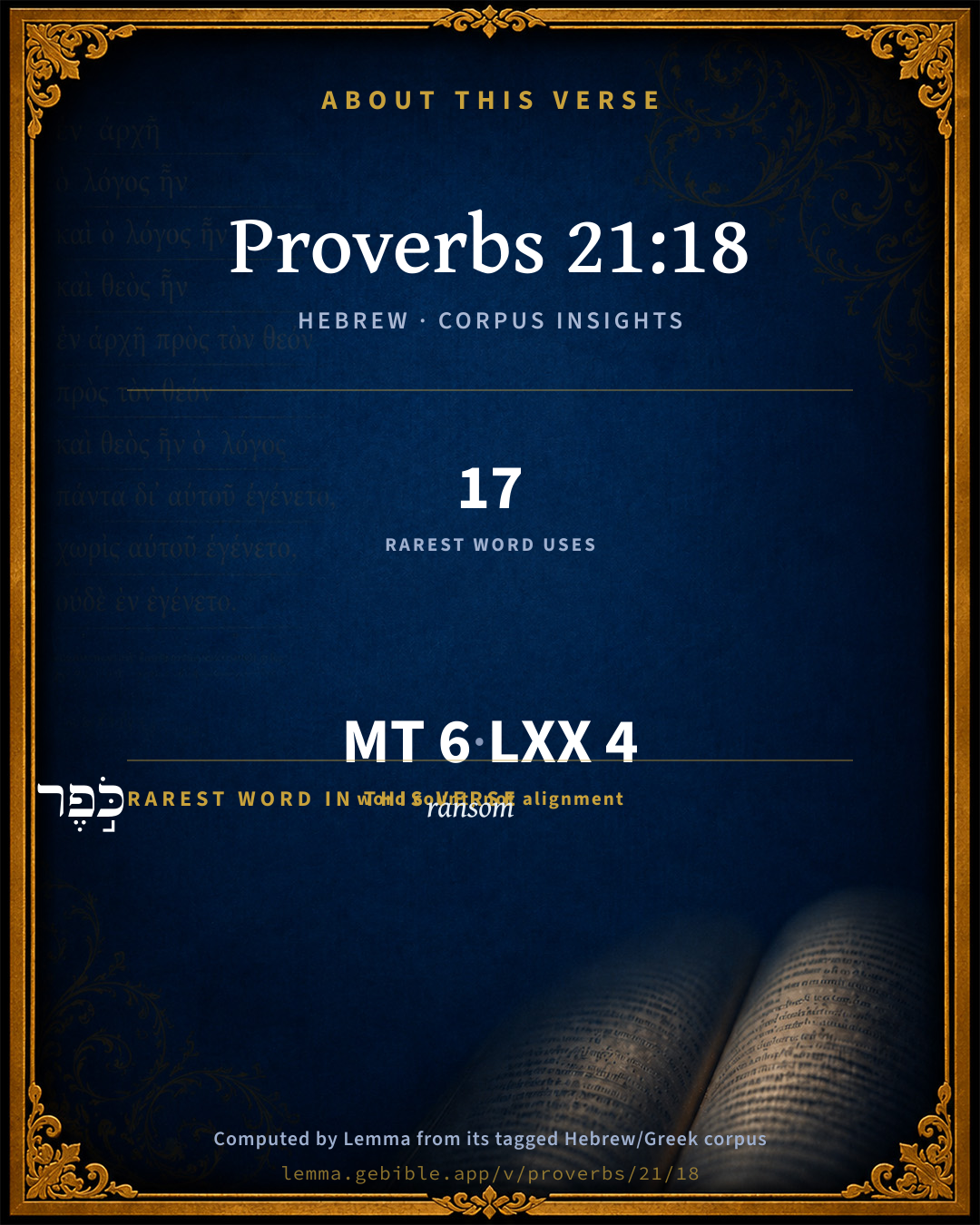
The rarest word here is כֹּ֣פֶר ransom H3724 — appearing just 17 times in the whole Hebrew Bible.

Shared distinctive vocabulary

כֹּ֣פֶר ransom H3724 occurs in 17 verses of the Hebrew Bible. Also found in:

Grammatical profile

  • 1 verb
  • 1 noun
  • 3 adjectives
  • 1 preposition

Verb forms

  • בּוֹגֵֽד Qal · Participle Active

Hebrew & Septuagint length

In English translation the verse runs 13 words from the Hebrew and 10 from the Septuagint (LXX English) — closely comparable.

A rough comparison of the two English renderings, which tokenize alike — not a word-level alignment.

Word counts can differ between the Hebrew and the Greek without any difference in meaning — e.g. the Hebrew direct-object marker אֵת has no separate Greek word, and Greek often adds the article ὁ.

In the original languages it is 6 Hebrew tokens and 4 Greek tokens — but the two are counted differently (Hebrew bundles its prefixes and suffixes into one token; the Greek is in lemma form), so that isn’t a like-for-like length.

Cross-references

5

Topical passages linked to Proverbs 21:18 in the Treasury of Scripture Knowledge — connected by theme and wording, ordered by reader-vote popularity; previews shown in the World English Bible.

  • Proverbs 11:8 A righteous person is delivered out of trouble, And the wicked takes his place.
  • Isaiah 43:3–4 For I am Yahweh your God, the Holy One of Israel, your Savior; I have given Egypt as your ransom, Ethiopia and Seba in your place.
  • Isaiah 53:4–5 Surely he has borne our sickness, and carried our suffering; yet we considered him plagued, struck by God, and afflicted.
  • 1 Peter 3:18 Because Christ also suffered for sins once, the righteous for the unrighteous, that he might bring you to God; being put to death in the flesh, but made alive in the spirit;
  • Isaiah 55:8–9 For my thoughts are not your thoughts, neither are your ways my ways, says Yahweh.

Cross-references courtesy of OpenBible.info (CC BY 4.0).

Hebrew and Greek witnesses Masoretic Hebrew ↔ Greek Septuagint

The same verse in the two great witnesses to the Old Testament, shown verse-for-verse.

These are two independent witnesses, not word-aligned to each other, and the Septuagint is shown in lemma (dictionary) form.

Hebrew Proverbs 21:18 Masoretic · Westminster Leningrad Codex

כֹּ֣פֶר לַצַּדִּ֣יק רָשָׁ֑ע וְתַ֖חַת יְשָׁרִ֣ים בּוֹגֵֽד

The wicked is a ransom for the righteous; The treacherous for the upright.

World English Bible · Public Domain

Greek LXX Proverbs 21:18 Septuagint · lemma form

περικάθαρμα δέ δίκαιος ἄνομος

and a transgressor is the abomination of a righteous man.

LXX2012 (modern English Septuagint) · Public Domain

On this verse, The Pulpit Commentary discusses the Septuagint’s reading. Read the note in Commentary ↓

Hebrew: Westminster Leningrad Codex (CC BY 4.0). Greek: Septuagint (public domain); English from LXX2012 (modern English Septuagint) (Public Domain). How the Septuagint differs from the Hebrew →

Commentary

Notes on Proverbs 21:18 from classic Christian and Jewish commentators (each source and its license shown beneath its notes). The classic Christian expositions comment on the surrounding passage and are grouped to its opening verse, so a note may address several verses; the Jewish commentaries on the Tanakh (Rashi and others) are per-verse, so they appear only where the commentator wrote on this verse.

Lemma curates 59 commentaries, every one of them public domain or Creative Commons licensed, each selected and text-cleaned for this edition rather than reprinted as found. About our sources →

Trapp's Complete Commentary

John Trapp

Pro 21:18 The wicked [shall be] a ransom for the righteous, and the transgressor for the upright.

Ver. 18. The wicked shall be a ransom.] Heb., Copher, a cover, or an expiation; as Achan was for Israel, and as those condemned persons among the heathens, that in time of pestilence or contagious infection were offered up by way of public expiation, with these words, περιψημα ημων γενου; Be thou a reconciliation for us. {a} To this custom St Paul seems to allude. {1Co 4:13} Thus, when Saul’s sons were hanged, God’s wrath was appeased; {2Sa 21:1-9} and when guilty Jonah was cast into the sea, all was calm. Thus God gave Egypt for Israel’s ransom; yea, Sheba and Ethiopia. {Isa 43:3} And although he may seem sometimes to "sell his people for nought, and not to increase his wealth by their price," {Psa 44:12} yet when it comes to a critical point, "I will give men for thee, and people for thy price." {Isa 43:4} {See Trapp on "Pro 11:8"}

{a} Budaeus.

John Trapp, A Commentary or Exposition upon All the Books of the Old and New Testament (1647–1656) — public domain. Text from a community e-Sword module.

Joseph Benson's Commentary

Pro 21:18. The wicked shall be a ransom for the righteous — The wicked shall be brought into those troubles which were designed by wicked men against the righteous, and by that means, as by a ransom, the righteous shall be delivered; thus Haman was a ransom for Mordecai.

Joseph Benson's Commentary on the Old and New Testaments (1811–1818) — public domain. Text from a community e-Sword module.

The Preacher's Complete Homiletical Commentary

Joseph S. Exell (gen. ed.)

MAIN HOMILETICS OF Pro_21:18

THE RANSOM OF THE RIGHTEOUS

This verse must be understood to express the same truth as that in Isa_43:3, in which Jehovah, speaking to the Hebrew people, says, “I gave Egypt for thy ransom—Ethiopia and Seba for thee,” referring doubtless to the deliverance by the overthrow of the Egyptians and other nations. Here the Divine interposition is not on behalf of an elect nation, but on behalf of a special character; not for the deliverance of Israel according to the flesh, but of the true Israelite—the righteous and upright man wherever he is found, for “in every nation he that feareth Him and worketh righteousness is accepted with Him” (Act_10:35).

I. When the wicked man stands in the way of the true advancement of the good he shall be removed out of the way. It is a law of the universe, and the end to which all God’s government tends, that goodness shall finally have the ascendancy over evil—that right shall triumph over wrong. Now, although we speak of goodness and of evil in the abstract, they have no abstract existence; they can only exist in connection with free personalities; with beings who have the choice of their actions. Hence, if evil is to be put down, it must be put down in the person of evil men or devils, and if good is to rule it must rule in the person of the good. Therefore, when the transgressor in any way opposes the real and true advancement of the righteous man he opposes the advance of righteousness, and he must be sacrificed. This is not always apparent to human eyes; things often seem to tend in quite the contrary direction; but this is because we do not know what is really most conducive to the coming of the kingdom of righteousness, nor how the overthrow of evil can be best accomplished.

II. Every man must either be ransomed from sin or become a ransom for righteousness. The righteous and the upright on the earth have only become so by submission to the righteous will of God—by taking His yoke and choosing His service. This has delivered them from the power of evil—this has redeemed them from the slavery of sin. It was quite open to Pharaoh to fall in with God’s will concerning Israel—to obey the demand which was made upon him. It was only after repeated refusal that he and his were made a ransom for God’s people. It is in every case where God’s will is made known, and it is only when men persist in transgression that they are made a ransom for the upright. But there is no neutral ground. Every man who is not upright is a transgressor, and as such will be subject to this law.

OUTLINES AND SUGGESTIVE COMMENTS

In the time of some strange visitation for sin, the notorious offender, who is guilty of heinous crimes, by his suffering and death shall free the innocent person from the stroke of God’s vengeance, who should not be spared, but plagued, if the evildoer were winked at. Moreover, some one that hath, by breaking the Lord’s covenant or precept, caused trouble to fall both on himself and many others, who in like manner have not sinned as he hath done, shall, suffering alone for the sin which he hath committed, deliver by his misery the rest that are in the same adversity, but not for the same cause. The executing of Saul’s sons (2 Samuel 21.), the storming of Achan (Jos_7:20), and casting of Jonah into the sea (Jon_1:12), may more plainly declare and more fully prove the truth of this matter. It may be here objected, if the Lord punish the righteous for the wicked man’s offence, how is he then righteous? To answer hereunto briefly—First, though the Lord afflict the innocent with the sinners oftentimes, yet He doth not correct them for the faults of transgressors, but for their own faults, there being none so just but that he sinneth sometimes. Secondly, when the just, having authority to punish sin, wink at the known offences of the ungodly, by letting them go scot-free, they make their transgressions their own, so that in such cases no marvel if the Lord scourge the just with the unjust; for even the just do in such cases appertain to the family of the unjust.—Muffet.

It is the hatred of the wicked against the righteous that bringeth them into captivity, but it is the favour of God towards them that He maketh those who have made them captives to be themselves the redemption of them. Or else, if the condition of this world by God’s permission and providence hath cast the righteous into thraldom, it is the sport of the wicked to insult over them; but it is the compassion of God towards them that He maketh those who make sport at them to be themselves the sacrifice of their deliverance. And, seeing misery, being man’s master, requireth the right of command over him, according as many are the general calamities of mankind, God maketh the wicked to serve it, and the transgressor to pay bondage unto it instead of the righteous.—Jermin.

The subjects of Pro_21:19-20 have been already treated in this chapter. See on Pro_21:5-7, and on Pro_21:9.

The Preacher's Complete Homiletical Commentary (gen. ed. Joseph S. Exell; Funk & Wagnalls, c. 1892) — public domain (pre-1929). A full-Bible homiletical/sermon-outline anthology covering 65 of 66 books (2 John is absent from the source module). Text from a community e-Sword module.

Tyndale Open Study Notes

Tyndale Open Resources

21:18 The wicked will fall prey to the traps they set for others (26:27; see also 11:8).

Tyndale Open Study Notes — © Tyndale Open Resources, licensed CC BY-SA 4.0. Text via the HelloAO Bible API.

Geneva Bible (1599)

Geneva Bible translators

God shall cause that to fall on their own heads, which they intended against the just by delivering the just, and putting the wicked in their places.

Geneva Bible (1599) marginal notes — public domain. Text via Bolls.life.

Matthew Henry's Commentary

This intimates, 1. What should be done by the justice of men: The wicked, that are the troublers of a land, ought to be punished, for the preventing and turning away of those national judgments which otherwise will be inflicted and in which even the righteous are many times involved. Thus when Achan was stoned he was a ransom for the camp of righteous Israel; and the seven sons of Saul, when they were hanged, were a ransom for the kingdom of righteous David. 2. What is often done by the providence of God: The righteous is delivered out of trouble, and the wicked comes in his stead, and so seems as if he were a ransom for him, Pro 11:8. God will rather leave many wicked people to be cut off than abandon his own people. I will give men for thee, Isa 43:3, Isa 43:4.

Matthew Henry's Commentary on the Whole Bible (1708–1710) — public domain (CC PDM 1.0). Text via the HelloAO Bible API.

Jamieson, Fausset & Brown

Robert Jamieson, A. R. Fausset & David Brown

(Compare Pro 11:8). By suffering what they had devised for the righteous, or brought on them, the wicked became their ransom, in the usual sense of substitutes (compare Jos 7:26; Est 7:9).

Jamieson, Fausset & Brown — Commentary Critical and Explanatory on the Whole Bible (1871) — public domain (CC PDM 1.0). Text via the HelloAO Bible API.

Adam Clarke's Commentary

Verse 18. The wicked shall be a ransom for the righteous] God often in his judgments cuts off the wicked, in order to prevent them from destroying the righteous. And in general, we find that the wicked fall into the traps and pits they have digged for the righteous.

Adam Clarke's Commentary on the Bible (1810–1826) — public domain. Text from a community e-Sword/MySword module.

Ellicott's Commentary for English Readers

(18) The wicked shall be a ransom for the righteous.—The righteous is “delivered out of trouble (Pro_11:8; comp. Isa_57:1), and the wicked cometh in his stead” to receive upon his own head God’s descending punishment. So it was with Mordecai and Haman.

A Bible Commentary for English Readers, edited by Charles John Ellicott (1878–1897) — public domain. Text from a community e-Sword module.

The Cambridge Bible for Schools and Colleges

gen. ed. J. J. S. Perowne

18. a ransom] Comp. “I have given Egypt for thy ransom, Ethiopia and Seba for thee … I will give men for thee and peoples for thy life,” Isa_43:3-4. Egypt was, so to speak, the price paid for the deliverance of Israel (Exo_10:7; Exo_12:29; Exo_14:30).

The second member of the verse is better rendered, with R.V.,

And the treacherous cometh in the stead of the upright. Comp. Pro_11:8.

The Cambridge Bible for Schools and Colleges (gen. ed. J. J. S. Perowne; Cambridge University Press, 1878–1918) — public domain. Text from a community e-Sword module.

John Gill's Exposition

The wicked shall be a ransom for the righteous,.... Not to make satisfaction for them, as Christ is a ransom for his people; but as a ransom is in the room of another, so the wicked cometh in the stead of the righteous, and into the trouble he is delivered from; as Haman for Mordecai, which instance Jarchi mentions; see Pro 11:8; or when a body of people are threatened with divine vengeance; and this falls upon the wicked, whose sins caused it, and the righteous are delivered from it; as in the case of Achan, and the seven sons of Saul, Jos 7:26. And sometimes God turns the wrath of the princes of the earth from his own people, and causes it to fall upon the wicked, and so they are a ransom for them; as Sennacherib intended the destruction of the Jews, but was called off in providence to fall upon the Egyptians, Ethiopians, and Sabeans, and therefore they are said to be a ransom for them; see Isa 43:3; and sometimes wicked men are the means of a ransom or deliverance of the righteous, as Cyrus was of the Jews: and it may be considered, as the word used signifies a "cover" (d), whether it will not bear this sense, that the wicked are a cover for the righteous, and oftentimes protect and defend them; so the earth helped the woman, Rev 12:16;

and the transgressor for the upright; which are but different characters of the same persons, bad and good men; and the sense is the same as before.

(d)

John Gill's Exposition of the Whole Bible (1746–1763) — public domain (CC PDM 1.0). Text via the HelloAO Bible API.

Albert Barnes' Notes on the Bible

Compare the marginal reference. Evil doers seem to draw down the wrath of God upon their heads, and so become, as it were, the scapegoats of the comparatively righteous.

Albert Barnes' Notes on the Bible (1834–1885) — public domain. Text from a community e-Sword/MySword module.

Haydock's Catholic Bible Commentary

Righteous. Many are deterred from wickedness by the punishment of malefactors, whose injuries are frequently irreparable. God abandoned Pharao and Aman to save his people. He treated them as victims of wrath, Isaias xliii. 3.

George Leo Haydock (1774–1849), Haydock's Catholic Family Bible and Commentary, 1859 edition — public domain. Excludes Psalms (Douay-Rheims chapter numbering differs from Protestant) and Deuterocanonical books (Catholic canon only).

Matthew Poole's English Annotations

The wicked shall be brought into those troubles which were either threatened by God or designed by wicked men against the righteous, and by that means, as by a ransom, the righteous shall be delivered. Thus Achan was a ransom for Israel, Jos 7:26, and Haman for Mordecai.

Matthew Poole's English Annotations on the Holy Bible (1683–1685) — public domain. Text from a community e-Sword/MySword module.

Whedon's Commentary on the Bible

Daniel D. Whedon

18. A ransom — A propitiation, lustration, an atonement; that is, figuratively. The wicked bring on themselves the evil they intended for the righteous. Thus their destruction may be considered a ransom for the righteous: it saves them from the intended doom.

Transgressor — The treacherous. Haman’s case is an illustration of the proverb. See Est_7:10, etc.; Pro_11:8.

Daniel D. Whedon (gen. ed.), Commentary on the Old and New Testaments (1874–1909) — public domain. Text from a community e-Sword module.

The Pulpit Commentary

The wicked shall be a ransom for the righteous. The same thought occurs in Pro_11:8 (where see note) rpKo (kopher), "price of atonement," means of reconciliation. Delitzsch instances that the great movement which gathered the nations together for the destruction of Babylon put an end to Israel"s exile; and that Cyrus, the scourge of so many heathen peoples, was the liberator of the Jews. (comp. Isa_44:28) And the transgressor for the upright. The faithless takes the place of the upright; the stroke passes over the latter, to fall on the former, as in Egypt the destroying angel spared the houses of the Israelites, and poured his wrath on the Egyptians. Septuagint, "A transgressor is the offscouring (perikayarma , perhaps equivalent to "ransom") of a righteous man.

Vers. 18-20. Alternatives presented to choice.

I THE JUST AND UPRIGHT, THE FAITHLESS AND WICKED LIFE. (Ver. 18) It occurs in many cases that the Divine wrath in judgment turns aside from the just man to roll upon the head of the sinner. See this in a natural light in Isa_43:3, and in the great Christian light of redemption. (2Co_5:21 1Pe_3:18) Christ became as sin, or in the place of the sinner, for us. We must not, however, confuse the evident meaning of the text, which is that in critical moments of calamity the faithful minority appear to escape unscathed; and the lesson that righteousness alone is safe.

II SOLITUDE OR UNPLEASANT SOCIETY. (Ver. 19; see on ver: 9)

III WISE STORING OR FOOLISH SQUANDERING. (Ver. 20) Thrift and economy give meetness to every home enjoyment they purchase. Waste is without zest, and brings positive dishonor. J.

The Pulpit Commentary (1880–1919), ed. H.D.M. Spence-Jones & Joseph S. Exell — public domain. Text from a community e-Sword module.

John Wesley's Explanatory Notes

A ransom - The wicked shall be brought into those troubles, which were designed by wicked men for the righteous: thus Haman was a ransom for Mordecai.

John Wesley, Explanatory Notes Upon the Whole Bible (1754–1765) — public domain. Text via the GEBible commentary corpus.

Keil & Delitzsch

C. F. Keil & F. Delitzsch

18 The godless becometh a ransom for the righteous;

And the faithless cometh into the place of the upright.

The thought is the same as at Pro 11:8. An example of this is, that the same world-commotion which brought the nations round Babylon for its destruction, put an end to Israel's exile: Cyrus, the instrument in God's hands for inflicting punishment on many heathen nations, was Israel's liberator, Isa 43:3. Another example is in the exchange of places by Haman and Mordecai, to which Rashi refers. כּפר is equivalent to λύτρον, ransom; but it properly signifies price of atonement, and generally, means of reconciliation, which covers or atones for the guilt of any one; the poll-tax and "oblations" also, Exo 30:15., Num 31:50, are placed under this point of view, as blotting out guilt: if the righteousness of God obtains satisfaction, it makes its demand against the godless, and lets the righteous go free; or, as the substantival clause 18b expresses, the faithless steps into the place of the upright, for the wrath passes by the latter and falls upon the former. Regarding בּוגד, vid., Pro 2:22. Thus, in contrast to the ישׁר, he is designated, who keeps faith neither with God nor man, and with evil intention enters on deceitful ways - the faithless, the malicious, the assassin.

Keil & Delitzsch — Biblical Commentary on the Old Testament (1861–1891) — public domain (CC PDM 1.0). Text via the HelloAO Bible API. (Old Testament only.)

Bridges on Proverbs

Charles Bridges

The ransom is here spoken of only in a popular sense, as equivalent to a substitute. (Psa 49:7-8 .) God sometimes, for wise reasons, involves the righteous in the same judgment with the wicked. Sometimes the punishment of the wicked is the ordained means of averting calamity from a righteous nation. (Jos 7:24-26 .) Often, in the LORD’s retributive justice, the wicked are brought into the very trouble, which they designed for the righteous.†1 Thus, suffering in their stead, they are as it were a ransom for them. God may seem in trouble to "sell his people for nought" (Psa 44:12 ); yet "so precious are they in his sight," that a whole nation shall, if needful for their preservation, be given to ruin. Egypt and Ethiopia were thus a ransom for Jerusalem, when God turned Sennacherib’s fury against them, and warded off the threatened strokes from the sacred city,†2 just as a bait thrown to a beast of prey, would give opportunity to the devoted victim to escape. Often does God turn the enemies of the church to fight among themselves, so that the destined scourge for his church is turned to another quarter, as if the crushed nation was a ransom, a victim in the stead of the innocent. However lowering the prospects of the church may be, yet there is no ground for faintness or trembling for the ark of God. His promises to his church are not empty sounds, but "the munitions of rocks." "No weapon that is formed against thee shall prosper. He that toucheth you, toucheth the apple of mine eye." (Isa 54:17 . Zec 2:8 .) The night may be dark; but the morn will look forth gloriously.

Footnotes:

†1 Pro 11:8, and references. See also the first-born of Egypt given for the deliverance of Israel. Exo 11:4-8 ; Exo 12:29-36 .

†2 Isa 43:3-4. Ransom, the same word in the original. Compare 2Ki 19:7-9 .

Charles Bridges, An Exposition of the Book of Proverbs (1846) — public domain. Text from a community e-Sword module.

Kretzmann's Popular Commentary

Paul E. Kretzmann

v. 18. The wicked shall be a ransom for the righteous, for by the punishment which he suffers he atones, in a way, for the errors of the pious or is substituted by God for his intended victim, as Haman was for Mordecai, and the transgressor for the upright. Cf Jos 7:26; Est 7:9.

Paul E. Kretzmann, Popular Commentary of the Bible (1921–1924) — public domain. Text from a community e-Sword module.

Rashi

Rabbi Shlomo Yitzchaki (Rashi)

A wicked man shall be ransom for a righteous man, and a treacherous one instead of the upright A righteous man is rescued, and a wicked man comes in his stead (above 11:8), such as Mordecai and Haman.

Rashi on the Tanakh — English translations: “The Judaica Press complete Tanach with Rashi, translated by A. J. Rosenberg” (CC BY 4.0); “Pentateuch with Rashi's commentary by M. Rosenbaum and A.M. Silbermann, 1929-1934” (public domain); “The Metsudah Tanach series, Lakewood, N.J” (CC BY 4.0); and “The Book of Joshua, Metsudah Publications, 1997” (CC BY 4.0). Text via Sefaria.

Lesson kit

Teaching starters — assembled from the data on this page, not authored interpretation. Every prompt links to the verse data it draws on. Edit before teaching.

Proverbs, in the Wisdom, opens this verse with 6 words (6 distinct Hebrew lemmas). Its most distinctive word is kôpher (“ransom”). A historical commentator’s framing appears above. Read the whole chapter for the surrounding context.

Discussion questions

  1. The word kôpher carries the sense “ransom.” How does it shape the verse?
  2. How does Genesis 6:14, which shares the word «ransom», read alongside this verse?
  3. These translations render this verse differently; the difference is in the English rendering, not the original. What questions does that raise?
  4. «בּוֹגֵֽד» is a Qal Participle Active verb. How does that grammatical form shape the action described?
  5. Compare how Trapp's Complete Commentary and Joseph Benson's Commentary read this verse. Where do they agree or differ?

Things to notice

Reading settings

Reading text

Shown beneath each verse's original-language words.

Old Testament
Old Testament edition

Read the OT as the Masoretic Hebrew (MT) or the Greek Septuagint (LXX).

English shown for the Greek Septuagint (in the Hebrew ↔ Greek comparison).

Comparing translations? Open the Compare panel on any verse page to stack up to four side by side.