
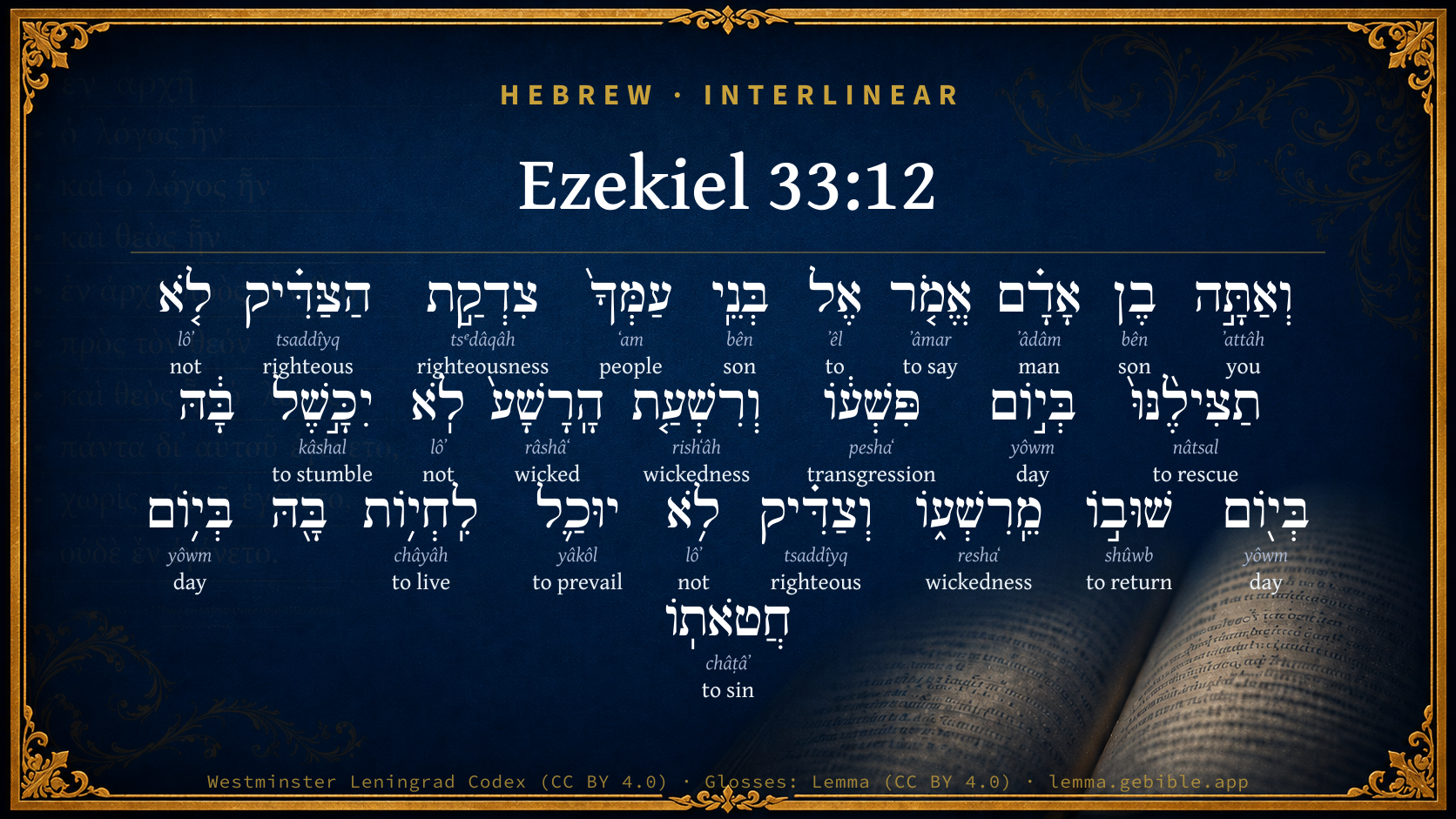
Ezekiel 33:12

Hebrew (Westminster Leningrad Codex) Ezekiel 33:12 appears in the Hebrew Old Testament. The text above is from the Westminster Leningrad Codex. Each word links to its Strong’s number, a concise gloss, and parsing drawn from the Open Scriptures Hebrew Bible morphology. Click any word for its full Brown-Driver-Briggs (BDB) entry.
Download image
Cite this verse

Ezekiel 33:12 (World English Bible). Public Domain. Lemma interlinear Bible study tool, https://lemma.gebible.app/v/ezekiel/33/12.

Show BibTeX & RIS
BibTeX
RIS
English Translation
You, son of man, tell the children of your people, The righteousness of the righteous shall not deliver him in the day of his disobedience; and as for the wickedness of the wicked, he shall not fall thereby in the day that he turns from his wickedness; neither shall he who is righteous be able to live thereby in the day that he sins.
World English Bible · Public Domain
Download a study sheet

One document with this verse’s original text, its word-by-word gloss line, the meaning frame, cross-references with their text, attributed commentary, and full source and license credits — printable, and it pastes into notes with its structure intact.

This verse Autodidact and up

Study sheet (.html) Plain text (.txt)

A passage Seminary Student

Up to 50 verses in one chapter. A passage sheet keeps up to 6 commentary sources and 12 cross-references per verse, in the order this page ranks them, and says so on the sheet whenever that leaves anything out. Ask for a single verse and you get the Autodidact verse sheet above.

Everything on this page stays free to read, with no account — the sheet is a download of what is already on screen, not access to it.

Want to remove ads? Support Godless Engineer
Compare translations 3

The same verse in 3 English versions, stacked beneath the original-language interlinear above. Click any original word for its lexicon entry.

Each is an independent rendering of the whole verse — the interlinear is not word-aligned to these translations.

Highlighted words mark where these versions differ — a whole-verse word diff, not a word-by-word alignment.

  • World English Bible Public Domain
    You, son of man, tell the children of your people, The righteousness of the righteous shall not deliver him in the day of his disobedience; and as for the wickedness of the wicked, he shall not fall thereby in the day that he turns from his wickedness; neither shall he who is righteous be able to live thereby in the day that he sins.
  • King James Version Public Domain
    Therefore, thou son of man, say unto the children of thy people, The righteousness of the righteous shall not deliver him in the day of his transgression: as for the wickedness of the wicked, he shall not fall thereby in the day that he turneth from his wickedness; neither shall the righteous be able to live for his righteousness in the day that he sinneth.
  • unfoldingWord Literal Text CC BY-SA 4.0
    So now you, son of man, say to your people, ‘The righteousness of a righteous person will not save him if he sins! The wickedness of a wicked person will not cause him to perish if he repents from his sin! For the righteous person will not be able to live because of his righteousness if he sins.

unfoldingWord Literal Text — © unfoldingWord, licensed CC BY-SA 4.0. Word-aligned USFM3 via Door43 (git.door43.org/unfoldingWord/en_ult).

Versions to compare (up to 4)

3 of 4 selected

Show all 18 translations

Every available English version of this verse, each an independent rendering of the whole verse.

  • World English Bible Public Domain
    You, son of man, tell the children of your people, The righteousness of the righteous shall not deliver him in the day of his disobedience; and as for the wickedness of the wicked, he shall not fall thereby in the day that he turns from his wickedness; neither shall he who is righteous be able to live thereby in the day that he sins.
  • Berean Standard Bible Public Domain
    Therefore, son of man, say to your people: ‘The righteousness of the righteous man will not deliver him in the day of his transgression; neither will the wickedness of the wicked man cause him to stumble on the day he turns from his wickedness. Nor will the righteous man be able to survive by his righteousness on the day he sins.’
  • Majority Standard Bible Public Domain
    Therefore, son of man, say to your people: ‘The righteousness of the righteous man will not deliver him in the day of his transgression; neither will the wickedness of the wicked man cause him to stumble on the day he turns from his wickedness. Nor will the righteous man be able to survive by his righteousness on the day he sins.’
  • King James Version Public Domain
    Therefore, thou son of man, say unto the children of thy people, The righteousness of the righteous shall not deliver him in the day of his transgression: as for the wickedness of the wicked, he shall not fall thereby in the day that he turneth from his wickedness; neither shall the righteous be able to live for his righteousness in the day that he sinneth.
  • American Standard Version (1901) Public Domain
    And thou, son of man, say unto the children of thy people, The righteousness of the righteous shall not deliver him in the day of his transgression; and as for the wickedness of the wicked, he shall not fall thereby in the day that he turneth from his wickedness; neither shall he that is righteous be able to live thereby in the day that he sinneth.
  • Revised Version (1885) Public Domain
    And thou, son of man, say unto the children of thy people, The righteousness of the righteous shall not deliver him in the day of his transgression; and as for the wickedness of the wicked, he shall not fall thereby in the day that he turneth from his wickedness: neither shall he that is righteous be able to live thereby in the day that he sinneth.
  • Geneva Bible (1599) Public Domain
    Therefore thou sonne of man, saye vnto the children of thy people, The righteousnesse of the righteous shall not deliuer him in the day of his transgression, nor the wickednesse of the wicked shall cause him to fall therein, in the day that he returneth from his wickednesse, neither shall the righteous liue for his righteousnesse in the day that he sinneth.
  • Douay-Rheims (1899) Public Domain
    Thou therefore, O son of man, say to the children of thy people: The justice of the just shall not deliver him, in what day soever he shall sin: and the wickedness of the wicked shall not hurt him, in what day soever he shall turn from his wickedness: and the just shall not be able to live in his justice, in what day soever he shall sin.
  • Young's Literal Translation Public Domain
    And thou, son of man, say unto the sons of thy people: The righteousness of the righteous doth not deliver him in the day of his transgression, And the wickedness of the wicked, He doth not stumble for it in the day of his turning from his wickedness, And the righteous is not able to live in it in the day of his sinning.
  • Literal Standard Version CC BY-SA 4.0
    And you, son of man, say to the sons of your people: The righteousness of the righteous does not deliver him in the day of his transgression, || And the wickedness of the wicked, || He does not stumble for it in the day of his turning from his wickedness, || And the righteous is not able to live in it in the day of his sinning.
  • Unlocked Literal Bible CC BY-SA 4.0
    So now you, son of man, say to your people, 'The righteousness of a righteous person will not save him if he sins! The wickedness of a wicked person will not cause him to perish if he repents from his sin! For the righteous person will not be able to live because of his righteousness if he sins.
  • unfoldingWord Literal Text CC BY-SA 4.0
    So now you, son of man, say to your people, ‘The righteousness of a righteous person will not save him if he sins! The wickedness of a wicked person will not cause him to perish if he repents from his sin! For the righteous person will not be able to live because of his righteousness if he sins.
  • Darby Bible Public Domain
    And thou, son of man, say unto the children of thy people, The righteousness of the righteous shall not deliver him in the day of his transgression; and as for the wickedness of the wicked, he shall not fall thereby in the day that he turneth from his wickedness; neither shall the righteous be able to live thereby in the day that he sinneth.
  • World Messianic Bible Public Domain
    “You, son of man, tell the children of your people, ‘The righteousness of the righteous will not deliver him in the day of his disobedience. And as for the wickedness of the wicked, he will not fall by it in the day that he turns from his wickedness; neither will he who is righteous be able to live by it in the day that he sins.
  • Webster's Bible Public Domain
    Therefore, thou son of man, say to the children of thy people, The righteousness of the righteous shall not deliver him in the day of his transgression: as for the wickedness of the wicked, he shall not fall by it in the day that he turneth from his wickedness; neither shall the righteous be able to live for his righteousness in the day that he sinneth.
  • Free Bible Version CC BY-SA 4.0
    So, son of man, tell your people: All the good things a good person has done won't save them when they sin; while the bad things a bad person has done won't be a problem for them if they stop sinning. But good people won't live if they start sinning.
  • Bible in Basic English Public Domain
    And you, son of man, say to the children of your people, The righteousness of the upright man will not make him safe in the day when he does wrong; and the evil-doing of the evil man will not be the cause of his fall in the day when he is turned from his evil-doing; and the upright man will not have life because of his righteousness in the day when he does evil.
  • JPS Tanakh (1917) Public Domain
    And thou, son of man, say unto the children of thy people: The righteousness of the righteous shall not deliver him in the day of his transgression; and as for the wickedness of the wicked, he shall not stumble thereby in the day that he turneth from his wickedness; neither shall he that is righteous be able to live thereby in the day that he sinneth.

Literal Standard Version (2020), Covenant Press — licensed CC BY-SA 4.0. Text via the HelloAO Bible API (eBible.org). Unlocked Literal Bible (unfoldingWord) — licensed CC BY-SA 4.0. Text via the HelloAO Bible API (eBible.org). unfoldingWord Literal Text — © unfoldingWord, licensed CC BY-SA 4.0. Word-aligned USFM3 via Door43 (git.door43.org/unfoldingWord/en_ult). Free Bible Version, Dr. Jonathan Gallagher — licensed CC BY-SA 4.0. Text via the HelloAO Bible API (eBible.org).

Word by word

More ways to search: Search by grammar → Find every occurrence → Compare this word →

Practice this passage: Drill this verse → Learn its vocabulary →

וְרִשְׁעַ֤ת
rishʻâh
H7564
“and · wickedness of”
Conjunction + Noun, Common, Feminine, Singular, Construct
Part of Speech
Conjunction + Noun
Type
Common
Gender
Feminine
Number
Singular
State
Construct
Full BDB Definition

Origin: from H7562

TWOT: 2222c

wickedness, guilt - wickedness (in civil relations) - wickedness (of enemies) - wickedness (ethical and religious)
  1. וְאַתָּ֣ה ʼattâh H859 “and · you” Conjunction + Pronoun, Personal, 2nd Person, Masculine, Singular
  2. בֶן bên H1121 “son of” Noun, Common, Masculine, Singular, Construct
  3. אָדָ֗ם ʼâdâm H120 “man” Noun, Common, Masculine, Singular, Absolute
  4. אֱמֹ֤ר ʼâmar H559 “say” Verb, Qal, Imperative, 2nd Person, Masculine, Singular
  5. אֶל ʼêl H413 “to” Preposition
  6. בְּנֵֽי bên H1121 “sons of” Noun, Common, Masculine, Plural, Construct
  7. עַמְּךָ֙ ʻam H5971 “people · your” Noun, Common, Masculine, Singular, Construct + Suffix, Personal, 2nd Person, Masculine, Singular
  8. צִדְקַ֣ת tsᵉdâqâh H6666 “righteousness of” Noun, Common, Feminine, Singular, Construct
  9. הַצַּדִּ֗יק tsaddîyq H6662 “the · righteous” Particle, Definite Article + Adjective, Adjective, Masculine, Singular, Absolute
  10. לֹ֤א lôʼ H3808 “not” Particle, Negative
  11. תַצִּילֶ֨נּוּ֙ nâtsal H5337 “to rescue · him” Verb, Hiphil, Imperfect, 3rd Person, Feminine, Singular + Suffix, Personal, 3rd Person, Masculine, Singular
  12. בְּי֣וֹם yôwm H3117 “in/at · day of” Preposition + Noun, Common, Masculine, Singular, Construct
  13. פִּשְׁע֔וֹ peshaʻ H6588 “transgression · his” Noun, Common, Masculine, Singular, Construct + Suffix, Personal, 3rd Person, Masculine, Singular
  14. הָֽרָשָׁע֙ râshâʻ H7563 “the · wicked” Particle, Definite Article + Adjective, Adjective, Masculine, Singular, Absolute
  15. לֹֽא lôʼ H3808 “not” Particle, Negative
  16. יִכָּ֣שֶׁל kâshal H3782 “to stumble” Verb, Niphal, Imperfect, 3rd Person, Masculine, Singular
  17. בְּי֖וֹם yôwm H3117 “in/at · day of” Preposition + Noun, Common, Masculine, Singular, Construct
  18. שׁוּב֣וֹ shûwb H7725 “to return · him” Verb, Qal, Infinitive Construct + Suffix, Personal, 3rd Person, Masculine, Singular
  19. מֵֽרִשְׁע֑וֹ reshaʻ H7562 “from · wickedness · his” Preposition + Noun, Common, Masculine, Singular, Construct + Suffix, Personal, 3rd Person, Masculine, Singular
  20. וְצַדִּ֗יק tsaddîyq H6662 “and · righteous” Conjunction + Adjective, Adjective, Masculine, Singular, Absolute
  21. לֹ֥א lôʼ H3808 “not” Particle, Negative
  22. יוּכַ֛ל yâkôl H3201 “to prevail” Verb, Qal, Imperfect, 3rd Person, Masculine, Singular
  23. לִֽחְי֥וֹת châyâh H2421 “to live” Preposition + Verb, Qal, Infinitive Construct
  24. בְּי֥וֹם yôwm H3117 “in/at · day of” Preposition + Noun, Common, Masculine, Singular, Construct
  25. חֲטֹאתֽוֹ châṭâʼ H2398 “to sin · him” Verb, Qal, Infinitive Construct + Suffix, Personal, 3rd Person, Masculine, Singular

About this verse

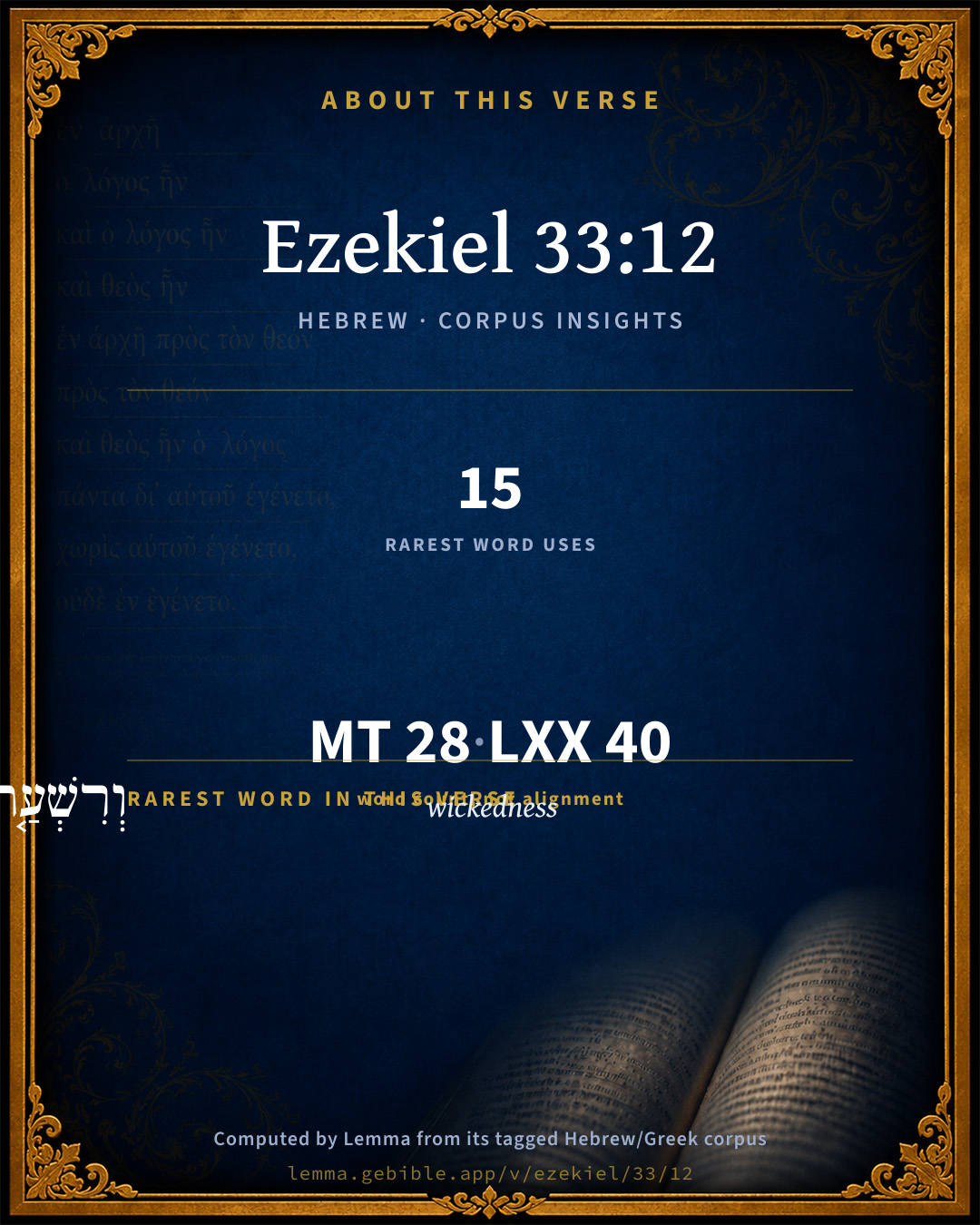
These counts appear in no published source. They are computed here, from the morphology-tagged text and Lemma’s own curated glosses. What Lemma adds →

28
words
20
distinct lemmas
Prophets
section

Notable vocabulary

The rarest word here is וְרִשְׁעַ֤ת wickedness H7564 — appearing just 15 times in the whole Hebrew Bible.

Shared distinctive vocabulary

וְרִשְׁעַ֤ת wickedness H7564 occurs in 15 verses of the Hebrew Bible. Also found in:

Grammatical profile

  • 7 verbs
  • 11 nouns
  • 3 adjectives
  • 1 pronoun
  • 3 prepositions
  • 3 particles

Verb forms

  • אֱמֹ֤ר Qal · Imperative
  • תַצִּילֶ֨נּוּ֙ Hiphil · Imperfect
  • יִכָּ֣שֶׁל Niphal · Imperfect
  • שׁוּב֣וֹ Qal · Infinitive Construct
  • יוּכַ֛ל Qal · Imperfect
  • לִֽחְי֥וֹת Qal · Infinitive Construct
  • חֲטֹאתֽוֹ Qal · Infinitive Construct

Repetition

Words recur within this verse — often emphatic in Hebrew:

  • בְּי֣וֹם day H3117 ×3
  • בֶן son H1121 ×2
  • הַצַּדִּ֗יק righteous H6662 ×2
  • לֹ֤א not H3808 ×3

Hebrew & Septuagint length

In English translation the verse runs 64 words from the Hebrew and 52 from the Septuagint (LXX English) — closely comparable.

A rough comparison of the two English renderings, which tokenize alike — not a word-level alignment.

Word counts can differ between the Hebrew and the Greek without any difference in meaning — e.g. the Hebrew direct-object marker אֵת has no separate Greek word, and Greek often adds the article ὁ.

In the original languages it is 28 Hebrew tokens and 40 Greek tokens — but the two are counted differently (Hebrew bundles its prefixes and suffixes into one token; the Greek is in lemma form), so that isn’t a like-for-like length.

Cross-references

10

Topical passages linked to Ezekiel 33:12 in the Treasury of Scripture Knowledge — connected by theme and wording, ordered by reader-vote popularity; previews shown in the World English Bible.

  • 2 Chronicles 7:14 if my people, who are called by my name, shall humble themselves, and pray, and seek my face, and turn from their wicked ways; then will I hear from heaven, and will forgive their sin, and will heal their land.
  • Ezekiel 33:18–19 When the righteous turns from his righteousness, and commits iniquity, he shall even die therein.
  • Romans 3:25 whom God set forth to be an atoning sacrifice, through faith in his blood, for a demonstration of his righteousness through the passing over of prior sins, in God's forbearance;
  • 1 Kings 8:48–50 if they return to you with all their heart and with all their soul in the land of their enemies, who carried them captive, and pray to you toward their land, which you gave to their fathers, the city which you have chosen, and the house which I have built for your name:
  • Ezekiel 3:20–21 Again, when a righteous man does turn from his righteousness, and commit iniquity, and I lay a stumbling block before him, he shall die: because you have not given him warning, he shall die in his sin, and his righteous deeds which he has done shall not be remembered; but his blood will I require at your hand.
  • Ezekiel 18:21 But if the wicked turn from all his sins that he has committed, and keep all my statutes, and do that which is lawful and right, he shall surely live, he shall not die.
  • Ezekiel 18:24–32 But when the righteous turns away from his righteousness, and commits iniquity, and does according to all the abominations that the wicked man does, shall he live? None of his righteous deeds that he has done shall be remembered: in his trespass that he has trespassed, and in his sin that he has sinned, in them shall he die.
  • Ezekiel 33:2 Son of man, speak to the children of your people, and tell them, When I bring the sword on a land, and the people of the land take a man from among them, and set him for their watchman;
  • Matthew 21:28–31 But what do you think? A man had two sons, and he came to the first, and said, 'Son, go work today in my vineyard.'
  • 1 John 2:1 My little children, I write these things to you so that you may not sin. If anyone sins, we have a Counselor with the Father, Jesus Christ, the righteous.

Cross-references courtesy of OpenBible.info (CC BY 4.0).

Hebrew and Greek witnesses Masoretic Hebrew ↔ Greek Septuagint

The same verse in the two great witnesses to the Old Testament, shown verse-for-verse.

These are two independent witnesses, not word-aligned to each other, and the Septuagint is shown in lemma (dictionary) form.

Hebrew Ezekiel 33:12 Masoretic · Westminster Leningrad Codex

וְאַתָּ֣ה בֶן אָדָ֗ם אֱמֹ֤ר אֶל בְּנֵֽי עַמְּךָ֙ צִדְקַ֣ת הַצַּדִּ֗יק לֹ֤א תַצִּילֶ֨נּוּ֙ בְּי֣וֹם פִּשְׁע֔וֹ וְרִשְׁעַ֤ת הָֽרָשָׁע֙ לֹֽא יִכָּ֣שֶׁל בָּ֔הּ בְּי֖וֹם שׁוּב֣וֹ מֵֽרִשְׁע֑וֹ וְצַדִּ֗יק לֹ֥א יוּכַ֛ל לִֽחְי֥וֹת בָּ֖הּ בְּי֥וֹם חֲטֹאתֽוֹ

You, son of man, tell the children of your people, The righteousness of the righteous shall not deliver him in the day of his disobedience; and as for the wickedness of the wicked, he shall not fall thereby in the day that he turns from his wickedness; neither shall he who is righteous be able to live thereby in the day that he sins.

World English Bible · Public Domain

Greek LXX Ezekiel 33:12 Septuagint · lemma form

εἶπον πρός ὁ υἱός ὁ λαός σύ δικαιοσύνη δίκαιος οὐ μή ἐκαἱρέω αὐτός ἐν ὅς ἄν ἡμέρα πλανάω καί ἀνομία ἀσεβής οὐ μή κακόω αὐτός ἐν ὅς ἄν ἡμέρα ἀποστρέφω ἀπό ὁ ἀνομία αὐτός καί δίκαιος οὐ μή δύναμαι σώζω

Say to the children of your people, The righteousness of the righteous shall not deliver him, in the day wherein he errs: and the iniquity of the ungodly shall not harm him, in the day wherein he turns from his iniquity, but the righteous erring shall not be able to deliver himself.

LXX2012 (modern English Septuagint) · Public Domain

Hebrew: Westminster Leningrad Codex (CC BY 4.0). Greek: Septuagint (public domain); English from LXX2012 (modern English Septuagint) (Public Domain). How the Septuagint differs from the Hebrew →

Targum (Aramaic paraphrase)

1

The Targum is the ancient Jewish Aramaic paraphrase of the Hebrew Scriptures — an interpretive translation, not the Hebrew text itself. Onkelos (literal) and Pseudo-Jonathan (expansive) render the Torah, and Jonathan the Prophets. Coverage is partial: where no permissively-licensed English translation exists for a verse, only the Aramaic is shown. This is verse-level text, not a word-by-word alignment to the Hebrew.

  1. Targum Jonathan Prophets (Joshua–Malachi)
    וְאַתְּ בַּר אָדָם אֱמַר לִבְנֵי עַמָךְ זְכוּת זַכָּאָה לָא תְשֵׁיזְבִינֵיהּ בְּיוֹמָא דְחוֹבְתֵּהּ וְחוֹבַת חַיָבָא לָא יִתְקַל בָּהּ בְּיוֹמָא דִיתוּב מֵחוֹבֵיהּ וְצַדִיקָא לָא יֵכוּל לְאִתְקַיְמָא בֵיהּ בְּיוֹמָא דְחוֹבְתֵּיהּ:

    (no public-domain English translation for this verse)

    Targum Jonathan — Aramaic: “Mikraot Gedolot” (public domain). English: “Sefaria Community Translation” (CC0 1.0 (public-domain dedication)); “London "Chaldee Paraphrase," 1871” (public domain). Text via Sefaria.

Commentary

Notes on Ezekiel 33:12 from classic Christian and Jewish commentators (each source and its license shown beneath its notes). The classic Christian expositions comment on the surrounding passage and are grouped to its opening verse, so a note may address several verses; the Jewish commentaries on the Tanakh (Rashi and others) are per-verse, so they appear only where the commentator wrote on this verse.

Lemma curates 59 commentaries, every one of them public domain or Creative Commons licensed, each selected and text-cleaned for this edition rather than reprinted as found. About our sources →

Trapp's Complete Commentary

John Trapp

Eze 33:12 Therefore, thou son of man, say unto the children of thy people, The righteousness of the righteous shall not deliver him in the day of his transgression: as for the wickedness of the wicked, he shall not fall thereby in the day that he turneth from his wickedness; neither shall the righteous be able to live for his [righteousness] in the day that he sinneth.

Ver. 12. Say unto the children.] The same as before, only with a proviso of perseverance in welldoing, for else all is lost. Non enim quaeruntur in Christianis initia sed finis, saith Jerome, The end is better than the beginning.

John Trapp, A Commentary or Exposition upon All the Books of the Old and New Testament (1647–1656) — public domain. Text from a community e-Sword module.

Tyndale Open Study Notes

Tyndale Open Resources

33:12-16 The principle stated in 33:10-11 is worked out in two case studies. The first involves righteous people who trust in their past righteousness to save them, even though they turn to sin. God will destroy these people in their sins, notwithstanding their earlier righteous behavior. The second case study involves wicked people who repent of wickedness. Complete forgiveness is available from the Lord. Whatever their past, those who turn from their sins and do what is just and right will live. As with the word concerning the watchman, what had been said earlier is revisited. In ch 18, the people said that they were being punished for their parents’ sins. Here they were apparently saying that their parents’ sins had put the nation under an endless curse, so repentance was useless.

Tyndale Open Study Notes — © Tyndale Open Resources, licensed CC BY-SA 4.0. Text via the HelloAO Bible API.

Geneva Bible (1599)

Geneva Bible translators

Read of this righteousness, Ezek. 18:21, 24.

Geneva Bible (1599) marginal notes — public domain. Text via Bolls.life.

Jamieson, Fausset & Brown

Robert Jamieson, A. R. Fausset & David Brown

not fall . . . in the day that he turneth-- (Ch2 7:14; see Eze 3:20; Eze 18:24).

Jamieson, Fausset & Brown — Commentary Critical and Explanatory on the Whole Bible (1871) — public domain (CC PDM 1.0). Text via the HelloAO Bible API.

The Cambridge Bible for Schools and Colleges

gen. ed. J. J. S. Perowne

12. It would have been enough to illustrate the earnest exhortation, Turn ye, why will ye die? (Eze_33:11) by the assurance that if the wicked turns his past sins will not be remembered against him (Eze_33:16). But the prophet states the truth in a more general form. His purpose is to teach also the general truth that the past of one’s life does not of necessity determine the future either in itself or in the judgment of God. This, next to the assurance of God’s gracious will regarding men (Eze_33:11), was the truth most needed to comfort the people and awaken them out of the stupor which lay on them into a moral life and activity again.

It is merely to distort the prophet’s words to say that he teaches that a man’s past life goes for nothing, and that he will be judged merely according to what he is found doing “at the moment” of the judgment. The prophet is not speaking of moments. He speaks to men overwhelmed by a judgment of God which seemed to leave no hope for the future, and he lays down the principle needful for the moral awakening of the people that the past is not irrevocable, that a future of possibility lies before them. It is too true that the evil of a man’s past life prolongs itself into the future and that sin cannot at once be done with. Yet we “believe in the forgiveness of sins;” and this is the truth which the prophet desires to teach his countrymen, over whelmed with the thought of their own evil past. When he says the righteous shall “live” he means by living the complex thing, having the favour of God and having an external felicity corresponding to this.

Old Testament prophets and saints were hardly able to conceive the first of these two things existing apart from the second. And the prophet probably still considers them inseparably connected. And hence, when teaching that the son shall not suffer for the sins of the father, and that the righteous shall “live” and the wicked “die,” he has been charged with inculcating a doctrine more false to reality than the old one which it was designed to supersede. But here again a certain injustice is done to the prophet. No doubt when he uses the word “live” he employs it in the pregnant sense, viz. to enjoy the favour of God and to have this favour reflected in outward felicity. But just as Jeremiah relegates the principle that the children shall not suffer for the sins of the father to the new era about to dawn, so Ezek. agrees with him. Neither prophet is laying down a new principle which is to obtain in the world, the world going on as it had done before. Ezek. feels himself, as all the prophets do, on the threshold of a new Epoch, the era of the perfect kingdom of God, and it is in this new era that the principle which he enunciates shall prevail. See at the end of ch. 18.

The Cambridge Bible for Schools and Colleges (gen. ed. J. J. S. Perowne; Cambridge University Press, 1878–1918) — public domain. Text from a community e-Sword module.

John Gill's Exposition

When I shall say to the righteous, that he shall surely live,.... A happy life, here and hereafter; an eternal life, and not die the second death: this must be understood, should he appear a truly righteous person; one that does not trust to his own righteousness, but to the righteousness of Christ, and lives by faith on that; looking for the hope of righteousness through it, and behaving agreeably to his character:

but if he trust to his own righteousness, and commit iniquity; as he will by trusting to it; if he trusts to it for acceptance with God, and justification in his sight, and thinks himself proof against all temptation to sin on account of it; and that he has righteousness enough to make amends for sins committed, or for other sins he may commit; and which he may venture upon through this false notion, and so be led on to an open course of sinning, and series of committing iniquity:

all his righteousness shall not be remembered; God will take no notice of it; it shall be of no avail to justify him from sin, and secure him from wrath; it will be as if it never had been:

but for his iniquity that he hath committed, he shall die for it; an eternal death, which is the just wages of sin; from which a man's own righteousness can never deliver him, though the righteousness of Christ does deliver from it; see Pro 10:2.

John Gill's Exposition of the Whole Bible (1746–1763) — public domain (CC PDM 1.0). Text via the HelloAO Bible API.

Haydock's Catholic Bible Commentary

Hurt him. God effaces all past crimes: yet a relapse makes them as it were revive, and is pardoned with more difficulty, Matthew xviii. 35. Some read, "In what day the converted sinner groans, he shall be saved," as if they had taken in part of Isaias xxx. 15.

George Leo Haydock (1774–1849), Haydock's Catholic Family Bible and Commentary, 1859 edition — public domain. Excludes Psalms (Douay-Rheims chapter numbering differs from Protestant) and Deuterocanonical books (Catholic canon only).

Matthew Poole's English Annotations

As for the wickedness of the wicked, & c.: see Eze 3:20; 18:20-22,24, where the same things are explained.

Matthew Poole's English Annotations on the Holy Bible (1683–1685) — public domain. Text from a community e-Sword/MySword module.

The Pulpit Commentary

Vers. 12-16. Past and present.

I THE PRESENT WILL NOT BE JUDGED BY THE PAST. This is one principle underlying the various very clear statements of the passage. It is a principle that is needed in order to balance the influence of other principles that appear to work in an opposite direction. Indeed, at first sight it seems to be contradictory to some well-known laws. Is it not repeatedly asserted that a man will be judged by his past life? The sins of the past may be forgotten, but they stand recorded in the book of judgment and the guilt of them remains on the sinner. How, then, is it possible for the present and future to be free from the past?

1. The past lives by its effects in the present. If, however, by effort of will, aided by Divine grace, we neutralize the bad past, then that past is slain.

2. Forgiveness removes the guilt of the past.

3. Past innocence has no power in it to prevent present sin. It is a help in that direction, for it works through the force of habit. But habit may be resisted and broken.

II PAST RIGHTEOUSNESS WILL NOT EXCUSE PRIEST SIN. We are judged chiefly, at all events, by what we are, rather than by what we were. Moreover, there is no possibility of our having acquired an extra stock of merit in the past which we can set off against our present failing. We never have a balance on the credit side of our account with Heaven. At our best we are but "unprofitable servants". (Luk_17:10) An employer cares little for old testimonials. He must see a certificate of character up to date. If a man has borne an excellent reputation for years, and at last breaks down and disgraces himself, he is said to have "lost his character." His good name in the past now counts for nothing. It is utterly gone. Now, the practical warning that issues from these considerations is that we must take good heed to our present life. It is of no use to hark back to the day of conversion for assurance. We may long have left the good beginnings of that day. There is no security in past service, position in the Church, etc. We need to be on our guard against falling, even to the last. It is possible to turn aside at the eleventh hour. The ship may be wrecked in sight of the haven; then her passengers will not be saved by their memory of their long prosperous voyage.

III PAST SIN WILL NOT PREVENT PRESENT SALVATION. Happily, the principle works both ways. If we must first take it as a warning against trusting in a good past, we may also consider it as a reason for not despairing on account of a bad past.

1. The bad past may be forsaken. The grace of Christ will help us to break loose from the tyranny of habit.

2. The bad past may be forgiven. The Lamb of God who taketh away the sin of the world removes the stains of guilt from penitent souls. Then God will no more accuse them of the past. Pardon covers the past with oblivion.

3. The new present is what God observes. "If any man be in Christ, he is a new creature; old things are passed away; behold, all things are become. (2Co_5:17) Then God only looks at the new life and judges of that. Therefore we supremely need grace for the present moment. We live in the present. Religion is for the present. Vers. 12, 13The vanity of transitory goodness.

The ministers of religion are often pained and sometimes discouraged by instances, such as are here referred to, of that goodness which is "as the morning cloud and the early dew, which soon goeth away.

I THERE IS A GOODNESS WHICH IS SPECIOUS, BUT SUPERFICIAL. Like the seed growing upon rocky soil, it springs up rapidly, and its show is fair; but the reality has no correspondence to the appearance. Impressible, easily influenced, and fickle natures are the soil upon which this growth is observed.

II IN TIME OF TRIAL THE BASELESSNESS OF THIS GOODNESS IS MADE APPARENT. The man trusts to his own righteousness, commits iniquity, and transgresses the Divine Law. Temptation assails, persecution terrifies, ridicule overcomes, evil example persuades; and then the weak character yields, unable to endure the probation. Such cases are frequent in the experience of all who work for God and have to deal with a variety of human character and disposition.

III GOODNESS WHICH DOES NOT ENDURE PROBATION IS NOT REMEMBERED, AND AVAILS NOTHING IN GOD"S SIGHT. The character of a man is regarded as a whole, and is not judged by any partial aspects or manifestations. Because a man has had good feelings or has performed good acts, it does not follow that he is a good man. It is life, and not any one day of life, which is the true period of probation. A virtue that cannot endure temptation is no true virtue. "He that endureth to the end shall be saved.

APPLICATION. The minister of religion must not be misled by the mere appearance of piety. He must wait and look for the proof of that deep-seated principle, which alone can govern the conduct and transfigure the life. At the same time, he must make use of every means to fortify men against inevitable temptation, and especially must he admonish the young and inexperienced to watch and to pray, and to take unto them the whole armor of God. T.

Vers. 12-19God"s equal way.

These words bring out

I THE OPPORTUNITY OF THE STONER. God gives him the opportunity of returning, and of recovering that which was lost (see previous homily). He is "not to fall in the day that he turns from his wickedness.

1. God condemns and warns him; he tells him that his sin is ruining him, leading him to death (ver. 14).

2. He hearkens and repents; has so deep a sense of his folly and his guilt that he turns utterly away, in heart and in life, from all his wrong-doing (vers. 14, 15). And then:

3. God takes him back freely and fully into his Divine favor (ver. 16). His sin is frankly forgiven him, and he "lives" unto God and in his sight.

This opportunity is offered to:

1. The ignorant idolater who has been brought up in the dark shadows of superstition.

2. The man who, though brought up in the light of truth, has fallen into flagrant and shameful sin, into vice or crime.

3. The man who, while maintaining the proprieties of behavior, and perhaps the semblance of devotion, keeps his heart closed against the truth and grace of Jesus Christ. To all of these, though they have lived through many years and even whole periods of sin, there is open the gateway of immediate return and of full reconciliation to God.

II THE PERIL OF THE RIGHTEOUS.

1. His God-given hope. He looks for life: "He shall surely live" (ver. 13). The future before him is bright with many a precious promise; the further he goes the more he has to expect at the hands of the faithful and generous Giver. But let him not presume; here is:

2. His serious danger. He may, like the Jew, and like too many an erring Christian, imagine a favoritism on the part of the Supreme which does not exist, and, presuming upon it, may fall. If once the devout man loses his humility; forgets that he is but a weak, endeavoring human spirit; fosters in himself a sense of security; "trusts to his own righteousness; then he stands at once within the circumference of spiritual peril. It is "when he is (consciously) weak, then he is strong". (2Co_12:10) And, conversely, when he is confidently strong, then is he weak, then is he most exposed to the darts of the enemy: pride precedes a fall.

3. His condemnation and his doom. His former "righteousness will not deliver him;" for his iniquity and in his iniquity "he will die." No man living in sin may look up to God and say, "I was once pure," with any hope of acceptance; God requires of us that we be pure in heart, loyal in spirit, upright in word and deed, or he cannot grant us his benediction or admit us to his home.

III THE RIGHTEOUSNESS OF GOD IN BOTH RESPECTS.

1. God is righteous in forgiving the sinful man and restoring him to fullness of life. The Pharisaic view of this act is that it is unrighteous, inasmuch as a guilty soul is taken back to favor and raised up to life and joy. But there are two things overlooked.

(1) God is ever seeking the best in man; he is working towards purity and goodness. How can this be promoted in the sinful? In no way so well as by the extension of Divine mercy. Unrelieved penalty only crushes and condemns to a hopeless continuance in sin; but mercy implants hope, it leads to penitence, and it ends in purity, in wisdom, in moral and spiritual well-being.

(2) Though mercifully restored to life, the sinner does not fail to suffer; some penalty for past transgression he must pay. In the nature of things, or rather under the working of the wise and righteous laws of God, sin works immediate mischief in the soul, and it importantly affects the life; so that not even the abounding mercy of God makes it the same thing to a man whether he spends his earlier years in wisdom or in folly.

2. God is merciful even in condemning the backslider. For if he were to act otherwise, if he were to allow a man, because he had once been righteous, to fall into any sinfulness without condemning and punishing him, what license he would be giving to iniquity, and how would he be multiplying transgression on every hand! It is in the true and lasting interest of our race, and of all his intelligent creation, that God affixes his rebuke and some appropriate penalty to all wrong-doing or wrong-being, in whomsoever it may be found. Thus the Divine Ruler and Father of men is righteous when he forgives, and is merciful when he condemns. His ways are equal, and if we fail to see it, it is because we fail to recognize the profound righteousness of mercy, and the equally profound mercy of righteousness. C.

The Pulpit Commentary (1880–1919), ed. H.D.M. Spence-Jones & Joseph S. Exell — public domain. Text from a community e-Sword module.

unfoldingWord translationNotes

Door43 World Missions Community

General Information:

Yahweh continues giving Ezekiel his message to the Israelites.

The righteousness of a righteous person will not save him if he sins!

The abstract noun "righteousness" can be stated as the adjective "right." It is implied that they will not be saved from God's punishment. AT: "If righteous people start to sin, the fact that they did what was right before will not stop me from punishing them" (See: Abstract Nouns and Assumed Knowledge and Implicit Information)

The wickedness of a wicked person will not cause him to perish

The abstract noun "wickedness" can be stated as the adjective "wicked." AT: "A person who does what is wicked will not perish" (See: Abstract Nouns)

if he trusts in his righteousness

The person thinks that because he was righteous, Yahweh will not punish him, even if he sins. The abstract noun "righteousness" can be stated as the adjective "right." AT: "if he depends on the right things he has done" (See: Abstract Nouns)

commits injustice

"does what is evil" or "does wicked things"

I will not call to mind

This is an idiom. AT: "I will not think about" or "I will not recall" (See: Idiom)

for the wickedness he committed

The abstract noun "wickedness" can be stated as the adjective "wicked" AT: "because of the wicked things he has done" (See: Abstract Nouns)

translationWords

righteous

save

sin

evil

perish

repent

life

trust

die

unfoldingWord translationNotes — © Distant Shores Media and the Door43 World Missions Community, licensed CC BY-SA 4.0. Source: git.door43.org/Door43/en_tn.

Rashi

Rabbi Shlomo Yitzchaki (Rashi)

live with it with his righteousness.

Rashi on the Tanakh — English translations: “The Judaica Press complete Tanach with Rashi, translated by A. J. Rosenberg” (CC BY 4.0); “Pentateuch with Rashi's commentary by M. Rosenbaum and A.M. Silbermann, 1929-1934” (public domain); “The Metsudah Tanach series, Lakewood, N.J” (CC BY 4.0); and “The Book of Joshua, Metsudah Publications, 1997” (CC BY 4.0). Text via Sefaria.

Lesson kit

Teaching starters — assembled from the data on this page, not authored interpretation. Every prompt links to the verse data it draws on. Edit before teaching.

Ezekiel, in the Prophets, opens this verse with 28 words (20 distinct Hebrew lemmas). Its most distinctive word is rishʻâh (“wickedness”). A historical commentator’s framing appears above. Read the whole chapter for the surrounding context.

Discussion questions

  1. What does “wickedness” (rishʻâh) contribute to the verse as a whole?
  2. Deuteronomy 9:4 shares the word «wickedness» with this verse. How do the two illuminate each other?
  3. “day” occurs 3× in this one verse. What is the effect of the repetition?
  4. These translations render this verse differently; the difference is in the English rendering, not the original. What questions does that raise?
  5. The verb «אֱמֹ֤ר» is Qal Imperative. How does its form color the action?
  6. Reading how Trapp's Complete Commentary and Tyndale Open Study Notes read this verse, where do the two commentators agree and where do they part?

Things to notice

Reading settings

Reading text

Shown beneath each verse's original-language words.

Old Testament
Old Testament edition

Read the OT as the Masoretic Hebrew (MT) or the Greek Septuagint (LXX).

English shown for the Greek Septuagint (in the Hebrew ↔ Greek comparison).

Comparing translations? Open the Compare panel on any verse page to stack up to four side by side.