
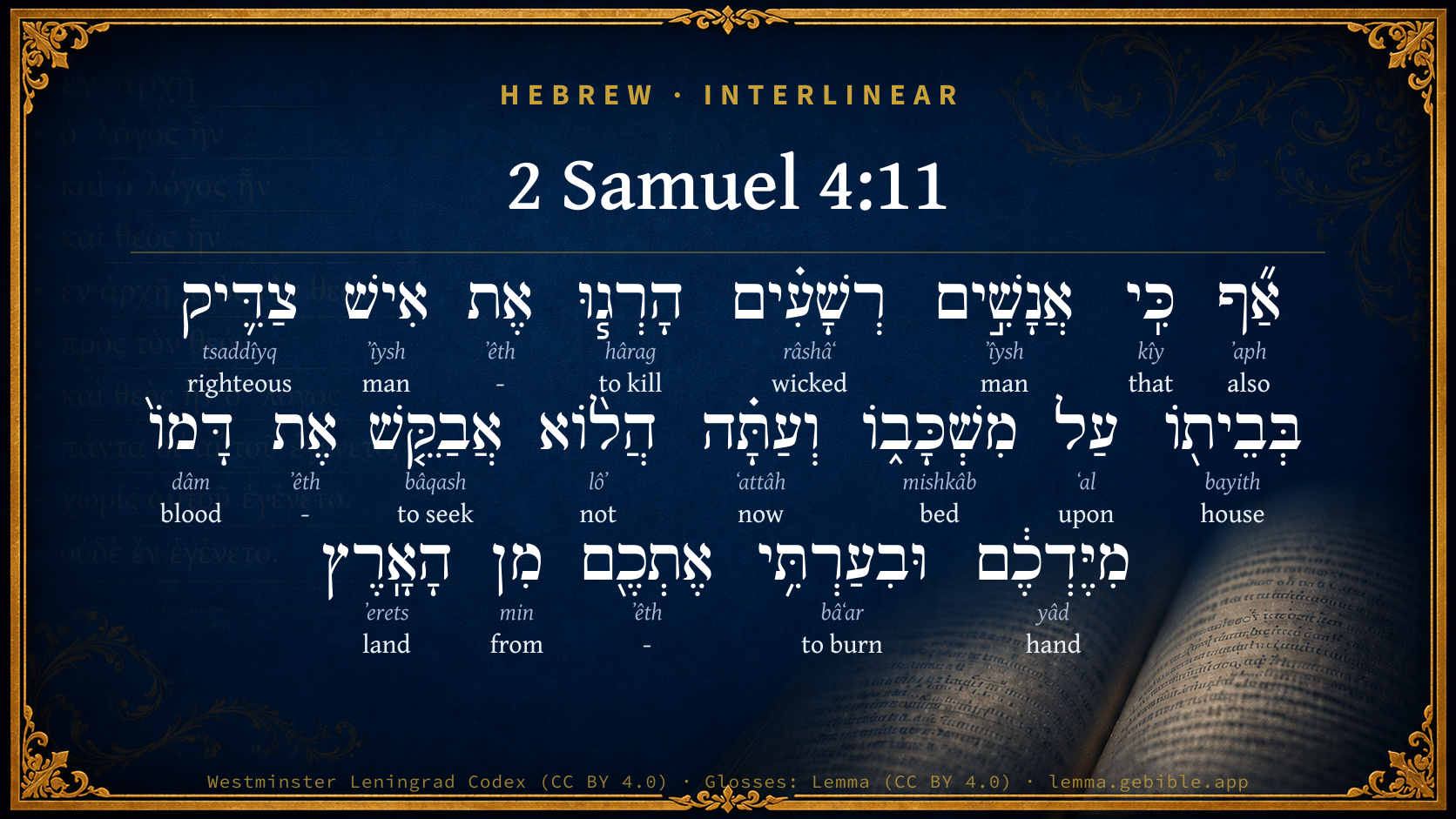
2 Samuel 4:11

Hebrew (Westminster Leningrad Codex) 2 Samuel 4:11 appears in the Hebrew Old Testament. The text above is from the Westminster Leningrad Codex. Each word links to its Strong’s number, a concise gloss, and parsing drawn from the Open Scriptures Hebrew Bible morphology. Click any word for its full Brown-Driver-Briggs (BDB) entry.
Download image
Cite this verse

2 Samuel 4:11 (World English Bible). Public Domain. Lemma interlinear Bible study tool, https://lemma.gebible.app/v/2-samuel/4/11.

Show BibTeX & RIS
BibTeX
RIS
English Translation
How much more, when wicked men have slain a righteous person in his own house on his bed, shall I not now require his blood of your hand, and take you away from the earth?
World English Bible · Public Domain
Download a study sheet

One document with this verse’s original text, its word-by-word gloss line, the meaning frame, cross-references with their text, attributed commentary, and full source and license credits — printable, and it pastes into notes with its structure intact.

This verse Autodidact and up

Study sheet (.html) Plain text (.txt)

A passage Seminary Student

Up to 50 verses in one chapter. A passage sheet keeps up to 6 commentary sources and 12 cross-references per verse, in the order this page ranks them, and says so on the sheet whenever that leaves anything out. Ask for a single verse and you get the Autodidact verse sheet above.

Everything on this page stays free to read, with no account — the sheet is a download of what is already on screen, not access to it.

Want to remove ads? Support Godless Engineer
Compare translations 3

The same verse in 3 English versions, stacked beneath the original-language interlinear above. Click any original word for its lexicon entry.

Each is an independent rendering of the whole verse — the interlinear is not word-aligned to these translations.

Highlighted words mark where these versions differ — a whole-verse word diff, not a word-by-word alignment.

  • World English Bible Public Domain
    How much more, when wicked men have slain a righteous person in his own house on his bed, shall I not now require his blood of your hand, and take you away from the earth?
  • King James Version Public Domain
    How much more, when wicked men have slain a righteous person in his own house upon his bed? shall I not therefore now require his blood of your hand, and take you away from the earth?
  • unfoldingWord Literal Text CC BY-SA 4.0
    How much more, when wicked men have murdered a righteous man in his house on his bed! And now, shall I not seek his blood from your hand and consume you from the earth?”

unfoldingWord Literal Text — © unfoldingWord, licensed CC BY-SA 4.0. Word-aligned USFM3 via Door43 (git.door43.org/unfoldingWord/en_ult).

Versions to compare (up to 4)

3 of 4 selected

Show all 18 translations

Every available English version of this verse, each an independent rendering of the whole verse.

  • World English Bible Public Domain
    How much more, when wicked men have slain a righteous person in his own house on his bed, shall I not now require his blood of your hand, and take you away from the earth?
  • Berean Standard Bible Public Domain
    How much more, when wicked men kill a righteous man in his own house and on his own bed, shall I not now require his blood from your hands and remove you from the earth!”
  • Majority Standard Bible Public Domain
    How much more, when wicked men kill a righteous man in his own house and on his own bed, shall I not now require his blood from your hands and remove you from the earth!”
  • King James Version Public Domain
    How much more, when wicked men have slain a righteous person in his own house upon his bed? shall I not therefore now require his blood of your hand, and take you away from the earth?
  • American Standard Version (1901) Public Domain
    How much more, when wicked men have slain a righteous person in his own house upon his bed, shall I not now require his blood of your hand, and take you away from the earth?
  • Revised Version (1885) Public Domain
    How much more, when wicked men have slain a righteous person in his own house upon his bed, shall I not now require his blood of your hand, and take you away from the earth?
  • Geneva Bible (1599) Public Domain
    How much more, when wicked men haue slaine a righteous person in his owne house, and vpon his bed? shall I not now therfore require his blood at your hand, and take you from the earth?
  • Douay-Rheims (1899) Public Domain
    How much more now when wicked men have slain an innocent man in his own house, upon his bed, shall I not require his blood at your hand, and take you away from the earth?
  • Young's Literal Translation Public Domain
    Also -- when wicked men have slain the righteous man in his own house, on his bed; and now, do not I require his blood of your hand, and have taken you away from the earth?'
  • Literal Standard Version CC BY-SA 4.0
    Also—when wicked men have slain the righteous man in his own house, on his bed; and now, do I not require his blood from your hand, and have taken you away from the earth?”
  • Unlocked Literal Bible CC BY-SA 4.0
    How much more, when wicked men have killed an innocent person in his own house on his bed, should I not now require his blood from your hand, and remove you from the earth?”
  • unfoldingWord Literal Text CC BY-SA 4.0
    How much more, when wicked men have murdered a righteous man in his house on his bed! And now, shall I not seek his blood from your hand and consume you from the earth?”
  • Darby Bible Public Domain
    how much more, when wicked men have slain a righteous person in his own house upon his bed? and should I not now demand his blood of your hand, and take you away from the earth?
  • World Messianic Bible Public Domain
    How much more, when wicked men have slain a righteous person in his own house on his bed, should I not now require his blood from your hand, and rid the earth of you?”
  • Webster's Bible Public Domain
    How much more, when wicked men have slain a righteous person in his own house upon his bed? shall I not therefore now require his blood of your hand, and take you away from the earth?
  • Free Bible Version CC BY-SA 4.0
    Even more so then, when evil men kill a good man in his own house, and in his own bed, shouldn't I demand you pay for his life with your own lives, and exterminate you!”
  • Bible in Basic English Public Domain
    How much more, when evil men have put an upright person to death, in his house, sleeping on his bed, will I take payment from you for his blood, and have you cut off from the earth?
  • JPS Tanakh (1917) Public Domain
    How much more, when wicked men have slain a righteous person in his own house upon his bed, shall I not now require his blood of your hand, and take you away from the earth?'

Literal Standard Version (2020), Covenant Press — licensed CC BY-SA 4.0. Text via the HelloAO Bible API (eBible.org). Unlocked Literal Bible (unfoldingWord) — licensed CC BY-SA 4.0. Text via the HelloAO Bible API (eBible.org). unfoldingWord Literal Text — © unfoldingWord, licensed CC BY-SA 4.0. Word-aligned USFM3 via Door43 (git.door43.org/unfoldingWord/en_ult). Free Bible Version, Dr. Jonathan Gallagher — licensed CC BY-SA 4.0. Text via the HelloAO Bible API (eBible.org).

Word by word

More ways to search: Search by grammar → Find every occurrence → Compare this word →

Practice this passage: Drill this verse → Learn its vocabulary →

מִשְׁכָּב֑וֹ
mishkâb
H4904
“bed · his”
Noun, Common, Masculine, Singular, Construct + Suffix, Personal, 3rd Person, Masculine, Singular
Part of Speech
Noun
Type
Common
Gender
Masculine
Number
Singular
State
Construct
Full BDB Definition

Origin: from H7901

TWOT: 2381c

a lying down, couch, bier, act of lying - couch, bed - act of lying, lying down or sleeping room, bedroom - lying down (for sexual contact)
  1. אַ֞ף ʼaph H637 “also” Particle, Accusative
  2. כִּֽי kîy H3588 “that” Conjunction
  3. אֲנָשִׁ֣ים ʼîysh H376 “men” Noun, Common, Masculine, Plural, Absolute
  4. רְשָׁעִ֗ים râshâʻ H7563 “wicked” Adjective, Adjective, Masculine, Plural, Absolute
  5. הָרְג֧וּ hârag H2026 “to kill” Verb, Qal, Perfect, 3rd Person, Common, Plural
  6. אֶת ʼêth H853 “-” Particle, Direct Object
  7. אִישׁ ʼîysh H376 “man” Noun, Common, Masculine, Singular, Absolute
  8. צַדִּ֛יק tsaddîyq H6662 “righteous” Adjective, Adjective, Masculine, Singular, Absolute
  9. בְּבֵית֖וֹ bayith H1004 “in/at · house · his” Preposition + Noun, Common, Masculine, Singular, Construct + Suffix, Personal, 3rd Person, Masculine, Singular
  10. עַל ʻal H5921 “upon” Preposition
  11. וְעַתָּ֗ה ʻattâh H6258 “and · now” Conjunction + Adverb
  12. הֲל֨וֹא lôʼ H3808 “not” Particle, Interrogative + Particle, Negative
  13. אֲבַקֵּ֤שׁ bâqash H1245 “to seek” Verb, Piel, Imperfect, 1st Person, Common, Singular
  14. אֶת ʼêth H853 “-” Particle, Direct Object
  15. דָּמוֹ֙ dâm H1818 “blood · his” Noun, Common, Masculine, Singular, Construct + Suffix, Personal, 3rd Person, Masculine, Singular
  16. מִיֶּדְכֶ֔ם yâd H3027 “from · hand · your” Preposition + Noun, Common, Both, Singular, Construct + Suffix, Personal, 2nd Person, Masculine, Plural
  17. וּבִעַרְתִּ֥י bâʻar H1197 “and · to burn” Conjunction + Verb, Piel, Sequential Perfect, 1st Person, Common, Singular
  18. אֶתְכֶ֖ם ʼêth H853 “- · you” Particle, Direct Object + Suffix, Personal, 2nd Person, Masculine, Plural
  19. מִן min H4480 “from” Preposition
  20. הָאָֽרֶץ ʼerets H776 “the · land” Particle, Definite Article + Noun, Common, Both, Singular, Absolute

About this verse

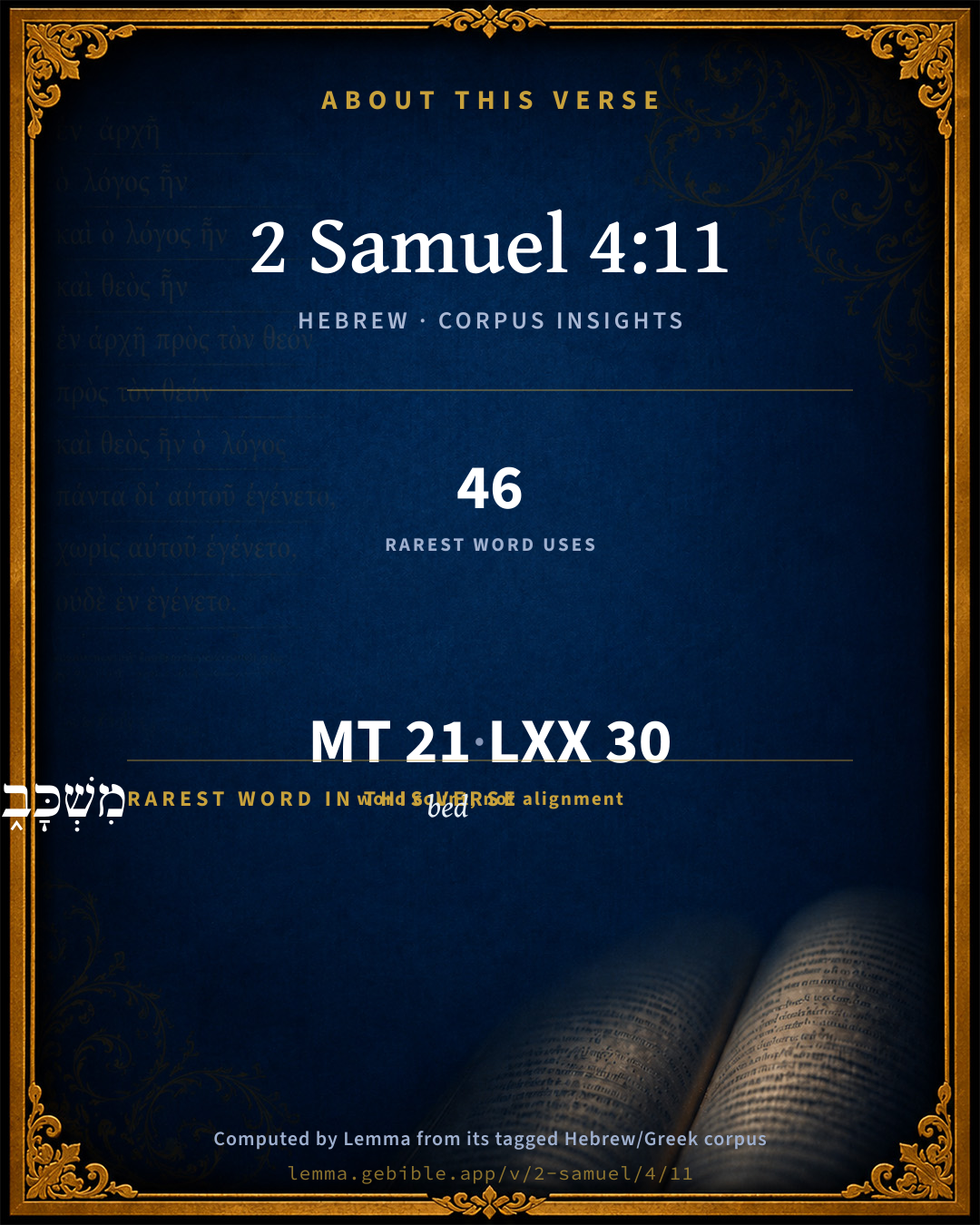
These counts appear in no published source. They are computed here, from the morphology-tagged text and Lemma’s own curated glosses. What Lemma adds →

21
words
18
distinct lemmas
Historical
section

Shared distinctive vocabulary

מִשְׁכָּב֑וֹ bed H4904 occurs in 44 verses of the Hebrew Bible. Also found in:

Grammatical profile

  • 3 verbs
  • 7 nouns
  • 2 adjectives
  • 2 prepositions
  • 1 conjunction
  • 1 adverb
  • 5 particles

Verb forms

  • הָרְג֧וּ Qal · Perfect
  • אֲבַקֵּ֤שׁ Piel · Imperfect
  • וּבִעַרְתִּ֥י Piel · Sequential Perfect

Repetition

A word recurs within this verse — often emphatic in Hebrew:

  • אֲנָשִׁ֣ים man H376 ×2

Hebrew & Septuagint length

In English translation the verse runs 35 words from the Hebrew and 34 from the Septuagint (LXX English) — closely comparable.

A rough comparison of the two English renderings, which tokenize alike — not a word-level alignment.

Word counts can differ between the Hebrew and the Greek without any difference in meaning — e.g. the Hebrew direct-object marker אֵת has no separate Greek word, and Greek often adds the article ὁ.

In the original languages it is 21 Hebrew tokens and 30 Greek tokens — but the two are counted differently (Hebrew bundles its prefixes and suffixes into one token; the Greek is in lemma form), so that isn’t a like-for-like length.

Cross-references

18

Topical passages linked to 2 Samuel 4:11 in the Treasury of Scripture Knowledge — connected by theme and wording, ordered by reader-vote popularity; previews shown in the World English Bible.

  • Psalms 9:12 For he who avenges blood remembers them. He doesn't forget the cry of the afflicted.
  • Genesis 9:5–6 I will surely require your blood of your lives. At the hand of every animal I will require it. At the hand of man, even at the hand of every man's brother, I will require the life of man.
  • Numbers 35:31–34 Moreover you shall take no ransom for the life of a murderer who is guilty of death; but he shall surely be put to death.
  • Proverbs 2:22 But the wicked will be cut off from the land. The treacherous will be rooted out of it.
  • Genesis 4:11 Now you are cursed because of the ground, which has opened its mouth to receive your brother's blood from your hand.
  • Genesis 6:13 God said to Noah, "The end of all flesh has come before me, for the earth is filled with violence through them. Behold, I will destroy them with the earth.
  • Genesis 7:23 Every living thing was destroyed that was on the surface of the ground, including man, cattle, creeping things, and birds of the sky. They were destroyed from the earth. Only Noah was left, and those who were with him in the ark.
  • Exodus 9:15 For now I would have put forth my hand, and struck you and your people with pestilence, and you would have been cut off from the earth;
  • Exodus 21:12 "One who strikes a man so that he dies shall surely be put to death,
  • 2 Samuel 3:27 When Abner was returned to Hebron, Joab took him aside into the midst of the gate to speak with him quietly, and struck him there in the body, so that he died, for the blood of Asahel his brother.
  • 2 Samuel 3:39 I am this day weak, though anointed king; and these men the sons of Zeruiah are too hard for me. May Yahweh reward the evil-doer according to his wickedness."
  • 1 Kings 2:32 Yahweh will return his blood on his own head, because he fell on two men more righteous and better than he, and killed them with the sword, and my father David didn't know it, [to wit], Abner the son of Ner, captain of the host of Israel, and Amasa the son of Jether, captain of the host of Judah.
  • Psalms 109:15 Let them be before Yahweh continually, That he may cut off the memory of them from the earth;
  • Proverbs 25:26 Like a muddied spring, and a polluted well, So is a righteous man who gives way before the wicked.
  • Jeremiah 10:11 Thus shall you say to them, The gods that have not made the heavens and the earth, these shall perish from the earth, and from under the heavens.
  • Habakkuk 1:4 Therefore the law is paralyzed, and justice never goes forth; for the wicked surround the righteous; therefore justice goes forth perverted.
  • Habakkuk 1:12 Aren't you from everlasting, Yahweh my God, my Holy One? We will not die. Yahweh, you have appointed him for judgment. You, Rock, have established him to punish.
  • 1 John 3:12 unlike Cain, who was of the evil one, and killed his brother. Why did he kill him? Because his works were evil, and his brother's righteous.

Cross-references courtesy of OpenBible.info (CC BY 4.0).

Hebrew and Greek witnesses Masoretic Hebrew ↔ Greek Septuagint

The same verse in the two great witnesses to the Old Testament, shown verse-for-verse.

These are two independent witnesses, not word-aligned to each other, and the Septuagint is shown in lemma (dictionary) form.

Hebrew 2 Samuel 4:11 Masoretic · Westminster Leningrad Codex

אַ֞ף כִּֽי אֲנָשִׁ֣ים רְשָׁעִ֗ים הָרְג֧וּ אֶת אִישׁ צַדִּ֛יק בְּבֵית֖וֹ עַל מִשְׁכָּב֑וֹ וְעַתָּ֗ה הֲל֨וֹא אֲבַקֵּ֤שׁ אֶת דָּמוֹ֙ מִיֶּדְכֶ֔ם וּבִעַרְתִּ֥י אֶתְכֶ֖ם מִן הָאָֽרֶץ

How much more, when wicked men have slain a righteous person in his own house on his bed, shall I not now require his blood of your hand, and take you away from the earth?

World English Bible · Public Domain

Greek LXX 2 Samuel 4:11 Septuagint · lemma form

καί νῦν ἀνήρ πονηρός ἀποκτείνω ἀνήρ δίκαιος ἐν ὁ οἶκος αὐτός ἐπί ὁ κοίτη αὐτός καί νῦν ἐκζητέω ὁ αἷμα αὐτός ἐκ χείρ σύ καί ἐκὀλεθρεύω σύ ἐκ ὁ γῆ

And now evil men have slain a righteous men in his house on his bed: now then I will require his blood of your hand, and I will destroy you from off the earth.

LXX2012 (modern English Septuagint) · Public Domain

Hebrew: Westminster Leningrad Codex (CC BY 4.0). Greek: Septuagint (public domain); English from LXX2012 (modern English Septuagint) (Public Domain). How the Septuagint differs from the Hebrew →

Targum (Aramaic paraphrase)

1

The Targum is the ancient Jewish Aramaic paraphrase of the Hebrew Scriptures — an interpretive translation, not the Hebrew text itself. Onkelos (literal) and Pseudo-Jonathan (expansive) render the Torah, and Jonathan the Prophets. Coverage is partial: where no permissively-licensed English translation exists for a verse, only the Aramaic is shown. This is verse-level text, not a word-by-word alignment to the Hebrew.

  1. Targum Jonathan Prophets (Joshua–Malachi)
    אַף אֲרֵי גַבְרִין רַשִׁיעַיָא קְטַלוּ יַת גְבַר זַכַּאי בְּבֵיתֵיהּ עַל שִׁווּיֵה וּכְעַן הֲלָא אִתְבַּע יַת דְמֵיהּ מִיֶדְכוֹן וַאֲפַלֵי יַתְכוֹן מִן אַרְעָא:

    (no public-domain English translation for this verse)

    Targum Jonathan — Aramaic: “Mikraot Gedolot” (public domain). English: “Sefaria Community Translation” (CC0 1.0 (public-domain dedication)); “London "Chaldee Paraphrase," 1871” (public domain). Text via Sefaria.

Commentary

Notes on 2 Samuel 4:11 from classic Christian and Jewish commentators (each source and its license shown beneath its notes). The classic Christian expositions comment on the surrounding passage and are grouped to its opening verse, so a note may address several verses; the Jewish commentaries on the Tanakh (Rashi and others) are per-verse, so they appear only where the commentator wrote on this verse.

Lemma curates 59 commentaries, every one of them public domain or Creative Commons licensed, each selected and text-cleaned for this edition rather than reprinted as found. About our sources →

Trapp's Complete Commentary

John Trapp

2Sa 4:11 How much more, when wicked men have slain a righteous person in his own house upon his bed? shall I not therefore now require his blood of your hand, and take you away from the earth?

Ver. 11. How much more,] q.d., That Amalekite’s perdition should have been your caution; especially since you are far greater sinners against your own souls; for how bad soever Ishbosheth was, yet in comparison of you, he was righteous; and to you a good lord.

In his own house.] Which is a man’s castle, tutissimum cuique Refugium atque Receptaculum, saith the civil law.

Require his blood of your hand.] Which, because it is not in your power to repair and restore, should I not execute you?

John Trapp, A Commentary or Exposition upon All the Books of the Old and New Testament (1647–1656) — public domain. Text from a community e-Sword module.

Joseph Benson's Commentary

2Sa 4:11. How much more, &c. — If he put the Amalekite to death for barely saying that he slew Saul, even at Saul’s own command, and when his life was despaired of, how much more would he take signal vengeance on their united and aggravated treachery and murder? When wicked men have slain a righteous person — For such Ish-bosheth was in respect of them. Saul might have some guilt in the Amalekite’s eye from his former destruction of the Amalekites; but Ish-bosheth could have none with regard to these his murderers, to whom he had done no wrong, but had preferred them to places of trust and honour. In respect of David, however, Ish- bosheth was not righteous, because he opposed him whom he knew God had appointed to the throne. In his own house, upon his bed — This aggravated their crime, and made it very different from that of the Amalekite who slew Saul. Shall I not, therefore, require his blood at your hands? — As persons unworthy to live. There is no one villany which the human mind so naturally, so instinctively abhors as treachery; because it is, perhaps, the only villany from which no man living is secure; and for this reason every man must take pleasure in the punishing it. This conduct of David toward these murderers of Ish-bosheth is well worth our attention; it is a proof of his integrity and piety, and of his detestation of treachery and cruelty. And we may learn from hence, that we ought not only to do no hurt to our enemies, but that we ought not even to rejoice at the hurt which may happen to them without our contributing any thing to it, nor to countenance injustice and vice in any degree, how great advantage soever we may reap from them.

Joseph Benson's Commentary on the Old and New Testaments (1811–1818) — public domain. Text from a community e-Sword module.

Geneva Bible (1599)

Geneva Bible translators

Forasmuch as neither the example of him that slew Saul, nor duty to their master, nor the innocency of the person, nor reverence of the place, nor time did move them, they deserved most grievous punishment.

Geneva Bible (1599) marginal notes — public domain. Text via Bolls.life.

Adam Clarke's Commentary

Verse 11. How much more] Here are several things which aggravated the guilt of those wicked men.

1. Ish-bosheth was an innocent man, and therefore none could have any ground of quarrel against him.

2. He was in his own house, which was his sanctuary, and none but the worst of men would disturb him there.

3. He was upon his bed, resting in the heat of the day, and so free from suspicion that he was not even attended by his guards, nor had he his doors secured. To take away the life of such a man, in such circumstances, whom also they professed to hold as their sovereign, was the most abandoned treachery.

Adam Clarke's Commentary on the Bible (1810–1826) — public domain. Text from a community e-Sword/MySword module.

Ellicott's Commentary for English Readers

(11) A righteous person—i.e., righteous, not at fault, so far as the matter in hand and his relation to the assassins is concerned.

Take you away from the earth.—“Rather, put you away out of the land. The word is one specially used of removing evil or the guilt of evil from the land (Deu_19:13; Deu_19:19, &c.). The guilt of murder defiled the land, until expiated by the execution of the murderer. (Num_35:33.)”—Kirkpatrick.

A Bible Commentary for English Readers, edited by Charles John Ellicott (1878–1897) — public domain. Text from a community e-Sword module.

The Cambridge Bible for Schools and Colleges

gen. ed. J. J. S. Perowne

11. a righteous person] “A man who had done no one any harm,” as Josephus says. His merits seem to have been negative rather than positive.

require his blood] Demand satisfaction for his murder. God is said to “require blood,” i.e. to avenge murder (Gen_9:5; Psa_9:12), and in punishing the murderers David acted as His representative.

take you away from the earth] Rather, put you away out of the land. The word is one specially used of removing evil or the guilt of evil from the land (Deu_19:13; Deu_19:19, &c.). The guilt of murder defiled the land until expiated by the execution of the murderer (Num_35:33).

The Cambridge Bible for Schools and Colleges (gen. ed. J. J. S. Perowne; Cambridge University Press, 1878–1918) — public domain. Text from a community e-Sword module.

John Gill's Exposition

And David commanded his young men, and they slew them,.... He ordered some of his guards about him to fall on them, and put them to death; and they accordingly did:

and cut off their hands and their feet; their hands, which had smote Ishbosheth, and cut off his head; and their feet, which had been swift to shed his blood, and made haste to bring his head so many miles to David; this was what the Jews call measure for measure:

and hanged them up over the pool in Hebron; not their hands and their feet, but the trunks of their bodies, thus mutilated; so Theodoret; though others think their hands and their feet were hung up, and not their bodies, because dead bodies were not to hang upon the tree more than a day; they were hung up over the fish pool in Hebron, because a public place, and where they were the more exposed to their shame, and the terror of others:

but they took the head of Ishbosheth, and buried it in the sepulchre of Abner in Hebron; by order of David no doubt, who it seems had made, or ordered to be made, a sepulchre, for Abner, see Sa2 3:38; all which David did to show his regard to the family of Saul, his abhorrence of such execrable murders, and to remove all suspicion of his being concerned in them, and to conciliate the minds of the Israelites to him.

Next: 2 Samuel Chapter 5

John Gill's Exposition of the Whole Bible (1746–1763) — public domain (CC PDM 1.0). Text via the HelloAO Bible API.

Haydock's Catholic Bible Commentary

Innocent. Isboseth was such, at least, in their regard. He might also have mounted his father’s throne, bona fide; and, at any rate, it was not their business to decide the matter (Calmet) in this treacherous manner. Thus Alexander punished Bessus, who had murdered his master, Darius, with whom the former was at war. (Haydock)

George Leo Haydock (1774–1849), Haydock's Catholic Family Bible and Commentary, 1859 edition — public domain. Excludes Psalms (Douay-Rheims chapter numbering differs from Protestant) and Deuterocanonical books (Catholic canon only).

Matthew Poole's English Annotations

A righteous person; for so he was comparatively, and in respect of these men, having not deserved death at their hands.

Matthew Poole's English Annotations on the Holy Bible (1683–1685) — public domain. Text from a community e-Sword/MySword module.

Whedon's Commentary on the Bible

Daniel D. Whedon

11. A righteous person — Ishbosheth was guilty of no crime. It is doubtful if he would have assumed the regal power without the instance of Abner.

Daniel D. Whedon (gen. ed.), Commentary on the Old and New Testaments (1874–1909) — public domain. Text from a community e-Sword module.

The Pulpit Commentary

A righteous person. Ishbosheth was probably a weak rather than a wicked man; but David is not speaking of him generally, and, as regards Rechab and Baanah, he was quite guiltless, and their crime was not in revenge for any wrong done them.

The Pulpit Commentary (1880–1919), ed. H.D.M. Spence-Jones & Joseph S. Exell — public domain. Text from a community e-Sword module.

unfoldingWord translationNotes

Door43 World Missions Community

How much more ... should I not now require his blood from your hand, and remove you from the earth?

This question is used to show that the men had committed an especially serious crime. It can be translated as a statement. AT: "You are even more guilty! It is my duty to require his blood from your hand and to remove you from the earth." (See: Rhetorical Question)

require his blood from your hand

The phrase "his blood" represents the life of Ishbosheth. Here "from your hand" represents Rechab and Baanah, the sons of Rimmon the Beerothite, introduced in 2 Samuel 4:5. AT: "hold you responsible for the death of Ishbosheth" (See: Metonymy)

cut off their hands and feet and hung them up

These were symbolic actions to show contempt for the men. (See: Symbolic Action)

they took the head of Ishbosheth and buried it in the grave

This was a symbolic act to honor Ishbosheth. This could be stated explicitly. AT: "they honored Ishbosheth by burying his head in the grave" (See: Symbolic Action and Assumed Knowledge and Implicit Information)

translationWords

evil

innocent

hand

bury

grave

Abner

unfoldingWord translationNotes — © Distant Shores Media and the Door43 World Missions Community, licensed CC BY-SA 4.0. Source: git.door43.org/Door43/en_tn.

Lesson kit

Teaching starters — assembled from the data on this page, not authored interpretation. Every prompt links to the verse data it draws on. Edit before teaching.

2 Samuel, in the Historical, opens this verse with 21 words (18 distinct Hebrew lemmas). Its most distinctive word is mishkâb (“bed”). A historical commentator’s framing appears above. Read the whole chapter for the surrounding context.

Discussion questions

  1. What does “bed” (mishkâb) contribute to the verse as a whole?
  2. How does Genesis 49:4, which shares the word «bed», read alongside this verse?
  3. What does the repetition of “man” (2× in this one verse) do in this verse?
  4. These translations render this verse differently. What is at stake in choosing one wording over another?
  5. «הָרְג֧וּ» is a Qal Perfect verb. How does that grammatical form shape the action described?
  6. Compare how Trapp's Complete Commentary and Joseph Benson's Commentary read this verse. Where do they agree or differ?

Things to notice

Reading settings

Reading text

Shown beneath each verse's original-language words.

Old Testament
Old Testament edition

Read the OT as the Masoretic Hebrew (MT) or the Greek Septuagint (LXX).

English shown for the Greek Septuagint (in the Hebrew ↔ Greek comparison).

Comparing translations? Open the Compare panel on any verse page to stack up to four side by side.