
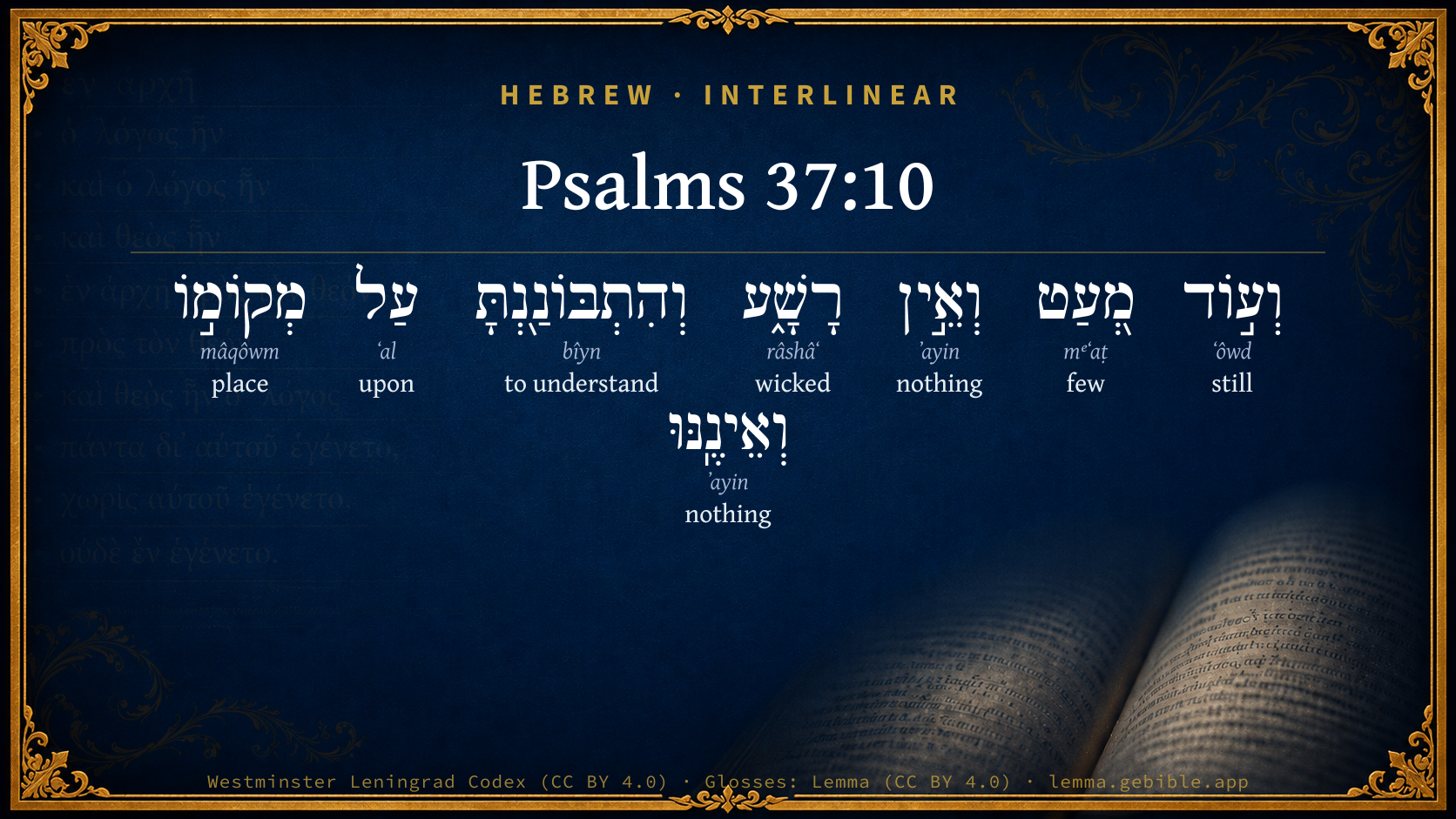
Psalms 37:10

Hebrew (Westminster Leningrad Codex) Psalms 37:10 appears in the Hebrew Old Testament. The text above is from the Westminster Leningrad Codex. Each word links to its Strong’s number, a concise gloss, and parsing drawn from the Open Scriptures Hebrew Bible morphology. Click any word for its full Brown-Driver-Briggs (BDB) entry.
Download image
Cite this verse

Psalms 37:10 (World English Bible). Public Domain. Lemma interlinear Bible study tool, https://lemma.gebible.app/v/psalms/37/10.

Show BibTeX & RIS
BibTeX
RIS
English Translation
For yet a little while, and the wicked will be no more. Yes, though you look for his place, he isn't there.
World English Bible · Public Domain
Download a study sheet

One document with this verse’s original text, its word-by-word gloss line, the meaning frame, cross-references with their text, attributed commentary, and full source and license credits — printable, and it pastes into notes with its structure intact.

This verse Autodidact and up

Study sheet (.html) Plain text (.txt)

A passage Seminary Student

Up to 50 verses in one chapter. A passage sheet keeps up to 6 commentary sources and 12 cross-references per verse, in the order this page ranks them, and says so on the sheet whenever that leaves anything out. Ask for a single verse and you get the Autodidact verse sheet above.

Everything on this page stays free to read, with no account — the sheet is a download of what is already on screen, not access to it.

Want to remove ads? Support Godless Engineer
Compare translations 3

The same verse in 3 English versions, stacked beneath the original-language interlinear above. Click any original word for its lexicon entry.

Each is an independent rendering of the whole verse — the interlinear is not word-aligned to these translations.

Highlighted words mark where these versions differ — a whole-verse word diff, not a word-by-word alignment.

  • World English Bible Public Domain
    For yet a little while, and the wicked will be no more. Yes, though you look for his place, he isn't there.
  • King James Version Public Domain
    For yet a little while, and the wicked shall not be: yea, thou shalt diligently consider his place, and it shall not be.
  • unfoldingWord Literal Text CC BY-SA 4.0
    And yet a little and there are no wicked; then you will look carefully at his place, but he is not.

unfoldingWord Literal Text — © unfoldingWord, licensed CC BY-SA 4.0. Word-aligned USFM3 via Door43 (git.door43.org/unfoldingWord/en_ult).

Versions to compare (up to 4)

3 of 4 selected

Show all 18 translations

Every available English version of this verse, each an independent rendering of the whole verse.

  • World English Bible Public Domain
    For yet a little while, and the wicked will be no more. Yes, though you look for his place, he isn't there.
  • Berean Standard Bible Public Domain
    Yet a little while, and the wicked will be no more; though you look for them, they will not be found.
  • Majority Standard Bible Public Domain
    Yet a little while, and the wicked will be no more; though you look for them, they will not be found.
  • King James Version Public Domain
    For yet a little while, and the wicked shall not be: yea, thou shalt diligently consider his place, and it shall not be.
  • American Standard Version (1901) Public Domain
    For yet a little while, and the wicked shall not be: Yea, thou shalt diligently consider his place, and he shall not be.
  • Revised Version (1885) Public Domain
    For yet a little while, and the wicked shall not be: yea, thou shalt diligently consider his place, and he shall not be.
  • Geneva Bible (1599) Public Domain
    Therefore yet a litle while, and the wicked shall not appeare, and thou shalt looke after his place, and he shall not be found.
  • Douay-Rheims (1899) Public Domain
    For yet a little while, and the wicked shall not be: and thou shalt seek his place, and shalt not find it.
  • Young's Literal Translation Public Domain
    And yet a little, and the wicked is not, And thou hast considered his place, and it is not.
  • Literal Standard Version CC BY-SA 4.0
    And yet a little [while], and the wicked is not, || And you have considered his place, and it is not.
  • Unlocked Literal Bible CC BY-SA 4.0
    In a little while the evil man will disappear; you will look at his place, but he will be gone.
  • unfoldingWord Literal Text CC BY-SA 4.0
    And yet a little and there are no wicked; then you will look carefully at his place, but he is not.
  • Darby Bible Public Domain
    For yet a little while, and the wicked is not; and thou considerest his place, but he is not.
  • World Messianic Bible Public Domain
    For yet a little while, and the wicked will be no more. Yes, though you look for his place, he isn’t there.
  • Webster's Bible Public Domain
    For yet a little while, and the wicked shall not be: yes, thou shalt diligently consider his place, and it shall not be.
  • Free Bible Version CC BY-SA 4.0
    In a little while the wicked will be no more—though you look for them you won't find them.
  • Bible in Basic English Public Domain
    For in a short time the evil-doer will be gone: you will go searching for his place, and it will not be there.
  • JPS Tanakh (1917) Public Domain
    And yet a little while, and the wicked is no more; yea, thou shalt look well at his place, and he is not.

Literal Standard Version (2020), Covenant Press — licensed CC BY-SA 4.0. Text via the HelloAO Bible API (eBible.org). Unlocked Literal Bible (unfoldingWord) — licensed CC BY-SA 4.0. Text via the HelloAO Bible API (eBible.org). unfoldingWord Literal Text — © unfoldingWord, licensed CC BY-SA 4.0. Word-aligned USFM3 via Door43 (git.door43.org/unfoldingWord/en_ult). Free Bible Version, Dr. Jonathan Gallagher — licensed CC BY-SA 4.0. Text via the HelloAO Bible API (eBible.org).

Word by word

More ways to search: Search by grammar → Find every occurrence → Compare this word →

Practice this passage: Drill this verse → Learn its vocabulary →

About this verse

These counts appear in no published source. They are computed here, from the morphology-tagged text and Lemma’s own curated glosses. What Lemma adds →

8
words
7
distinct lemmas
Wisdom
section

Grammatical profile

  • 1 verb
  • 2 nouns
  • 1 adjective
  • 1 preposition
  • 1 adverb
  • 2 particles

Verb forms

  • וְהִתְבּוֹנַ֖נְתָּ Hithpolel · Perfect

Repetition

A word recurs within this verse — often emphatic in Hebrew:

  • וְאֵ֣ין nothing H369 ×2

Hebrew & Septuagint length

In English translation the verse runs 22 words from the Hebrew and 23 from the Septuagint (LXX English) — closely comparable.

A rough comparison of the two English renderings, which tokenize alike — not a word-level alignment.

Word counts can differ between the Hebrew and the Greek without any difference in meaning — e.g. the Hebrew direct-object marker אֵת has no separate Greek word, and Greek often adds the article ὁ.

Cross-references

22

Topical passages linked to Psalms 37:10 in the Treasury of Scripture Knowledge — connected by theme and wording, ordered by reader-vote popularity; previews shown in the World English Bible.

  • Job 24:24 They are exalted; yet a little while, and they are gone. Yes, they are brought low, they are taken out of the way as all others, And are cut off as the tops of the ears of grain.
  • Psalms 37:35–36 I have seen the wicked in great power, Spreading himself like a green tree in its native soil.
  • Psalms 103:16 For the wind passes over it, and it is gone. Its place remembers it no more.
  • Psalms 107:42–43 The upright will see it, and be glad. All the wicked will shut their mouths.
  • 1 Peter 4:7 But the end of all things is near. Therefore be of sound mind, self-controlled, and sober in prayer.
  • Job 7:10 He shall return no more to his house, Neither shall his place know him any more.
  • Psalms 52:5 God will likewise destroy you forever. He will take you up, and pluck you out of your tent, And root you out of the land of the living. Selah.
  • Psalms 58:10–11 The righteous shall rejoice when he sees the vengeance. He shall wash his feet in the blood of the wicked;
  • Hebrews 10:36–37 For you need endurance so that, having done the will of God, you may receive the promise.
  • Job 20:8–9 He shall fly away as a dream, and shall not be found: Yes, he shall be chased away like a vision of the night.
  • Luke 12:20–21 "But God said to him, 'You foolish one, tonight your soul is required of you. The things which you have prepared--whose will they be?'
  • Luke 16:27–28 "He said, 'I ask you therefore, father, that you would send him to my father's house;
  • Revelation 6:10–11 They cried with a loud voice, saying, "How long, Master, the holy and true, until you judge and avenge our blood on those who dwell on the earth?"
  • Esther 7:10–8:1 So they hanged Haman on the gallows that he had prepared for Mordecai. Then was the king's wrath pacified.
  • Job 14:10 But man dies, and is laid low. Yes, man gives up the spirit, and where is he?
  • Psalms 49:10 For he sees that wise men die; Likewise the fool and the senseless perish, And leave their wealth to others.
  • Isaiah 14:16–19 Those who see you shall gaze at you, they shall consider you, [saying], "Is this the man who made the earth to tremble, who shook kingdoms;
  • 1 Samuel 25:38–39 It happened about ten days after, that Yahweh struck Nabal, so that he died.
  • 2 Kings 9:25 Then said [Jehu] to Bidkar his captain, Take up, and cast him in the portion of the field of Naboth the Jezreelite; for remember how that, when I and you rode together after Ahab his father, Yahweh laid this burden on him:
  • 2 Kings 9:34–37 When he was come in, he ate and drink; and he said, See now to this cursed woman, and bury her; for she is a king's daughter.
  • Job 7:21 Why do you not pardon my disobedience, and take away my iniquity? For now shall I lie down in the dust. You will seek me diligently, but I shall not be."
  • Psalms 73:18–20 Surely you set them in slippery places. You throw them down to destruction.

Cross-references courtesy of OpenBible.info (CC BY 4.0).

Hebrew and Greek witnesses Masoretic Hebrew ↔ Greek Septuagint

The same verse in the two great witnesses to the Old Testament, shown verse-for-verse.

You’re reading Greek Psalm 36 (Hebrew Psalm 37). The Septuagint counts the superscription, so verse numbers can differ from the Hebrew — chapter-level alignment, not verse-by-verse. Numbering follows Rahlfs.

These are two independent witnesses, not word-aligned to each other, and the Septuagint is shown in lemma (dictionary) form.

Hebrew Psalms 37:10 Masoretic · Westminster Leningrad Codex

וְע֣וֹד מְ֭עַט וְאֵ֣ין רָשָׁ֑ע וְהִתְבּוֹנַ֖נְתָּ עַל מְקוֹמ֣וֹ וְאֵינֶֽנּוּ

For yet a little while, and the wicked will be no more. Yes, though you look for his place, he isn't there.

World English Bible · Public Domain

Greek LXX Greek Psalm 36:10 Septuagint · lemma form

καί ἔτι ὀλίγος καί οὐ μή ὑποἄρχω ὁ ἁμαρτωλός καί ζητέω ὁ τόπος αὐτός καί οὐ μή εὑρίσκω

And yet a little while, and the sinner shall not be, and you shall seek for his place, and shall not find it.

LXX2012 (modern English Septuagint) · Public Domain

On this verse, Keil & Delitzsch discusses the Septuagint’s reading. Read the note in Commentary ↓

Hebrew: Westminster Leningrad Codex (CC BY 4.0). Greek: Septuagint (public domain); English from LXX2012 (modern English Septuagint) (Public Domain). How the Septuagint differs from the Hebrew →

Commentary

Notes on Psalms 37:10 from classic Christian and Jewish commentators (each source and its license shown beneath its notes). The classic Christian expositions comment on the surrounding passage and are grouped to its opening verse, so a note may address several verses; the Jewish commentaries on the Tanakh (Rashi and others) are per-verse, so they appear only where the commentator wrote on this verse.

Lemma curates 59 commentaries, every one of them public domain or Creative Commons licensed, each selected and text-cleaned for this edition rather than reprinted as found. About our sources →

Trapp's Complete Commentary

John Trapp

Psa 37:10 For yet a little while, and the wicked [shall] not [be]: yea, thou shalt diligently consider his place, and it [shall] not [be].

Ver. 10. For yet a little while and the wicked, &c.] Tantillum, tantillum, adhuc pauxillum; wait, therefore, and fret not. See Psa 37:9, the same in effect with this and the next; for more certainty of the matter, and to correct our short spiritedness, who would have things done straight upon it or not at all.

Yea, thou shalt diligently consider his place] There is neither root nor branch to be found, tale nor tidings to be heard of him, he is utterly vanished, and banished out of the world.

John Trapp, A Commentary or Exposition upon All the Books of the Old and New Testament (1647–1656) — public domain. Text from a community e-Sword module.

The Biblical Illustrator

Joseph S. Exell

Psa_37:10-11

For yet a little while, and the wicked shall not be: yea, thou shalt diligently consider his place, and it shall not be.

But the meek shall inherit the earth.

The character and blessedness of the meek

I. The nature of christian meekness. It stands opposed to--

1. Hastiness and violence of temper.

2. That of the haughty and vindictive.

3. That which is positive, dogmatical and unteachable.

II. What is declared concerning such characters. Whatever opinion the world may form of them, they are highly privileged and blessed. They shall possess the earth, and be refreshed, nay, even delight themselves in the multitude or abundance, of peace. They may not have the largest share of earthly good things; but they are the men who will ever have the purest and most proper enjoyment of what God has allotted them. In this view, better is a little that the righteous hath, than great riches of the ungodly. But the meek-spirited are here represented as not only possessing tranquillity or peace, but the multitude, the abundance thereof; and as being not only refreshed, but delighted therein. Gracious tempers, the fruits of the Spirit, are conducive to present felicity as well as preparatives for future glory: there is both peace and joy in the Holy Ghost. (S. Knight, M. A.)

Christian meekness

Is it to the future only, or also to the present, that such a promise as this may be said to have respect? We believe assuredly that it relates to both. There is a large and beautiful sense in which the meek do already inherit the earth. But there is something too expansive in the words to allow of our supposing the present to be their perfect fulfilment. From the very character which they hear, the meek for the most part are trampled on and oppressed; so that in place of being given over to their sway, the earth is most commonly wrenched from their possession. But if the promise mark out to us a season when the rebellious shall have been swept from the globe, when the saints of every generation shall assemble from the sepulchres, and shall reign with their Lord over a renovated world, then indeed, we may literally maintain--Blessed are the meek; for they shall inherit the earth. First of all, who are the meek? We go to Christ for a description of meekness, and we gather that we should be forbearing, forgiving, patient under injuries and contradiction. But distinguish between that meekness which may be only the effect of constitution, and another which is the clear produce of grace. Natural virtues belong only to mans animal soul, and must not be confounded with the properties and virtues over which death has no power. With many men there is so much amiableness of temper that though strangers altogether to religion, they deserve to be called meek in the common acceptation of the term. In many cases, this constitutional meekness, if rigidly examined, will be found to spring from a love of ease; at all events, it is a mere quality of the animal soul, and ought not to be substituted for that holy meekness which Jesus exhibited. Christian meekness is in the largest sense compatible with Christian boldness, so that he who will submit to taunts and injuries, and give only prayers in return for revilings and wrongs, may yet in the hour of a nations danger, or the Churchs peril, rise up as a hero with the fire in his eye, and nerve in his arm, to stand against a host for his country and his God. Christian meekness must chiefly result, first from a deep sense of our own unworthiness; and, secondly, an earnest love of our fellow-men. He who is humble in the meek consciousness of his own vileness as a sinner, will invariably be averse from all overbearing; and he who is zealous for the well-being of others will forbear and forgive, and keep down resentment, however injurious the conduct of others. Thus, without asserting that meekness is composed of no other ingredients, we think humility and love are amongst its chief. Imagine the case of a man who is all alive to the conviction that he is wholly unworthy the favour of his Maker; and that the blessing cannot be mentioned which he is entitled to claim. Not indeed that every believer is fraught as he ought to be with a conviction like this. But the feeling ought to be paramount, so far as meekness is made up of a sense of unworthiness; and he alone is a meek man to whom every day mercies wear the character of wonders. And inasmuch as the meek man possesses this consciousness, he may justly be said to inherit the earth. He traces a Fathers hand; he reads a Fathers tenderness in the daily allotments of food and clothing and habitation. The earth sends not up the blade of corn which seems not a wonder in his eye, because given to transgressors. The drop of water leaps not from the fountain which sparkles not with prodigy, because intended for the refreshment of those who have sinned against God. A ray of light falls on no human habitation which does not appear as a miracle, because illuminating the dwelling-place of the friendless and the prodigal. Thus the earth will be to the Christian a very different scene from what it is to others. Others possess the earth--the meek inherit the earth. Others move upon its provinces, gather in its productions, and delight in its riches, but they cannot survey it with the feelings of an heir. Glance at the second characteristic or ingredient into which we resolved the meekness of the Christian--earnest love for his fellow-men. And surely in proportion as a man acquires this love he may clearly be said to inherit the earth. In place of being broken into tribes and kindreds, each separated from the rest by its own interests and concerns, the millions of our race become as one vast household, every individual of which is a brother. What then? The spot cannot be found where the meek man being placed shall be quite a stranger. I say you cannot place him where there is no object of his love, none in whose welfare he has no interest. Wherever he journeys he may still be said to be at home. Thus the meek man possesses the earth; nay, rather, inherits the earth. He possesses it by family compact--by the claims and the rights of relationship; and the possession thus obtained is possession by heirship. Only then allow that the meek man must be animated with the love of all men, and you also allow that he turns the whole human population into one household, and that household his own. And if we have thus a home in the earth in its length and breadth, we contend it is fairly and literally made out that the meek man inherits the earth. And assuredly that must be a blessed thing; so that the promise of our text should animate us to the cultivation of Christian meekness. (H. Melvill, B. D.)

The Biblical Illustrator, edited by Joseph S. Exell (c. 1880s–1900s) — public domain. Text from a community e-Sword module.

Keil & Delitzsch

C. F. Keil & F. Delitzsch

The protasis in Psa 37:10 is literally: adhuc parum (temporis superest), עוד מעט ו, as e.g., Exo 23:30, and as in a similar connection מעט ו, Job 24:24. והתבּוננתּ also is a protasis with a hypothetical perfect, Ges. ֗155, 4, a. This promise also runs in the mouth of the Preacher on the Mount (Mat 5:5) just as the lxx renders Psa 37:11: οἱ δὲ πρᾳεῖς κληρονομήσουσι γῆν. Meekness, which is content with God, and renounces all earthly stays, will at length become the inheritor of the land, yea of the earth. Whatever God-opposed self-love may amass to itself and may seek to acquire, falls into the hands of the meek as their blessed possession.

Keil & Delitzsch — Biblical Commentary on the Old Testament (1861–1891) — public domain (CC PDM 1.0). Text via the HelloAO Bible API. (Old Testament only.)

J. A. Alexander on Psalms

Joseph Addison Alexander

10. (Psa 37:10) And yet a little, i.e. ere long, soon—bear and forbear a little longer—and the wicked is not, or there is no wicked, there is no such person as the wicked man who seemed so prosperous—and thou shalt gaze, or look attentively, upon his place, the place which he now occupies, and it is not, his very place has disappeared—or referring the pronoun to the person, he is not, he is no more. Why then be discomposed, and even tempted into sin, by the sight of what is so soon to vanish?

Joseph Addison Alexander, The Psalms Translated and Explained (1850) — public domain. Text from a community e-Sword module.

Geneva Bible (1599)

Geneva Bible translators

He correcteth the impatience of our nature, which cannot abide till the fullness of God’s time be come.

Geneva Bible (1599) marginal notes — public domain. Text via Bolls.life.

Jamieson, Fausset & Brown

Robert Jamieson, A. R. Fausset & David Brown

shall not be--literally, "is not"--is not to be found.

Jamieson, Fausset & Brown — Commentary Critical and Explanatory on the Whole Bible (1871) — public domain (CC PDM 1.0). Text via the HelloAO Bible API.

Adam Clarke's Commentary

Verse 10. For yet a little while, and the wicked shall not be] A prediction of the destruction of Babylon. This empire was now in its splendour; and the captives lived to see it totally overturned by Cyrus, so that even the shadow of its power did not remain.

Thou shalt diligently consider his place] ואיננו veeynennu, and he is not. The ruler is killed; the city is taken; and the whole empire is overthrown, in one night! And now even the place where Babylon stood cannot be ascertained.

Adam Clarke's Commentary on the Bible (1810–1826) — public domain. Text from a community e-Sword/MySword module.

John Calvin's Commentaries

10 Yet a little while, and the wicked shall not be. This is a confirmation of the preceding verse. It might well have been objected, that the actual state of things in the world is very different from what David here represents it, since the ungodly riot in their pleasures, and the people of God pine away in sickness and poverty. David, therefore, wishing to guard us against a rash and hasty judgment, exhorts us to be quiet for a little while, till the Lord cut off the wicked entirely, and show the efficacy of his grace towards his own people. What he requires then on the part of the true believers is, that in the exercise of their wisdom they should suspend their judgment for a time, and not stop at every trifle, but exercise their thoughts in meditation upon divine providence, until God show out of heaven that the full time is come. Instead, however, of describing them as those who wait upon the Lord, he now speaks of them as the meek; and this he does not without good reason: for unless a man believe that God preserves his own people in a wonderful manner, as if they were like sheep among wolves, he will be always endeavoring to repel force by force. It is hope alone, therefore, which of itself produces meekness; for, by restraining the impetuosity of the flesh, and allaying its vehemence, it trains to equanimity and patience those who submit themselves to God. From this passage it would seem, that Christ has taken that which is written in Matthew 5:5. The word peace is generally employed in the Hebrew to denote the prosperous and happy issue of things; yet another sense will agree better with this place, namely, that while the ungodly shall be agitated with inward trouble, and God shall encompass them on every side with terror, the faithful shall rejoice in the abundance of peace. It is not meant that they are exempted from trouble, but they are sustained by the tranquillity of their minds; so that accounting all the trials which they endure to be only temporary, they now rejoice in hope of the promised rest.

John Calvin's Commentaries (1540-1563) — public domain. Text from the Calvin Translation Society English edition (1840s-50s) via the Christian Classics Ethereal Library (ccel.org). Calvin's coverage is partial (roughly two-thirds of the Bible); uncommented books and verses are honest gaps, never fabricated. The 19th-century editor's footnotes and remarks are omitted so the notes are faithfully Calvin's own voice.

Ellicott's Commentary for English Readers

(10) For yet a little . . .—Better,

For yet a little while, and the wicked is not;

Thou lookest at his place, and he is not;

i.e., he has dropped out of his place in society, his tribe knows him no more.

A Bible Commentary for English Readers, edited by Charles John Ellicott (1878–1897) — public domain. Text from a community e-Sword module.

The Cambridge Bible for Schools and Colleges

gen. ed. J. J. S. Perowne

10. Cp. Psa_37:36 : Isa_29:20.

his place] His abode. Cp. Job_7:10; Job_8:18; Job_20:9.

and it shall not be] Better, as R.V., and he shall not be.

10, 11. Stanza of Vâv; expanding the preceding verse.

The Cambridge Bible for Schools and Colleges (gen. ed. J. J. S. Perowne; Cambridge University Press, 1878–1918) — public domain. Text from a community e-Sword module.

John Gill's Exposition

But the meek shall inherit the earth,.... See Gill on Psa 37:9; of this character See Gill on Psa 22:26. Our Lord seems to refer to this passage in Mat 5:5;

and shall delight themselves is the abundance of peace; of spiritual peace enjoyed in a way of believing, arising from a comfortable view of interest in the blood, righteousness, and sacrifice of Christ; and of all happiness and prosperity in the kingdom of Christ here on earth, at which time there will be abundance of peace, Psa 72:7; or of eternal peace in the world to come, which will be a state of uninterrupted and unspeakable peace; see Psa 37:37; all which afford inconceivable delight and pleasure; and therefore such have no need to fret and be envious at the fading happiness of wicked men.

John Gill's Exposition of the Whole Bible (1746–1763) — public domain (CC PDM 1.0). Text via the HelloAO Bible API.

Albert Barnes' Notes on the Bible

For yet a little while, and the wicked shall not be - The thee will soon come when they shall pass away. The language “shall not be” cannot mean that they will cease to exist altogether, for the connection does not demand this interpretation. All that is intended is that they would be no longer on the earth; they would no longer live to give occasion for anxious thoughts and troubled feelings in the hearts of good people.

Yea, thou shalt diligently consider his place - The place where he lived; the house in which he dwelt; the office which he filled; the grounds which he cultivated.

And it shall not be - Or rather, perhaps, as in the former member of the verse, “he is not.” That is, you will not see him there. His seat at the table is vacant; he is seen no more riding over his grounds; he is no more in the social circle where he found his pleasure, or in the place of business or of revelry: you are impressed with the feeling that “he is gone.” You look where he was, but he is not there; you visit every place where you have been accustomed to see him, “but he is gone.” Alas! where has he gone? Compare Job 14:10.

Albert Barnes' Notes on the Bible (1834–1885) — public domain. Text from a community e-Sword/MySword module.

Matthew Poole's English Annotations

Their time and prosperity is very short, and therefore no matter of envy.

Shall not be, to wit, in the land of the living. He shall be dead and gone, as this phrase is commonly taken.

Diligently consider his place; industriously seeking to find him.

It shall not be, i.e. his place, and estate, and glory shall be gone. Or, he shall not be, as before.

Matthew Poole's English Annotations on the Holy Bible (1683–1685) — public domain. Text from a community e-Sword/MySword module.

The Treasury of David

Charles H. Spurgeon

Ver. 10. For yet a little while, and the wicked shall not be. When bad men reach to greatness, the judgments of God frequently sweep them away; their riches melt, their power decays, their happiness turns to wretchedness; they themselves cease any longer to be numbered with the living. The shortness of life makes us see that the glitter of the wicked great is not true gold. O wherefore, tried believer, dost thou envy one who in a little while will lie lower than the dust? Yea, thou shalt diligently consider his place, and it shall not be. His house shall be empty, his chair of office vacant, his estate without an owner; he shall be utterly blotted out, perhaps cut off by his own debauchery, or brought to a deathbed of penury by his own extravagance. Gone like a passing cloudforgotten as a dream where are his boastings and hectorings, and where the pomp which made poor mortals think the sinner blest?

Ver. 10. Thou shalt diligently consider his place, and it shall not be. To wit, because he shall be grubbed up by the roots. Arthur Jackson.

Ver. 10. His place...shall not be. The very land he occupied as a home, and the title to which was unimpeachable, is no longer his place. It has passed into other hands. Nothing of all he had on earth is his. He is as poor as the most miserable object that subsisted on alms. William S. Plumer.

Ver. 10. The peacock, a glorious fowl, when he beholds that comely fan and circle which he maketh of the beautiful feathers of his tail, he rejoiceth, he setteth, and beholdeth every part thereof: but when he looketh on his feet, which he perceiveth to be black and foul, he by and by, with great misliking, vails his top gallant, and seemeth to sorrow. In like manner, a great many know by experience, that when they see themselves to abound in riches and honours, they glory and are deeply conceited of themselves; they praise their fortune, and admire themselves; they make plots, and appoint much for themselves to perform in many years to come. This year, they say, we will bear this office, and the next year that; afterward we shall have the rule of such a province; then we will build a palace in such a city, whereunto we will adjoin such gardens of pleasure, and such vineyards: and thus they make a very large reckoning aforehand, who if they did but once behold their feet, if they did but think upon the shortness of their life, so transitory and inconstant; how soon would they let fall their proud feathers, forsake their arrogancy, and change their purpose, their minds, their lives, and their manners. Thomas Tymme.

Ver. 10.

1. Consider what the departed sinner has left. Possessions, joys, honours, aims, hopes, etc.

2. Consider where he has gone.

3. Consider whether you will share the same lot.

Ver. 10-11. Terror to the wicked: comfort for believers. A. Farindon.

Psalms 37:11*

Ver. 10-11. Terror to the wicked: comfort to believers. A. Farindon.

Charles H. Spurgeon's The Treasury of David (1869–1885) — public domain. Psalms only. Text from a community e-Sword/MySword module.

Whedon's Commentary on the Bible

Daniel D. Whedon

10. The wicked… his place—Both the “wicked” and his “place” of abode shall be obliterated from the earth. This does not teach the annihilation of the wicked. The antithesis does not lie between existence and non-existence, but between the triumph of the wicked and that of the righteous, the one being but brief, the other abiding.

Daniel D. Whedon (gen. ed.), Commentary on the Old and New Testaments (1874–1909) — public domain. Text from a community e-Sword module.

The Pulpit Commentary

For yet a little while, and the wicked shall not be (compare the comment on ver. 2). Yea, thou shalt diligently consider his place, and it shall not be; or, he shall not be. He shall have been swept away; his "place shall know him no more". (Psa_103:16)

The Pulpit Commentary (1880–1919), ed. H.D.M. Spence-Jones & Joseph S. Exell — public domain. Text from a community e-Sword module.

John Wesley's Explanatory Notes

Not be - He shall be dead and gone. Diligently - Industriously seeking him. His place - His place and estate, and glory.

John Wesley, Explanatory Notes Upon the Whole Bible (1754–1765) — public domain. Text via the GEBible commentary corpus.

Rashi

Rabbi Shlomo Yitzchaki (Rashi)

A short while longer When you wait a little longer, you will see that the wicked man is not here.

and you shall look at his place and you shall look at the place where he was, and he is not there, because he has died and has perished.

Rashi on the Tanakh — English translations: “The Judaica Press complete Tanach with Rashi, translated by A. J. Rosenberg” (CC BY 4.0); “Pentateuch with Rashi's commentary by M. Rosenbaum and A.M. Silbermann, 1929-1934” (public domain); “The Metsudah Tanach series, Lakewood, N.J” (CC BY 4.0); and “The Book of Joshua, Metsudah Publications, 1997” (CC BY 4.0). Text via Sefaria.

Lesson kit

Teaching starters — assembled from the data on this page, not authored interpretation. Every prompt links to the verse data it draws on. Edit before teaching.

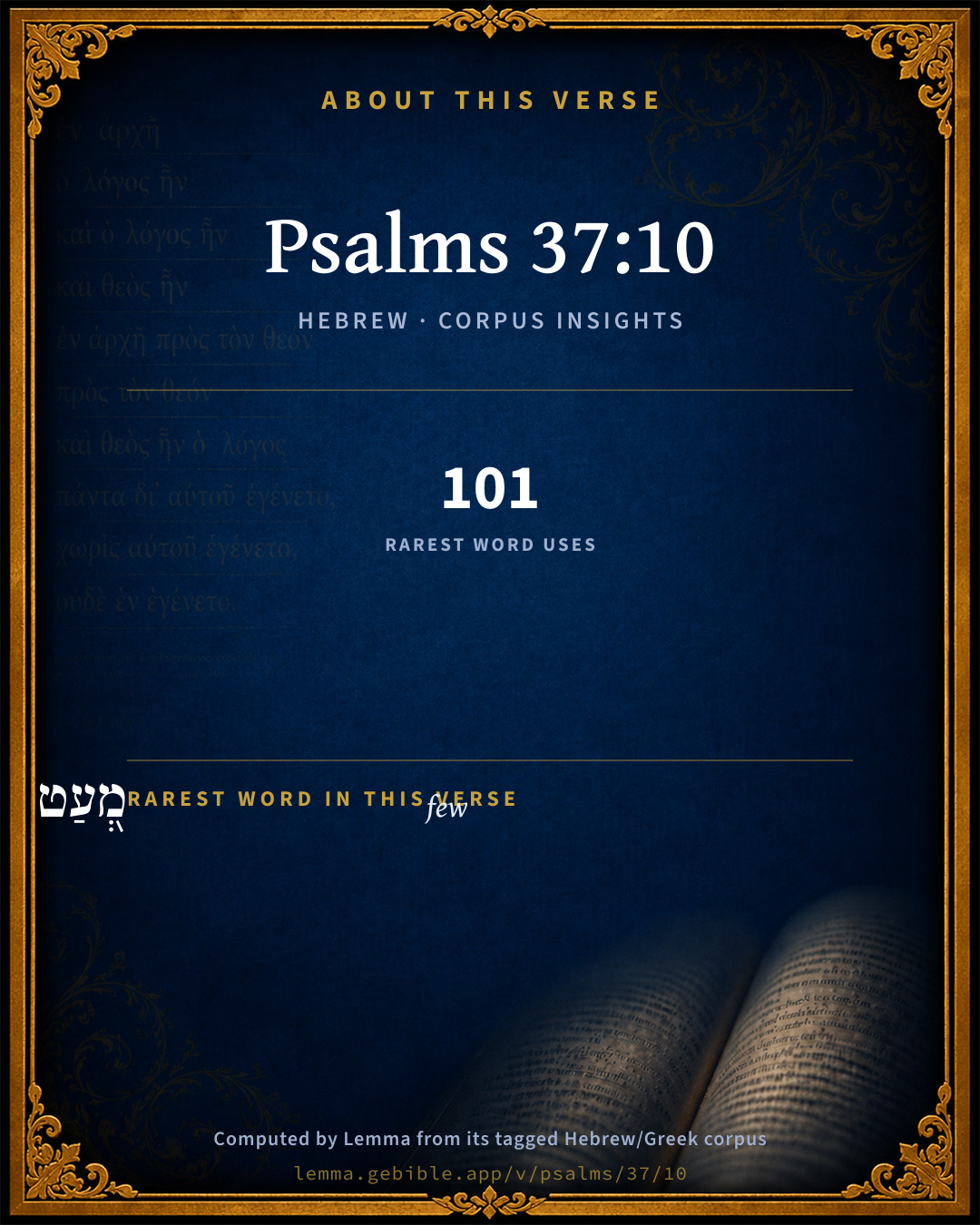
Psalms, in the Wisdom, opens this verse with 8 words (7 distinct Hebrew lemmas). Its most distinctive word is mᵉʻaṭ (“few”). A historical commentator’s framing appears above. Read the whole chapter for the surrounding context.

Discussion questions

  1. The word mᵉʻaṭ carries the sense “few.” How does it shape the verse?
  2. How does Job 24:24, which shares this passage’s theme, read alongside this verse?
  3. What does the repetition of “nothing” (2× in this one verse) do in this verse?
  4. The translations on this page render this verse differently — a whole-verse word diff, not a word-by-word alignment. What might account for the different wordings?
  5. «וְהִתְבּוֹנַ֖נְתָּ» is a Hithpolel Perfect verb. How does that grammatical form shape the action described?
  6. Compare how Trapp's Complete Commentary and The Biblical Illustrator read this verse. Where do they agree or differ?

Things to notice

Reading settings

Reading text

Shown beneath each verse's original-language words.

Old Testament
Old Testament edition

Read the OT as the Masoretic Hebrew (MT) or the Greek Septuagint (LXX).

English shown for the Greek Septuagint (in the Hebrew ↔ Greek comparison).

Comparing translations? Open the Compare panel on any verse page to stack up to four side by side.