
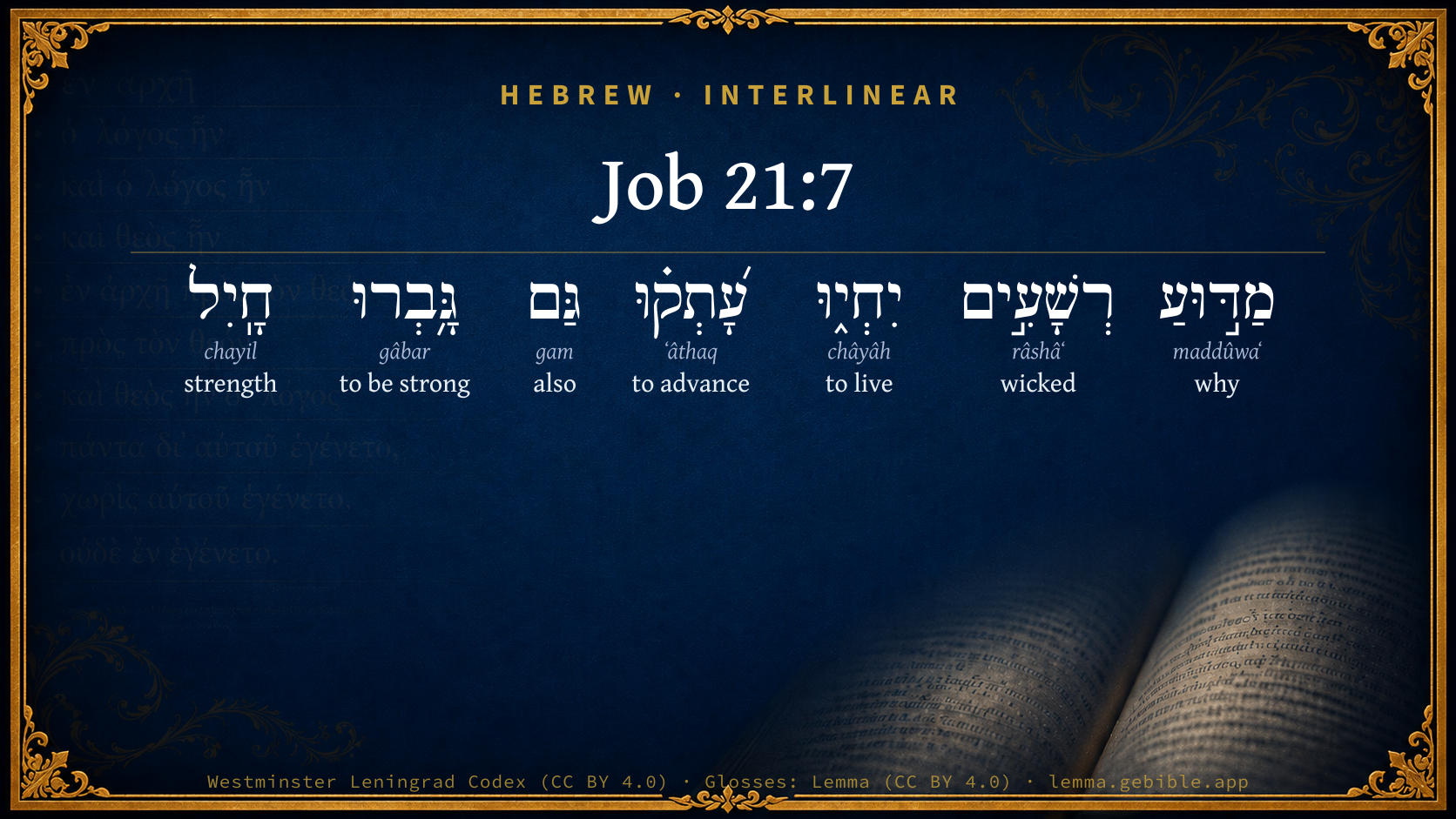
Job 21:7

Hebrew (Westminster Leningrad Codex) Job 21:7 appears in the Hebrew Old Testament. The text above is from the Westminster Leningrad Codex. Each word links to its Strong’s number, a concise gloss, and parsing drawn from the Open Scriptures Hebrew Bible morphology. Click any word for its full Brown-Driver-Briggs (BDB) entry.
Download image
Cite this verse

Job 21:7 (World English Bible). Public Domain. Lemma interlinear Bible study tool, https://lemma.gebible.app/v/job/21/7.

Show BibTeX & RIS
BibTeX
RIS
English Translation
"Why do the wicked live, Become old, yes, and grow mighty in power?
World English Bible · Public Domain
Download a study sheet

One document with this verse’s original text, its word-by-word gloss line, the meaning frame, cross-references with their text, attributed commentary, and full source and license credits — printable, and it pastes into notes with its structure intact.

This verse Autodidact and up

Study sheet (.html) Plain text (.txt)

A passage Seminary Student

Up to 50 verses in one chapter. A passage sheet keeps up to 6 commentary sources and 12 cross-references per verse, in the order this page ranks them, and says so on the sheet whenever that leaves anything out. Ask for a single verse and you get the Autodidact verse sheet above.

Everything on this page stays free to read, with no account — the sheet is a download of what is already on screen, not access to it.

Want to remove ads? Support Godless Engineer
Compare translations 3

The same verse in 3 English versions, stacked beneath the original-language interlinear above. Click any original word for its lexicon entry.

Each is an independent rendering of the whole verse — the interlinear is not word-aligned to these translations.

Highlighted words mark where these versions differ — a whole-verse word diff, not a word-by-word alignment.

  • World English Bible Public Domain
    "Why do the wicked live, Become old, yes, and grow mighty in power?
  • King James Version Public Domain
    Wherefore do the wicked live, become old, yea, are mighty in power?
  • unfoldingWord Literal Text CC BY-SA 4.0
    Why do the wicked live, grow old, and become mighty power?

unfoldingWord Literal Text — © unfoldingWord, licensed CC BY-SA 4.0. Word-aligned USFM3 via Door43 (git.door43.org/unfoldingWord/en_ult).

Versions to compare (up to 4)

3 of 4 selected

Show all 18 translations

Every available English version of this verse, each an independent rendering of the whole verse.

  • World English Bible Public Domain
    "Why do the wicked live, Become old, yes, and grow mighty in power?
  • Berean Standard Bible Public Domain
    Why do the wicked live on, growing old and increasing in power?
  • Majority Standard Bible Public Domain
    Why do the wicked live on, growing old and increasing in power?
  • King James Version Public Domain
    Wherefore do the wicked live, become old, yea, are mighty in power?
  • American Standard Version (1901) Public Domain
    Wherefore do the wicked live, Become old, yea, wax mighty in power?
  • Revised Version (1885) Public Domain
    Wherefore do the wicked live, become old, yea, wax mighty in power?
  • Geneva Bible (1599) Public Domain
    Wherefore do the wicked liue, and waxe olde, and grow in wealth?
  • Douay-Rheims (1899) Public Domain
    Why then do the wicked live, are they advanced, and strengthened with riches?
  • Young's Literal Translation Public Domain
    Wherefore do the wicked live? They have become old, Yea, they have been mighty in wealth.
  • Literal Standard Version CC BY-SA 4.0
    Why do the wicked live? They have become old, || Indeed, they have been mighty in wealth.
  • Unlocked Literal Bible CC BY-SA 4.0
    Why do wicked people continue to live, become old, and grow mighty in power?
  • unfoldingWord Literal Text CC BY-SA 4.0
    Why do the wicked live, grow old, and become mighty power?
  • Darby Bible Public Domain
    Wherefore do the wicked live, grow old, yea, become mighty in power?
  • World Messianic Bible Public Domain
    “Why do the wicked live, become old, yes, and grow mighty in power?
  • Webster's Bible Public Domain
    Why do the wicked live, become old, and, are mighty in power?
  • Free Bible Version CC BY-SA 4.0
    Why do the wicked continue to live, to grow old and increasingly powerful?
  • Bible in Basic English Public Domain
    Why is life given to the evil-doers? why do they become old and strong in power?
  • JPS Tanakh (1917) Public Domain
    Wherefore do the wicked live, become old, yea, wax mighty in power?

Literal Standard Version (2020), Covenant Press — licensed CC BY-SA 4.0. Text via the HelloAO Bible API (eBible.org). Unlocked Literal Bible (unfoldingWord) — licensed CC BY-SA 4.0. Text via the HelloAO Bible API (eBible.org). unfoldingWord Literal Text — © unfoldingWord, licensed CC BY-SA 4.0. Word-aligned USFM3 via Door43 (git.door43.org/unfoldingWord/en_ult). Free Bible Version, Dr. Jonathan Gallagher — licensed CC BY-SA 4.0. Text via the HelloAO Bible API (eBible.org).

Word by word

More ways to search: Search by grammar → Find every occurrence → Compare this word →

Practice this passage: Drill this verse → Learn its vocabulary →

About this verse

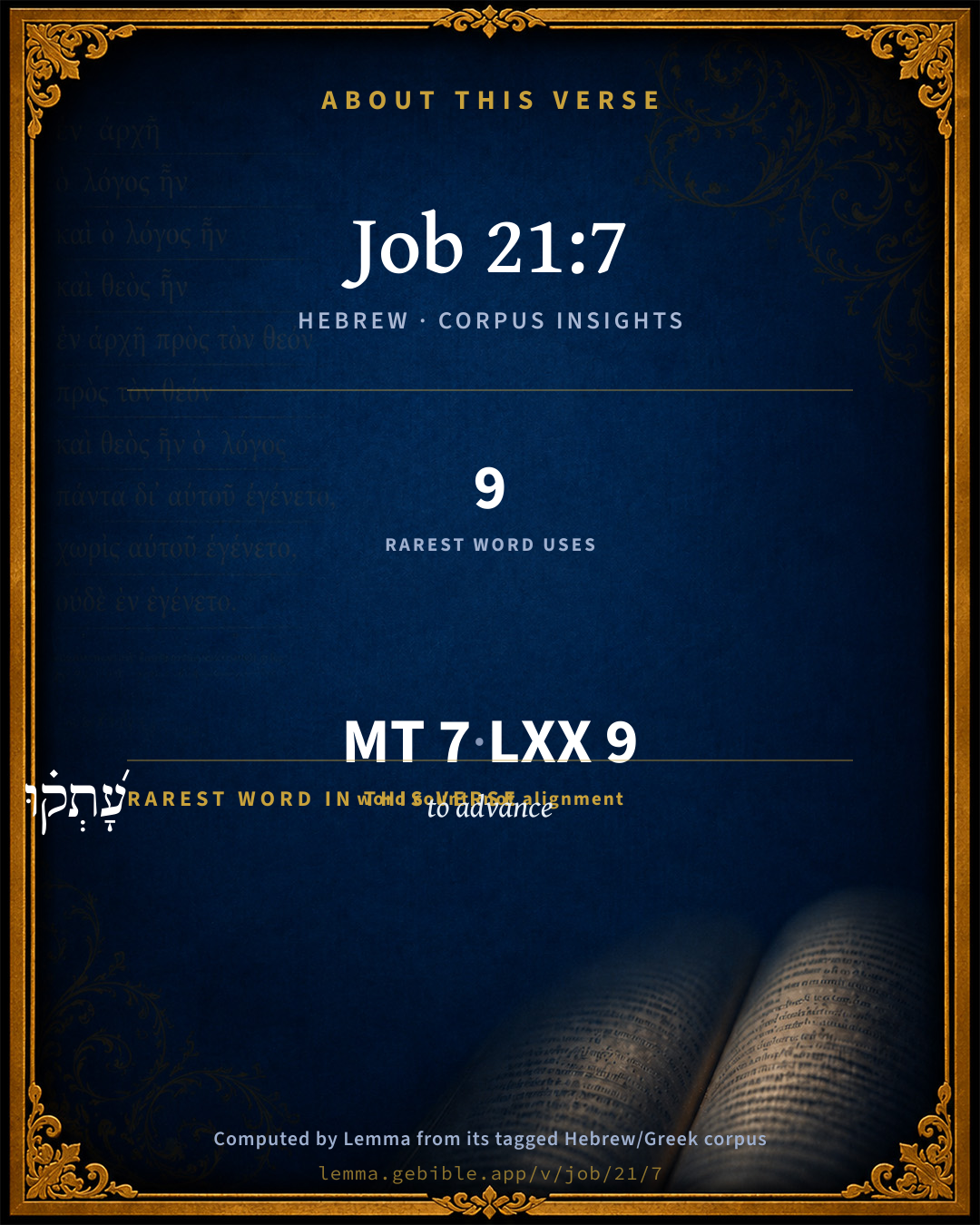
These counts appear in no published source. They are computed here, from the morphology-tagged text and Lemma’s own curated glosses. What Lemma adds →

7
words
7
distinct lemmas
Wisdom
section

Notable vocabulary

The rarest word here is עָ֝תְק֗וּ to advance H6275 — appearing just 9 times in the whole Hebrew Bible.

Shared distinctive vocabulary

עָ֝תְק֗וּ to advance H6275 occurs in 9 verses of the Hebrew Bible. Also found in:

Grammatical profile

  • 3 verbs
  • 1 noun
  • 1 adjective
  • 2 particles

Verb forms

  • יִחְי֑וּ Qal · Imperfect
  • עָ֝תְק֗וּ Qal · Perfect
  • גָּ֥בְרוּ Qal · Perfect

Hebrew & Septuagint length

In English translation the verse runs 13 words from the Hebrew and 11 from the Septuagint (LXX English) — closely comparable.

A rough comparison of the two English renderings, which tokenize alike — not a word-level alignment.

Word counts can differ between the Hebrew and the Greek without any difference in meaning — e.g. the Hebrew direct-object marker אֵת has no separate Greek word, and Greek often adds the article ὁ.

In the original languages it is 7 Hebrew tokens and 9 Greek tokens — but the two are counted differently (Hebrew bundles its prefixes and suffixes into one token; the Greek is in lemma form), so that isn’t a like-for-like length.

Cross-references

10

Topical passages linked to Job 21:7 in the Treasury of Scripture Knowledge — connected by theme and wording, ordered by reader-vote popularity; previews shown in the World English Bible.

  • Psalms 73:3–12 For I was envious of the arrogant, When I saw the prosperity of the wicked.
  • Job 12:6 The tents of robbers prosper, Those who provoke God are secure; Who carry their God in their hands.
  • Psalms 37:35 I have seen the wicked in great power, Spreading himself like a green tree in its native soil.
  • Jeremiah 12:1–3 Righteous are you, Yahweh, when I contend with you; yet would I reason the cause with you: why does the way of the wicked prosper? why are all they at ease who deal very treacherously?
  • Psalms 17:10 They close up their callous hearts. With their mouth they speak proudly.
  • Habakkuk 1:13 You who have purer eyes than to see evil, and who cannot look on perversity, why do you tolerate those who deal treacherously, and keep silent when the wicked swallows up the man who is more righteous than he,
  • Daniel 4:17 The sentence is by the decree of the watchers, and the demand by the word of the holy ones; to the intent that the living may know that the Most High rules in the kingdom of men, and gives it to whoever he will, and sets up over it the lowest of men.
  • Habakkuk 1:15–16 He takes up all of them with the hook. He catches them in his net, and gathers them in his dragnet. Therefore he rejoices and is glad.
  • Revelation 13:2–7 The beast which I saw was like a leopard, and his feet were like those of a bear, and his mouth like the mouth of a lion. The dragon gave him his power, his throne, and great authority.
  • Revelation 17:2–4 with whom the kings of the earth committed sexual immorality, and those who dwell in the earth were made drunken with the wine of her sexual immorality."

Cross-references courtesy of OpenBible.info (CC BY 4.0).

Hebrew and Greek witnesses Masoretic Hebrew ↔ Greek Septuagint

The same verse in the two great witnesses to the Old Testament, shown verse-for-verse.

These are two independent witnesses, not word-aligned to each other, and the Septuagint is shown in lemma (dictionary) form.

Hebrew Job 21:7 Masoretic · Westminster Leningrad Codex

מַדּ֣וּעַ רְשָׁעִ֣ים יִחְי֑וּ עָ֝תְק֗וּ גַּם גָּ֥בְרוּ חָֽיִל

"Why do the wicked live, Become old, yes, and grow mighty in power?

World English Bible · Public Domain

Greek LXX Job 21:7 Septuagint · lemma form

διά τίς ἀσεβής ζάω παλαιόω δέ καί ἐν πλοῦτος

Therefore do the ungodly live, and grow old even in wealth?

LXX2012 (modern English Septuagint) · Public Domain

On this verse, Keil & Delitzsch discusses the Septuagint’s reading. Read the note in Commentary ↓

Hebrew: Westminster Leningrad Codex (CC BY 4.0). Greek: Septuagint (public domain); English from LXX2012 (modern English Septuagint) (Public Domain). How the Septuagint differs from the Hebrew →

Commentary

Notes on Job 21:7 from classic Christian and Jewish commentators (each source and its license shown beneath its notes). The classic Christian expositions comment on the surrounding passage and are grouped to its opening verse, so a note may address several verses; the Jewish commentaries on the Tanakh (Rashi and others) are per-verse, so they appear only where the commentator wrote on this verse.

Lemma curates 59 commentaries, every one of them public domain or Creative Commons licensed, each selected and text-cleaned for this edition rather than reprinted as found. About our sources →

Matthew Henry's Commentary

All Job's three friends, in their last discourses, had been very copious in describing the miserable condition of a wicked man in this world. "It is true," says Job, "remarkable judgments are sometimes brought upon notorious sinners, but not always; for we have many instances of the great and long prosperity of those that are openly and avowedly wicked; though they are hardened in their wickedness by their prosperity, yet they are still suffered to prosper."

I. He here describes their prosperity in the height, and breadth, and length of it. "If this be true, as you say, pray tell me wherefore do the wicked live?" Job 21:7.

1. The matter of fact is taken for granted, for we see instances of it every day. (1.) They live, and are not suddenly cut off by the strokes of divine vengeance. Those yet speak who have set their mouths against the heavens. Those yet act who have stretched out their hands against God. Not only they live (that is, they are reprieved), but they live in prosperity, Sa1 25:6. Nay, (2.) They become old; they have the honour, satisfaction, and advantage of living long, long enough to raise their families and estates. We read of a sinner a hundred years old, Isa 65:20. But this is not all. (3.) They are mighty in power, are preferred to places of authority and trust, and not only make a great figure, but bear a great sway. Vivit imo, et in senatum venit - He not only lives, but appears in the senate. Now wherefore is it so? Note, It is worth while to enquire into the reasons of the outward prosperity of wicked people. It is not because God has forsaken the earth, because he does not see, or does not hate, or cannot punish their wickedness; but it is because the measure of their iniquities is not full. This is the day of God's patience, and, in some way or other, he makes use of them and their prosperity to serve his own counsels, while it ripens them for ruin; but the chief reason is because he will make it to appear there is another world which is the world of retribution, and not this.

2. The prosperity of the wicked is here described to be,

(1.) Complete and consummate. [1.] They are multiplied, and their family is built up, and they have the satisfaction of seeing it (Job 21:8): Their seed is established in their sight. This is put first, as that which gives both a pleasant enjoyment and a pleasing prospect. [2.] They are easy and quiet, Job 21:9. Whereas Zophar had spoken of their continual frights and terrors, Job says, Their houses are safe both from danger and from the fear of it (Job 21:9), and so far are they from the killing wounds of God's sword or arrows that they do not feel the smart of so much as the rod of God upon them. [3.] They are rich and thrive in their estates. Of this he gives only one instance, Job 21:10. Their cattle increase, and they meet with no disappointment in them; not so much as a cow casts her calf, and then their much must needs grow more. This is promised, Exo 23:26; Deu 7:14. [4.] They are merry and live a jovial life (Job 21:11, Job 21:12): They send forth their little ones abroad among their neighbours, like a flock, in great numbers, to sport themselves. They have their balls and music-meetings, at which their children dance; and dancing is fittest for children, who know not better how to spend their time and whose innocency guards them against the mischiefs that commonly attend it. Though the parents are not so very youthful and frolicsome as to dance themselves, yet they take the timbrel and harp; they pipe, and their children dance after their pipe, and they know no grief to put their instruments out of tune or to withhold their hearts from any joy. Some observe that this is an instance of their vanity, as well as of their prosperity. Here is none of that care taken of their children which Abraham took of his, to teach them the way of the Lord, Gen 18:19. Their children do not pray, or say their catechism, but dance, and sing, and rejoice at the sound of the organ. Sensual pleasures are all the delights of carnal people, and as men are themselves so they breed their children.

(2.) Continuing and constant (Job 21:13): They spend their days, all their days, in wealth, and never know what it is to want - in mirth, and never know what sadness means; and at last, without any previous alarms to frighten them, without any anguish or agony, in a moment they go down to the grave, and there are no bands in their death. If there were not another life after this, it were most desirable to die by the quickest shortest strokes of death. Since we must go down to the grave, if that were the furthest of our journey, we should wish to go down in a moment, to swallow the bitter pill, and not chew it.

II. He shows how they abuse their prosperity and are confirmed and hardened by it in their impiety, Job 21:14, Job 21:15.

1. Their gold and silver serve to steel them, to make them more insolent, and more impudent, in their wickedness. Now he mentions this either, (1.) To increase the difficulty. It is strange that any wicked people should prosper thus, but especially that those should prosper who have arrived at such a pitch of wickedness as openly to bid defiance to God himself, and tell him to his face that they care not for him; nay, and that their prosperity should be continued, though they bear up themselves upon that, in their opposition to God; with that weapon they fight against him, and yet are not disarmed. Or, (2.) To lessen the difficulty. God suffers them to prosper; but let us not wonder at it, for the prosperity of fools destroys them, by hardening them in sin, Pro 1:32; Psa 73:7-9.

2. See how light these prospering sinners make of God and religion, as if because they have so much of this world they had no need to look after another.

(1.) See how ill affected they are to God and religion; they abandon them, and cast off the thoughts of them. [1.] They dread the presence of God; they say unto him, "Depart from us; let us never be troubled with the apprehension of our being under God's eye nor be restrained by the fear of him." Or they bid him depart as one they do not need, nor have any occasion to make use of. The world is the portion they have chosen, and take up with, and think themselves happy in; while they have that they can live without God. Justly will God say Depart (Mat 25:41) to those who have bidden him depart; and justly does he now take them at their word. [2.] They dread the knowledge of God, and of his will, and of their duty to him: We desire not the knowledge of thy ways. Those that are resolved not to walk in God's ways desire not to know them, because their knowledge will be a continual reproach to their disobedience, Joh 3:19.

(2.) See how they argue against God and religion (Job 21:15): What is the Almighty? Strange that ever creatures should speak so insolently, that ever reasonable creatures should speak so absurdly and unreasonably. The two great bonds by which we are drawn and held to religion are those of duty and interest; now they here endeavour to break both these bonds asunder. [1.] They will not believe it is their duty to be religious: What is the Almighty, that we should serve him? Like Pharaoh (Exo 5:2), Who is the Lord, that I should obey his voice? Observe, First, How slightly they speak of God: What is the Almighty? As if he were a mere name, a mere cipher, or one they have nothing to do with and that has nothing to do with them. Secondly, How hardly they speak of religion. They call it a service, and mean a hard service. Is it not enough, they think, to keep up a fair correspondence with the Almighty, but they must serve him, which they look upon as a task and drudgery. Thirdly, How highly they speak of themselves: "That we should serve him; we who are rich and mighty in power, shall we be subject and accountable to him? No, we are lords," Jer 2:31. [2.] They will not believe it is their interest to be religious: What profit shall we have if we pray unto him? All the world are for what they can get, and therefore wisdom's merchandise is neglected, because they think there is nothing to be got by it. It is vain to serve God, Mal 3:13, Mal 3:14. Praying will not pay debts nor portion children; nay, perhaps serious godliness may hinder a man's preferment and expose him to losses; and what then? Is nothing to be called gain but the wealth and honour of this world? If we obtain the favour of God, and spiritual and eternal blessings, we have no reason to complain of losing by our religion. But, if we have not profit by prayer, it is our own fault (Isa 58:3, Isa 58:4), it is because we ask amiss, Jam 4:3. Religion itself is not a vain thing; if it be so to us, we may thank ourselves for resting in the outside of it, Jam 1:26.

III. He shows their folly herein, and utterly disclaims all concurrence with them (Job 21:19): Lo, their good is not in their hand, that is, they did not get it without God, and therefore they are very ungrateful to slight him thus. It was not their might, nor the power of their hand, that got them this wealth, and therefore they ought to remember God who gave it them. Nor can they keep it without God, and therefore they are very unwise to lose their interest in him and bid him to depart from them. Some give this sense of it: "Their good is in their barns and their bags, hoarded up there; it is not in their hand, to do good to others with it; and then what good does it do them?" "Therefore," says Job, "the counsel of the wicked is far from me. Far be it from me that I should be of their mind, say as they say, do as they do, and take my measures from them. Their posterity approve their sayings, though their way be their folly (Psa 49:13); but I know better things than to walk in their counsel."

Matthew Henry's Commentary on the Whole Bible (1708–1710) — public domain (CC PDM 1.0). Text via the HelloAO Bible API.

The Cambridge Bible for Schools and Colleges

gen. ed. J. J. S. Perowne

7. Wherefore do the wicked live] The question scarcely means, How is it, if your principles be true, that the wicked live? Job’s mind is engrossed with the great problem itself, and he asks, Why in the government of a righteous God do the wicked live? They not only live, they live to old age, and wax mighty in the earth.

7–16. The mystery is, Why do the wicked prosper? They live long, they see their children grow up, and their homes are peaceful (Job_21:7-9). Their cattle thrives (Job_21:10). Their children and they pass a mirthful life with music and dance (Job_21:11-12). And with no pain at last they die, though they had openly renounced God (Job_21:13-15). Yet it is God who bestows this prosperity upon them (Job_21:16).

7–21. This great mystery of the prosperity of the wicked in God’s providence Job now unfolds on both its sides: first, they and all belonging to them prosper, and they die in peace, although in conscious godlessness they bade the Almighty depart from them, Job_21:7-16; and second, negatively, examples of calamity befalling them are few, Job_21:17-21.

The Cambridge Bible for Schools and Colleges (gen. ed. J. J. S. Perowne; Cambridge University Press, 1878–1918) — public domain. Text from a community e-Sword module.

Trapp's Complete Commentary

John Trapp

Job 21:7 Wherefore do the wicked live, become old, yea, are mighty in power?

Ver. 7. Wherefore do the wicked live, become old] Vivunt, veteraseunt, they are lively and longlived, so that they outlast many better than themselves; being as sound as roaches and as vivacious as the snail, the property whereof is to live a long while even after the head is off and the heart out. Of some creatures we use to say, that they have nine lives; of some wicked men it may be thought so, they do evil a hundred times, and yet their days are prolonged, Ecc 9:12. Manasseh reigned longest of any king in Judah. Pope John XXII. (that monster and mortalist) lived longest of any pope, and died richest. God gives wealth, health, and long life to many wicked, Non aliter ac siquis crumenam ingentem aure plenam latrinae inieciat, saith one; No otherwise than as when a man casts a great purse filled with gold into an outhouse (Gasp. Ens.). Now if any shall ask, with Job, Why all this? the apostle answereth one question by another: Rom 9:22, "What if God, willing to show his wrath, and to make his power known, endure with much long suffering the vessels of wrath fitted to destruction?" What hath anyman to say to that? And again, Who knows not that the Lord hath appointed a day wherein he will judge the world in righteousness, even that day of the revelation of the righteous judgment, Act 17:31 Rom 2:5. The Judge of the earth keepeth his petty sessions now, letting the law pass upon some few, reserving the rest till the great assizes, 1Ti 5:24.

Yea, are mighty in power?] Or, prevail in wealth, which maketh them mighty; for money is the monarch of this present world, and carrieth all before it.

John Trapp, A Commentary or Exposition upon All the Books of the Old and New Testament (1647–1656) — public domain. Text from a community e-Sword module.

The Biblical Illustrator

Joseph S. Exell

Job_21:7

Wherefore do the wicked live?

Reason for the existence of the wicked on earth

I. As witnesses to attest.

1. The amount of freedom with which man is endowed. How free is man compared to everything about him.

2. The wonderful forbearance of God.

3. The existence of an extraordinary element in the Divine government of this world. We know that in heaven beings live and are happy because they are holy; we are taught that in hell there is inexpressible misery because there is such awful sin. But here are men living often to a good old age, often possessing all they can wish of earthly comfort, and yet rebels against God, without repentance, without faith, without love, and we wonder why this world is thus an exception. Earth is under a mediatorial government. This great mystery of Christs suffering for man, and prolonging his probation, can alone explain the other great mystery, that men of debased spirit and godless life are permitted to live here instead of being banished to hell.

II. As instruments to discipline.

1. In calling out resistance. Blessed is the man that endureth temptation; when he is tried he shall receive a crown of life. The wicked are often as the chisel by which God carves out the good mans character, the fires by which it is purified.

2. By calling out the Christians benevolence. Our compassion, prayers, self-sacrifice, work, are all called forth by the existence of the wicked.

III. As beacons to warn.

1. As to the progress of sin.

2. As to the effects of sin.

IV. As criminals to reform. This is the grand end of their prolonged life. The world is a great reformatory. (Urijah R. Thomas.)

Why do the live

?--

1. That they may have the opportunity of being reconciled to God.

2. That they may be the instruments of good to others.

3. That they may display the long suffering and forbearance of God.

4. That they may furnish an argument for a future state of retribution.

5. That they may demonstrate the equity of their own everlasting condemnation. (G. Brooks.)

Why do the wicked live

They build up fortunes that overshadow the earth, and confound all the life insurance tables on the subject of longevity, some of them dying octogenarians, or perhaps nonagenarians, or possibly centenarians. Ahab in the palace, and Elijah in the loft. Unclean Herod on the throne, and Paul, the consecrated, twisting ropes for tent making. Manasseh, the worst of all the kings of Judah, lives the longest. While the general rule is that the wicked do not live out half their days, there are instances where they live to a great age in paradises of beauty and luxury, with a whole college of physicians expending its skill in the attempt for further prolongation, and then have a funeral with coffin under mountains of calla lily and a procession with all the finest equipages of the city flashing and jingling into hue, taking the poor angleworm of the dust out to its hole in the ground with a pomp that might make the passing spirit from some other world think that the archangel Michael was dead. Go up among the great residences of our cities and read the door plates and see how many of them hold the names of men mighty for commercial or social iniquity, vampires of the century, Gorgons of the ages. Every wheel of their carriage is a Juggernaut wet with the blood of those sacrificed to their avarice and evil design. Men who are like Caligula, who wished that all people were in one neck that he might cut it off at one blow. Oh, the slain! the slain! what a procession of libertines, of usurers, of infamous quacks, of legal charlatans, of world-grabbing monsters. What apostles of despoliation! what demons incarnate thousands of men who have concentrated all their energies of body, mind, and soul into one prolonged and ever-intensified and unrelenting effort to sacrifice and blast and consume the world! I do not blame you for asking the quivering, throbbing, burning, resounding, appalling question of the text: Why do the wicked live? (T. De Witt Talmage.)

The Biblical Illustrator, edited by Joseph S. Exell (c. 1880s–1900s) — public domain. Text from a community e-Sword module.

Joseph Benson's Commentary

Job 21:7. Wherefore do the wicked live? — That is, long and happily: become old? — Namely, in their prosperous state: yea, are mighty in power? — Are preferred to places of authority and trust, and not only make a great figure, but bear a great sway? Now, if things be as you say, how comes this to pass? Wherefore does the righteous God distribute things so unequally? “The description, which follows, of a prosperous estate is such as might, indeed, justly create envy, were a wicked man, in any state, to be envied; for we have here the chief ingredients of human happiness, as it respects this life, brought together and described in terms exactly suiting the simplicity of manners, and the way of living in Job’s time and country, as, first, security and safety to themselves and families; Job 21:9. Their houses are safe from fear — Of the incursions of robbers, we may suppose, or the depredations of the neighbouring clans, so usual in those ancient times, and of which Job had felt the mischievous effects. Next health, or a freedom from diseases, called in the language of that age, the rod of God. See 1Sa 26:10. To this is added plenty of cattle, the riches of those times; Job 21:10. Next comes a numerous and hopeful offspring; and what a rural picture has he drawn of them! Job 21:11. They send forth their little ones like a flock — Of sheep or goats, as the word signifies, in great numbers, and with sweet concord, which is a singular delight to them and their parents. They take the timbrel and harp, and rejoice at the sound of the pipe; Job 21:12. Lastly, and to crown all, after a prosperous and pleasant life comes an easy death. They spend their days in wealth, and in a moment go down to the grave — That is, their days pass on in a continual flow of prosperity, till they drop into the grave without a groan. As every thing in this divine poem is wonderful, there is scarce any thing more to be admired in it than the variety of descriptions which are given us of human life, in its most exalted prosperity, on the one hand, and its deepest distress on the other: for this is what their subject led them to enlarge upon on both sides; with this only difference, that the three friends were for limiting prosperity to the good, whereas Job insists upon a mixed distribution of things from the hand of Providence; but as all of them, in every speech almost, enlarge upon one or other of these topics, the variety of imagery and colouring in which they paint to us these different estates, all drawn from nature, and suiting the simplicity of those ancient times, is inexpressibly amusing and entertaining: then their being considered as the dispensations of Providence, and it being represented that we can receive neither good nor evil but from God, the judge of all, a point acknowledged on both hands, is what renders these descriptions interesting and affecting to us in the highest degree; and the whole affords no contemptible argument of the antiquity of the book. See Peters and Dodd.

Joseph Benson's Commentary on the Old and New Testaments (1811–1818) — public domain. Text from a community e-Sword module.

Whedon's Commentary on the Bible

Daniel D. Whedon

Main division — THE DIVINE ADMINISTRATION OF AWARDS IN THIS WORLD TENDS TO CONFOUND MORAL DISTINCTIONS, Job_21:7-26.

First half — THE WICKED DEFY GOD, AND YET GOD PROSPERS THEM EVEN UNTO SHEOL, Job_21:7-16.

First strophe — Instead of suffering punishment, as Zophar maintained, the wicked live, grow old surrounded by their families, and safe from the discipline of Heaven, Job_21:7-11.

7. Wherefore do the wicked live — Zophar’s assertion (Job_20:5,) calls forth the counter thesis of this verse. The existence of evil is a mystery, among the first to perplex and the last to leave the mind. The question why the wicked live is but one of its phases, and is of personal interest, for it concerns ourselves. The question does not so often assume the form why we should live, as why others should, whom we suppose to be much more depraved than ourselves. Its solution is much simplified if we confine the thought to ourselves, for extreme wickedness is but the outgrowth of a nature that we share in common with the wicked. In such case of reflection upon ourselves and others there will readily be suggested: 1. The possibilities for good in all moral existence; 2. That the freedom of the will devolves upon the human agent the responsibility of perverted life; and, 3. Perfection of being can seemingly be secured only amid the most adverse influences of trial, for Christ himself was made “perfect through suffering,” one large element of which was meted out at the hand of the wicked. Science resolves its nebulae; but this cloud of mystery defies all resolution, and may continue so to do forever. Goethe has said profoundly, “Man is not born to solve the mystery of existence, but he must nevertheless attempt it, that he may learn to keep within the limits of the knowable.” For Plutarch’s views on the protracted life of the wicked, see Meth. Quar. Revelation, 1852, pp. 399-401; or Bib. Sacra, 1856, pp. 616-619.

Daniel D. Whedon (gen. ed.), Commentary on the Old and New Testaments (1874–1909) — public domain. Text from a community e-Sword module.

Keil & Delitzsch

C. F. Keil & F. Delitzsch

7 Wherefore do the wicked live,

Become old, yea, become mighty in power?

8 Their posterity is established before them about them,

And their offspring before their eyes.

9 Their houses have peace without fear,

And the rod of Eloah cometh not upon them.

10 His (the evil-doer's) bull gendereth and faileth not;

His cow calveth easily, and casteth not her calf.

11 They let their little ones run about as a flock,

And their children jump about.

The question in Job 21:7 is the same as that which Jeremiah also puts forth, Job 12:1-3. It is the antithesis of Zophar's thesis, Job 20:5, and seeks the reason of the fact established by experience which had also well-nigh proved the ruin of Asaph (Ps 73: comp. Mal 3:13-15), viz., that the ungodly, far from being overtaken by the punishment of their godlessness, continued in the enjoyment of life, that they attain to old age, and also a proportionately increasing power and wealth. The verb עתק, which in Job 14:18; Job 18:4 (comp. the Hiph. Job 9:5; Job 32:15), we read in the signification promoveri, has here, like the Arabic ‛ataqa, ‛atuqa, the signification to become old, aetate provehi; and גּבר חיל, to become strong in property, is a synonym of השׂגּה חיל, to acquire constantly increasing possessions, used in a similar connection in Psa 73:12. The first feature in the picture of the prosperity of the wicked, which the pang of being bereft of his own children brings home to Job, is that they are spared the same kind of loss: their posterity is established (נכון, constitutus, elsewhere standing in readiness, Job 12:5; Job 15:23; Job 18:12, here standing firm, as e.g., Psa 93:2) in their sight about them (so that they have to mourn neither their loss by death nor by separation from their home), and their offspring (צאצאים, a word common only to the undisputed as well as to the disputed prophecies of Isaiah and the book of Job) before their eyes; נכון must be carried over to Job 21:8 as predicate: they are, without any loss, before their eyes. The description passes over from the children, the corner-stones of the house (vid., Ges. Thes., s.v. בנה), to the houses themselves. It is just as questionable here as in Job 5:24; Isa 41:3, and elsewhere, whether שׁלום is a subst. (= בשׁלום) or an adj.; the substantival rendering is at least equally admissible in such an elevated poetic speech, and the plur. subject בּתּיהם, which, if the predicate were intended to be taken as an adj., leads one to expect שׁלומים, decides in its favour. On מפּחד, without (far from) terrifying misfortune, as Isa 22:3, מקשׁת, without a bow, vid., on Job 19:26. That which is expressed in Job 21:9, according to external appearance, is in Job 21:9 referred to the final cause; Eloah's שׁבט, rod, with which He smites in punishment (Job 9:34; Job 37:13, comp. Isa 10:24-26, where שׁוט, scourge, interchanges with it), is not over them, i.e., threatens and smites them not.

Job 21:10 comes specially to the state of the cattle, after the state of the household in general has been treated of. Since שׁורו and פּרתו are interchangeable, and are construed according to their genus, the former undoubtedly is intended of the male, not also epikoi'noos of the female (lxx ἡ βοῦς, Jerome, Saadia), as Rosenm., after Bochart, believes it must be taken, because `br is never said de mare feminam ineunte, but always de femina quae concipit. In reality, however, it is with עבר otherwise than with עדה, whose Pael and Aphel certainly signify concipere (prop. transmittere sc. semen in a passive sense). On the other hand, עבר, even in Kal, signifies to be impregnated (whence עובר, the embryo, and the biblical אבוּר, like the extra-biblical עבּוּר, the produce of the land), the Pael consequently to impregnate, whence מעבּרא (from the part. pass. מעבּר) impregnated (pregnant), the Ithpa. to be impregnated, as Rabb. Pual מעבּרת, impregnated (by which עברת also signifies pregnant, which would be hardly possible if עבר in this sexual sense were not radically distinct from עבר, περ-ᾶν). Accordingly the Targ. translates עבּר by מבטין (impraegnans), and Gecatilia translates שׁורו by Arab. fḥlhm (admissarius eorum), after which nearly all Jewish expositors explain. This explanation also suits לא יגעל, which lxx translates οὐκ οὀμοτόκησε (Jer. non abortivit), Symm. in a like sense οὐκ ἐξέτρωσε, Aq. οὐκ εξέβαλε, Saad. la julziq. The reference of שׁורו to the female animal everywhere assumed is incorrect; on the contrary, the bullock kept for breeding is the subject; but proceeding from this, that which is affirmed is certainly referred to the female animal. For גּעל signifies to cast out, cast away; the Hiph. therefore: to cause to cast out; Rabb. in the specified signification: so to heat what has sucked in that which is unclean, that it gives it back or lets it go (לפלוט הבלוע). Accordingly Raschi explains: "he injects not useless seed into her, which might come back and be again separated (נפלט) from her inward part, without impregnation taking place." What therefore עבּר says positively, ולא יגעיל says negatively: neque efficit ut ejiciat.

(Note: The Aruch under גּעל, quotes a passage of the Tosefta: מוזרות נפשׁ היפה תאכלם גיעולי ביצים מותרים באכילה, the cast away (Wrflinge) eggs (i.e., such as have fallen away from the hen from a stroke on the tail of some other cause, and which are not completely formed) are allowed as food; he may eat them who does not loathe them.)

It is then further, in Job 21:9, said of the female animal which has been impregnated that she does not allow it to glide away, i.e., the fruit, therefore that she brings forth (פּלּט as מלּט, המליט), and that she does not cause or suffer any untimely birth.

At the end of the strophe, Job 21:11, the poet with delicate tact makes the sufferer, who is become childless, return to the joy of the wicked in the abundance of children. שׁלּח signifies here, as Isa 32:20, to allow freedom for motion and exercise. On עויל, vid., on Job 16:11; Job 19:18. It has a similar root (Arab. ‛âl, alere) to the Arab. ‛ajjil (collect. ‛ijâl), servants, but not a similar meaning. The subj. to Job 21:12 are not the children, but the "wicked" themselves, the happy fathers of the flocks of children that are let loose.

Keil & Delitzsch — Biblical Commentary on the Old Testament (1861–1891) — public domain (CC PDM 1.0). Text via the HelloAO Bible API. (Old Testament only.)

Geneva Bible (1599)

Geneva Bible translators

Job proveth against his adversaries that God punisheth not straightways the wicked, but oft times giveth them long life, and prosperity: so that we must not judge God just or unjust by the things that appear to our eyes.

Geneva Bible (1599) marginal notes — public domain. Text via Bolls.life.

Jamieson, Fausset & Brown

Robert Jamieson, A. R. Fausset & David Brown

The answer is Rom 2:4; Ti1 1:16; Psa 73:18; Ecc 8:11-13; Luk 2:35-end; Pro 16:4; Rom 9:22.

old--in opposition to the friends who asserted that sinners are "cut off" early (Job 8:12, Job 8:14).

Jamieson, Fausset & Brown — Commentary Critical and Explanatory on the Whole Bible (1871) — public domain (CC PDM 1.0). Text via the HelloAO Bible API.

Adam Clarke's Commentary

Verse 7. Wherefore do the wicked live] You have frequently asserted that the wicked are invariably punished in this life; and that the righteous are ever distinguished by the strongest marks of God's providential kindness; how then does it come that many wicked men live long and prosperously, and at last die in peace, without any evidence whatever of God's displeasure? This is a fact that is occurring daily; none can deny it; how then will you reconcile it with your maxims?

Adam Clarke's Commentary on the Bible (1810–1826) — public domain. Text from a community e-Sword/MySword module.

John Gill's Exposition

Their seed is established in their sight with them,.... Which is to be understood not of seed sown in the earth, and of the permanence and increase of that, but of their children; to have a numerous progeny, was reckoned a great temporal blessing, and to have them settled happily and comfortably in the world was an additional one; and what contributed still more to their felicity was, that they were well settled during their life, or they yet living, and with their eyes beholding their prosperous and stable condition; and also "with them"; near them, in the same neighbourhood, or at no great distance from them; or even in like circumstances with them, equally as well settled and as prosperous as themselves, as this phrase is sometimes used, see Psa 106:6;

and their offspring before their eyes; their children's children, as the Targum, and so the Vulgate Latin version; so that prosperity attends not only wicked men and their children, but also their grandchildren, and they live to see these grown up and settled in the world, and in thriving circumstances; all which must give them pleasure, and be matter of honour and glory to them, Pro 17:6. Now this is diametrically opposite to Zophar's notion of the short continuance of the prosperity of wicked men, and of the low and miserable condition of their children, Job 20:5.

John Gill's Exposition of the Whole Bible (1746–1763) — public domain (CC PDM 1.0). Text via the HelloAO Bible API.

Albert Barnes' Notes on the Bible

Wherefore do the wicked live? - Job comes now to the main design of his argument in this chapter, to show that it is a fact, that the wicked often have great prosperity; that they are not treated in this life according to their character; and that it is not a fact that men of eminent wickedness, as his friends maintained, would meet, in this life, with proportionate sufferings. He says, that the fact is, that they enjoy great prosperity; that they live to a great age; and that they are surrounded with the comforts of life in an eminent degree. The meaning is, “If you are positive that the wicked are treated according to their character in this life - that great wickedness is followed by great judgments, how is it to be accounted for that they live, and grow old, and are mighty in power?” Job assumes the fact to be so, and proceeds to argue as if that were indisputable. It is remarkable, that the fact was not adverted to at an earlier period of the debate. It would have done much to settle the controversy. The “question,” “Why do the wicked live?” is one of great importance at all times, and one which it is natural to ask, but which it is not even yet always easy to answer. “Some” points are clear, and may be easily suggested. They are such as these - They live

(1) to show the forbearance and long suffering of God;

(2) to furnish a full illustration of the character of the human heart;

(3) to afford them ample space for repentance, so that there shall not be the semblance of a ground of complaint when they are called before God, and are condemned;

(4) because God intends to make some of them the monuments of his mercy, and more fully to display the riches of his grace in their conversion, as he did in the case of Paul, Augustine, John Bunyan, and John Newton;

(5) they may be preserved to be the instruments of his executing some important purpose by them, as was the case with Pharaoh, Sennacherib, and Nebuchadnezzar; or,

(6) he keeps them, that the great interests of society may be carried on; that the affairs of the commercial and the political world may be forwarded by their skill and talent.

For some, or all of these purposes, it may be, the wicked are kept in the land of the living, and are favored with great external prosperity, while many a Christian is oppressed, afflicted, and crushed to the dust. Of the “fact,” there can be no doubt; of the “reasons” for the fact, there will be a fuller development in the future world than there can be now.

Become old - The friends of Job had maintained that the wicked would be cut off. Job, on the other hand, affirms that they live on to old age. The “fact” is, that many of the wicked are cut off for their sins in early life, but that some live on to an extreme old age. The argument of Job is founded on the fact, that “any” should live to old age, as, according to the principles of his friends, “all” were treated in this life according to their character.

Yea, are mighty in power - Or, rather, “in wealth” - חיל chayı̂l. Jerome, “Are comforted in riches” - ”confortatique divitiis.” So the Septuagint, ἐν πλούτῳ en ploutō. The idea is, that they become very rich.

Albert Barnes' Notes on the Bible (1834–1885) — public domain. Text from a community e-Sword/MySword module.

Haydock's Catholic Bible Commentary

Riches. This is what fills me with great anxiety. Yet it quite destroys the force of your argument, (Calmet) since you pretend that the prosperity of the wicked is never of long duration. We see them, however, live to an advanced old age, (Haydock) continually offending God, and annoying their neighbours. (Calmet) --- Septuagint, "yea, they grow old in riches."

George Leo Haydock (1774–1849), Haydock's Catholic Family Bible and Commentary, 1859 edition — public domain. Excludes Psalms (Douay-Rheims chapter numbering differs from Protestant) and Deuterocanonical books (Catholic canon only).

Matthew Poole's English Annotations

He expostulates this matter partly with his friends, If things be as you say, how comes this to pass, &c? partly with God himself, Wherefore doth the righteous God distribute things so unequally?

The wicked live, to wit, long and happily; as living is oft taken, as Lev 18:5; 1Sa 10:24; 25:6; Psa 38:19; a painful and afflicted life being a kind of death, and oft so called, as Deu 30:15,19; Pr 15:10; 19:16; 1Co 3:22; 15:31.

Become old, to wit, in their prosperous estate.

Matthew Poole's English Annotations on the Holy Bible (1683–1685) — public domain. Text from a community e-Sword/MySword module.

The Pulpit Commentary

Wherefore do the wicked live, become old, yea, are mighty in power? Job asks for an explanation of the facts which his own experience has impressed upon him. He has seen that "the wicked live" quite as long as the righteous, that in many cases they attain to a ripe old age, and become among the powerful of the earth. The great "pyramid kings" of Egypt, whose cruel oppressions were remembered down to the time of Herodotus (Herod., 2:124-128), reigned respectively, according to Egyptian tradition, sixty-three and sixty-six years (Manetho ap. Euseb., "Chronicles Can.," pars 2.). Rameses II, the cruel oppressor of the Jews, and the Pharaoh from whom Moses fled, had a reign of sixty-seven years ("Hist. of Ancient Egypt," vol. 2. p. 301).

HOMILIES BY R. GREEN Vers. 7-15. The perverse misapplication of the Divine goodness.

Job is ready with his answer. Although Zophar has correctly represented the judgments that come upon the wicked, and the evils to which wickedness not unfrequently lead, yet many cases of departure from this rule are to be observed. Job therefore proposes a counter-question," Wherefore do the wicked live, become old, yea, are mighty in power? "He then depicts the prosperity which again and again marks the career of the wicked, to whom the Divine bounty is shown

(1) in prolonged life;

(2) in the power and influence they are permitted to gain;

(3) in their family prosperity;

(4) in their freedom from calamity;

(5) in their domestic security;

(6) in their abundance and joy.

This mystery Job does not instantly unravel But what is the effect of all this prosperity on the wicked? It does not humble him nor make him thankful As an uneven glass distorts the fairest image, so their impure and ill-regulated minds turn the goodness of God into an occasion of impious rejection. Therefore they say unto God, Depart from us." The distortions of the evil mind pervert the goodness of God into

I AN OCCASION OF IMPIOUS DESPIAL OF THE DIVINE NAME. They refuse to know God. They shut out the knowledge of God from their hearts. With a wicked "Depart!" they resist the Holy One. They have no aspiration after a holy corn reunion, or the vision of the pure. The Lord is abhorrent to them. Their tastes are corrupt; their preferences are for evil. Truly they pervert and reverse all good things. They put darkness for light, and light for darkness. They put bitter for sweet, and sweet for hitter. The very call to adoration and praise they turn into an occasion of despisal and rejection.

II In their perversions they make the Divine goodness AN OCCASION FOR A DESPISAL OF THE DIVINE WAYS. This is always the danger of them who have abundance and yet lack the fear of God. This is the basis of a teaching long afterwards touchingly taught concerning the rich, to whom it is so "hard" to "enter into the kingdom of heaven." The satisfied man becomes the self-satisfied, even though indebted to another for his possessions. Then the spirit of independence becomes a spirit of revulsion against all authority that might be raised over it. So they who "spend their days in wealth" say," We desire not the knowledge of thy ways.

III This same spirit ripens into AN ABSOLUTE REFUSAL TO SUBMIT TO THE DIVINE AUTHORITY. "What is the Almighty, that we should serve him?" So far is the goodness of God from leading him to repentance who is evil in spirit. Wickedness is the fruit of an ill-directed judgment, and it tends to impair the judgment more and more. It distorts all the moral sensibilities, and therefore all the moral processes. If the judgment were accurately to decide in favour of the Divine Law and its obligatory character, the perverted preferences of the mind would reject the testimony, and by a rude rebellion within would prevent a right decision from being arrived at. Even the check and restraint of the enlightened judgment becomes a signal for resistance. Its goad is kicked against; its repressions refused; its warning unheeded; its plain path, narrow and difficult to follow, is rejected, and a broad and easy way, in which the foolish heart finds its pleasure, chosen in preference. So the Divine authority is rejected and despised.

The ill effects of rejecting the Divine authority are seen:

1. In the loss of the guidance of the supreme wisdom.

2. In the inevitable injuries resulting from following a false and erroneous judgment.

3. In the demoralization of the life.

4. In the final vindication of the Divine authority. R.G.

Vers. 7-21. The prosperity of the wicked.

Job here gives his version of the old familiar theme. It is not as the three friends supposed. These neat maxims do not fit in with the facts of life as Job has seen them. The prosperity of the wicked is a real though a mysterious fact, one that cannot be gainsaid.

I THE FACTS AS WITNESSED IN LIFE.

1. An established family. Job"s home is desolate. The seed of the wicked is established in their sight. They have their children about them.

2. Security. (Ver. 8) "Their houses are safe from fear." They are not haunted by the alarms of guilt. On the contrary, they are very comfortable and self-satisfied (ver. 9).

3. Freedom from chastisement. The rod of God is not upon them. The righteous man is chastised; the godless man is spared (ver. 9).

4. Good fortune. Their cattle breed successfully (ver. 10). The mishaps which fall to the lot of others avoid them. A certain good fortune follows them, even into those chances of life which are beyond human control.

5. Pleasure. These wicked people are not troubled by their sins. They have no puritanical scruples to sour them. They spend their days in gaiety (vers. 11, 12).

6. Prosperity lasting till death. (Ver. 13) They do not have the reverse of fortune which the three moralizers assumed to be their lot. A long life of wealth and ease is followed by a quick and almost painless death. Here is unmitigated prosperity from the cradle to the grave.

II THE DISASTROUS CONSEQUENCES OF THESE FACTS. Because they are so prosperous the wicked harden themselves against God.

1. Dispensing with God. (Ver. 14) They think they can do very well without God. This world"s goods satisfy them, and of this world"s goods they have a sufficiency. They have no need to cry to God for help for they are not in trouble. They see no reason for prayer, for they have all they want without it.

2. Rejecting God. (Ver. 15) These prosperous wicked people go further than to live without God. They actually rebel against him. Being self-sufficient, they decline to admit that they are under any obligation to serve God. Thus their very prosperity increases their sin.

III THE GREAT MYSTERY OF THESE FACTS. This is inexplicable from the standpoint of Job"s friends. If suffering is only the punishment of sin, the wicked must suffer, or there is no just Judge over all. By pointing to the plain facts of life Job is able to refute the pedantic dogmas of his critics. Theology that will not stand the test of life is worthless. But graver questions are at issue than those that merely concern the correctness of orthodox notions. Where is the justice of facts as Job sets them forth? To him all is a profound mystery. Now, it is something to be brought to this point. There is a mystery in the course of life which we cannot fathom. Then let us not attempt to judge, but confess our ignorance. Still, if there is to be an outlook towards the light, we must seek it in two directions.

1. In the prospect of a future life. There God will rectify the inequalities of this life.

2. In attaching less weight to outward circumstances. Prosperity is not the greatest good. On both sides, among the disappointed good as well as among the fortunate wicked, too much is made of external things. True prosperity is soul-prosperity. "The life is more than meat" etc. W.F.A.

The Pulpit Commentary (1880–1919), ed. H.D.M. Spence-Jones & Joseph S. Exell — public domain. Text from a community e-Sword module.

Kretzmann's Popular Commentary

Paul E. Kretzmann

Job Points out the Difference in Calamities Befalling Men

v. 7. Wherefore do the wicked live, become old, yea, are mighty in power? Whereas Zophar had maintained that they die early, 20:5, Job here states that they live on, that they reach a ripe old age, that they are mighty in possessions.

v. 8. Their seed is established in their sight with them; their posterity, their children, endure, they remain, they surround the wicked, so that the latter have the benefit and the enjoyment of their companionship, and their offspring before their eyes, all this in contrast with Job’s having been bereaved of all his children.

v. 9. Their houses are safe from fear, literally, "peace from fear," peace lives in them, and they are far removed from fear, neither is the rod of God upon them, namely, for the purpose of punishing them. They suffer neither such terrors nor such scourges as had brought ruin upon Job.

v. 10. Their bull gendereth and faileth not; their cow calveth and casteth not her calf, neither miscarriage nor any other accident hinders the increase of their herds.

v. 11. They send forth their little ones like a flock, their large number in itself being a sign of blessing, and their children dance, skipping in joyous and healthful play, the possession of a flourishing troop of children being regarded as apiece of good fortune throughout the Bible.

v. 12. They take the timbrel and harp, singing aloud in their festivities, and rejoice at the sound of the organ, a pipe or a set of pipes, the three instruments mentioned being the simplest and the most ancient species, the first representatives of instruments of percussion (tambourines), of string instruments (a small lute or lyre), and wind instruments.

v. 13. They spend their days in wealth, in the full enjoyment of prosperity, and in a moment go down to the grave; having had a care-free life, they enjoy also a quick death, without prolonged suffering.

v. 14. Therefore, or "yet," they say unto God, Depart from us; for we desire not the knowledge of Thy ways. Their prosperity, which should have constrained them to turn to God in appreciation and gratitude, rather makes them proud and conceited.

v. 15. What is the Almighty that we should serve Him? And what profit should we have if we pray unto Him? Filled with haughty self-assurance, they account the service of God and prayer to Him as useless.

v. 16. Lo, their god is not in their hand! Their prosperity, as Job contends, surely cannot be a matter of their own power; God must in some way be connected with it, a fact which makes the solution of the problem so difficult. The counsel of the wicked is far from me. Job refuses in any manner to take the part of the ungodly or to renounce God, even if he cannot understand this part of the Lord’s government.

v. 17. How oft is the candle of the wicked put out! that is, How rarely is their lamp, the light of their prosperity, extinguished! And how oft cometh their destruction upon them? The answer implied is: Seldom enough. God distributed sorrows in His anger, rather, "How often does He distribute sorrows in His anger?" The answer is again implied: It happens only rarely that they suffer calamities; usually they are perfectly happy all their lives.

v. 18. They are as stubble before the wind and as chaff that the storm carried away. Here again a question is intended: How often does this well-deserved punishment strike them? Cf Psa 73:3-8.

v. 19. God layeth up his iniquity for his children, that is, for the children of the wicked, this exclamation showing what hopes Job still held. He rewardeth him, and he shall know it, or, Let God recompense, repay it to the ungodly, that he may feel it. That is what Job expects from the justice of God.

v. 20. His eyes, those of the wicked person, shall see his destruction, feeling the blow of the divine punishment, and he shall drink of the wrath of the Almighty, quaffing it like a bitter draught.

v. 21. For what pleasure hath he in his house after him, what does the wicked care about those whom he leaves behind, what interest has he in their welfare, when the number of his months is cut off in the midst? As long as he can enjoy the full term of his life and have the full benefit of its pleasures, the selfish evildoer is satisfied. What comes after him does not bother him. Job implies, of course, that the wicked should therefore be punished during his life, for this very reason, but that events seldom take this just turn. Not only is it impossible, however, to judge God correctly in this respect; His present dealings with men are, in general, beyond the knowledge and teaching of men.

v. 22. Shall any teach God knowledge? seeing He judgeth those that are high, the heavenly dignitaries, the angels themselves. How, then, can a mere mortal presume to be the teacher of God?

v. 23. One dieth in his full strength, in the full possession of the highest prosperity, being wholly at ease and quiet, lacking nothing in human happiness.

v. 24. His breasts, rather, his troughs, milk-pails, skins for carrying liquids, are full of milk, and his bones are moistened with marrow, literally, "the marrow of his bones is well watered," like rich, irrigated meadow-land.

v. 25. And another, in contrast with this person, dieth in the bitterness of his soul and never eateth with pleasure, not even having tasted of prosperity.

v. 26. They, the fortunate with the unfortunate, shall lie down alike in the dust, in the grave, and the worms shall cover them. In death all men are equal, becoming a prey to the worms. No mere man, then, has the right to draw conclusions or to judge the righteousness of God from the evidence of his eyes alone.

Paul E. Kretzmann, Popular Commentary of the Bible (1921–1924) — public domain. Text from a community e-Sword module.

unfoldingWord translationNotes

Door43 World Missions Community

Connecting Statement:

Job continues speaking to his friends.

Why do wicked people continue to live, become old, and grow mighty in power?

Job uses this question to show that his friends are wrong to think evil men always suffer. AT: "Wicked people indeed continue to live, become old, and become wealthier." (See: Rhetorical Question)

Their descendants are established with them in their sight ... their offspring are established before their eyes

This two clauses mean the same thing and emphasize that this is true. (See: Parallelism)

in their sight ... before their eyes

These phrases mean the same thing because "eyes" refers to sight. Wicked people get to watch their descendants grow strong and wealthy. (See: Parallelism and Metonymy)

Their houses

Here "houses" refers to the family members that lives in them. AT: "Their families" (See: Metonymy)

rod of God

This refers to God's punishment. (See: Metonymy)

translationWords

evil

life

might

power

descend

offspring

house

fear

rod

God

unfoldingWord translationNotes — © Distant Shores Media and the Door43 World Missions Community, licensed CC BY-SA 4.0. Source: git.door43.org/Door43/en_tn.

Lesson kit

Teaching starters — assembled from the data on this page, not authored interpretation. Every prompt links to the verse data it draws on. Edit before teaching.

Job, in the Wisdom, opens this verse with 7 words (7 distinct Hebrew lemmas). Its most distinctive word is ʻâthaq (“to advance”). A historical commentator’s framing appears above. Read the whole chapter for the surrounding context.

Discussion questions

  1. How does “to advance” (ʻâthaq) shape what this verse is saying?
  2. How does Genesis 12:8, which shares the word «to advance», read alongside this verse?
  3. These translations render this verse differently; the difference is in the English rendering, not the original. What questions does that raise?
  4. «יִחְי֑וּ» is a Qal Imperfect verb. How does that grammatical form shape the action described?
  5. Compare how Matthew Henry's Commentary and The Cambridge Bible for Schools and Colleges read this verse. Where do they agree or differ?

Things to notice

Reading settings

Reading text

Shown beneath each verse's original-language words.

Old Testament
Old Testament edition

Read the OT as the Masoretic Hebrew (MT) or the Greek Septuagint (LXX).

English shown for the Greek Septuagint (in the Hebrew ↔ Greek comparison).

Comparing translations? Open the Compare panel on any verse page to stack up to four side by side.