
Proverbs 11:5

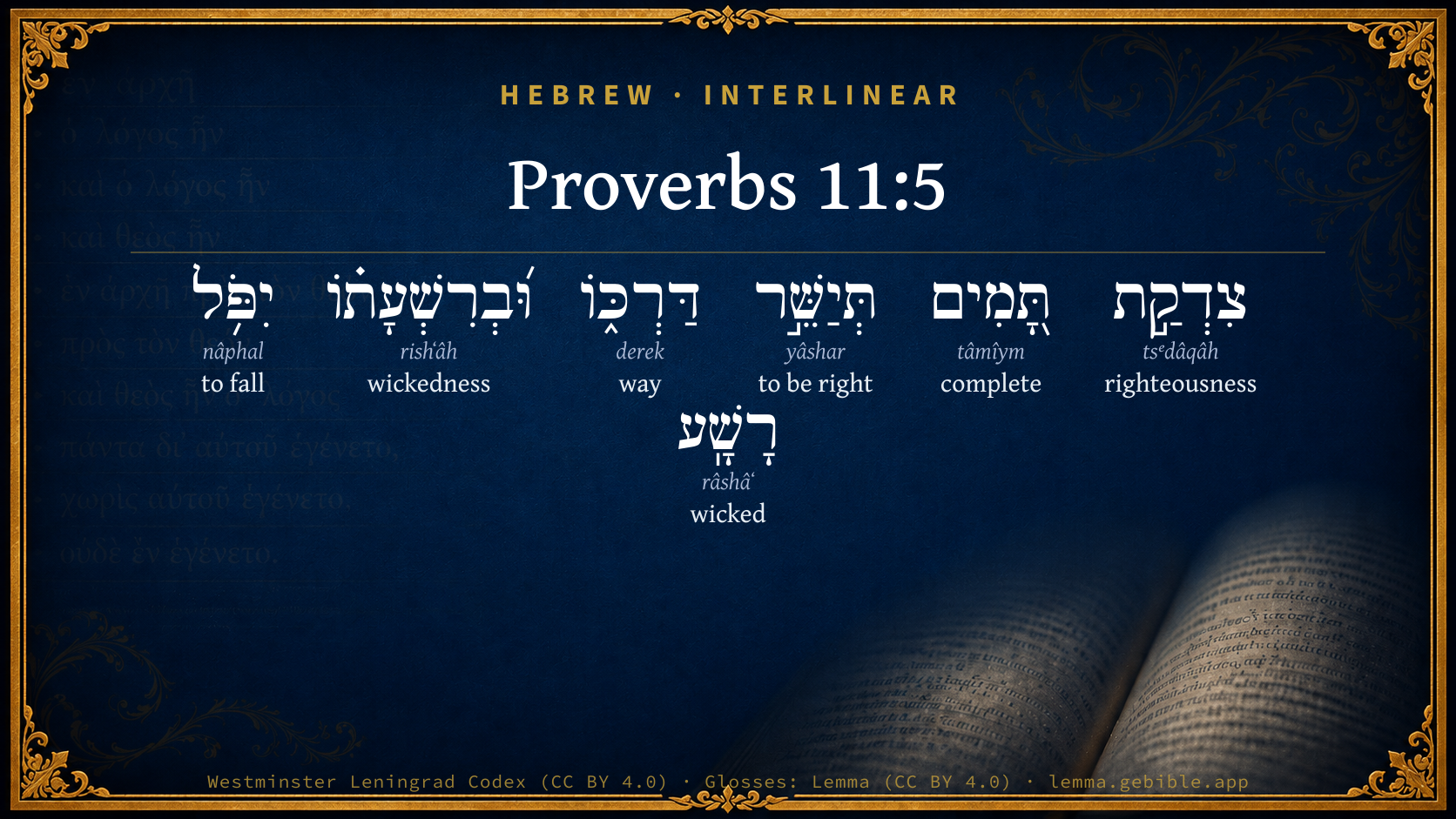
Hebrew (Westminster Leningrad Codex) Proverbs 11:5 appears in the Hebrew Old Testament. The text above is from the Westminster Leningrad Codex. Each word links to its Strong’s number, a concise gloss, and parsing drawn from the Open Scriptures Hebrew Bible morphology. Click any word for its full Brown-Driver-Briggs (BDB) entry.
Download image
Cite this verse

Proverbs 11:5 (World English Bible). Public Domain. Lemma interlinear Bible study tool, https://lemma.gebible.app/v/proverbs/11/5.

Show BibTeX & RIS
BibTeX
RIS
English Translation
The righteousness of the blameless will direct his way, But the wicked shall fall by his own wickedness.
World English Bible · Public Domain
Download a study sheet

One document with this verse’s original text, its word-by-word gloss line, the meaning frame, cross-references with their text, attributed commentary, and full source and license credits — printable, and it pastes into notes with its structure intact.

This verse Autodidact and up

Study sheet (.html) Plain text (.txt)

A passage Seminary Student

Up to 50 verses in one chapter. A passage sheet keeps up to 6 commentary sources and 12 cross-references per verse, in the order this page ranks them, and says so on the sheet whenever that leaves anything out. Ask for a single verse and you get the Autodidact verse sheet above.

Everything on this page stays free to read, with no account — the sheet is a download of what is already on screen, not access to it.

Want to remove ads? Support Godless Engineer
Compare translations 3

The same verse in 3 English versions, stacked beneath the original-language interlinear above. Click any original word for its lexicon entry.

Each is an independent rendering of the whole verse — the interlinear is not word-aligned to these translations.

Highlighted words mark where these versions differ — a whole-verse word diff, not a word-by-word alignment.

  • World English Bible Public Domain
    The righteousness of the blameless will direct his way, But the wicked shall fall by his own wickedness.
  • King James Version Public Domain
    The righteousness of the perfect shall direct his way: but the wicked shall fall by his own wickedness.
  • unfoldingWord Literal Text CC BY-SA 4.0
    The righteousness of a blameless one will make his way straight, but by his wickedness, a wicked one will fall.

unfoldingWord Literal Text — © unfoldingWord, licensed CC BY-SA 4.0. Word-aligned USFM3 via Door43 (git.door43.org/unfoldingWord/en_ult).

Versions to compare (up to 4)

3 of 4 selected

Show all 18 translations

Every available English version of this verse, each an independent rendering of the whole verse.

  • World English Bible Public Domain
    The righteousness of the blameless will direct his way, But the wicked shall fall by his own wickedness.
  • Berean Standard Bible Public Domain
    The righteousness of the blameless directs their path, but the wicked fall by their own wickedness.
  • Majority Standard Bible Public Domain
    The righteousness of the blameless directs their path, but the wicked fall by their own wickedness.
  • King James Version Public Domain
    The righteousness of the perfect shall direct his way: but the wicked shall fall by his own wickedness.
  • American Standard Version (1901) Public Domain
    The righteousness of the perfect shall direct his way; But the wicked shall fall by his own wickedness.
  • Revised Version (1885) Public Domain
    The righteousness of the perfect shall direct his way: but the wicked shall fall by his own wickedness.
  • Geneva Bible (1599) Public Domain
    The righteousnes of the vpright shall direct his way: but the wicked shall fall in his owne wickednes.
  • Douay-Rheims (1899) Public Domain
    The justice of the upright shall make his way prosperous: and the wicked man shall fall by his own wickedness.
  • Young's Literal Translation Public Domain
    The righteousness of the perfect maketh right his way, And by his wickedness doth the wicked fall.
  • Literal Standard Version CC BY-SA 4.0
    The righteousness of the perfect makes his way right, || And by his wickedness the wicked fall.
  • Unlocked Literal Bible CC BY-SA 4.0
    The right conduct of a blameless person makes his way straight, but the wicked will fall because of their own wickedness.
  • unfoldingWord Literal Text CC BY-SA 4.0
    The righteousness of a blameless one will make his way straight, but by his wickedness, a wicked one will fall.
  • Darby Bible Public Domain
    The righteousness of the perfect maketh plain his way; but the wicked falleth by his own wickedness.
  • World Messianic Bible Public Domain
    The righteousness of the blameless will direct his way, but the wicked shall fall by his own wickedness.
  • Webster's Bible Public Domain
    The righteousness of the perfect shall direct his way: but the wicked shall fall by his own wickedness.
  • Free Bible Version CC BY-SA 4.0
    The goodness of the innocent keeps them on track, but the wicked fall by their own wickedness.
  • Bible in Basic English Public Domain
    The righteousness of the good man will make his way straight, but the sin of the evil-doer will be the cause of his fall.
  • JPS Tanakh (1917) Public Domain
    The righteousness of the sincere shall make straight his way; but the wicked shall fall by his own wickedness.

Literal Standard Version (2020), Covenant Press — licensed CC BY-SA 4.0. Text via the HelloAO Bible API (eBible.org). Unlocked Literal Bible (unfoldingWord) — licensed CC BY-SA 4.0. Text via the HelloAO Bible API (eBible.org). unfoldingWord Literal Text — © unfoldingWord, licensed CC BY-SA 4.0. Word-aligned USFM3 via Door43 (git.door43.org/unfoldingWord/en_ult). Free Bible Version, Dr. Jonathan Gallagher — licensed CC BY-SA 4.0. Text via the HelloAO Bible API (eBible.org).

Word by word

More ways to search: Search by grammar → Find every occurrence → Compare this word →

Practice this passage: Drill this verse → Learn its vocabulary →

וּ֝בְרִשְׁעָת֗וֹ
rishʻâh
H7564
“and · in/at · wickedness · his”
Conjunction + Preposition + Noun, Common, Feminine, Singular, Construct + Suffix, Personal, 3rd Person, Masculine, Singular
Part of Speech
Conjunction + Preposition + Noun
Type
Common
Gender
Feminine
Number
Singular
State
Construct
Full BDB Definition

Origin: from H7562

TWOT: 2222c

wickedness, guilt - wickedness (in civil relations) - wickedness (of enemies) - wickedness (ethical and religious)
  1. צִדְקַ֣ת tsᵉdâqâh H6666 “righteousness of” Noun, Common, Feminine, Singular, Construct
  2. תָּ֭מִים tâmîym H8549 “complete” Adjective, Adjective, Masculine, Singular, Absolute
  3. תְּיַשֵּׁ֣ר yâshar H3474 “to be right” Verb, Piel, Imperfect, 3rd Person, Feminine, Singular
  4. דַּרְכּ֑וֹ derek H1870 “way · his” Noun, Common, Both, Singular, Construct + Suffix, Personal, 3rd Person, Masculine, Singular
  5. יִפֹּ֥ל nâphal H5307 “to fall” Verb, Qal, Imperfect, 3rd Person, Masculine, Singular
  6. רָשָֽׁע râshâʻ H7563 “wicked” Adjective, Adjective, Masculine, Singular, Absolute

About this verse

These counts appear in no published source. They are computed here, from the morphology-tagged text and Lemma’s own curated glosses. What Lemma adds →

7
words
7
distinct lemmas
Wisdom
section

Notable vocabulary

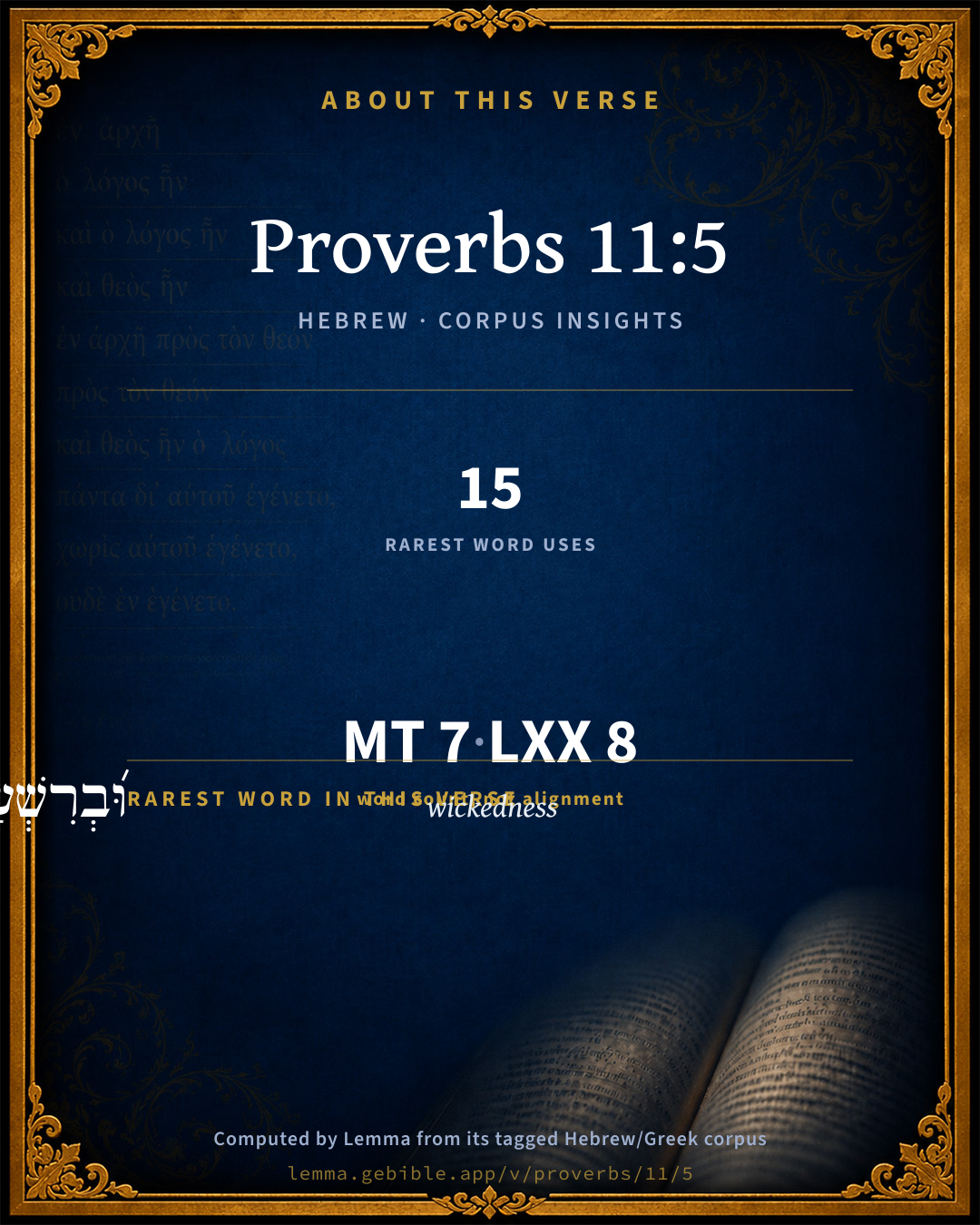
The rarest word here is וּ֝בְרִשְׁעָת֗וֹ wickedness H7564 — appearing just 15 times in the whole Hebrew Bible.

Shared distinctive vocabulary

וּ֝בְרִשְׁעָת֗וֹ wickedness H7564 occurs in 15 verses of the Hebrew Bible. Also found in:

Grammatical profile

  • 2 verbs
  • 3 nouns
  • 2 adjectives

Verb forms

  • תְּיַשֵּׁ֣ר Piel · Imperfect
  • יִפֹּ֥ל Qal · Imperfect

Hebrew & Septuagint length

In English translation the verse runs 18 words from the Hebrew and 10 from the Septuagint (LXX English) — the Septuagint runs noticeably shorter here. See the side-by-side →

A rough comparison of the two English renderings, which tokenize alike — not a word-level alignment.

Word counts can differ between the Hebrew and the Greek without any difference in meaning — e.g. the Hebrew direct-object marker אֵת has no separate Greek word, and Greek often adds the article ὁ.

In the original languages it is 7 Hebrew tokens and 8 Greek tokens — but the two are counted differently (Hebrew bundles its prefixes and suffixes into one token; the Greek is in lemma form), so that isn’t a like-for-like length.

Cross-references

7

Topical passages linked to Proverbs 11:5 in the Treasury of Scripture Knowledge — connected by theme and wording, ordered by reader-vote popularity; previews shown in the World English Bible.

  • Proverbs 5:22 The evil deeds of the wicked ensnare him. The cords of his sin hold him firmly.
  • Psalms 9:15–16 The nations have sunk down in the pit that they made; In the net which they hid, their own foot is taken.
  • Esther 7:3–10 Then Esther the queen answered, If I have found favor in your sight, O king, and if it please the king, let my life be given me at my petition, and my people at my request:
  • Proverbs 1:31–32 Therefore they will eat of the fruit of their own way, And be filled with their own schemes.
  • Proverbs 3:6 In all your ways acknowledge him, And he will direct your paths.
  • Proverbs 11:3 The integrity of the upright shall guide them, But the perverseness of the treacherous shall destroy them.
  • Matthew 27:4–5 saying, "I have sinned in that I betrayed innocent blood." But they said, "What is that to us? You see to it."

Cross-references courtesy of OpenBible.info (CC BY 4.0).

Hebrew and Greek witnesses Masoretic Hebrew ↔ Greek Septuagint

The same verse in the two great witnesses to the Old Testament, shown verse-for-verse.

Here the Septuagint runs noticeably shorter than the Hebrew — LXX2012 (modern English Septuagint) 10 words vs World English Bible 18. A rough length comparison of the two English translations, not a word-level alignment — read both below.

These are two independent witnesses, not word-aligned to each other, and the Septuagint is shown in lemma (dictionary) form.

Hebrew Proverbs 11:5 Masoretic · Westminster Leningrad Codex

צִדְקַ֣ת תָּ֭מִים תְּיַשֵּׁ֣ר דַּרְכּ֑וֹ וּ֝בְרִשְׁעָת֗וֹ יִפֹּ֥ל רָשָֽׁע

The righteousness of the blameless will direct his way, But the wicked shall fall by his own wickedness.

World English Bible · Public Domain

Greek LXX Proverbs 11:5 Septuagint · lemma form

δικαιοσύνη ἄμωμος ὀρθοτομέω ὁδός ἀσέβεια δέ περιπίπτω ἀδικία

Righteousness traces out blameless paths: but ungodliness encounters unjust dealing.

LXX2012 (modern English Septuagint) · Public Domain

On this verse, The Pulpit Commentary discusses the Septuagint’s reading. Read the note in Commentary ↓

Hebrew: Westminster Leningrad Codex (CC BY 4.0). Greek: Septuagint (public domain); English from LXX2012 (modern English Septuagint) (Public Domain). How the Septuagint differs from the Hebrew →

Commentary

Notes on Proverbs 11:5 from classic Christian and Jewish commentators (each source and its license shown beneath its notes). The classic Christian expositions comment on the surrounding passage and are grouped to its opening verse, so a note may address several verses; the Jewish commentaries on the Tanakh (Rashi and others) are per-verse, so they appear only where the commentator wrote on this verse.

Lemma curates 59 commentaries, every one of them public domain or Creative Commons licensed, each selected and text-cleaned for this edition rather than reprinted as found. About our sources →

Trapp's Complete Commentary

John Trapp

Pro 11:5 The righteousness of the perfect shall direct his way: but the wicked shall fall by his own wickedness.

Ver. 5. The righteousness of the perfect.] This is the same in effect with Pro 11:3. Nunquam satis dicitur, quod nunquam satis discitur. {a}

But the wicked shall fall by his own wickedness.] Or, In his own wickedness. He shall fall out of one wickedness unto another, while he "draws iniquity with cords of vanity, and sin as it were with a cart rope." {Isa 5:18} Thus Babylon’s sins are said to "reach unto heaven"; {Rev 18:5} quasi concatenatus funis. Therefore "she is fallen, she is fallen," certo, brevi, penitus, nondum tamen. Flagitium et flagellum, ut acus et filum. Sin and punishment are inseparable companions.

{a} Seneca.

John Trapp, A Commentary or Exposition upon All the Books of the Old and New Testament (1647–1656) — public domain. Text from a community e-Sword module.

The Biblical Illustrator

Joseph S. Exell

Pro_11:5

The righteousness of the perfect shall direct his way.

The Divine nature of righteousness

Not unreasonably this book of Proverbs charged with unspirituality. It is not a manual of devotion. It is not a setting forth of eternal principles of truth. It is a collection of homely aphorisms applicable to the practical life of man. But these proverbs rest upon spiritual principles, and they are saved from narrowness by the way in which they explain, amplify, and qualify each other. The great pervading principle of the book is righteousness, its Divine nature, and its blessed fruits.

I. The fundamental principle of this book, and of all moral teaching. Whatsoever a man soweth, that shall he reap. This by the world is--

1. Denied in practice.

2. Denied in theory. The theory is false that, live as you like, the result will be the same. It is contradicted by experience. It is inconsistent with the very being of a God.

II. Special statement of the principles.

1. The righteousness of the perfect shall direct his way. Note the leading words. Perfect, not faultless, but upright. Not consciously or intentionally reserving anything from God. His righteousness. Not his own, but Gods; yet made his own by free adoption of his will. Its work. Not an arbitrary reward.

2. Wicked fall by his own wickedness. Generally speaking, failure is worked for, and comes as payment. Apply to

(1) Mans earthly life.

(2) To mans spiritual life. (W. R. Clarke, M.A.)

Goodness required by God

The main characteristic of all heathen religions is that their gods do not demand righteousness, but certain outward and formal observances. Sacrifices must be offered to them, their vindictive temper must be propitiated, their anger averted; if the dues of the gods are paid, the stipulated quantity of corn and wine and oil, the tithes, the first-fruits, the animals for the altar, the tribute for the temple, then the Worshipper, who has thus discharged his obligations, may feel himself free to follow out his own tastes and inclinations. In the Roman religion, for example, every dealing with the gods was a strictly legal contract; the Roman general agreed with Jupiter or with Mars that if the battle should be won a temple should be built. It was not necessary that the cause should be right, or that the general should be good; the sacrifice of the wicked, though offered with an evil intent, was as valid as the sacrifice of the good. In either case the same amount of marble and stone, of silver and gold, would come to the god. In the Eastern religions not only were goodness and righteousness dissociated from the idea of the gods, but evil of the grossest kinds was definitely associated with them. The Phoenician deities, like those of the Hindoos, were actually worshipped with rites of murder and lust. Every vice had its patron god or goddess, and it was forgotten by priest and people that goodness could be the way of pleasing God, or moral evil a cause of offence to Him. Even in Israel, where the teaching of revelation was current in the proverbs of the people, the practice generally followed the heathen conceptions. All the burning protests of the inspired prophets could not avail to convince the Israelite that what God required was not sacrifice and offering, but to do justice, to love mercy, and to walk humbly with Him. Again and again we find that the high places were frequented, and the ritual supported by men who were sensual, unjust, and cruel. The Sabbath Day was kept, the feasts were duly observed, the priests were handsomely maintained, and there, it was supposed, the legitimate claims of Jehovah ceased. What more could He desire? This is surely the most impressive proof that the truth which is under consideration is far from being obvious. So far from treating the truth as a truism, our Lord in all His teaching laboured to bring it out in greater clearness, and to set it in the forefront of His message to men. He painted with exquisite simplicity and clearness the right life, the conduct which God requires of us, and then likened every one who practised this life to a man who builds his house on a rock, and every one who does not practise it to a man who builds his house on the sand. He declared, in the spirit of the Book of Proverbs, that teachers were to be judged by their fruits, and that God would estimate our lives not by what we professed to do, but by what we did; and He took up the very language of the book in declaring that every man should be judged according to his works. In every word He spoke He made it plain that goodness is what God loves, and that wickedness is what He judges and destroys. In the same way every one of the apostles insists on this truth with a new earnestness. St. John more especially reiterates it, in words which sound even more like a truism than the sayings of this book: He that doeth righteousness, is righteous even as He is righteous; and, If ye know that He is righteous, ye know that every one also that doeth righteousness is begotten of Him. (R. F. Herren, D.D.)

The Biblical Illustrator, edited by Joseph S. Exell (c. 1880s–1900s) — public domain. Text from a community e-Sword module.

The Preacher's Complete Homiletical Commentary

Joseph S. Exell (gen. ed.)

CRITICAL NOTES.—

Pro_11:5. Direct, “make smooth or even.”

Pro_11:6. Naughtiness, “cravings,” “desires,” “covetousness.”

MAIN HOMILETICS OF THE LATTER CLAUSES OF Pro_11:5-6

MADE OR MARRED BY DESIRES

The word translated “naughtiness” should be rendered “lust” or “desires.” (See Critical Notes).

I. Sin is compliance with desires that do not harmonise with moral righteousness. A traveller on a lonely and dangerous road may have two guides offered to him by the opposite promptings of his own mind. He may have a strong desire to explore a path which looks most pleasant and attractive but which he knows does not lead to his destination, and is beset with many perils although its aspect is inviting. On the other hand, his good sense tells him it is unwise to run the risk of injury by thus turning aside from the road that he knows leads to the goal which he desires to reach, although the path may be rough and toilsome. If he yields to his first desire and pursues the dangerous path until it is too late to retrace his steps, he may lose his life by a false step over a precipice and so be destroyed by his own desires. All men are under the dominion of desires, and if their desires after God and righteousness have the rule they will be guided by them into the ways of deliverance and safety, as we saw in considering Pro_11:3. But if they yield themselves up to the guidance of desires which run counter to the law of God and right, as they are made known both by conscience and revelation, they sink lower and lower in the scale of moral being and become slaves when they might have been free men. “Whosoever committeth sin is the servant of sin.” “Know ye not, that to whom ye yield yourselves servants to obey, his servants ye are to whom ye obey; whether of sin unto death, or of obedience unto righteousness” (Joh_8:34; Rom_6:16).

II. The sinner is the forger of his own fetters. If a man labours in his field, his garden, or his vineyard, in harmony with the known laws which God has ordained to be observed, he may reasonably expect a good crop—an abundant harvest. But if he sets at nought these laws—if he yields to desires of self-indulgence—or in any other way acts contrary to the conditions which are indispensable to success—he has no one to blame but himself if he finds himself a beggar when he might have had plenty. The law of God’s moral universe is written in revelation, upon conscience, in the history of men, that “Whatsoever a man soweth, that shall he also reap,” that “The wages of sin is death” (Gal_6:7; Rom_6:23). If men are “taken,” are first enslaved by sin and then suffer the penalty of sinning, they have themselves digged the pit of their own destruction—have forged the chains by which they are bound.

OUTLINES AND SUGGESTIVE COMMENTS

Pro_11:4. How badly led those are who are not righteous, appears in this: that while righteousness does everything for a man in journeying to his end, wealth does nothing for him. “Wealth,” which seems to be the great guide of the human family, not only cannot deliver, but cannot profit in the crisis of fate. While “righteousness,” all covered with stains, lets no day go to waste; lets no mile be utterly lost; lets no fear ever be realised; still grapples a man’s hand; and still guides a man’s tread, till he steps at last into the regions of safety.—Miller.

It were no bad comparison to liken mere rich men to camels and mules; for they often pursue their devious way, over hills and mountains, laden with India purple, with gems, aromas, and generous wines upon their backs, attended, too, by a long line of servants as a safeguard on their way. Soon, however, they come to their evening halting-place, and forthwith their precious burdens are taken from their backs; and they, now wearied, and stripped of their lading and their retinue of slaves, show nothing but livid marks of stripes. So, also, those who glitter in gold and purple raiment, when the evening of life comes rushing on them, have nought to show but marks and wounds of sin impressed upon them by the evil use of riches.—St. Augustine.

Riches will not even obtain “a drop of water to cool the tormented tongue” (Luk_16:19-24). In vain will “the rich men of the earth” seek a shelter from the wrath of the Lamb” (Rev_6:15-17).—Bridges.

While the words are true in their highest sense of the great dies irœ of the future, they speak, in the first instance, as do the like words in Zep_1:15-18, of any “day of the Lord,” any time of judgment, when men or nations receive the chastisement of their sins.—Plumptre.

“Wherefore should I die, being so rich?” said that wretched Cardinal, Henry Beaufort, Bishop of Winchester, in Henry VI.’s time. “Fie,” quoth he, “will not death be lured? Will money do nothing?”—Trapp.

If righteousness delivereth not from the day, yet it delivereth from the wrath of the day: if it deliver not from death, yet it delivereth from the death of the wicked.—Jermin.

Pro_11:5. “The righteousness of the man of integrity” is perfect only in heaven, and how it “directs” or “levels” his way appears best by the perfect facility of walking in that bright abode. It will be no trouble there to travel forward. While more work will be done in heaven than here, yet there it is done so easily that it is called a “Rest.” The paths of this world are not only difficult, but deadly. “The wicked” will not only struggle, but “fall” in them; and the roughnesses at which he stumbles are not ever in the paths themselves, but really his “own wickedness.”—Miller.

Greedy desire (see Critical Notes) will strongly tempt men to sin, and so they will be ensnared.—Stuart.

The first part of this text may be taken—I. As declaring a fact. A real Christian takes, for direction in his way, the rule of righteousness. The question that he continually puts to himself is—“What ought I to do?” This is the character of a believer in the abstract; and though none may lay claim to perfection, yet none can be justly called believers, unless their lives in the main answer to this description. II. As propounding a promise. It is nowhere promised that the righteous shall not come into trouble, but the strait road goes through them. The other statement of the text may also be regarded—I. As an assertion proved by experience. The drunkard ruins his health and shortens his life by excesses. The spendthrift brings himself to beggary. The contentious man brings himself to mischief. They often dig a pit for others and fall into it themselves. III. As a threat. It does not always happen that men are visited for their sins in this life. Still it may be said to every ungodly man, “Be sure your sin will find you out.”—B. W. Dibdin.

Pro_11:6. Godliness hath many troubles, and as many helps against trouble. As Moses’ hand, it turns the serpent into a rod; and as the tree that Moses cast into the waters of Marah, it sweeteneth the bitter waters of affliction. Well may it be called the divine nature, for as God doth bring light out of darkness, so doth grace.—Trapp.

There need no blocks to be laid in the way of the wicked, no enemies need to thrust him down, for his own wickedness being his way, by that he shall fall.… Wickedness is fastened, by the devil, like a cord about the wicked; by that he pulls them after him: by that he makes them fall, first into shame and misery here, and into hell when they are gone hence.—Jermin.

The Preacher's Complete Homiletical Commentary (gen. ed. Joseph S. Exell; Funk & Wagnalls, c. 1892) — public domain (pre-1929). A full-Bible homiletical/sermon-outline anthology covering 65 of 66 books (2 John is absent from the source module). Text from a community e-Sword module.

Matthew Henry's Commentary

These two verses are, in effect, the same, and both to the same purport with Pro 11:3. For the truths are here of such certainty and weight that they cannot be too often inculcated. Let us govern ourselves by these principles.

I. That the ways of religion are plain and safe, and in them we may enjoy a holy security. A living principle of honesty and grace will be, 1. Our best direction in the right way, in every doubtful case to say to us, This is the way, walk in it. He that acts without a guide looks right on and sees his way before him. 2. Our best deliverance from every false way: The righteousness of the upright shall be armour of proof to them, to deliver them from the allurements of the devil and the world, and from their menaces.

The ways of wickedness are dangerous and destructive: The wicked shall fail into misery and ruin by their own wickedness, and be taken in their own naughtiness as in a snare. O Israel! thou hast destroyed thyself. Their sin will be their punishment; that very thing by which they contrived to shelter themselves will make against them.

Matthew Henry's Commentary on the Whole Bible (1708–1710) — public domain (CC PDM 1.0). Text via the HelloAO Bible API.

Jamieson, Fausset & Brown

Robert Jamieson, A. R. Fausset & David Brown

direct--or, "make plain"; wicked ways are not plain (Pro 13:17).

Jamieson, Fausset & Brown — Commentary Critical and Explanatory on the Whole Bible (1871) — public domain (CC PDM 1.0). Text via the HelloAO Bible API.

Ellicott's Commentary for English Readers

(5) Shall direct his way.—Or, make smooth, as Pro_3:6. The just man by his exact performance of all duty both towards God and man receives more and more light, and therefore continually sees more clearly how to avoid the difficulties that beset his path. The wicked darkens his conscience more and more by the commission of evil, till he stumbles as in the night (Joh_11:9), and at last falls, and rises not again.

A Bible Commentary for English Readers, edited by Charles John Ellicott (1878–1897) — public domain. Text from a community e-Sword module.

The Cambridge Bible for Schools and Colleges

gen. ed. J. J. S. Perowne

5. direct] Or, make plain, or straight; so that it leads to a prosperous issue. See Pro_3:6, note.

The Cambridge Bible for Schools and Colleges (gen. ed. J. J. S. Perowne; Cambridge University Press, 1878–1918) — public domain. Text from a community e-Sword module.

John Gill's Exposition

The righteousness of the perfect shall direct his way,.... Or "make it plain" (f); that is, the righteousness of those who are perfect in Christ, complete in him, perfectly justified by his righteousness; that righteousness makes their way plain; it is the direct way, the highway, the pathway to eternal life and happiness; see Pro 12:28;

but the wicked shall fall by his own wickedness; or, "in his wickedness" (g): in his own wicked way, which he has chosen and delights to walk in; he shall stumble therein, and fall into ruin and destruction, into hell and damnation: or by means or because of it he will fall; his wickedness will be the cause of his fall; as it will be the cause of the fall of Babylon, Rev 18:2.

(f) "rectam facit", Cocceius; "complanat viam ejus", Schultens. (g) "in impietate sua", Tigurine version, Montanus, Baynus, Michaelis; "improbitate sua", Junius & Tremellius, Piscator; "in injustitia sua", Cocceius; "in improbitate sua turbulenta", Schultens.

John Gill's Exposition of the Whole Bible (1746–1763) — public domain (CC PDM 1.0). Text via the HelloAO Bible API.

Matthew Poole's English Annotations

Shall direct his way; shall bring all his designs and endeavours to a happy issue, by comparing this clause with the next.

Matthew Poole's English Annotations on the Holy Bible (1683–1685) — public domain. Text from a community e-Sword/MySword module.

Whedon's Commentary on the Bible

Daniel D. Whedon

5. Righteousness of the perfect — This may be regarded as another form of the proverb in Pro_11:3.

Shall direct — Make straight, plain, even.

Daniel D. Whedon (gen. ed.), Commentary on the Old and New Testaments (1874–1909) — public domain. Text from a community e-Sword module.

The Pulpit Commentary

The perfect; the upright and honest. Vulgate, "simple;" Septuagint, "blameless." Shall direct make straight or smoothhis way. (Pro_3:6) The good man, not blinded by passion, follows a safe and direct path of life; but the wicked, led by his own evil pretensions, and losing the light of conscience, (Joh_11:10) stumbles and fails. Septuagint, "Righteousness cutteth straight (oryotomei ) blameless paths, but ungodliness walketh in iniquity." Oryotomew occurs in Pro_3:6, and nowhere else in the Septuagiut. St. Paul adopts the word in 2Ti_2:15.

The Pulpit Commentary (1880–1919), ed. H.D.M. Spence-Jones & Joseph S. Exell — public domain. Text from a community e-Sword module.

Keil & Delitzsch

C. F. Keil & F. Delitzsch

5 The righteousness of the blameless smootheth his way,

And by his own wickedness doth the wicked fall.

With the תּמים (cf. Pro 1:12), formed after the passive, more than with תּם, is connected the idea of the perfected, but more in the negative sense of moral spotlessness than of moral perfection. The rectitude of a man who seeks to keep his conscience and his character pure, maketh smooth (ישּׁר, as Pro 3:6, not of the straightness of the line, but of the surface, evenness) his life's path, so that he can pursue his aim without stumbling and hindrance, and swerving from the direct way; while, on the contrary, the godless comes to ruin by his godlessness - that by which he seeks to forward his interests, and to make a way for himself, becomes his destruction.

Keil & Delitzsch — Biblical Commentary on the Old Testament (1861–1891) — public domain (CC PDM 1.0). Text via the HelloAO Bible API. (Old Testament only.)

Scofield Reference Notes

C. I. Scofield

perfect

(See Scofield "1Ki 8:61").

The Scofield Reference Bible (1917 edition), notes by C. I. Scofield — public domain. Text from a community e-Sword module.

Kretzmann's Popular Commentary

Paul E. Kretzmann

v. 5. The righteousness of the perfect, of him whose conduct is beyond reproach, shall direct his way, make it plain and open, enabling him to walk in the security of a good conscience; but the wicked shall fall by his own wickedness, their own lusts proving a snare to them.

Paul E. Kretzmann, Popular Commentary of the Bible (1921–1924) — public domain. Text from a community e-Sword module.

unfoldingWord translationNotes

Door43 World Missions Community

makes his way straight

"has clear direction"

the wicked ... the treacherous

These nominal adjectives can be stated as adjectives. AT: "those who are wicked ... those who are treacherous" (See: Nominal Adjectives)

the treacherous are trapped by their cravings

"those who do evil are captured by their passions"

treacherous

ready to betray trust; traitorous; deceptive

translationWords

blameless

evil

God

unfoldingWord translationNotes — © Distant Shores Media and the Door43 World Missions Community, licensed CC BY-SA 4.0. Source: git.door43.org/Door43/en_tn.

Lesson kit

Teaching starters — assembled from the data on this page, not authored interpretation. Every prompt links to the verse data it draws on. Edit before teaching.

Proverbs, in the Wisdom, opens this verse with 7 words (7 distinct Hebrew lemmas). Its most distinctive word is rishʻâh (“wickedness”). The Greek Septuagint runs shorter here. A historical commentator’s framing appears above. Read the whole chapter for the surrounding context.

Discussion questions

  1. What does “wickedness” (rishʻâh) contribute to the verse as a whole?
  2. Deuteronomy 9:4 shares the word «wickedness» with this verse. How do the two illuminate each other?
  3. Compared with the Hebrew, the Septuagint runs shorter here. What questions does that raise?
  4. These translations render this verse differently. What is at stake in choosing one wording over another?
  5. The verb «תְּיַשֵּׁ֣ר» is Piel Imperfect. How does its form color the action?
  6. Reading how Trapp's Complete Commentary and The Biblical Illustrator read this verse, where do the two commentators agree and where do they part?

Things to notice

Reading settings

Reading text

Shown beneath each verse's original-language words.

Old Testament
Old Testament edition

Read the OT as the Masoretic Hebrew (MT) or the Greek Septuagint (LXX).

English shown for the Greek Septuagint (in the Hebrew ↔ Greek comparison).

Comparing translations? Open the Compare panel on any verse page to stack up to four side by side.