
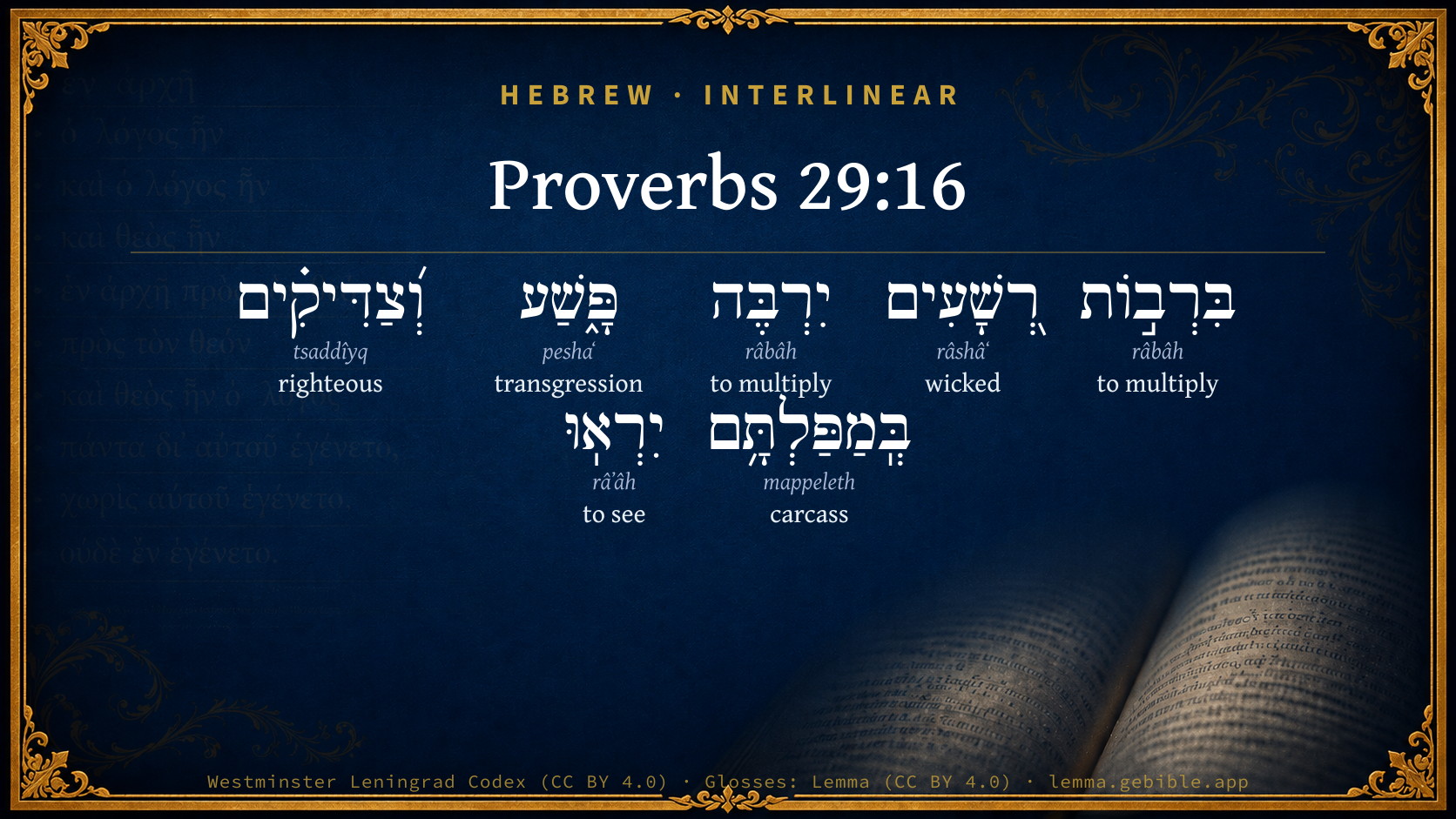
Proverbs 29:16

Hebrew (Westminster Leningrad Codex) Proverbs 29:16 appears in the Hebrew Old Testament. The text above is from the Westminster Leningrad Codex. Each word links to its Strong’s number, a concise gloss, and parsing drawn from the Open Scriptures Hebrew Bible morphology. Click any word for its full Brown-Driver-Briggs (BDB) entry.
Download image
Cite this verse

Proverbs 29:16 (World English Bible). Public Domain. Lemma interlinear Bible study tool, https://lemma.gebible.app/v/proverbs/29/16.

Show BibTeX & RIS
BibTeX
RIS
English Translation
When the wicked increase, sin increases; But the righteous will see their downfall.
World English Bible · Public Domain
Download a study sheet

One document with this verse’s original text, its word-by-word gloss line, the meaning frame, cross-references with their text, attributed commentary, and full source and license credits — printable, and it pastes into notes with its structure intact.

This verse Autodidact and up

Study sheet (.html) Plain text (.txt)

A passage Seminary Student

Up to 50 verses in one chapter. A passage sheet keeps up to 6 commentary sources and 12 cross-references per verse, in the order this page ranks them, and says so on the sheet whenever that leaves anything out. Ask for a single verse and you get the Autodidact verse sheet above.

Everything on this page stays free to read, with no account — the sheet is a download of what is already on screen, not access to it.

Want to remove ads? Support Godless Engineer
Compare translations 3

The same verse in 3 English versions, stacked beneath the original-language interlinear above. Click any original word for its lexicon entry.

Each is an independent rendering of the whole verse — the interlinear is not word-aligned to these translations.

Highlighted words mark where these versions differ — a whole-verse word diff, not a word-by-word alignment.

  • World English Bible Public Domain
    When the wicked increase, sin increases; But the righteous will see their downfall.
  • King James Version Public Domain
    When the wicked are multiplied, transgression increaseth: but the righteous shall see their fall.
  • unfoldingWord Literal Text CC BY-SA 4.0
    When the wicked increase, transgression increases, but the righteous will see their downfall.

unfoldingWord Literal Text — © unfoldingWord, licensed CC BY-SA 4.0. Word-aligned USFM3 via Door43 (git.door43.org/unfoldingWord/en_ult).

Versions to compare (up to 4)

3 of 4 selected

Show all 18 translations

Every available English version of this verse, each an independent rendering of the whole verse.

  • World English Bible Public Domain
    When the wicked increase, sin increases; But the righteous will see their downfall.
  • Berean Standard Bible Public Domain
    When the wicked thrive, rebellion increases; but the righteous will see their downfall.
  • Majority Standard Bible Public Domain
    When the wicked thrive, rebellion increases; but the righteous will see their downfall.
  • King James Version Public Domain
    When the wicked are multiplied, transgression increaseth: but the righteous shall see their fall.
  • American Standard Version (1901) Public Domain
    When the wicked are increased, transgression increaseth; But the righteous shall look upon their fall.
  • Revised Version (1885) Public Domain
    When the wicked are increased, transgression increaseth: but the righteous shall look upon their fall.
  • Geneva Bible (1599) Public Domain
    When the wicked are increased, transgression increaseth: but ye righteous shall see their fall.
  • Douay-Rheims (1899) Public Domain
    When the wicked are multiplied, crimes shall be multiplied: but the just shall see their downfall.
  • Young's Literal Translation Public Domain
    In the multiplying of the wicked transgression multiplieth, And the righteous on their fall do look.
  • Literal Standard Version CC BY-SA 4.0
    In the multiplying of the wicked transgression multiplies, || And the righteous look on their fall.
  • Unlocked Literal Bible CC BY-SA 4.0
    When wicked people are in power, transgression increases, but righteous people will see the downfall of those wicked people.
  • unfoldingWord Literal Text CC BY-SA 4.0
    When the wicked increase, transgression increases, but the righteous will see their downfall.
  • Darby Bible Public Domain
    When the wicked increase, transgression increaseth; but the righteous shall see their fall.
  • World Messianic Bible Public Domain
    When the wicked increase, sin increases; but the righteous will see their downfall.
  • Webster's Bible Public Domain
    When the wicked are multiplied, transgression increaseth: but the righteous shall see their fall.
  • Free Bible Version CC BY-SA 4.0
    When the wicked are in power, sin increases; but the good will see their downfall.
  • Bible in Basic English Public Domain
    When evil men are in power, wrongdoing is increased; but the upright will have pleasure when they see their downfall.
  • JPS Tanakh (1917) Public Domain
    When the wicked are increased, transgression increaseth; but the righteous shall gaze upon their fall.

Literal Standard Version (2020), Covenant Press — licensed CC BY-SA 4.0. Text via the HelloAO Bible API (eBible.org). Unlocked Literal Bible (unfoldingWord) — licensed CC BY-SA 4.0. Text via the HelloAO Bible API (eBible.org). unfoldingWord Literal Text — © unfoldingWord, licensed CC BY-SA 4.0. Word-aligned USFM3 via Door43 (git.door43.org/unfoldingWord/en_ult). Free Bible Version, Dr. Jonathan Gallagher — licensed CC BY-SA 4.0. Text via the HelloAO Bible API (eBible.org).

Word by word

More ways to search: Search by grammar → Find every occurrence → Compare this word →

Practice this passage: Drill this verse → Learn its vocabulary →

About this verse

These counts appear in no published source. They are computed here, from the morphology-tagged text and Lemma’s own curated glosses. What Lemma adds →

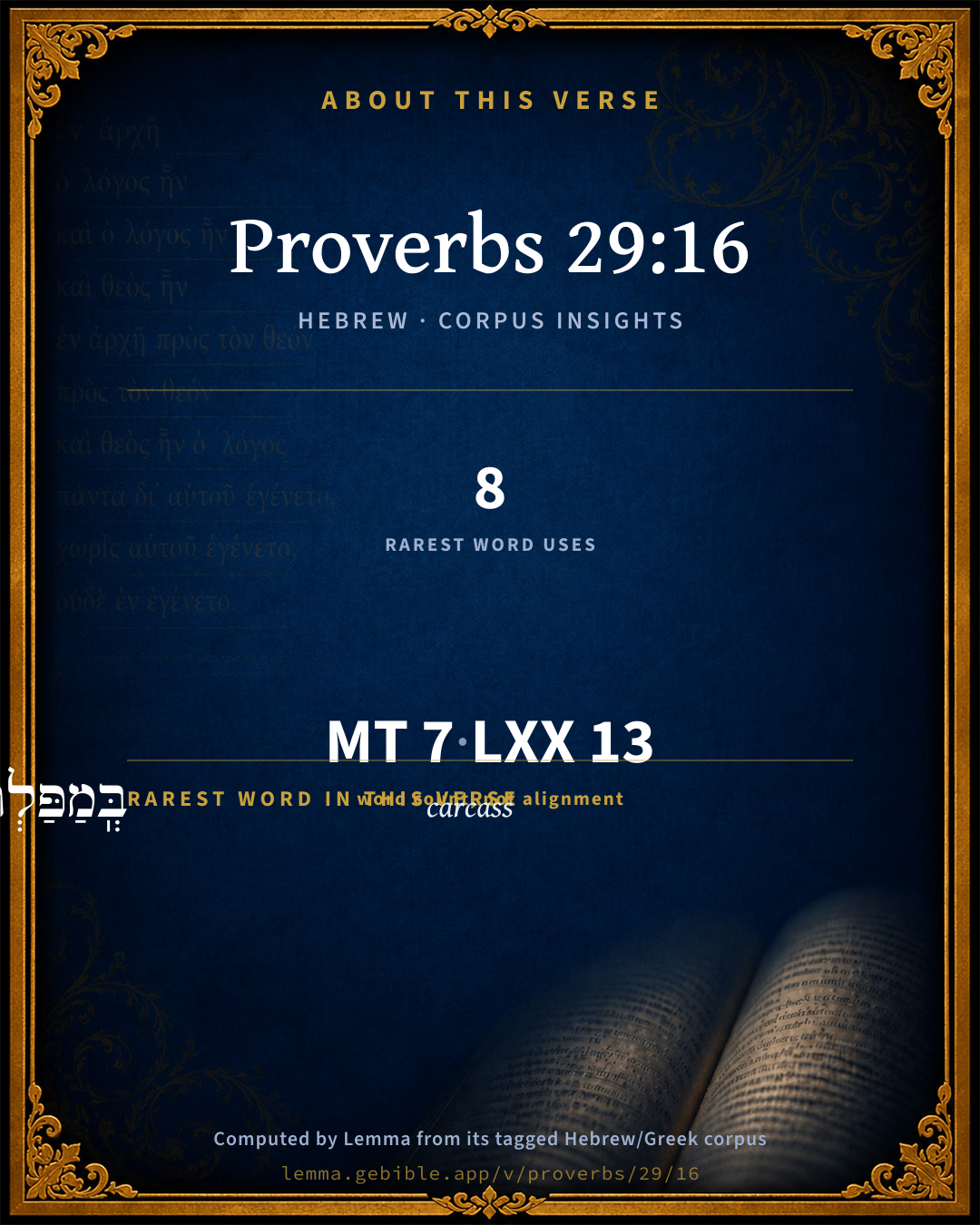
7
words
6
distinct lemmas
Wisdom
section

Notable vocabulary

The rarest word here is בְּֽמַפַּלְתָּ֥ם carcass H4658 — appearing just 8 times in the whole Hebrew Bible.

Shared distinctive vocabulary

בְּֽמַפַּלְתָּ֥ם carcass H4658 occurs in 8 verses of the Hebrew Bible. Also found in:

Grammatical profile

  • 3 verbs
  • 2 nouns
  • 2 adjectives

Verb forms

  • בִּרְב֣וֹת Qal · Infinitive Construct
  • יִרְבֶּה Qal · Imperfect
  • יִרְאֽוּ Qal · Imperfect

Repetition

A word recurs within this verse — often emphatic in Hebrew:

  • בִּרְב֣וֹת to multiply H7235 ×2

Hebrew & Septuagint length

In English translation the verse runs 13 words from the Hebrew and 14 from the Septuagint (LXX English) — closely comparable.

A rough comparison of the two English renderings, which tokenize alike — not a word-level alignment.

Word counts can differ between the Hebrew and the Greek without any difference in meaning — e.g. the Hebrew direct-object marker אֵת has no separate Greek word, and Greek often adds the article ὁ.

In the original languages it is 7 Hebrew tokens and 13 Greek tokens — but the two are counted differently (Hebrew bundles its prefixes and suffixes into one token; the Greek is in lemma form), so that isn’t a like-for-like length.

Cross-references

10

Topical passages linked to Proverbs 29:16 in the Treasury of Scripture Knowledge — connected by theme and wording, ordered by reader-vote popularity; previews shown in the World English Bible.

  • Psalms 37:34 Wait for Yahweh, and keep his way, And he will exalt you to inherit the land. When the wicked are cut off, you shall see it.
  • Psalms 37:36 But he passed away, and, behold, he was not. Yes, I sought him, but he could not be found.
  • Psalms 58:10 The righteous shall rejoice when he sees the vengeance. He shall wash his feet in the blood of the wicked;
  • Psalms 91:8 You will only look with your eyes, And see the recompense of the wicked.
  • Psalms 92:11 My eye has also seen my enemies. My ears have heard of the wicked enemies who rise up against me.
  • Proverbs 29:2 When the righteous thrive, the people rejoice; But when the wicked rule, the people groan.
  • Psalms 112:8 His heart is established. He will not be afraid in the end when he sees his adversaries.
  • Revelation 15:4 Who wouldn't fear you, Lord, And glorify your name? For you only are holy. For all the nations will come and worship before you. For your righteous acts have been revealed."
  • Revelation 18:20 Rejoice over her, O heaven, you saints, apostles, and prophets; for God has judged your judgment on her."
  • Psalms 92:9 For, behold, your enemies, Yahweh, For, behold, your enemies shall perish. All the evil-doers will be scattered.

Cross-references courtesy of OpenBible.info (CC BY 4.0).

Hebrew and Greek witnesses Masoretic Hebrew ↔ Greek Septuagint

The same verse in the two great witnesses to the Old Testament, shown verse-for-verse.

These are two independent witnesses, not word-aligned to each other, and the Septuagint is shown in lemma (dictionary) form.

Hebrew Proverbs 29:16 Masoretic · Westminster Leningrad Codex

בִּרְב֣וֹת רְ֭שָׁעִים יִרְבֶּה פָּ֑שַׁע וְ֝צַדִּיקִ֗ים בְּֽמַפַּלְתָּ֥ם יִרְאֽוּ

When the wicked increase, sin increases; But the righteous will see their downfall.

World English Bible · Public Domain

Greek LXX Proverbs 29:16 Septuagint · lemma form

πολύς εἰμί ἀσεβής πολύς γίγνομαι ἁμαρτία ὁ δέ δίκαιος ἐκεῖνος πίπτω κατάφοβοι γίγνομαι

When the ungodly abound, sins abound: but when they fall, the righteous are warned.

LXX2012 (modern English Septuagint) · Public Domain

On this verse, The Pulpit Commentary discusses the Septuagint’s reading. Read the note in Commentary ↓

Hebrew: Westminster Leningrad Codex (CC BY 4.0). Greek: Septuagint (public domain); English from LXX2012 (modern English Septuagint) (Public Domain). How the Septuagint differs from the Hebrew →

Commentary

Notes on Proverbs 29:16 from classic Christian and Jewish commentators (each source and its license shown beneath its notes). The classic Christian expositions comment on the surrounding passage and are grouped to its opening verse, so a note may address several verses; the Jewish commentaries on the Tanakh (Rashi and others) are per-verse, so they appear only where the commentator wrote on this verse.

Lemma curates 59 commentaries, every one of them public domain or Creative Commons licensed, each selected and text-cleaned for this edition rather than reprinted as found. About our sources →

Trapp's Complete Commentary

John Trapp

Pro 29:16 When the wicked are multiplied, transgression increaseth: but the righteous shall see their fall.

Ver. 16. When the wicked are multiplied, transgression increaseth.] As saith the proverb of the ancients: Wickedness proceedeth from the wicked. Miserable man hath, by his fall from God, contracted a necessity of sinning against God. And when a rabble of rebels are gotten together, are grown many and mighty, they make account to carry all before them, and not to suffer a godly man to live - as in Spain, and where the Inquisition is admitted. But the righteous shall see their fall; shall see it and rejoice at it, as the Hebrew doctors expound this text by comparing it with Oba 1:12-13, "Thou shouldest not have looked on the day of thy brother in the day of his calamity, neither shouldest thou have rejoiced over the children of Judah," &c. "The righteous shall rejoice when he seeth the vengeance"; being moved with a zeal of God, he shall rejoice with trembling; "he shall wash his feet in the blood of the wicked"; beholding their ruin he shall become more cautious; {a} "so that a man shall say," - any man but of an ordinary capacity shall make this observation - "Verily, there is a reward for the righteous; verily he is a God that judgeth in the earth," {Psa 58:10-11} that will sink to the bottom the bottle of wickedness, when once filled with those bitter waters. {Gen 15:16}

{a} Alterius perditio tua cautio.

John Trapp, A Commentary or Exposition upon All the Books of the Old and New Testament (1647–1656) — public domain. Text from a community e-Sword module.

Joseph Benson's Commentary

Pro 29:16. When the wicked are multiplied — Or rather, are advanced, or in authority, as the word ברבות, is understood, Pro 29:2; transgression increaseth — Sin and sinners abound, and grow impudent by impunity, and the example and encouragement of such rulers. But the righteous shall see their fall — The destruction of such transgressors in due time.

Joseph Benson's Commentary on the Old and New Testaments (1811–1818) — public domain. Text from a community e-Sword module.

The Preacher's Complete Homiletical Commentary

Joseph S. Exell (gen. ed.)

MAIN HOMILETICS OF Pro_29:16

VICTORY NOT WITH THE MAJORITY

I. There is no necessary connection between numbers and righteousness. Weeds grow faster than wheat, and are much more abundant than the grain. But the simple fact that there are more weeds than there is corn does not alter the character of either. In the same field it may happen that there is more to bind for fuel than for food—that the tares far outnumber the ears of wheat—and in this case the worth is on the side of the smaller quantity. So is it in the moral field of the world. It is a startling fact that under the government of God the wicked are permitted to multiply—that when a man sets himself in opposition to his Maker, he is not at once removed from the earth, but is permitted to live and use his life to make other men wicked like himself. We may sometimes be inclined to ask with the patriarch, “Wherefore do the wicked live, become old, yea, are mighty in power” (Job_21:7), and the question may be difficult for us to answer: but this we must never forget, that neither with man nor with God is there any necessary connection between quantity and quality, between worth and abundance.

II. Neither are numbers any guarantee of victory. The greatness of a tree and the number of its branches do not make it certain that it will outlive the storm—on the contrary, its great bulk and height are often the causes of its fall. When the wicked multiply, and so increase transgression, they sometimes lose sight of their personal sin and danger in the sin and danger of the multitude, and persuade themselves that there is safety in numbers. But the very opposite is the case. Men grow more bold in transgression in proportion as they are surrounded with other transgressors, and venture to do deeds of wickedness when in company with others that they would fear to commit alone. And so the multiplication of the wicked, as it increases transgression, is the means of hastening their fall instead of retarding it. It was “when men began to multiply upon the face of the earth” (Gen_6:1) that their wickedness became so great as to compel God to destroy them by a flood. It was the combination of the entire Jewish nation that enabled them to commit the crime of crucifying the Lord of Glory, but it was this “increase of transgression” that led to their final fall.

OUTLINES AND SUGGESTIVE COMMENTS

Combination emboldens in sin. (Isa_41:7.) Each particle of the mass is corrupt. The mass therefore of itself ferments with evil. Hence the prevalence of infidelity in our densely crowded districts above the more thinly populated villages. There is the same evil in individual hearts, but not the same fermentation of evil.—Bridges.

The reference is, in all probability, to the influence of wicked rulers in promoting the increase of wickedness in the community, which requires not either illustration or proof.—“But the righteous shall see their fall.”—Their fall, that is, from power and authority. It is not the final fall—the perdition of the wicked, that is intended. In that the righteous have no pleasure. Herein they resemble God; are of one mind and heart with Him. He says, and confirms it by His oath—“As I live, saith the Lord, I have no pleasure in the death of the wicked.” In the execution of the sentence against them, God glorifies Himself; and the righteous solemnly acquiesce, acknowledging and celebrating the justice of the divine administration:—“Even so, Lord God, Almighty, for true and righteous are Thy judgments!” But pleasure in witnessing the execution of the sentence, we cannot, we must not, for a moment, imagine them to have.—Wardlaw.

Cyrillus Alexandrinus tells us, when man was alone upon the earth there was then no such matter as sinning.… Much company in sin ever makes more, it being the weakness of man’s understanding to fear little hurt and danger, where many run into it, and it being the nature of wickedness to take strength from a multitude, as not fearing then to be opposed or resisted.—Jermin.

For Homiletics on the subject of Pro_29:17, see on chap. Pro_19:18, page 573.

The Preacher's Complete Homiletical Commentary (gen. ed. Joseph S. Exell; Funk & Wagnalls, c. 1892) — public domain (pre-1929). A full-Bible homiletical/sermon-outline anthology covering 65 of 66 books (2 John is absent from the source module). Text from a community e-Sword module.

Matthew Henry's Commentary

Note, 1. The more sinners there are the more sin there is: When the wicked, being countenanced by authority, grow numerous, and walk on every side, no marvel if transgression increases, as a plague in the country is said to increase when still more and more are infected with it. Transgression grows more impudent and bold, more imperious and threatening, when there are many to keep it in countenance. In the old world, when men began to multiply, they began to degenerate and corrupt themselves and one another. 2. The more sin there is the nearer is the ruin threatened. Let not the righteous have their faith and hope shocked by the increase of sin and sinners. Let them not say that they have cleansed their hands in vain, or that God has forsaken the earth, but wait with patience; the transgressors shall fall, the measure of their iniquity will be full, and then they shall fall from their dignity and power, and fall into disgrace and destruction, and the righteous shall have the satisfaction of seeing their fall (Psa 37:34), perhaps in this world, certainly in the judgment of the great day, when the fall of God's implacable enemies will be the joy and triumph of glorified saints. See Isa 66:24; Gen 19:28.

Matthew Henry's Commentary on the Whole Bible (1708–1710) — public domain (CC PDM 1.0). Text via the HelloAO Bible API.

Jamieson, Fausset & Brown

Robert Jamieson, A. R. Fausset & David Brown

(Compare Pro 29:2, Pro 29:12; Psa 12:1-8).

shall see . . . fall--and triumph in it (Psa 37:34-38; Psa 58:10-11).

Jamieson, Fausset & Brown — Commentary Critical and Explanatory on the Whole Bible (1871) — public domain (CC PDM 1.0). Text via the HelloAO Bible API.

Adam Clarke's Commentary

Verse 16. When the wicked are multiplied] That, in the multiplication of the wicked transgression is increased, requires no proof; but an important doctrine attaches to this. On this account wicked nations and wicked families are cut off and rooted out. Were it not so righteousness would in process of time be banished from the earth. This will account for many of the numerous instances in which whole families fail.

Adam Clarke's Commentary on the Bible (1810–1826) — public domain. Text from a community e-Sword/MySword module.

Ellicott's Commentary for English Readers

(16) But the righteous shall see their fall with joy (Psa_54:7), having long expected it (ibid, Psa_73:18, sqq.).

A Bible Commentary for English Readers, edited by Charles John Ellicott (1878–1897) — public domain. Text from a community e-Sword module.

The Cambridge Bible for Schools and Colleges

gen. ed. J. J. S. Perowne

16. are multiplied] “Or, are in authority,” R.V. marg. See Pro_29:2, note.

shall see] shall look upon, R.V., with thoughtful satisfaction. Comp. Psa_37:34; Psa_112:8.

The Cambridge Bible for Schools and Colleges (gen. ed. J. J. S. Perowne; Cambridge University Press, 1878–1918) — public domain. Text from a community e-Sword module.

John Gill's Exposition

When the wicked are multiplied,.... Or "are in authority" (r); as the word is rendered, Pro 29:2;

transgression increaseth; among the common people, being encouraged by their wicked rulers, whose examples they follow; or as the wicked themselves increase, in numbers, in age, in power, and riches, their sins increase too;

but the righteous shall see their fall, from their places of authority and power, of honour, riches, and grandeur, into a low and despicable condition, into ruin and destruction; and that with pleasure, because of the glory of God, his wisdom, justice, truth, and faithfulness, displayed therein; see Psa 58:10.

(r) "dominantibus impiis"; some in Mercerus; "quum praesunt impii", Tigurine version.

John Gill's Exposition of the Whole Bible (1746–1763) — public domain (CC PDM 1.0). Text via the HelloAO Bible API.

Matthew Poole's English Annotations

Are multiplied; or rather, are advanced, because this is opposed to their

falling in the next clause; and so this Hebrew word is taken above, Pro 29:2.

Transgression increaseth; sin and sinners abound and grow impudent by impunity, and the example and encouragement of such rulers.

Their fall; the destruction of such transgressors in due time.

Matthew Poole's English Annotations on the Holy Bible (1683–1685) — public domain. Text from a community e-Sword/MySword module.

Whedon's Commentary on the Bible

Daniel D. Whedon

16. When the wicked are multiplied — Magnified, become great in power, authority, office.

Transgression increaseth — Becomes great; crimes are greater in number and in enormity from the example or complicity of those in power. There appears to be a paronomasia on the words ברבות, (birbhoth,) and ירבה, (yirbeh,) from the same root, רבה, (rabhah,) which signifies either to become many, or to become great — when the wicked increase, transgression increases. Comp. Pro_29:2. See their fall — Their ruin. The righteous shall be there to look on. Patrick says: “Shall have pleasure to see their downfall.” There may be nothing wicked in rejoicing over the fall of bad rulers. It may proceed from benevolence rather than from malice. Compare Psa_58:10, Psa_91:8.

Daniel D. Whedon (gen. ed.), Commentary on the Old and New Testaments (1874–1909) — public domain. Text from a community e-Sword module.

The Pulpit Commentary

When the wicked are multiplied, transgression increaseth. The verb rabah is used in both parts of the sentence, and should have been so translated, When the wicked increase, transgression increaseth. Septuagint, "When the godless are many, sins become many." Where the wicked get the upper hand in a community, their evil example is copied, and a lowering of moral tone and a general laxity in conduct prevail. (see on ver. 12: comp. also ver. 2 Pro_28:12, Pro_28:28) But the righteous shall see their fall. Retribution shall overtake them, and God"s justice shall be vindicated. This the righteous shall witness, and shall rejoice in the vengeance, when his eye shall see its desire upon his enemies. (Psa_54:7; see also Psa_37:34 Psa_73:17, etc.) Septuagint (punctuating differently), "But when they (the godless) fall, the righteous become fearful (katafoboi );" they are awestruck at the sudden and grievous fall of sinners.

The Pulpit Commentary (1880–1919), ed. H.D.M. Spence-Jones & Joseph S. Exell — public domain. Text from a community e-Sword module.

Keil & Delitzsch

C. F. Keil & F. Delitzsch

16 When the godless increase, wickedness increaseth;

But the righteous shall see their fall.

The lxx translation is not bad: πολλῶν ὄντων ἀσεβῶν πολλαὶ γίνονται ἁμαρτίαι (vid., regarding רבה, Pro 29:2, Pro 28:28); but in the main it is only a Binsenwahrheit, as they say in Swabia, i.e., a trivial saying. The proverb means, that if among a people the party of the godless increases in number, and at the same time in power, wickedness, i.e., a falling away into sins of thought and conduct, and therewith wickedness, prevails. When irreligion and the destruction of morals thus increase, the righteous are troubled; but the conduct of the godless carries the judgment in itself, and the righteous shall with joy perceive, in the righteous retribution of God, that the godless man will be cast down from his power and influence. This proverb is like a motto to Psa 12:1-8.

Keil & Delitzsch — Biblical Commentary on the Old Testament (1861–1891) — public domain (CC PDM 1.0). Text via the HelloAO Bible API. (Old Testament only.)

Bridges on Proverbs

Charles Bridges

The increase of transgression is obviously proportioned to the increase of transgressors. (Hos 4:7 .) Nor is it merely a numerical increase, but also in power and daring of sin. "The men, who began to multiply upon the face of the old earth, were giants" in wickedness, as in strength, until "the striving of the Spirit of God" could endure no longer. (Gen 6:3 .) Thus was it with the Babel-builders (Gen 11:8 ), and the cities of the plain. (Gen 18:20 .) Combination emboldens in sin. (Isa 41:7 .) Each particle of the mass is corrupt. The mass therefore of itself ferments with evil. Hence the prevalence of infidelity in our densely-crowded districts above the more thinly-populated villages. There is the same evil in individual hearts; but not the same fermentation of evil.

But for the prospects of faith, the Christian eye could not bear the sight. But the righteous shall see their fall.†1 Noah saw the destruction of the old world,†2 Abraham the ruin of the devoted cities;†3 "Israel saw the Egyptians dead upon the sea-shore." (Exo 14:30 .) ’Let not the righteous’ — said good Bishop Patrick — ’be discouraged; for the wickeder men are, the shorter is their reign.’ The faithful Minister, conscious of his inability to stem the everflowing torrent of iniquity, would sink in despair, but for the assured confidence, that he is on the conquering side; that his cause, as the cause of his Lord, must eventually prevail. Yes — though now sin seems to triumph, and Satan boasts of his victories; yet "the kingdoms of this world," with all their vast population, shall "become the kingdoms of our Lord and his Christ, and he shall reign for ever and ever." (Rev 11:15 .) This is indeed the supporting joy of faith; to realize the glory of this day, when the righteous shall see the fall of the now triumphing wicked; and one universal shout shall swell throughout the earth — "Alleluia; salvation, and glory, and honor, and power, unto the Lord our God; for true and righteous are his judgments — Alleluia; for the Lord God Omnipotent reigneth."†4

Footnotes:

†1 Psa 37:34; Psa 58:11 .

†2 Gen 7:23.

†3 Gen 19:28.

†4 Rev 19:1-6, with Rev 15:4 ; Rev 18:20 . Compare Isa 66:24 .

Charles Bridges, An Exposition of the Book of Proverbs (1846) — public domain. Text from a community e-Sword module.

Lesson kit

Teaching starters — assembled from the data on this page, not authored interpretation. Every prompt links to the verse data it draws on. Edit before teaching.

Proverbs, in the Wisdom, opens this verse with 7 words (6 distinct Hebrew lemmas). Its most distinctive word is mappeleth (“carcass”). A historical commentator’s framing appears above. Read the whole chapter for the surrounding context.

Discussion questions

  1. The word mappeleth carries the sense “carcass.” How does it shape the verse?
  2. How does Judges 14:8, which shares the word «carcass», read alongside this verse?
  3. What does the repetition of “to multiply” (2× in this one verse) do in this verse?
  4. These translations render this verse differently. What is at stake in choosing one wording over another?
  5. «בִּרְב֣וֹת» is a Qal Infinitive Construct verb. How does that grammatical form shape the action described?
  6. Compare how Trapp's Complete Commentary and Joseph Benson's Commentary read this verse. Where do they agree or differ?

Things to notice

Reading settings

Reading text

Shown beneath each verse's original-language words.

Old Testament
Old Testament edition

Read the OT as the Masoretic Hebrew (MT) or the Greek Septuagint (LXX).

English shown for the Greek Septuagint (in the Hebrew ↔ Greek comparison).

Comparing translations? Open the Compare panel on any verse page to stack up to four side by side.