
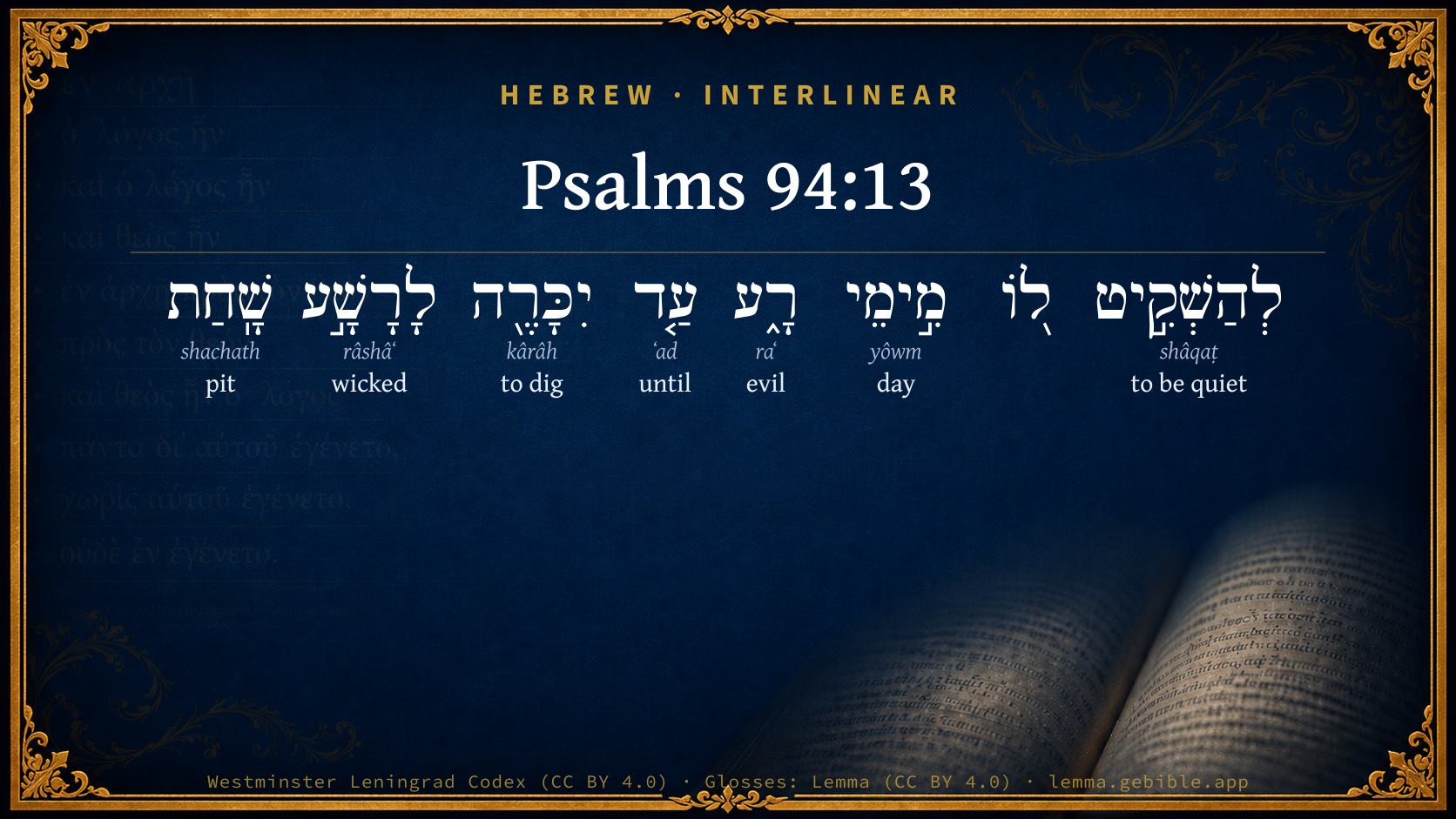
Psalms 94:13

Hebrew (Westminster Leningrad Codex) Psalms 94:13 appears in the Hebrew Old Testament. The text above is from the Westminster Leningrad Codex. Each word links to its Strong’s number, a concise gloss, and parsing drawn from the Open Scriptures Hebrew Bible morphology. Click any word for its full Brown-Driver-Briggs (BDB) entry.
Download image
Cite this verse

Psalms 94:13 (World English Bible). Public Domain. Lemma interlinear Bible study tool, https://lemma.gebible.app/v/psalms/94/13.

Show BibTeX & RIS
BibTeX
RIS
English Translation
That you may give him rest from the days of adversity, Until the pit is dug for the wicked.
World English Bible · Public Domain
Download a study sheet

One document with this verse’s original text, its word-by-word gloss line, the meaning frame, cross-references with their text, attributed commentary, and full source and license credits — printable, and it pastes into notes with its structure intact.

This verse Autodidact and up

Study sheet (.html) Plain text (.txt)

A passage Seminary Student

Up to 50 verses in one chapter. A passage sheet keeps up to 6 commentary sources and 12 cross-references per verse, in the order this page ranks them, and says so on the sheet whenever that leaves anything out. Ask for a single verse and you get the Autodidact verse sheet above.

Everything on this page stays free to read, with no account — the sheet is a download of what is already on screen, not access to it.

Want to remove ads? Support Godless Engineer
Compare translations 3

The same verse in 3 English versions, stacked beneath the original-language interlinear above. Click any original word for its lexicon entry.

Each is an independent rendering of the whole verse — the interlinear is not word-aligned to these translations.

Highlighted words mark where these versions differ — a whole-verse word diff, not a word-by-word alignment.

  • World English Bible Public Domain
    That you may give him rest from the days of adversity, Until the pit is dug for the wicked.
  • King James Version Public Domain
    That thou mayest give him rest from the days of adversity, until the pit be digged for the wicked.
  • unfoldingWord Literal Text CC BY-SA 4.0
    to give rest to him from days of evil until a pit is dug for the wicked.

unfoldingWord Literal Text — © unfoldingWord, licensed CC BY-SA 4.0. Word-aligned USFM3 via Door43 (git.door43.org/unfoldingWord/en_ult).

Versions to compare (up to 4)

3 of 4 selected

Show all 18 translations

Every available English version of this verse, each an independent rendering of the whole verse.

  • World English Bible Public Domain
    That you may give him rest from the days of adversity, Until the pit is dug for the wicked.
  • Berean Standard Bible Public Domain
    to grant him relief from days of trouble, until a pit is dug for the wicked.
  • Majority Standard Bible Public Domain
    to grant him relief from days of trouble, until a pit is dug for the wicked.
  • King James Version Public Domain
    That thou mayest give him rest from the days of adversity, until the pit be digged for the wicked.
  • American Standard Version (1901) Public Domain
    That thou mayest give him rest from the days of adversity, Until the pit be digged for the wicked.
  • Revised Version (1885) Public Domain
    That thou mayest give him rest from the days of adversity, until the pit be digged for the wicked.
  • Geneva Bible (1599) Public Domain
    That thou mayest giue him rest from the dayes of euill, whiles the pitte is digged for the wicked.
  • Douay-Rheims (1899) Public Domain
    That thou mayst give him rest from the evil days: till a pit be dug for the wicked.
  • Young's Literal Translation Public Domain
    To give rest to him from days of evil, While a pit is digged for the wicked.
  • Literal Standard Version CC BY-SA 4.0
    To give rest to him from days of evil, || While a pit is dug for the wicked.
  • Unlocked Literal Bible CC BY-SA 4.0
    You give him rest in times of trouble until a pit is dug for the wicked.
  • unfoldingWord Literal Text CC BY-SA 4.0
    to give rest to him from days of evil until a pit is dug for the wicked.
  • Darby Bible Public Domain
    That thou mayest give him rest from the days of evil, until the pit be digged for the wicked.
  • World Messianic Bible Public Domain
    that you may give him rest from the days of adversity, until the pit is dug for the wicked.
  • Webster's Bible Public Domain
    That thou mayest give him rest from the days of adversity, until the pit be digged for the wicked.
  • Free Bible Version CC BY-SA 4.0
    You give them peace in days of trouble, until a pit is dug to trap the wicked.
  • Bible in Basic English Public Domain
    So that you may give him rest from the days of evil, till a hole is made ready for the destruction of the sinners.
  • JPS Tanakh (1917) Public Domain
    That Thou mayest give him rest from the days of evil, until the pit be digged for the wicked.

Literal Standard Version (2020), Covenant Press — licensed CC BY-SA 4.0. Text via the HelloAO Bible API (eBible.org). Unlocked Literal Bible (unfoldingWord) — licensed CC BY-SA 4.0. Text via the HelloAO Bible API (eBible.org). unfoldingWord Literal Text — © unfoldingWord, licensed CC BY-SA 4.0. Word-aligned USFM3 via Door43 (git.door43.org/unfoldingWord/en_ult). Free Bible Version, Dr. Jonathan Gallagher — licensed CC BY-SA 4.0. Text via the HelloAO Bible API (eBible.org).

Word by word

More ways to search: Search by grammar → Find every occurrence → Compare this word →

Practice this passage: Drill this verse → Learn its vocabulary →

About this verse

These counts appear in no published source. They are computed here, from the morphology-tagged text and Lemma’s own curated glosses. What Lemma adds →

8
words
7
distinct lemmas
Wisdom
section

Notable vocabulary

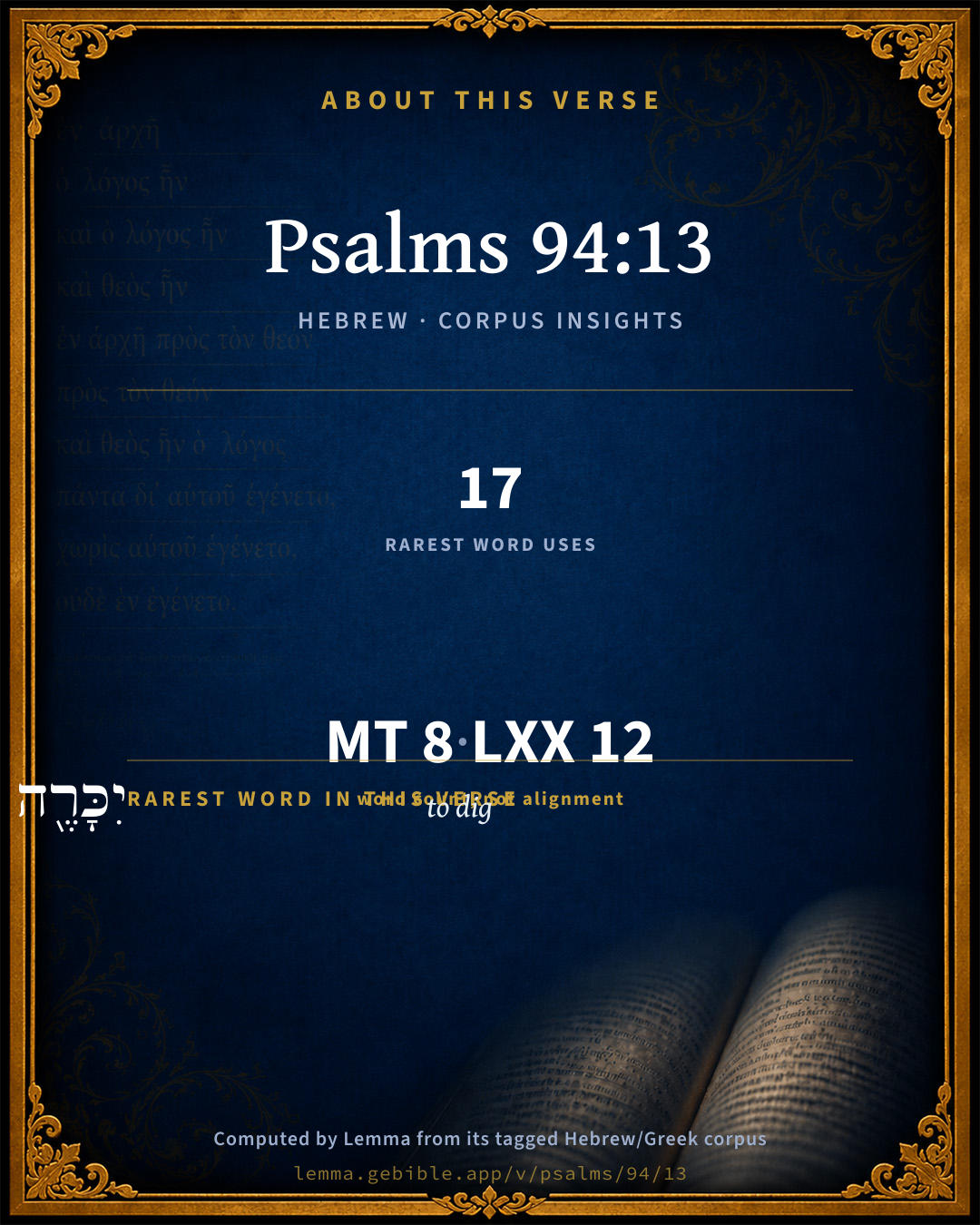
The rarest word here is יִכָּרֶ֖ה to dig H3738 — appearing just 17 times in the whole Hebrew Bible.

Shared distinctive vocabulary

יִכָּרֶ֖ה to dig H3738 occurs in 17 verses of the Hebrew Bible. Also found in:

Grammatical profile

  • 2 verbs
  • 2 nouns
  • 2 adjectives
  • 2 prepositions

Verb forms

  • לְהַשְׁקִ֣יט Hiphil · Infinitive Construct
  • יִכָּרֶ֖ה Niphal · Imperfect

Hebrew & Septuagint length

In English translation the verse runs 19 words from the Hebrew and 16 from the Septuagint (LXX English) — closely comparable.

A rough comparison of the two English renderings, which tokenize alike — not a word-level alignment.

Word counts can differ between the Hebrew and the Greek without any difference in meaning — e.g. the Hebrew direct-object marker אֵת has no separate Greek word, and Greek often adds the article ὁ.

In the original languages it is 8 Hebrew tokens and 12 Greek tokens — but the two are counted differently (Hebrew bundles its prefixes and suffixes into one token; the Greek is in lemma form), so that isn’t a like-for-like length.

Cross-references

16

Topical passages linked to Psalms 94:13 in the Treasury of Scripture Knowledge — connected by theme and wording, ordered by reader-vote popularity; previews shown in the World English Bible.

  • Psalms 55:23 But you, God, will bring them down into the pit of destruction. Bloodthirsty and deceitful men shall not live out half their days, But I will trust in you.
  • 2 Peter 2:9 the Lord knows how to deliver the godly out of temptation and to keep the unrighteous under punishment for the day of judgment;
  • Psalms 9:15 The nations have sunk down in the pit that they made; In the net which they hid, their own foot is taken.
  • Isaiah 26:20–21 Come, my people, enter you into your chambers, and shut your doors about you: hide yourself for a little moment, until the indignation be past.
  • Habakkuk 3:16 I heard, and my body trembled. My lips quivered at the voice. Rottenness enters into my bones, and I tremble in my place, Because I must wait quietly for the day of trouble, For the coming up of the people who invade us.
  • 2 Thessalonians 1:7–8 and to give relief to you that are afflicted with us, when the Lord Jesus is revealed from heaven with his mighty angels in flaming fire,
  • Revelation 14:13 I heard the voice from heaven saying, "Write, 'Blessed are the dead who die in the Lord from now on.'" "Yes," says the Spirit, "that they may rest from their labors; for their works follow with them."
  • Psalms 49:5 Why should I fear in the days of evil, When iniquity at my heels surrounds me?
  • Jeremiah 18:22 Let a cry be heard from their houses, when you shall bring a troop suddenly on them; for they have dug a pit to take me, and hid snares for my feet.
  • 2 Corinthians 4:17–18 For our light affliction, which is for the moment, works for us more and more exceedingly an eternal weight of glory;
  • 2 Peter 3:3–7 knowing this first, that in the last days mockers will come, walking after their own lusts,
  • Revelation 6:10–11 They cried with a loud voice, saying, "How long, Master, the holy and true, until you judge and avenge our blood on those who dwell on the earth?"
  • Revelation 11:18 The nations were angry, and your wrath came, as did the time for the dead to be judged, and to give your bondservants the prophets, their reward, as well as to the saints, and those who fear your name, to the small and the great; and to destroy those who destroy the earth."
  • Job 34:29 When he gives quietness, who then can condemn? When he hides his face, who then can see him? Alike whether to a nation, or to a man:
  • Jeremiah 18:20 Shall evil be recompensed for good? for they have dug a pit for my soul. Remember how I stood before you to speak good for them, to turn away your wrath from them.
  • Hebrews 4:9 There remains therefore a Sabbath rest for the people of God.

Cross-references courtesy of OpenBible.info (CC BY 4.0).

Hebrew and Greek witnesses Masoretic Hebrew ↔ Greek Septuagint

The same verse in the two great witnesses to the Old Testament, shown verse-for-verse.

You’re reading Greek Psalm 93 (Hebrew Psalm 94). The Septuagint counts the superscription, so verse numbers can differ from the Hebrew — chapter-level alignment, not verse-by-verse. Numbering follows Rahlfs.

These are two independent witnesses, not word-aligned to each other, and the Septuagint is shown in lemma (dictionary) form.

Hebrew Psalms 94:13 Masoretic · Westminster Leningrad Codex

לְהַשְׁקִ֣יט ל֭וֹ מִ֣ימֵי רָ֑ע עַ֤ד יִכָּרֶ֖ה לָרָשָׁ֣ע שָֽׁחַת

That you may give him rest from the days of adversity, Until the pit is dug for the wicked.

World English Bible · Public Domain

Greek LXX Greek Psalm 93:13 Septuagint · lemma form

ὁ πραΰνω αὐτός ἀπό ἡμέρα πονηρός ἕως ὅς ὀρύσσω ὁ ἁμαρτωλός βόθρος

to give him rest from evil days, until a pit be digged for the sinful one.

LXX2012 (modern English Septuagint) · Public Domain

Hebrew: Westminster Leningrad Codex (CC BY 4.0). Greek: Septuagint (public domain); English from LXX2012 (modern English Septuagint) (Public Domain). How the Septuagint differs from the Hebrew →

Commentary

Notes on Psalms 94:13 from classic Christian and Jewish commentators (each source and its license shown beneath its notes). The classic Christian expositions comment on the surrounding passage and are grouped to its opening verse, so a note may address several verses; the Jewish commentaries on the Tanakh (Rashi and others) are per-verse, so they appear only where the commentator wrote on this verse.

Lemma curates 59 commentaries, every one of them public domain or Creative Commons licensed, each selected and text-cleaned for this edition rather than reprinted as found. About our sources →

Trapp's Complete Commentary

John Trapp

Psa 94:13 That thou mayest give him rest from the days of adversity, until the pit be digged for the wicked.

Ver. 13. That thou mayest give him rest] Here usually, but hereafter certainly. Mors aerumnarum requies was Cbaucer’s motto; Those that die in the Lord shall rest from their labours. Meanwhile they are chastened of the Lord that they may not be condemned with the world, 1Co 11:32.

Until the pit be digged for the wicked] Until the cold grave hold his body, and hot hell hold his soul.

John Trapp, A Commentary or Exposition upon All the Books of the Old and New Testament (1647–1656) — public domain. Text from a community e-Sword module.

The Biblical Illustrator

Joseph S. Exell

Psa_94:13

Until the pit be digged for the ungodly.

The retributive doom of the wicked

I. It is terrible; it is a pit; conveying the idea--

1. Of darkness; no sunlight.

2. Confinement; enclosed all around.

3. Of desolation; no society.

II. It is preparing. The pit is being digged, it is in process, not completed. Who is digging it? Not the Almighty, but the sinner himself. Deeper and deeper it becomes with every transgression he commits. (Homilist.)

The Biblical Illustrator, edited by Joseph S. Exell (c. 1880s–1900s) — public domain. Text from a community e-Sword module.

J. A. Alexander on Psalms

Joseph Addison Alexander

13. (Psa 94:13) To give him rest from days of evil, until a pit be digged for the wicked. Compare Psa 49:5; Psa 112:8. The first verb is a causative, to make him rest. From days of evil does not mean merely after them, but so as to escape them. The last clause ensures the safety of the righteous even during the prosperity and triumph of the wicked.

Joseph Addison Alexander, The Psalms Translated and Explained (1850) — public domain. Text from a community e-Sword module.

Tyndale Open Study Notes

Tyndale Open Resources

94:13 God’s relief includes his comfort and rescue.

Tyndale Open Study Notes — © Tyndale Open Resources, licensed CC BY-SA 4.0. Text via the HelloAO Bible API.

Adam Clarke's Commentary

Verse 13. That thou mayest give him rest] He whom God instructs is made wise unto salvation; and he who is thus taught has rest in his soul, and peace and confidence in adversity.

Adam Clarke's Commentary on the Bible (1810–1826) — public domain. Text from a community e-Sword/MySword module.

John Calvin's Commentaries

By evil days, or days of evil, the Psalmist might thus mean the everlasting destruction which awaits the ungodly, whom God has spared for a certain interval. Or his words may be expounded as signifying, that the man is blessed who has learned to be composed and tranquil under trials. The rest intended would then be that of an inward kind, enjoyed by the believer even during the storms of adversity; and the scope of the passage would be, that the truly happy man is he who has so far profited, by the word of God, as to sustain the assault of evils from without, with peace and composure. But as it is added, whilst the pit is digged for the wicked, it would seem necessary, in order to bring out the opposition contained in the two members of the sentence, to suppose that the Psalmist rather commends the wisdom of those who reckon that God afflicts them with a view to saving them from destruction, and bringing them eventually to a happy issue. It was necessary to state this second ground of comfort, because our hearts cannot fail to be affected with the most intense grief when we see the wicked triumph, and no Divine restraint put upon them. The Psalmist meets the temptation by appropriately reminding us that the wicked are left upon earth, just as a dead body which is stretched out upon a bed, till its grave be dug. Here believers are warned that, if they would preserve their constancy, they must mount their watchtower, as Habakkuk says, (Habakkuk 2:1) and take a view in the distance of God’s judgments. They shall see worldly men rioting in worldly delights, and, if they extend their view no farther, they will give way to impatience. But it would moderate their grief, would they only remember that those houses which are nominally appropriated to the living, are, in fact, only granted to the dead, until their grave be digged; and that, though they remain upon earth, they are already devoted to destruction.

John Calvin's Commentaries (1540-1563) — public domain. Text from the Calvin Translation Society English edition (1840s-50s) via the Christian Classics Ethereal Library (ccel.org). Calvin's coverage is partial (roughly two-thirds of the Bible); uncommented books and verses are honest gaps, never fabricated. The 19th-century editor's footnotes and remarks are omitted so the notes are faithfully Calvin's own voice.

John Gill's Exposition

That thou mayest give him rest from the days of adversity,.... Or "evil" (c); or "in the evil days", as the Arabic version; for through teaching men under afflictions, they become tranquil and quiet in them; they yield the peaceable fruits of righteousness to them; such men patiently bear them; and quietly submit to the will of God in them, and are still, and know that he is God, that does all things well and wisely: moreover, the Lord does not always chasten his people; when he has taught them by his rod, and the affliction has answered its end, he gives them rest or intermission from those days of affliction: God does not always suffer the rod of the wicked, or persecution, to be upon the lot of the righteous; he gives his churches rest at times: in all ages there have been some intervals of respite; and after the slaying of the witnesses, and their rising, there will be no more of those days of adversity; but the

times of refreshing, or rest, will come, which will make up the spiritual reign of Christ; and there remains a "rest", or "sabbatism", for the people of God, which will last a thousand years; and, after that, an eternal rest in heaven, which the light afflictions of the saints here are working, and are the means of making them meet for it: "until the pit be digged for the wicked"; hell, the pit of destruction, the lake which burns with fire and brimstone, the everlasting fire prepared for the devil and his angels: this pit and lake is dug and prepared by the sovereign will and unchangeable purpose and decree of God, for all wicked and Christless sinners; particularly for the beast and false prophet, and his followers, who shall be cast into it, and be tormented in it day and night, and have no rest; while the saints they here persecuted will be in the greatest repose, and utmost felicity; and when it will appear who are the blessed and happy persons, and who not.

(c) "mali", Pagninus, Montanus, Piscator, Cocceius, Gejerus, Michaelis.

John Gill's Exposition of the Whole Bible (1746–1763) — public domain (CC PDM 1.0). Text via the HelloAO Bible API.

Albert Barnes' Notes on the Bible

That thou mayest give him rest - Mayest make his mind quiet and calm; mayest save him from murmuring, from despondency, from impatience, by just confidence in thee, and in thy government.

From the days of adversity - Or, in the days of evil; the time of calamity and trouble. That his mind may then be composed and calm.

Until the pit be digged for the wicked - Until the wicked be punished; that is, while the preparations are going on, or while God seems to delay punishment, and the wicked are suffered to live as if God did not notice them, or would not punish them. The idea is, that the mind should not be impatient as if their punishment would not come, or as if God were unconcerned; and that just views of the divine administration would tend to make the mind calm even when the wicked “seemed” to prosper and triumph. See the notes at Psa 73:16-22. The phrase “until the pit be digged” is derived from the method of hunting wild beasts by digging a pit into which they might fall and be taken. See the notes at Psa 7:15.

Albert Barnes' Notes on the Bible (1834–1885) — public domain. Text from a community e-Sword/MySword module.

Matthew Poole's English Annotations

For their present and short troubles prepare them for, and lead them to, true rest and blessedness, whilst the seeming felicities of the wicked make way for those tremendous judgments which God hath prepared for them.

Matthew Poole's English Annotations on the Holy Bible (1683–1685) — public domain. Text from a community e-Sword/MySword module.

The Treasury of David

Charles H. Spurgeon

Ver. 13. That thou mayest give him rest from the days of adversity, until the pit be digged for the wicked. The chastening hand and instructive book are sanctified to us, so that we learn to rest in the Lord. We see that his end is our everlasting benefit, and therefore abide quiet under all trying providences and bitter persecutions, waiting our time. The Mighty Hunter is preparing the pit for the brutish ones; they are prowling about at this time, and tearing the sheep, but they will soon be captured and destroyed, therefore the people of the Lord learn to rest in days of adversity, and tarry the leisure of their God. Wicked men may not yet be ripe for punishment, nor punishment ready for them: hell is a prepared place for a prepared people; as days of grace ripen saints for glory, so days of wantonness help sinners to rot into the corruption of eternal destruction.

Ver. 13. That thou mayest give him rest. Here usually, but hereafter certainly. Mors aerumnarum requies, was Chaucer's motto: those that die in the Lord shall rest from their labours. Meanwhile they are chastened of the Lord, that they may not be condemned with the world. 1Co 11:32. John Trapp.

Ver. 13. To give him rest. This is the end of God's teaching, that his servant may wait in patience, unmoved by, safe from, the days of evil (comp. Ps 49:5) seeing the evil all round lifting itself up, but seeing also the secret, mysterious retribution, slowly but surely accomplishing itself. In this sense the "rest" is the rest of a calm, self possessed spirit, as Isa 7:4 30:15 32:17 57:20; and "to give him" signifies "that thou mayest give him." J. J. S. Perowne.

Ver. 13. Rest. Let there be a revival of the passive virtues. Mr. Hume calls them the "monkish virtues." Many speak of them slightingly, especially as compared with the dashing qualities so highly esteemed in the world. But quietness of mind and of spirit, like a broken heart, is of great price in the sight of God. Some seem to have forgotten that silence and meekness are graces. William S. Plumer.

Ver. 13. Rest from the days of adversity. To rest from the days of adversity is not to be disturbed by them to such an extent as to murmur, or despond in spirit, but to trust in God, and in silence of the mind and affections expect from God deliverance. See Isa 7:4; Isa 26:20, &c. Moreover he says not ymyk in, but ymym from the days of adversity, an expression of greater elegancy and wider range of meaning. For there is a reference to the primary form of the verb vqv to sink, to settle down, as when the dregs of disturbed liquor fall to the bottom; when it is applied to the mind when shaken with a great agitation of cares, and full of bitterness. The dregs, therefore, sprung from the days of adversity, are pointed out as settling down. Besides, not only is rest of mind while the evils continue indicated, but also while they are ceasing, since m, from, has here, as not infrequently elsewhere, a negativ force. Venema.

Ver. 13. Until the pit be digged for the wicked. Behold, thou hast the counsel of God, and the reason why he spareth the wicked; the pit is being digged for the sinner. You wish to bury him at once: the pit is as yet being dug for him: do not be in haste to bury him. Augustine.

Psalms 94:14*

Charles H. Spurgeon's The Treasury of David (1869–1885) — public domain. Psalms only. Text from a community e-Sword/MySword module.

Whedon's Commentary on the Bible

Daniel D. Whedon

13. Rest from the days of adversity—Exemption and safety from the fatal calamities which shall overtake the wicked.

Until the pit be digged— Whilst the pit shall be digged, etc. So the particle usually rendered until is sometimes used, as in 1Sa_14:19; Job_1:18. On the sense of the passage, compare Psa_91:8

Daniel D. Whedon (gen. ed.), Commentary on the Old and New Testaments (1874–1909) — public domain. Text from a community e-Sword module.

The Pulpit Commentary

That thou mayest give him rest from the days of adversity. Trials and afflictions are means to an end, and the intended end is "rest" and peace. "There remaineth, therefore, a rest to the people of God". (Heb_4:9) Until the pit be digged for the wicked. (comp. Psa_9:1 Psa_35:7, Psa_35:8)

The Pulpit Commentary (1880–1919), ed. H.D.M. Spence-Jones & Joseph S. Exell — public domain. Text from a community e-Sword module.

Rashi

Rabbi Shlomo Yitzchaki (Rashi)

To grant him peace from days of evil For the chastisements cause him to have peace from the days of the judgment of Gehinnom. while he sees that a pit is dug for the wicked man.

Rashi on the Tanakh — English translations: “The Judaica Press complete Tanach with Rashi, translated by A. J. Rosenberg” (CC BY 4.0); “Pentateuch with Rashi's commentary by M. Rosenbaum and A.M. Silbermann, 1929-1934” (public domain); “The Metsudah Tanach series, Lakewood, N.J” (CC BY 4.0); and “The Book of Joshua, Metsudah Publications, 1997” (CC BY 4.0). Text via Sefaria.

Lesson kit

Teaching starters — assembled from the data on this page, not authored interpretation. Every prompt links to the verse data it draws on. Edit before teaching.

Psalms, in the Wisdom, opens this verse with 8 words (7 distinct Hebrew lemmas). Its most distinctive word is kârâh (“to dig”). A historical commentator’s framing appears above. Read the whole chapter for the surrounding context.

Discussion questions

  1. How does “to dig” (kârâh) shape what this verse is saying?
  2. How does Genesis 26:25, which shares the word «to dig», read alongside this verse?
  3. These translations render this verse differently; the difference is in the English rendering, not the original. What questions does that raise?
  4. «לְהַשְׁקִ֣יט» is a Hiphil Infinitive Construct verb. How does that grammatical form shape the action described?
  5. Compare how Trapp's Complete Commentary and The Biblical Illustrator read this verse. Where do they agree or differ?

Things to notice

Reading settings

Reading text

Shown beneath each verse's original-language words.

Old Testament
Old Testament edition

Read the OT as the Masoretic Hebrew (MT) or the Greek Septuagint (LXX).

English shown for the Greek Septuagint (in the Hebrew ↔ Greek comparison).

Comparing translations? Open the Compare panel on any verse page to stack up to four side by side.