
Psalms 37:16

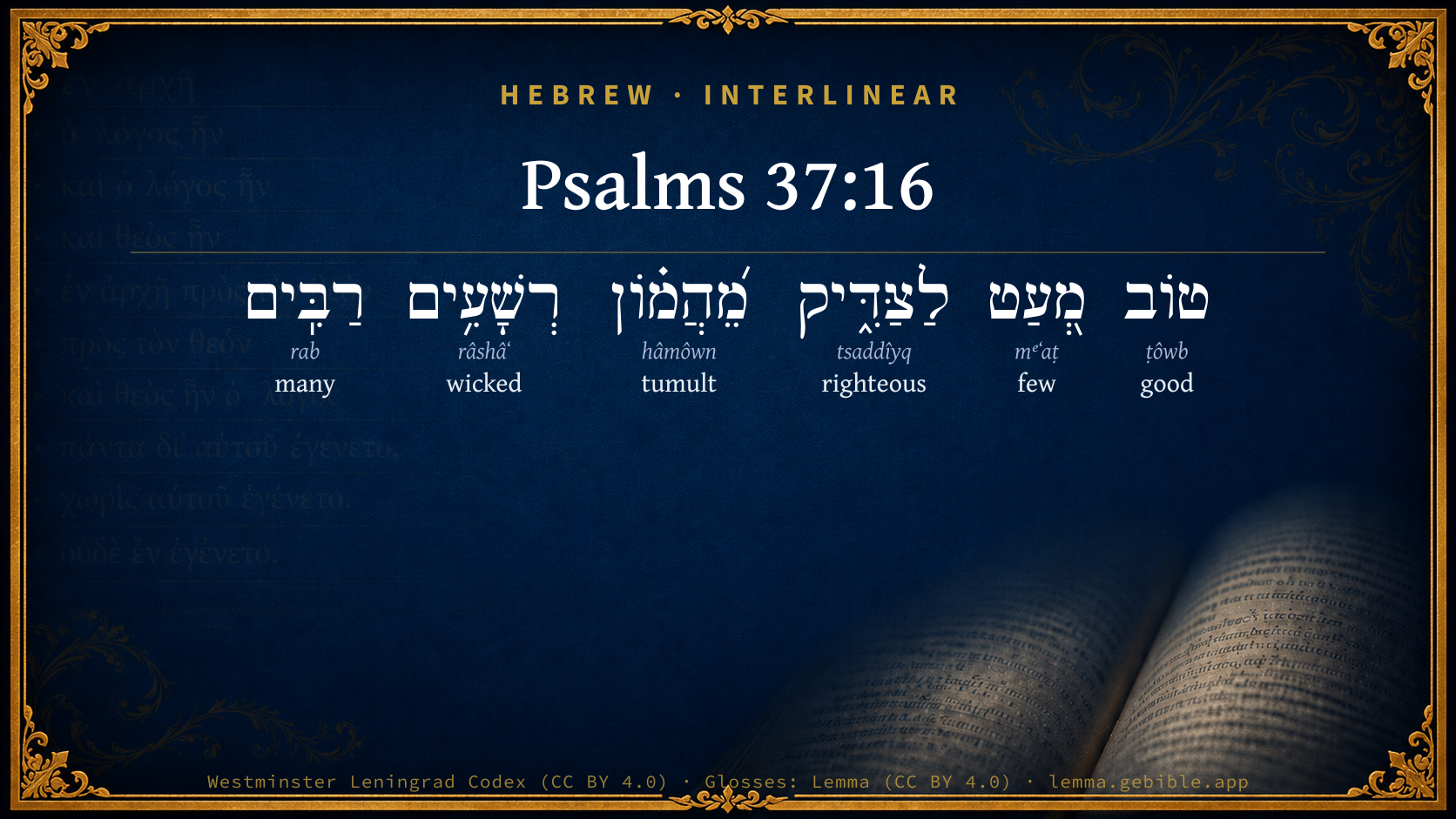
Hebrew (Westminster Leningrad Codex) Psalms 37:16 appears in the Hebrew Old Testament. The text above is from the Westminster Leningrad Codex. Each word links to its Strong’s number, a concise gloss, and parsing drawn from the Open Scriptures Hebrew Bible morphology. Click any word for its full Brown-Driver-Briggs (BDB) entry.
Download image
Cite this verse

Psalms 37:16 (World English Bible). Public Domain. Lemma interlinear Bible study tool, https://lemma.gebible.app/v/psalms/37/16.

Show BibTeX & RIS
BibTeX
RIS
English Translation
Better is a little that the righteous has, Than the abundance of many wicked.
World English Bible · Public Domain
Download a study sheet

One document with this verse’s original text, its word-by-word gloss line, the meaning frame, cross-references with their text, attributed commentary, and full source and license credits — printable, and it pastes into notes with its structure intact.

This verse Autodidact and up

Study sheet (.html) Plain text (.txt)

A passage Seminary Student

Up to 50 verses in one chapter. A passage sheet keeps up to 6 commentary sources and 12 cross-references per verse, in the order this page ranks them, and says so on the sheet whenever that leaves anything out. Ask for a single verse and you get the Autodidact verse sheet above.

Everything on this page stays free to read, with no account — the sheet is a download of what is already on screen, not access to it.

Want to remove ads? Support Godless Engineer
Compare translations 3

The same verse in 3 English versions, stacked beneath the original-language interlinear above. Click any original word for its lexicon entry.

Each is an independent rendering of the whole verse — the interlinear is not word-aligned to these translations.

Highlighted words mark where these versions differ — a whole-verse word diff, not a word-by-word alignment.

  • World English Bible Public Domain
    Better is a little that the righteous has, Than the abundance of many wicked.
  • King James Version Public Domain
    A little that a righteous man hath is better than the riches of many wicked.
  • unfoldingWord Literal Text CC BY-SA 4.0
    Better the little of the righteous than the abundance of many wicked.

unfoldingWord Literal Text — © unfoldingWord, licensed CC BY-SA 4.0. Word-aligned USFM3 via Door43 (git.door43.org/unfoldingWord/en_ult).

Versions to compare (up to 4)

3 of 4 selected

Show all 18 translations

Every available English version of this verse, each an independent rendering of the whole verse.

  • World English Bible Public Domain
    Better is a little that the righteous has, Than the abundance of many wicked.
  • Berean Standard Bible Public Domain
    Better is the little of the righteous than the abundance of many who are wicked.
  • Majority Standard Bible Public Domain
    Better is the little of the righteous than the abundance of many who are wicked.
  • King James Version Public Domain
    A little that a righteous man hath is better than the riches of many wicked.
  • American Standard Version (1901) Public Domain
    Better is a little that the righteous hath Than the abundance of many wicked.
  • Revised Version (1885) Public Domain
    Better is a little that the righteous hath than the abundance of many wicked.
  • Geneva Bible (1599) Public Domain
    A small thing vnto the iust man is better, then great riches to the wicked and mightie.
  • Douay-Rheims (1899) Public Domain
    Better is a little to the just, than the great riches of the wicked.
  • Young's Literal Translation Public Domain
    Better `is' the little of the righteous, Than the store of many wicked.
  • Literal Standard Version CC BY-SA 4.0
    Better [is] the little of the righteous, || Than the store of many wicked.
  • Unlocked Literal Bible CC BY-SA 4.0
    Better is the little that the righteous has than the abundance of many wicked people.
  • unfoldingWord Literal Text CC BY-SA 4.0
    Better the little of the righteous than the abundance of many wicked.
  • Darby Bible Public Domain
    The little that the righteous hath is better than the abundance of many wicked;
  • World Messianic Bible Public Domain
    Better is a little that the righteous has, than the abundance of many wicked.
  • Webster's Bible Public Domain
    A little that a righteous man hath is better than the riches of many wicked.
  • Free Bible Version CC BY-SA 4.0
    It's better to do right and only have a little, than to be wicked and rich.
  • Bible in Basic English Public Domain
    The little which the good man has is better than the wealth of evil-doers.
  • JPS Tanakh (1917) Public Domain
    Better is a little that the righteous hath than the abundance of many wicked.

Literal Standard Version (2020), Covenant Press — licensed CC BY-SA 4.0. Text via the HelloAO Bible API (eBible.org). Unlocked Literal Bible (unfoldingWord) — licensed CC BY-SA 4.0. Text via the HelloAO Bible API (eBible.org). unfoldingWord Literal Text — © unfoldingWord, licensed CC BY-SA 4.0. Word-aligned USFM3 via Door43 (git.door43.org/unfoldingWord/en_ult). Free Bible Version, Dr. Jonathan Gallagher — licensed CC BY-SA 4.0. Text via the HelloAO Bible API (eBible.org).

Word by word

More ways to search: Search by grammar → Find every occurrence → Compare this word →

Practice this passage: Drill this verse → Learn its vocabulary →

About this verse

These counts appear in no published source. They are computed here, from the morphology-tagged text and Lemma’s own curated glosses. What Lemma adds →

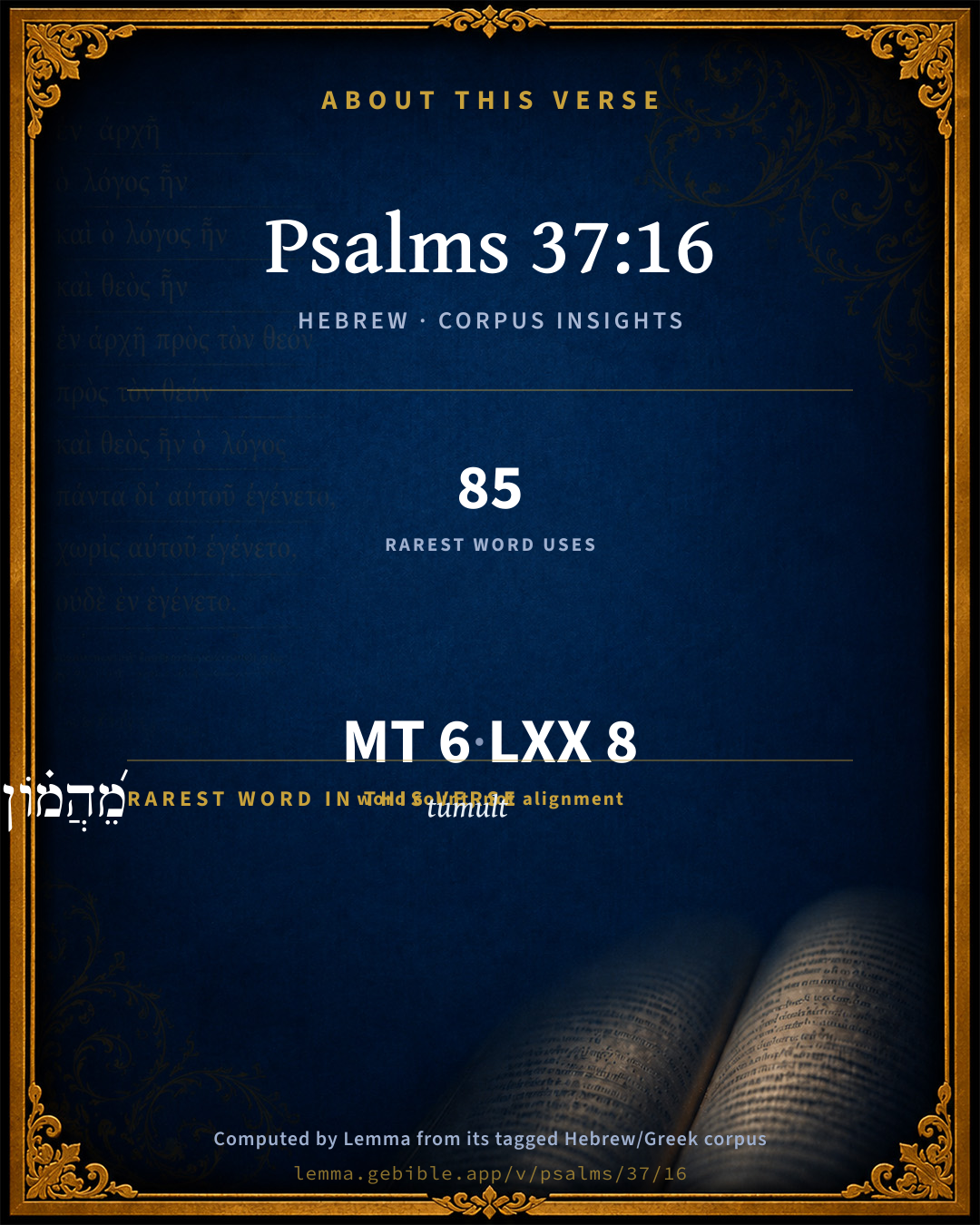
6
words
6
distinct lemmas
Wisdom
section

Grammatical profile

  • 2 nouns
  • 4 adjectives

Hebrew & Septuagint length

In English translation the verse runs 14 words from the Hebrew and 12 from the Septuagint (LXX English) — closely comparable.

A rough comparison of the two English renderings, which tokenize alike — not a word-level alignment.

Word counts can differ between the Hebrew and the Greek without any difference in meaning — e.g. the Hebrew direct-object marker אֵת has no separate Greek word, and Greek often adds the article ὁ.

In the original languages it is 6 Hebrew tokens and 8 Greek tokens — but the two are counted differently (Hebrew bundles its prefixes and suffixes into one token; the Greek is in lemma form), so that isn’t a like-for-like length.

Cross-references

9

Topical passages linked to Psalms 37:16 in the Treasury of Scripture Knowledge — connected by theme and wording, ordered by reader-vote popularity; previews shown in the World English Bible.

  • Proverbs 16:8 Better is a little with righteousness, Than great revenues with injustice.
  • Proverbs 15:16–17 Better is little, with the fear of Yahweh, Than great treasure with trouble.
  • 1 Timothy 6:6 But godliness with contentment is great gain.
  • Proverbs 13:25 The righteous one eats to the satisfying of his soul, But the belly of the wicked goes hungry.
  • Proverbs 3:33 Yahweh's curse is in the house of the wicked, But he blesses the habitation of the righteous.
  • Ecclesiastes 4:6 Better is a handful, with quietness, than two handfuls with labor and chasing after wind.
  • Proverbs 30:9 Lest I be full, deny you, and say, 'Who is Yahweh?' Or lest I be poor, and steal, And so dishonor the name of my God.
  • Ecclesiastes 2:26 For to the man who pleases him, God gives wisdom, knowledge, and joy; but to the sinner he gives travail, to gather and to heap up, that he may give to him who pleases God. This also is vanity and a chasing after wind.

Cross-references courtesy of OpenBible.info (CC BY 4.0).

Hebrew and Greek witnesses Masoretic Hebrew ↔ Greek Septuagint

The same verse in the two great witnesses to the Old Testament, shown verse-for-verse.

You’re reading Greek Psalm 36 (Hebrew Psalm 37). The Septuagint counts the superscription, so verse numbers can differ from the Hebrew — chapter-level alignment, not verse-by-verse. Numbering follows Rahlfs.

These are two independent witnesses, not word-aligned to each other, and the Septuagint is shown in lemma (dictionary) form.

Hebrew Psalms 37:16 Masoretic · Westminster Leningrad Codex

טוֹב מְ֭עַט לַצַּדִּ֑יק מֵ֝הֲמ֗וֹן רְשָׁעִ֥ים רַבִּֽים

Better is a little that the righteous has, Than the abundance of many wicked.

World English Bible · Public Domain

Greek LXX Greek Psalm 36:16 Septuagint · lemma form

κρείσσων ὀλίγος ὁ δίκαιος ὑπέρ πλοῦτος ἁμαρτωλός πολύς

A little is better to the righteous than abundant wealth of sinners.

LXX2012 (modern English Septuagint) · Public Domain

On this verse, The Cambridge Bible for Schools and Colleges discusses the Septuagint’s reading. Read the note in Commentary ↓

Hebrew: Westminster Leningrad Codex (CC BY 4.0). Greek: Septuagint (public domain); English from LXX2012 (modern English Septuagint) (Public Domain). How the Septuagint differs from the Hebrew →

Commentary

Notes on Psalms 37:16 from classic Christian and Jewish commentators (each source and its license shown beneath its notes). The classic Christian expositions comment on the surrounding passage and are grouped to its opening verse, so a note may address several verses; the Jewish commentaries on the Tanakh (Rashi and others) are per-verse, so they appear only where the commentator wrote on this verse.

Lemma curates 59 commentaries, every one of them public domain or Creative Commons licensed, each selected and text-cleaned for this edition rather than reprinted as found. About our sources →

Trapp's Complete Commentary

John Trapp

Psa 37:16 A little that a righteous man hath [is] better than the riches of many wicked.

Ver. 16. A little that the righteous man hath, &c.] Whereas it was said before, the meek shall inherit the earth, some man might object that sach are commonly poor enough; and that is no small affliction, as the heathens (Menander, Euripides, Alcus, &c.) have affirmed; and experience assureth it. Hereunto it is answered that "a little that the righteous man hath is better," &c., as a box of pearls is more worth than many loads of pebbles. And as a bird with a little eye, and the advantage of a wing to soar with, may see far wider than an ox with a greater; so the righteous, with a little estate, joined with faith, tranquillity, and devotion, may have mere pleasure, feel more comfort, see more of God’s bounty, than one of vast possessions, whose heart cannot lift itself above the earth, as one well observeth. Some render it thus, Better is the little of one righteous man than the plenteous mammon of many wicked. The bee is as well (if not better) content with feeding on the dew, or sucking from a flower, as Behemoth, that grazeth on the mountains. Here the psalmist speaketh, saith Vatablus, of the secret blessing of God; Quia etsi in diem victitent, e caelo tamen non secus ac manna pascuntur; for although they have but from hand to mouth, yet they are fed from heaven, as it were, with manna.

John Trapp, A Commentary or Exposition upon All the Books of the Old and New Testament (1647–1656) — public domain. Text from a community e-Sword module.

The Biblical Illustrator

Joseph S. Exell

Psa_37:16-20

A little that a righteous man hath is better than the riches of many wicked.

The folly of fretful envy

I. The good in comparative poverty are better off than the wicked with plenty, A little that a righteous man hath is better than the riches of many wicked. Better for two reasons.

1. His condition would be a more enjoyable one. He would have higher happiness, tits happiness would spring from within, that of the other from without. The happiness of the one selfish, the other generous; the one decreasing, the other heightening.

2. His condition would be a more honourable one. The one is honoured for what he has, the other for what he is. The one is honoured only here by the depraved, the other is honoured yonder by angels and by God.

II. The good are divinely supported, but the wicked shall lose their power, The arms of the wicked shall be broken; but the Lord upholdeth the righteous.

1. The power of the wicked to execute their purpose is to be destroyed. They have often a great deal of power, the arm of literature, commerce, law, war, and with these they work out their iniquitous plans; but the arms are not imperishable.

2. The power of the good to prosecute their mission will he Divinely sustained.

(1) The power to do good is Divine.

(2) Divine power is indestructible. If God be for us, who can be against us?

III. The good shall have a permanent inheritance, but ruin is the doom of the wicked. The Lord knoweth the days of the upright, and their inheritance shall be for ever. What is the inheritance of the righteous? The Lord Himself. The Lord is my portion.

1. This inheritance will preclude all disappointment. They shall not be ashamed in the evil time. Whatever comes, whatever the wrecks of life, and the riot of confusion, with this inheritance there will he calm courage. I am persuaded that neither life nor death, etc.

2. This inheritance will yield satisfaction under the most unfavourable circumstances. (Homilist.)

The righteous and his little, better than the wicked with his much

The little may be better than the much This is Heavens arithmetic. Why is the little better?

I. Because it is honestly gained. Either the product of healthy labour, of commendable skill, or of lawful inheritance.

II. Because it may be safely retained. Prayer and benevolence are a great preservative to wealth.

III. Because it may be truly enjoyed.

IV. Because it will be carefully spent.

V. Because it will be benevolently used. The righteous gain by giving. A running stream inherits the most territory.

VI. Because it will be divinely blessed. Lessons:--

1. To be satisfied with little.

2. To make little sufficient.

3. To use little well. (Joseph Exell, M. A.)

The advantages of the virtuous for the enjoyment of external good

I. A good man has greater enjoyment, purer and more solid satisfaction, from a little, than the wicked can have from the largest fortune.

1. Vice produces a temper which is very unfavourable to our enjoyment. It destroys the constitution, and breaks the vigour of the soul. It subjects it to the most uneasy feelings and the most painful passions (Isa_1:5-6). The fiercest shocks of thunder, winds, and rains cannot produce more dreadful convulsions in the frame of nature, than those into which tumultuous, exorbitant, and jarring passions throw the soul: they ravage all its enjoyments.

2. On the other hand, virtue establishes a temper in the soul, which fits us for taking pleasure in whatever we possess. It dispels the black clouds which overcast the vicious heart, and intercept the comfort which might arise from outward things: they are scattered by its brightness; they fly away before it as the shadows of the night before the rising sun. A virtuous temper lays the mind open to every satisfaction that comes in its way, prepares it for embracing and enjoying it; and it renders the man so well disposed, so happy in himself, that almost every object throws some satisfaction in his way.

II. His enjoyment is more durable.

1. As bodily distemper, from small beginnings, increases till it prove mortal, as one disease neglected is the cause of many others; so the vices of the depraved heart daily acquire new strength by indulgence; they propagate many more; they infect the temper and disorder the constitution with a growing multitude of tormenting passions; they root guilt, remorse, and terror deeper in the soul. Whatever good qualities he once possessed, they will be gradually choked by his spreading vices; they will wither and decay; his capacity of enjoyment will be blasted in the same proportion. The man who never thinks of rectifying the depravities of his temper, but goes on to indulge them without control, must at last become abandoned, and insusceptible of genuine satisfaction.

2. The enjoyment of the good man is in every respect the reverse. Like his practice, it is as the shining light, that shineth more and more unto the perfect day. His virtue does not merely secure the continuance of that relish which he has for true pleasure; it improves his relish in proportion as itself is, by careful practice, strengthened and refined. By daily progress in holiness, he will be more and more possessed of that heavenly serenity of soul, which, by giving him the full enjoyment of himself, prepares him for deriving high and solid satisfaction from every agreeable circumstance in his worldly condition.

III. But a strong objection seems to arise from experience: the wicked, it may be urged, have actually a greater, and the righteous a less degree of enjoyment than we have asserted. We admit the fact; if the wicked were so totally destitute of enjoyment as we have represented them to be, their life would be insupportable: but we maintain that, when this fact is examined, instead of weakening our argument, it will confirm it. We have hitherto supposed the character to be purely virtuous, or purely vicious, that by viewing virtue and vice separately, we might the better discover the genuine tendency of both: but every human character is mixed, composed of some virtues and some vices; and the actual enjoyment of every human creature is affected by each of the ingredients which enter into the composition. Every abatement to which the good mans enjoyment is liable in this mixed state, is to be placed to the account of vice and whatever degree of enjoyment the world can convey to the wicked, is to be ascribed to their imperfect virtues.

1. If these things be so, need we be surprised that so few are really happy? Is it not rather surprising that so many find life tolerable?

2. Need we be concerned that outward things are distributed so promiscuously, or so unequally? It is in the power of every man, by the assistance of Gods grace, to cultivate a virtuous and holy temper: and this is infinitely more important to his enjoyment than the gaudiest distinctions of external state.

3. Would we be truly happy? Let us be virtuous. It is not more our duty than it is our interest. (A. Gerard, D. D.)

How to make much of a little

1. See, in any poor cottage, where true devotion and honest industry abide, how far even very scant wages will go towards providing the real comforts of life. It is not only that Christian patience makes them content with a little, but somehow Christian prudence teaches them to make the most of that little, so that it seems to grow in their hands, and to reach further in the way of making them comfortable than any one would have thought possible.

2. Nor is it less surprising, on the other hand, to see how irreligion wears out and destroys, if not the riches themselves of worldly men, at least all the enjoyment and pleasure that might be looked for in them. How often do we hear of great fortunes dissipated unexpectedly, and nothing, people say, to show for it all I

3. This becomes still plainer when we come down to more particulars--to the things wherein people are supposed particularly to enjoy their wealth. Better is a dinner of herbs, where love is, than a stalled ox, and barred therewith. Who would not rather be St. John in the wilderness, with the leathern girdle about his loins, and his meat locusts and wild honey, than such a wealthy king as Herod, making a feast to his lords, high captains, and chief estates of Galilee?

4. It is the same in the matter of health and strength. A saint on a sick-bed--Hezekiah turning his face to the wall and praying--shall do more, shall really exert more power to change the face of the world, than a mighty conqueror, such as Sennacherib, at the head of his army.

5. One chief supposed advantage of wealth is, that it enables men to choose their company, and to abound in all social enjoyment; but one sure friend that the righteous hath is worth all the companions of the ungodly. Elijah in the wilderness, with now and then a visit from an angel: did he not find that the remembrance of those rare moments cast a light over all his long, solitary hours, which quite prevented them from being tedious? Did he ever wish himself, think you, in Ahabs place, with his many friends and allies, and his seventy children?

6. Nay, and the same rule holds, not only in respect of outward things, but of knowledge also, and scholarship, and acquaintance even with divine matters. Thus a little drop of knowledge, touched by Divine grace, may swell into a sea: as the wise son of Sirach describes Gods dealings with himself: I came out, he says, as a brook from a river, and as a conduit into a garden: I said, I will water my best garden, and will water abundantly my garden bed; and lo, my brook became a river, and my river became a sea. Because he applied himself to his immediate and nearest duty with all [ is heart, God blessed him with large and high knowledge, beyond all the ungodly wisdom of the world.

7. Such is Gods mercy on the one hand, and the perverseness of men on the other, that, even in respect of spiritual blessings also, the psalmists saying holds true. A little measure of grace well employed, and received into a heart willing to be made righteous, is better--far better--than the highest spiritual privileges, when God, in His unsearchable judgments, has vouchsafed them to unworthy persons. Here is comfort for those who seem to be placed in less favourable circumstances than others; less within reach of the means of grace; farther from churches, or with rarer opportunities of receiving the Sacraments. I do not deny that their loss is great: yet our Lord not doubtfully gives us to understand that it may be made up, though they themselves know not how, by increased and most earnest prayers and endeavours on their part. They may be like the woman of Canaan, who, although she was in the place of the dogs, yet was allowed a portion of the childrens bread, because of her great faith, her persevering and humble prayer. (Plain Sermons by Contributors to the Tracts for the Times. )

Gladness under constrained conditions

As I was writing these words there broke upon my ears the song of a canary bird hanging in the room overhead. Its thrilling notes were not a whir less joyous than those which I have often heard rained down from the infinite expanse of heaven by the little skylark of my native land. In spite of its cage that tiny warbler sings, and when its young mistress goes to speak to it, there is a flutter of joy in its wings as with ruffled neck and chattering gladness it leaps to bid her welcome. So let us accept our bonds, whether of poverty, or weakness, or duty, as the bird accepts its cage. You may cage the bird, but you cannot cage its song. No more can you confine or restrain the joy of the heart which, accepting its condition, sees God in it and greets Him from it. (W. M. Taylor.)

The Biblical Illustrator, edited by Joseph S. Exell (c. 1880s–1900s) — public domain. Text from a community e-Sword module.

Joseph Benson's Commentary

Psa 37:16-17. Is better than the riches of many wicked — Because he hath it with many great and glorious advantages; with God’s favour and blessing, with great serenity and satisfaction of his own mind, which is infinitely more desirable and comfortable than all earthly possessions, with the consolations of God’s Spirit, and the assurance of everlasting felicity: while wicked men’s riches are loaded with many encumbrances; with the wrath and curse of God; the torment of their own consciences and passions; and the dreadful expectation of an after-reckoning, and of endless miseries. The Lord upholdeth the righteous — This is a proof of what he had said Psa 37:16. For what the wicked have shall suddenly be lost and gone, but God will maintain the righteous in their happy estate.

Joseph Benson's Commentary on the Old and New Testaments (1811–1818) — public domain. Text from a community e-Sword module.

Keil & Delitzsch

C. F. Keil & F. Delitzsch

With Psa 37:16 accord Pro 15:16; Pro 16:8, cf. Tobit 12:8. The ל of לצּדּיק is a periphrastic indication of the genitive (Ges. 115). המון is a noisy multitude, here used of earthly possessions. רבּים is not per attract. (cf. Psa 38:11, הם for הוּא) equivalent to רב, but the one righteous man is contrasted with many unrighteous. The arms are here named instead of the bow in Psa 37:15. He whose arms are broken can neither injure others nor help himself. Whereas Jahve does for the righteous what earthly wealth and human power cannot do: He Himself upholds them.

Keil & Delitzsch — Biblical Commentary on the Old Testament (1861–1891) — public domain (CC PDM 1.0). Text via the HelloAO Bible API. (Old Testament only.)

J. A. Alexander on Psalms

Joseph Addison Alexander

16. (Psa 37:16) Good is a little to the righteous, which, in our idiom, means, better is a little that the righteous has. This clause exemplifies two remarkable deficiencies of the Hebrew language, the want of a distinct form for the comparative degree, which can only be suggested by construction or the context, and the want of the verb have, which is common to the whole Semitic family of languages.—Than the noise, tumult, turmoil, which attends the acquisition and the care of great possessions. That the Hebrew denotes this incident of wealth rather than wealth itself, may be inferred, not only from its etymology and its use in 1Sa 4:14; 1Sa 14:19, 1Ki 18:41, etc., but from the analogy of Psa 39:7 (6), and Pro 15:16.—Of many wicked, whose noisy and vexatious wealth is here contrasted with the quiet enjoyment of one righteous man, not only with respect to present ease of mind, but also to their future destiny, as stated in the next verse.

Joseph Addison Alexander, The Psalms Translated and Explained (1850) — public domain. Text from a community e-Sword module.

Tyndale Open Study Notes

Tyndale Open Resources

37:16 Being wise with modest means is better than having prosperity and power and being wicked (Prov 15:16; 16:8, 19; 17:1; 28:6).

Tyndale Open Study Notes — © Tyndale Open Resources, licensed CC BY-SA 4.0. Text via the HelloAO Bible API.

Geneva Bible (1599)

Geneva Bible translators

For they are daily fed as with Manna from heaven, and have sufficient, when the wicked have never enough, but ever hunger.

Geneva Bible (1599) marginal notes — public domain. Text via Bolls.life.

Jamieson, Fausset & Brown

Robert Jamieson, A. R. Fausset & David Brown

riches--literally, "noise and tumult," as incidental to much wealth (compare Psa 39:6). Thus the contrast with the "little" of one man is more vivid.

Jamieson, Fausset & Brown — Commentary Critical and Explanatory on the Whole Bible (1871) — public domain (CC PDM 1.0). Text via the HelloAO Bible API.

Adam Clarke's Commentary

Verse 16. A little that a righteous man hath] This is a solid maxim. Whatever a good man has, has God's blessing in it; even the blessings of the wicked are cursed.

Adam Clarke's Commentary on the Bible (1810–1826) — public domain. Text from a community e-Sword/MySword module.

John Calvin's Commentaries

16. Better is the little of the righteous, etc This verse, without any sufficient reason, has been variously rendered. The word המון, hamon, which is rendered abundance, indeed, sometimes signifies a great multitude of men, and sometimes abundance of things; sometimes, too, an adjective of the plural number is joined to a substantive of the singular number. But those who wrest David’s words to this sense, that a few righteous persons are better than a great multitude of the ungodly, plainly destroy their import, and pervert the meaning of the whole sentence. Nor can I receive the explanation which others have given, that the little which the just man possesses is better than the great abundance of the wicked; for I see no necessity for connecting, contrary to the rules of grammar, the word המון, hamon, which denotes abundance, with the word רבים, rabbim. which signifies many or great, and not with the word רשעים, reshaim, which means wicked I have therefore no doubt; that David here contrasts the limited possessions of one righteous man with the riches and wealth of many wicked men. The Hebrew word רבים, rabbim, however, which I have rendered many, may also be properly taken to denote persons of great authority and power. Certainly, it is not difficult to understand that David means to say, that although the wicked excel in this world, and are enriched with its possessions in great abundance and trust in their riches, yet the little which the just man possesses is far better than all their treasures. From this we learn, that David is here speaking, not so much of external grandeur and wealth, as of the secret blessing of God which truly enriches the righteous; for although they live from hand to mouth, yet are they fed from heaven as it were with manna; while the ungodly are always hungry, or else waste away in the very midst of their abundance.

To this also belongs the reason which is added in the next verse, namely, that there is nothing stable in the world except it be sustained by the power of God; but we are plainly told that the righteous only are upheld by him, and that the power of the ungodly shall be broken Here again we see, that in order to form a right and proper estimate of true felicity, we must look forward to the future, or contemplate by the eye of faith the secret grace of God, and his hidden judgments. Unless we are persuaded by faith that God cherishes us in his bosom as a father does his children, our poverty will always be a source of trouble to us; and, on the other hand, unless we bear in mind what is here said concerning the wicked, that their arms shall be broken, we will make too great account of their present condition. But if this doctrine be deeply fixed in the hearts of the faithful, as soon as they shall have learned to rely upon the divine blessing, the delight and joy which they will experience from their little store shall be equal to the magnanimity with which they shall look down, as it were from an eminence, upon the vast treasures in which the ungodly glory. At the same time, we are here admonished, that whilst the ungodly rely upon their own strength, and proudly boast of it, we ought to wait patiently till God arise and break their arms in pieces. As for us, the best consolation which we could have in our infirmity is, that God himself upholds and strengthens us.

John Calvin's Commentaries (1540-1563) — public domain. Text from the Calvin Translation Society English edition (1840s-50s) via the Christian Classics Ethereal Library (ccel.org). Calvin's coverage is partial (roughly two-thirds of the Bible); uncommented books and verses are honest gaps, never fabricated. The 19th-century editor's footnotes and remarks are omitted so the notes are faithfully Calvin's own voice.

Ellicott's Commentary for English Readers

(16) A little.—A natural reflection, when it is remembered that great riches bring corresponding cares (Pro_15:16), and often lead to ruinous indulgence and luxury (Pro_13:25; Job_20:12.) Besides, the contentment which is often enjoyed in virtuous poverty seldom dwells with the mammon of unrighteousness.

A Bible Commentary for English Readers, edited by Charles John Ellicott (1878–1897) — public domain. Text from a community e-Sword module.

The Cambridge Bible for Schools and Colleges

gen. ed. J. J. S. Perowne

16. Better is a little that the righteous hath

Than the abundance of many wicked. (R.V.)

Abundance, lit. tumult (a different word from that in Psa_37:11), suggests the idea of noisy, ostentatious opulence. Cp. Pro_15:16; Pro_16:8; and Tob_12:8; “a little with righteousness is better than much with unrighteousness.” The P.B.V. great riches of the ungodly follows the LXX, Vulg. and Jer.: but the present Heb. text cannot be so rendered.

16, 17. Stanza of Teth. The nature of true wealth.

The Cambridge Bible for Schools and Colleges (gen. ed. J. J. S. Perowne; Cambridge University Press, 1878–1918) — public domain. Text from a community e-Sword module.

John Gill's Exposition

For the arms of the wicked shall be broken,.... That is, their sword arm, with which they have drawn it; and so shall not be able to strike with it; and with which they have bent their bows, but shall not be able to shoot: and this proves, what is before suggested, that their efforts shall be fruitless; or their substance shall be taken away from them, in which they trusted, and wherein their strength lay; and this confirms what had been just spoken, that the righteous man's little is better than the wicked man's much; and which is further confirmed by what follows;

but the Lord upholdeth the righteous; both in a providential way, by supporting them in their being, supplying their need, preserving them from dangers, and bearing them up under all their afflictions; and in a spiritual way, by maintaining the principle of grace and life in them, by furnishing them with all spiritual blessings, by sustaining them in times of temptation, and by securing them safe from their enemies; upholding them so as that they stand in the grace of God now, and shall stand before Christ with confidence hereafter; and shall not fall here finally and totally, nor in the day of judgment. The Targum is, "the Word of the Lord upholdeth the righteous".

John Gill's Exposition of the Whole Bible (1746–1763) — public domain (CC PDM 1.0). Text via the HelloAO Bible API.

Albert Barnes' Notes on the Bible

A little that a righteous man hath - literally, “Good is a little to the righteous, more than,” etc. Our translation, however, has expressed the sense with sufficient accuracy. There are two things implied here:

(a) that it happens not unfrequently that the righteous have little of the wealth of this world; and

(b) that this little is to them of more real value, accompanied, as it is, with higher blessings, than the more abundant wealth which the wicked often possess.

It is better to have but little of this world’s goods with righteousness, than it is to have the riches of many wicked men - or the wealth which is often found in the possession of wicked men - with their ungodliness. It is not always true, indeed, that the righteous are poor; but if they are poor, their lot is more to be desired than that of the wicked man, though he is rich. Compare Luk 16:19-31.

Is better than the riches of many wicked - Of many wicked people. The small property of one truly good man, with his character and hopes, is of more value than would be the aggregate wealth of many rich wicked men with their character and prospects. The word rendered “riches” here - המון hâmôn - means properly noise, sound, as of rain or of a multitude of people; then, a multitude, a crowd of people; and then, a “multitude” of possessions; that is, riches or wealth. The allusion here is not, as Prof. Alexander supposes, to the tumult or bustle which often attends the acquisition of property, or to the disorder and disquiet which attends its possession, but simply to the “amount” considered as large, or as accumulated or brought together. It is true that its acquisition is often attended with bustle and noise; it is true that its possessor has not often the peace and calmness of mind which the man has who has a mere competence; but the simple thought here is that, in reference to the amount, or the actual possession, it is better, on the whole, to have what the poor, pious man has, than to have what many wicked men have, if it were all gathered together. It does more to make a man happy on earth; it furnishes a better prospect for the life to come.

Albert Barnes' Notes on the Bible (1834–1885) — public domain. Text from a community e-Sword/MySword module.

Matthew Poole's English Annotations

Because he hath it with many great and glorious advantages, with God’s favour and blessings, with great serenity, and satisfaction of his own mind, which is infinitely more desirable and comfortable than all earthly possessions; with the consolations of God’s Spirit, and the assurance of everlasting felicity; whilst wicked men’s riches are loaded with many encumbrances, with the wrath and curse of God, the torment of their own consciences and passions, and the dreadful expectation of an after-reckoning, and of endless miseries.

Matthew Poole's English Annotations on the Holy Bible (1683–1685) — public domain. Text from a community e-Sword/MySword module.

The Treasury of David

Charles H. Spurgeon

Ver. 16. A little that a righteous man hath is better than the riches of many wicked. This is a fine proverb. The little of one good man is contrasted with the riches of many wicked, and so the expression is rendered the more forcible. There is more happiness in the godly dinner of herbs than in the stalled ox of profane rioters. In the original there is an allusion to the noise of a multitude, as if to hint at the turmoil and hurly burly of riotous wealth, and to contrast it with the quiet of the humbler portion of the godly. We would sooner hunger with John than feast with Herod; better feed on scant fare with the prophets in Obadiah's cave than riot with the priests of Baal. A man's happiness consists not in the heaps of gold which he has in store. Content finds multum in parvo, while for a wicked heart the whole world is too little.

Ver. 16. A little that a righteous man hath, etc. To wit, 1. Because the wicked do often enrich themselves by unjust means, and so have much vexation and trouble with them, and likewise thereby do treasure up wrath against the day of wrath; whereas the righteous with a little, well gotten, have much peace of conscience, with hope of heaven hereafter. 2. Because the righteous use theirs well, and are the better for them; whereas the wicked abuse theirs many ways, and are in many respects the worse for them. 3. Because the righteous enjoy what they have from hand to mouth as the gifts of God, and the pledges of his fatherly love and care over them, and so it is to them as manna from heaven, and hereby they enjoy much sweet comfort, and are fully satisfied with what they have; whereas the wicked have none of this joy nor satisfaction by their wealth. 4. Because God by his blessing doth usually make that the righteous enjoy to be more effectual for their good than is the abundance of the wicked. A little coarse fare makes them more healthful and strong than the wicked are with all their plenty. And, 5. Because the wicked enjoys not his wealth long, as the righteous man doth; and this indeed agrees best with the following words. Arthur Jackson.

Ver. 16. Strangers to Christ have the use of outward mercies, but cannot be properly said to have the enjoyment; they seem to be masters of them, but indeed they are servants to them; possessors as to outward use, but slaves as to their inward affections; they serve them while they seem to dispose of them; they do not dominari, but servire have not the command of, but are enslaved. Nor is their use truly comfortable; they may fancy comfort, but their comfort is but a fancy; it flows from another fountain tan can be digged in earth; true, solid comfort is the portion of those only who have the righteousness of Christ for their portion. These may look upon every temporal enjoyment as a token of everlasting love, as a pledge and earnest of eternal glory; and both these, because they may receive them as the purchase of the blood and righteousness of Christ; aye, here is the well spring of comfort, the fountain of that comfort which is better than life. Oh, what comfort is it to taste the sweetness of Christ's love in every enjoyment! When we can say, "Christ loved me, and gave himself for me, that I might enjoy these blessings, "oh, how will this raise the value of every common mercy! Christ's righteousness which was performed, the highest expression of his love, purchased this for me! Upon this account is that of the psalmist true, A little that a righteous man hath is better than the riches of many wicked. He that hath but food and raiment hath in this respect more than he that hath the Turkish empire, or the gold of the Indies. He hath more ground of comfort in his little than they in all. David Clarkson.

Ver. 16. If thine estate were but little, yet it would be perfumed with love, and that lump of sugar in thy cup would make the liquor sweet, be it never so small. As the waters which flow from the hills of some of the islands of Molucca taste of the cinnamon and cloves which grow there, so should thy gift, though it were but water, taste of the goodwill and special grace of the Giver. Thy little, with the fear of the Lord, would be better than the riches of many wicked men. As a little ring with a very costly diamond in it is far more worth than many great ones without it, so thy estate, though it were but a penny, should be joined with the precious jewel of that love which is better than life, and enjoyed by special promise, and thereby be infinitely more worth than the thousands and millions of others bestowed merely from common bounty, and enjoyed only by a general providence. George Swinnock.

Ver. 16. It is as possible for a wicked man to fill his body with air and his chest with grace, as his mind with wealth. It is with them as with a ship; it may be overladen with silver and gold, even unto sinking, and yet have compass and sides to hold ten times more. So here, a covetous wretch, though he have enough to sink him, yet he shall never have enough to satisfy him. So that the conclusion which the psalmist delivers is most worthy to be observed: A little that a righteous man hath is better than the riches of many wicked; he doth not say of how many, because let us think of never so many, yea, all of them, the righteous man's little is better in very many respects than all their greatest treasures heaped together. The King of Spain although the greatest prince in Christendom by far, having his empire so far extended, that he may truly say, that the sun ever shines upon his dominions, yet gives this for his motto, Totus non sufficit orbis, The whole world is not sufficient. God by Solomon tells us that "In the house of the righteous is much treasure" Pr 15:6, although many times there is scarce a good bed to lie, or a seat to sit on. The time will certainly come, when the richest wicked men that ever lived will see clearly that their account would have been much narrower, and consequently their condition to all eternity less miserable, if they had been so poor as to have begged their bread from door to door all their lives long. It is with the blessings of this life as it is with perfumed gloves; when they are richly perfumed their perfume is much more valuable than the leather of which they are made: so, not so much earthly blessings considered in themselves, as their being perfumed with the sweet love of God in Christ, is that which maketh them blessings indeed, truly deserving the name they bear. Now all the blessings of those who have made Mary's choice are all thus perfumed; all the barley bread they eat, be it never so coarse; all the clothes they wear, be they never so mean; with all their other temporal blessings, they proceed from the same sweet love of God, wherewith he was moved to bestow Jesus Christ upon them for salvation. Ro 8:32. John Glascock's Sermon, entitled "Mary's Choice, "1659.

Ver. 16-17. A little blest is better than a great deal curst; a little blest is better than a world enjoyed; a pound blest is better than a thousand curst; a black crust blest is better than a feast curst; the gleanings blest are better than the whole harvest curst; a drop of mercy blest is better than a sea of mercy curst; Lazarus crumbs blest was better than Dives' delicates curst; Jacob's little blest unto him was better than Esau's great estate that was curst unto him. It is always better to have scraps with a blessing, than to have manna and quails with a curse; a thin table with a blessing is better than a full table with a snare; a threadbare coat with a blessing is better than a purple robe curst; a hole, a cave, a den, a barn, a chimney corner with a blessing, is better than stately palaces with a curse; a woollen cap blest is better than a golden crown curst; and it may be that emperor understood as much, that said of his crown, when he looked on it with tears: "If you knew the cares that are under this crown you would never stoop to take it up." And therefore, why should not a Christian be contented with a little, seeing his little shall be blest unto him? Isaac tills the ground and sows his seed, and God blesses him with an hundredfold; and Cain tills the ground and sows his seed, but the earth is cursed to him and commanded not to yield to him his strength. Oh, therefore never let a Christian murmur because he hath but little, but rather let him be still blessing of that God that hath blest his little, and doth bless his little, and that will bless his little to him. Thomas Brooks.

Ver. 16. How to make much of a little.

Ver. 16-17.

1. The owners contrasted.

2. The possessions compared.

3. The preference given.

4. The reasons declared.

Psalms 37:17*

Ver. 16-17. See Psalms on "Ps 37:17" for further information.

Charles H. Spurgeon's The Treasury of David (1869–1885) — public domain. Psalms only. Text from a community e-Sword/MySword module.

Whedon's Commentary on the Bible

Daniel D. Whedon

16. Little that a righteous man hath—Because it sufficeth for all natural and reasonable want, and is received with gratitude and contentment, is better, etc. Wealth never satisfies the craving for wealth, nor induces soul rest; neither can indulgence abate the force and tyranny of vicious appetites. See Pro_15:16; Pro_16:8

Daniel D. Whedon (gen. ed.), Commentary on the Old and New Testaments (1874–1909) — public domain. Text from a community e-Sword module.

The Pulpit Commentary

A little that a righteous man hath is better than the riches of many wicked. (comp. Pro_15:16 Pro_16:8)

The Pulpit Commentary (1880–1919), ed. H.D.M. Spence-Jones & Joseph S. Exell — public domain. Text from a community e-Sword module.

unfoldingWord translationNotes

Door43 World Missions Community

Better is the little that the righteous has than the abundance of many wicked people

"It is better to be poor and righteous than to be wicked with great wealth"

Better is the little that the righteous has

The nominal adjective "the little" refers to few possessions. The nominal adjective "the righteous" refers to a righteous person. AT: "Better are the few possessions that a righteous person has" (See: Nominal Adjectives)

the abundance

This refers to the wealth of the wicked people. (See: Nominal Adjectives)

For the arms of the wicked people will be broken

Here "arms" represent the strength of the wicked people. Breaking their arms represents taking away their power. This could be stated in active form. AT: "For Yahweh will remove the strength of the wicked people" (See: Metonymy and Active or Passive)

translationWords

people group

unfoldingWord translationNotes — © Distant Shores Media and the Door43 World Missions Community, licensed CC BY-SA 4.0. Source: git.door43.org/Door43/en_tn.

Rashi

Rabbi Shlomo Yitzchaki (Rashi)

The few of the righteous are better The few men who go to the aid of the righteous are better.

than the multitude of many wicked men Amraphel and his allies initiated a war in the world for the purpose of capturing Lot and provoking Abraham, but the few who were with Abraham succeeded and wiped out all those armies.

Rashi on the Tanakh — English translations: “The Judaica Press complete Tanach with Rashi, translated by A. J. Rosenberg” (CC BY 4.0); “Pentateuch with Rashi's commentary by M. Rosenbaum and A.M. Silbermann, 1929-1934” (public domain); “The Metsudah Tanach series, Lakewood, N.J” (CC BY 4.0); and “The Book of Joshua, Metsudah Publications, 1997” (CC BY 4.0). Text via Sefaria.

Lesson kit

Teaching starters — assembled from the data on this page, not authored interpretation. Every prompt links to the verse data it draws on. Edit before teaching.

Psalms, in the Wisdom, opens this verse with 6 words (6 distinct Hebrew lemmas). Its most distinctive word is hâmôwn (“tumult”). A historical commentator’s framing appears above. Read the whole chapter for the surrounding context.

Discussion questions

  1. How does “tumult” (hâmôwn) shape what this verse is saying?
  2. How does Proverbs 16:8, which shares this passage’s theme, read alongside this verse?
  3. These translations render this verse differently; the difference is in the English rendering, not the original. What questions does that raise?
  4. Compare how Trapp's Complete Commentary and The Biblical Illustrator read this verse. Where do they agree or differ?

Things to notice

Reading settings

Reading text

Shown beneath each verse's original-language words.

Old Testament
Old Testament edition

Read the OT as the Masoretic Hebrew (MT) or the Greek Septuagint (LXX).

English shown for the Greek Septuagint (in the Hebrew ↔ Greek comparison).

Comparing translations? Open the Compare panel on any verse page to stack up to four side by side.