Ecclesiastes 3:17

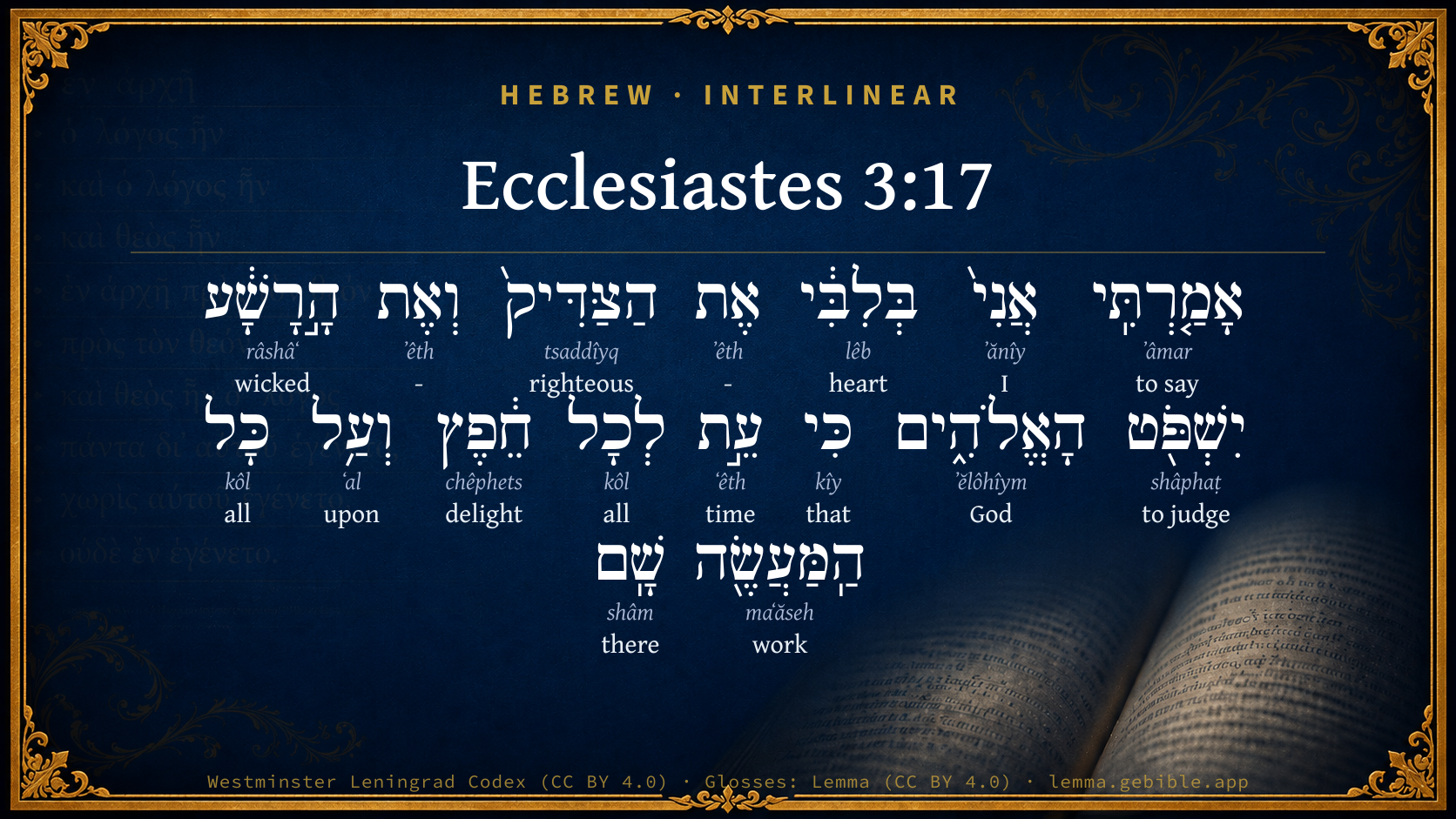
Hebrew (Westminster Leningrad Codex) Ecclesiastes 3:17 appears in the Hebrew Old Testament. The text above is from the Westminster Leningrad Codex. Each word links to its Strong’s number, a concise gloss, and parsing drawn from the Open Scriptures Hebrew Bible morphology. Click any word for its full Brown-Driver-Briggs (BDB) entry.
Download image
Cite this verse

Ecclesiastes 3:17 (World English Bible). Public Domain. Lemma interlinear Bible study tool, https://lemma.gebible.app/v/ecclesiastes/3/17.

Show BibTeX & RIS
BibTeX
RIS
English Translation
I said in my heart, "God will judge the righteous and the wicked; for there is a time there for every purpose and for every work."
World English Bible · Public Domain
Download a study sheet

One document with this verse’s original text, its word-by-word gloss line, the meaning frame, cross-references with their text, attributed commentary, and full source and license credits — printable, and it pastes into notes with its structure intact.

This verse Autodidact and up

Study sheet (.html) Plain text (.txt)

A passage Seminary Student

Up to 50 verses in one chapter. A passage sheet keeps up to 6 commentary sources and 12 cross-references per verse, in the order this page ranks them, and says so on the sheet whenever that leaves anything out. Ask for a single verse and you get the Autodidact verse sheet above.

Everything on this page stays free to read, with no account — the sheet is a download of what is already on screen, not access to it.

Want to remove ads? Support Godless Engineer
Compare translations 3

The same verse in 3 English versions, stacked beneath the original-language interlinear above. Click any original word for its lexicon entry.

Each is an independent rendering of the whole verse — the interlinear is not word-aligned to these translations.

Highlighted words mark where these versions differ — a whole-verse word diff, not a word-by-word alignment.

  • World English Bible Public Domain
    I said in my heart, "God will judge the righteous and the wicked; for there is a time there for every purpose and for every work."
  • King James Version Public Domain
    I said in mine heart, God shall judge the righteous and the wicked: for there is a time there for every purpose and for every work.
  • unfoldingWord Literal Text CC BY-SA 4.0
    I spoke, I with my heart: “The equitable and the wicked the God will judge, because a time for every matter and on account of every deed there.”

unfoldingWord Literal Text — © unfoldingWord, licensed CC BY-SA 4.0. Word-aligned USFM3 via Door43 (git.door43.org/unfoldingWord/en_ult).

Versions to compare (up to 4)

3 of 4 selected

Show all 18 translations

Every available English version of this verse, each an independent rendering of the whole verse.

  • World English Bible Public Domain
    I said in my heart, "God will judge the righteous and the wicked; for there is a time there for every purpose and for every work."
  • Berean Standard Bible Public Domain
    I said in my heart, “God will judge the righteous and the wicked, since there is a time for every activity and every deed.”
  • Majority Standard Bible Public Domain
    I said in my heart, “God will judge the righteous and the wicked, since there is a time for every activity and every deed.”
  • King James Version Public Domain
    I said in mine heart, God shall judge the righteous and the wicked: for there is a time there for every purpose and for every work.
  • American Standard Version (1901) Public Domain
    I said in my heart, God will judge the righteous and the wicked; for there is a time there for every purpose and for every work.
  • Revised Version (1885) Public Domain
    I said in mine heart, God shall judge the righteous and the wicked: for there is a time there for every purpose and for every work.
  • Geneva Bible (1599) Public Domain
    I thought in mine heart, God wil iudge the iust and the wicked: for time is there for euery purpose and for euery worke.
  • Douay-Rheims (1899) Public Domain
    And I said in my heart: God shall judge both the just and the wicked, and then shall be the time of every thing.
  • Young's Literal Translation Public Domain
    I said in my heart, `The righteous and the wicked doth God judge, for a time `is' to every matter and for every work there.'
  • Literal Standard Version CC BY-SA 4.0
    I said in my heart, “The righteous and the wicked God judges, for a time [is] to every matter and for every work there.”
  • Unlocked Literal Bible CC BY-SA 4.0
    I said in my heart, “God will judge the righteous and the wicked at the right time for every matter and every deed.”
  • unfoldingWord Literal Text CC BY-SA 4.0
    I spoke, I with my heart: “The equitable and the wicked the God will judge, because a time for every matter and on account of every deed there.”
  • Darby Bible Public Domain
    I said in my heart, God will judge the righteous and the wicked; for there is a time there for every purpose and for every work.
  • World Messianic Bible Public Domain
    I said in my heart, “God will judge the righteous and the wicked; for there is a time there for every purpose and for every work.”
  • Webster's Bible Public Domain
    I said in my heart, God will judge the righteous and the wicked: for there is a time there for every purpose and for every work.
  • Free Bible Version CC BY-SA 4.0
    But then I thought to myself, “Ultimately God will judge both those who do right and those who do wrong, and every deed and action, at the appointed time.”
  • Bible in Basic English Public Domain
    I said in my heart, God will be judge of the good and of the bad; because a time for every purpose and for every work has been fixed by him.
  • JPS Tanakh (1917) Public Domain
    I said in my heart: 'The righteous and the wicked God will judge; for there is a time there for every purpose and for every work.'

Literal Standard Version (2020), Covenant Press — licensed CC BY-SA 4.0. Text via the HelloAO Bible API (eBible.org). Unlocked Literal Bible (unfoldingWord) — licensed CC BY-SA 4.0. Text via the HelloAO Bible API (eBible.org). unfoldingWord Literal Text — © unfoldingWord, licensed CC BY-SA 4.0. Word-aligned USFM3 via Door43 (git.door43.org/unfoldingWord/en_ult). Free Bible Version, Dr. Jonathan Gallagher — licensed CC BY-SA 4.0. Text via the HelloAO Bible API (eBible.org).

Word by word

More ways to search: Search by grammar → Find every occurrence → Compare this word →

Practice this passage: Drill this verse → Learn its vocabulary →

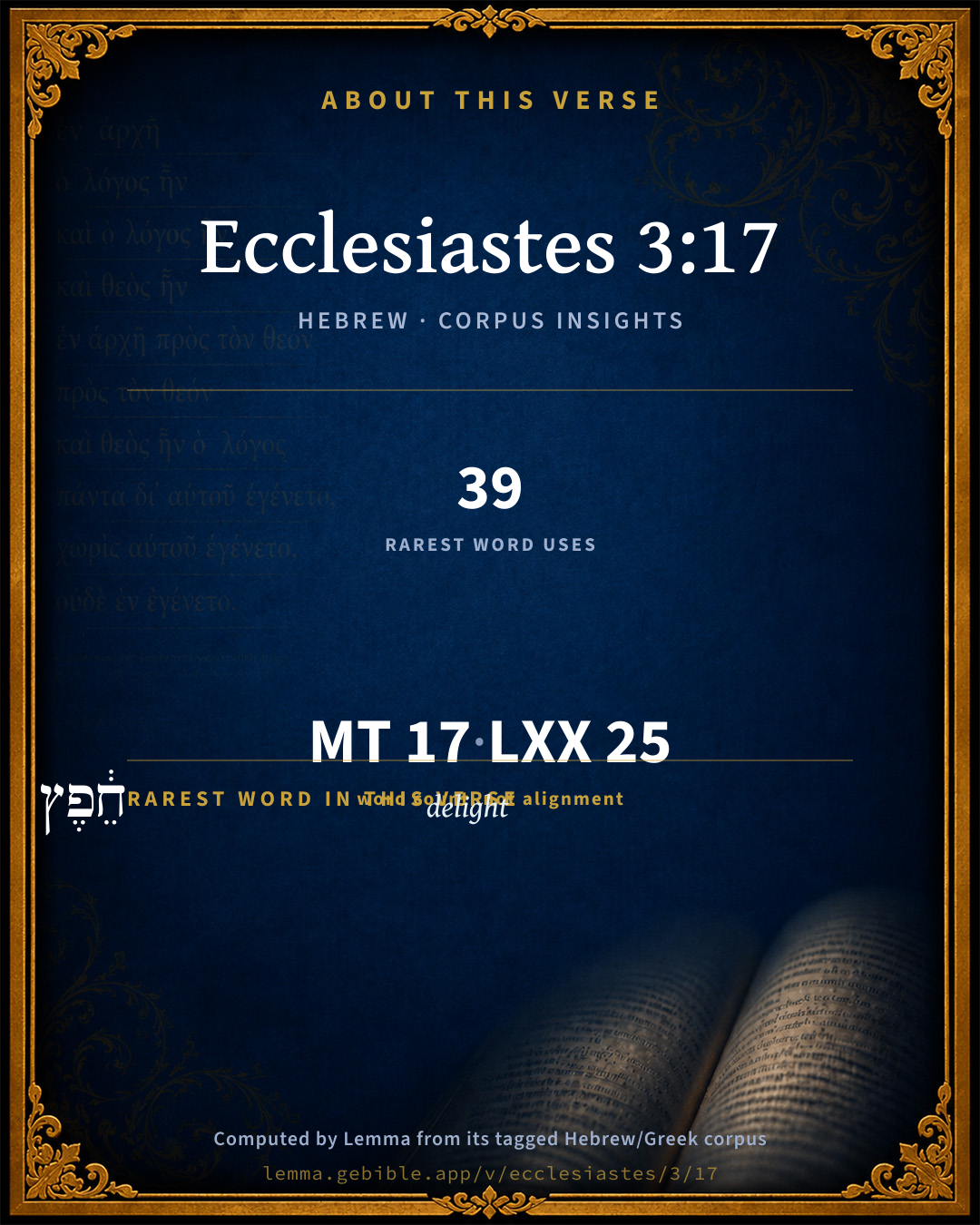
חֵ֔פֶץ
chêphets
H2656
“delight”
Noun, Common, Masculine, Singular, Absolute
Part of Speech
Noun
Type
Common
Gender
Masculine
Number
Singular
State
Absolute
Full BDB Definition

Origin: from H2654

TWOT: 712b

delight, pleasure - delight - desire, longing - the good pleasure - that in which one takes delight
  1. אָמַ֤רְתִּֽי ʼâmar H559 “to say” Verb, Qal, Perfect, 1st Person, Common, Singular
  2. אֲנִי֙ ʼănîy H589 “I” Pronoun, Personal, 1st Person, Common, Singular
  3. בְּלִבִּ֔י lêb H3820 “in/at · heart · my” Preposition + Noun, Common, Masculine, Singular, Construct + Suffix, Personal, 1st Person, Common, Singular
  4. אֶת ʼêth H853 “-” Particle, Direct Object
  5. הַצַּדִּיק֙ tsaddîyq H6662 “the · righteous” Particle, Definite Article + Adjective, Adjective, Masculine, Singular, Absolute
  6. וְאֶת ʼêth H853 “and · -” Conjunction + Particle, Direct Object
  7. הָ֣רָשָׁ֔ע râshâʻ H7563 “the · wicked” Particle, Definite Article + Adjective, Adjective, Masculine, Singular, Absolute
  8. יִשְׁפֹּ֖ט shâphaṭ H8199 “to judge” Verb, Qal, Imperfect, 3rd Person, Masculine, Singular
  9. הָאֱלֹהִ֑ים ʼĕlôhîym H430 “the · God(s)” Particle, Definite Article + Noun, Common, Masculine, Plural, Absolute
  10. כִּי kîy H3588 “that” Conjunction
  11. עֵ֣ת ʻêth H6256 “time” Noun, Common, Both, Singular, Absolute
  12. לְכָל kôl H3605 “to/for · all of” Preposition + Noun, Common, Masculine, Singular, Construct
  13. וְעַ֥ל ʻal H5921 “and · upon” Conjunction + Preposition
  14. כָּל kôl H3605 “all of” Noun, Common, Masculine, Singular, Construct
  15. הַֽמַּעֲשֶׂ֖ה maʻăseh H4639 “the · work” Particle, Definite Article + Noun, Common, Masculine, Singular, Absolute
  16. שָֽׁם shâm H8033 “there” Adverb

About this verse

These counts appear in no published source. They are computed here, from the morphology-tagged text and Lemma’s own curated glosses. What Lemma adds →

17
words
15
distinct lemmas
Wisdom
section

Shared distinctive vocabulary

חֵ֔פֶץ delight H2656 occurs in 38 verses of the Hebrew Bible. Also found in:

Grammatical profile

  • 2 verbs
  • 7 nouns
  • 2 adjectives
  • 1 pronoun
  • 1 preposition
  • 1 conjunction
  • 1 adverb
  • 2 particles

Verb forms

  • אָמַ֤רְתִּֽי Qal · Perfect
  • יִשְׁפֹּ֖ט Qal · Imperfect

Repetition

A word recurs within this verse — often emphatic in Hebrew:

  • לְכָל all H3605 ×2

Hebrew & Septuagint length

In English translation the verse runs 26 words from the Hebrew and 27 from the Septuagint (LXX English) — closely comparable.

A rough comparison of the two English renderings, which tokenize alike — not a word-level alignment.

Word counts can differ between the Hebrew and the Greek without any difference in meaning — e.g. the Hebrew direct-object marker אֵת has no separate Greek word, and Greek often adds the article ὁ.

In the original languages it is 17 Hebrew tokens and 25 Greek tokens — but the two are counted differently (Hebrew bundles its prefixes and suffixes into one token; the Greek is in lemma form), so that isn’t a like-for-like length.

Cross-references

29

Topical passages linked to Ecclesiastes 3:17 in the Treasury of Scripture Knowledge — connected by theme and wording, ordered by reader-vote popularity; previews shown in the World English Bible.

  • 2 Corinthians 5:10 For we must all be revealed before the judgment seat of Christ; that each one may receive the things in the body, according to what he has done, whether good or bad.
  • Ecclesiastes 12:14 For God will bring every work into judgment, with every hidden thing, whether it is good, or whether it is evil.
  • Ecclesiastes 3:1 For everything there is a season, and a time for every purpose under heaven:
  • Matthew 16:27 For the Son of Man will come in the glory of his Father with his angels, and then he will render to everyone according to his deeds.
  • Psalms 98:9 Let them sing before Yahweh, For he comes to judge the earth. He will judge the world with righteousness, And the peoples with equity.
  • Ecclesiastes 11:9 Rejoice, young man, in your youth, And let your heart cheer you in the days of your youth, And walk in the ways of your heart, And in the sight of your eyes; But know that for all these things God will bring you into judgment.
  • Romans 2:5–10 But according to your hardness and unrepentant heart you are treasuring up for yourself wrath in the day of wrath, revelation, and of the righteous judgment of God;
  • 2 Thessalonians 1:6–10 Since it is a righteous thing with God to repay affliction to those who afflict you,
  • Acts 1:7 He said to them, "It isn't for you to know times or seasons which the Father has set within His own authority.
  • Revelation 20:11–15 I saw a great white throne, and him who sat on it, from whose face the earth and the heaven fled away. There was found no place for them.
  • Genesis 18:25 Be it far from you to do things like that, to kill the righteous with the wicked, that so the righteous should be as the wicked. May that be far from you. Shouldn't the Judge of all the earth do right?"
  • Ecclesiastes 1:16 I said to myself, "Behold, I have obtained for myself great wisdom above all who were before me in Jerusalem. Yes, my heart has had great experience of wisdom and knowledge."
  • Ecclesiastes 2:1 I said in my heart, "Come now, I will test you with mirth: therefore enjoy pleasure;" and, behold, this also was vanity.
  • Ecclesiastes 8:6 For there is a time and procedure for every purpose, although the misery of man is heavy on him.
  • Jeremiah 29:10–11 For thus says Yahweh, After seventy years are accomplished for Babylon, I will visit you, and perform my good word toward you, in causing you to return to this place.
  • Daniel 11:40 At the time of the end shall the king of the south contend with him; and the king of the north shall come against him like a whirlwind, with chariots, and with horsemen, and with many ships; and he shall enter into the countries, and shall overflow and pass through.
  • Daniel 12:4 But you, Daniel, shut up the words, and seal the book, even to the time of the end: many shall run back and forth, and knowledge shall be increased."
  • Daniel 12:9 He said, Go your way, Daniel; for the words are shut up and sealed until the time of the end.
  • Daniel 12:11–13 From the time that the continual [burnt offering] shall be taken away, and the abomination that makes desolate set up, there shall be one thousand two hundred ninety days.
  • Matthew 25:31–46 "But when the Son of Man comes in his glory, and all the holy angels with him, then he will sit on the throne of his glory.
  • John 5:22 For the Father judges no one, but he has given all judgment to the Son,
  • John 5:26–29 For as the Father has life in himself, even so he gave to the Son also to have life in himself.
  • Acts 17:31 because he has appointed a day in which he will judge the world in righteousness by the man whom he has ordained; of which he has given assurance to all men, in that he has raised him from the dead."
  • 1 Corinthians 4:5 Therefore judge nothing before the time, until the Lord comes, who will both bring to light the hidden things of darkness, and reveal the counsels of the hearts. Then each man will get his praise from God.
  • 2 Peter 3:7–8 But the heavens that now are, and the earth, by the same word have been stored up for fire, being reserved against the day of judgment and destruction of ungodly men.
  • Revelation 11:2–3 Leave out the court which is outside of the temple, and don't measure it, for it has been given to the gentiles. They will tread the holy city under foot for forty-two months.
  • Revelation 11:18 The nations were angry, and your wrath came, as did the time for the dead to be judged, and to give your bondservants the prophets, their reward, as well as to the saints, and those who fear your name, to the small and the great; and to destroy those who destroy the earth."
  • Revelation 20:2 He seized the dragon, the old serpent, which is the devil and Satan, who deceives the whole inhabited earth, and bound him for a thousand years,
  • Revelation 20:7–9 And after the thousand years, Satan will be released from his prison,

Cross-references courtesy of OpenBible.info (CC BY 4.0).

Hebrew and Greek witnesses Masoretic Hebrew ↔ Greek Septuagint

The same verse in the two great witnesses to the Old Testament, shown verse-for-verse.

These are two independent witnesses, not word-aligned to each other, and the Septuagint is shown in lemma (dictionary) form.

Hebrew Ecclesiastes 3:17 Masoretic · Westminster Leningrad Codex

אָמַ֤רְתִּֽי אֲנִי֙ בְּלִבִּ֔י אֶת הַצַּדִּיק֙ וְאֶת הָ֣רָשָׁ֔ע יִשְׁפֹּ֖ט הָאֱלֹהִ֑ים כִּי עֵ֣ת לְכָל חֵ֔פֶץ וְעַ֥ל כָּל הַֽמַּעֲשֶׂ֖ה שָֽׁם

I said in my heart, "God will judge the righteous and the wicked; for there is a time there for every purpose and for every work."

World English Bible · Public Domain

Greek LXX Ecclesiastes 3:17 Septuagint · lemma form

εἶπον ἐγώ ἐν καρδία ἐγώ σύν ὁ δίκαιος καί σύν ὁ ἀσεβής κρίνω ὁ θεός ὅτι καιρός ὁ πᾶς πρᾶγμα καί ἐπί πᾶς ὁ ποίημα

And I said in my heart, God will judge the righteous and the ungodly: for there is a time there for every action and for every work.

LXX2012 (modern English Septuagint) · Public Domain

On this verse, The Pulpit Commentary discusses the Septuagint’s reading. Read the note in Commentary ↓

Hebrew: Westminster Leningrad Codex (CC BY 4.0). Greek: Septuagint (public domain); English from LXX2012 (modern English Septuagint) (Public Domain). How the Septuagint differs from the Hebrew →

Commentary

Notes on Ecclesiastes 3:17 from classic Christian and Jewish commentators (each source and its license shown beneath its notes). The classic Christian expositions comment on the surrounding passage and are grouped to its opening verse, so a note may address several verses; the Jewish commentaries on the Tanakh (Rashi and others) are per-verse, so they appear only where the commentator wrote on this verse.

Lemma curates 59 commentaries, every one of them public domain or Creative Commons licensed, each selected and text-cleaned for this edition rather than reprinted as found. About our sources →

Jamieson, Fausset & Brown

Robert Jamieson, A. R. Fausset & David Brown

Solution of it. There is a coming judgment in which God will vindicate His righteous ways. The sinner's "time" of his unrighteous "work" is short. God also has His "time" and "work" of judgment; and, meanwhile, is overruling, for good at last, what seems now dark. Man cannot now "find out" the plan of God's ways (Ecc 3:11; Psa 97:2). If judgment instantly followed every sin, there would be no scope for free will, faith, and perseverance of saints in spite of difficulties. The previous darkness will make the light at last the more glorious.

there-- (Job 3:17-19) in eternity, in the presence of the Divine Judge, opposed to the "there," in the human place of judgment (Ecc 3:16): so "from thence" (Gen 49:24).

Jamieson, Fausset & Brown — Commentary Critical and Explanatory on the Whole Bible (1871) — public domain (CC PDM 1.0). Text via the HelloAO Bible API.

Ellicott's Commentary for English Readers

(17) A time there—viz., with God. In this verse a judgment after this life is clearly spoken of, but not yet asserted as a conclusion definitely adopted, but only as a belief of the writer’s conflicting with the doubts expressed in the following verses. “1 said in mine heart,” with which Ecc_3:17-18 both begin, conveys the idea, “I thought,” and yet again I thought.” The writer returns again to speak of the punishment of the wicked in Ecc_8:15; Ecc_11:9.

A Bible Commentary for English Readers, edited by Charles John Ellicott (1878–1897) — public domain. Text from a community e-Sword module.

Trapp's Complete Commentary

John Trapp

Ecc 3:17 I said in mine heart, God shall judge the righteous and the wicked: for [there is] a time there for every purpose and for every work.

Ver. 17. I said in my heart, God shall judge, &c.] He did not deny the Divine providence, as Averroes for this cause did; much less did he turn atheist with Diagoras, because he could not have justice done upon a fellow that had stolen a poem of his, and published it in his own name. But he concluded within himself, that God would surely take the matter into his own hand, judge those unrighteous judges, right and relieve the oppressed, "bring forth their righteousness as the light, and their innocence as the noonday," {Psa 37:6} if not in this world, yet certainly at that great assizes to be held by his Son. "Because he hath appointed a day in the which he will judge the world in righteousness, whereof he hath given assurance to all men." {Act 17:31} His petty sessions he keepeth now, letting the law pass upon some few corrupt judges by untimely death, disgraces, banishment, remorse of conscience, &c. - as he did upon Judge Morgan, that condemned the Lady Jane Grey; Judge Hales, Belknap, Empson, Dudley, that I speak not of Pilate, Felix, &c. - reserving the rest till the great assizes. {1Ti 5:24} Some he punisheth here, lest his providence - but not all, lest his patience and promise of judgment - should be called into question, as Augustine well observeth. His twenty-two learned books, De Civitate Dei, were purposely written to clear up this truth; and so were Salvian’s eight books, De gubernatione Dei, et de iusto praesentique eius iudicio.

John Trapp, A Commentary or Exposition upon All the Books of the Old and New Testament (1647–1656) — public domain. Text from a community e-Sword module.

The Biblical Illustrator

Joseph S. Exell

Ecc_3:17

God shall judge the righteous and the wicked.

The reasonableness and equity of a future judgment

I. It is reasonable and equal that there should be a future judgment.

1. Seeing all men come hither without any knowledge or choice, having their life, as it were, obtruded on them; and seeing ordinarily (according to the general complaints of men) the pains of this life do overbalance its pleasures; so that it seemeth, in regard to what men find here, a punishment to be born; it seemeth also thence equal that men should he put into a capacity, on their good behaviour in this troublesome state, of a better state hereafter, in compensation for what they endure here; otherwise God might seem not to have dealt fairly with His creatures.

2. Seeing man is endued with a free choice and power over his actions, and thence by a good or bad use thereof is capable of deserving well or ill, it is just that a respective difference be made, according to due estimation; and that men answerably should be proceeded with either here or hereafter, reaping the fruits of what they voluntarily did sow.

3. Seeing there is a natural subordination of man to God, as of a creature to his Maker, as of a subject or servant to his lord, as of a client or dependant to his patron, protector, and benefactor, whence correspondent obligations do result; it is just that men should be accountable for the performance, and for the violation or neglect of them.

4. Seeing also there are natural relations of men to one another, and frequent transactions between them, founding several duties of humanity and justice; the which may be observed or transgressed; so that some men shall do, and others suffer much injury, without any possible redress from otherwhere, it is fit that a reference of such cases should be made to the common Patron of right, and that by Him they should be so decided, that due amends should he made to one party, and fit correction inflicted on the other.

5. Whereas also there are many secret good actions, many inward good dispositions, good wishes, and good purposes, unto which here no honour, no profit, no pleasure, no sort of benefit is annexed, or indeed well can be (they being indiscernible to men), there are likewise many bad practices and designs concealed or disguised, so as necessarily to pass away without any check, any disgrace, any damage or chastisement here, it is most equal that hereafter both these kinds should be disclosed, and obtain answerable recompense.

6. There are also persons whom, although committing grievous wrong, oppression, and other heinous misdemeanours, offensive to God and man, yet, by reason of the inviolable sacredness of their authority, or because of their uncontrollable power, no justice hero can reach, nor punishment can touch; who therefore should be reserved to the impartial and irresistible judgment of God.

7. On these and the like accounts, equity requireth that a judgment should pass on the deeds of men; and thereto the common opinions of men and the private dictates of each mans conscience do attest.

8. Every man also having committed any notable misdemeanour (repugnant to piety, justice, or sobriety), doth naturally accuse himself for it, doth in his heart sentence himself to deserve punishment, and doth stand possessed with a dread thereof; so, even unwillingly, avouching the equity of a judgment, and by a forcible instinct presaging it to come.

II. It is further, on divers accounts, requisite and needful that men should have an apprehension concerning such a judgment appointed by God, and consequently that such an one should really be.

1. It is needful to engage men on the practice of any virtue, and to restrain them from any vice; for that indeed without it, no consideration of reason, no provision of law here, can he much available to those purposes.

2. The same supposition is also needful for the welfare of human society; the which, without the practice of justice, fidelity, and other virtues, can hardly subsist; without which practice indeed a body of men would be worse than a company of wolves or foxes; and vain it were to think that it can anywhere stand without conscience; and conscience, without fear checking, or hope spurring it on, can be no more than a name: all societies, therefore, we may see, have been fain to call in the notion of a future judgment to the aid of justice and support of fidelity; obliging men to bind their testimonies by oaths, and plight their truth by sacraments; implying a dread of that Divine judgment to which they solemnly do then appeal and make themselves accountable.

3. But, further, the persuasion concerning a future judgment is, on peculiar accounts, most requisite to the support of religion and defence of piety. It is certain that no authority, on whatever reason or equity grounded, if it do not present competent encouragements to obedient subjects, if it do not hold forth an armed hand, menacing chastisement to the refractory, will signify anything, or be able to sustain the respect due to it; so it is generally; and so it is even in regard to God, the sovereign King and Governor of the world, as piety doth suppose Him: His authority will never be maintained, His laws will never be obeyed, the duties towards Him will never be minded, without influence on the hopes and fears of men; they will not yield to Him any reverence, they will nowise regard His commands, if they may not from their respect and obedience expect good benefit, if they dread not a sore vengeance for their rebellion or neglect; nothing to them will seem more fond than to serve Him who doth not well requite for the performance, than to revere Him, who doth not soundly punish for the neglect of His service. Forasmuch also as piety doth require duties somewhat high and hard, as much crossing the natural inclinations and desires of men, it peculiarly, for the overruling such aversion, doth need answerably great encouragements to the practice, and determents from the transgression of what it requireth; on which score it may also further appear that temporal judgments and recompenses here are not sufficient to procure a due obedience to the laws of piety; for how indeed can he, that for the sake of piety doth undergo disgrace, loss, or pain, expect to be satisfied here? What other benefits can he presume on beside those which he doth presently forfeit? (Isaac Barrow, D. D.)

The Biblical Illustrator, edited by Joseph S. Exell (c. 1880s–1900s) — public domain. Text from a community e-Sword module.

Joseph Benson's Commentary

Ecc 3:17. I said in my heart — I was sorely grieved at this, but I quieted myself with this consideration. God shall judge, &c. — Absolving the just, and condemning the wicked. For there is a time there — Namely, at the judgment-seat of God; a time fixed by God’s unalterable decree. He implies, that as this life is the sinner’s time, in which he doth whatsoever seemeth good in his own eyes, so God will have his time to reckon with sinners, and rectify all these disorders; for every purpose, and for every work — For examining not only men’s actions, but all their thoughts and purposes. The design of this verse is both to strike a terror into oppressing potentates, and to satisfy the doubts and support the spirits of good men, who are oppressed in this life.

Joseph Benson's Commentary on the Old and New Testaments (1811–1818) — public domain. Text from a community e-Sword module.

Tyndale Open Study Notes

Tyndale Open Resources

3:17 In due season God will judge: Human injustices (3:16) are temporary and will be righted by God’s justice. The narrator repeats this point to close the entire book (12:14).

Tyndale Open Study Notes — © Tyndale Open Resources, licensed CC BY-SA 4.0. Text via the HelloAO Bible API.

Geneva Bible (1599)

Geneva Bible translators

Meaning, with God, howsoever man neglect his duty.

Geneva Bible (1599) marginal notes — public domain. Text via Bolls.life.

Adam Clarke's Commentary

Verse 17. For there is a time there for every purpose] Man has his time here below, and God shall have his time above. At his throne the judged shall be rejudged, and iniquity for ever close her mouth.

Adam Clarke's Commentary on the Bible (1810–1826) — public domain. Text from a community e-Sword/MySword module.

The Cambridge Bible for Schools and Colleges

gen. ed. J. J. S. Perowne

17. God shall judge the righteous and the wicked] The words “I said in my heart” introduce this as the first thought that rises unbidden at the sight of the wrong-doing in the world. It was, as it were, an immediate intuitive judgment, as distinguished from those which are introduced by “I returned,” or “I considered” (chap. Ecc_4:1; Ecc_4:4; Ecc_4:7; Ecc_4:15). In the emphatic “there is a time there,” we may, perhaps, trace, as in the grand abruptness of Medea’s blessing on her children,

Εὐδαιμονοίτον· ἀλλʼ ἐκεί· τὰ δʼ ἐνθάδε

Πάτηρ ἀφείλετʼ.

“All good be with you!—but it must be there;

Here it is stolen from you by your sire.”

Eurip. Med. 1065.

or in Plato, ἡ ἐκείσε πορεία, (= “the journey thither” Phaed. p. 107 d), and in the “that world” of Luk_20:35, a passing belief in a judgment after death as redressing the wrongs of earth, soon to be, for a time, at least, traversed and overclouded by the sceptical thoughts with which the writer had come in contact. It is, however, possible that “there” may refer to the unfathomed depths of the divine Judgment which works, through long delay, at its appointed time, and in this case the thought finds a parallel in the complaint and confession of Psa_73:17-28. The one immediate conviction is, however, balanced in the conflict of thought through which the Debater is passing, by another which seems incompatible with it.

The Cambridge Bible for Schools and Colleges (gen. ed. J. J. S. Perowne; Cambridge University Press, 1878–1918) — public domain. Text from a community e-Sword module.

John Gill's Exposition

I said in mine heart, God shall judge the righteous and the wicked,.... This he considered in his mind, and set it down for a certain truth, and which relieved him under the consideration of the sad perversion of justice; and made him easy under it, and willing to leave things to him that judgeth righteously, and wait his time when everything that was now wrong would be set right: he knew from reason, from tradition, and from the word of God, that there was a judgment to come, a general, righteous, and eternal one; that this judicial process would be carried on by God himself, who is holy, righteous, just, and true, omniscient, and omnipotent; and, being the Judge of all the earth, would do right; when he would vindicate the righteous, and clear them from all calumnies and charges; acquit and justify them, and condemn the wicked, pass a just sentence on them, and execute it;

for there is a time there for every purpose, and for every work; or "then", as Noldius; in the day of the great judgment, as the Targum adds; and which continues to paraphrase the words thus,

"for a time is appointed for every business, and for every work which they do in this world they shall be judged there;''

there is a time fixed, a day appointed, for the judgment of the world; though of that day and hour knows no man; yet, it is settled, and will certainly come, Act 17:31; and when it is come, every purpose, counsel, and thought of men's hearts, will be made manifest, as well as every work, good or bad, open or secret, yea, every idle word, and men will be judged according to these; see Co1 4:5, Mat 12:36.

John Gill's Exposition of the Whole Bible (1746–1763) — public domain (CC PDM 1.0). Text via the HelloAO Bible API.

Haydock's Catholic Bible Commentary

And then. Protestants, "for there is a time there (ver. 1.) for every purpose, and for every work." At the day of judgment all will receive their due. (Haydock)

George Leo Haydock (1774–1849), Haydock's Catholic Family Bible and Commentary, 1859 edition — public domain. Excludes Psalms (Douay-Rheims chapter numbering differs from Protestant) and Deuterocanonical books (Catholic canon only).

Matthew Poole's English Annotations

I said in mine heart, mine heart was sorely grieved at this disorder, but I quieted it with this consideration,

God shall judge the righteous and the wicked; absolving and saving the just, and condemning the wicked.

A time, fixed by God’s unalterable decree. He implies, that as this life is the sinner’s time in which he doth whatsoever seemeth good in his own eyes, so God will have his time to reckon with them, and rectify all these disorders.

There; in the presence or at the judgment-seat of God; which is easily understood out of the foregoing words, the relative being put for the antecedent, as it is Num 7:89; Est 9:25; Job 1:21; Psa 14:5; 114:2. Or it may be rendered then, as this particle is used, Psa 14:5; Hos 2:15, and as it is usual in other authors for adverbs of place to be put for adverbs of time.

For every purpose, and for every work; for the examining and judging, not only all men’s practices or open actions, but also all their secret thoughts and purposes; all the evil which they either did, or designed, or desired, or endeavoured to do. The design of this verse is partly to strike a terror into oppressing potentates, and partly to satisfy the doubts and support the spirits of good men, who are oppressed in this life.

Matthew Poole's English Annotations on the Holy Bible (1683–1685) — public domain. Text from a community e-Sword/MySword module.

Whedon's Commentary on the Bible

Daniel D. Whedon

17. God shall judge — The thought of a final judgment is here introduced, not so much as a matter of calm belief, as the grasping of a discouraged and despairing heart snatching at what comfort the instinct of a final adjudication and settlement may give. The word there, after time, must be understood as accompanied with a gesture skyward and forward; for the allusion must be to the future general judgment.

Daniel D. Whedon (gen. ed.), Commentary on the Old and New Testaments (1874–1909) — public domain. Text from a community e-Sword module.

The Pulpit Commentary

I said in mine heart, God shall judge the righteous and the wicked. In view of the injustice that prevails in earthly tribunals, Koheleth takes comfort in the thought that there is retribution in store for every man. when God shall award sentence according to deserts. God is a righteous Judge strong and patient, and his decisions are infallible. Future judgment is here plainly stated, as it is at the final conclusion. (Ecc_11:1-4) They who refuse to credit the writer with belief in this great doctrine resort to the theory of interpolation and alteration in order to account for the language in this and analogous passages. There can be no doubt that the present text has hitherto always been regarded as genuine, and that it does clearly assert future retribution, though not so much as a conclusion firmly established, but rather as a belief which may explain anomalies and afford comfort under trying circumstances. For there is a time there for every purpose and for every work. The adverb rendered "there" ( sham) is placed emphatically, at the end of the sentence. Thus the Septuagint, "There is a reason for every action, and for every work there (ejkei)." Many take it to mean" in the other world," and Plumptre cites Eurip., "Med.," 1073 jEndaimonoiton ajll ejkei tade Pathlet

All good be with you! but it must be there; Here it is stolen from you by your sire.

But it is unexampled to find the elliptical "there," when no place has been mentioned in the context, and when we are precluded from interpreting the dark word by a significant gesture, as Medea may have pointed downwards in her histrionic despair. Where the words, "that day," are used in the New Testament (e.g. Luk_10:12; 2Ti_1:18, etc.) the context shows plainly to what they refer. Some take the adverb here in the sense of "then." Thus the Vulgate, Justum et impium iudicabit Deus, et tempus omnis rei tunc erit." But really no time has been mentioned, unless we conceive the writer to have been guilty of a clumsy tautology, expressing by "then" the same idea as a time for every purpose," etc. Ewald would understand it of the past; but this is quite arbitrary, and limits the signification of the sentence unnecessarily. It is best, with many modern commentators, to refer the adverb to God, who has just been spoken of in the preceding clause. A similar use is found in Gen_49:24. With God, spud Deum, in his counsels, there is a time or judgment and retribution for every act of man, when anomalies which have obtained on earth shall be rectified, injustice shall be punished, virtue rewarded. There is no need, with some commentators, to read up, "he appointed;" the usual reading gives a satisfactory sense.

The Pulpit Commentary (1880–1919), ed. H.D.M. Spence-Jones & Joseph S. Exell — public domain. Text from a community e-Sword module.

John Wesley's Explanatory Notes

I said - I was sorely grieved at this, but I quieted myself with this consideration. Shall judge - Absolving the just, and condemning the wicked. A time - God will have his time to rectify all these disorders. There - At the judgment-seat of God. For - For examining not only all men's actions, but all their thoughts and purposes.

John Wesley, Explanatory Notes Upon the Whole Bible (1754–1765) — public domain. Text via the GEBible commentary corpus.

Keil & Delitzsch

C. F. Keil & F. Delitzsch

"I said in mine heart: God shall judge the righteous as well as the wicked: for there is there a time for every purpose and for every work." Since "the righteous" stands first, the word ישׁפּט has here the double sense of judging [richtens = setting upright] = acting uprightly, justly by one, as in the shofteni of Psa 7:9; Psa 26:1, etc., and of judging = inflicting punishment. To the righteous, as well as to the wicked,

(Note: The lxx (in Aquila's manner): σὺν τὸν δίκαιον καὶ σὺν τὸν ἀσεβῆ - according to the Talm. hermeneut. rule, that where the obj. is designated by את, with that which is expressly named, something else is associated, and is to be thought of along with it.)

God will administer that which of right belongs to them. But this does not immediately happen, and has to be waited for a long time, for there is a definite time for every undertaking (Ecc 3:1), and for (על, in the more modern form of the language, interchanges promiscue with אל ht and ל, e.g., Jer 19:15; Eze 22:3; Ewald, 217i) every work there is a "time." This שׁם, defended by all the old interpreters, cannot have a temporal sense: tunc = in die judicii (Jerome, Targ.), cf. Psa 14:5; 36:13, for "a time of judgment there is for all one day" is not intended, since certainly the שׁם (day of judgment) is this time itself, and not the time of this time. Ewald renders שׁם as pointing to the past, for he thus construes: the righteous and the unrighteous God will judge (for there is a time for everything), and judge (vav thus explicat., "and that too," "and indeed") every act there, i.e., everything done before. But this שׁם is not only heavy, but also ambiguous and purposeless; and besides, by this parenthesizing of the words וגו עת כּי for there is a time for everything, the principal thought, that with God everything, even His act of judgment, has its time, is robbed of its independence and of the place in the principal clause appropriate to it. But if שׁם is understood adverbially, it certainly has a local meaning connected with it: there, viz., with God, apud Deum; true, for this use of the word Gen 49:24 affords the only example, and it stands there in the midst of a very solemn and earnest address. Therefore it lies near to read, with Houbig., Dderl., Palm., and Hitz., שׁם, "a definite time ... has He (God) ordained;" שׂום (שׂים) is the usual word for the ordinances of God in the natural world and in human history (Pro 8:29; Exo 21:13; Num 24:23; Hab 1:12, etc.), and, as in the Assyr. simtuv, so the Heb. שׂימה (שׂוּמה), Sa2 13:32, signifies lot or fate, decree.

(Note: Vid., Schrader's Keilsch. u. A. T. p. 105, simtu ubilsu, i.e., fate snatched him away (Heb. simah hovilathhu), cf. Fried. Delitzsch's Assyr. Stud. p. 66f.)

With this reading, Elster takes exception to the position of the words; but at Jdg 6:19 also the object goes before שׂם, and "unto every purpose and for every work" is certainly the complement of the object-conception, so that the position of the words is in reality no other than at Ecc 10:20; Dan 2:17. Quite untenable is Herzfeld's supposition (Frst, Vaih.), that שׁם has here the Talm. signification: aestimat, taxat, for (1) this שׁוּם = Arab. sham, has not על, but the accus. after it; (2) the thought referring to the tie on which Ecc 3:18 rests is thereby interrupted. Whether we read שׂם, or take שׁם in the sense of עמּו (Job 25:2; Job 23:14, etc.), the thought is the same, and equally congruous: God will judge the innocent and the guilty; it shall be done some time, although not so soon as one might wish it, and think necessary, for God has for every undertaking and for every work its fixed time, also its judicial decision (vid., at Psa 74:3); He permits wickedness, lets it develope itself, waits long before He interposes (vid., under Isa 18:4.).

Reflecting on God's delay to a time hidden from men, and known only to Himself, Koheleth explains the matter to himself in the following verse: -

Keil & Delitzsch — Biblical Commentary on the Old Testament (1861–1891) — public domain (CC PDM 1.0). Text via the HelloAO Bible API. (Old Testament only.)

Rashi

Rabbi Shlomo Yitzchaki (Rashi)

I said to myself, etc. Therefore, I say: The Holy One, blessed be He, judges everyone after a time, and even though the matter is delayed, it will ultimately reach its time, for there is a time for every matter, even for retribution, and there is a time for the visitation of judgment.

and for every deed that man did, they will judge him there when the time of the visitation arrives; there at that time, a time is given for every deed, to be judged for it. [The Rabbis say:] At the gate of the fold there are words (of bargaining), but in the stall (where the sheep are delivered) there is strict accounting (Shab. 32a).

Rashi on the Tanakh — English translations: “The Judaica Press complete Tanach with Rashi, translated by A. J. Rosenberg” (CC BY 4.0); “Pentateuch with Rashi's commentary by M. Rosenbaum and A.M. Silbermann, 1929-1934” (public domain); “The Metsudah Tanach series, Lakewood, N.J” (CC BY 4.0); and “The Book of Joshua, Metsudah Publications, 1997” (CC BY 4.0). Text via Sefaria.

Lesson kit

Teaching starters — assembled from the data on this page, not authored interpretation. Every prompt links to the verse data it draws on. Edit before teaching.

Ecclesiastes, in the Wisdom, opens this verse with 17 words (15 distinct Hebrew lemmas). Its most distinctive word is chêphets (“delight”). A historical commentator’s framing appears above. Read the whole chapter for the surrounding context.

Discussion questions

  1. How does “delight” (chêphets) shape what this verse is saying?
  2. How does 1 Samuel 15:22, which shares the word «delight», read alongside this verse?
  3. What does the repetition of “all” (2× in this one verse) do in this verse?
  4. These translations render this verse differently. What is at stake in choosing one wording over another?
  5. «אָמַ֤רְתִּֽי» is a Qal Perfect verb. How does that grammatical form shape the action described?
  6. Compare how Jamieson, Fausset & Brown and Ellicott's Commentary for English Readers read this verse. Where do they agree or differ?

Things to notice

Reading settings

Reading text

Shown beneath each verse's original-language words.

Old Testament
Old Testament edition

Read the OT as the Masoretic Hebrew (MT) or the Greek Septuagint (LXX).

English shown for the Greek Septuagint (in the Hebrew ↔ Greek comparison).

Comparing translations? Open the Compare panel on any verse page to stack up to four side by side.