
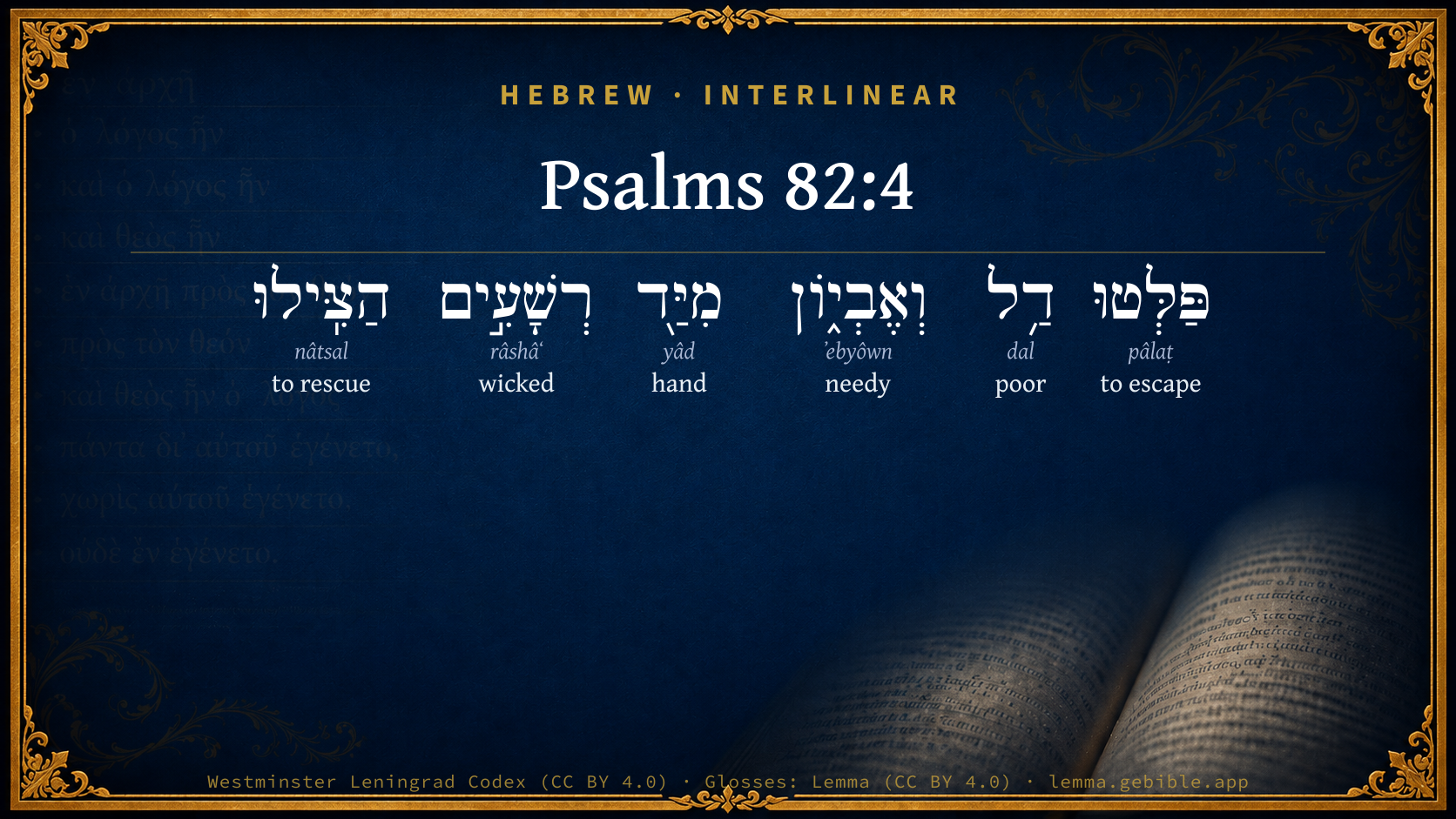
Psalms 82:4

Hebrew (Westminster Leningrad Codex) Psalms 82:4 appears in the Hebrew Old Testament. The text above is from the Westminster Leningrad Codex. Each word links to its Strong’s number, a concise gloss, and parsing drawn from the Open Scriptures Hebrew Bible morphology. Click any word for its full Brown-Driver-Briggs (BDB) entry.
Download image
Cite this verse

Psalms 82:4 (World English Bible). Public Domain. Lemma interlinear Bible study tool, https://lemma.gebible.app/v/psalms/82/4.

Show BibTeX & RIS
BibTeX
RIS
English Translation
Rescue the weak and needy. Deliver them out of the hand of the wicked."
World English Bible · Public Domain
Download a study sheet

One document with this verse’s original text, its word-by-word gloss line, the meaning frame, cross-references with their text, attributed commentary, and full source and license credits — printable, and it pastes into notes with its structure intact.

This verse Autodidact and up

Study sheet (.html) Plain text (.txt)

A passage Seminary Student

Up to 50 verses in one chapter. A passage sheet keeps up to 6 commentary sources and 12 cross-references per verse, in the order this page ranks them, and says so on the sheet whenever that leaves anything out. Ask for a single verse and you get the Autodidact verse sheet above.

Everything on this page stays free to read, with no account — the sheet is a download of what is already on screen, not access to it.

Want to remove ads? Support Godless Engineer
Compare translations 3

The same verse in 3 English versions, stacked beneath the original-language interlinear above. Click any original word for its lexicon entry.

Each is an independent rendering of the whole verse — the interlinear is not word-aligned to these translations.

Highlighted words mark where these versions differ — a whole-verse word diff, not a word-by-word alignment.

  • World English Bible Public Domain
    Rescue the weak and needy. Deliver them out of the hand of the wicked."
  • King James Version Public Domain
    Deliver the poor and needy: rid them out of the hand of the wicked.
  • unfoldingWord Literal Text CC BY-SA 4.0
    Rescue the poor and the needy; deliver from the hand of the wicked.

unfoldingWord Literal Text — © unfoldingWord, licensed CC BY-SA 4.0. Word-aligned USFM3 via Door43 (git.door43.org/unfoldingWord/en_ult).

Versions to compare (up to 4)

3 of 4 selected

Show all 18 translations

Every available English version of this verse, each an independent rendering of the whole verse.

  • World English Bible Public Domain
    Rescue the weak and needy. Deliver them out of the hand of the wicked."
  • Berean Standard Bible Public Domain
    Rescue the weak and needy; save them from the hand of the wicked.
  • Majority Standard Bible Public Domain
    Rescue the weak and needy; save them from the hand of the wicked.
  • King James Version Public Domain
    Deliver the poor and needy: rid them out of the hand of the wicked.
  • American Standard Version (1901) Public Domain
    Rescue the poor and needy: Deliver them out of the hand of the wicked.
  • Revised Version (1885) Public Domain
    Rescue the poor and needy: deliver them out of the hand of the wicked.
  • Geneva Bible (1599) Public Domain
    Deliuer the poore and needie: saue them from the hand of the wicked.
  • Douay-Rheims (1899) Public Domain
    Rescue the poor; and deliver the needy out of the hand of the sinner.
  • Young's Literal Translation Public Domain
    Let the weak and needy escape, From the hand of the wicked deliver them.
  • Literal Standard Version CC BY-SA 4.0
    Let the weak and needy escape, || Deliver them from the hand of the wicked.
  • Unlocked Literal Bible CC BY-SA 4.0
    Rescue the poor and needy; take them out of the hand of the wicked.
  • unfoldingWord Literal Text CC BY-SA 4.0
    Rescue the poor and the needy; deliver from the hand of the wicked.
  • Darby Bible Public Domain
    Rescue the poor and needy, deliver them out of the hand of the wicked.
  • World Messianic Bible Public Domain
    Rescue the weak and needy. Deliver them out of the hand of the wicked.”
  • Webster's Bible Public Domain
    Deliver the poor and needy: deliver them from the hand of the wicked.
  • Free Bible Version CC BY-SA 4.0
    Rescue the poor and those unable to help themselves; save them from the clutches of evil people.
  • Bible in Basic English Public Domain
    Be the saviour of the poor and those who have nothing: take them out of the hand of the evil-doers.
  • JPS Tanakh (1917) Public Domain
    Rescue the poor and needy; deliver them out of the hand of the wicked.

Literal Standard Version (2020), Covenant Press — licensed CC BY-SA 4.0. Text via the HelloAO Bible API (eBible.org). Unlocked Literal Bible (unfoldingWord) — licensed CC BY-SA 4.0. Text via the HelloAO Bible API (eBible.org). unfoldingWord Literal Text — © unfoldingWord, licensed CC BY-SA 4.0. Word-aligned USFM3 via Door43 (git.door43.org/unfoldingWord/en_ult). Free Bible Version, Dr. Jonathan Gallagher — licensed CC BY-SA 4.0. Text via the HelloAO Bible API (eBible.org).

Word by word

More ways to search: Search by grammar → Find every occurrence → Compare this word →

Practice this passage: Drill this verse → Learn its vocabulary →

About this verse

These counts appear in no published source. They are computed here, from the morphology-tagged text and Lemma’s own curated glosses. What Lemma adds →

6
words
6
distinct lemmas
Wisdom
section

Notable vocabulary

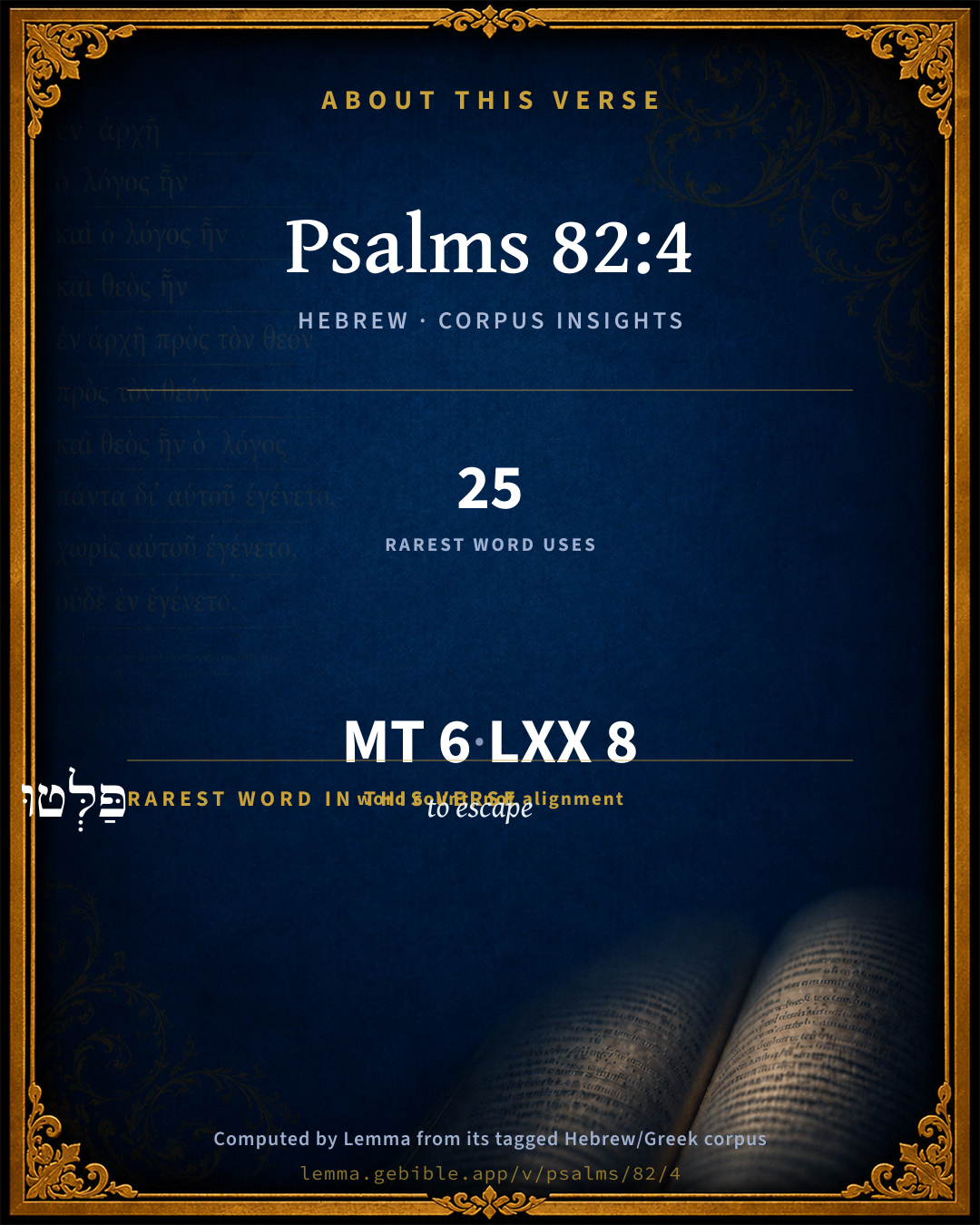
The rarest word here is פַּלְּטוּ to escape H6403 — appearing just 25 times in the whole Hebrew Bible.

Shared distinctive vocabulary

פַּלְּטוּ to escape H6403 occurs in 23 verses of the Hebrew Bible. Also found in:

Grammatical profile

  • 2 verbs
  • 1 noun
  • 3 adjectives

Verb forms

  • פַּלְּטוּ Piel · Imperative
  • הַצִּֽילוּ Hiphil · Imperative

Hebrew & Septuagint length

In English translation the verse runs 14 words from the Hebrew and 14 from the Septuagint (LXX English) — the same length.

A rough comparison of the two English renderings, which tokenize alike — not a word-level alignment.

Word counts can differ between the Hebrew and the Greek without any difference in meaning — e.g. the Hebrew direct-object marker אֵת has no separate Greek word, and Greek often adds the article ὁ.

In the original languages it is 6 Hebrew tokens and 8 Greek tokens — but the two are counted differently (Hebrew bundles its prefixes and suffixes into one token; the Greek is in lemma form), so that isn’t a like-for-like length.

Cross-references

7

Topical passages linked to Psalms 82:4 in the Treasury of Scripture Knowledge — connected by theme and wording, ordered by reader-vote popularity; previews shown in the World English Bible.

  • Proverbs 24:11–12 Rescue those who are being led away to death! Indeed, hold back those who are staggering to the slaughter!
  • Job 5:15–16 But he saves from the sword of their mouth, Even the needy from the hand of the mighty.
  • Job 29:12 Because I delivered the poor who cried, And the fatherless also, who had none to help him.
  • Psalms 72:12–14 For he will deliver the needy when he cries; The poor, who has no helper.
  • Psalms 140:12 I know that Yahweh will maintain the cause of the afflicted, And justice for the needy.
  • Job 29:16–17 I was a father to the needy. The cause of him who I didn't know, I searched out.
  • Nehemiah 5:1–13 Then there arose a great cry of the people and of their wives against their brothers the Jews.

Cross-references courtesy of OpenBible.info (CC BY 4.0).

Hebrew and Greek witnesses Masoretic Hebrew ↔ Greek Septuagint

The same verse in the two great witnesses to the Old Testament, shown verse-for-verse.

You’re reading Greek Psalm 81 (Hebrew Psalm 82). The Septuagint counts the superscription, so verse numbers can differ from the Hebrew — chapter-level alignment, not verse-by-verse. Numbering follows Rahlfs.

These are two independent witnesses, not word-aligned to each other, and the Septuagint is shown in lemma (dictionary) form.

Hebrew Psalms 82:4 Masoretic · Westminster Leningrad Codex

פַּלְּטוּ דַ֥ל וְאֶבְי֑וֹן מִיַּ֖ד רְשָׁעִ֣ים הַצִּֽילוּ

Rescue the weak and needy. Deliver them out of the hand of the wicked."

World English Bible · Public Domain

Greek LXX Greek Psalm 81:4 Septuagint · lemma form

ἐκαἱρέω πένης καί πτωχός ἐκ χείρ ἁμαρτωλός ῥύομαι

Rescue the needy, and deliver the poor out of the hand of the sinner.

LXX2012 (modern English Septuagint) · Public Domain

Hebrew: Westminster Leningrad Codex (CC BY 4.0). Greek: Septuagint (public domain); English from LXX2012 (modern English Septuagint) (Public Domain). How the Septuagint differs from the Hebrew →

Commentary

Notes on Psalms 82:4 from classic Christian and Jewish commentators (each source and its license shown beneath its notes). The classic Christian expositions comment on the surrounding passage and are grouped to its opening verse, so a note may address several verses; the Jewish commentaries on the Tanakh (Rashi and others) are per-verse, so they appear only where the commentator wrote on this verse.

Lemma curates 59 commentaries, every one of them public domain or Creative Commons licensed, each selected and text-cleaned for this edition rather than reprinted as found. About our sources →

Trapp's Complete Commentary

John Trapp

Psa 82:4 Deliver the poor and needy: rid [them] out of the hand of the wicked.

Ver. 4. Rid them out of the hand of the wicked] Heb. of the turbulent, who make ado, as the devil doth, and vex others.

John Trapp, A Commentary or Exposition upon All the Books of the Old and New Testament (1647–1656) — public domain. Text from a community e-Sword module.

J. A. Alexander on Psalms

Joseph Addison Alexander

4. (Psa 82:4) Deliver the weak and the needy (man), front the hand of wicked (men) free (him). The first verb means originally to suffer or cause to escape; the second to extricate or disembarrass. From the hand of the wicked implies from their power, as actually exercised for coercion. The structure of the sentence may be made more regular by disregarding the pause-accent and attaching the needy to the last clause, and the poor from the hand of the wicked set free.

Joseph Addison Alexander, The Psalms Translated and Explained (1850) — public domain. Text from a community e-Sword module.

Geneva Bible (1599)

Geneva Bible translators

Not only when they cry for help, but when their cause requireth aid and support.

Geneva Bible (1599) marginal notes — public domain. Text via Bolls.life.

Ellicott's Commentary for English Readers

(4) The poor and needy.—Better, The miserable (as in Psa_82:8) and poor, a different word from “needy” in Psa_82:3.

A Bible Commentary for English Readers, edited by Charles John Ellicott (1878–1897) — public domain. Text from a community e-Sword module.

The Cambridge Bible for Schools and Colleges

gen. ed. J. J. S. Perowne

4. Rescue the weak and needy:

Deliver them out of the hand of the wicked.

Cp. Isa_1:17; Isa_10:1-2. Human authorities are God’s representatives to see that the weak and friendless have justice done them. See Exo_22:22 ff.; Deu_10:17-18; Psa_10:14; Psa_10:18; Mal_3:5 : and comp. the portrait of the ideal ruler in Psa_72:12 ff.; Isa_11:3-4.

The Cambridge Bible for Schools and Colleges (gen. ed. J. J. S. Perowne; Cambridge University Press, 1878–1918) — public domain. Text from a community e-Sword module.

John Gill's Exposition

Deliver the poor and needy,.... From his adversary and oppressor, who is mightier than he, and draws him to the judgment seat; when it is not in his power to defend himself against him, and get out of his hands, unless a righteous judge will show a regard to him and his cause; and sometimes even an unjust judge, through importunity, will do this, as everyone ought, and every righteous one will:

rid them out of the hand of the wicked; this was what the poor widow importuned the unjust judge for, and obtained, Luk 18:3.

John Gill's Exposition of the Whole Bible (1746–1763) — public domain (CC PDM 1.0). Text via the HelloAO Bible API.

Albert Barnes' Notes on the Bible

Deliver the poor and needy - That is, Deliver them from the power and the arts of those who would oppress and wrong them. This would not be showing them partiality; it would be simply doing them justice.

Rid them out of the hand of the wicked - Deliver, or Rescue them from their hands; that is, from their attempts to oppress and wrong them.

Albert Barnes' Notes on the Bible (1834–1885) — public domain. Text from a community e-Sword/MySword module.

Matthew Poole's English Annotations

These he recommends to the special care and protection of magistrates, because such are commonly neglected and crushed by men in higher place and power, and they are unable to right themselves.

Matthew Poole's English Annotations on the Holy Bible (1683–1685) — public domain. Text from a community e-Sword/MySword module.

The Treasury of David

Charles H. Spurgeon

Ver. 4. Deliver the poor and needy: rid them out of the hand of the wicked. Break the nets of the man catchers, the legal toils, the bonds, the securities, with which cunning men capture and continue to hold in bondage the poor and the embarrassed. It is a brave thing when a judge can liberate a victim like a fly from the spider's web, and a horrible case when magistrate and plunderer are in league. Law has too often been an instrument for vengeance in the hand of unscrupulous men, an instrument as deadly as poison or the dagger. It is for the judge to prevent such villainy.

Whole Psalm. Asaph, who has written so much in the previous Psalms of the coming of Christ in the flesh, now speaks of his second coming to judgment. Josephus Maria Thomasius. 1649-1713.

Charles H. Spurgeon's The Treasury of David (1869–1885) — public domain. Psalms only. Text from a community e-Sword/MySword module.

Whedon's Commentary on the Bible

Daniel D. Whedon

4. Deliver… rid—The charge given in Psa_82:3 has relation to ordinary suits; this to cases of persecution and oppression. In those they were to pronounce justice; in these snatch the victims of avarice and malice out of the clutch of their tormentors. The two words are different, but they both have relation, not simply to arbitrative justice, but to power also—the interference of the strong arm of legal protection.

Daniel D. Whedon (gen. ed.), Commentary on the Old and New Testaments (1874–1909) — public domain. Text from a community e-Sword module.

The Pulpit Commentary

Deliver the poor and needy. The poor were terribly oppressed, and needed "deliverance". (see Job_29:12 Isa_1:17 Isa_3:14, 15 58:6 Mic_3:2, Mic_3:3) Rid them out of the hand of the wicked; or, rescue them.

The national peril in the mal-administration of justice.

This subject is illustrated by the rebellion of Absalom. That rebellion would not have been possible if the confidence of the people had not been lost by David"s neglect of the judgment seat. Absalom gained favour by craftily saying, "Oh that I were made judge in the land, that every man which hath any suit or cause might come unto me, and I would do him justice!". (2Sa_15:4) Those who search into the causes of great national revolutions find they have always to take account of the influence on the people of unfaithfulness in the judges, and lost public confidence that the right can be obtained. This is true of Western nations, but it is more true of Eastern nations, who know of justice as the decision of an official, rather than as the execution of a recognized and written law. Solomon gained public confidence by a wise and quick-witted judgment. He in part lost public confidence by high-handed dealing with the people"s complaints. The prophets, in their complaints of the special evils of their times, give prominence to the injustice of the judges, and their neglect of the causes of the poor. Still no crimes are supposed to undermine more swiftly the public confidence, and produce more social mischief, than those committed by mercenary judges, who give decisions in view of their own interests, rather than on the basis of what is just and right.

1. Men look for a standard of righteousness higher than they can reach themselves. They are taught to look for that standard in the impartial public judges and magistrates. If they find themselves disappointed in them, they readily get the feeling that there is no standard right, and then they lose the check upon their own wilful, self-pleasing doings. Public justice is found to be the necessary foundation and buttress of public morality.

2. National life loses its inspiring example when the king, the magistrate, and the official are found to do unjust things. Nations, as well as individuals, must make their ideals, and realize them, or think they realize them, in some individuals. Kings ought to be to their people realized ideals, and so living examples. And in the more limited spheres, so should the judges be. A man easily goes to ruin when he finds his realized ideal fail him. And so does a nation. There seems to be no right when there is no public right; no right in its high places. Nations are rightly severe on all judges who dishonour the seat of judgment. R.T.

The Pulpit Commentary (1880–1919), ed. H.D.M. Spence-Jones & Joseph S. Exell — public domain. Text from a community e-Sword module.

Lesson kit

Teaching starters — assembled from the data on this page, not authored interpretation. Every prompt links to the verse data it draws on. Edit before teaching.

Psalms, in the Wisdom, opens this verse with 6 words (6 distinct Hebrew lemmas). Its most distinctive word is pâlaṭ (“to escape”). A historical commentator’s framing appears above. Read the whole chapter for the surrounding context.

Discussion questions

  1. What does “to escape” (pâlaṭ) contribute to the verse as a whole?
  2. 2 Samuel 22:2 shares the word «to escape» with this verse. How do the two illuminate each other?
  3. The translations on this page render this verse differently — a whole-verse word diff, not a word-by-word alignment. What might account for the different wordings?
  4. The verb «פַּלְּטוּ» is Piel Imperative. How does its form color the action?
  5. Reading how Trapp's Complete Commentary and J. A. Alexander on Psalms read this verse, where do the two commentators agree and where do they part?

Things to notice

Reading settings

Reading text

Shown beneath each verse's original-language words.

Old Testament
Old Testament edition

Read the OT as the Masoretic Hebrew (MT) or the Greek Septuagint (LXX).

English shown for the Greek Septuagint (in the Hebrew ↔ Greek comparison).

Comparing translations? Open the Compare panel on any verse page to stack up to four side by side.