
Proverbs 15:9

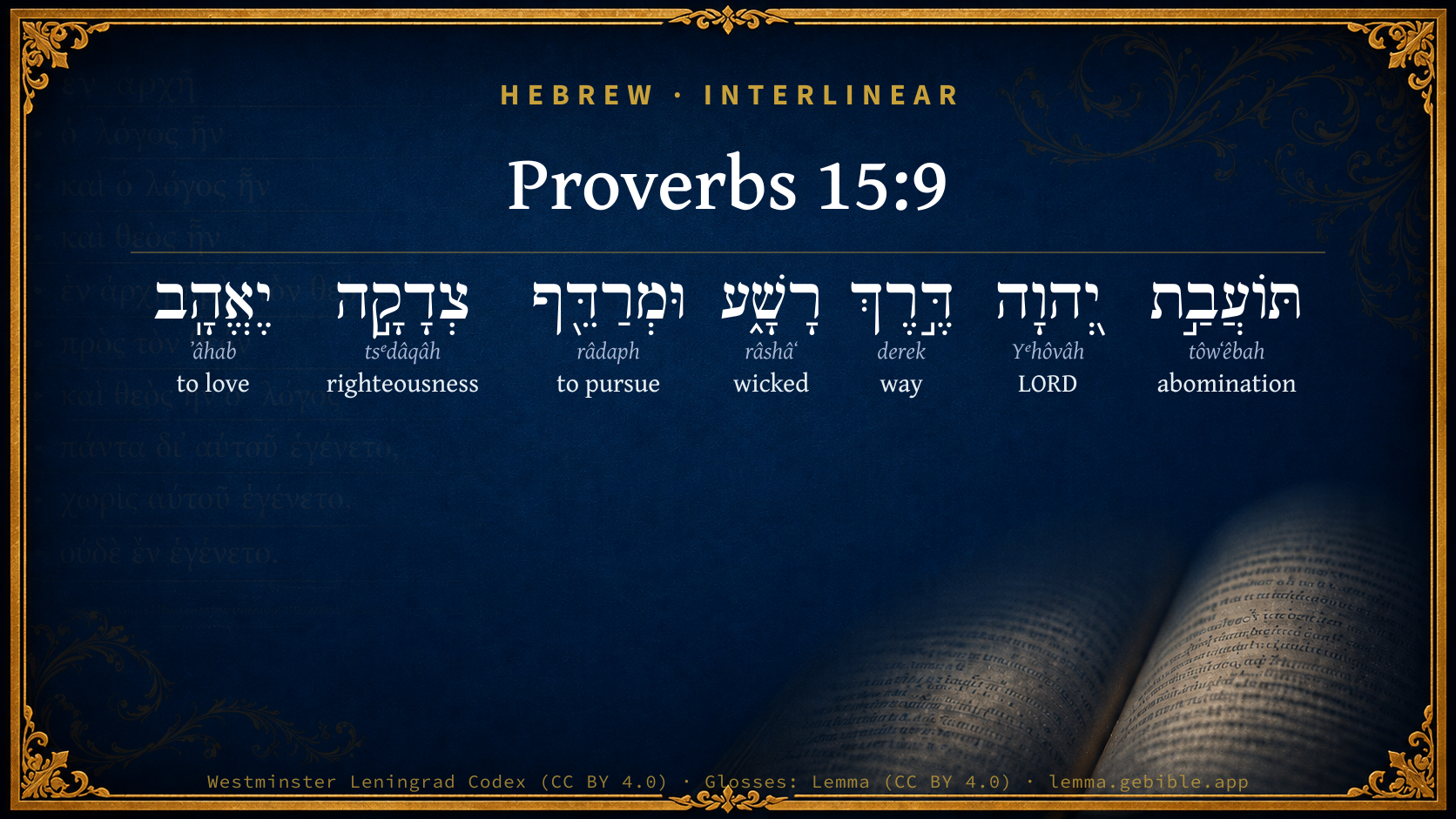
Hebrew (Westminster Leningrad Codex) Proverbs 15:9 appears in the Hebrew Old Testament. The text above is from the Westminster Leningrad Codex. Each word links to its Strong’s number, a concise gloss, and parsing drawn from the Open Scriptures Hebrew Bible morphology. Click any word for its full Brown-Driver-Briggs (BDB) entry.
Download image
Cite this verse

Proverbs 15:9 (World English Bible). Public Domain. Lemma interlinear Bible study tool, https://lemma.gebible.app/v/proverbs/15/9.

Show BibTeX & RIS
BibTeX
RIS
English Translation
The way of the wicked is an abomination to Yahweh, But he loves him who follows after righteousness.
World English Bible · Public Domain
Download a study sheet

One document with this verse’s original text, its word-by-word gloss line, the meaning frame, cross-references with their text, attributed commentary, and full source and license credits — printable, and it pastes into notes with its structure intact.

This verse Autodidact and up

Study sheet (.html) Plain text (.txt)

A passage Seminary Student

Up to 50 verses in one chapter. A passage sheet keeps up to 6 commentary sources and 12 cross-references per verse, in the order this page ranks them, and says so on the sheet whenever that leaves anything out. Ask for a single verse and you get the Autodidact verse sheet above.

Everything on this page stays free to read, with no account — the sheet is a download of what is already on screen, not access to it.

Want to remove ads? Support Godless Engineer
Compare translations 3

The same verse in 3 English versions, stacked beneath the original-language interlinear above. Click any original word for its lexicon entry.

Each is an independent rendering of the whole verse — the interlinear is not word-aligned to these translations.

Highlighted words mark where these versions differ — a whole-verse word diff, not a word-by-word alignment.

  • World English Bible Public Domain
    The way of the wicked is an abomination to Yahweh, But he loves him who follows after righteousness.
  • King James Version Public Domain
    The way of the wicked is an abomination unto the LORD: but he loveth him that followeth after righteousness.
  • unfoldingWord Literal Text CC BY-SA 4.0
    An abomination to Yahweh the way of the wicked, but a pursuer of righteousness he loves.

unfoldingWord Literal Text — © unfoldingWord, licensed CC BY-SA 4.0. Word-aligned USFM3 via Door43 (git.door43.org/unfoldingWord/en_ult).

Versions to compare (up to 4)

3 of 4 selected

Show all 18 translations

Every available English version of this verse, each an independent rendering of the whole verse.

  • World English Bible Public Domain
    The way of the wicked is an abomination to Yahweh, But he loves him who follows after righteousness.
  • Berean Standard Bible Public Domain
    The LORD detests the way of the wicked, but He loves those who pursue righteousness.
  • Majority Standard Bible Public Domain
    The LORD detests the way of the wicked, but He loves those who pursue righteousness.
  • King James Version Public Domain
    The way of the wicked is an abomination unto the LORD: but he loveth him that followeth after righteousness.
  • American Standard Version (1901) Public Domain
    The way of the wicked is an abomination to Jehovah; But he loveth him that followeth after righteousness.
  • Revised Version (1885) Public Domain
    The way of the wicked is an abomination to the LORD: but he loveth him that followeth after righteousness.
  • Geneva Bible (1599) Public Domain
    The way of the wicked is an abomination vnto the Lord: but he loueth him that followeth righteousnes.
  • Douay-Rheims (1899) Public Domain
    The way of the wicked is an abomination to the Lord: he that followeth justice is beloved by him.
  • Young's Literal Translation Public Domain
    An abomination to Jehovah `is' the way of the wicked, And whoso is pursuing righteousness He loveth.
  • Literal Standard Version CC BY-SA 4.0
    The way of the wicked [is] an abomination to YHWH, || And He loves whoever is pursuing righteousness.
  • Unlocked Literal Bible CC BY-SA 4.0
    Yahweh hates the way of wicked people, but he loves the one who pursues what is right.
  • unfoldingWord Literal Text CC BY-SA 4.0
    An abomination to Yahweh the way of the wicked, but a pursuer of righteousness he loves.
  • Darby Bible Public Domain
    The way of a wicked [man] is an abomination to Jehovah; but him that pursueth righteousness he loveth.
  • World Messianic Bible Public Domain
    The way of the wicked is an abomination to the LORD, but he loves him who follows after righteousness.
  • Webster's Bible Public Domain
    The way of the wicked is an abomination to the LORD; but he loveth him that followeth after righteousness.
  • Free Bible Version CC BY-SA 4.0
    The Lord hates the ways of the wicked, but he loves those who do what is right.
  • Bible in Basic English Public Domain
    The way of the evil-doer is disgusting to the Lord, but he who goes after righteousness is dear to him.
  • JPS Tanakh (1917) Public Domain
    The way of the wicked is an abomination to the LORD; but He loveth him that followeth after righteousness.

Literal Standard Version (2020), Covenant Press — licensed CC BY-SA 4.0. Text via the HelloAO Bible API (eBible.org). Unlocked Literal Bible (unfoldingWord) — licensed CC BY-SA 4.0. Text via the HelloAO Bible API (eBible.org). unfoldingWord Literal Text — © unfoldingWord, licensed CC BY-SA 4.0. Word-aligned USFM3 via Door43 (git.door43.org/unfoldingWord/en_ult). Free Bible Version, Dr. Jonathan Gallagher — licensed CC BY-SA 4.0. Text via the HelloAO Bible API (eBible.org).

Word by word

More ways to search: Search by grammar → Find every occurrence → Compare this word →

Practice this passage: Drill this verse → Learn its vocabulary →

About this verse

These counts appear in no published source. They are computed here, from the morphology-tagged text and Lemma’s own curated glosses. What Lemma adds →

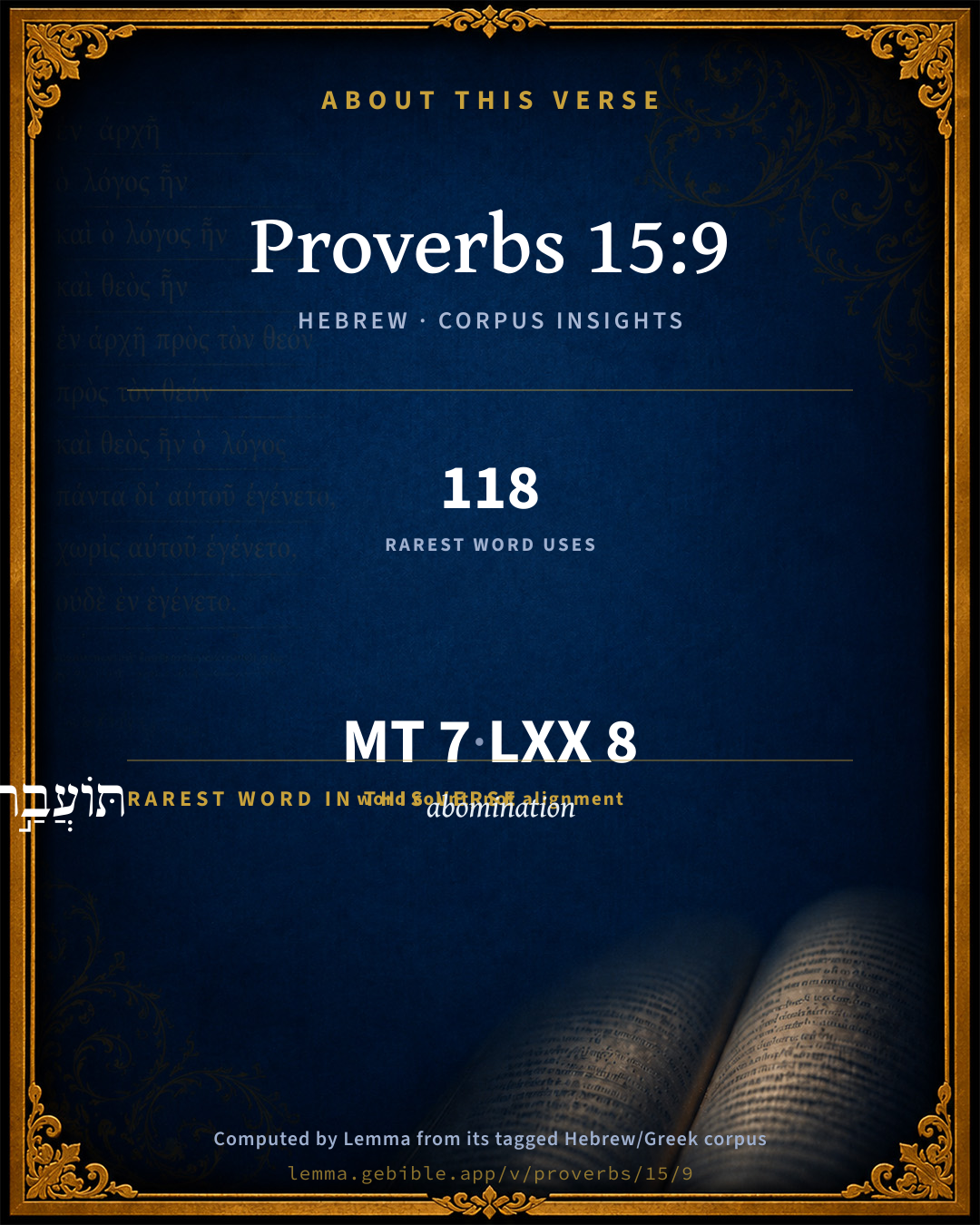
7
words
7
distinct lemmas
Wisdom
section

Grammatical profile

  • 2 verbs
  • 4 nouns
  • 1 adjective

Verb forms

  • וּמְרַדֵּ֖ף Piel · Participle Active
  • יֶאֱהָֽב Qal · Imperfect

Hebrew & Septuagint length

In English translation the verse runs 18 words from the Hebrew and 20 from the Septuagint (LXX English) — closely comparable.

A rough comparison of the two English renderings, which tokenize alike — not a word-level alignment.

Word counts can differ between the Hebrew and the Greek without any difference in meaning — e.g. the Hebrew direct-object marker אֵת has no separate Greek word, and Greek often adds the article ὁ.

In the original languages it is 7 Hebrew tokens and 8 Greek tokens — but the two are counted differently (Hebrew bundles its prefixes and suffixes into one token; the Greek is in lemma form), so that isn’t a like-for-like length.

Cross-references

15

Topical passages linked to Proverbs 15:9 in the Treasury of Scripture Knowledge — connected by theme and wording, ordered by reader-vote popularity; previews shown in the World English Bible.

  • 1 Timothy 6:11 But you, man of God, flee these things, and follow after righteousness, godliness, faith, love, patience, and gentleness.
  • Proverbs 21:21 He who follows after righteousness and kindness Finds life, righteousness, and honor.
  • Jeremiah 44:4 However I sent to you all my servants the prophets, rising up early and sending them, saying, Oh, don't do this abominable thing that I hate.
  • Hosea 6:3 Let us acknowledge Yahweh. Let us press on to know Yahweh. As surely as the sun rises, Yahweh will appear. He will come to us like the rain, Like the spring rain that waters the earth."
  • Habakkuk 1:13 You who have purer eyes than to see evil, and who cannot look on perversity, why do you tolerate those who deal treacherously, and keep silent when the wicked swallows up the man who is more righteous than he,
  • Matthew 7:13 "Enter in by the narrow gate; for wide is the gate and broad is the way that leads to destruction, and many are those who enter in by it.
  • Psalms 1:6 For Yahweh knows the way of the righteous, But the way of the wicked shall perish.
  • Psalms 146:8–9 Yahweh opens the eyes of the blind. Yahweh raises up those who are bowed down. Yahweh loves the righteous.
  • Proverbs 4:19 The way of the wicked is like darkness. They don't know what they stumble over.
  • Proverbs 21:4 A high look, and a proud heart, The lamp of the wicked, is sin.
  • Proverbs 21:8 The way of the guilty is devious, But the conduct of the innocent is upright.
  • Isaiah 26:7 The way of the just is uprightness: you that are upright do direct the path of the just.
  • Isaiah 51:1 Listen to me, you who follow after righteousness, you who seek Yahweh: look to the rock whence you were hewn, and to the hold of the pit whence you were dug.
  • Isaiah 51:7 Listen to me, you who know righteousness, the people in whose heart is my law; don't you fear the reproach of men, neither be you dismayed at their insults.
  • 2 Timothy 2:22 Flee from youthful lusts; but pursue righteousness, faith, love, and peace with those who call on the Lord out of a pure heart.

Cross-references courtesy of OpenBible.info (CC BY 4.0).

Hebrew and Greek witnesses Masoretic Hebrew ↔ Greek Septuagint

The same verse in the two great witnesses to the Old Testament, shown verse-for-verse.

These are two independent witnesses, not word-aligned to each other, and the Septuagint is shown in lemma (dictionary) form.

Hebrew Proverbs 15:9 Masoretic · Westminster Leningrad Codex

תּוֹעֲבַ֣ת יְ֭הוָה דֶּ֣רֶךְ רָשָׁ֑ע וּמְרַדֵּ֖ף צְדָקָ֣ה יֶאֱהָֽב

The way of the wicked is an abomination to Yahweh, But he loves him who follows after righteousness.

World English Bible · Public Domain

Greek LXX Proverbs 15:9 Septuagint · lemma form

βδέλυγμα κύριος ὁδός ἀσεβής διώκω δέ δικαιοσύνη ἀγαπάω

The ways of an ungodly man are an abomination to the Lord; but he loves those that follow after righteousness.

LXX2012 (modern English Septuagint) · Public Domain

Hebrew: Westminster Leningrad Codex (CC BY 4.0). Greek: Septuagint (public domain); English from LXX2012 (modern English Septuagint) (Public Domain). How the Septuagint differs from the Hebrew →

Commentary

Notes on Proverbs 15:9 from classic Christian and Jewish commentators (each source and its license shown beneath its notes). The classic Christian expositions comment on the surrounding passage and are grouped to its opening verse, so a note may address several verses; the Jewish commentaries on the Tanakh (Rashi and others) are per-verse, so they appear only where the commentator wrote on this verse.

Lemma curates 59 commentaries, every one of them public domain or Creative Commons licensed, each selected and text-cleaned for this edition rather than reprinted as found. About our sources →

Trapp's Complete Commentary

John Trapp

Pro 15:9 The way of the wicked [is] an abomination unto the LORD: but he loveth him that followeth after righteousness.

Ver. 9. The way of the wicked is abomination.] Not his sacrifices only, but his civilities; all his actions - natural, moral, recreative, religious - are offensive to all God’s senses, as the word signifies. The very "ploughing of the wicked is sin": {Pro 21:4} all they do is defiled, yea, their "very consciences." {2Ti 1:15} Their hearts, like some filthy bog or fen, or like the lake of Sodom, send up continual poisonous vapours unto God: and he, not able to abide them, sends down eftsoons a counterpoison of plagues and punishments. {Psa 11:6 Rom 1:18}

But he loveth him that followeth after righteousness.] Although he fulfil not all righteousness, yet if he make after it with might and main, as the word signifies, if he pursue it and have it in chase, as ravenous creatures have their prey, "if by any means he may attain to the resurrection of the dead"; {Php 3:11} that is, that height of holiness that accompanieth the resurrection: this is the man whom God loves. Now God’s love is not an empty love; it is not like the winter sun, that casts a goodly countenance when it shines, but gives little warmth and comfort. "Thou meetest him that rejoiceth and worketh righteousness; those that remember thee in thy ways," {Isa 64:5} "that think upon thy commandments to do them," {Psa 103:20} qui faciunt praecepta, etsi non perficiant, {a} that are weak but willing, θελοντες, {Heb 13:18} that are lifting at the latch, though they cannot do up the door: "Surely, shall every such one say, In the Lord have I righteousness and strength." {Isa 45:24} "Righteousness," that is, mercy to those that come over to him, and "strength" to enable them to come, as the sea sends out waters to fetch us to it.

{a} Augustin.

John Trapp, A Commentary or Exposition upon All the Books of the Old and New Testament (1647–1656) — public domain. Text from a community e-Sword module.

Matthew Henry's Commentary

This is a reason of what was said in the foregoing verse. 1. The sacrifices of the wicked are an abomination to God, not for want of some nice points of ceremony, but because their way, the whole course and tenour of their conversation, is wicked, and consequently an abomination to him. Sacrifices for sin were not accepted of those that resolved to go on in sin, and were to the highest degree abominable if intended to obtain a connivance at sin and a permission to go on in it. 2. Therefore the prayer of the upright is his delight, because he is a friend of God, and he loves him who, though he have not yet attained, is following after righteousness, aiming at it and pressing towards it, as St. Paul, Phi 3:13.

Matthew Henry's Commentary on the Whole Bible (1708–1710) — public domain (CC PDM 1.0). Text via the HelloAO Bible API.

John Gill's Exposition

The way of the wicked is an abomination unto the Lord,.... The way his heart devises, which he chooses and delights in, in which he walks; nor will he leave it, nor can he be diverted from it, but by the powerful grace of God. This is a way not good, but evil, and so an abomination to the Lord; and the whole tenor and course of his life, which is meant by his way being evil: hence his sacrifices, and all his external duties of religion performed by him, are abominable to the Lord; for, while he continues in a course of sin, all his religious exercises will be of no avail, cannot be pleasing and acceptable to God;

but he loveth him that followeth after righteousness; either after a justifying righteousness; not the righteousness of the law, which the carnal Jews followed after, but did not attain unto; nor is righteousness to be had by the works of the law, nor any justification by it, nor can a man be acceptable to God on account of it; but the righteousness of Christ, which he has wrought out, and is revealed in the Gospel: to follow after this supposes a want of one; a sense of that want; a view of the glory, fulness, suitableness, and excellency of Christ's righteousness; an eager desire after it, sometimes expressed by hungering and thirsting after it, as here by a pursuit of it; which means no other than an earnest and importunate request to be found in it: and such, as they shall be satisfied or filled with it, so they are loved by the Lord, and are acceptable to him through the righteousness they are seeking after: or else it may be understood of following after true holiness of heart and life, without which there is no seeing the Lord; and though perfection in it is not attainable in this live, yet a gracious soul presses after it, which is well pleasing in the sight of God.

John Gill's Exposition of the Whole Bible (1746–1763) — public domain (CC PDM 1.0). Text via the HelloAO Bible API.

Matthew Poole's English Annotations

The way; the conversation or course of life. This verse seems to contain a reason of the foregoing. God hates wicked men’s religious performances, because they are accompanied with ungodly lives, and they pull down with one hand what they build up with another.

That followeth after righteousness; that earnestly desires, and constantly and diligently endeavours, to be holy and righteous in the course of his life, although he doth not attain to that perfect righteousness which he thirsts after.

Matthew Poole's English Annotations on the Holy Bible (1683–1685) — public domain. Text from a community e-Sword/MySword module.

Whedon's Commentary on the Bible

Daniel D. Whedon

9. Way of the wicked… abomination — This proverb is kindred to the preceding, but not the same; expressed in different words. It is here the “way of the wicked” in general that is an “abomination,” not specially his worship, as in the preceding.

Followeth after righteousness — Or, who earnestly pursues it, is studious to be right and to do right. Compare Pro_12:21; Psa_34:14; Deu_16:20; Isa_51:1; Isa_51:7; Hos_6:3; 1Ti_6:11.

Daniel D. Whedon (gen. ed.), Commentary on the Old and New Testaments (1874–1909) — public domain. Text from a community e-Sword module.

The Pulpit Commentary

This verse gives the reason for the treatment specified in the preceding verse. (comp. Pro_11:20 Pro_12:22) Followeth after; chaseth, implying effort and perseverance, as in the pursuit of game. (Pro_11:19 Pro_21:21)

The Pulpit Commentary (1880–1919), ed. H.D.M. Spence-Jones & Joseph S. Exell — public domain. Text from a community e-Sword module.

Kretzmann's Popular Commentary

Paul E. Kretzmann

v. 9. The way of the wicked is an abomination unto the Lord, He loathes their entire conduct; but He loveth him that followeth after righteousness, who makes it his business to search after, to pursue with great eagerness, that righteousness of life which pleases Jehovah.

Paul E. Kretzmann, Popular Commentary of the Bible (1921–1924) — public domain. Text from a community e-Sword module.

unfoldingWord translationNotes

Door43 World Missions Community

Yahweh hates the way of wicked people

The lifestyles of wicked people are spoken of as if they are paths on which those people walk. AT: "Yahweh hates the way that wicked people live" (See: Metaphor)

the one who pursues what is right

Being diligent to live rightly is spoken of as if it were chasing after right things. AT: "the person who strives to live rightly" (See: Metaphor)

anyone who forsakes the way

Here "the way" refers to the way of righteousness. A person who stops doing what is right is spoken of as if he has stopped walking on the correct path. AT: "anyone who stops living rightly" (See: Metaphor)

he who hates correction

The word "correction" can be translated as a verb. AT: "the person who hates it when others correct him" (See: Abstract Nouns)

translationWords

Yahweh

evil

love

discipline

forsake

die

unfoldingWord translationNotes — © Distant Shores Media and the Door43 World Missions Community, licensed CC BY-SA 4.0. Source: git.door43.org/Door43/en_tn.

Lesson kit

Teaching starters — assembled from the data on this page, not authored interpretation. Every prompt links to the verse data it draws on. Edit before teaching.

Proverbs, in the Wisdom, opens this verse with 7 words (7 distinct Hebrew lemmas). Its most distinctive word is tôwʻêbah (“abomination”). A historical commentator’s framing appears above. Read the whole chapter for the surrounding context.

Discussion questions

  1. What does “abomination” (tôwʻêbah) contribute to the verse as a whole?
  2. 1 Timothy 6:11 shares this passage’s theme. How do the two illuminate each other?
  3. The translations on this page render this verse differently — a whole-verse word diff, not a word-by-word alignment. What might account for the different wordings?
  4. The verb «וּמְרַדֵּ֖ף» is Piel Participle Active. How does its form color the action?
  5. Reading how Trapp's Complete Commentary and Matthew Henry's Commentary read this verse, where do the two commentators agree and where do they part?

Things to notice

Reading settings

Reading text

Shown beneath each verse's original-language words.

Old Testament
Old Testament edition

Read the OT as the Masoretic Hebrew (MT) or the Greek Septuagint (LXX).

English shown for the Greek Septuagint (in the Hebrew ↔ Greek comparison).

Comparing translations? Open the Compare panel on any verse page to stack up to four side by side.