
Psalms 12:8

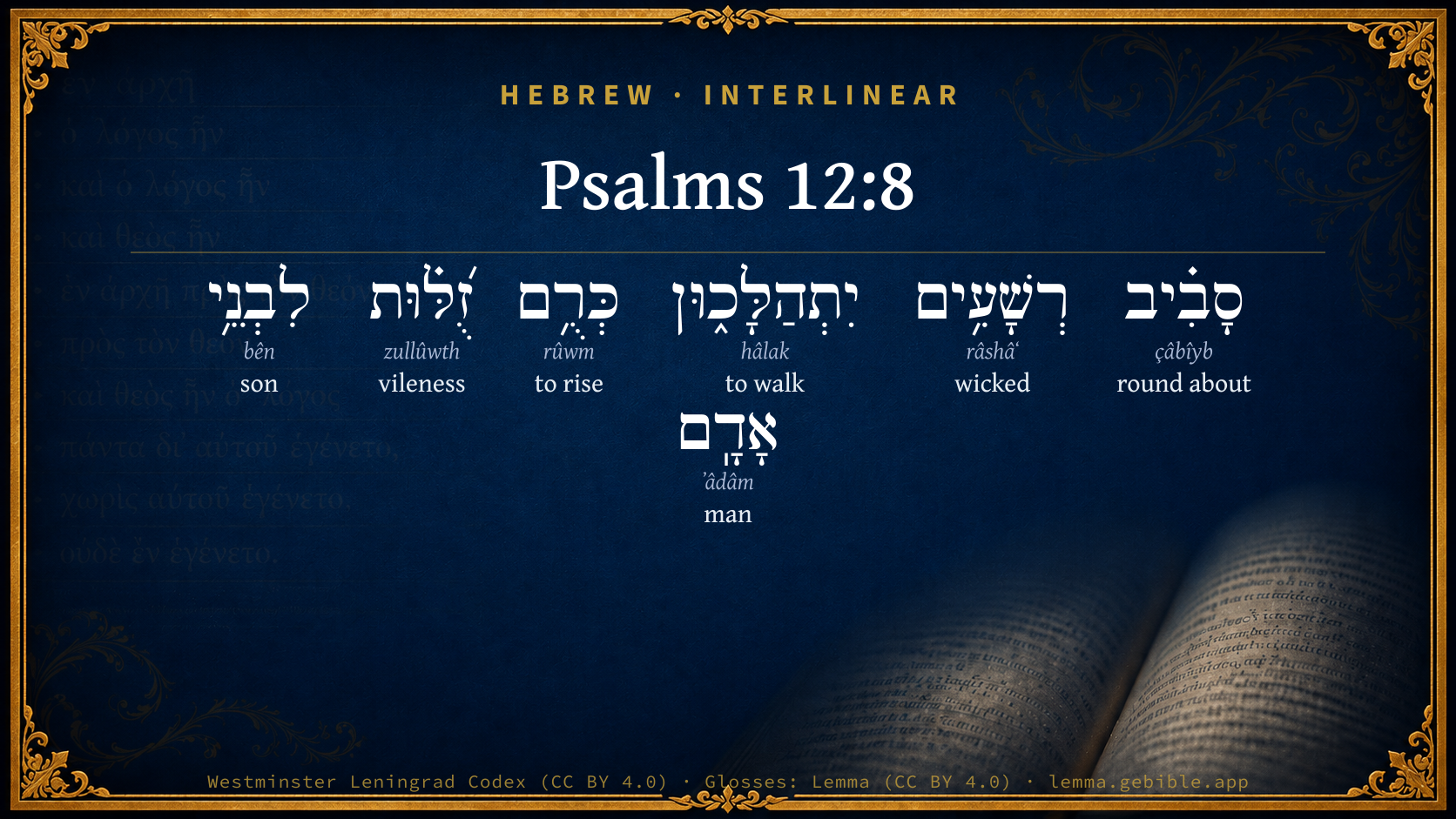
Hebrew (Westminster Leningrad Codex) Psalms 12:8 appears in the Hebrew Old Testament. The text above is from the Westminster Leningrad Codex. Each word links to its Strong’s number, a concise gloss, and parsing drawn from the Open Scriptures Hebrew Bible morphology. Click any word for its full Brown-Driver-Briggs (BDB) entry.
Download image
Cite this verse

Psalms 12:8 (World English Bible). Public Domain. Lemma interlinear Bible study tool, https://lemma.gebible.app/v/psalms/12/8.

Show BibTeX & RIS
BibTeX
RIS
English Translation
The wicked walk on every side, When what is vile is exalted among the sons of men.
World English Bible · Public Domain
Highlights
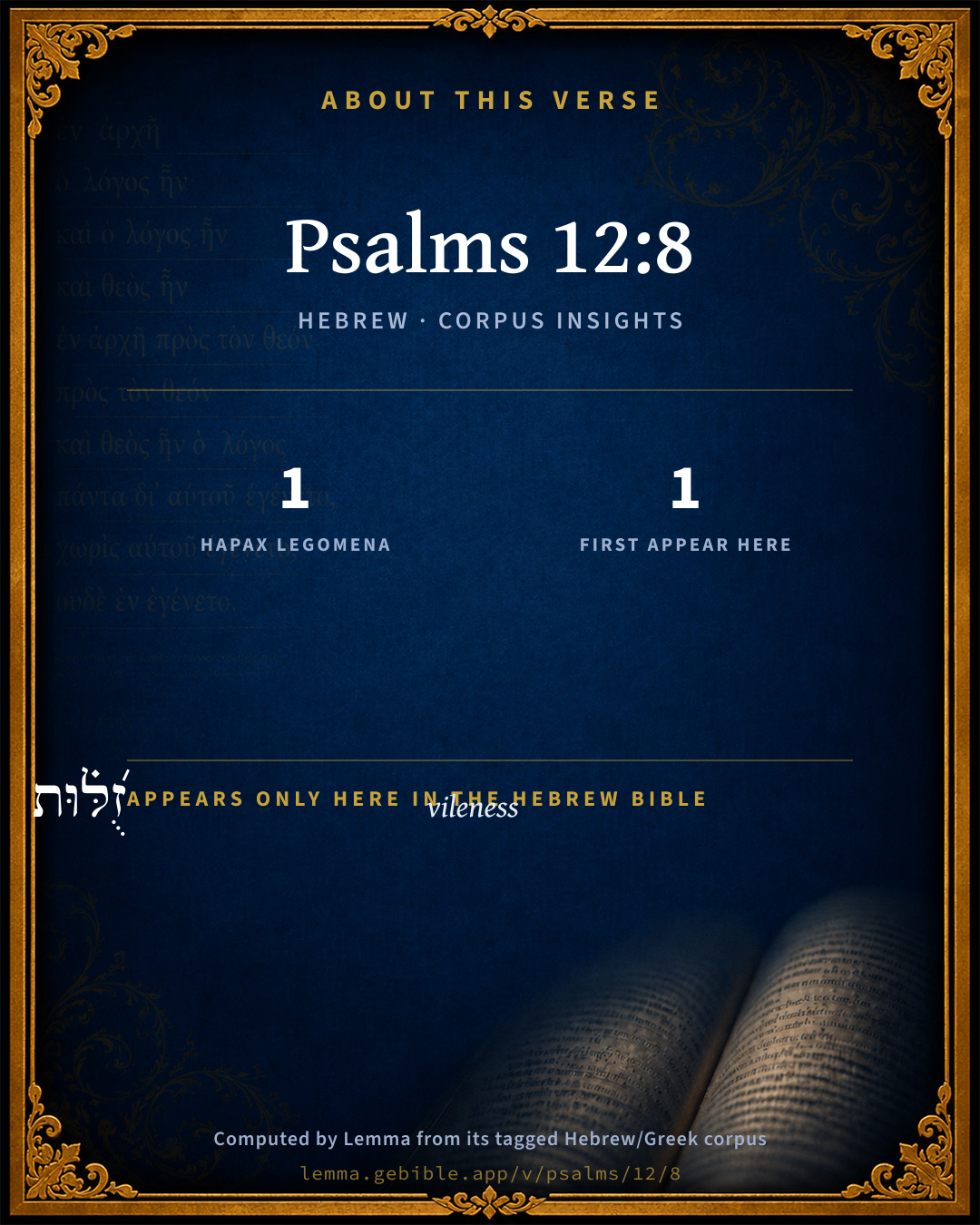
  • 1 hapax legomenon — only here in the Hebrew Bible
  • 1 first appearance in the Hebrew Bible
Full analysis ↓
Download a study sheet

One document with this verse’s original text, its word-by-word gloss line, the meaning frame, cross-references with their text, attributed commentary, and full source and license credits — printable, and it pastes into notes with its structure intact.

This verse Autodidact and up

Study sheet (.html) Plain text (.txt)

A passage Seminary Student

Up to 50 verses in one chapter. A passage sheet keeps up to 6 commentary sources and 12 cross-references per verse, in the order this page ranks them, and says so on the sheet whenever that leaves anything out. Ask for a single verse and you get the Autodidact verse sheet above.

Everything on this page stays free to read, with no account — the sheet is a download of what is already on screen, not access to it.

Want to remove ads? Support Godless Engineer
Compare translations 3

The same verse in 3 English versions, stacked beneath the original-language interlinear above. Click any original word for its lexicon entry.

Each is an independent rendering of the whole verse — the interlinear is not word-aligned to these translations.

Highlighted words mark where these versions differ — a whole-verse word diff, not a word-by-word alignment.

  • World English Bible Public Domain
    The wicked walk on every side, When what is vile is exalted among the sons of men.
  • King James Version Public Domain
    The wicked walk on every side, when the vilest men are exalted.
  • unfoldingWord Literal Text CC BY-SA 4.0
    The wicked walk about on every side when vileness is high among the sons of man.

unfoldingWord Literal Text — © unfoldingWord, licensed CC BY-SA 4.0. Word-aligned USFM3 via Door43 (git.door43.org/unfoldingWord/en_ult).

Versions to compare (up to 4)

3 of 4 selected

Show all 18 translations

Every available English version of this verse, each an independent rendering of the whole verse.

  • World English Bible Public Domain
    The wicked walk on every side, When what is vile is exalted among the sons of men.
  • Berean Standard Bible Public Domain
    The wicked wander freely, and vileness is exalted among men.
  • Majority Standard Bible Public Domain
    The wicked wander freely, and vileness is exalted among men.
  • King James Version Public Domain
    The wicked walk on every side, when the vilest men are exalted.
  • American Standard Version (1901) Public Domain
    The wicked walk on every side, When vileness is exalted among the sons of men. Psalm 13 For the Chief Musician. A Psalm of David.
  • Revised Version (1885) Public Domain
    The wicked walk on every side, when vileness is exalted among the sons of men.
  • Geneva Bible (1599) Public Domain
    The wicked walke on euery side: when they are exalted, it is a shame for the sonnes of men.
  • Douay-Rheims (1899) Public Domain
    Thou, O Lord, wilt preserve us.: and keep us from this generation for ever.
  • Young's Literal Translation Public Domain
    Around the wicked walk continually, According as vileness is exalted by sons of men!
  • Literal Standard Version CC BY-SA 4.0
    The wicked walk around continually, || According as vileness is exalted by sons of men!
  • Unlocked Literal Bible CC BY-SA 4.0
    The wicked walk on every side when evil is exalted among the children of mankind.
  • unfoldingWord Literal Text CC BY-SA 4.0
    The wicked walk about on every side when vileness is high among the sons of man.
  • Darby Bible Public Domain
    The wicked walk about on every side, when vileness is exalted among the children of men.
  • World Messianic Bible Public Domain
    The wicked walk on every side, when what is vile is exalted among the sons of men.
  • Webster's Bible Public Domain
    \\12:7\\Thou shalt keep them, O LORD, thou shalt preserve them from this generation for ever.
  • Free Bible Version CC BY-SA 4.0
    even though the wicked are all around us, and evil is being promoted everywhere.
  • Bible in Basic English Public Domain
    The sinners are walking on every side, and evil is honoured among the children of men.
  • JPS Tanakh (1917) Public Domain
    (12-9) The wicked walk on every side, when vileness is exalted among the sons of men.

Literal Standard Version (2020), Covenant Press — licensed CC BY-SA 4.0. Text via the HelloAO Bible API (eBible.org). Unlocked Literal Bible (unfoldingWord) — licensed CC BY-SA 4.0. Text via the HelloAO Bible API (eBible.org). unfoldingWord Literal Text — © unfoldingWord, licensed CC BY-SA 4.0. Word-aligned USFM3 via Door43 (git.door43.org/unfoldingWord/en_ult). Free Bible Version, Dr. Jonathan Gallagher — licensed CC BY-SA 4.0. Text via the HelloAO Bible API (eBible.org).

Word by word

More ways to search: Search by grammar → Find every occurrence → Compare this word →

Practice this passage: Drill this verse → Learn its vocabulary →

About this verse

These counts appear in no published source. They are computed here, from the morphology-tagged text and Lemma’s own curated glosses. What Lemma adds →

7
words
7
distinct lemmas
Wisdom
section

Notable vocabulary

1 hapax legomenon — a word that appears only here in the entire Hebrew Bible:

  • זֻ֝לּ֗וּת vileness H2149

First appearance in Scripture

This word makes its first canonical appearance in the Hebrew Bible here:

  • זֻ֝לּ֗וּת vileness H2149

Grammatical profile

  • 2 verbs
  • 4 nouns
  • 1 adjective

Verb forms

  • יִתְהַלָּכ֑וּן Hithpael · Imperfect
  • כְּרֻ֥ם Qal · Infinitive Construct

Hebrew & Septuagint length

In English translation the verse runs 17 words from the Hebrew and 16 from the Septuagint (LXX English) — closely comparable.

A rough comparison of the two English renderings, which tokenize alike — not a word-level alignment.

Word counts can differ between the Hebrew and the Greek without any difference in meaning — e.g. the Hebrew direct-object marker אֵת has no separate Greek word, and Greek often adds the article ὁ.

Cross-references

10

Topical passages linked to Psalms 12:8 in the Treasury of Scripture Knowledge — connected by theme and wording, ordered by reader-vote popularity; previews shown in the World English Bible.

  • Psalms 55:10–11 Day and night they prowl around on its walls. Malice and abuse are also within her.
  • Mark 14:63–65 The high priest tore his clothes, and said, "What further need have we of witnesses?
  • Proverbs 29:12 If a ruler listens to lies, All of his officials are wicked.
  • Hosea 5:11 Ephraim is oppressed, He is crushed in judgment; Because he is intent in his pursuit of idols.
  • Judges 9:18–57 and you are risen up against my father's house this day, and have slain his sons, seventy persons, on one stone, and have made Abimelech, the son of his maid-servant, king over the men of Shechem, because he is your brother);
  • Isaiah 32:4–6 The heart of the rash shall understand knowledge, and the tongue of the stammerers shall be ready to speak plainly.
  • Micah 6:16 For the statutes of Omri are kept, And all the works of the house of Ahab. You walk in their counsels, That I may make you a ruin, And her inhabitants a hissing; And you will bear the reproach of my people."
  • Esther 3:6–15 But he scorned the thought of laying hands on Mordecai alone; for they had made known to him the people of Mordecai: therefore Haman sought to destroy all the Jews who were throughout the whole kingdom of Ahasuerus, even the people of Mordecai.
  • Job 30:8 They are children of fools, yes, children of base men. They were flogged out of the land.
  • Daniel 11:21 In his place shall stand up a contemptible person, to whom they had not given the honor of the kingdom: but he shall come in time of security, and shall obtain the kingdom by flatteries.

Cross-references courtesy of OpenBible.info (CC BY 4.0).

Hebrew and Greek witnesses Masoretic Hebrew ↔ Greek Septuagint

The same verse in the two great witnesses to the Old Testament, shown verse-for-verse.

You’re reading Greek Psalm 11 (Hebrew Psalm 12). The Septuagint counts the superscription, so verse numbers can differ from the Hebrew — chapter-level alignment, not verse-by-verse. Numbering follows Rahlfs.

These are two independent witnesses, not word-aligned to each other, and the Septuagint is shown in lemma (dictionary) form.

Hebrew Psalms 12:8 Masoretic · Westminster Leningrad Codex

סָבִ֗יב רְשָׁעִ֥ים יִתְהַלָּכ֑וּן כְּרֻ֥ם זֻ֝לּ֗וּת לִבְנֵ֥י אָדָֽם

The wicked walk on every side, When what is vile is exalted among the sons of men.

World English Bible · Public Domain

Greek LXX Greek Psalm 11:8 Septuagint · lemma form

σύ κύριος φυλάσσω ἐγώ καί διατηρέω ἐγώ ἀπό ὁ γενεά οὗτος καί εἰς ὁ αἰών

The ungodly walk around: according to your greatness you have greatly exalted the sons of men.

LXX2012 (modern English Septuagint) · Public Domain

Hebrew: Westminster Leningrad Codex (CC BY 4.0). Greek: Septuagint (public domain); English from LXX2012 (modern English Septuagint) (Public Domain). How the Septuagint differs from the Hebrew →

Commentary

Notes on Psalms 12:8 from classic Christian and Jewish commentators (each source and its license shown beneath its notes). The classic Christian expositions comment on the surrounding passage and are grouped to its opening verse, so a note may address several verses; the Jewish commentaries on the Tanakh (Rashi and others) are per-verse, so they appear only where the commentator wrote on this verse.

Lemma curates 59 commentaries, every one of them public domain or Creative Commons licensed, each selected and text-cleaned for this edition rather than reprinted as found. About our sources →

Adam Clarke's Commentary

Verse 8. The wicked walk on every side] The land is full of them. When the vilest men are exalted; rather, As villany gains ground among the sons of Adam. See the Hebrew. The Vulgate has, "In circuito impii ambulant; secundum altitudinem tuam multiplicasti filios hominum;" which is thus translated and paraphrased in my old MS.: -

Trans. In umgang wiked gos: eftir thy heenes thu has multiplied the sons of man.

Par. Us thy kepes; bot wiked gas in umgang; that es, in covatyng of erdley gudes, that turned with the whele of seven daies: in the qwilk covatys, thai ryn ay aboute; for that sett nane endyng of thaire syn: and tharfor settes God na terme of thair pyne, but sons of men that lyfs skilwisly and in ryghtwisnes, thu has multiplied, aftir thi heghnes in vertus; aftir the heghnes of thi consayll, thou hast multiplied men bath il and gude; for na man may perfitely witt in erd, qwy God makes so many men, the qwilk he wote well sal be dampned: bot it es the privete of his counsayle, so ryghtwis, that no thyng may be ryghtwiser.

In this we find a number of singular expressions, which, while they elucidate the text, will not be uninteresting to the antiquary. Here, for instance, we see the true etymology of the words righteous and righteousness, i.e., right wise and right wiseness. For we have it above as a noun, rightwisnes: as an adjective, rightwis; and as an adjective in the comparative degree, rightwiser: and we should have had it as an adverb, ryghtwisely, had not the word skilwisly occurred to the author.

Righteousness is right wiseness, or that which is according to true wisdom. A righteous man is one who is right wise; properly instructed in Divine wisdom, and acts according to its dictates; and among them who act rightwisely, there are some who act rightwiser than others; and nothing can be rightwiser than ever to think and act according to the principles of that wisdom which comes from above.

Right, [Anglo-Saxon] rectus, straight, is opposed to wrong, from [A.S.] injury, and that from [A.S.], to twist. As [A.S.] rehtan signifies to direct, so [A.S.] wrangen signifies to twist, or turn out of a straight or direct line. Right is straight, and wrong, crooked. Hence the righteous man is one who goes straight forward, acts and walks by line and rule; and the unrighteous is he who walks in crooked paths, does what is wrong, and is never guided by true wisdom. Such a person is sometimes termed wicked, from the Anglo-Saxon [A.S.], to act by witch-craft, (hence [A.S.] wicca, a witch,) that is to renounce God and righteousness, and to give one's self to the devil, which is the true character of a wicked man. Let him that readeth understand.

The vilest men are exalted] Were we to take this in its obvious sense, it would signify that at that time wickedness was the way to preferment, and that good men were the objects of persecution.

ANALYSIS OF THE TWELFTH PSALM

There are four parts in this Psalm: -

I. A prayer, and the reason of it; Ps 12:1-2.

II. A prophecy of the fall of the wicked Ps 12:3, whose arrogance he describes, Ps 12:4.

III. God's answer to the petition, with a promise full of comfort, Ps 12:5; ratified, Ps 12:6.

IV. A petitory, or affirmative conclusion: Keep them; or a confident affirmation that God will keep them from the contagion of the wicked, Ps 12:7, of which there were too many, Ps 12:8.

I. The prayer, which is very short, for he breaks in upon God with one word, הושעה Hoshiah! Help! Save, Lord! Ps 12:1. For which he gives two reasons:-

1. The scarcity of good men: "For the godly man ceaseth," c. There is neither piety nor fidelity among men.

2. The great abundance of the wicked, the licentious times the perfidiousness, hypocrisy, and dissimulation of the men among whom he lived. "They speak vanity every one with his neighbour," c. Ps 12:2. They take no care to perform what they promise.

II. The prophecy. This shows the end of their dissembling: "The Lord shall cut off all flattering lips;" Ps 12:3. These are described,

1. As proud boasters: "With our tongues will we prevail," c.

2. As persons restrained by no authority: "Who is the Lord over us?" Ps 12:4.

III. God's answer to the petition, Help, Lord! is it so that the wicked are so numerous, so tyrannous, so proud, and so arrogant?

1. "I will arise, saith the Lord."

2. I will not delay: "Now I will arise" Ps 12:5.

3. "I will set him in safety (my followers) from him that puffeth," c.

4. I am moved to it by his sighs and groans: "For the oppression of the poor, for the sighing of the needy," c. Ps 12:5.

I. And of this let no man doubt: "The words of the Lord are pure words." There is no more fallacy in the words of God than there is impurity in silver seven times refined Ps 12:6.

IV. A petitory, or affirmative conclusion: Thou shalt keep them, O Lord; or, O keep them! The overflowings of wickedness are great.

1. Keep them. For unless God keep them they will be infected.

2. Keep them from this generation. For they are a generation of vipers.

3. Keep them for ever. For unless thou enable them to persevere, they will fall.

4. And keep them. For the power, pride, and influence of these impious men are very great. 1. "The wicked walk on every side." As wolves they seek whom they may devour. 2. And wickedness is the way to preferment: "The vilest men are exalted;" Ps 12:8.

Thy people call on thee for help; they know thou canst help, and therefore are they confident that thou wilt help, because they know that thou art good.

Adam Clarke's Commentary on the Bible (1810–1826) — public domain. Text from a community e-Sword/MySword module.

Trapp's Complete Commentary

John Trapp

Psa 12:8 The wicked walk on every side, when the vilest men are exalted.

Ver. 8. The wicked walk on every side] In circuitu, saith the Vulgate; the circular motion is most subtle, the devil walketh the rounds to do mischief; but better render it circumquaque, on every side, to show their numbers and their insolence. All places are full of them, such dust heaps are found in every corner; when as the godly are as the salt of the earth, sprinkled here and there, as salt useth to be, to keep the rest from putrefying.

When the vilest men are exalted] Heb. Vilities, the abstract for the concrete, quisquiliae, ουτιδανοι. Oft empty vessels swim aloft, rotten posts are gilt with adulterate gold, the worst weeds spring up bravest. Chaff will get to the top of the fan when good grain, as it lieth at the bottom of the heap, so it falls low at the feet of the farmer. The reason why wicked men walk on every side, are so brisk, so busy, and who but they? is given in to be this, because losels and rioters were exalted. See Pro 28:12; Pro 28:18; Pro 29:2. As rheums and catarrhs fall from the head to the lungs, and cause a consumption of the whole body; so it is in the body politic. As a fish putrefies first in the head, and then in all the parts; so here. Some render the text thus, When they (that is, the wicked) are exalted, it is a shame for the sons of men, that other men, who better deserve preferment, are not only slighted, but vilely handled by such worthless ambitionists; who yet the higher they climb, as apes, the more they discover their deformities.

John Trapp, A Commentary or Exposition upon All the Books of the Old and New Testament (1647–1656) — public domain. Text from a community e-Sword module.

Joseph Benson's Commentary

Psa 12:8. The wicked walk on every side — They fill all places, and go about boldly and securely, seeking to deceive, corrupt, and destroy others, being neither afraid nor ashamed to discover themselves; when the vilest of men are exalted — To places of trust and power, who, instead of putting the laws in execution against vice and injustice, and punishing the wicked according to their deserts, patronize and protect them, or give them countenance and support by their own example. The Hebrew, כרם זלות, cherum zulloth, is literally, when vilenesses are exalted, when all manner of wickedness, lying, slandering, profaneness, oppression, cruelty, and the like, instead of being punished and suppressed, are countenanced and encouraged by magistrates and persons of power and influence. Both these interpretations come to one. For when vile persons are exalted, so also are vile practices. Both these, it appears, were advanced and encouraged under Saul’s government, which caused David to complain that the foundations were destroyed, Psa 11:3.

Joseph Benson's Commentary on the Old and New Testaments (1811–1818) — public domain. Text from a community e-Sword module.

J. A. Alexander on Psalms

Joseph Addison Alexander

9. (Psa 12:8). Round about will the wicked walk. This may either mean that they shall walk at liberty and have full licence, or that they shall encompass and surround the righteous. Compare Psa 3:7 (6). The other clause is one of the most doubtful and disputed in the whole book. The particle k may denote either time or resemblance, and the noun tUl.z, which occurs nowhere else, has been variously explained to mean a storm, an earthquake, vileness or contempt, &c. Among the different senses put upon the whole phrase are the following:

"When the vileness (or vilest) of men is exalted."

"Like the rising of a storm upon the sons of men."

"When they rise (or are exalted) there is shame (or disgrace) to the sons of men."

"When disgrace arises to the sons of men."

"Like exaltation is disgrace to the sons of man."

In favour of this last it has been urged, that it gives to each word its most natural and obvious sense, and that it closes with a prospect of relief, and not with an unmitigated threatening, which would be at variance with the usage of the Psalms. The meaning of the verse is then, that although the wicked are now in the ascendant, and the righteous treated with contempt, this disgrace is really an exaltation, because only external and in man's judgment, not in God's, who will abundantly indemnify his people for the dishonour which is put upon them. The unusual and almost unintelligible form in which this idea is expressed, is supposed to agree well with David's fondness for obscure and enigmatical expressions; see above, on Psa 5:1 and Psa 7:1.

Joseph Addison Alexander, The Psalms Translated and Explained (1850) — public domain. Text from a community e-Sword module.

Geneva Bible (1599)

Geneva Bible translators

For they suppress the godly and maintain the wicked.

Geneva Bible (1599) marginal notes — public domain. Text via Bolls.life.

Jamieson, Fausset & Brown

Robert Jamieson, A. R. Fausset & David Brown

The wicked roam undisturbed doing evil, when vileness and vile men are exalted.

Next: Psalms Chapter 13

Jamieson, Fausset & Brown — Commentary Critical and Explanatory on the Whole Bible (1871) — public domain (CC PDM 1.0). Text via the HelloAO Bible API.

John Calvin's Commentaries

8. The ungodly walk about on every side. The Hebrew word סביב, sabib, which we have translated on every side, signifies a circuit, or a going round; and, therefore, some explain it allegorically thus: the ungodly seize upon all the defiles or narrow parts of roads, in order to shut up or besiege the good on all sides; and others expound it even more ingeniously, thus: that they lay snares by indirect means, and by inventions full of art and deception. But I think the simple meaning is, that they possess the whole land, and range about through every part of it; as if the Psalmist had said, Wherever I turn my eyes, I see troops of them on every side. In the next clause he complains that mankind are shamefully and basely oppressed by their tyranny. This is the meaning, provided the clause is read as a distinct one by itself, separate from the preceding, a point about which interpreters differ, although this view seems to come nearer to the mind of the inspired writer. Some render the verse in one continuous sentence, thus: The ungodly fly about every where, when the reproaches among the children of men (that is to say, when the worthless and the refuse of men) are exalted, an exposition which is not unsuitable. It commonly happens, that as diseases flow from the head into the members, so corruptions proceed from princes, and infect the whole people. As, however, the former exposition is more generally received, and the most learned grammarians tell us that the Hebrew word זלות, zuluth, which we have translated reproach, is a noun of the singular number, I have adopted the former exposition, not that I am dissatisfied with the latter, but because we must needs choose the one or the other.

John Calvin's Commentaries (1540-1563) — public domain. Text from the Calvin Translation Society English edition (1840s-50s) via the Christian Classics Ethereal Library (ccel.org). Calvin's coverage is partial (roughly two-thirds of the Bible); uncommented books and verses are honest gaps, never fabricated. The 19th-century editor's footnotes and remarks are omitted so the notes are faithfully Calvin's own voice.

Ellicott's Commentary for English Readers

(8) The wicked.—Gesenius translates this verse, “The wicked walk on every side like the rising of a tempest upon the sons of men.” There seems no reason to question his rendering of the word zullûth (Authorised Version, “vilest”), which is peculiar to this passage; but by comparison with Psa_39:6; Psa_58:7, we may render the first clause, the wicked vanish on every side; and a slight change gives for the second clause, at the rising of a tempest on the sons of men.

A Bible Commentary for English Readers, edited by Charles John Ellicott (1878–1897) — public domain. Text from a community e-Sword module.

The Cambridge Bible for Schools and Colleges

gen. ed. J. J. S. Perowne

8. Jehovah will preserve the righteous; although when vileness is exalted among the sons of men, when worthless or profligate men are raised to positions of authority, the wicked stalk insolently everywhere, unabashed and unrestrained. Cp. Psa_11:1-3. The Psalmist returns to the thought of the prevailing corruption, from which he started.

The Cambridge Bible for Schools and Colleges (gen. ed. J. J. S. Perowne; Cambridge University Press, 1878–1918) — public domain. Text from a community e-Sword module.

John Gill's Exposition

The wicked walk on every side,.... Of the poor and needy, of the righteous ones, to watch them, lay snares for them, and hurt them; therefore, Lord, keep and preserve them: the wicked are everywhere in great numbers, the whole world lies in wickedness; and the men of it are like their father the devil, they go about to do all the mischief they can to the saints; wherefore they stand in need continually of divine preservation;

when the vilest men are exalted: either to great dignities and high offices, to be magistrates and rulers; see Pro 29:2; or are highly esteemed and caressed; which shows the sad degeneracy and badness of the times, and the unsafe and dangerous condition the people of God are in, unless kept by him; see Mal 3:15; or else these words may be considered as expressive of the judgment of God upon wicked men, and so confirm what the psalmist had said of God's regard to and preservation of his own people; and the sense be, that the wicked shall walk up and down here and there, as outcasts and vagabonds, in a most desolate, destitute, and miserable condition; and as the latter clause may be rendered, "according to their exaltation shall be the vileness", depression, or humiliation "of the children of men" (r); they shall be brought as low as they have been made high; by how much the more highly they have been exalted, by so much the more deeply they shall be humbled: or else the meaning is, they shall walk about here and there fretting and vexing, when they shall see such who in their opinion are the meanest and basest of men, of low degree, and of a mean extract, exalted to the highest posts of honour and dignity; as David, who was taken from the sheepfold, and placed on the throne of Israel; so Jarchi, who observes that the Haggadah explains it of the Israelites, who will be exalted in time to come.

(r) "secundum superelevationem, vilitas (erit vel est)", Cocceius.

Next: Psalms Chapter 13

John Gill's Exposition of the Whole Bible (1746–1763) — public domain (CC PDM 1.0). Text via the HelloAO Bible API.

Albert Barnes' Notes on the Bible

The wicked walk on every side - Everywhere. They have full license, or seem to be wholly unrestrained.

When the vilest men are exalted - Margin, “The vilest of the sons of men are exalted.” This expression has been very variously translated. Dr. Horsley renders it, “When the scorn of the sons of men is exalted.” De Wette, “They exalt themselves; terror to the sons of men.” Luther, “Where such wicked people rule among the sons of men.” Hengstenberg, “Like exaltation is disgrace to the sons of men.” Prof. Alexander seems inclined to favor this last view. According to this interpretation, the meaning is, that “although the wicked are now in the ascendant, and the righteous are treated with contempt, this disgrace is realy an exaltation, because only ... in man’s judgment, not in God’s, who will abundantly indemnity his people for the dishonor put upon them.” The word rendered in our version “the vilest” - זלות zûllûth - means, according to Gesenius, “trembling, terror.” It occurs nowhere else in the Scriptures. The verb from which it is derived - זלל zâlal - means to shake, to tremble; then (as one shakes out, or casts away worthless things) to be vile, abject, despised, worthless.

Perhaps, however, the common version expresses the idea more accurately than any of these proposed amendments. I would offer the following as a fair translation of the passage: “The wicked walk on every side; (it is) as the lifting up, or the exaltation of vileness among the sons of men.” That is, the state of things is as if the vilest were exalted, or were honored. It seems to be the very exaltation of wickedness or depravity in the world. A state of things exists in which, from the prevalence of iniquity, the wicked seem to go unrestrained; in which no regard is paid to truth; in which falsehood and flattery abound; and it is as if honor were done to the worst forms of sin, and the most abandoned seem to be the most exalted. This appears to be the reason in the mind of the psalmist why the divine interposition is necessary; with this idea the psalm commences, and with this it appropriately closes. There was a state of widespread depravity and successful iniquity, as if all honor were conferred on wicked and abandoned men, while the virtuous were oppressed and degraded. The psalm expresses “confidence” in God - confidence in his faithful word and promises; but the psalmist sees a state of things wherein it was eminently desirable that God should interpose, for the righteous seemed to have failed out of the earth, and the wicked seemed to be wholly in the ascendancy.

Albert Barnes' Notes on the Bible (1834–1885) — public domain. Text from a community e-Sword/MySword module.

Matthew Poole's English Annotations

The wicked walk on every side; which phrase may note,

1. Their great numbers; they fill all places.

2. Their freedom and safety; they are not restrained nor punished, but go about boldly and securely whither they please.

3. Their proficiency and success, which is sometimes signified by this verb, as Gen 26:13; 1Sa 2:21; Isa 40:31. They grow worse and worse, and prosper in and by their wickedness.

4. Their incessant and unwearied industry in doing mischief to good men. Compare 1Pe 5:8. And this is very fitly here added, as another argument to prevail with God to arise to help his poor people who are oppressed by wicked men.

The vilest men, Heb. vilenesses, i.e. all manner of wickedness, lying and slandering, profaneness; oppression, cruelty, and the like; or, vile persons, the abstract being put for the concrete, which is frequent, as pride, Psa 36:11, for a proud man, and many such like; both comes to one, vile persons and vile practices were both advanced and encouraged through Saul’s misgovernment, whereby all the foundations were destroyed, as he complained, Psa 11:3. The Hebrew word zolel (whence this zuloth comes) signifies first a glutton or drunkard, as Deu 21:20; Pro 23:21, and thence any vile person, as Jer 15:19; Lam 1:11.

Matthew Poole's English Annotations on the Holy Bible (1683–1685) — public domain. Text from a community e-Sword/MySword module.

The Treasury of David

Charles H. Spurgeon

Ver. 8. Here we return to the fount of bitterness, which first made the psalmist run to the wells of salvation, namely, the prevalence of wickedness. When those in power are vile, their underlings will be no better. As a warm sun brings out noxious flies, so does a sinner in honour foster vice everywhere. Our turf would not so swarm with abominables if those who are styled honourables did not give their countenance to the craft. Would to God that the glory and triumph of our Lord Jesus would encourage us to walk and work on every side; as like acts upon like, since an exalted sinner encourages sinners, our exalted Redeemer must surely excite, cheer, and stimulate his saints. Nerved by a sight of his reigning power we shall meet the evils of the times in the spirit of holy resolution, and shall the more hopefully pray, "Help, Lord."

Ver. 8. When the vilest men are exalted: Hebrew, vilities, outidanoi the abstract for the concrete, quisquilioe, outidanoi. Oft, empty vessels swim aloft, rotten posts are gilt with adulterate gold, the worst weeds spring up bravest. Chaff will get to the top of the fan, when good corn, as it lieth at the bottom of the heap, so it falls low at the feet of the fanner. The reason why wicked men walk on every side, are so brisk, so busy (and who but they?) is given to be this, because losels and rioters were exalted. See Pr 28:12, 18 29:2. As rheums and catarrhs fall from the head to the lungs, and cause a consumption of the whole body, so it is in the body politic. As a fish putrefies first in the head and then in all the parts, so here. Some render the text thus, "When they (that is, the wicked) are exalted, it is a "shame for the sons of men, "that other men who better deserve preferment, are not only slighted, but vilely handled by such worthless ambitionists, who yet the higher they climb, as apes, the more they discover their deformities." John Trapp.

Ver. 8 Good thus translates this verse:

Should the wicked advance on every side; Should the dregs of the earth be uppermost?

The original is given literally. (twlz) means "foeces, foeculences, dregs." (Mrk) is here an adverb, and imports uppermost, rather than exalted. J. Mason Good, in loc.

Ver. 8. Sin in high places specially infectious. Call to the rich and prominent to remember their responsibility. Thankfulness for honourable rulers. Discrimination to be used in choice of our representatives, or civic magistrates.

Charles H. Spurgeon's The Treasury of David (1869–1885) — public domain. Psalms only. Text from a community e-Sword/MySword module.

Whedon's Commentary on the Bible

Daniel D. Whedon

8. The wicked walk on every side—They walk round and round. The phrase not only intimates numerically their multitude, (Isa_49:18; Isa_60:4,) but also, that they wear an air of wantonness and arrogance, as conscious of holding the sway of public affairs.

When the vilest men are exalted—This gives the cause of the degeneracy of the times. Pro_28:12. Base, low, weak, and worthless men in power will ruin any age. Let Christian voters of this country see to it. The psalmist ends where he begins, with an echo of Psa_12:1-2, but sustained by the wordof Jehovah, who (Psa_12:5) promises deliverance.

Daniel D. Whedon (gen. ed.), Commentary on the Old and New Testaments (1874–1909) — public domain. Text from a community e-Sword module.

The Pulpit Commentary

The wicked walk on every side. This can scarcely have been intended as an independent clause, though grammatically it stands alone. It is best to supply "while" or "though" before "the wicked," as Dr. Kay does, and to translate, Though (or, while) wicked men march to and fro on all sides; i.e. while they have their way, and control all other men"s incomings and out-goings, being free themselves. When the vilest men are exalted; rather, and though villainy (twOLzu) exalteth itself among the sons of men.

The Pulpit Commentary (1880–1919), ed. H.D.M. Spence-Jones & Joseph S. Exell — public domain. Text from a community e-Sword module.

Rashi

Rabbi Shlomo Yitzchaki (Rashi)

shall guard them Those poor and needy people being pursued by this generation, who are informers.

Rashi on the Tanakh — English translations: “The Judaica Press complete Tanach with Rashi, translated by A. J. Rosenberg” (CC BY 4.0); “Pentateuch with Rashi's commentary by M. Rosenbaum and A.M. Silbermann, 1929-1934” (public domain); “The Metsudah Tanach series, Lakewood, N.J” (CC BY 4.0); and “The Book of Joshua, Metsudah Publications, 1997” (CC BY 4.0). Text via Sefaria.

Lesson kit

Teaching starters — assembled from the data on this page, not authored interpretation. Every prompt links to the verse data it draws on. Edit before teaching.

Psalms, in the Wisdom, opens this verse with 7 words (7 distinct Hebrew lemmas). Its most distinctive word is zullûwth (“vileness”). A historical commentator’s framing appears above. Read the whole chapter for the surrounding context.

Discussion questions

  1. What does “vileness” (zullûwth) contribute to the verse as a whole?
  2. 1 word here appears nowhere else in the Hebrew Bible. Why might the author reach for such rare wording?
  3. This is the first place “vileness” appears in Scripture (first appears here). What does its debut here establish?
  4. How does Psalms 55:10–11, which shares this passage’s theme, read alongside this verse?
  5. The translations on this page render this verse differently — a whole-verse word diff, not a word-by-word alignment. What might account for the different wordings?
  6. «יִתְהַלָּכ֑וּן» is a Hithpael Imperfect verb. How does that grammatical form shape the action described?
  7. Compare how Adam Clarke's Commentary and Trapp's Complete Commentary read this verse. Where do they agree or differ?

Things to notice

  • 1 word in this verse appears nowhere else in the Hebrew Bible.
  • 1 word makes its first canonical appearance in Scripture here.
  • These translations choose different wording for 11 words in this verse.
  • 7 distinct Hebrew lemmas span 7 words in this verse.

Reading settings

Reading text

Shown beneath each verse's original-language words.

Old Testament
Old Testament edition

Read the OT as the Masoretic Hebrew (MT) or the Greek Septuagint (LXX).

English shown for the Greek Septuagint (in the Hebrew ↔ Greek comparison).

Comparing translations? Open the Compare panel on any verse page to stack up to four side by side.