
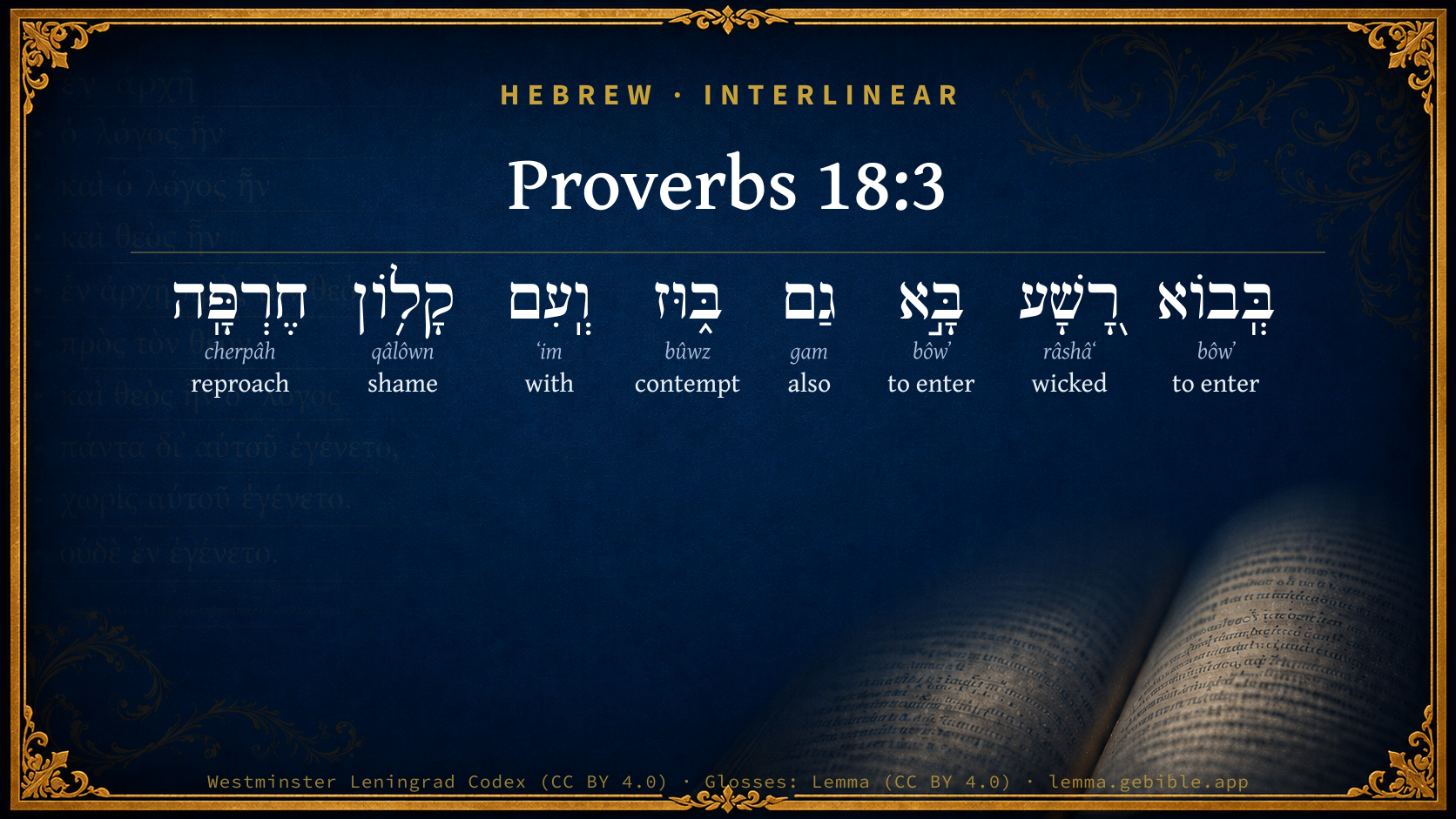
Proverbs 18:3

Hebrew (Westminster Leningrad Codex) Proverbs 18:3 appears in the Hebrew Old Testament. The text above is from the Westminster Leningrad Codex. Each word links to its Strong’s number, a concise gloss, and parsing drawn from the Open Scriptures Hebrew Bible morphology. Click any word for its full Brown-Driver-Briggs (BDB) entry.
Download image
Cite this verse

Proverbs 18:3 (World English Bible). Public Domain. Lemma interlinear Bible study tool, https://lemma.gebible.app/v/proverbs/18/3.

Show BibTeX & RIS
BibTeX
RIS
English Translation
When wickedness comes, contempt also comes, And with shame comes disgrace.
World English Bible · Public Domain
Download a study sheet

One document with this verse’s original text, its word-by-word gloss line, the meaning frame, cross-references with their text, attributed commentary, and full source and license credits — printable, and it pastes into notes with its structure intact.

This verse Autodidact and up

Study sheet (.html) Plain text (.txt)

A passage Seminary Student

Up to 50 verses in one chapter. A passage sheet keeps up to 6 commentary sources and 12 cross-references per verse, in the order this page ranks them, and says so on the sheet whenever that leaves anything out. Ask for a single verse and you get the Autodidact verse sheet above.

Everything on this page stays free to read, with no account — the sheet is a download of what is already on screen, not access to it.

Want to remove ads? Support Godless Engineer
Compare translations 3

The same verse in 3 English versions, stacked beneath the original-language interlinear above. Click any original word for its lexicon entry.

Each is an independent rendering of the whole verse — the interlinear is not word-aligned to these translations.

Highlighted words mark where these versions differ — a whole-verse word diff, not a word-by-word alignment.

  • World English Bible Public Domain
    When wickedness comes, contempt also comes, And with shame comes disgrace.
  • King James Version Public Domain
    When the wicked cometh, then cometh also contempt, and with ignominy reproach.
  • unfoldingWord Literal Text CC BY-SA 4.0
    When a wicked one comes, contempt also comes, and with shame, reproach.

unfoldingWord Literal Text — © unfoldingWord, licensed CC BY-SA 4.0. Word-aligned USFM3 via Door43 (git.door43.org/unfoldingWord/en_ult).

Versions to compare (up to 4)

3 of 4 selected

Show all 18 translations

Every available English version of this verse, each an independent rendering of the whole verse.

  • World English Bible Public Domain
    When wickedness comes, contempt also comes, And with shame comes disgrace.
  • Berean Standard Bible Public Domain
    With a wicked man comes contempt as well, and shame is accompanied by disgrace.
  • Majority Standard Bible Public Domain
    With a wicked man comes contempt as well, and shame is accompanied by disgrace.
  • King James Version Public Domain
    When the wicked cometh, then cometh also contempt, and with ignominy reproach.
  • American Standard Version (1901) Public Domain
    When the wicked cometh, there cometh also contempt, And with ignominy `cometh' reproach.
  • Revised Version (1885) Public Domain
    When the wicked cometh, there cometh also contempt, and with ignominy cometh reproach.
  • Geneva Bible (1599) Public Domain
    When the wicked commeth, then commeth contempt, and with the vile man reproch.
  • Douay-Rheims (1899) Public Domain
    The wicked man when he is come into the depth of sine, contemneth: but ignominy and reproach follow him.
  • Young's Literal Translation Public Domain
    With the coming of the wicked come also hath contempt, And with shame -- reproach.
  • Literal Standard Version CC BY-SA 4.0
    Contempt has also come with the coming of the wicked, || And with shame—reproach.
  • Unlocked Literal Bible CC BY-SA 4.0
    When a wicked person comes, contempt comes with him— along with shame and reproach.
  • unfoldingWord Literal Text CC BY-SA 4.0
    When a wicked one comes, contempt also comes, and with shame, reproach.
  • Darby Bible Public Domain
    When the wicked cometh, there cometh also contempt, and with ignominy reproach.
  • World Messianic Bible Public Domain
    When wickedness comes, contempt also comes, and with shame comes disgrace.
  • Webster's Bible Public Domain
    When the wicked cometh, then cometh also contempt, and with ignominy reproach.
  • Free Bible Version CC BY-SA 4.0
    With wickedness comes contempt; with dishonor comes disgrace.
  • Bible in Basic English Public Domain
    When the evil-doer comes, a low opinion comes with him, and with the loss of honour comes shame.
  • JPS Tanakh (1917) Public Domain
    When the wicked cometh, there cometh also contempt, and with ignominy reproach.

Literal Standard Version (2020), Covenant Press — licensed CC BY-SA 4.0. Text via the HelloAO Bible API (eBible.org). Unlocked Literal Bible (unfoldingWord) — licensed CC BY-SA 4.0. Text via the HelloAO Bible API (eBible.org). unfoldingWord Literal Text — © unfoldingWord, licensed CC BY-SA 4.0. Word-aligned USFM3 via Door43 (git.door43.org/unfoldingWord/en_ult). Free Bible Version, Dr. Jonathan Gallagher — licensed CC BY-SA 4.0. Text via the HelloAO Bible API (eBible.org).

Word by word

More ways to search: Search by grammar → Find every occurrence → Compare this word →

Practice this passage: Drill this verse → Learn its vocabulary →

About this verse

These counts appear in no published source. They are computed here, from the morphology-tagged text and Lemma’s own curated glosses. What Lemma adds →

8
words
7
distinct lemmas
Wisdom
section

Notable vocabulary

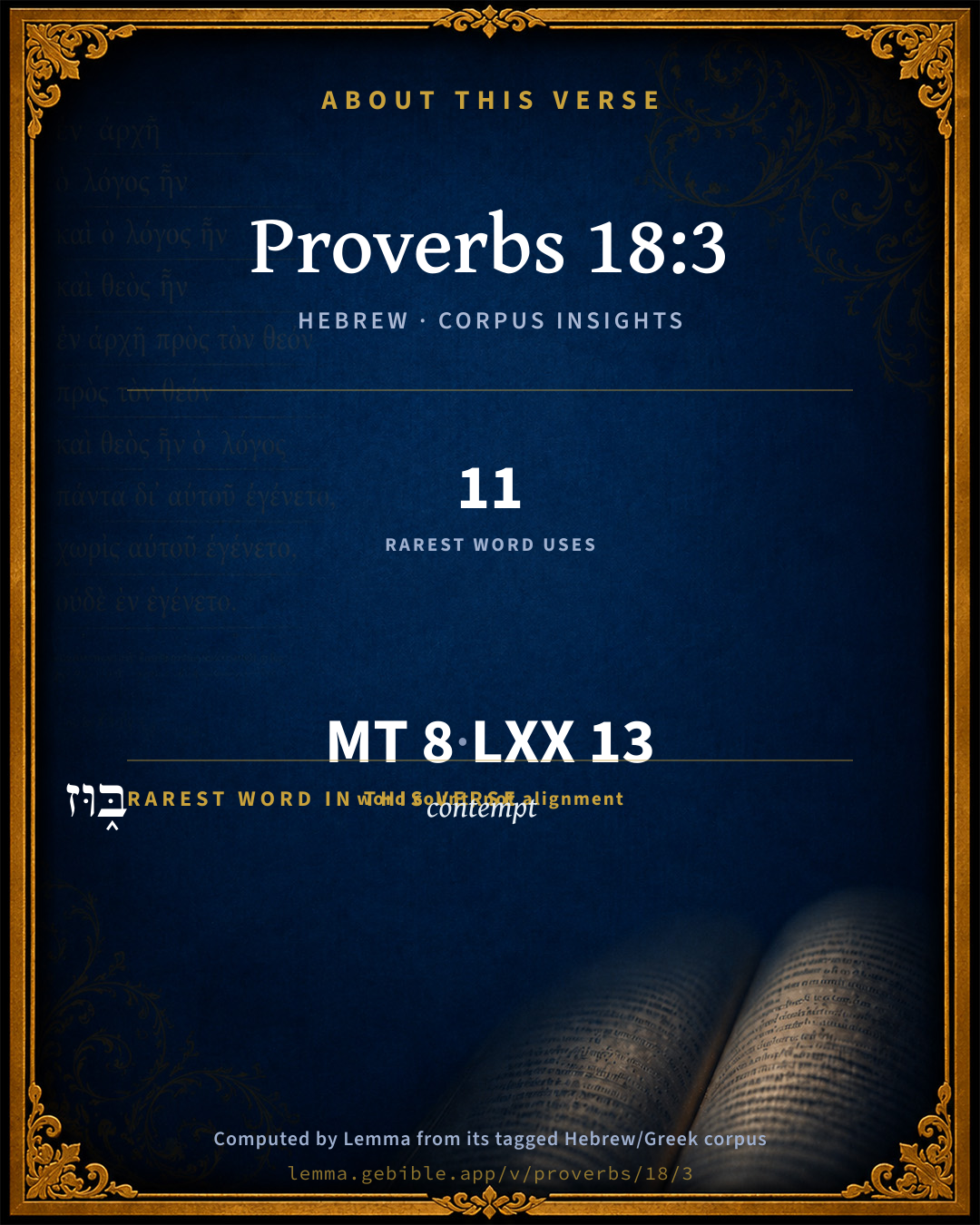
The rarest word here is בּ֑וּז contempt H937 — appearing just 11 times in the whole Hebrew Bible.

Shared distinctive vocabulary

בּ֑וּז contempt H937 occurs in 11 verses of the Hebrew Bible. Also found in:

Grammatical profile

  • 2 verbs
  • 3 nouns
  • 1 adjective
  • 1 preposition
  • 1 adverb

Verb forms

  • בְּֽבוֹא Qal · Infinitive Construct
  • בָּ֣א Qal · Perfect

Repetition

A word recurs within this verse — often emphatic in Hebrew:

  • בְּֽבוֹא to enter H935 ×2

Hebrew & Septuagint length

In English translation the verse runs 11 words from the Hebrew and 20 from the Septuagint (LXX English) — the Septuagint runs noticeably longer here. See the side-by-side →

A rough comparison of the two English renderings, which tokenize alike — not a word-level alignment.

Word counts can differ between the Hebrew and the Greek without any difference in meaning — e.g. the Hebrew direct-object marker אֵת has no separate Greek word, and Greek often adds the article ὁ.

In the original languages it is 8 Hebrew tokens and 13 Greek tokens — but the two are counted differently (Hebrew bundles its prefixes and suffixes into one token; the Greek is in lemma form), so that isn’t a like-for-like length.

Cross-references

11

Topical passages linked to Proverbs 18:3 in the Treasury of Scripture Knowledge — connected by theme and wording, ordered by reader-vote popularity; previews shown in the World English Bible.

  • Proverbs 22:10 Drive out the mocker, and strife will go out; Yes, quarrels and insults will stop.
  • 1 Peter 4:14 If you are insulted for the name of Christ, blessed are you; because the Spirit of glory and of God rests on you. On their part he is blasphemed, but on your part he is glorified.
  • Proverbs 11:2 When pride comes, then comes shame, But with humility comes wisdom.
  • Proverbs 29:16 When the wicked increase, sin increases; But the righteous will see their downfall.
  • 1 Peter 4:4 They think it is strange that you don't run with them into the same excess of riot, blaspheming:
  • 1 Samuel 20:30 Then Saul's anger was kindled against Jonathan, and he said to him, You son of a perverse rebellious woman, don't I know that you have chosen the son of Jesse to your own shame, and to the shame of your mother's nakedness?
  • Nehemiah 4:4 Hear, our God; for we are despised: and turn back their reproach on their own head, and give them up for a spoil in a land of captivity;
  • Psalms 69:9 For the zeal of your house consumes me. The reproaches of those who reproach you have fallen on me.
  • Psalms 69:20 Reproach has broken my heart, and I am full of heaviness. I looked for some to take pity, but there was none; For comforters, but I found none.
  • Psalms 123:3–4 Have mercy on us, Yahweh, have mercy on us, For we have endured much contempt.
  • Matthew 27:39–44 Those who passed by blasphemed him, wagging their heads,

Cross-references courtesy of OpenBible.info (CC BY 4.0).

Hebrew and Greek witnesses Masoretic Hebrew ↔ Greek Septuagint

The same verse in the two great witnesses to the Old Testament, shown verse-for-verse.

Here the Septuagint runs noticeably longer than the Hebrew — LXX2012 (modern English Septuagint) 20 words vs World English Bible 11. A rough length comparison of the two English translations, not a word-level alignment — read both below.

These are two independent witnesses, not word-aligned to each other, and the Septuagint is shown in lemma (dictionary) form.

Hebrew Proverbs 18:3 Masoretic · Westminster Leningrad Codex

בְּֽבוֹא רָ֭שָׁע בָּ֣א גַם בּ֑וּז וְֽעִם קָל֥וֹן חֶרְפָּֽה

When wickedness comes, contempt also comes, And with shame comes disgrace.

World English Bible · Public Domain

Greek LXX Proverbs 18:3 Septuagint · lemma form

ὅταν ἔρχομαι ἀσεβής εἰς βάθος κακός καταφρονέω ἐπιἔρχομαι δέ αὐτός ἀτιμία καί ὄνειδος

When an ungodly man comes into a depth of evils, he despises them; but dishonor and reproach come upon him.

LXX2012 (modern English Septuagint) · Public Domain

On this verse, John Gill's Exposition discusses the Septuagint’s reading. Read the note in Commentary ↓

Hebrew: Westminster Leningrad Codex (CC BY 4.0). Greek: Septuagint (public domain); English from LXX2012 (modern English Septuagint) (Public Domain). How the Septuagint differs from the Hebrew →

Commentary

Notes on Proverbs 18:3 from classic Christian and Jewish commentators (each source and its license shown beneath its notes). The classic Christian expositions comment on the surrounding passage and are grouped to its opening verse, so a note may address several verses; the Jewish commentaries on the Tanakh (Rashi and others) are per-verse, so they appear only where the commentator wrote on this verse.

Lemma curates 59 commentaries, every one of them public domain or Creative Commons licensed, each selected and text-cleaned for this edition rather than reprinted as found. About our sources →

Trapp's Complete Commentary

John Trapp

Pro 18:3 When the wicked cometh, [then] cometh also contempt, and with ignominy reproach.

Ver. 3. When the wicked cometh, then cometh contempt.] It comes into the world with him, so the Hebrew doctors expound it. He is born a contemner of God, of his people, and of his ordinances, being "vainly puffed up by his fleshly mind," {Col 2:18} and having a base esteem of others, in comparison of himself. Thus "vain man would be wise," yea, the only wise, "though man be born like a wild ass’s colt," {Job 11:12} and so he could not but confess, would he but consult a while with himself. But he doth with himself as some people do by dogs and monkeys, which they know to be paltry carrion beasts, and yet they set great store by them, and make precious account of them, merely for their mind’s sake.

And with ignominy, reproach.] These two he shall be sure of, according to that of 1Sa 2:30 : - "They that despise me shall be lightly esteemed"; and Pro 3:34, "Surely God scorneth the scorners"; {See Trapp on "Pro 3:34"} he pays them in their own coin, overshoots them in their own bow, makes them to meet with such as will mete them out their own measure, and for their contempt repay them with ignominy, "reproach."

John Trapp, A Commentary or Exposition upon All the Books of the Old and New Testament (1647–1656) — public domain. Text from a community e-Sword module.

Joseph Benson's Commentary

Pro 18:3. When the wicked cometh — Into any place or company; then cometh also contempt — Either, 1st, He is justly contemned by those who converse with him: or rather, 2d, He despiseth and scorneth all instruction and reproof, neither fearing God nor reverencing man; and with ignominy reproach — And he not only contemns others in his heart, but shows his contempt of them by ignominious and reproachful expressions and actions. Bishop Patrick takes this verse in a somewhat different sense, namely, “Into whatsoever company or society (suppose into the schools of wisdom) a profane person comes, he brings along with him contempt of God and religion, and good men; and (as one wickedness grows out of another) that contempt improves into affronts, and reproachful language of them.”

Joseph Benson's Commentary on the Old and New Testaments (1811–1818) — public domain. Text from a community e-Sword module.

The Preacher's Complete Homiletical Commentary

Joseph S. Exell (gen. ed.)

CRITICAL NOTES.—

Pro_18:3. Ignominy, rather, “shameful deeds.”

MAIN HOMILETICS OF Pro_18:3

This verse also, as will be seen from a reference to the Critical Notes, and also from the Comments, is susceptible of several interpretations. We think it treats of—

THE SHORT-LIVED PROSPERITY OF EVIL MEN

I. Wicked men do come into places of power and influence. This fact has often tried the faith of righteous men. Asaph’s “steps had well-nigh slipped” when he saw “the prosperity of the wicked”—that “violence covered them as a garment,” and that they “set their mouth against the heavens;” and yet that “their strength was firm,” and “they had more than heart could wish” (Psa_73:2-8). The tiller of the soil knows from experience that the useless weeds and noxious plants often seem to absorb all the nutriment from the earth, and so make it well-nigh impossible for the useful herb and sweet-scented flower to grow in the same field or garden. And moral weeds seem to have a like capability of utilising everything that comes in their way to their own advancement—the unrighteous man makes a fortune, or a position, or a name for himself, while his godly neighbour is struggling for a bare subsistence. In the field of the world, the tares grow as well as the wheat (Mat_13:26), and often they seem for a time to be more flourishing. Ahab and Jezebel dwell in Samaria, and Elijah is compelled to flee into the desert. Herod feasts in the palace, while John the Baptist is beheaded in the dungeon.

II. Contempt and reproach are their final portion. Their day of power is short-lived. David has recorded as his experience that he had “seen the wicked in great power, and spreading himself like a green bay-tree”—but he “passed by, and lo, he was not” (Psa_37:35). And however their success may dazzle men’s eyes and warp their judgment for a season, contempt is their portion at last. They are often held in contempt even while living, and the reproaches of those who have been made to suffer by them are heaped upon their heads. Many of those who fawned upon them and flattered them while they were prospering will be most ready to scorn and upbraid them, if the day of their retribution arrives before they quit this world. And if they keep their power and influence throughout the term of their human probation, their names will be contemned by posterity, and in the day when “everyone receives the things done in his body” (2Co_5:10), they shall “awake to shame and everlasting contempt” (Dan_12:2).

OUTLINES AND SUGGESTIVE COMMENTS

When a “wicked” man enters upon the stage, that creature, the most degraded of the universe, and who has the least right to show any contempt, is the very person to be the most contemptuous; and the mortal who is himself most disgraced, shows the readiest mind to cry shame upon and to reproach and that even the Most High. Doubtless there is secular truth in all this The disgraced citizen is often the most reproachful.—Miller.

I. They bring “contempt,” not to themselves only, but to the places they fill, and the societies to which they become united—to themselves, for the unworthy manner in which they fulfil the duties of the trust they have assumed, or have had committed to them; and to their places and societies, with which their names are associated. They entail “ignominy and reproach” upon all they have to do with. And in no case is this more true, than with regard to offices in the Church. O what an amount of scorn and reproach has been brought upon the sacred office of the ministry by the intrusion, under numberless pretexts, and from numberless causes, of wicked, worldly, ungodly men into its holy functions! How full is Church history of this deplorable evil!—and how many infidels and scorners has Church history by this means produced. Thus it was under the old dispensation. The wickedness of the sons of Eli made men “abhor the offering of the Lord.” And thus it is still. Of the “false teachers” who should arise in the latter days, it is said—“by reason of them the way of truth shall be evil-spoken of.” From few other sources, if from any, has there proceeded a greater profusion of unmerited “reproach” of the name and doctrine and kingdom of the Lord; or has “the chair of the scorner” drawn a greater number and variety of its sarcastic sneers and bitter revilings. II. The phrase may mean—“When the wicked cometh” into intimacy, companionship, familiarity, “then cometh contempt.”—He who admits the wicked to his intimacy—makes him his associate—must share the infamy of his ill-chosen companion. Many a time too has this been exemplified.—Wardlaw.

The Preacher's Complete Homiletical Commentary (gen. ed. Joseph S. Exell; Funk & Wagnalls, c. 1892) — public domain (pre-1929). A full-Bible homiletical/sermon-outline anthology covering 65 of 66 books (2 John is absent from the source module). Text from a community e-Sword module.

Keil & Delitzsch

C. F. Keil & F. Delitzsch

The group beginning with Pro 18:3 terminates in two proverbs (Pro 18:6 and Pro 18:7), related to the concluding verse of the foregoing:

3 If a godless man cometh, then cometh also contempt;

And together with disgrace, shame.

J. D. Michaelis, and the most of modern critics, read רשׁע; then, contempt etc., are to be thought of as the consequences that follow godlessness; for that קלון means (Hitzig) disgracefulness, i.e., disgraceful conduct, is destitute of proof; קלון always means disgrace as an experience. But not only does the Masoretic text punctuate רשׁע, but also all the old translators, the Greek, Aramaic, and Latin, have done so. And is it on this account, because a coming naturally seems to be spoken of a person? The "pride cometh, then cometh shame," Pro 11:2, was in their recollection not less firmly, perhaps, than in ours. They read רשׁע, because בוּז does not fittingly designate the first of that which godlessness effects, but perhaps the first of that which proceeds from it. Therefore we adhere to the opinion, that the proverb names the fiends which appear in the company of the godless wherever he goes, viz., first בוז, contempt (Psa 31:19), which places itself haughtily above all due subordination, and reverence, and forbearance; and then, with the disgrace [turpitudo], קלון, which attaches itself to those who meddle with him (Isa 22:18), there is united the shame, הרפּה (Psa 39:9), which he has to suffer from him who has only always expected something better from him. Fleischer understands all the three words in the passive sense, and remarks, "עם־קלון חרפה, a more artificial expression for קלון וחרפה, in the Turkish quite common for the copula wāw, e.g., swylh ṭbrâk, earth and water, 'wrtylh âr, the man and the woman." But then the expression would be tautological; we understand בוז and חרפה of that which the godless does to others by his words, and קלון of that which he does to them by his conduct. By this interpretation, עם is more than the representative of the copula.

Keil & Delitzsch — Biblical Commentary on the Old Testament (1861–1891) — public domain (CC PDM 1.0). Text via the HelloAO Bible API. (Old Testament only.)

Geneva Bible (1599)

Geneva Bible translators

Meaning, such one as contemneth all others.

Geneva Bible (1599) marginal notes — public domain. Text via Bolls.life.

Matthew Henry's Commentary

This may include a double sense: - 1. That wicked people are scornful people, and put contempt upon others. When the wicked comes into any company, comes into the schools of wisdom or into the assemblies for religious worship, then comes contempt of God, of his people and ministers, and of every thing that is said and done. You can expect no other from those that are profane than that they will be scoffers; they will be an ignominy and reproach; they will flout and jeer every thing that is serious and grave. But let not wise and good men regard it, for the proverb of the ancients says, such wickedness proceeds from the wicked. 2. That wicked people are shameful people, and bring contempt upon themselves, for God has said that those who despise him shall be lightly esteemed. As soon as ever sin entered shame followed it, and sinners make themselves despicable. Nor do they only draw contempt upon themselves, but they bring ignominy and reproach upon their families, their friends, their ministers, and all that are in any way related to them. Those therefore who would secure their honour must retain their virtue.

Matthew Henry's Commentary on the Whole Bible (1708–1710) — public domain (CC PDM 1.0). Text via the HelloAO Bible API.

Jamieson, Fausset & Brown

Robert Jamieson, A. R. Fausset & David Brown

So surely are sin and punishment connected (Pro 16:4).

wicked, for "wickedness," answers to

ignominy, or the state of such; and

contempt, the feeling of others to them; and to

reproach, a manifestation of contempt.

Jamieson, Fausset & Brown — Commentary Critical and Explanatory on the Whole Bible (1871) — public domain (CC PDM 1.0). Text via the HelloAO Bible API.

Adam Clarke's Commentary

Verse 3. When the wicked cometh, c.] would it not be better to read this verse thus? "When the wicked cometh contempt cometh and with ignominy cometh reproach." A wicked man is despised even by the wicked. He who falls under ignominy falls under reproach.

Adam Clarke's Commentary on the Bible (1810–1826) — public domain. Text from a community e-Sword/MySword module.

Ellicott's Commentary for English Readers

(3) When the wicked cometh, then cometh also contempt.—Comp. the whole burden of Psalms 106, that sorrow and shame follow sin.

A Bible Commentary for English Readers, edited by Charles John Ellicott (1878–1897) — public domain. Text from a community e-Sword module.

The Cambridge Bible for Schools and Colleges

gen. ed. J. J. S. Perowne

3. with ignominy reproach] Or, with ignominy cometh reproach. As shame is inseparable from wickedness, so is reproach from ignominy, i.e. ignominious character and conduct (“a shameful deed,” Gesen.; “turpi mores, turpiter facta,” Maur.).

The rendering, however, of A.V. gives a good sense: when the wicked cometh, all these evil things, contempt, ignominy and reproach, come with him.

The Cambridge Bible for Schools and Colleges (gen. ed. J. J. S. Perowne; Cambridge University Press, 1878–1918) — public domain. Text from a community e-Sword module.

John Gill's Exposition

When the wicked cometh, then cometh also contempt,.... When he comes into the world, as Aben Ezra; as soon as he is born, he is liable to contempt, being born in sin; but this is true of all: rather, as the Vulgate Latin, and with which the Septuagint, Syriac, and Arabic versions agree, when he cometh into the depth of sin, or to the height of his wickedness; he commences a scoffer at, and condemner of all that is good: when he comes into the house of God, it may be said, "there comes contempt"; for he comes not to hear the word, in order to receive any profit by it, but to contemn it, and the ministers of it;

and with ignominy reproach: or, "with the ignominious man reproach" (l): he that despises all that is good, and treats divine things in a ludicrous way, will not spare to reproach the best of men, and speak evil of them falsely, for the sake of religion. Or the meaning of the whole is, that wicked men, sooner or later, come into contempt, ignominy, and reproach, themselves; they that despise the Lord are lightly esteemed by him; and a vile person is contemned in the eyes of a good man: such bring shame and disgrace upon themselves and families while they live; and, when they die, they are laid in the grave with dishonour; an infamy rests upon their memories, and they wilt rise to everlasting shame and contempt.

(l) "viro ignominioso, venit opprobriunu", Pagninus; "cum ignominioso probrum", Junis & Tremeilius; "cum probroso opprobrium", Schultens, so Vatablus, Mercerus, Gejerus.

John Gill's Exposition of the Whole Bible (1746–1763) — public domain (CC PDM 1.0). Text via the HelloAO Bible API.

Albert Barnes' Notes on the Bible

With ignominy - Better, “together with baseness comes reproach.” The outer shame follows close upon the inner.

Albert Barnes' Notes on the Bible (1834–1885) — public domain. Text from a community e-Sword/MySword module.

Haydock's Catholic Bible Commentary

Contemneth both God and man, Luke xviii. 4. Hebrew, "is contemned" in his turn. (Calmet) --- He is like a man abandoned by the physician. (Op. Imp. in Matt. Hom. 40.)

George Leo Haydock (1774–1849), Haydock's Catholic Family Bible and Commentary, 1859 edition — public domain. Excludes Psalms (Douay-Rheims chapter numbering differs from Protestant) and Deuterocanonical books (Catholic canon only).

Matthew Poole's English Annotations

When the wicked cometh into any place or company,

then cometh also contempt; either,

1. Passively; he is justly contemned and reproached by those who converse with him. Or rather,

2. Actively; he despiseth and scorneth all instruction and reproof, neither fearing God nor reverencing man; for he seems here to note his sin rather than his punishment.

And with ignominy reproach; and he doth not only contemn others in his heart, but showeth his contempt of them by ignominious and reproachful expressions and carriages.

Matthew Poole's English Annotations on the Holy Bible (1683–1685) — public domain. Text from a community e-Sword/MySword module.

Whedon's Commentary on the Bible

Daniel D. Whedon

3. Ignominy — Usually rendered, shame or dishonour. The idea probably is, that contempt follows wickedness, and reproach comes along with an ignominious or shameful act. (Comp. Pro_11:2.) “Reproach along with shame.” — Conant.

Daniel D. Whedon (gen. ed.), Commentary on the Old and New Testaments (1874–1909) — public domain. Text from a community e-Sword module.

The Pulpit Commentary

When the wicked cometh, then cometh also contempt. The contempt here spoken of is not that with which the sinner is regarded, but that which he himself learns to feel for all that is pure and good and lovely. (Psa_31:18) As the LXX interprets, "When the wicked cometh into the depth of evil, he despiseth," he turns a despiser. So the Vulgate. Going forward in evil, adding sin to sin, he end by casting all shame aside, deriding the Law Divine and human, and saying in his heart, "There is no God." St. Gregory, "As he who is plunged into a well is confined to the bottom of it; so would the mind fall in, and remain, as it were, at the bottom, if, after having once fallen, it were to confine itself within any measure of sin. But when it cannot be contented with the sin into which it has fallen, while it is daily plunging into worse offences, it finds, as it were, no bottom to the well into which it has fallen, on which to rest. For there would be a bottom to the well, if there were any bounds to his sin. Whence it is well said, "When a sinner hath come into the lowest depth of sins, he contemneth." For he puts by returning, because he has no hope that he can be forgiven. But when he sins still more through despair, he withdraws, as it were, the bottom from the well, so as to find therein no resting place" ("Moral.," 26:69, Oxford transl.). Even the heathen could see this terrible consequence. Thus Juvenal is quoted ("Sat.," 13:240, etc.)"Nam quis Peccandi finem posuit sibi? quando receipt Ejectum semel attrita de fronte ruborem? Quisnam hominum est, quem tu contentum videris uno Flagitio?

And with ignominy cometh reproach. Here again it is not the reproach suffered by the sinner that is meant, (as in Pro_11:2) but the abuse which he heaps on others who strive to impede him in his evil courses. All that he says or does brings disgrace, and he is always ready to revue any who are better than himself. Both the Septuagint and the Vulgate make the wicked man the victim instead of the actor, thus: "but upon him there cometh disgrace and reproach." The Hebrew does not well admit this interpretation.

The Pulpit Commentary (1880–1919), ed. H.D.M. Spence-Jones & Joseph S. Exell — public domain. Text from a community e-Sword module.

John Wesley's Explanatory Notes

Cometh - Into any place or company. Contempt - He despiseth all instruction and reproof. Reproach - And he shews his contempt by ignominious and reproachful expressions.

John Wesley, Explanatory Notes Upon the Whole Bible (1754–1765) — public domain. Text via the GEBible commentary corpus.

Bridges on Proverbs

Charles Bridges

Selfishness is the character of the wicked. ’Wheresoever he cometh, he is apt to cast contempt and reproach upon every man’s face.’†1 His neighbour’s circumstances or infirmities furnish materials to hold him up to scorn. The word of God has no favor in his eyes. His people are the objects of his reproach. Their seriousness he calls gloom, their cheerfulness levity. (Mat 11:18-19 .) If "none occasion or fault can be found" (Dan 6:4 ), invention forges it with unwearied ingenuity. "As saith the proverb of the ancients, wickedness proceedeth from the wicked." (1Sa 24:13 .) We must calculate upon this furnace, though the fires of martyrdom are extinguished. Our blessed Lord bore all the evils of the world without flinching. But contempt and reproach pierced his soul more keenly, than the "nails did his hands and his feet." "Reproach," saith he — "hath broken my heart."†2 And must not the servant expect to be as his Master?†3 Often however does retributive justice overwhelm the wicked themselves with ignominy and reproach.†4 A scornful spirit against the godly is never forgotten. Every bitter word is registered against the great day.†5 And what a sight will it then be, when the reviled shall stand forth, clothed with all the glory of "the King of saints," and the faces of their persecutors shall be covered with "everlasting shame and contempt!" (Dan 12:2 .) The sight of that day will never be blotted out! The rebuke of his people shall be taken away from off all the earth, "for the LORD hath spoken it." (Isa 25:8 .)

Footnotes:

†1 Bishop Hall. Compare Pro 29:16 .

†2 Psa 69:20. Mat 27:39-44 .

†3 Mat 10:25. Joh 15:20 .

†4 2Sa 6:20-23 . Est 7:9-10 .

†5 1Pe 4:4-5 . Jud 1:14-15 .

Charles Bridges, An Exposition of the Book of Proverbs (1846) — public domain. Text from a community e-Sword module.

Kretzmann's Popular Commentary

Paul E. Kretzmann

v. 3. When the wicked cometh, then cometh also contempt, for such a person considers himself above submission to others and therefore is lacking in both reverence and forbearance, and with ignominy reproach, for the wicked must display his assumed superiority by treating all those not in his favor with studied contempt.

Paul E. Kretzmann, Popular Commentary of the Bible (1921–1924) — public domain. Text from a community e-Sword module.

unfoldingWord translationNotes

Door43 World Missions Community

contempt comes with him—along with shame and reproach

Here "contempt," "shame," and "reproach" are spoken of as if they are people who accompany a wicked man. Possible meanings are 1) people show contempt towards the wicked man and cause him to feel shame and reproach. AT: "people feel contempt for him along with shame and reproach" or 2) the wicked man shows contempt for others and causes them to feel shame and reproach. AT: "he shows his contempt for other people and causes them to feel shame and reproach" (See: Personification)

shame and reproach

These two words have similar meaning and are used together to emphasize the "shame" felt by either the wicked man or other people. (See: Doublet)

The words of a man's mouth are deep waters; ... the fountain of wisdom is a flowing stream

These two lines are parallel and it is implied that the man in the first line is a wise man. AT: "The words of a wise man's mouth are deep waters; ... the fountain of wisdom is a flowing stream" (See: Parallelism and Assumed Knowledge and Implicit Information)

The words of a man's mouth are deep waters

This speaks of a wise man's words being profound as if they were profound and as deep as deep waters. AT: "The words of a man's mouth are as profound as deep waters" or "The words of a man's mouth are deep and profound" (See: Metaphor)

a man's mouth

Here the man is referred to by his mouth to emphasize what he says. AT: "of a man" (See: Synecdoche)

the fountain of wisdom is a flowing stream

This speaks of the source of wisdom being plentiful as if it were a gushing spring. The gushing of the spring is spoken of as if it were a flowing stream. AT: "the source of wisdom is as plentiful as the water of a gushing spring" (See: Metaphor)

translationWords

evil

contempt

shame

reproach

word

water

fountain

wise

unfoldingWord translationNotes — © Distant Shores Media and the Door43 World Missions Community, licensed CC BY-SA 4.0. Source: git.door43.org/Door43/en_tn.

Rashi

Rabbi Shlomo Yitzchaki (Rashi)

and with disdain disgrace comes. He who chooses disdain and adultery—it is a disgrace for him.

Rashi on the Tanakh — English translations: “The Judaica Press complete Tanach with Rashi, translated by A. J. Rosenberg” (CC BY 4.0); “Pentateuch with Rashi's commentary by M. Rosenbaum and A.M. Silbermann, 1929-1934” (public domain); “The Metsudah Tanach series, Lakewood, N.J” (CC BY 4.0); and “The Book of Joshua, Metsudah Publications, 1997” (CC BY 4.0). Text via Sefaria.

Lesson kit

Teaching starters — assembled from the data on this page, not authored interpretation. Every prompt links to the verse data it draws on. Edit before teaching.

Proverbs, in the Wisdom, opens this verse with 8 words (7 distinct Hebrew lemmas). Its most distinctive word is bûwz (“contempt”). The Greek Septuagint runs longer here. A historical commentator’s framing appears above. Read the whole chapter for the surrounding context.

Discussion questions

  1. The word bûwz carries the sense “contempt.” How does it shape the verse?
  2. How does Genesis 38:23, which shares the word «contempt», read alongside this verse?
  3. What does the repetition of “to enter” (2× in this one verse) do in this verse?
  4. The Septuagint runs longer here than the Hebrew. What might account for the difference?
  5. The translations on this page render this verse differently — a whole-verse word diff, not a word-by-word alignment. What might account for the different wordings?
  6. «בְּֽבוֹא» is a Qal Infinitive Construct verb. How does that grammatical form shape the action described?
  7. Compare how Trapp's Complete Commentary and Joseph Benson's Commentary read this verse. Where do they agree or differ?

Things to notice

Reading settings

Reading text

Shown beneath each verse's original-language words.

Old Testament
Old Testament edition

Read the OT as the Masoretic Hebrew (MT) or the Greek Septuagint (LXX).

English shown for the Greek Septuagint (in the Hebrew ↔ Greek comparison).

Comparing translations? Open the Compare panel on any verse page to stack up to four side by side.