
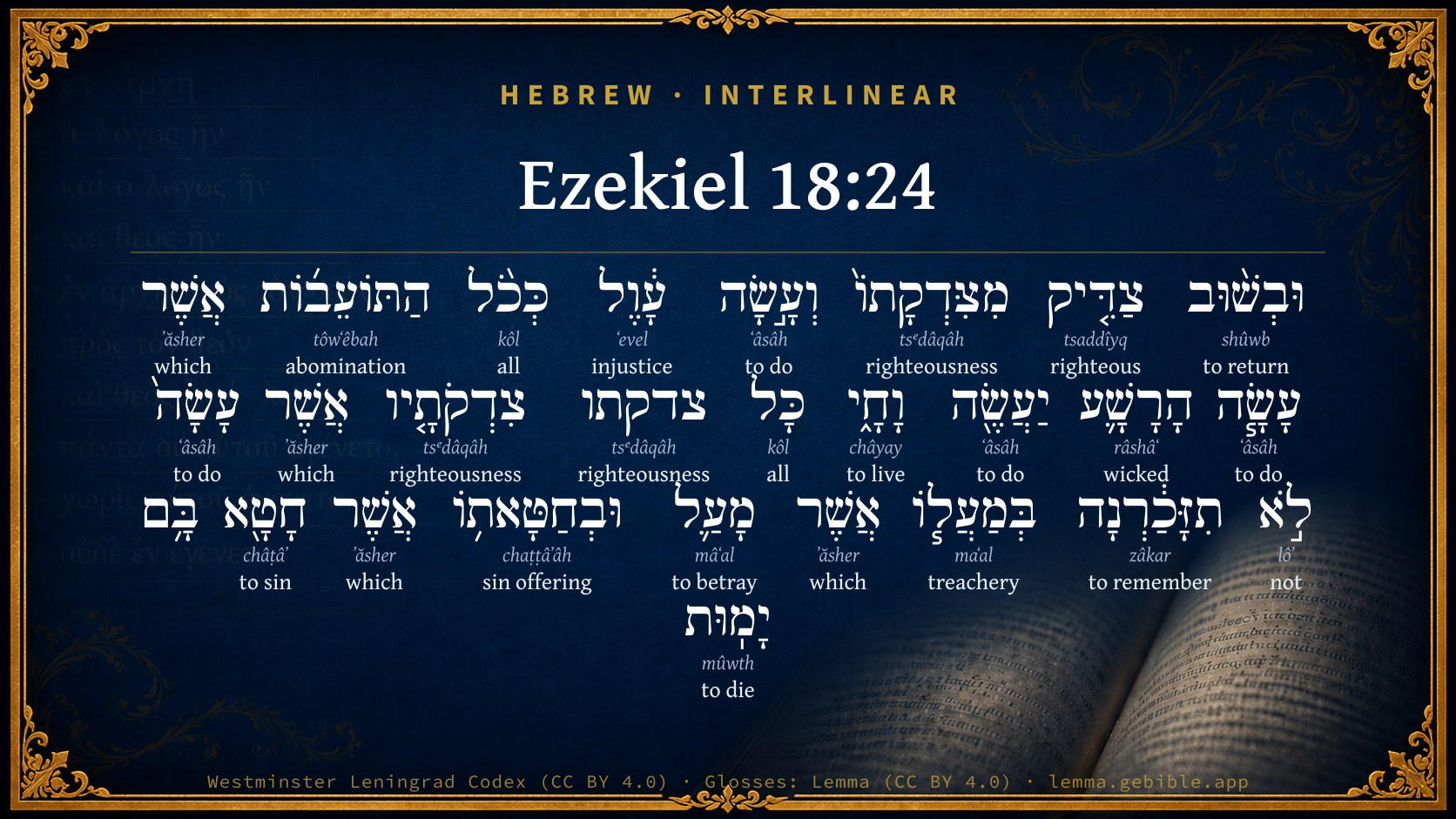
Ezekiel 18:24

Hebrew (Westminster Leningrad Codex) Ezekiel 18:24 appears in the Hebrew Old Testament. The text above is from the Westminster Leningrad Codex. Each word links to its Strong’s number, a concise gloss, and parsing drawn from the Open Scriptures Hebrew Bible morphology. Click any word for its full Brown-Driver-Briggs (BDB) entry.
Download image
Cite this verse

Ezekiel 18:24 (World English Bible). Public Domain. Lemma interlinear Bible study tool, https://lemma.gebible.app/v/ezekiel/18/24.

Show BibTeX & RIS
BibTeX
RIS
English Translation
But when the righteous turns away from his righteousness, and commits iniquity, and does according to all the abominations that the wicked man does, shall he live? None of his righteous deeds that he has done shall be remembered: in his trespass that he has trespassed, and in his sin that he has sinned, in them shall he die.
World English Bible · Public Domain
Download a study sheet

One document with this verse’s original text, its word-by-word gloss line, the meaning frame, cross-references with their text, attributed commentary, and full source and license credits — printable, and it pastes into notes with its structure intact.

This verse Autodidact and up

Study sheet (.html) Plain text (.txt)

A passage Seminary Student

Up to 50 verses in one chapter. A passage sheet keeps up to 6 commentary sources and 12 cross-references per verse, in the order this page ranks them, and says so on the sheet whenever that leaves anything out. Ask for a single verse and you get the Autodidact verse sheet above.

Everything on this page stays free to read, with no account — the sheet is a download of what is already on screen, not access to it.

Want to remove ads? Support Godless Engineer
Compare translations 3

The same verse in 3 English versions, stacked beneath the original-language interlinear above. Click any original word for its lexicon entry.

Each is an independent rendering of the whole verse — the interlinear is not word-aligned to these translations.

Highlighted words mark where these versions differ — a whole-verse word diff, not a word-by-word alignment.

  • World English Bible Public Domain
    But when the righteous turns away from his righteousness, and commits iniquity, and does according to all the abominations that the wicked man does, shall he live? None of his righteous deeds that he has done shall be remembered: in his trespass that he has trespassed, and in his sin that he has sinned, in them shall he die.
  • King James Version Public Domain
    But when the righteous turneth away from his righteousness, and committeth iniquity, and doeth according to all the abominations that the wicked man doeth, shall he live? All his righteousness that he hath done shall not be mentioned: in his trespass that he hath trespassed, and in his sin that he hath sinned, in them shall he die.
  • unfoldingWord Literal Text CC BY-SA 4.0
    But if the righteous person turns away from his righteousness and commits iniquity and practices abominations like all the abominations that the wicked person does, then will he live? All the righteousness that he had done will not be called to mind when he betrays me in his treason. So he will die in the sins that he committed.

unfoldingWord Literal Text — © unfoldingWord, licensed CC BY-SA 4.0. Word-aligned USFM3 via Door43 (git.door43.org/unfoldingWord/en_ult).

Versions to compare (up to 4)

3 of 4 selected

Show all 18 translations

Every available English version of this verse, each an independent rendering of the whole verse.

  • World English Bible Public Domain
    But when the righteous turns away from his righteousness, and commits iniquity, and does according to all the abominations that the wicked man does, shall he live? None of his righteous deeds that he has done shall be remembered: in his trespass that he has trespassed, and in his sin that he has sinned, in them shall he die.
  • Berean Standard Bible Public Domain
    But if a righteous man turns from his righteousness and practices iniquity, committing the same abominations as the wicked, will he live? None of the righteous acts he did will be remembered. Because of the unfaithfulness and sin he has committed, he will die.
  • Majority Standard Bible Public Domain
    But if a righteous man turns from his righteousness and practices iniquity, committing the same abominations as the wicked, will he live? None of the righteous acts he did will be remembered. Because of the unfaithfulness and sin he has committed, he will die.
  • King James Version Public Domain
    But when the righteous turneth away from his righteousness, and committeth iniquity, and doeth according to all the abominations that the wicked man doeth, shall he live? All his righteousness that he hath done shall not be mentioned: in his trespass that he hath trespassed, and in his sin that he hath sinned, in them shall he die.
  • American Standard Version (1901) Public Domain
    But when the righteous turneth away from his righteousness, and committeth iniquity, and doeth according to all the abominations that the wicked man doeth, shall he live? None of his righteous deeds that he hath done shall be remembered: in his trespass that he hath trespassed, and in his sin that he hath sinned, in them shall he die.
  • Revised Version (1885) Public Domain
    But when the righteous turneth away from his righteousness, and committeth iniquity, and doeth according to all the abominations that the wicked man doeth, shall he live? None of his righteous deeds that he hath done shall be remembered: in his trespass that he hath trespassed, and in his sin that he hath sinned, in them shall he die.
  • Geneva Bible (1599) Public Domain
    But if the righteous turne away from his righteousnes, and commit iniquitie, and doe according to all the abominations, that the wicked man doeth, shall he liue? all his righteousnes that he hath done, shall not be mentioned: but in his transgression that he hath committed, and in his sinne that he hath sinned, in them shall he die.
  • Douay-Rheims (1899) Public Domain
    But if the just man turn himself away from his justice, and do iniquity according to all the abominations which the wicked man useth to work, shall he live? all his justices which he hath done, shall not be remembered: in the prevarication, by which he hath prevaricated, and in his sin, which he hath committed, in them he shall die.
  • Young's Literal Translation Public Domain
    And in the turning back of the righteous from his righteousness, And he hath done perversity, According to all the abominations That the wicked hath done, he doth -- thus he liveth, All his righteousnesses that he hath done are not remembered, For his trespass that he hath trespassed, And for his sin that he hath sinned, For them he doth die.
  • Literal Standard Version CC BY-SA 4.0
    And in the turning back of the righteous from his righteousness, || And he has done perversity, || According to all the abominations || That the wicked has done, || Does he then live? All his righteous deeds that he has done are not remembered, || For his trespass that he has trespassed, || And for his sin that he has sinned, || For them he dies.
  • Unlocked Literal Bible CC BY-SA 4.0
    But if the righteous person turns away from his righteousness and commits iniquity and practices abominations like all the abominations that the wicked person does, then will he live? All the righteousness that he had done will not be called to mind when he betrays me in his treason. So he will die in the sins that he committed.
  • unfoldingWord Literal Text CC BY-SA 4.0
    But if the righteous person turns away from his righteousness and commits iniquity and practices abominations like all the abominations that the wicked person does, then will he live? All the righteousness that he had done will not be called to mind when he betrays me in his treason. So he will die in the sins that he committed.
  • Darby Bible Public Domain
    And when the righteous turneth from his righteousness and practiseth what is wrong, [and] doeth according to all the abominations that the wicked doeth, shall he live? None of his righteous acts which he hath done shall be remembered: in his unfaithfulness which he hath wrought, and in his sin which he hath sinned, in them shall he die.
  • World Messianic Bible Public Domain
    “But when the righteous turns away from his righteousness, and commits iniquity, and does according to all the abominations that the wicked man does, should he live? None of his righteous deeds that he has done will be remembered. In his trespass that he has trespassed, and in his sin that he has sinned, in them he shall die.
  • Webster's Bible Public Domain
    But when the righteous turneth away from his righteousness, and committeth iniquity, and doeth according to all the abominations that the wicked man doeth, shall he live? All his righteousness that he hath done shall not be mentioned: in his trespass that he hath trespassed, and in his sin that he hath sinned, in them shall he die.
  • Free Bible Version CC BY-SA 4.0
    But if someone who is living according to what's right stops and does wrong, doing the same offensive things as the wicked, will that person live? Of course not! In fact, all the good things they did previously will be forgotten. That person will die because of their betrayal of me and the sins they've committed.
  • Bible in Basic English Public Domain
    But when the upright man, turning away from his righteousness, does evil, like all the disgusting things which the evil man does, will he have life? Not one of his upright acts will be kept in memory: in the wrong which he has done and in his sin death will overtake him.
  • JPS Tanakh (1917) Public Domain
    But when the righteous turneth away from his righteousness, and committeth iniquity, and doeth according to all the abominations that the wicked man doeth, shall he live? None of his righteous deeds that he hath done shall be remembered; for his trespass that he trespassed, and for his sin that he hath sinned, for them shall he die.

Literal Standard Version (2020), Covenant Press — licensed CC BY-SA 4.0. Text via the HelloAO Bible API (eBible.org). Unlocked Literal Bible (unfoldingWord) — licensed CC BY-SA 4.0. Text via the HelloAO Bible API (eBible.org). unfoldingWord Literal Text — © unfoldingWord, licensed CC BY-SA 4.0. Word-aligned USFM3 via Door43 (git.door43.org/unfoldingWord/en_ult). Free Bible Version, Dr. Jonathan Gallagher — licensed CC BY-SA 4.0. Text via the HelloAO Bible API (eBible.org).

Word by word

More ways to search: Search by grammar → Find every occurrence → Compare this word →

Practice this passage: Drill this verse → Learn its vocabulary →

וָחָ֑י
châyay
H2425
“and · to live”
Conjunction + Verb, Qal, Sequential Perfect, 3rd Person, Masculine, Singular
Part of Speech
Conjunction + Verb
Stem
Qal
Form
Sequential Perfect
Person
3rd Person
Gender
Masculine
Number
Singular
Full BDB Definition

Origin: a primitive root [compare H2421 ]

TWOT: 644

to live, have life, remain alive, sustain life, live prosperously, live for ever, be quickened, be alive, be restored to life or health - (Qal) - to live - to have life - to continue in life, remain alive - to sustain life, to live on or upon - to live (prosperously) - to revive, be quickened - from sickness - from discouragement - from faintness - from death - (Piel) - to preserve alive, let live - to give life - to quicken, revive, refresh - to restore to life - to cause to grow - to restore - to revive - (Hiphil) - to preserve alive, let live - to quicken, revive - to restore (to health) - to revive - to restore to life
  1. וּבְשׁ֨וּב shûwb H7725 “and · in/at · to return” Conjunction + Preposition + Verb, Qal, Infinitive Construct
  2. צַדִּ֤יק tsaddîyq H6662 “righteous” Adjective, Adjective, Masculine, Singular, Absolute
  3. מִצִּדְקָתוֹ֙ tsᵉdâqâh H6666 “from · righteousness · his” Preposition + Noun, Common, Feminine, Singular, Construct + Suffix, Personal, 3rd Person, Masculine, Singular
  4. וְעָ֣שָׂה ʻâsâh H6213 “and · to do” Conjunction + Verb, Qal, Sequential Perfect, 3rd Person, Masculine, Singular
  5. עָ֔וֶל ʻevel H5766 “injustice” Noun, Common, Both, Singular, Absolute
  6. כְּכֹ֨ל kôl H3605 “like/as · all of” Preposition + Noun, Common, Masculine, Singular, Construct
  7. הַתּוֹעֵב֜וֹת tôwʻêbah H8441 “the · abominations” Particle, Definite Article + Noun, Common, Feminine, Plural, Absolute
  8. אֲשֶׁר ʼăsher H834 “which” Particle, Relative
  9. עָשָׂ֧ה ʻâsâh H6213 “to do” Verb, Qal, Perfect, 3rd Person, Masculine, Singular
  10. הָרָשָׁ֛ע râshâʻ H7563 “the · wicked” Particle, Definite Article + Adjective, Adjective, Masculine, Singular, Absolute
  11. יַעֲשֶׂ֖ה ʻâsâh H6213 “to do” Verb, Qal, Imperfect, 3rd Person, Masculine, Singular
  12. כָּל kôl H3605 “all of” Noun, Common, Masculine, Singular, Construct
  13. צדקתו tsᵉdâqâh H6666 “righteousness · his” Noun, Common, Feminine, Singular, Construct + Suffix, Personal, 3rd Person, Masculine, Singular
  14. צִדְקֹתָ֤יו tsᵉdâqâh H6666 “righteous acts · his” Noun, Common, Feminine, Plural, Construct + Suffix, Personal, 3rd Person, Masculine, Singular
  15. אֲשֶׁר ʼăsher H834 “which” Particle, Relative
  16. עָשָׂה֙ ʻâsâh H6213 “to do” Verb, Qal, Perfect, 3rd Person, Masculine, Singular
  17. לֹ֣א lôʼ H3808 “not” Particle, Negative
  18. תִזָּכַ֔רְנָה zâkar H2142 “to remember” Verb, Niphal, Imperfect, 3rd Person, Feminine, Plural
  19. בְּמַעֲל֧וֹ maʻal H4604 “in/at · treachery · his” Preposition + Noun, Common, Masculine, Singular, Construct + Suffix, Personal, 3rd Person, Masculine, Singular
  20. אֲשֶׁר ʼăsher H834 “which” Particle, Relative
  21. מָעַ֛ל mâʻal H4603 “to betray” Verb, Qal, Perfect, 3rd Person, Masculine, Singular
  22. וּבְחַטָּאת֥וֹ chaṭṭâʼâh H2403 “and · in/at · sin offering · his” Conjunction + Preposition + Noun, Common, Feminine, Singular, Construct + Suffix, Personal, 3rd Person, Masculine, Singular
  23. אֲשֶׁר ʼăsher H834 “which” Particle, Relative
  24. חָטָ֖א châṭâʼ H2398 “to sin” Verb, Qal, Perfect, 3rd Person, Masculine, Singular
  25. יָמֽוּת mûwth H4191 “to die” Verb, Qal, Imperfect, 3rd Person, Masculine, Singular

About this verse

These counts appear in no published source. They are computed here, from the morphology-tagged text and Lemma’s own curated glosses. What Lemma adds →

27
words
17
distinct lemmas
Prophets
section

Notable vocabulary

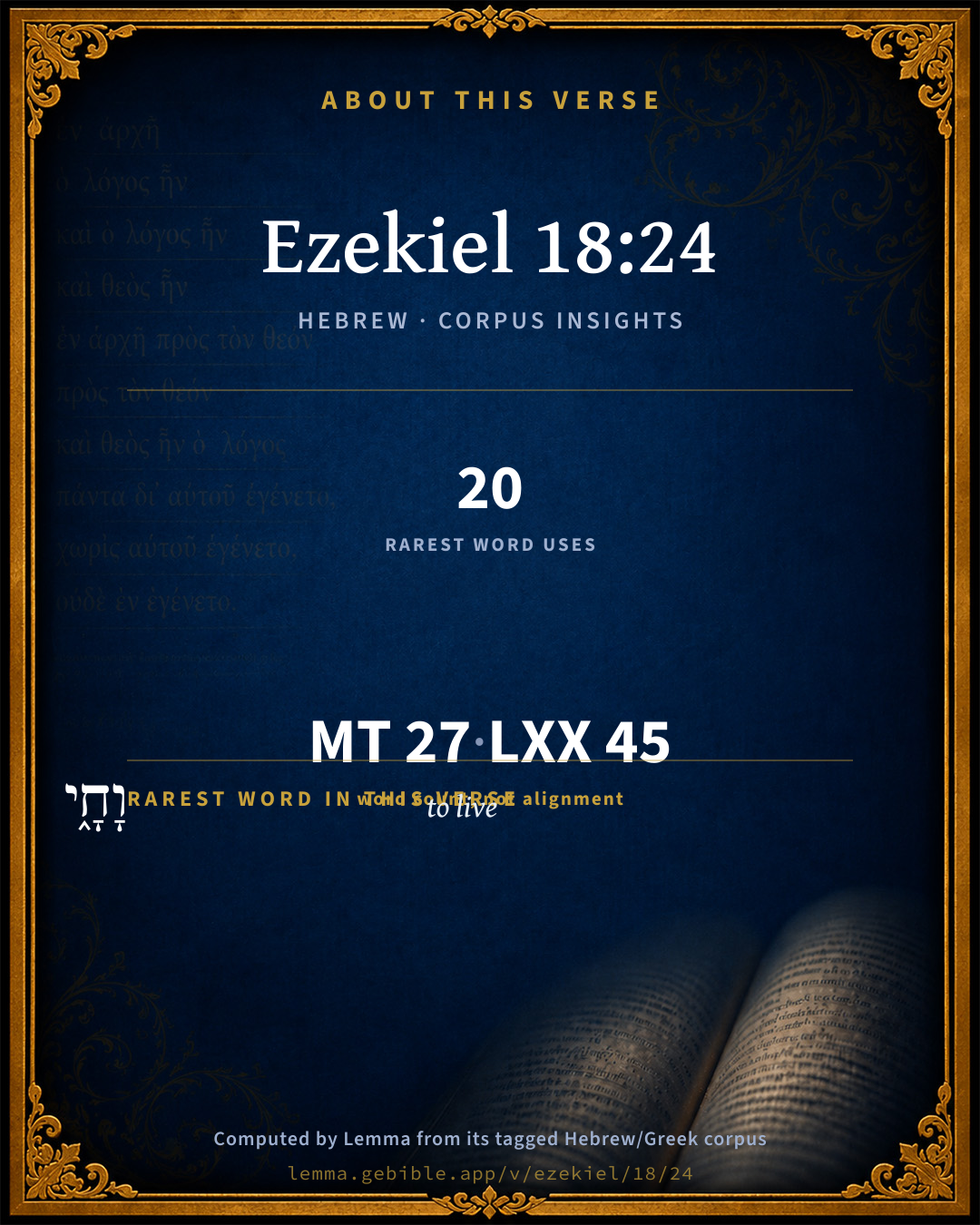
The rarest word here is וָחָ֑י to live H2425 — appearing just 20 times in the whole Hebrew Bible.

Shared distinctive vocabulary

וָחָ֑י to live H2425 occurs in 20 verses of the Hebrew Bible. Also found in:

Grammatical profile

  • 10 verbs
  • 9 nouns
  • 2 adjectives
  • 1 preposition
  • 5 particles

Verb forms

  • וּבְשׁ֨וּב Qal · Infinitive Construct
  • וְעָ֣שָׂה Qal · Sequential Perfect
  • עָשָׂ֧ה Qal · Perfect
  • יַעֲשֶׂ֖ה Qal · Imperfect
  • וָחָ֑י Qal · Sequential Perfect
  • עָשָׂה֙ Qal · Perfect
  • תִזָּכַ֔רְנָה Niphal · Imperfect
  • מָעַ֛ל Qal · Perfect
  • חָטָ֖א Qal · Perfect
  • יָמֽוּת Qal · Imperfect

Repetition

Words recur within this verse — often emphatic in Hebrew:

  • וְעָ֣שָׂה to do H6213 ×4
  • מִצִּדְקָתוֹ֙ righteousness H6666 ×3
  • כְּכֹ֨ל all H3605 ×2
  • אֲשֶׁר which H834 ×4

Hebrew & Septuagint length

In English translation the verse runs 59 words from the Hebrew and 56 from the Septuagint (LXX English) — closely comparable.

A rough comparison of the two English renderings, which tokenize alike — not a word-level alignment.

Word counts can differ between the Hebrew and the Greek without any difference in meaning — e.g. the Hebrew direct-object marker אֵת has no separate Greek word, and Greek often adds the article ὁ.

In the original languages it is 27 Hebrew tokens and 45 Greek tokens — but the two are counted differently (Hebrew bundles its prefixes and suffixes into one token; the Greek is in lemma form), so that isn’t a like-for-like length.

Cross-references

38

Topical passages linked to Ezekiel 18:24 in the Treasury of Scripture Knowledge — connected by theme and wording, ordered by reader-vote popularity; previews shown in the World English Bible.

  • Ezekiel 33:18 When the righteous turns from his righteousness, and commits iniquity, he shall even die therein.
  • Proverbs 21:16 The man who wanders out of the way of understanding Shall rest in the assembly of the dead.
  • 2 John 1:8 Watch yourselves, that we don't lose the things which we have accomplished, but that we receive a full reward.
  • Ezekiel 33:12–13 You, son of man, tell the children of your people, The righteousness of the righteous shall not deliver him in the day of his disobedience; and as for the wickedness of the wicked, he shall not fall thereby in the day that he turns from his wickedness; neither shall he who is righteous be able to live thereby in the day that he sins.
  • 2 Chronicles 24:17–22 Now after the death of Jehoiada came the princes of Judah, and made obeisance to the king. Then the king listened to them.
  • Galatians 3:4 Did you suffer so many things in vain, if it is indeed in vain?
  • Revelation 3:11 I am coming quickly! Hold firmly that which you have, so that no one takes your crown.
  • Ezekiel 18:26 When the righteous man turns away from his righteousness, and commits iniquity, and dies therein; in his iniquity that he has done shall he die.
  • 1 John 2:19 They went out from us, but they didn't belong to us; for if they had belonged to us, they would have continued with us. But they left, that they might be revealed that none of them belong to us.
  • Revelation 2:10 Don't be afraid of the things which you are about to suffer. Behold, the devil is about to throw some of you into prison, that you may be tested; and you will have oppression for ten days. Be faithful to death, and I will give you the crown of life.
  • 1 Samuel 15:11 It repents me that I have set up Saul to be king; for he is turned back from following me, and has not performed my commandments. Samuel was angry; and he cried to Yahweh all night.
  • Ezekiel 3:20–21 Again, when a righteous man does turn from his righteousness, and commit iniquity, and I lay a stumbling block before him, he shall die: because you have not given him warning, he shall die in his sin, and his righteous deeds which he has done shall not be remembered; but his blood will I require at your hand.
  • Ezekiel 18:10–13 If he fathers a son who is a robber, a shedder of blood, and who does any one of these things,
  • Ezekiel 18:22 None of his transgressions that he has committed shall be remembered against him: in his righteousness that he has done he shall live.
  • Matthew 7:22–23 Many will tell me in that day, 'Lord, Lord, didn't we prophesy in your name, in your name cast out demons, and in your name do many mighty works?'
  • Psalms 125:5 But as for those who turn aside to their crooked ways, Yahweh will lead them away with the workers of iniquity. Peace be on Israel.
  • Zephaniah 1:6 those who have turned back from following Yahweh, and those who haven't sought Yahweh nor inquired after him.
  • Matthew 13:20–21 What was sown on the rocky places, this is he who hears the word, and immediately with joy receives it;
  • Mark 13:13 You will be hated by all men for my name's sake, but he who endures to the end, the same will be saved.
  • John 8:24 I said therefore to you that you will die in your sins; for unless you believe that I am he, you will die in your sins."
  • Romans 1:28–31 Even as they refused to have God in their knowledge, God gave them up to a reprobate mind, to do those things which are not fitting;
  • 2 Corinthians 12:20–21 For I am afraid that by any means, when I come, I might find you not the way I want to, and that I might be found by you as you don't desire; that by any means there would be strife, jealousy, outbursts of anger, factions, slander, whisperings, proud thoughts, riots;
  • Galatians 5:7 You were running well! Who interfered with you that you should not obey the truth?
  • 2 Timothy 3:1–5 But know this, that in the last days, grievous times will come.
  • Hebrews 6:4–6 For concerning those who were once enlightened and tasted of the heavenly gift, and were made partakers of the Holy Spirit,
  • Hebrews 10:26–31 For if we sin willfully after we have received the knowledge of the truth, there remains no more a sacrifice for sins,
  • Hebrews 10:38–39 But the righteous will live by faith. If he shrinks back, my soul has no pleasure in him."
  • 2 Peter 2:18–22 For, uttering great swelling words of emptiness, they entice in the lusts of the flesh, by licentiousness, those who are indeed escaping from those who live in error;
  • 2 Chronicles 24:2 Joash did that which was right in the eyes of Yahweh all the days of Jehoiada the priest.
  • Psalms 36:3–4 The words of his mouth are iniquity and deceit. He has ceased to be wise and to do good.
  • Proverbs 14:32 The wicked is brought down in his calamity, But in death, the righteous has a refuge.
  • Ezekiel 18:18 As for his father, because he cruelly oppressed, robbed his brother, and did that which is not good among his people, behold, he shall die in his iniquity.
  • Ezekiel 20:27 Therefore, son of man, speak to the house of Israel, and tell them, Thus says the Lord Yahweh: In this moreover have your fathers blasphemed me, in that they have committed a trespass against me.
  • Matthew 12:43–45 But the unclean spirit, when he is gone out of the man, passes through waterless places, seeking rest, and doesn't find it.
  • John 6:66–70 At this, many of his disciples went back, and walked no more with him.
  • John 8:21 Jesus said therefore again to them, "I am going away, and you will seek me, and you will die in your sins. Where I go, you can't come."
  • 1 John 5:16–18 If anyone sees his brother sinning a sin not leading to death, he shall ask, and God will give him life for those who sin not leading to death. There is a sin leading to death. I don't say that he should make a request concerning this.
  • Jude 1:12 These are hidden rocky reefs in your love feasts when they feast with you, shepherds who without fear feed themselves; clouds without water, carried along by winds; autumn leaves without fruit, twice dead, plucked up by the roots;

Cross-references courtesy of OpenBible.info (CC BY 4.0).

Hebrew and Greek witnesses Masoretic Hebrew ↔ Greek Septuagint

The same verse in the two great witnesses to the Old Testament, shown verse-for-verse.

These are two independent witnesses, not word-aligned to each other, and the Septuagint is shown in lemma (dictionary) form.

Hebrew Ezekiel 18:24 Masoretic · Westminster Leningrad Codex

וּבְשׁ֨וּב צַדִּ֤יק מִצִּדְקָתוֹ֙ וְעָ֣שָׂה עָ֔וֶל כְּכֹ֨ל הַתּוֹעֵב֜וֹת אֲשֶׁר עָשָׂ֧ה הָרָשָׁ֛ע יַעֲשֶׂ֖ה וָחָ֑י כָּל צדקתו צִדְקֹתָ֤יו אֲשֶׁר עָשָׂה֙ לֹ֣א תִזָּכַ֔רְנָה בְּמַעֲל֧וֹ אֲשֶׁר מָעַ֛ל וּבְחַטָּאת֥וֹ אֲשֶׁר חָטָ֖א בָּ֥ם יָמֽוּת

But when the righteous turns away from his righteousness, and commits iniquity, and does according to all the abominations that the wicked man does, shall he live? None of his righteous deeds that he has done shall be remembered: in his trespass that he has trespassed, and in his sin that he has sinned, in them shall he die.

World English Bible · Public Domain

Greek LXX Ezekiel 18:24 Septuagint · lemma form

ἐν δέ ὁ ἀποστρέφω δίκαιος ἐκ ὁ δικαιοσύνη αὐτός καί ποιέω ἀδικία κατά πᾶς ὁ ἀνομία ὅς ποιέω ὁ ἄνομος πᾶς ὁ δικαιοσύνη αὐτός ὅς ποιέω οὐ μή μιμνήσκω ἐν ὁ παράπτωμα αὐτός ὅς παραπίπτω καί ἐν ὁ ἁμαρτία αὐτός ὅς ἁμαρτάνω ἐν αὐτός ἀποθνήσκω

But when the righteous man turns away from his righteousness, and commits iniquity, according to all the transgressions which the transgressor has wrought, none of his righteousness which he has wrought shall be at all remembered: in his trespass wherein he has trespassed, and in his sins wherein he has sinned, in them shall he die.

LXX2012 (modern English Septuagint) · Public Domain

Hebrew: Westminster Leningrad Codex (CC BY 4.0). Greek: Septuagint (public domain); English from LXX2012 (modern English Septuagint) (Public Domain). How the Septuagint differs from the Hebrew →

Targum (Aramaic paraphrase)

1

The Targum is the ancient Jewish Aramaic paraphrase of the Hebrew Scriptures — an interpretive translation, not the Hebrew text itself. Onkelos (literal) and Pseudo-Jonathan (expansive) render the Torah, and Jonathan the Prophets. Coverage is partial: where no permissively-licensed English translation exists for a verse, only the Aramaic is shown. This is verse-level text, not a word-by-word alignment to the Hebrew.

  1. Targum Jonathan Prophets (Joshua–Malachi)
    וְכַד יְתוּב זַכָּאָה מִזְכוּתֵהּ וְיַעְבֵּיד שְׁקַר כְּכֹל תּוֹעֲבָתָא דִי עֲבַד רַשִׁיעָא יַעְבֵּיד דְאִתְקַיֵם כָּל זְכוּתֵיהּ דַעֲבַד לָא יִדְכְּרוּן בְּשִׁקְרֵיהּ דִשְׁקַר וּבְחוֹבוֹהִי דִי חַב בְּהוֹן יְמוּת:

    (no public-domain English translation for this verse)

    Targum Jonathan — Aramaic: “Mikraot Gedolot” (public domain). English: “Sefaria Community Translation” (CC0 1.0 (public-domain dedication)); “London "Chaldee Paraphrase," 1871” (public domain). Text via Sefaria.

Commentary

Notes on Ezekiel 18:24 from classic Christian and Jewish commentators (each source and its license shown beneath its notes). The classic Christian expositions comment on the surrounding passage and are grouped to its opening verse, so a note may address several verses; the Jewish commentaries on the Tanakh (Rashi and others) are per-verse, so they appear only where the commentator wrote on this verse.

Lemma curates 59 commentaries, every one of them public domain or Creative Commons licensed, each selected and text-cleaned for this edition rather than reprinted as found. About our sources →

Trapp's Complete Commentary

John Trapp

Eze 18:24 But when the righteous turneth away from his righteousness, and committeth iniquity, [and] doeth according to all the abominations that the wicked [man] doeth, shall he live? All his righteousness that he hath done shall not be mentioned: in his trespass that he hath trespassed, and in his sin that he hath sinned, in them shall he die.

Ver. 24. But when the righteous.] He that is good in his own eyes, and passeth for good in the esteem of others, but yet is not really righteous, if such a one do utterly fall away, and lose that little that he seemed to have, what wonder? Comman grace can never hold out, or stretch to eternity. Bellarmine saith well, That which is true grace, veritate essentiae, only may be lost: not that that is true veritate firma soliditatis, with the truth of firm solidity; which latter, being rightly understood, may be called special, as the other common grace.

John Trapp, A Commentary or Exposition upon All the Books of the Old and New Testament (1647–1656) — public domain. Text from a community e-Sword module.

The Biblical Illustrator

Joseph S. Exell

Eze_18:24

When the righteous turneth away from his righteousness.

The evil of apostasy

1. There is a righteousness which men may turn from. There is an opinionative righteousness (Luk_18:9; Mat_23:28); many think themselves righteous, and appear so to others: there is also a duty, a moral, or legal righteousness, such as Paul had (Php_3:6); and from these righteousnesses men may and do turn daily. Many attain to a duty righteousness under the Gospel, but yet fall off again (Mat_13:20-22; 1Ti_5:15; Joh_6:66; 2Pe_2:2; 1Ti_4:1). Take heed, therefore, of trusting in or to any righteousness of your own.

2. It is not sufficient to begin well unless we proceed: fair beginnings without progress come to nothing. Consider the arguments which lie here in the text, to keep you from falling off, and encourage you to persevere in God.

(1) If you do turn back you will fall into iniquity; you will commit iniquity, the frame, bent, and set of the heart will be that way; the thoughts, studies, counsels, motions, endeavours will be towards and in iniquity, you will be an evil-doer, a worker of iniquity.

(2) He lies obvious to all manner of sin; what will not the man do that turns from his holy profession?

(3) Whatever good he hath formerly done shall be all forgotten: if he have done much good to his family or friends, it shall be all laid aside, buried in the dark, and not once be mentioned unto him.

(4) He shall die, and that eternally, in his apostasy, and the guilt, not of one sin, but all his sins, shall be upon him. (W. Greenhill, M. A.)

The danger of relapse

Presumption and desperation are two dangerous maladies, not more opposite one to the other, than to the health of the soul; presumption overprizeth Gods mercy, and undervalueth our sins; and on the contrary, desperation overprizeth our sins, and undervalueth Gods mercy. Both are most injurious to God; the one derogateth from His mercy, the other from His justice, both band against hearty and speedy repentance; the one opposing it as needless, the other as bootless Presumption saith, thou mayest repent at leisure, gather the buds of sinful pleasures before they wither, repentance is not yet seasonable; desperation saith, the root of faith is withered, it is now too late to repent. The life of a Christian is not unfitly compared to a long and dangerous sea voyage; the sea is this present world, the barques are our bodies, the sailors our souls, the pilot our faith, the card Gods Word, the rudder constancy, the anchor hope, the mainmast the cross of Christ, the strong cables our violent affections, the sails our desires, and the Holy Spirit the good wind which filleth the sails and driveth the barque and mariners to the fair haven which is heaven. Now, in our way which lieth through many temptations and tribulations, there are two dangerous rocks, the one on the right hand, the other on the left; the rock on the right hand to be avoided is presumption, the rock on the left threatening shipwreck is despair; between which we are to steer our ship by fear on the one side and hope on the other. To hold us in a solicitous fear that we touch not upon presumption, let us have always in the eye of our mind--

1. The glorious and most omnipotent majesty of God.

2. His all-seeing providence.

3. His impartial justice.

4. His severe threatenings against sin.

5. The dreadful punishments He inflicteth upon sinners.

6. The heinousness of the sin of presumption, which turneth Gods grace into wantonness.

7. The difficulty of recovery after relapses.

8. The uncertainty of Gods offer of grace after the frequent refusal thereof.

To keep us in hope, that we dash not upon the rock of despair on the contrary side, let us set before our troubled and affrighted consciences these grounds of comfort--

1. The infiniteness of Gods mercy.

2. The price and value of Christs blood.

3. The efficacy of His intercession.

4. The virtue of the Sacraments.

5. The universality and certainty of Gods promises to the penitent.

6. The joy of God and angels for the conversion of a sinner.

7. The communion of saints, who all pray for the comfort of afflicted consciences, and the ease of all that are heavy laden with their sins.

8. The examples of mercy showed to most grievous sinners.

But to confine my meditations to the letter of my text. The words divide themselves into (first) a supposition, when, or, if the righteous forsake; secondly, an inference, his former righteousness shall not be remembered, etc. The supposition is dangerous, the inference is pernicious.

1. Of the supposition, when the righteous turneth away from his righteousness. No man ever made question but that a truly regenerate man may depart from his actual righteousness, and commit iniquity, and do according to all the abominations that the wicked doth; and that if he should die without repentance, that his former righteousness should stand him in no stead, but that he should suffer the pain of eternal death, which is all that the letter of this text enforceth our assent unto. Our motions to God-ward, and proceedings in a sanctified course of life, are like the rowing of a small boat against a strong wind and tide (the blasts of the evil spirit, and the propension of our corrupt nature), much labour and sweat is required, and very little is done with much ado; and if we slack our hands, and miss but one stroke, we are carried down with the stream, and cast farther back than we can fetch again with many strokes. What a foul and shameful thing is it with the dog to return to your vomit of luxury, and with the swine to your wallowing in the mire of sensual pleasures. As in the diseases of the body, so also much more of the soul, all relapses are dangerous, and in some diseases altogether incurable; the reason whereof alleged by some learned physicians is this, that when we first take our bed the malignity of the disease worketh upon corrupt humours in the body, which when they are purged, and we restored to health, if after by any distemper we fall into the same malady, the malignity of the disease worketh upon our vital spirits; in like manner the malignity of sin before our conversion worketh but upon our corrupt nature, but after upon the graces of Gods Spirit. We find in Scripture many desperately sick, yet cured the first time by our Saviour; but where do we read in all the Gospel of any blind mans eyes twice enlightened? of any deaf ears twice opened? of any tied tongue twice loosened? of any possessed with devils twice dispossessed? of any dead twice raised? No doubt Christ could have done it, but we read not that ever He did it, that we should be most careful to avoid relapses into our former sins, the recovery whereof is always most difficult, and in some cases (as the Apostle teacheth us) impossible (Heb_6:4-8). (D. Featly, D. D.)

The Biblical Illustrator, edited by Joseph S. Exell (c. 1880s–1900s) — public domain. Text from a community e-Sword module.

Joseph Benson's Commentary

Eze 18:24. But when the righteous turneth away from his righteousness, &c. — “The question here,” say some commentators, “is not whether truly righteous men ever do thus apostatize.” No? Surely it is the question, and the sole question: for if the truly righteous (of whom alone the prophet is speaking, and not of the hypocritically righteous, or mere professors of righteousness) do never apostatize, why does the prophet suppose that they do? Nay, why does he expressly affirm it, saying, When the righteous turneth away from his righteousness, and committeth iniquity? &c. Which is repeated Eze 18:26, with the addition, And dieth in them; for the iniquity that he hath done shall he die. Surely these words are utterly irreconcilable with the notion, that the truly righteous never fall away. They who maintain this position may, on similar grounds, maintain, and, to be consistent with themselves, ought to maintain, in contradiction to the 21st and 27th verses, that the truly wicked never turn from their wickedness, never truly repent, and save their souls alive. For both events are equally supposed by the prophet frequently to take place, and it is affirmed in similar terms that both do take place. See note on Eze 3:20. Nor is this prophet singular in teaching this doctrine, or this the only passage of Scripture in which it is taught: it is abundantly and explicitly declared and attested in other parts of holy writ, and by other inspired writers, especially those of the New Testament, and even by Christ himself, as the reader may see, if he will take the trouble of consulting the passages quoted in the margin. All his righteousness that he hath done shall not be mentioned — For, better had it been for him not to have known the way of righteousness, than after he hath known it, to turn aside from the holy commandment, 2Pe 2:21. Such a one sins against a clearer light, and greater convictions, and withal is guilty of the highest ingratitude in doing despite unto the Spirit of grace.

Joseph Benson's Commentary on the Old and New Testaments (1811–1818) — public domain. Text from a community e-Sword module.

Geneva Bible (1599)

Geneva Bible translators

That is, the false opinion that the hypocrites have of their righteousness.

Geneva Bible (1599) marginal notes — public domain. Text via Bolls.life.

Jamieson, Fausset & Brown

Robert Jamieson, A. R. Fausset & David Brown

righteous--one apparently such; as in Mat 9:13, "I came not to call the righteous," &c., that is, those who fancy themselves righteous. Those alone are true saints who by the grace of God persevere (Mat 24:13; Co1 10:12; Joh 10:28-29).

turneth away from . . . righteousness--an utter apostasy; not like the exceptional offenses of the godly through infirmity or heedlessness, which they afterwards mourn over and repent of.

not be mentioned--not be taken into account so as to save them.

his trespass--utter apostasy.

Jamieson, Fausset & Brown — Commentary Critical and Explanatory on the Whole Bible (1871) — public domain (CC PDM 1.0). Text via the HelloAO Bible API.

Adam Clarke's Commentary

Verse 24. When the righteous turneth away from his righteousness] Here is the second case. Can a man who was once holy and pure, fall away so as to perish everlastingly? YES. For God says, "If he turn away from his righteousness;" not his self-righteousness, the gloss of theologians: for God never speaks of turning away from that, for, in his eyes, that is a nonentity. There is no righteousness or holiness but what himself infuses into the soul of man, and as to self-righteousness, i.e., a man's supposing himself to be righteous when he has not the life of God in his soul, it is the delusion of a dark and hardened heart; therefore it is the real righteous principle and righteous practice that God speaks of here. And he tells us, that a man may so "turn away from this," and so "commit iniquity," and "act as the wicked man," that his righteousness shall be no more mentioned to his account, than the sins of the penitent backslider should be mentioned to his condemnation; and "in the sin that he," this once righteous man, "hath sinned, and in the trespass that he hath trespassed, in them shall he die." O, how awful a termination of a life once distinguished for righteousness and true holiness! So then, God himself informs us that a righteous man may not only fall foully, but fall finally. But to such righteous persons the devil will ever preach, "Ye shall not surely die; ye shall be as God." Touch, taste, and handle; ye cannot ultimately fall. Thus we find, by the manner of treating these two cases, that God's way is equal, Eze 18:25; just, merciful, and impartial. And to prove this, he sums up his conduct in the above cases, in the following verses, 26-29. Eze 18:26-29 And then, that the "wicked may not die in his sins," and that the "backslider may return and find mercy," he thus exhorts: -

Adam Clarke's Commentary on the Bible (1810–1826) — public domain. Text from a community e-Sword/MySword module.

John Calvin's Commentaries

As in the last lecture the Prophet offered to sinners a sure hope of pardon if they heartily repented, and promised that God would be propitious to them as soon as they shall seek reconciliation with him: so now, on the other hand, he pronounces, if the just shall decline from his justice, whatever he has hitherto done, shall not come into the account before God. He urged sinners to repentance when he assured them that God was prepared to pardon them: but he now frightens those who profess for the occasion to be pure and sincere worshipers of God, if they fall back in the midst of their course: as Paul says, Let him who stands take heed lest he fall. (1 Corinthians 10:12.) Besides, we gather from this passage, as Christ teaches, that those only are happy who persevere, (Matthew 24:13;) since a temporary righteousness will never profit those apostates who afterwards turn aside from God. We see, then, how these two clauses unite together, namely, that God invites all who are in danger of perdition with extended arms, and promises them salvation if they heartily return to him. Again, that he may restrain within the bounds of duty those who have made some progress, and correct their sloth and stir up their anxiety, he threatens, that unless they pursue the course of a holy and pious life to the end, their former righteousness will not profit them. But here a question arises, Can a truly just person deflect from the right way? for he who is begotten of God is so free from the tyranny of sin that he devotes himself wholly to righteousness: and then if any do turn aside, they prove that they were always strangers to God. If they had been of us, says John, they would never have gone out from us. (1 John 2:19.) And regeneration is an incorruptible seed: so we must determine that the faithful who are truly regenerate never fall away from righteousness, but are retained by God’s unconquered power: for God’s calling in the elect is without repentance. (Romans 11:29.) Hence he continues the course of his grace even to the end. Nor are they to be listened to, who, in contradiction to Scripture, teach that faith is extinct in the elect, when, through its barrenness, they bring forth no fruit. In what sense, then, does Ezekiel mean that the just fall away? That question is easily answered, since he is not here treating of the living root of justice, but of the outward form or appearance, as we commonly say. Paul reminds us that God knows us, but adds, that this seal remains. (2 Timothy 2:19.) God therefore claims to himself alone the difference between the elect and the reprobate, since many seem to be members of his Church who are only outwardly such. And that passage of Augustine is true, that there are many wolves within, and many sheep without. For before God demonstrates his election, the sheep wander, and seem altogether strangers to the hope of salvation. Meanwhile many hypocrites make use of the name of God, and openly boast themselves pre-eminent in the Church, but inwardly they are wolves. But because it often happens that some make the greatest show of piety and justice, the Prophet very properly says, that if such fall away, they cannot boast of their former righteousness before God, since its remembrance will be bloated out.

In fine, we see that the word righteousness is referred to our senses, and not to God’s hidden judgment; so that the Prophet does not teach anything but what we perceive daily: for those who seem to excel others desert their calling, shake off every yoke, and cast away the fear of God, and sometimes rush on with diabolical fury. When this result occurs we hear what the Spirit pronounces by the mouth of the Prophet, that none of their righteousness shall be taken into account. But weight is added to his words when he says, if you have turned aside from righteousness, and done according to all the abominations of the impious, (or wicked,) shall he live? For the Prophet separates those who desert God and rush into every wickedness from those who fall through infirmity or want of thought, and from those also who would fall headlong into ruin, unless God preserved them, yet do not utterly cast off his fear, and the desire of living piously and righteously. For example: every one is occasionally off his guard; and hence, in numberless ways, we offend God through error: and hence David exclaims, Who can understand his faults? (Psalm 19:12.) We fall of our own accord, since we are often conquered by temptations, even when our consciences accuse us; so that, although sanctified, we decline from the path of uprightness through ignorance, and depart from duty through infirmity. But what is far worse, the saints sometimes rush headlong, as though utterly desperate. For the example of David shows that the elect, although regenerated by God’s Spirit, not only sin to a small extent, but, as I have said, plunge into the very lowest abyss. David became a perfidious homicide, and a traitor to the army of God; then that wretched king fell into a series of crimes: yet he failed in only one thing, and showed that God’s grace was only suffocated within him, and not altogether extinguished. For as soon as Nathan reproves him, he confesses that he had sinned, and is prepared to undergo any punishment which God may inflict. Since, therefore, the saints sometimes fall, the Prophet here stretches forth his hand, lest they should despair, and bears witness that God does not reject them unless they turn aside from their righteousness and commit all the abominations which the impious do. By these words, as we see, he expresses a complete revolt, and he so mitigates the severity of the sentence, lest the minds of those who had only partially relapsed should despond. Now we see the meaning of this language: If he has done according to all the abominations of the wicked, shall he live? says he; all the righteousness which he has done shall not be remembered, because he shall perish. Here the Prophet shows that: a mere temporary righteousness will not profit us unless we persevere unto the end in the fear of God.

Here again the contrast is worthy of notice, because it enables us to refute a fiction which is current in the schools of the papacy. They say that guilt is remitted by God, but the punishment is retained. Now what says our Prophet? If the impious turn away from his impiety, I will no longer remember any of his iniquities. Here the papists thrust for-ward the foolish distinction, that God does not remember them as to their guilt, but he does as to their punishment. But what follows a little afterwards? If the just turn away from his justice, his justice shall not be taken into account. But if they do not come into the account as to merit, and yet do as to reward, what is the meaning of the passage? how will the Prophet’s meaning stand? But it is necessary thus to receive what the Prophet says; because, if the distinction of guilt and punishment avails, that of merit and reward will avail also. Hence it will follow, that as to merit God forgets all acts of righteousness; but as far as reward is concerned, they are remembered since they are not abolished. Since, then, it is sufficiently clear that the righteousness of the backslider is not taken into account, so as to lead him to hope for reward, it follows, on the other hand, that his sins are abolished not only as to guilt, but also as to punishment. It now follows —

John Calvin's Commentaries (1540-1563) — public domain. Text from the Calvin Translation Society English edition (1840s-50s) via the Christian Classics Ethereal Library (ccel.org). Calvin's coverage is partial (roughly two-thirds of the Bible); uncommented books and verses are honest gaps, never fabricated. The 19th-century editor's footnotes and remarks are omitted so the notes are faithfully Calvin's own voice.

The Cambridge Bible for Schools and Colleges

gen. ed. J. J. S. Perowne

24. Although it would have sufficed for the prophet’s purpose to assure the repentant sinner of God’s forgiveness, he has a certain theoretical interest in the principle which he is insisting on which makes him develop it on the other side also.

The Cambridge Bible for Schools and Colleges (gen. ed. J. J. S. Perowne; Cambridge University Press, 1878–1918) — public domain. Text from a community e-Sword module.

John Gill's Exposition

Yet ye say,.... Notwithstanding these plain instances, which show the equity of God in his proceedings, and vindicate his justice in the dispensations of his providence; yet such was the blindness and stupidity of these people, or rather their stubbornness, obstinacy, and impudence, that they still insisted upon it that

the way of the Lord is not equal; just and right; is not even, according to the rules of justice and equity; or is not ordered aright, is not steady, and firm, and consistent with himself, and the declaration of his will; a very bold and blasphemous charge, and yet the Lord condescends to reason with them about it:

hear now, O house of Israel; the ten tribes that were now in captivity; or the Jews that were carried captive with Jeconiah, with those that were still in Jerusalem and Judea; these are called upon to hear the Lord, what he had to say in vindication of himself from this charge, as it was but just and reasonable they should:

is not my way equal? plain and even, constant and uniform, according to the obvious rules of justice and truth? can any instance be given to the contrary? what is to be said to support the charge against me? bring forth your strong reasons if you cart, and prove what is asserted:

are not your ways unequal? it is plain they are; your actions, your course of life, are manifest deviations from my law, and from all the rules of righteousness and goodness; it is you that are in the wrong, and I in the right.

John Gill's Exposition of the Whole Bible (1746–1763) — public domain (CC PDM 1.0). Text via the HelloAO Bible API.

Haydock's Catholic Bible Commentary

CHAPTER XVIII.

Remembered, to procure him pardon; yet he will suffer less than if he had never done any good. (Calmet)

George Leo Haydock (1774–1849), Haydock's Catholic Family Bible and Commentary, 1859 edition — public domain. Excludes Psalms (Douay-Rheims chapter numbering differs from Protestant) and Deuterocanonical books (Catholic canon only).

Matthew Poole's English Annotations

After the stating the equity of God’s ways in his dealings with parents and children, and his mercy in dealing with sinners that return according to his own promise, he proceeds to vindicate the equity of his ways in another case.

When, or if; should it so happen at any time. The righteous; one who really had observed the commands of the law, not done the abominations the wicked do, but done the good which the righteous doth, and in the sight of man appears as righteous, and as good as any one; whose apostacy is first full proof of his unsoundness and hypocrisy.

Turneth; changeth his course into sinful practices, like the wicked.

His righteousness; there is a righteousness which is of God, and there is a righteousness which is a man’s own, such as does arise from a man’s own reason and will, improved by common grace, or education, or awed by fears, or swayed by interest, or maintained by some failing spring which may easily dry up; these righteous ones easily fall away, and of such the prophet speaks.

Committeth iniquity; makes sin his work and business, Joh 8:31; 1Jo 3:8,9.

Doeth according to all the abominations; forgets all better rules, derides his own former preciseness, and shakes off all restraints, that he may run to the excess of sin.

Abominations; recounted Eze 18:10-13.

That the wicked man doeth: see Eze 18:21.

Shall he live? do you think I will be so partial as to acquit him from real wickedness, committed with his whole heart, from his last works, which are abominable? Do you think his first heartless, partial, temporary righteousness will counterbalance his last and final apostacy? I tell you nay, but he shall die in it.

All his righteousness that he hath done; though he could produce his own righteousnesses, (as the Hebrew,) and these multiplied to many, all, and that they were really done, yet these should not avail before a just judge; who by a law that requires man should ever be and do what he was and did at best, is to determine his rewards or punishments according to what the man is at last, not according to what he was or seemed to be at first.

Shall not be mentioned; the parable tells us, Mat 25:44,45, some will plead that they did what they had opportunity of doing, and others, Mat 7:22, will mention what they have done. But though they may mention these, the just judge will not, nor the law by which they are to be judged will not, allow it for a good and sufficient plea: see the phrase Eze 18:22.

In his trespass that he hath trespassed: this expression shows that this man’s heart was on his sin; in his transgression he transgressed with full bent of mind, with delight and consent he did what he did, and could not say, I do what I would not; or, So then it is no more I that do it, but sin that dwelleth in me, as Rom 7:17. Lest any stumble at sight of infirmities in all, or needlessly disquiet themselves with fears of wrath at last, because they cannot be sinless, yet they do not fall under the character of such as are here threatened.

In them; in these great, wilful, continued, and multiplied sins.

Shall he die; every such obdurate and final apostate shall be condemned and punished temporally and eternally, and therefore look to it, ye wicked Jews, and consider, ye sinful Christians.

Matthew Poole's English Annotations on the Holy Bible (1683–1685) — public domain. Text from a community e-Sword/MySword module.

Whedon's Commentary on the Bible

Daniel D. Whedon

24. When the righteous turneth away — Having emphasized the new relations to Jehovah attained by the repentant sinner, he has a word of warning for any one who, having once felt the certainty of God’s approving grace, may think himself safe forever. The righteous man, if he be not watchful, may lose his righteousness and thus lose God’s favor. (Compare 1Co_9:27.)

Daniel D. Whedon (gen. ed.), Commentary on the Old and New Testaments (1874–1909) — public domain. Text from a community e-Sword module.

The Pulpit Commentary

In the previous argument (ver. 21) the truth that the individual character may change had been stated as a ground of hope. Here it appears as a ground, for fear and watchfulness. The "grey-haired saint may fail at last," the apostle may become a castaway, (1Co_9:27) and the righteousness of a life may be cancelled by the sins of a year or of a day. Whether there was an opening for repentance, even after that fall, the prophet does not say, but the law that a man is in spiritual life or death according to what he is at any given moment of his course, seems to require the extension of the hope, unless we assume that the nature of the fall in the case supposed fetters the freedom of the will, and makes repentance impossible. (Heb_6:4-7; 2Pe_2:20)

The Pulpit Commentary (1880–1919), ed. H.D.M. Spence-Jones & Joseph S. Exell — public domain. Text from a community e-Sword module.

unfoldingWord translationNotes

Door43 World Missions Community

General Information:

Yahweh gives an example of a man who turns from righteousness to wickedness.

then will he live?

Yahweh asks this rhetorical question to emphasize the negative answer. AT: "then he will surely not live." (See: Rhetorical Question)

All the righteousness that he had done will not be called to mind

The idiom "call to mind" means to remember. This can be stated in active form. AT: "I will not remember all the righteousness that he had done" (See: Idiom and Active or Passive)

treason

crime done against a country or against God, by someone who is expected to be loyal

he will die in the sins

"he will die because of the sins"

translationWords

righteous

turn

iniquity

abomination

evil

life

betray

die

sin

unfoldingWord translationNotes — © Distant Shores Media and the Door43 World Missions Community, licensed CC BY-SA 4.0. Source: git.door43.org/Door43/en_tn.

Rashi

Rabbi Shlomo Yitzchaki (Rashi)

All his righteous deeds, etc., shall not be remembered Our Sages qualified this as referring to one who regrets them.

Rashi on the Tanakh — English translations: “The Judaica Press complete Tanach with Rashi, translated by A. J. Rosenberg” (CC BY 4.0); “Pentateuch with Rashi's commentary by M. Rosenbaum and A.M. Silbermann, 1929-1934” (public domain); “The Metsudah Tanach series, Lakewood, N.J” (CC BY 4.0); and “The Book of Joshua, Metsudah Publications, 1997” (CC BY 4.0). Text via Sefaria.

Lesson kit

Teaching starters — assembled from the data on this page, not authored interpretation. Every prompt links to the verse data it draws on. Edit before teaching.

Ezekiel, in the Prophets, opens this verse with 27 words (17 distinct Hebrew lemmas). Its most distinctive word is châyay (“to live”). A historical commentator’s framing appears above. Read the whole chapter for the surrounding context.

Discussion questions

  1. The word châyay carries the sense “to live.” How does it shape the verse?
  2. Genesis 3:22 shares the word «to live» with this verse. How do the two illuminate each other?
  3. “to do” occurs 4× in this one verse. What is the effect of the repetition?
  4. These translations render this verse differently. What is at stake in choosing one wording over another?
  5. The verb «וּבְשׁ֨וּב» is Qal Infinitive Construct. How does its form color the action?
  6. Reading how Trapp's Complete Commentary and The Biblical Illustrator read this verse, where do the two commentators agree and where do they part?

Things to notice

Reading settings

Reading text

Shown beneath each verse's original-language words.

Old Testament
Old Testament edition

Read the OT as the Masoretic Hebrew (MT) or the Greek Septuagint (LXX).

English shown for the Greek Septuagint (in the Hebrew ↔ Greek comparison).

Comparing translations? Open the Compare panel on any verse page to stack up to four side by side.