
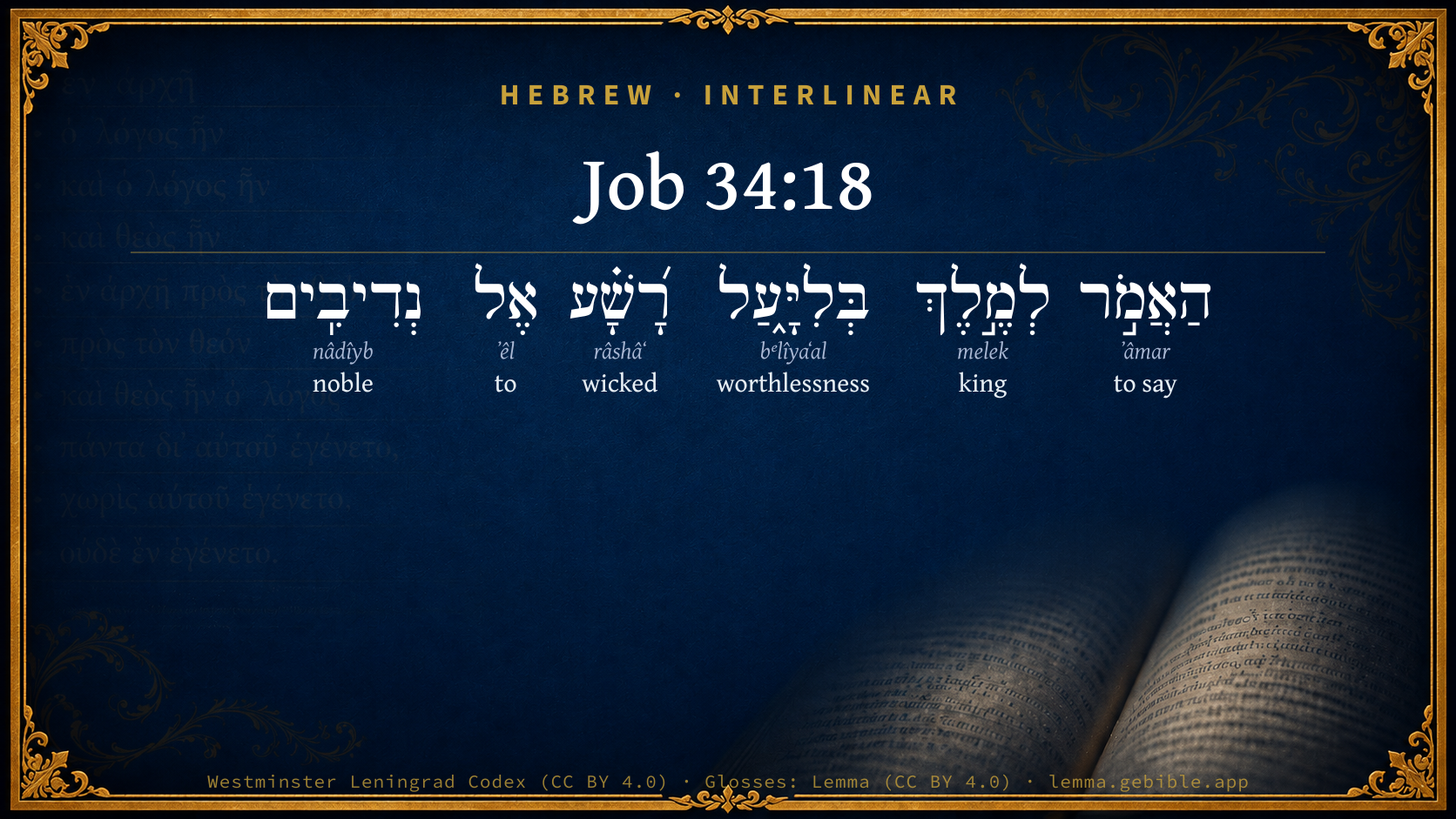
Job 34:18

Hebrew (Westminster Leningrad Codex) Job 34:18 appears in the Hebrew Old Testament. The text above is from the Westminster Leningrad Codex. Each word links to its Strong’s number, a concise gloss, and parsing drawn from the Open Scriptures Hebrew Bible morphology. Click any word for its full Brown-Driver-Briggs (BDB) entry.
Download image
Cite this verse

Job 34:18 (World English Bible). Public Domain. Lemma interlinear Bible study tool, https://lemma.gebible.app/v/job/34/18.

Show BibTeX & RIS
BibTeX
RIS
English Translation
Who says to a king, 'Vile!' Or to nobles, 'Wicked!'
World English Bible · Public Domain
Download a study sheet

One document with this verse’s original text, its word-by-word gloss line, the meaning frame, cross-references with their text, attributed commentary, and full source and license credits — printable, and it pastes into notes with its structure intact.

This verse Autodidact and up

Study sheet (.html) Plain text (.txt)

A passage Seminary Student

Up to 50 verses in one chapter. A passage sheet keeps up to 6 commentary sources and 12 cross-references per verse, in the order this page ranks them, and says so on the sheet whenever that leaves anything out. Ask for a single verse and you get the Autodidact verse sheet above.

Everything on this page stays free to read, with no account — the sheet is a download of what is already on screen, not access to it.

Want to remove ads? Support Godless Engineer
Compare translations 3

The same verse in 3 English versions, stacked beneath the original-language interlinear above. Click any original word for its lexicon entry.

Each is an independent rendering of the whole verse — the interlinear is not word-aligned to these translations.

Highlighted words mark where these versions differ — a whole-verse word diff, not a word-by-word alignment.

  • World English Bible Public Domain
    Who says to a king, 'Vile!' Or to nobles, 'Wicked!'
  • King James Version Public Domain
    Is it fit to say to a king, Thou art wicked? and to princes, Ye are ungodly?
  • unfoldingWord Literal Text CC BY-SA 4.0
    the one saying ‘Worthless!’ to a king, ‘Wicked!’ nobles,

unfoldingWord Literal Text — © unfoldingWord, licensed CC BY-SA 4.0. Word-aligned USFM3 via Door43 (git.door43.org/unfoldingWord/en_ult).

Versions to compare (up to 4)

3 of 4 selected

Show all 18 translations

Every available English version of this verse, each an independent rendering of the whole verse.

  • World English Bible Public Domain
    Who says to a king, 'Vile!' Or to nobles, 'Wicked!'
  • Berean Standard Bible Public Domain
    who says to kings, ‘You are worthless!’ and to nobles, ‘You are wicked,’
  • Majority Standard Bible Public Domain
    who says to kings, ‘You are worthless!’ and to nobles, ‘You are wicked,’
  • King James Version Public Domain
    Is it fit to say to a king, Thou art wicked? and to princes, Ye are ungodly?
  • American Standard Version (1901) Public Domain
    `Him' that saith to a king, `Thou art' vile, `Or' to nobles, `Ye are' wicked;
  • Revised Version (1885) Public Domain
    Is it fit to say to a king, Thou art vile? or to nobles, Ye are wicked?
  • Geneva Bible (1599) Public Domain
    Wilt thou say vnto a King, Thou art wicked? or to princes, Ye are vngodly?
  • Douay-Rheims (1899) Public Domain
    Who saith to the king: Thou art an apostate: who calleth rulers ungodly?
  • Young's Literal Translation Public Domain
    Who hath said to a king -- `Worthless,' Unto princes -- `Wicked?'
  • Literal Standard Version CC BY-SA 4.0
    Who has said to a king, Worthless, || To princes, Wicked?
  • Unlocked Literal Bible CC BY-SA 4.0
    God, who says to a king, 'You are vile,' or says to nobles, 'You are wicked'?
  • unfoldingWord Literal Text CC BY-SA 4.0
    the one saying ‘Worthless!’ to a king, ‘Wicked!’ nobles,
  • Darby Bible Public Domain
    Shall one say to a king, Belial? to nobles, Wicked?
  • World Messianic Bible Public Domain
    who says to a king, ‘Vile!’ or to nobles, ‘Wicked!’?
  • Webster's Bible Public Domain
    Is it fit to say to a king, Thou art wicked? and to princes, Ye are ungodly?
  • Free Bible Version CC BY-SA 4.0
    He's the one who tells kings, ‘You're useless!’ or says to nobles, ‘You're wicked!’
  • Bible in Basic English Public Domain
    He who says to a king, You are an evil-doer; and to rulers, You are sinners;
  • JPS Tanakh (1917) Public Domain
    Is it fit to say to a king: 'Thou art base'? Or to nobles: 'Ye are wicked'? —

Literal Standard Version (2020), Covenant Press — licensed CC BY-SA 4.0. Text via the HelloAO Bible API (eBible.org). Unlocked Literal Bible (unfoldingWord) — licensed CC BY-SA 4.0. Text via the HelloAO Bible API (eBible.org). unfoldingWord Literal Text — © unfoldingWord, licensed CC BY-SA 4.0. Word-aligned USFM3 via Door43 (git.door43.org/unfoldingWord/en_ult). Free Bible Version, Dr. Jonathan Gallagher — licensed CC BY-SA 4.0. Text via the HelloAO Bible API (eBible.org).

Word by word

More ways to search: Search by grammar → Find every occurrence → Compare this word →

Practice this passage: Drill this verse → Learn its vocabulary →

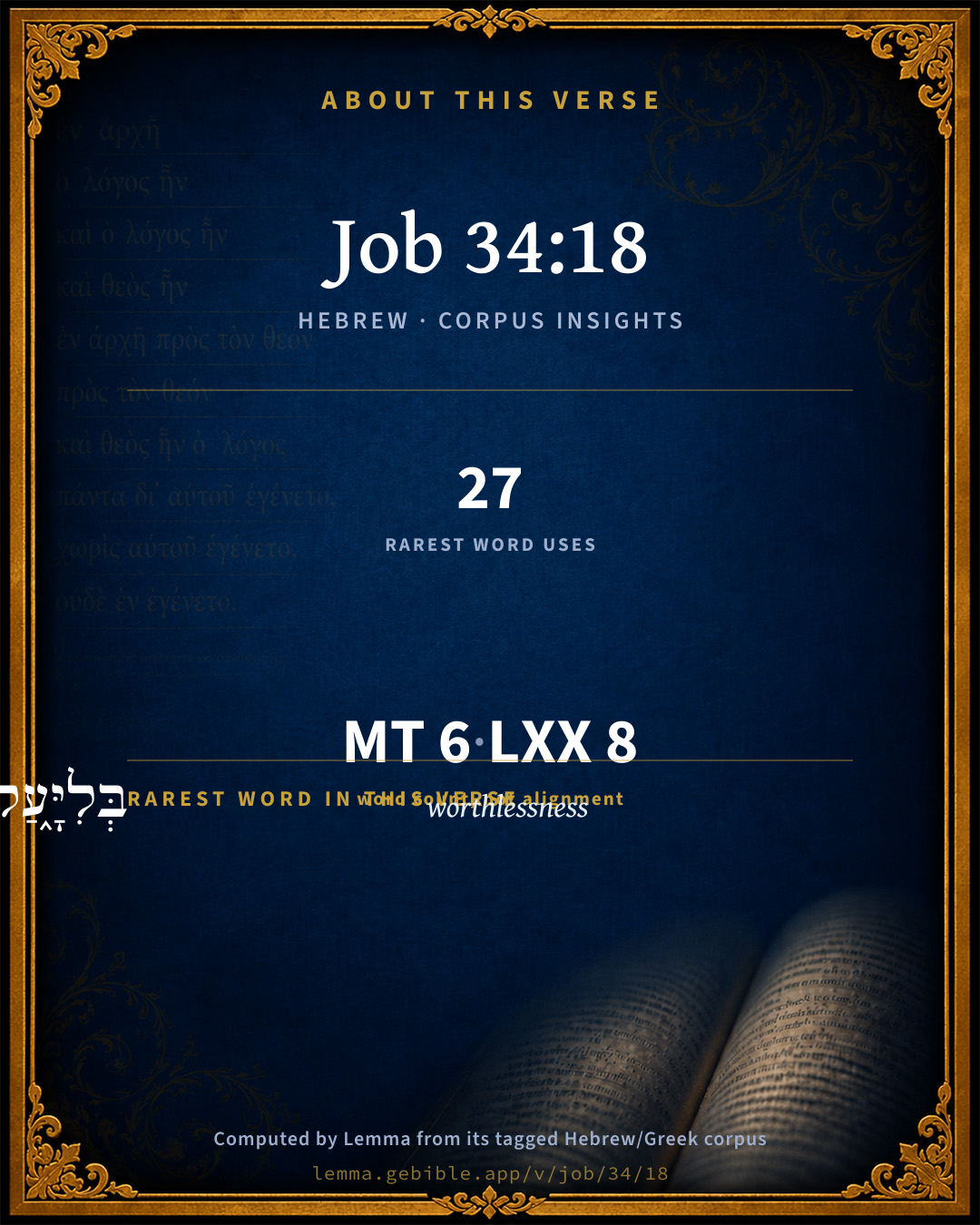
About this verse

These counts appear in no published source. They are computed here, from the morphology-tagged text and Lemma’s own curated glosses. What Lemma adds →

6
words
6
distinct lemmas
Wisdom
section

Shared distinctive vocabulary

בְּלִיָּ֑עַל worthlessness H1100 occurs in 26 verses of the Hebrew Bible. Also found in:

Grammatical profile

  • 1 verb
  • 2 nouns
  • 2 adjectives
  • 1 preposition

Verb forms

  • הַאֲמֹ֣ר Qal · Infinitive Construct

Hebrew & Septuagint length

In English translation the verse runs 10 words from the Hebrew and 20 from the Septuagint (LXX English) — the Septuagint runs noticeably longer here. See the side-by-side →

A rough comparison of the two English renderings, which tokenize alike — not a word-level alignment.

Word counts can differ between the Hebrew and the Greek without any difference in meaning — e.g. the Hebrew direct-object marker אֵת has no separate Greek word, and Greek often adds the article ὁ.

In the original languages it is 6 Hebrew tokens and 8 Greek tokens — but the two are counted differently (Hebrew bundles its prefixes and suffixes into one token; the Greek is in lemma form), so that isn’t a like-for-like length.

Cross-references

8

Topical passages linked to Job 34:18 in the Treasury of Scripture Knowledge — connected by theme and wording, ordered by reader-vote popularity; previews shown in the World English Bible.

  • Exodus 22:28 "You shall not blaspheme God, nor curse a ruler of your people.
  • Proverbs 17:26 Also to punish the righteous is not good, Nor to flog officials for their integrity.
  • Romans 13:7 Give therefore to everyone what you owe: taxes to whom taxes are due; customs to whom customs; respect to whom respect; honor to whom honor.
  • Acts 23:3 Then Paul said to him, "God will strike you, you whitewashed wall! Do you sit to judge me according to the law, and command me to be struck contrary to the law?"
  • Acts 23:5 Paul said, "I didn't know, brothers, that he was high priest. For it is written, 'You shall not speak evil of a ruler of your people.'"
  • Jude 1:8 Yet in like manner these also in their dreaming defile the flesh, despise authority, and slander celestial beings.
  • 2 Peter 2:10 but chiefly those who walk after the flesh in the lust of defilement, and despise authority. Daring, self-willed, they are not afraid to speak evil of dignitaries;
  • 1 Peter 2:17 Honor all men. Love the brotherhood. Fear God. Honor the king.

Cross-references courtesy of OpenBible.info (CC BY 4.0).

Hebrew and Greek witnesses Masoretic Hebrew ↔ Greek Septuagint

The same verse in the two great witnesses to the Old Testament, shown verse-for-verse.

Here the Septuagint runs noticeably longer than the Hebrew — LXX2012 (modern English Septuagint) 20 words vs World English Bible 10. A rough length comparison of the two English translations, not a word-level alignment — read both below.

These are two independent witnesses, not word-aligned to each other, and the Septuagint is shown in lemma (dictionary) form.

Hebrew Job 34:18 Masoretic · Westminster Leningrad Codex

הַאֲמֹ֣ר לְמֶ֣לֶךְ בְּלִיָּ֑עַל רָ֝שָׁ֗ע אֶל נְדִיבִֽים

Who says to a king, 'Vile!' Or to nobles, 'Wicked!'

World English Bible · Public Domain

Greek LXX Job 34:18 Septuagint · lemma form

ἀσεβής ὁ λέγω βασιλεύς παρανομέω ἀσεβής ὁ ἄρχων

He is ungodly that says to a king, You are a transgressor, that says to princes, O most ungodly one.

LXX2012 (modern English Septuagint) · Public Domain

On this verse, Jamieson, Fausset & Brown discusses the Septuagint’s reading. Read the note in Commentary ↓

Hebrew: Westminster Leningrad Codex (CC BY 4.0). Greek: Septuagint (public domain); English from LXX2012 (modern English Septuagint) (Public Domain). How the Septuagint differs from the Hebrew →

Commentary

Notes on Job 34:18 from classic Christian and Jewish commentators (each source and its license shown beneath its notes). The classic Christian expositions comment on the surrounding passage and are grouped to its opening verse, so a note may address several verses; the Jewish commentaries on the Tanakh (Rashi and others) are per-verse, so they appear only where the commentator wrote on this verse.

Lemma curates 59 commentaries, every one of them public domain or Creative Commons licensed, each selected and text-cleaned for this edition rather than reprinted as found. About our sources →

Trapp's Complete Commentary

John Trapp

Job 34:18 [Is it fit] to say to a king, [Thou art] wicked? [and] to princes, [Ye are] ungodly?

Ver. 18. Is it fit to say to a king, Thou art wicked?] Heb. Belial; that is, Thou yokeless, lawless, masterless monster. Kings are not wont to be so accosted and aviled, nor is it lawful, Exo 22:28. It is blasphemy in the second table to speak evil of dignities, Jdg 1:8, Qui dicit regi Apostata (Vulg.). It was some disadvantage to St Paul that, although provoked and unjustly smitten, he called the high priest whited wall, Act 23:3; he was glad to excuse it by his ignorance. And Luther cried our Henry VIII mercy, for his uncivil language to him, such as was that, Audi, Domine Rex, edocebo te, in a jeer. Henry VI indeed was coarsely handled in a tumult, and wounded, but then he was at in bad times; and being restored, he freely pardoned the offender, saying, Alas, poor soul, he struck me more to win favour with others than of any ill will he bare me: but this was a rare example of patience in a king (Dan. Hist.). Alexander the Great dealt more harshly with his friends, Clitus and Callisthenes, for their plain dealing. Tiberius put to death a poet for uttering some free words against him, though under the person of Agamemnon, quem in tragoedia probris lacessisset (Sen.). Savonarola suffered deeply for telling the pope his own. And Bajazet II took great revenge upon his janizaries, {a} who, for his casting Achmetes Bassa into prison, they in an uproar insolently cried out that they would by and by teach him, as a drunkard, a beast, and a rascal, to use his great place and calling with more sobriety and discretion. Kings must be spoken to with soft and silken words, as she said, η ηκιστα, η ηδιστα (Plut.). If Elijah, or Elisha, or Isaiah, or the Baptist do otherwise, that is not a copy for every man to write after. Is it safe to take a lion by the beard, or a bear by the tooth? Naboth suffered, though falsely accused to curse the king; and Shimei had at length his payment for reviling David. If Ezekiel called the king of Judah, Thou wicked and profane prince, Eze 21:25, that was by an extraordinary spirit, and by a special command of God.

And to princes, Ye are ungodly?] Ingenuis. These, as they must not be flattered, so neither may they be unmannerly advertised of their duty or danger. It is probable that Joseph used some kind of preface to Pharaoh’s chief baker in reading him that hard destiny, Gen 40:19, such haply as was that of Daniel to Nebuchadnezzar, Job 4:19, "My lord, the dream be to them that hate thee," &c.; or as Philo brings him in with a Utinam tale somnium non vidisses, I wish I had no such dream to interpret unto you. But for the matter he giveth him a sound, though a sharp interpretation.

{a} One of a former body of Turkish infantry, constituting the Sultan’s guard and the main part of the standing army. The body was first organized in the 14th century, and was composed mainly of tributary children of Christians; after a large number of them had been massacred in 1826, the organization was finally abolished.

John Trapp, A Commentary or Exposition upon All the Books of the Old and New Testament (1647–1656) — public domain. Text from a community e-Sword module.

Joseph Benson's Commentary

Job 34:18-19. Is it fit to say to a king, Thou art wicked? — Hebrew, Belial, or a son of Belial. Though a king may be wicked, yet his subjects neither may nor dare call him so, Exo 22:28. And therefore if any evil thought did arise in thee, thou oughtest to have been afraid to utter it, and bring forth such unworthy expressions against God. That accepteth not the persons of any — Who respecteth not the greatest princes, so as to do any unjust thing to gain their favour, or avoid their displeasure, and to whom princes and peasants are equally subject, and infinitely inferior; who, therefore, is free from all temptation to injustice, which commonly proceeds from respect of persons; and to whom therefore thou didst owe more reverence than thy words have expressed. For they all are the work of his hands — And therefore of equal worth and price with him, and equally subject to his power and pleasure.

Joseph Benson's Commentary on the Old and New Testaments (1811–1818) — public domain. Text from a community e-Sword module.

Geneva Bible (1599)

Geneva Bible translators

If man of nature fear to speak evil of such as have power, then much more ought they to be afraid to speak evil of God.

Geneva Bible (1599) marginal notes — public domain. Text via Bolls.life.

Jamieson, Fausset & Brown

Robert Jamieson, A. R. Fausset & David Brown

Literally, (Is it fit) to be said to a king? It would be a gross outrage to reproach thus an earthly monarch, much more the King of kings (Exo 22:28). But MAURER with the Septuagint and Vulgate reads, (It is not fit to accuse of injustice Him) who says to a king, Thou art wicked; to princes, Ye are ungodly; that is, who punishes impartially the great, as the small. This accords with Job 34:19.

Jamieson, Fausset & Brown — Commentary Critical and Explanatory on the Whole Bible (1871) — public domain (CC PDM 1.0). Text via the HelloAO Bible API.

Adam Clarke's Commentary

Verse 18. Is it fit to say to a king, Thou art wicked?] The sentence is very short, and is thus translated by the VULGATE: Qui dicit regi, Apostata? Qui vocat duces impios? "Who says to a king, Apostate? Who calls leaders impious ?" Literally, Who calls a king Belial? Who calls princes wicked? Civil governors should be treated with respect; no man should speak evil of the ruler of the people. This should never be permitted. Even where the man cannot be respected, because his moral conduct is improper, even there the office is sacred, and should be reverenced. He who permits himself to talk against the man, would destroy the office and authority, if he could.

Adam Clarke's Commentary on the Bible (1810–1826) — public domain. Text from a community e-Sword/MySword module.

Ellicott's Commentary for English Readers

(18) Is it fit to say to a king?—The argument is from the less to the greater. “Who could challenge a king or princes? and if not a king, how much less the King of kings?” There is a strong ellipse in the Hebrew, but yet one that is naturally supplied. (Comp. Psa_137:5.)

A Bible Commentary for English Readers, edited by Charles John Ellicott (1878–1897) — public domain. Text from a community e-Sword module.

The Cambridge Bible for Schools and Colleges

gen. ed. J. J. S. Perowne

18. The verse reads,

Is it fit to say to a king, Thou wicked!

Or to princes, Ye ungodly!

The word “wicked” means worthless, Heb. belial. No doubt many kings, whether in the past or the present, might be justly enough addressed as “wicked,” and princes in abundance as “ungodly,” but the speaker is thinking here less of persons than of the offices which they fill as rulers. If earthly rule implies righteousness, how much more the rule of the Supreme (Job_34:19).

The Cambridge Bible for Schools and Colleges (gen. ed. J. J. S. Perowne; Cambridge University Press, 1878–1918) — public domain. Text from a community e-Sword module.

John Gill's Exposition

How much less to him that accepteth not the persons of princes,.... And indeed God is not the respecter of the persons of any, no, not of the greatest men on earth, kings and princes, Act 10:34; these are alike dealt with by him as others in the dispensations of his providence; nor do they escape the marks of his displeasure, wrath and vengeance, when they sin against him:

nor regardeth the rich more than the poor? by showing favour to them, or conniving at them,

for they are all the work of his hands; both the rich and the poor; not only as creatures made by him, but as rich men and poor men; it is God that makes men rich or poor, Sa1 2:7; instances follow proving this, that God is no respecter of persons on account of outward circumstances.

John Gill's Exposition of the Whole Bible (1746–1763) — public domain (CC PDM 1.0). Text via the HelloAO Bible API.

Albert Barnes' Notes on the Bible

Is it fit to say to a king, Thou art wicked? - The argument here is this: “There would be gross impropriety in arraigning the conduct of an earthly monarch, and using language severely condemning what he does. Respect is due to those of elevated rank. Their plans are often concealed. It is difficult to judge of them until they are fully developed. To condemn those plans, and to use the language of complaint, would not be tolerated, and would be grossly improper. How much more so when that language relates to the Great, the Infinite God, and to his eternal plans!” It may be added here, in accordance with the sentiment of Elihu, that people often indulge in thoughts and language about God which they would not tolerate respecting an earthly monarch.

Albert Barnes' Notes on the Bible (1834–1885) — public domain. Text from a community e-Sword/MySword module.

Haydock's Catholic Bible Commentary

Who. Theod.[Theodotion?] in Septuagint, "wicked is he who says to the king, thou actest contrary to the law; and to the rulers, thou most impious." (Haydock) --- Apostate. Hebrew, "Belial."

George Leo Haydock (1774–1849), Haydock's Catholic Family Bible and Commentary, 1859 edition — public domain. Excludes Psalms (Douay-Rheims chapter numbering differs from Protestant) and Deuterocanonical books (Catholic canon only).

Matthew Poole's English Annotations

Thou art wicked; or, Thou art Belial, or a son of Belial. Though a king may really be unjust and wicked, yet their subjects neither may nor dare presume to call them so, Exo 22:28. And therefore if some evil thought did arise in thee, yet how wast thou not afraid to utter such unworthy and almost blasphemous expressions against God?

Matthew Poole's English Annotations on the Holy Bible (1683–1685) — public domain. Text from a community e-Sword/MySword module.

Whedon's Commentary on the Bible

Daniel D. Whedon

18. Is it fit to say — האמר may also signify, “Him who saith.”

Thou art wicked — Some ascribe this language to God, “the most just,” and read, Him (God) who saith to a king, Thou worthless one, (literally, belial,) etc.; which accords better with the context.

Daniel D. Whedon (gen. ed.), Commentary on the Old and New Testaments (1874–1909) — public domain. Text from a community e-Sword module.

The Pulpit Commentary

Is it fit to say to a king, Thou art wicked? and to princes, Ye are ungodly? Would any subject of an earthly king deem it fitting to accuse his sovereign of wicked and unjust conduct? Would he even tax those who stood next to the king the princes and great officers of the court with ungodliness? If a sense of what is becoming and seemly would restrain a man from the use of language of this sort towards his earthly ruler, can it be right that he should allow himself in such liberty or speech towards his heavenly King, his absolute Lord and Master? Job had not really used such language of God, though the complaints which he had made with respect to God"s treatment of him might not unreasonably be held to imply some such accusation.

The Pulpit Commentary (1880–1919), ed. H.D.M. Spence-Jones & Joseph S. Exell — public domain. Text from a community e-Sword module.

John Wesley's Explanatory Notes

Wicked - Though a king may be wicked, yet his subjects neither may nor dare call him so.

John Wesley, Explanatory Notes Upon the Whole Bible (1754–1765) — public domain. Text via the GEBible commentary corpus.

unfoldingWord translationNotes

Door43 World Missions Community

General Information:

Elihu continues speaking.

God, who says to a king, 'You are vile,' or says to nobles, 'You are wicked'?

This continues the rhetorical question from the previous verse, emphasizing to Job that he cannot condemn God. This can be written as a statement. AT: "He says to some kings, 'You are vile,' and he says to some nobles, 'You are wicked.'" (See: Rhetorical Question)

God, who says to a king

This is part of the previous question. The understood words from the previous verse, "will you condemn God," may be supplied. AT: "Will you condemn God, who says to a king" (See: Ellipsis)

vile

"evil" or "worthless"

for they all are the work of his hands

Here "hands" refer to power. AT: "for God made them all" (See: Metonymy)

at midnight

Midnight is the time when one day ends and another begins. Here "midnight" is used as an idiom. AT: "at night" or "suddenly, at night" (See: Idiom)

people will be shaken and will pass away

This can be stated in active form. The phrase "will be shaken" is an idiom that means to be "struck." AT: "God strikes them and they die" (See: Active or Passive and Idiom)

mighty people will be taken away, but not by human hands

This means that it is God who causes people to die, not people. Also, this can be stated in active form. AT: "it is God and not humans who cause mighty people to die" (See: Euphemism and Active or Passive)

not by human hands

Here people are represented by their "hands." AT: "not by humans" or "not by people" (See: Synecdoche)

translationWords

king

noble

evil

favor

works

die

might

unfoldingWord translationNotes — © Distant Shores Media and the Door43 World Missions Community, licensed CC BY-SA 4.0. Source: git.door43.org/Door43/en_tn.

Rashi

Rabbi Shlomo Yitzchaki (Rashi)

Is it proper to say of a king, ‘scoundrel’ Is it fit and proper to say of a king, ‘scoundrel,’ or ‘wicked’ of nobles?

Rashi on the Tanakh — English translations: “The Judaica Press complete Tanach with Rashi, translated by A. J. Rosenberg” (CC BY 4.0); “Pentateuch with Rashi's commentary by M. Rosenbaum and A.M. Silbermann, 1929-1934” (public domain); “The Metsudah Tanach series, Lakewood, N.J” (CC BY 4.0); and “The Book of Joshua, Metsudah Publications, 1997” (CC BY 4.0). Text via Sefaria.

Lesson kit

Teaching starters — assembled from the data on this page, not authored interpretation. Every prompt links to the verse data it draws on. Edit before teaching.

Job, in the Wisdom, opens this verse with 6 words (6 distinct Hebrew lemmas). Its most distinctive word is bᵉlîyaʻal (“worthlessness”). The Greek Septuagint runs longer here. A historical commentator’s framing appears above. Read the whole chapter for the surrounding context.

Discussion questions

  1. The word bᵉlîyaʻal carries the sense “worthlessness.” How does it shape the verse?
  2. How does Deuteronomy 13:13, which shares the word «worthlessness», read alongside this verse?
  3. The Septuagint runs longer here than the Hebrew. What might account for the difference?
  4. The translations on this page render this verse differently — a whole-verse word diff, not a word-by-word alignment. What might account for the different wordings?
  5. «הַאֲמֹ֣ר» is a Qal Infinitive Construct verb. How does that grammatical form shape the action described?
  6. Compare how Trapp's Complete Commentary and Joseph Benson's Commentary read this verse. Where do they agree or differ?

Things to notice

Reading settings

Reading text

Shown beneath each verse's original-language words.

Old Testament
Old Testament edition

Read the OT as the Masoretic Hebrew (MT) or the Greek Septuagint (LXX).

English shown for the Greek Septuagint (in the Hebrew ↔ Greek comparison).

Comparing translations? Open the Compare panel on any verse page to stack up to four side by side.