
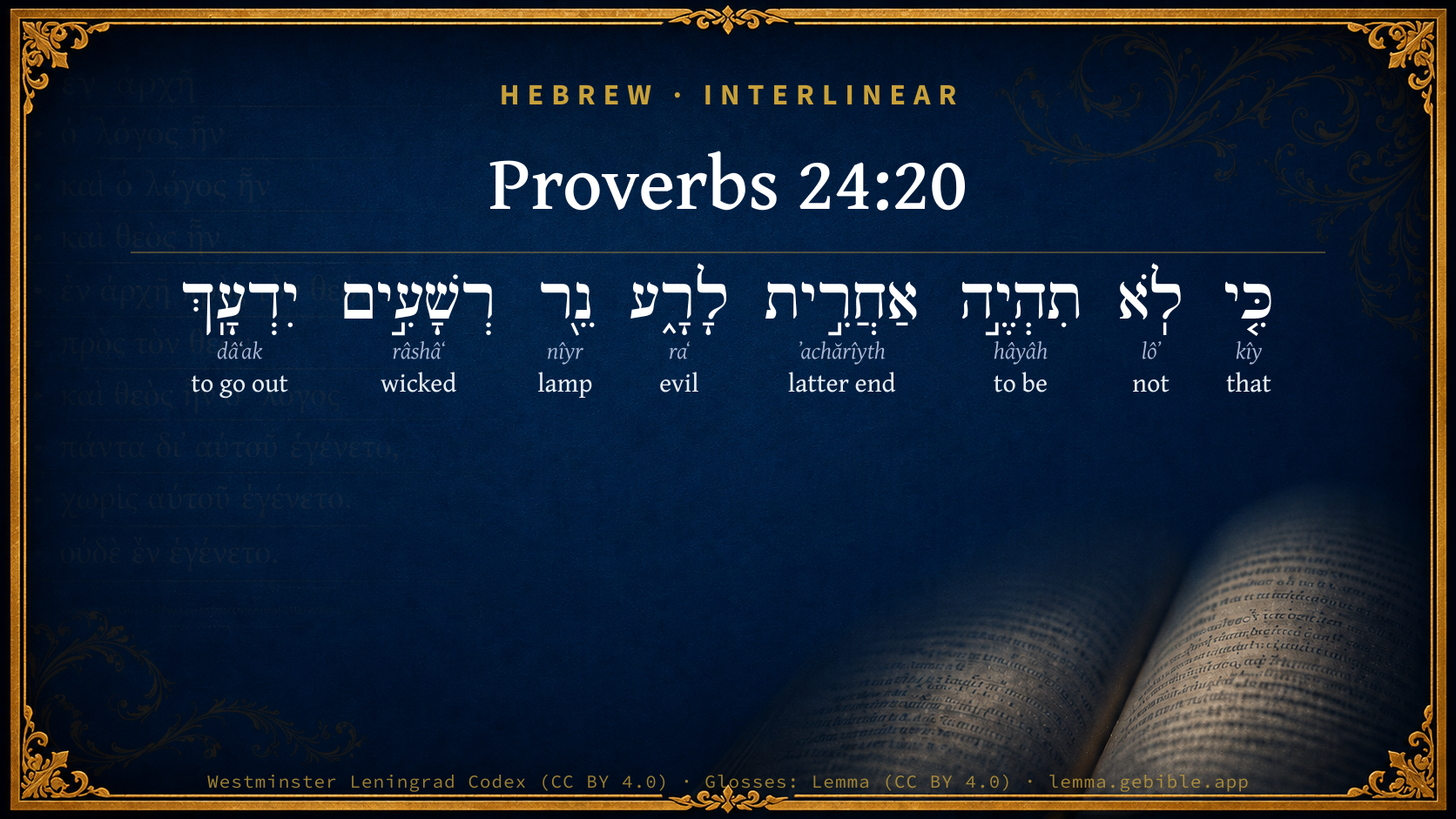
Proverbs 24:20

Hebrew (Westminster Leningrad Codex) Proverbs 24:20 appears in the Hebrew Old Testament. The text above is from the Westminster Leningrad Codex. Each word links to its Strong’s number, a concise gloss, and parsing drawn from the Open Scriptures Hebrew Bible morphology. Click any word for its full Brown-Driver-Briggs (BDB) entry.
Download image
Cite this verse

Proverbs 24:20 (World English Bible). Public Domain. Lemma interlinear Bible study tool, https://lemma.gebible.app/v/proverbs/24/20.

Show BibTeX & RIS
BibTeX
RIS
English Translation
For there will be no reward to the evil man; And the lamp of the wicked shall be snuffed out.
World English Bible · Public Domain
Download a study sheet

One document with this verse’s original text, its word-by-word gloss line, the meaning frame, cross-references with their text, attributed commentary, and full source and license credits — printable, and it pastes into notes with its structure intact.

This verse Autodidact and up

Study sheet (.html) Plain text (.txt)

A passage Seminary Student

Up to 50 verses in one chapter. A passage sheet keeps up to 6 commentary sources and 12 cross-references per verse, in the order this page ranks them, and says so on the sheet whenever that leaves anything out. Ask for a single verse and you get the Autodidact verse sheet above.

Everything on this page stays free to read, with no account — the sheet is a download of what is already on screen, not access to it.

Want to remove ads? Support Godless Engineer
Compare translations 3

The same verse in 3 English versions, stacked beneath the original-language interlinear above. Click any original word for its lexicon entry.

Each is an independent rendering of the whole verse — the interlinear is not word-aligned to these translations.

Highlighted words mark where these versions differ — a whole-verse word diff, not a word-by-word alignment.

  • World English Bible Public Domain
    For there will be no reward to the evil man; And the lamp of the wicked shall be snuffed out.
  • King James Version Public Domain
    For there shall be no reward to the evil man; the candle of the wicked shall be put out.
  • unfoldingWord Literal Text CC BY-SA 4.0
    For a future is not for an evil, the lamp of the wicked will be extinguished.

unfoldingWord Literal Text — © unfoldingWord, licensed CC BY-SA 4.0. Word-aligned USFM3 via Door43 (git.door43.org/unfoldingWord/en_ult).

Versions to compare (up to 4)

3 of 4 selected

Show all 18 translations

Every available English version of this verse, each an independent rendering of the whole verse.

  • World English Bible Public Domain
    For there will be no reward to the evil man; And the lamp of the wicked shall be snuffed out.
  • Berean Standard Bible Public Domain
    For the evil man has no future; the lamp of the wicked will be extinguished.
  • Majority Standard Bible Public Domain
    For the evil man has no future; the lamp of the wicked will be extinguished.
  • King James Version Public Domain
    For there shall be no reward to the evil man; the candle of the wicked shall be put out.
  • American Standard Version (1901) Public Domain
    For there shall be no reward to the evil man; The lamp of the wicked shall be put out.
  • Revised Version (1885) Public Domain
    For there will be no reward to the evil man; the lamp of the wicked shall be put out.
  • Geneva Bible (1599) Public Domain
    For there shall bee none ende of plagues to the euill man: the light of the wicked shall bee put out.
  • Douay-Rheims (1899) Public Domain
    For evil men have no hope of things to come, and the lamp of the wicked shall be put out.
  • Young's Literal Translation Public Domain
    For there is not a posterity to the evil, The lamp of the wicked is extinguished.
  • Literal Standard Version CC BY-SA 4.0
    For there is not a posterity to the evil, || The lamp of the wicked is extinguished.
  • Unlocked Literal Bible CC BY-SA 4.0
    for the evil person has no future and the lamp of wicked people will go out.
  • unfoldingWord Literal Text CC BY-SA 4.0
    For a future is not for an evil, the lamp of the wicked will be extinguished.
  • Darby Bible Public Domain
    for there shall be no future to the evil [man]; the lamp of the wicked shall be put out.
  • World Messianic Bible Public Domain
    for there will be no reward to the evil man. The lamp of the wicked will be snuffed out.
  • Webster's Bible Public Domain
    For there shall be no reward to the evil man; the candle of the wicked shall be extinguished.
  • Free Bible Version CC BY-SA 4.0
    for evil people have no future—the lamp of the wicked will be snuffed out.
  • Bible in Basic English Public Domain
    For there will be no future for the evil man; the light of sinners will be put out.
  • JPS Tanakh (1917) Public Domain
    For there will be no future to the evil man, the lamp of the wicked shall be put out.

Literal Standard Version (2020), Covenant Press — licensed CC BY-SA 4.0. Text via the HelloAO Bible API (eBible.org). Unlocked Literal Bible (unfoldingWord) — licensed CC BY-SA 4.0. Text via the HelloAO Bible API (eBible.org). unfoldingWord Literal Text — © unfoldingWord, licensed CC BY-SA 4.0. Word-aligned USFM3 via Door43 (git.door43.org/unfoldingWord/en_ult). Free Bible Version, Dr. Jonathan Gallagher — licensed CC BY-SA 4.0. Text via the HelloAO Bible API (eBible.org).

Word by word

More ways to search: Search by grammar → Find every occurrence → Compare this word →

Practice this passage: Drill this verse → Learn its vocabulary →

About this verse

These counts appear in no published source. They are computed here, from the morphology-tagged text and Lemma’s own curated glosses. What Lemma adds →

8
words
8
distinct lemmas
Wisdom
section

Notable vocabulary

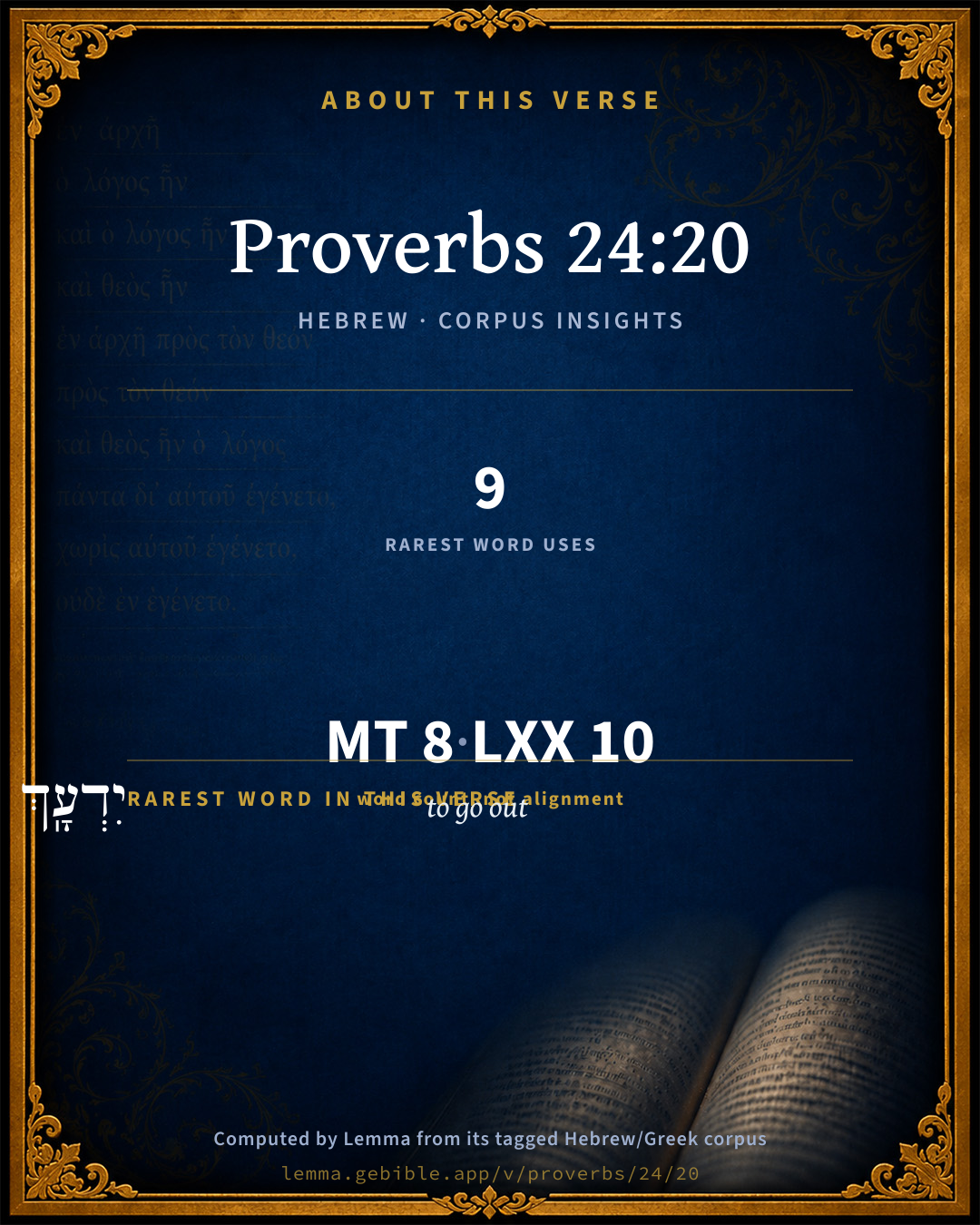
The rarest word here is יִדְעָֽךְ to go out H1846 — appearing just 9 times in the whole Hebrew Bible.

Shared distinctive vocabulary

יִדְעָֽךְ to go out H1846 occurs in 9 verses of the Hebrew Bible. Also found in:

Grammatical profile

  • 2 verbs
  • 2 nouns
  • 2 adjectives
  • 1 conjunction
  • 1 particle

Verb forms

  • תִהְיֶ֣ה Qal · Imperfect
  • יִדְעָֽךְ Qal · Imperfect

Hebrew & Septuagint length

In English translation the verse runs 20 words from the Hebrew and 18 from the Septuagint (LXX English) — closely comparable.

A rough comparison of the two English renderings, which tokenize alike — not a word-level alignment.

Word counts can differ between the Hebrew and the Greek without any difference in meaning — e.g. the Hebrew direct-object marker אֵת has no separate Greek word, and Greek often adds the article ὁ.

In the original languages it is 8 Hebrew tokens and 10 Greek tokens — but the two are counted differently (Hebrew bundles its prefixes and suffixes into one token; the Greek is in lemma form), so that isn’t a like-for-like length.

Cross-references

11

Topical passages linked to Proverbs 24:20 in the Treasury of Scripture Knowledge — connected by theme and wording, ordered by reader-vote popularity; previews shown in the World English Bible.

  • Proverbs 13:9 The light of the righteous shines brightly, But the lamp of the wicked is snuffed out.
  • Job 18:5–6 "Yes, the light of the wicked shall be put out, The spark of his fire shall not shine.
  • Job 21:17 "How often is it that the lamp of the wicked is put out? That their calamity comes on them? That God distributes sorrows in his anger?
  • Psalms 11:6 On the wicked he will rain blazing coals; Fire, sulfur, and scorching wind shall be the portion of their cup.
  • Proverbs 20:20 Whoever curses his father or his mother, His lamp shall be put out in blackness of darkness.
  • Psalms 9:17 The wicked shall be turned back to Sheol, Even all the nations that forget God.
  • Proverbs 23:18 Indeed surely there is a future hope, And your hope will not be cut off.
  • Isaiah 3:11 Woe to the wicked! Disaster is upon them; For the deeds of his hands will be paid back to him.
  • Matthew 8:12 but the children of the Kingdom will be thrown out into the outer darkness. There will be weeping and the gnashing of teeth."
  • Matthew 25:8 The foolish said to the wise, 'Give us some of your oil, for our lamps are going out.'
  • Jude 1:13 wild waves of the sea, foaming out their own shame; wandering stars, for whom the blackness of darkness has been reserved forever.

Cross-references courtesy of OpenBible.info (CC BY 4.0).

Hebrew and Greek witnesses Masoretic Hebrew ↔ Greek Septuagint

The same verse in the two great witnesses to the Old Testament, shown verse-for-verse.

These are two independent witnesses, not word-aligned to each other, and the Septuagint is shown in lemma (dictionary) form.

Hebrew Proverbs 24:20 Masoretic · Westminster Leningrad Codex

כִּ֤י לֹֽא תִהְיֶ֣ה אַחֲרִ֣ית לָרָ֑ע נֵ֖ר רְשָׁעִ֣ים יִדְעָֽךְ

For there will be no reward to the evil man; And the lamp of the wicked shall be snuffed out.

World English Bible · Public Domain

Greek LXX Proverbs 24:20 Septuagint · lemma form

οὐ γάρ μή γίγνομαι ἔκγονος πονηρός λαμπτήρ δέ ἀσεβής σβέννυμι

For the evil man shall have no posterity: and the light of the wicked shall be put out.

LXX2012 (modern English Septuagint) · Public Domain

On this verse, The Pulpit Commentary discusses the Septuagint’s reading. Read the note in Commentary ↓

Hebrew: Westminster Leningrad Codex (CC BY 4.0). Greek: Septuagint (public domain); English from LXX2012 (modern English Septuagint) (Public Domain). How the Septuagint differs from the Hebrew →

Commentary

Notes on Proverbs 24:20 from classic Christian and Jewish commentators (each source and its license shown beneath its notes). The classic Christian expositions comment on the surrounding passage and are grouped to its opening verse, so a note may address several verses; the Jewish commentaries on the Tanakh (Rashi and others) are per-verse, so they appear only where the commentator wrote on this verse.

Lemma curates 59 commentaries, every one of them public domain or Creative Commons licensed, each selected and text-cleaned for this edition rather than reprinted as found. About our sources →

Trapp's Complete Commentary

John Trapp

Pro 24:20 For there shall be no reward to the evil [man]; the candle of the wicked shall be put out.

Ver. 20. For there shall be no reward.] He shall suffer both pain of loss, and pain of sense, which whether is the more grievous, is hard to determine. Sure it is, that the tears of hell are not sufficient to bewail the loss of heaven; their worm of grief gnaws as painfully as their fire burns. "Depart from me, ye cursed," sounds as harsh in their ears as that which follows, "into everlasting flames."

John Trapp, A Commentary or Exposition upon All the Books of the Old and New Testament (1647–1656) — public domain. Text from a community e-Sword module.

Jamieson, Fausset & Brown

Robert Jamieson, A. R. Fausset & David Brown

candle--or, "prosperity"; it shall come to an end (Pro 13:9; Pro 20:20).

Jamieson, Fausset & Brown — Commentary Critical and Explanatory on the Whole Bible (1871) — public domain (CC PDM 1.0). Text via the HelloAO Bible API.

Adam Clarke's Commentary

Verse 20. For there shall be no reward to the evil man] אחרית acharith. There shall not be the future state of blessedness to the wicked. See Clarke on Pr 24:14. His candle shall be put out; his prosperity shall finally cease, or he shall have no posterity. Some have thought that this text intimates the annihilation of sinners; but it refers not to being, but to the state or condition of that being. The wicked shall be; but they shall not be HAPPY.

Adam Clarke's Commentary on the Bible (1810–1826) — public domain. Text from a community e-Sword/MySword module.

Ellicott's Commentary for English Readers

(20) For there shall be no reward.—Literally, future, as in Pro_24:15.

The candle of the wicked shall be put out —See above on Pro_13:9.

A Bible Commentary for English Readers, edited by Charles John Ellicott (1878–1897) — public domain. Text from a community e-Sword module.

The Cambridge Bible for Schools and Colleges

gen. ed. J. J. S. Perowne

20. reward] See Pro_24:14, and Pro_23:18, note.

candle] Rather, lamp, R.V. Comp. Pro_13:9, Pro_20:20. The lamp going out accords with the “no reward,” or “future” of the preceding clause.

The Cambridge Bible for Schools and Colleges (gen. ed. J. J. S. Perowne; Cambridge University Press, 1878–1918) — public domain. Text from a community e-Sword module.

John Gill's Exposition

My son, fear thou the Lord, and the king,.... First the Lord, and then the king; and such as fear the Lord are generally loyal to their king; the fear of God includes love to him, reverence of him, faith in him, submission to him, and the whole worship of him, inward and outward, attended with holiness of life and conversation: and the king, who is under God, is to be feared also, with a fear suitable to him; he is to be loved and reverenced, to be trusted in and submitted to, in everything consistent with the fear of God and obedience to him; in whatever is not contrary to his laws, commands, and ordinances; see Pe1 2:13;

and meddle not with them that are given to change; in political things; that are for new laws, new forms of government, a new ministry, and a new king; never easy with the government under which they are, but are continually entering into plots, conspiracies, and rebellions, who, instead of fearing God and the king, change the laws and commandments of God and the king, and therefore to be shunned. Some render it, "with rebels"; the Targum and Syriac version, "with fools"; as all such persons are, and should be avoided as scandalous and dangerous: mix not with them, as the word (s) signifies; keep no company, and have no conversation with them, lest you be brought into danger and mischief by them. Or who are given to change in religious things; make innovations in doctrine and practice, always love to hear or say some now thing; turn with every wind, and shift as that does; are tossed about with every wind of doctrine, fickle and inconstant, carried about like meteors in the air, with "divers and strange doctrines"; such as disagree with the perfections of God, the doctrines of Christ and his apostles, the Scriptures of truth, the analogy of faith, anti form of sound words; and so the word here used signifies "divers", and is so rendered Est 3:8; and may design such who hold doctrines and give into practices divers and different from the faith once delivered to the saints, and from the institutions and appointments of Christ; innovations in doctrine and worship ought not to be admitted of; and such who are for introducing them should not be meddled or mixed with; they should not be countenanced and encouraged; they should not be attended upon or given heed unto; have no fellowship, and join not in communion with them. This is interpreted by some of such who repeat (t) their sins after repentance, or who return a second time to their wickedness after they have repented, as Ben Melech observes.

(s) "ne misceas te", Pagninus, Montanus; "ne commisceto te", Junius & Tremellius, Piscator, so Michaelis, Schultens. (t) "cum iterantibus", Pagninus, Montanus; "sub iniquitates suas"; so some in Vatablus, Baynus.

John Gill's Exposition of the Whole Bible (1746–1763) — public domain (CC PDM 1.0). Text via the HelloAO Bible API.

Albert Barnes' Notes on the Bible

No reward - literally, “no future,” no life worthy to be called life, no blessing.

Albert Barnes' Notes on the Bible (1834–1885) — public domain. Text from a community e-Sword/MySword module.

Haydock's Catholic Bible Commentary

Come. Protestants, "no reward," (Haydock) prosperity, &c., as designated also by the lamp, ver. 14. (Calmet)

George Leo Haydock (1774–1849), Haydock's Catholic Family Bible and Commentary, 1859 edition — public domain. Excludes Psalms (Douay-Rheims chapter numbering differs from Protestant) and Deuterocanonical books (Catholic canon only).

Matthew Poole's English Annotations

There shall be no reward to the evil man; all his hopes and happiness shall quickly and eternally perish, and he shall have the share in those solid felicities and blessed recompences of a better life which thou shalt enjoy; therefore thou hast no reason to envy him.

The candle of the wicked shall be put out; all their comfort and glory shall cease.

Matthew Poole's English Annotations on the Holy Bible (1683–1685) — public domain. Text from a community e-Sword/MySword module.

Whedon's Commentary on the Bible

Daniel D. Whedon

20. No reward — No future reward, no hereafter. (Stuart.) There shall be no future of blessedness, whether in this world or the next.

Candle — Lamp, a metaphor of prosperity and happiness. Comp. Job_20:5; Job_21:17; Psa_37:2; Pro_13:9. Read, also, Psalms 37, 78, as a commentary on this verse.

Daniel D. Whedon (gen. ed.), Commentary on the Old and New Testaments (1874–1909) — public domain. Text from a community e-Sword module.

The Pulpit Commentary

For there shall be no reward to the evil man. He has no happy "future" to expect, as Ver. 14; Pro_22:18 (where see note). The candle, etc. (see Pro_13:9, where the clause appears) Septuagint, "For the evil man shall have no posterity, and the torch of the wicked shall be quenched."

The Pulpit Commentary (1880–1919), ed. H.D.M. Spence-Jones & Joseph S. Exell — public domain. Text from a community e-Sword module.

John Wesley's Explanatory Notes

No reward - All his happiness shall quickly and eternally perish. The candle - All their comfort and glory shall cease.

John Wesley, Explanatory Notes Upon the Whole Bible (1754–1765) — public domain. Text via the GEBible commentary corpus.

Kretzmann's Popular Commentary

Paul E. Kretzmann

v. 20. for there shall be no reward to the evil man, he will have no lucky future or end; the candle of the wicked shall be put out, a picture of eventual unhappiness and destruction.

Paul E. Kretzmann, Popular Commentary of the Bible (1921–1924) — public domain. Text from a community e-Sword module.

Lesson kit

Teaching starters — assembled from the data on this page, not authored interpretation. Every prompt links to the verse data it draws on. Edit before teaching.

Proverbs, in the Wisdom, opens this verse with 8 words (8 distinct Hebrew lemmas). Its most distinctive word is dâʻak (“to go out”). A historical commentator’s framing appears above. Read the whole chapter for the surrounding context.

Discussion questions

  1. What does “to go out” (dâʻak) contribute to the verse as a whole?
  2. How does Job 6:17, which shares the word «to go out», read alongside this verse?
  3. These translations render this verse differently. What is at stake in choosing one wording over another?
  4. «תִהְיֶ֣ה» is a Qal Imperfect verb. How does that grammatical form shape the action described?
  5. Compare how Trapp's Complete Commentary and Jamieson, Fausset & Brown read this verse. Where do they agree or differ?

Things to notice

Reading settings

Reading text

Shown beneath each verse's original-language words.

Old Testament
Old Testament edition

Read the OT as the Masoretic Hebrew (MT) or the Greek Septuagint (LXX).

English shown for the Greek Septuagint (in the Hebrew ↔ Greek comparison).

Comparing translations? Open the Compare panel on any verse page to stack up to four side by side.